Introduction
Studies relating sleep to cognition in healthy individuals have indicated that sleep quality may affect memory and executive function. In healthy young adults, sleep has been implicated in memory consolidation (Fowler, Sullivan, & Ekstrand, Reference Fowler, Sullivan and Ekstrand1973; Stickgold, Reference Stickgold2005; Stickgold, Hobson, Fosse, & Fosse, Reference Stickgold, Hobson, Fosse and Fosse2001), perceptual learning and visuospatial memory (Gais, Plihal, Wagner, & Born, Reference Gais, Plihal, Wagner and Born2000; Karni, Tanne, Rubenstein, Askenasy, & Sagi, Reference Karni, Tanne, Rubenstein, Askenasy and Sagi1994; Mednick, Makovski, Cai, & Jiang, Reference Mednick, Makovski, Cai and Jiang2009; Rasch, Buchel, Gais, & Born, Reference Rasch, Buchel, Gais and Born2007; Stickgold, James, & Hobson, Reference Stickgold, James and Hobson2000; Stickgold, Whidbee, Schirmer, Patel, & Hobson, Reference Stickgold, Whidbee, Schirmer, Patel and Hobson2000), REM-dependent procedural learning (Smith, Reference Smith2001), and development of problem solving skills (Goel, Rao, Durmer, & Dinges, Reference Goel, Rao, Durmer and Dinges2009; Smith, Reference Smith1993). Experimental studies of sleep restriction have reported that, in younger adults, there is a dose-related impairment in cognitive functioning after sleep deprivation (Van Dongen, Maislin, Mullington, & Dinges, Reference Van Dongen, Maislin, Mullington and Dinges2003).
In healthy older adults (ages 65 and over), relatively poor sleep has been associated with lower global cognitive function and poorer performance on a test of executive function and attention (Blackwell et al., Reference Blackwell, Yaffe, Ancoli-Israel, Schneider, Cauley, Hillier and Stone2006) as well as on working memory, attentional set shifting, and abstract problem solving, even after controlling for confounds such as cerebrovascular disease, mood, and medication use (Nebes, Buysse, Halligan, Houck, & Monk, Reference Nebes, Buysse, Halligan, Houck and Monk2009). Similar findings have been reported in older adults (ages 55 and over) presenting with insomnia, who have been shown to exhibit impairments on tasks of attention, concentration, reaction time (Bastien et al., Reference Bastien, Fortier-Brochu, Rioux, LeBlanc, Daley and Morin2003; Haimov, Hanuka, & Horowitz, Reference Haimov, Hanuka and Horowitz2008; Hauri, Reference Hauri1997), working memory (Kuriyama, Mishima, Suzuki, Aritake, & Uchiyama, Reference Kuriyama, Mishima, Suzuki, Aritake and Uchiyama2008), and semantic memory (Mendelson, Garnett, Gillin, & Weingartner, Reference Mendelson, Garnett, Gillin and Weingartner1984). Previous studies examining sleep and cognition did not specifically examine whether there is a differential link between sleep and each of executive, memory, and psychomotor function. Some of the studies have reported that all three domains are affected (Bastien et al., Reference Bastien, Fortier-Brochu, Rioux, LeBlanc, Daley and Morin2003; Haimov et al., Reference Haimov, Hanuka and Horowitz2008), whereas others examined only executive or global function (Blackwell et al., Reference Blackwell, Yaffe, Ancoli-Israel, Schneider, Cauley, Hillier and Stone2006).
Parkinson's disease (PD) is a progressive neurodegenerative disorder that is characterized by well-recognized motor impairments and non-motor symptoms, including impairments in cognition (Zgaljardic, Borod, Foldi, & Mattis, Reference Zgaljardic, Borod, Foldi and Mattis2003) and in sleep (Comella, Reference Comella2003). Specific cognitive changes are evident in many non-demented patients with PD who present with deficits in executive function (Zgaljardic et al., Reference Zgaljardic, Borod, Foldi and Mattis2003), including problems with set shifting (Woodward, Bub, & Hunter, Reference Woodward, Bub and Hunter2002), internal control of attention (Brown & Marsden, Reference Brown and Marsden1988), working memory (Owen, Iddon, Hodges, Summers, & Robbins, Reference Owen, Iddon, Hodges, Summers and Robbins1997) and verbal fluency (Henry & Crawford, Reference Henry and Crawford2004). Verbal and visual memory as well as visuospatial function have also been found to be compromised in PD (Amick, Grace, & Chou, Reference Amick, Grace and Chou2006; Cronin-Golomb, Reference Cronin-Golomb2010).
Sleep problems in PD are among the most distressing non-motor symptoms of the disease, impacting the quality of life of patients and caregivers (Comella, Reference Comella2006). Patients with PD experience a variety of sleep disorders, including rapid eye movement (REM) behavior disorder, sleep apnea, and restless legs syndrome/periodic leg movements, and related sleep complaints including sleep fragmentation, reduced sleep efficiency, and excessive daytime sleepiness (Comella, Reference Comella2006; Fahn, Reference Fahn2003). Despite the prevalence of sleep problems as well as cognitive impairment in PD, the relation of sleep disturbances to cognition has only been examined with respect to REM behavior disorder (RBD). Patients with RBD exhibit more impairment on tasks of executive function (Sinforiani et al., Reference Sinforiani, Zangaglia, Manni, Cristina, Marchioni, Nappi and Pacchetti2006; Vendette et al., Reference Vendette, Gagnon, Decary, Massicotte-Marquez, Postuma, Doyon and Montplaisir2007), memory and visuospatial function (Vendette et al., Reference Vendette, Gagnon, Decary, Massicotte-Marquez, Postuma, Doyon and Montplaisir2007), suggesting that RBD heralds the beginning stages of a more rapid dementing process. The general impact of sleep quality on cognition in PD, however, has not been examined.
The pathophysiology of PD is widespread and affects neural networks that are responsible for both cognitive function and sleep-wake regulation. The ascending progression of Lewy neurite and Lewy body pathology appears to begin in the brainstem and results in neuronal loss in the cholinergic, dopaminergic, and serotonergic systems. This pattern of pathology affects the reticular activating system, implicated in sleep-wake regulation and dream formation (Braak, Ghebremedhin, Rub, Bratzke, & Del Tredici, Reference Braak, Ghebremedhin, Rub, Bratzke and Del Tredici2004; Grinberg, Rueb, Alho, & Heinsen, Reference Grinberg, Rueb, Alho and Heinsen2009; Hobson, Stickgold, & Pace-Schott, Reference Hobson, Stickgold and Pace-Schott1998) as well as cortico-striato-thalamocortical circuits (Middleton & Strick, Reference Middleton and Strick2001) important for cognitive function.
The literature relating sleep impairments to cognitive deficits in healthy adults and in those with insomnia suggests that in any disorder that affects sleep, cognitive disturbance may follow. As PD presents with both cognitive and sleep impairments, we aimed to examine the impact of sleep quality on cognitive functioning in individuals with PD, using cognitive measures that are known to be affected by both PD and sleep. We hypothesized that PD patients with decreased sleep quality would exhibit greater impairments in all tested cognitive domains than those whose sleep was less disturbed. As PD presents with memory, attention/executive, and psychomotor deficits, all of which have been reported to be affected by sleep, our aim was to also explore whether there is a differential impact of sleep on these cognitive domains. We were especially interested in whether impairments in sleep and cognition, should they co-occur, were predicted by the same factors (e.g., disease severity) or instead whether the association of sleep and cognition was independent of disease-related characteristics.
Methods
Participants
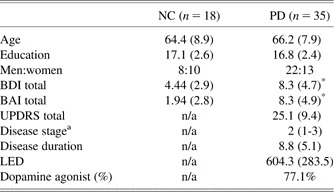
Thirty-five non-demented individuals with PD (22 men, 13 women; mean age, 66.2 years) were recruited from the outpatient Movement Disorders Clinic at the Boston University School of Medicine. Eighteen normal control subjects (NC) (8 men, 10 women; mean age, 64.4 years) were recruited from the local community. The study was approved by the Boston University Institutional Review Board and all participants provided informed consent. The investigators made an effort through the recruitment process to ensure that PD and NC were matched overall on age and education. Although there were more men in the PD group and more women in the NC group, this difference was not significant (χ 2 = 1.61; p > .05). On the modified Mini-Mental State Examination (mMMSE) (Stern, Sano, Paulson, & Mayeux, Reference Stern, Sano, Paulson and Mayeux1987), a cut-off score of 27 was used for NC participants whereas a cut-off score of 25 was used for PD participants, as this form of the MMSE is particularly sensitive to specific cognitive deficits found in PD without dementia (scores converted from the 57-point scale). Individuals with a history of substance abuse, head injury or neurologic disorders besides PD were excluded. None of the patients met criteria for Dementia with Lewy Bodies as per McKeith and colleagues (Reference McKeith, Dickson, Lowe, Emre, O'Brien, Feldman and Yamada2005). By participant self-report, all NC were healthy with no diagnosed sleep, psychiatric, or neurological disorders, and none were taking any sleep or psychiatric medications. All NC were right-handed. PD participants were right-handed except for two who were left-handed. Nine PD patients reported having been diagnosed with REM behavior disorder (RBD) or reported acting out their dreams at night, which is indicative of clinical RBD.
Motor symptom severity in PD was quantified using the Unified Parkinson's Disease Rating Scale (UPDRS) and Hoehn and Yahr staging (Hoehn & Yahr, Reference Hoehn and Yahr1967). Nineteen patients had right side of symptom onset and 15 had left side of symptom onset. The onset subgroups were too small to permit us to analyze data with respect to this variable. Levodopa equivalent dosages (LED) were calculated based on previous reports with LED: (regular levodopa dose × 1) + (levodopa controlled-release dose × 0.75) + (pramipexole dose × 67.0) + (ropinirole dose × 16.67) + (rotigotine × 16.67) + (pergolide dose and cabergoline dose × 67.0) + (bromocriptine dose × 10) + (regular levodopa dose + levodopa controlled-release dose × 0.75) (× 0.25 if taking tolcapone or entacapone) (Gjerstad, Boeve, Wentzel-Larsen, Aarsland, & Larsen, Reference Gjerstad, Boeve, Wentzel-Larsen, Aarsland and Larsen2008). None of the PD participants were taking anticholinergic medications. Five were taking sleep medications (clonazapam, seroquel, trazodone). All patients received the Beck Depression Inventory-II (BDI) and the Beck Anxiety Inventory (BAI) (Beck & Steer, Reference Beck and Steer1993; Beck, Steer, & Brown, Reference Beck, Steer and Brown1996). Table 1 describes all PD-group medications and other participant characteristics.
Demographic and clinical variables in NC and PD participants

Note. Means (SD) are reported unless otherwise indicated. NC = normal control adults; PD = Parkinson's disease; BDI = Beck Depression Inventory-II; BAI = Beck Anxiety Inventory; UPDRS = Unified Parkinson's Disease Rating Scale; LED = Levodopa equivalent dose; n/a = not applicable.
*Significant difference at p < .01
aMedian (range).
Sleep Measures
To measure activity during the sleep/wake cycle, the participants wore wrist actigraphs (Actiwatch AW-64; Mini Mitter, Sunriver, OR) continuously over a 1-week period on both wrists. Data from the non-dominant wrist alone were used for the current study, as per convention. The standard methods for measuring sleep and wake cycles using actigraphy are that each movement that is registered above the set sensitivity level is considered an activity count (Sadeh & Acebo, Reference Sadeh and Acebo2002). For the current study, the actigraphs were set to a medium sensitivity with 40 counts assessed as “wake” and an epoch length of 30 s. The Actiwatch data were downloaded to the Actiware sleep software (Mini Mitter). Actigraphic measures were averaged across the 7 days of monitoring. The measures were sleep latency (first 10-min period with fewer than two epochs of activity), sleep time (sum of time [in min] of epochs not exceeding the sensitivity threshold), sleep efficiency (sleep time divided by the time in bed multiplied by 100), wake after sleep onset (total time awake after the first sleep onset period), and movement and fragmentation index (number of 1-min periods of immobility relative to the total number of immobility phases). Reliability and validity studies in healthy adults have demonstrated that actigraphy is highly correlated with polysomnography for differentiating sleep from wake states (Blood, Sack, Percy, & Pen, Reference Blood, Sack, Percy and Pen1997; Jean-Louis et al., Reference Jean-Louis, von Gizycki, Zizi, Fookson, Spielman, Nunes and Taub1996). The validity of actigraphy in PD has been reported by showing correlations of actigraphy measures to those of patient self-report (Stavitsky, Saurman, McNamara, & Cronin-Golomb, Reference Stavitsky, Saurman, McNamara and Cronin-Golomb2010).
In addition to the actigraphs, each participant completed a sleep diary over the 7 days of monitoring. The sleep diary was adapted from a previously published diary from the National Sleep Foundation to which were added questions pertinent to sleep/wake behaviors in PD. The sleep diary included sections outlining daytime activity, “on/off” periods, daytime sleepiness, bed/rise times, time to sleep onset, number of awakenings, morning motor symptom ratings, morning refreshment, dreams, nocturnal hallucinations and other night time symptoms. Daytime sleepiness was also measured using the Epworth Sleepiness Scale (Johns, Reference Johns1991).
Cognitive Measures
The neuropsychological assessment was selected to be brief enough to ensure adherence and comprehensive enough to sample those cognitive domains known to be impaired in PD and in individuals with sleep disorders. The cognitive tests were administered when PD patients were in the “on” state of effectiveness of their dopaminergic medication.
All participants received standardized neuropsychological tests traditionally used to assess memory, attention/executive function, and psychomotor domains. Each measure was assigned to one dominant cognitive domain.
Memory
Measures of memory included the California Verbal Learning Test-II (CVLT-II) (Delis, Kramer, Kaplan, & Ober, Reference Delis, Kramer, Kaplan and Ober2000), a test of list-learning verbal memory, and the Brief Visual Memory Test (BVMT) (Benedict, Reference Benedict2005), a test of visual memory for figures on a page. For the CVLT, the measures of interest were List A Trial 1-5 Total (total learning), Short Delay Free Recall, Long Delay Free Recall and Yes/No Recognition. For the BVMT, the measures of interest were Learning (best of trials 2 and 3), Delayed Recall, and Yes/No Recognition.
Attention & executive function
In the present study, we used standardized neuropsychological tests that are common and validated in clinical practice and research to assess executive function. Tests of executive function and attention included Verbal Fluency (FAS and Category-Animals) (Benton & Hamsher, Reference Benton and Hamsher1989), Ruff Figural Fluency (Ruff, Light, & Evans, Reference Ruff, Light and Evans1987) (total unique designs and perseveration errors), Digit Span Backward (Wechsler, Reference Wechsler1997), Spatial Span Backward (Wechsler, 1997b), the Trail-Making Test B (Tombaugh, Reference Tombaugh2004), and the Stroop Color-Word Test (Stroop, Reference Stroop1935).
Psychomotor function
To assess psychomotor functioning, we administered the Trail Making Test A (Tombaugh, Reference Tombaugh2004) and the Purdue Pegboard Test (Purdue, Reference Purdue1948), the latter of which correlates with and is often used to predict motor severity in PD.
Statistical Analyses
Independent samples t tests were used to analyze differences between PD and NC participants. Summary scores were calculated for each cognitive domain (attention & executive function, memory, and psychomotor function). The score of each neuropsychological test was converted to a z-score based on the means of the NC and averaged for each cognitive domain. Pearson correlations were used to examine associations between sleep measures and summary scores within the PD and NC groups separately. All analyses used a conservative alpha of .01 to account for multiple comparisons. Multiple regression analyses were performed to examine the relative contribution of sleep quality and disease-related variables to cognitive functioning in PD using sleep efficiency and UPDRS total (motor symptom severity) as predictors, and summary scores for each cognitive domain as criterion variables.
Results
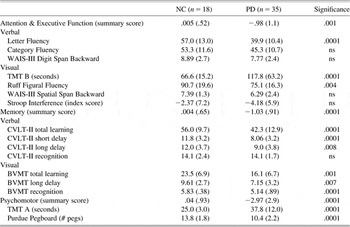
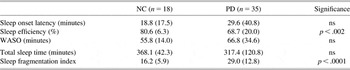
Although the patients were not demented, they performed significantly more poorly than NC on multiple measures of cognitive functioning (Table 2). In regard to attention and executive functioning, the overall summary score was significantly different between PD and NC participants. On the individual measures, PD patients generated significantly fewer words on the FAS letter test, drew fewer unique designs on the Ruff Figural Fluency test, and had longer completion time on the Trail Making Test B. For memory tests, the overall summary score was significantly lower for PD than NC participants. Examining individual tests, PD patients had lower scores on all CVLT-II measures of verbal recall except long-delay recognition, and recalled fewer figures on all BVMT measures of non-verbal memory. For tests of psychomotor function, PD and NC were significantly different on the summary score; as expected, PD patients performed significantly worse than NC on the Purdue Pegboard Test and were significantly slower on Trails A. On the actigraphy sleep measures, PD patients showed significantly poorer sleep efficiency and more sleep fragmentation than NC participants (Table 3). Excluding nine individuals with possible REM sleep disorder, these findings remained significant, with sleep efficiency and sleep fragmentation still different between PD and NC.
Comparison of cognitive performance in NC and PD participants

Note. Means (SD) are reported. Units are number correct unless otherwise indicated. NC = normal control adults; PD = Parkinson's disease; WAIS = Wechsler Adult Intelligence Scale; CVLT-II = California Verbal Learning Test-II; BVMT = Brief Visual Memory Test; TMT = Trail Making Test; ns = not significant.
Actigraphy sleep results in NC and PD participants

Means (SD) are reported. NC = normal control adults; PD = Parkinson's disease; WASO = wake after sleep onset; ns = not significant.
Correlations Between Sleep and Cognition
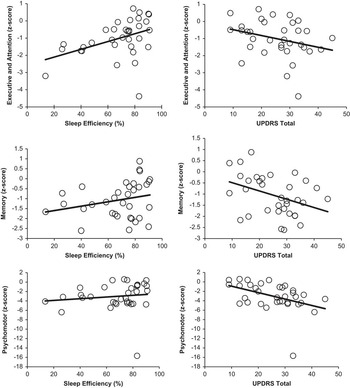
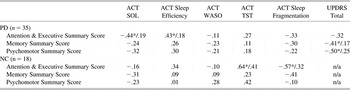
In the PD group, the attention/executive function summary score was significantly correlated with sleep onset latency and sleep efficiency (Figure 1). In the NC group the attention/executive function summary score was significantly associated with total sleep time and sleep fragmentation. Neither the memory nor the psychomotor summary score was significantly associated with any sleep measures for either the PD or NC (Table 4). No significant correlations were found between Epworth Sleepiness Scale total and performance in any of the cognitive domains.
Correlation plots of executive function/attention, memory, and psychomotor function summary scores as dependent variables with actigraphy-derived sleep efficiency and with Unified Parkinson's Disease Rating Scale (UPDRS) total. PD group only. (a) Executive function/attention and sleep efficiency (r = −.43; p < .01). (b) Executive function/attention and UPDRS total (r = −.32; p > .05). (c) Memory and sleep efficiency (r = .26; p > .05). (d) Memory and UPDRS total (r = .41; p < .01). (e) Psychomotor function and sleep efficiency (r = −.32; p > .05). (f) Psychomotor function and UPDRS total (r = .50; p < .01). Note: a higher sleep efficiency indicates better sleep whereas a higher UPDRS score indicates worse symptoms, which is the reason for different direction of slopes in the figures.

Correlations between actigraphy and cognitive performance in the PD and NC groups

Note. Correlation coefficients (r values)/effect sizes for significant results are reported. Values reported are for summary scores for each cognitive domain.
*p < .01
NC = normal control adults; PD = Parkinson's disease; ACT = actigraphy; SOL = Sleep onset latency; WASO = wake after sleep onset; TST = total sleep time; UPDRS = Unified Parkinson's Disease Rating Scale; n/a = not applicable.
As neither the BDI nor the BAI scores were significantly related to sleep measures or cognitive summary scores for either the PD or NC group, these were not used as covariates for any analyses. Because PD patients with RBD have been reported to demonstrate cognitive problems earlier in the disease course than those without RBD (Sinforiani et al., Reference Sinforiani, Zangaglia, Manni, Cristina, Marchioni, Nappi and Pacchetti2006; Vendette et al., Reference Vendette, Gagnon, Decary, Massicotte-Marquez, Postuma, Doyon and Montplaisir2007), the analyses were repeated excluding the nine patients presenting with RBD symptoms. With these follow-up analyses, sleep efficiency was still significantly related to attention and executive functioning.
Predictors of Cognitive Impairment
To answer the question of whether it was simply more severe disease that caused both impaired sleep and cognition in patients with PD, we conducted multiple regression analyses using sleep efficiency and UPDRS total (motor symptom severity) as predictors of cognitive impairment. When the attention and executive function summary score was the dependent variable, the overall model was significant, accounting for 21% of the variance in performance. When the independent variables were examined separately, sleep efficiency was a significant predictor of performance (β = .36; p < .05), but the UPDRS total was not (β = −.19; p > .05). When the memory summary score was the dependent variable, the overall model was significant, accounting for 18% of the variance in performance. Unlike for attention and executive function, sleep efficiency was not a significant factor contributing to performance in the memory functioning domain. Instead, in contrast to attention and executive function, memory was significantly predicted by UPDRS total score (β = −.37; p < .05) but not by the sleep efficiency score (β = .12; p > .05). For the psychomotor summary score, the overall model was significant, accounting for 27% of the variance with only UPDRS total (β = −.43; p < .05) and not sleep efficiency (β = .17; p > .05) being a significant predictor of performance.
Removing the nine individuals with possible RBD revealed the same results for the executive function and attention analyses and psychomotor function analyses. For the memory subscore, however, after those with RBD were removed, neither sleep efficiency nor UPDRS total were significant predictors of performance.
Discussion
This study examined how aspects of sleep quality as measured by actigraphy were related to cognitive functioning in patients with PD. In NC and PD participants, performance on actigraphic measures of sleep was significantly related to attention/executive function, demonstrating that the previously reported association in healthy individuals and in those with insomnia extends to patients with PD. There were no significant associations between sleep quality and the aspects of memory and psychomotor function assessed here; PD patients with poorer sleep efficiency as measured by actigraphy exhibited more attention/executive cognitive impairments but did not display more memory or psychomotor impairments.
Patients with PD have been repeatedly shown to have poor sleep, in particular problems with sleep efficiency and sleep fragmentation, often resulting in severe sleep deprivation (Comella, Reference Comella2003; Stavitsky et al., Reference Stavitsky, Saurman, McNamara and Cronin-Golomb2010). There is some evidence that disturbances of sleep and cognition in PD share at least some neuropathological substrates, possibly including the disruption of mesolimbic dopamine circuitry (Gagnon, Petit, Latreille, & Montplaisir, Reference Gagnon, Petit, Latreille and Montplaisir2008; Gunn, Naismith, & Lewis, Reference Gunn, Naismith and Lewis2010). Here we have shown that sleep and cognitive functioning are correlated, with worse sleep associated with worse cognitive performance. The association we found between sleep and cognitive functioning was not accounted for by daytime sleepiness.
A question addressed in this study was whether the association between sleep efficiency and cognition could mainly be accounted for by motor symptom severity. As PD is a progressive neurodegenerative disorder, the number and severity of symptoms increases with disease progression. With longer disease duration and worsening of motor symptoms, patients begin to exhibit worse sleep symptoms (Maetzler, Liepelt, & Berg, Reference Maetzler, Liepelt and Berg2009) and their cognitive functioning also declines (Muslimovic, Post, Speelman, De Haan, & Schmand, Reference Muslimovic, Post, Speelman, De Haan and Schmand2009; Verbaan et al., Reference Verbaan, Marinus, Visser, van Rooden, Stiggelbout, Middelkoop and van Hilten2007). We examined the contribution of disease severity and sleep efficiency to cognitive performance and found that for attention/executive function, which is most often associated with sleep disturbance, sleep efficiency was a significant predictor of performance, whereas motor symptom severity was not. For the psychomotor and memory summary scores, by contrast, our analyses indicated that it was motor symptom severity and not sleep quality that predicted memory performance. These findings point to the possible independence of individual cognitive impairments in PD, with correspondingly distinct underlying pathophysiology. Of note, when we removed individuals with possible REM behavior disorder, we found that neither sleep nor UPDRS total were significant predictors of memory performance. This may in part be due to a decrease in power with fewer patients in the sample size, or may support previous studies that have shown that patients with RBD tend to decline faster in cognitive functioning and are likely to be at the beginning stages of a more rapid dementing process (e.g., Vendette et al., Reference Vendette, Gagnon, Decary, Massicotte-Marquez, Postuma, Doyon and Montplaisir2007).
The pathology of PD affects brain areas responsible for cognitive functioning as well as for sleep/wake regulation (Gagnon et al., Reference Gagnon, Petit, Latreille and Montplaisir2008; Gunn et al., Reference Gunn, Naismith and Lewis2010). Hence, it is not possible to determine from this study whether the relation of sleep to cognition in PD reflects the underlying pathology of the disease impacting both networks, the direct effect of decreased sleep on attention/executive functioning, or a combination of the two possibilities. The literature on sleep and its effect on cognition has mostly centered on the clinical presentation or waking performance of individuals after sleep loss. Studies have begun to elucidate the effect of sleep problems on daytime function by demonstrating their effect on specific brain regions. For example, a study in older adults (mean age, 67 years) found that electroencephalographic (EEG) activity during sleep may be a marker of daytime frontal function, specifically indicating the association between frontal EEG activity during sleep and consequent daytime performance on waking executive function (Anderson & Horne, Reference Anderson and Horne2003). This study as well as others have pointed out that sleep is particularly important for the waking function of frontal regions and in particular the prefrontal cortex in both younger adults (Clark et al., Reference Clark, Dupont, Lehr, Yeung, Halpern, Golshan and Gillin1998) and older adults (Anderson & Horne, Reference Anderson and Horne2003). The association of sleep and executive function and attention is particularly important in patients with PD, because the disorder is characterized by frontal compromise (Zgaljardic et al., Reference Zgaljardic, Borod, Foldi, Mattis, Gordon, Feigin and Eidelberg2006). The additional impact of sleep loss may be particularly detrimental, as shown by our results with the attention/executive function measures.
Although psychomotor vigilance tasks are considered the preferred assay for sensitivity to sleep loss in otherwise healthy individuals (e.g., Rupp, Arnedt, Acebo, & Carskadon, Reference Rupp, Arnedt, Acebo and Carskadon2004), we saw no relation between sleep variables and psychomotor test performance in this sample of PD patients. Performance decrements most strongly related to sleep variables in this sample were tasks of executive function and attention.
In healthy individuals, sleep loss is not unequivocally related to executive function deficits. Indeed, previous reports of the relation between sleep and executive function may have been due to the failure to isolate specific components of executive functions tests; when this is done, effects of sleep loss on executive functions are less clear (Tucker, Whitney, Belenky, Hinson, & Van Dongen, Reference Tucker, Whitney, Belenky, Hinson and Van Dongen2010). More precision is required in analyzing components of putative executive function tasks that are affected by sleep restriction. Nevertheless, it appears that some higher-level cognitive control process best described as an “executive control” process is affected by sleep changes in PD (see also Groeger, Lo, Burns, & Dijk, Reference Groeger, Lo, Burns and Dijk2011, for a similar perspective).
Subgroups of PD have received much attention in the recent PD literature, as they may be important to understanding disease and treatment variability as well as to general understanding of neural networks related to the specificity of various functions, including cognition and mood. Studies often examine disease-related variables in individuals with PD through consideration of subgroups by age of onset, type of initial motor symptom, side of initial motor symptom, and gender. These meaningful subgroups can give insight into harbingers of the disease as well as treatment implications and can help with understanding the physiologic substrates of disease symptoms. Research into complex disease states such as PD often yields conflicting results, and much debate has ensued over the years especially about the essence of cognitive problems in this disorder. Some investigators have approached PD heterogeneity by focusing on neuropsychiatric features of the disease including presence or absence of depression, hallucinations and sleep disturbances (Bronnick, Aarsland, & Larsen, Reference Bronnick, Aarsland and Larsen2005). A recent review of the heterogeneity of PD suggested that sleep disturbances may be an important factor impacting the variability of the disease (Gunn et al., Reference Gunn, Naismith and Lewis2010). The present study is the first to our knowledge to demonstrate that disturbed sleep is related to the cognitive problems in PD and that sleep impairment contributes to the heterogeneity of the disease.
Given the potential contribution of sleep disturbance to the heterogeneity of the clinical presentation of PD, it is important in future studies to explore whether there are differences by subgroup (i.e., gender, side, and type of predominant motor symptom) in the association of sleep and cognition in this disorder. Previous studies have reported gender differences in sleep (Bordelon & Fahn, Reference Bordelon and Fahn2006; Miller & Cronin-Golomb, Reference Miller and Cronin-Golomb2010) as well as differences by side and motor symptom at onset (Alves, Larsen, Emre, Wentzel-Larsen, & Aarsland, Reference Alves, Larsen, Emre, Wentzel-Larsen and Aarsland2006; Cronin-Golomb, Reference Cronin-Golomb2010; Stavitsky et al., Reference Stavitsky, McNamara, Durso, Harris, Auerbach and Cronin-Golomb2008) with regard to sleep and cognitive functioning in PD. In the present study, subgroup analyses were not performed due to power limitations associated with sample sizes. Future studies should explore whether sleep disruption has a differentially greater impact on cognitive performance in men and women and by motor subgroups in PD.
A potential limitation of this study was that we used actigraphy rather than polysomnography (PSG), which is the gold standard for studying sleep. Although actigraphy is a useful and in some respects a preferred method of assessing many aspects of sleep in PD, as compared to self-report (Stavitsky et al., Reference Stavitsky, Saurman, McNamara and Cronin-Golomb2010; Stavitsky & Cronin-Golomb, Reference Stavitsky and Cronin-Golomb2011), actigraphy cannot differentiate between nocturnal activity due to wakefulness and nocturnal activity due to other common sleep disturbances of PD such as REM behavior disorder, periodic limb movements, or sleep apnea. All of these nocturnal sleep problems disrupt sleep and, therefore, decrease sleep quality. Sleep-disordered breathing in particular has been associated with cognitive deficits, such as those related to problems with executive function, vigilance, psychomotor function, and memory (see Decary, Rouleau, & Montplaisir, Reference Decary, Rouleau and Montplaisir2000 for review). To evaluate the presence of the common sleep disturbances in PD, we used a self-report measure in addition to actigraphy and determined that nine of the PD patients had been diagnosed with sleep-disordered breathing. Removing the data from these individuals did not change the main finding of the study, however, which was that attention and executive function were associated with sleep quality in patients with PD. It should be noted that undiagnosed sleep disorders are common in PD. As PSG was not used to ensure the absence of sleep disorders, there may have been individuals in our study who had sleep-disordered breathing, REM sleep behavior disorder or restless legs syndrome, which may have contributed to the results.
In summary, the current study is the first to demonstrate that sleep quality in PD is significantly correlated with cognitive functioning. Hence, the association between poor sleep and impaired cognition previously reported in other populations (Bastien et al., Reference Bastien, Fortier-Brochu, Rioux, LeBlanc, Daley and Morin2003; Blackwell et al., Reference Blackwell, Yaffe, Ancoli-Israel, Schneider, Cauley, Hillier and Stone2006) can be extended to those with PD. Among the most important findings was that the best predictor of the performance of PD patients on measures of attention and executive functioning was sleep efficiency, accounting for more variance than disease severity. By contrast, we found in the same patients that psychomotor function was more likely to be associated with disease severity than with sleep. Memory appeared to be associated with disease severity rather than with sleep, but the relation did not hold when we eliminated data from patients with symptoms of REM behavior disorder. In PD as with other studied populations, the integrity of sleep appears to be a significant factor in waking cognitive performance particularly in regard to attention and executive function. Further research is needed to investigate the neuroanatomical substrates underlying sleep and cognitive functioning in this disorder. In those with insomnia, it has been reported that improving sleep through behavioral therapy has a positive impact on waking cognitive function (Altena, Van Der Werf, Strijers, & Van Someren, Reference Altena, Van Der Werf, Strijers and Van Someren2008) and increases waking frontal activation (Altena, Van Der Werf, Sanz-Arigita et al., Reference Altena, Van Der Werf, Sanz-Arigita, Voorn, Rombouts, Kuijer and Van Someren2008). Understanding the relation of sleep efficiency and cognition in PD is particularly important because sleep problems are amenable to treatment, and both sleep and cognitive problems impact the quality of life of those with PD.
Acknowledgments
This study was supported by a Ruth L. Kirschstein National Research Service Award from the National Institute of Neurological Disorders and Stroke (1F31NS061555) and a Clara Mayo Foundation fellowship from the Department of Psychology, Boston University (K.S.), and by NINDS grant R01 NS050446 (A.C.G.). We report no conflicts of interest. Marie Saint-Hilaire, MD, FRCPC, Cathi Thomas, RN, MS, and Denyse Turpin, RN, MPH of the Department of Neurology, Boston Medical Center, provided valuable support of our participant recruitment efforts. Chase Ansok, Erica Appleman, Sophie Blease, Eric Griffith, Patricia Johnson, Barrett Phillips, and Jessica Saurman assisted with testing participants and scoring data. We acknowledge with gratitude the efforts of these colleagues and especially the efforts of all of the individuals who participated in this study.