INTRODUCTION
Ostertagia ostertagi is a highly pathogenic gastrointestinal nematode that infects cattle in temperate climate regions. During its development, the parasite induces several morphological, physiological and biochemical changes in the abomasum of the host. These changes result in tissue damage, a substantial increase in the pH of the abomasal contents, loss of functional activity of parietal cells, hypoalbuminaemia and hypergastrinaemia (McKellar, Reference McKellar1993). Also, O. ostertagi induces a strong Th2 type immune response, accompanied by accumulation of local antibodies, mast cells and eosinophils (Claerebout and Vercruysse, Reference Claerebout and Vercruysse2000). Although the mechanisms or processes used by the parasite to change the abomasal environment are largely unknown, parasite excretory-secretory (ES) products are considered to play an important role (Klesius, Reference Klesius1993; Simpson et al. Reference Simpson, Simpson, Simcock, Reynolds and Pomroy1999; Simpson, Reference Simpson2000). ES products comprise all of the material released by the parasites in vitro and presumably also in vivo. ES material is often stage specific and may be derived from the parasite surface, from specialized secretory glands or as by-products of parasite digestion (Knox, Reference Knox2000). In an attempt to gain insight in the composition of O. ostertagi ES products, Vercauteren et al. (Reference Vercauteren, Geldhof, Peelaers, Claerebout, Berx and Vercruysse2003) immuno-screened cDNA libraries of different life-cycle stages of O. ostertagi with polyclonal rabbit serum raised against ES products. This approach led to the identification of 15 secreted proteins, of which many were nematode specific but with an unknown function. The possible role of ES antigens as vaccine candidates also makes them particularly interesting. An ES antigen fraction purified from adult O. ostertagi ES material by thiol-Sepharose chromatography has previously been shown to partially protect cattle against challenge infection in 2 independent vaccination experiments (Geldhof et al. Reference Geldhof, Claerebout, Knox, Vercauteren, Looszova and Vercruysse2002, Reference Geldhof, Vercauteren, Vercruysse, Knox, van den Broeck and Claerebout2004). Mass spectrometric (MS) analysis indicated that the most abundant antigens present in this fraction were 2 activation-associated secreted proteins, termed Oo-ASP1 and Oo-ASP2 (Geldhof et al. Reference Geldhof, Vercauteren, Gevaert, Staes, Knox, Vandekerckhove, Vercruysse and Claerebout2003). A recent re-analysis of these MS data by comparison against currently available O. ostertagi expressed sequence tag (EST) dataset identified a previously undescribed nematode-specific protein family. In the present study, we report the further characterization of this novel nematode specific secreted protein family present in selected members of the subfamily Ostertagiinae. The transcription and expression pattern of its members and the phylogenetic relationship with the SCP/Tpx-1/Ag5/PR-1/Sc7 protein family were analysed.
MATERIALS AND METHODS
Bioinformatics
The full-length sequence of Oo-al1 (O. ostertagi ASP-like protein 1) was obtained by means of the BD Marathon® cDNA amplification kit (BD Clontech). The 5′-rapid amplification of cDNA ends (RACE) PCR was performed on an aliquot from an adult O. ostertagi cDNA library using the AP1 primer and a gene-specific primer OoAL1RTrev (5′-KCTTGTTATTRTGAATCCGTCA-3′) or OoAL2RTrev (5′-GTCGTGAATGGGCTTCTGTT-3′), as recommended by the manufacturer. Sequencing was carried out at the Center for Medical Genetics (University Hospital Ghent) by use of the dideoxy chain terminator method (Big Dye™ terminator v3.1, Applied Biosystems) and the ABI3730xl genetic analyser (Applied Biosystems). Database searches for homologues in other nematode species were carried out via NEMBASE (http://zeldia.cap.ed.ac.uk/ncbi_blast.html) and NCBI server (http://www.ncbi.nlm.nih.gov/BLAST/). Alignment and analyses of these nucleotide and deduced amino acid sequences were conducted using the program DNASTAR (DNAstar Inc). N-glycosylation and phosphorylation sites were predicted with PROSITE (www.expasy.ch/tools/scanprosite), while signal peptides were detected with SignalPV1.1 (www.cbs.dtu.dk/services/SignalP). Protein domain searches were also performed using the NEMBASE2 database (http://zeldia.cap.ed.ac.uk/nematodeESTs/search_domains.php). Multiple alignments were made using CLUSTALW (http://www.ebi.ac.uk/clustalw), and phylogenetic analysis was carried out using the program Mega v.3.1 (Kumar et al. Reference Kumar, Tamura and Nei2004). The neighbour-joining method was employed and the consensus tree (unrooted) selected from the analysis.
Genomic DNA organization
Genomic DNA was extracted from pooled O. ostertagi using the NucleoSpin® tissue kit (Macherey-Nagel). The PCR mixture (25 μl) consisted of 2 μl of template genomic DNA (1/10), 0·8 μm of forward primer, 0·8 μm of reverse primer, 1 U of Platinum®Taq DNA polymerase High Fidelity, 0·4 mm dNTP mixture, 2 mm MgSO4 and 2·5 μl 10×High Fidelity PCR Buffer (Invitrogen). Information on the various primer pairs used in this protocol can be obtained from the authors. The PCR was performed using the following conditions: 4 min at 94°C, followed by 35 cycles of 60 s at 94°C, 60 s at 60°C, 2 min 30 s at 68°C, and a final extension of 10 min at 68°C. The amplicons were subjected to electrophoresis in 1·5% agarose gels, subsequently excised and purified using NucleoSpin® Extract II kit (Macherey-Nagel). The purified amplicons were cloned into the pGEM®-T Easy vector and Escherichia coli (strain DH5α; Invitrogen) was transformed. Sequencing was performed as described in the previous section.
Stage-specific transcription
A PCR approach was used to investigate the transcription of Oo-al and Tc-al (T. circumcincta ASP-like protein). For O. ostertagi, RNA extraction and cDNA preparation were performed as described previously (Van Zeveren et al. Reference Van Zeveren, Visser, Hoorens, Vercruysse, Claerebout and Geldhof2007). The reaction mixture (25 μl) consisted of a master mix with Taq DNA polymerase (Invitrogen), dNTP, 1·5 mm MgCl2, 0·4 μm of both the forward (RTforw: 5′-CCCTAAAGAGTCGCCAACAAG-3′) and reverse gene-specific primer (OoAL1RTrev, OoAL2RTrev) and 1 μl of the cDNA (1/20) of the different developmental stages of O. ostertagi. The PCR started with a denaturation step at 94°C for 2 min, followed by 35 cycles of 94°C for 30 s, 58°C to 68°C (depending on the primer combination) for 30 s, 72°C for 30 s, and a final extension of 10 min at 72°C. To correct for sample-to-sample variation during RNA isolation and reverse transcription step, the transcription profile of the reference gene (rpl13) was also used for comparison. The amplicons were electrophoresed in 2% agarose. Bands were photographed using the Quantity One 4.5.1 Chemidoc EQ™ Software System (Bio-Rad, CA, USA).
For T. circumcincta, single-stranded cDNA (ss-cDNA) was synthesized from mRNA isolated from T. circumcincta eggs, infective L3, L4 (harvested 7 days post-infection) and adults (harvested at 28 days) as described previously (Redmond et al. Reference Redmond, Smith, Halliday, Smith, Jackson, Knox and Matthews2006). Approximately 5 ng of ss-cDNA were used as template in the semi-quantitative PCR employing specific, internal primers (Tc_Al_For: 5′-CTACGATATGCTGCTTCGTCTT-3′; Tc_Al_1_Rev: 5′-GCACCCTTCAAGGTTTCATCC-3′ and Tc_Al2b_Rev: 5′-ACATTCATCGACCTGGTTCC-3′) for each of Tc-al1 and Tc-al2. The following cycling conditions were used: 94°C for 5 min, followed by 32 cycles of 94°C for 30 s, 53°C for 30 s, 72°C for 1 min, with a final extension at 72°C for 7 min. Equal loading and integrity of each of the ss-cDNA preparations was verified by PCR using primers designed to amplify a 320 bp fragment of the T. circumcincta beta-tubulin gene. Amplicons were separated in a 1·5% (w/v) agarose gel and detected by staining with GelRed™ nucleic acid gel stain (Biotium, Hayward, USA).
Recombinant expression of Oo-AL1
The Oo-al1 cDNA (381 bp) was first cloned into the pGEM®-T-Easy vector (Promega Corporation), following PCR using primers containing the restriction sites BamHI and SalI (OoALBamHI: 5′-GGATCCGACTGCAACGAGAACAT-3′, OoALSalI: 5′-GTCGACCTACATGTATTGGTAATT-3′). The OoAL-pGEM®-T-Easy plasmid DNA was purified with Qiagen plasmid Midi kit (Westburg) and digested with both the restriction enzymes (Invitrogen). The digested Oo-al1 fragment was gel-purified and unidirectionally ligated in the expression vector pGEX-6P-1. Competent cells of E. coli strain BL21 (DE3; codon plus) were transformed and transformants selected. The DNA sequence and correct reading frame were verified. Clones containing the Oo-al1-pGEX-6P-1 construct were grown in 2×YT broth at 37°C to an optical density (600 nm) of 0·6, after which recombinant Oo-AL1 protein (rOo-AL1) synthesis was induced by the addition of 0·1 mm isopropyl-beta-D-thiogalactopyranoside (2 h at 37°C). Cell lysis and purification of the protein on glutathione agarose beads were performed according to an established protocol (Frangioni and Neel, Reference Frangioni and Neel1993). The glutathione S-transferase affinity tag was removed by PreScission protease cleavage (GE Healthcare). The protein concentration and purity were determined by SDS-PAGE and subsequent Coomassie blue staining, by comparison with a known bovine serum albumin (BSA) standard (Pierce).
Immunization of rabbits
A New Zealand white laboratory rabbit (4 months) was immunized subcutaneously with ~30 μg of purified recombinant Oo-AL1, 3 times with a 2-week interval. Each dose was supplemented with 5 μg Quil A (Superfos). Two weeks after the final immunization, the serum was collected.
Affinity purification of antibodies from rabbit serum
To diminish cross-reactivity, serum antibodies were affinity purified to rOo-AL1. Approximately 400 μg of rOo-AL1 was separated on SDS-PAGE and transferred to a polyvinyldine difluoride (PVDF) membrane (Immobilon®, Milipore). The Oo-AL1 region was excised and the strip was blocked with 10% horse serum (HS) in PBS containing 0·05% Tween 20 (Sigma) (PBST). The blot was incubated overnight at 4°C with the serum (diluted 1:40 in PBST+2% HS) and then washed extensively with PBST (3×5 min at room temperature). Bound antibodies were eluted by incubating the blot with 5 ml of 5 mm glycine, 0·5 m NaCl, pH 2·5 for 5 min. The eluted antibodies were neutralized immediately with 100 μl of 1m Tris, pH 8·5. Finally, HS (final concentration of 5%) was added to stabilize the purified antibodies (henceforth referred to as α-Oo-AL1 antibody).
SDS-PAGE and Western blot
Somatic extracts from the L4 and adult life stages were prepared as described by De Maere et al. (Reference De Maere, Vercauteren, Saverwyns, Claerebout, Berx and Vercruysse2002). ES products from L4s or adults were collected as described by Geldhof et al. (Reference Geldhof, Claerebout, Knox, Agneessens and Vercruysse2000). Ten micrograms of each extract and ES products and 5 μl of the positive control (rOo-AL1) were separated on NuPAGE® 10% Bis-Tris Gels (Invitrogen) under reducing and non-reducing conditions and subsequently blotted on to a PVDF membrane. Non-specific binding was blocked with 10% HS (in PBST). The blots were incubated with the α-Oo-AL1 antibody at 4°C overnight. Subsequently, the blots were washed extensively with PBST (3×5 min at room temperature) and incubated with affinity purified goat anti-rabbit IgG (Sigma, 1:5000 in PBST with 2% HS) conjugated with horseradish peroxidase and washed. The substrate 3·3 diaminobenzidine tetrachloride in PBS and 0·02% H2O2 was used to detect bands.
RESULTS AND DISCUSSION
Re-analyses of the previously obtained MS data for the ES-thiol fraction (Geldhof et al. Reference Geldhof, Vercauteren, Gevaert, Staes, Knox, Vandekerckhove, Vercruysse and Claerebout2003) against the O. ostertagi EST dataset resulted in a significant hit with EST contig number OOC00098. This contig represents 2 EST sequences (BG733966, BG733967), each encoding a predicted protein of 149 amino acids (aa). Protein domain searches with this sequence revealed a low but significant (E-value=0·65 with a significant E-value cut-off level ⩽1) with the SCP/Tpx-1/Ag5/PR-1/Sc7 protein motif. Although this motif is also present in the activation-associated secreted protein (ASP) family of nematodes, sequence analysis indicated that this O. ostertagi ES protein was distinct from all of the previously identified/characterized ASPs. Therefore, the protein was named the O. ostertagi ASP-like protein Oo-AL1, which has an estimated molecular weight of 16·6 kDa and a predicted pI of 6·32.
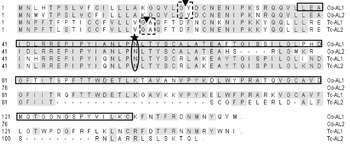
PCR amplification from the Oo-al1 cDNA from different parasite life stages revealed the presence of an additional Oo-al transcript in O. ostertagi, termed Oo-al2. The protein encoded by this transcript had a 81·6% sequence identity to protein Oo-AL1, has an estimated molecular weight of 8·5 kDa and a predicted pI of 8·33. Using the O. ostertagi Oo-al sequences to query all nematode genome and EST databases available, 6 similar EST sequences were identified in Teladorsagia circumcincta (the abomasal of small ruminants related to O. ostertagi). The AL proteins of T. circumcincta are encoded by 2 EST clusters. The first cluster TDC00472 consisted of 5 ESTs (CB037847, CB037904, CB038060, CB038565, CB039149) which code for a long variant of Tc-AL1 (163 aa) of ~17·5 kDa. The other EST cluster TDC00684 contained 1 EST (CB038818) which was 498 nucleotides (nt), coding for a shorter protein Tc-AL2 (114 AA) of 13 kDa. An alignment of the AL sequences for O. ostertagi and T. circumcincta is shown in Fig. 1. The proteins inferred from these Teladorsagia ESTs exhibit 48·7–58·7% sequence identity with the Oo-AL proteins. One putative N-linked glycosylation site (Asn-Leu-Thr-Tyr) was conserved in these 4 AL proteins from Ostertagia and Teladorsagia and is located between amino acids 55 and 57 (Fig. 1, marked with a star). Each of these proteins contained a signal peptide motif (Fig. 1, marked with an arrow), suggesting that these proteins are genuinely secreted.
Alignment of the predicted amino acid sequences of the AL-like proteins (Oo-AL1, Oo-AL2, Tc-AL1, Tc-AL2). The cleavage site of the N-terminal signal peptide is indicated by an arrow head (▼). The putative N-linked glycosylation site (Asn-Leu-Thr-Tyr) is marked with a star (★). The SCP-like extracellular protein domain (Pfam PF00188) in Oo-AL1 is marked with a box.

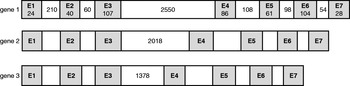
The Oo-al2 cDNA sequence is 98·5% identical to Oo-al1, except for 6 nucleotide polymorphisms and an indel of 58 nucleotides at position 199. To investigate whether the transcripts were encoded by two different genes or were the result of alternative splicing, PCR was performed on genomic DNA from pooled and individual O. ostertagi adults to isolate Oo-al encoding genes. Three predicted Oo-al genes (AM712631, AM712632 and AM712633) of ~2360, 3000 and 3500 bp, respectively, were isolated. Each gene had a similar structure and contained 7 exons and 6 introns. The genomic organization of the genes is shown in Fig. 2. The differences between the 3 genes related mainly to intron 3. The exon sequences of all the genes were almost identical to each other, and were presented to encode isoforms of the Oo-AL1 protein. None of these 3 genes encoded the Oo-AL2 protein. Based on these results, it is unlikely that Oo-AL2 is due to alternative splicing. The cDNA sequence of Oo-al2 differed from that of Oo-al1 in the lack of the last 58 nucleotides of exon 4. However, no different donor/acceptor splice sites could be identified in exon 4, which could explain this alternative truncation.
Genomic organization of Oo-al genes. Length (bp) of introns and exons is indicated. Only the length of intron 3 differs among the 3 genes.

The analysis of the O. ostertagi genes suggests that the 2 AL proteins identified in the T. circumcincta EST dataset are encoded by one or more genes with a similar structure to those of O. ostertagi. The part of the protein missing in the short Tc-AL variant matches the sequence encoded by exon 5, indicating (in contrast to the situation in O. ostertagi) that the short Tc-AL2 protein might indeed be a splice variant of the gene encoding the full Tc-AL1 protein. The alternative splicing of exon 5 is inferred to result in a frame shift and an earlier termination of the translation.
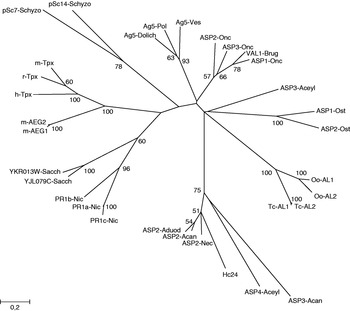
As an outgroup could not be accurately defined, an unrooted phylogenetic tree was constructed to display visually the relationship of the AL proteins with other SCP-like extracellular proteins (Pfam PF00188) from various organisms. This protein family is characterized by a high diversity in protein sequence and function among its members (reviewed by Van Loon and Van Strien, Reference Van Loon and Van Strien1999). In some parasites, such as hookworms, Haemonchus contortus and O. ostertagi, members of this protein family have proven their potential as vaccine antigens (Schallig et al. Reference Schallig, Van Leeuwen and Cornelissen1997; Geldhof et al. Reference Geldhof, Claerebout, Knox, Vercauteren, Looszova and Vercruysse2002, Reference Geldhof, Vercauteren, Gevaert, Staes, Knox, Vandekerckhove, Vercruysse and Claerebout2003, Reference Geldhof, Vercauteren, Vercruysse, Knox, van den Broeck and Claerebout2004; Bethony et al. Reference Bethony, Loukas, Smout, Brooker, Mendez, Plieskatt, Goud, Bottazzi, Zhan, Wang, Williamson, Lustigman, Correa-Oliveira, Xiao and Hotez2005). The phylogenetic analysis revealed a close relationship of the AL proteins representing Ostertagia and Teladorsagia, which clustered with (previously characterized) ASPs but represented a distinct group (Fig. 3).
Unrooted phylogenetic tree showing the relationship of Oo-AL1, Oo-AL2 and other SCP-like proteins from different species such as testis-specific proteins from humans (h-Tpx=X95237), mouse (m-Tpx=NP033446), rat (r-Tpx=AAD48090); mouse acidic epididymal glycoprotein-like molecules (m-AEG1=AAA37185, m-AEG2=AAA37186); Schizophyllum commune (pSc14-Schyzo=M81723, pSc7-Schyzo=M81722); Saccharomyces cerevisiae (YKR013W-Sacch=Z28238; YJL079C-Sacch=AY558306); Nicotiana tabacum pathogen-related proteins (PR1a-Nic=X06361, PR1b-Nic=X17680, PR1c-Nic=X17681); vespid venom allergen 5 from Vespula vulgaris (Ag5-Ves=AAA30333), Dolichovespula arenaria (Ag5-Dolich=AAA28303), Polistes annularis (Ag5-Pol=AAA29793); Brugia malayi venom allergen antigen-like protein 1 (VAL1-Brug=AAB97283); ASPs from Onchocerca volvolus (ASP1-Onc=AAB69625, ASP2-Onc=AAP06732, ASP3-Onc=AAB97282), O. ostertagi (ASP1-Ost=CAD23183, ASP2-Ost=CAD56659), Haemonchus contortus (Hc24=AAC47714), Ancylostoma ceylaticum (ASP3-Acetyl=AAR03712, ASP4-Acetyl=AAR03713), A. caninum (ASP2-Acan=AAC35986, ASP3-Acan=AAO63575), A. duodenale (ASP2-Aduod=AAP41951), Necator americanus (ASP2-Nec=AAP41952) and ASP-like proteins from O. ostertagi (Oo-AL1=AM712629, Oo-AL2=AM712630) and T. circumcincta (Tc-AL1=TDC00472, Tc-AL2=TDC00684). Bootstrap values of >50 are indicated.

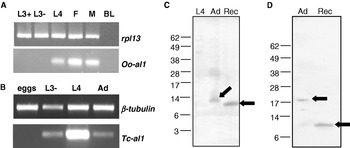
The transcription of the AL protein was investigated in both O. ostertagi and T. circumcincta by PCR. Specific primers for each gene were used on cDNA from the different life stages. The results are shown in Fig. 4. The Oo-al1 transcript was detected in the L4 stage and adult females and males of O. ostertagi. In T. circumcincta, the Tc-al1 transcript was present from the exsheathed L3 stage onwards, with the highest level of transcription in the L4. The PCRs for the shorter AL transcript forms (Oo-al2 and Tc-al2) revealed very faint bands, suggesting a low level of transcription for both of these forms (results not shown).
(A) Stage-specific transcription pattern of Oo-al1 and the reference gene rpl13 in the L3 stage with (L3+) and without sheath (L3−), the L4 stage, the adult females (F) and males (M) (BL=blank). (B) Stage-specific transcription of Tc-al1 and the reference gene β-tubulin in eggs, exsheated L3s (L3−), L4 and adult stages. (C) Western blot (denaturing conditions) of L4 ES, adult ES and rOo-AL1 probed with α-Oo-AL1 antibody. (D) Western blot (non-denaturing conditions) of adult ES and rOo-AL1 probed with the same antibody.

The expression pattern for the AL proteins in O. ostertagi was also analysed on Western blots of somatic extracts and ES products from L4 and adult O. ostertagi using the α-Oo-AL1 antibody probe. The blots inferred the presence of an Oo-AL protein in the ES products of adult worms. A band of ~14 kDa was detected under reducing conditions (Fig. 4, panel C). The Western blot of the non-reduced adult ES products revealed a higher band, suggesting dimerisation of the OoAL proteins under native conditions (Fig. 4, panel D). The specific anti-OoAL-1 antibody probe was also used in an attempt to detect the corresponding native protein on sections made from the adult life stages of O. ostertagi (cf. Geldhof et al. Reference Geldhof, Whitton, Gregory, Blaxter and Knox2005), but immunofluorescent labelling of Oo-AL1 was not detected (results not shown). This result may be attributable to insufficient amounts of Oo-AL1 to be detectable on the cross-sections and corresponded to the Western blot analysis of somatic extracts.
The present study provides a first insight into a novel nematode secreted protein family. We have named them the ASP-like (AL) protein family, because they contain the SCP/TPX-1/Ag5/PR-1/Sc7 protein domain (Pfam PF00188, InterPro domain IPR001283) which typifies the large nematode activation-associated secreted protein family (ASP). In O. ostertagi, the Oo-al1 transcript was detectable from the L4 stage onwards, whereas in T. circumcincta the Tc-al1 transcript was present from the exsheathed L3 stage onwards and was highest in the L4 larval stage.
There are at least 3 different genes encoding AL proteins in O. ostertagi. Surprisingly, all of these genes seem to code for the same protein, Oo-AL1. A gene encoding the shorter Oo-AL2 version could not be identified. The reason for this is unclear. Either Oo-AL2 is the product of a rare allele present in the population or Oo-AL2 is an isoform of Oo-AL1. The latter may be the case for the 2 AL variants in T. circumcincta, where Tc-AL2 lacks the amino acids encoded by exon 5. Alternative splicing, where an entire exon is deleted, is widely used by organisms to increase their proteome diversity (see Nagasaki et al. Reference Nagasaki, Arita, Nishizawa, Suwa and Gotoh2005). However, the situation for Oo-AL2 is different. The protein seems to be truncated within exon 4. This type of splicing with intron/exon isoforms has been reported previously in Caenorhabditis elegans and C. briggsae (see Kent and Zahler, Reference Kent and Zahler2000; Nagasaki et al. Reference Nagasaki, Arita, Nishizawa, Suwa and Gotoh2005), but requires alternative donor and acceptor splice sites. In this case, it would require a new 5′ splice site in exon 4. Although the nucleotide frequencies adjacent to the 5′ and 3′ splice sites in O. ostertagi have not been studied in detail, they are likely to be conserved in relation to other nematodes such as C. elegans. Multiple studies have shown that the canonical 5′ GT splice site in C. elegans is highly conserved (Kent and Zahler, Reference Kent and Zahler2000; Sheth et al. Reference Sheth, Roca, Hastings, Roeder, Krainer and Sachidanandam2006). This site is also present at the 5′ end of each intron in the genes encoding ALs in O. ostertagi. However, no such alternative 5′ GT splice site is present in exon 4, such that it is still unclear from which gene Oo-AL2 is derived.
The function of the AL proteins is presently unknown. The SCP/TPX-1/Ag5/PR-1/Sc7 protein domain is found in a broad range of proteins, such as the mammalian sperm-coating glycoproteins, cysteine-rich secretory proteins, testis-specific proteins, venom antigens, plant pathogen-related proteins (PR-1), lizard helothermine and some yeast proteins (reviewed by Van Loon and Van Strien, Reference Van Loon and Van Strien1999). The suggested functions of these proteins are equally diverse. The mouse TPX-1 (also called CRISP-2) is thought to be involved in sperm maturation and possesses lytic enzymatic activities for the degradation of egg structures during fertilization (Kasahara et al. Reference Kasahara, Gutknecht, Brew, Spurr and Goodfellow1989). The PR-1 family is induced under stress conditions, like plant responses to pathogens and tumor growth (Dixon et al. Reference Dixon, Cutt and Klessig1991; Durrant and Dong, Reference Durrant and Dong2004; Basse, Reference Basse2005). Helothermine is a toxin that blocks ryanodine receptors, whereas venom allergen 5 is a potent allergen that can induce allergic reactions in humans (Lu et al. Reference Lu, Villalba, Coscia, Hoffman and King1993). The function of the nematode ASPs is still unknown. It has been postulated that ASPs take part in the infection process and the transition to parasitism (Hawdon et al. Reference Hawdon, Jonest, Hoffman and Hotez1996, Reference Hawdon, Narasimhan and Hotez1999; Murray et al. Reference Murray, Gregory, Gomez-Escobar, Atmadja and Maizels2001; Moser et al. Reference Moser, Freitas, Arasu and Gibson2005).
The database searches conducted herein indicated that this novel protein family is specific to the subfamily Ostertagiinae (order Strongylida). No homologous AL-like proteins were identified in any other nematode species, both parasitic and free-living. This information suggests a key functional role for the AL proteins in the life-cycle of these abomasal parasites. The uniqueness of this group of proteins is also consistent with the outcome of a large-scale transcriptomic analysis of the phylum Nematoda, showing that many genes containing the SCP/TPX-1/Ag5/PR-1/Sc7 domain have undergone ‘lineage-specific amplification and divergence’ within the superfamily Strongyloidea (Parkinson et al. Reference Parkinson, Mitreva, Whitton, Thomson, Daub, Martin, Schmid, Hall, Barrell, Waterston, McCarter and Blaxter2004). Furthermore, the AL sequences from O. ostertagi and T. circumcincta show notable sequence diversity between the species and a slightly different transcription pattern, which could relate to an adaptation to cattle and small ruminants, respectively.
H. S. and A. V. were supported by a grant from Research Foundation-Flanders (F. W. O. – Vlaanderen). P. G. is a Postdoctoral Fellow of the Fund for Scientific Research – Flanders (Belgium) (F. W. O. – Vlaanderen) and the recipient of a Marie Curie EU Reintegration grant (no. 028870). The authors would like to thank D. P. Knox for his help with the manuscript.