

Introduction
The application of organic and inorganic fertilizers affects crop yields and soil properties (Hu et al., Reference Hu, Li, Qiao, Liu and Chen2015). In subtropical areas, most soils are deficient in organic matter (OM) and nitrogen (N), many are low in phosphorus (P), and some contain insufficient amounts of potassium (K) (Wang et al., Reference Wang, Shao, Deng and Li2005). To satisfy increasing food demand, intensive cropping and excessive tillage have further depleted soil OM and nutrient pools. However, restoration of OM and nutrient pools through fertilizer management can improve soil fertility and enhance agronomic yield (Shen et al., Reference Shen, Yang, Yao, Wu, Wang, Guo and Yin2007).
Chemical fertilizers are commonly used in crop cultivation because of the significant yield response, high nutrient concentration, and convenience for transport and application. However, the long-term use of only chemical fertilizers may lead to deterioration in soil physical, chemical, and biological properties (Blanco-Canqui and Schlegel, Reference Blanco-Canqui and Schlegel2013; Guo et al., Reference Guo, Liu, Zhang, Shen, Han, Zhang, Christie, Goulding, Vitousek and Zhang2010). On the other hand, the sole application of manure may not be able to maintain and synchronize the supply of plant nutrients with crop demand that is required for optimum crop yields, due to less plant-available nutrients and the time needed for mineralization and release of nutrients for effective plant uptake (Miao et al., Reference Miao, Stewart and Zhang2011). The combined application of inorganic and organic fertilizers is therefore deemed to be a better choice for sustaining high crop yield by improving soil properties and optimizing nutrient use efficiency (Ye et al., Reference Ye, Yu, Yang, Jiang, Ma, Wang, Wang, Sun and Fu2011; Zhao et al., Reference Zhao, Li, Li, Shi, Huang, Wang, Zhu, Yang, Liu and Chen2010).
There is a widespread implied assumption that soil enzymes are derived primarily from microorganisms (Liu et al., Reference Liu, Xia, Chen, Mao, Che and Li2011). Thus, microbial communities influence enzyme-catalyzed processes such as OM decomposition, humus synthesis, nutrient cycling, and detoxification from xenobiotics (Gattinger et al., Reference Gattinger, Palojärvi and Schloter2008). Bacteria, the most abundant and diverse group of soil organisms, are likely to release enzymes into the soil (Shen et al., Reference Shen, Wang, Ruan, Xue, Zhang, Li and Shen2014; Stroobants et al., Reference Stroobants, Degrune, Olivier, Roisin, Bodson, Portetelle and Vandenbol2012). By determining soil enzyme activities and bacterial composition, we might be able to better understand these soil processes and to develop management practices for improving soil quality. Numerous bacterial phyla live in soils, but traditional laboratory culture methods provide information on only the 1% of bacteria that are readily cultured. This generates extreme bias in the evaluation of bacterial diversity (Nocker et al., Reference Nocker, Burr and Camper2007). However, high-throughput sequencing after partial ribosomal DNA amplification is a recent and powerful molecular technique. It can identify huge numbers of bacteria and enable an in-depth investigation of bacterial diversity as affected by fertilizer management.
Paddy-upland rotations, a common practice in Southwest China and Southeast Asia, consume less water, use land efficiently, and produce high crop yields to satisfy the increasing demand for food. Short- and long-term effects of fertilizers on crop yields and soil properties are often studied in either arid or paddy soils in those subtropical areas, whereas less is known about the long-term effects in paddy-upland rotation systems. The main objectives of our present experiment were (i) to understand the long-term effect of fertilizers on crop yields, soil nutrients, and microbial properties, (ii) to provide information on the development of fertilization techniques, and (iii) to provide the local farmers and those in similar areas of Myanmar, Vietnam, Laos, and Thailand recommendations for fertilizer management in paddy-upland rotations with multiple crops and frequent tillage.
Materials and Methods
Experimental site
The experiment was initiated in 1998 (Spring) on a red sandy loam soil (Oxisol, pH 7.1) near Yuxi City, Yunnan Province, Southwest China (24°14′N, 102°30′E, 1630 m above sea level). The regional climate is subtropical with an average annual air temperature of 15.9 °C (ranging from 8.1 °C in January to 29.9 °C in June–July), and precipitation of 1011 mm. Approximately 90% of the annual rainfall occurs between May and September. The mean annual sunshine duration is 2480 h, with strong ultraviolet radiation. Some initial chemical characteristics of the experimental soil are presented in Table 1.
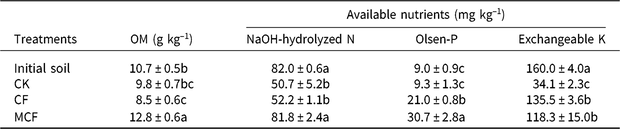
Selected chemical characteristics of the soil in response to fertilization treatments

In each column, the mean ± SDs followed by different small letters are significantly different at p < 0.05.
Crop cultivation
The crop cultivation regime is a rotation of summer rice (Oryza sativa L.), winter rapeseed (Brassica campestris L.), next summer tobacco (Nicotiana tabacum L.), and next winter hairy vetch (Vicia villosa Roth) rotation. This cropping system is common in the local area due to the effective use of soil in combination with the increase in soil N (biological fixation by hairy vetch), diverse crop products, and better weed controls. Rice plants (35-day old) and tobacco plants (50-day old) were grown from seeds in nursery beds and transplanted in early May. Rapeseed and hairy vetch seeds were sown in late October. The same crop cultivars were grown in all treatments each year. The soil was flooded during the rice growth period and the water was drained after harvest for growing the winter crops. A mild plow treatment (approximately 20-cm depth) followed by harrowing was adopted at seedling transplanting or seed sowing of each crop, and manual weed control was performed in the early crop growth stage.
Fertilization design
The local farmers provide crops with only chemical fertilizers or with chemical fertilizers in combination with manure. Thus, the experiment comprised three treatments (no fertilizer for all crops (CK);chemical fertilizer alone (CF); and manure plus chemical fertilizer (MCF)) laid out as a randomized block design with four replications. The plot dimensions were 10 m × 25 m. In the CF treatment, rapeseed received 150 kg N ha–1 and 100 kg P2O5 ha–1, rice received 150 kg N ha–1, 75 kg P2O5 ha–1, and 50 kg K2O ha–1, tobacco received 100 kg N ha–1, 60 kg P2O5 ha–1, and 200 kg K2O ha–1, and hairy vetch received 40 kg N ha–1 and 40 kg P2O5 ha–1. Chemical fertilizers were supplied as urea, calcium superphosphate, and potassium chloride for rapeseed, rice, and hairy vetch and as a compound fertilizer of NH4NO3, NH4H2PO4, and K2SO4 (N:P2O5:K2O = 10:10:25) for tobacco. In the MCF treatment, crops received the same amounts of nutrients (N, P, and K) as in the CF treatment. Specifically, hairy vetch received only chemical fertilizers. In the cultivation of rice, rapeseed, and tobacco, however, 50% of the N was replaced by hairy vetch-made green manure, while the balance of P was supplied as calcium superphosphate, and K was supplied as potassium chloride for rice and rapeseed and potassium sulfate for tobacco. The fresh weight of hairy vetch stems and leaves ranged from 16 to 18 Mg ha–1. Vetch-made green manure contained 2.50–3.00% N, 0.25–0.30% P2O5, and 1.80–2.00% K2O.
Sampling and analysis
Rice and rapeseed grains were weighed at harvest. Tobacco leaves were individually harvested as soon as they matured and were then weighed after baking. The tobacco leaf yield was the sum of the dry weight of each harvest.
Bulk soil samples were collected from each plot at 0–15-cm depth after the rice harvest in 2015 and divided into two parts. One part was immediately frozen in liquid N for microbial biomass measurement and bacterial DNA sequencing. The soil microbial biomass carbon (MBC) and microbial biomass nitrogen (MBN) were determined on fresh soil with an oven-dry weight of 15 g (sieved to <5 mm) using the chloroform-fumigation-extraction method (Vance et al., Reference Vance, Brookes and Jenkinson1987). Bacterial DNA extraction (a fresh soil sample with an oven-dry weight of 1.0 g), amplification, pooling, MiSeq Illumina sequencing, and data processing were performed at the Majorbio Biological Company (Shanghai, China) as described by Acosta-Martínez et al. (Reference Acosta-Martínez, Dowd, Sun and Allen2008) and Fierer et al. (Reference Fierer, Breitbart, Nulton, Salamon, Lozupone, Jones, Robeson, Edwards, Felts and Rayhawk2007). The generated qualified sequences were subjected to linkage clustering using the RDP (Ribosomal Database Project) Pipeline with a conservative dissimilarity of 3% to define operational taxonomic units (OTUs). OTUs were then used to generate predictive rarefaction models as described by Davinic et al. (Reference Davinic, Fultz, Acosta-Martinez, Calderón, Cox, Dowd, Allen, Zak and Moore-Kucera2012) for the accurate estimation of most bacterial species present in each soil sample and to calculate the bacterial community richness indexes Ace and Chao, and the diversity Shannon index (Chao and Bunge, Reference Chao and Bunge2002; Dethlefsen et al., Reference Dethlefsen, Huse, Sogin and Relman2008). Thereafter, the most abundant sequence from each OUT was selected and taxonomically classified by BLAST (Basic Local Alignment Search Tool) searching against the16S rRNA gene database (Silva SSU128). The remaining portion of soil was air dried, ground, and passed through a 0.5-mm sieve to determine pH (1:1, soil:water) with a pH meter. OM was determined by the dichromate oxidation method, Olsen-P by extraction with 1 M NaHCO3 and measurement by molybdenum blue spectrophotometry, exchangeable K by displacement with 1 M ammonium acetate followed by flame photometry, and 1 N NaOH-hydrolyzed N by the diffusion method (Pansu and Gautheyrou, Reference Pansu and Gautheyrou2007). In the measurement of NaOH-hydrolyzed N, 2.0 g of air-dried soil and 0.2 g of FeSO4·7H2O were mixed and placed in the outer sub-cell of a diffusion cell, and then 10 mL of 1 N NaOH and 0.1 mL of saturated Ag2SO4 solution were added, followed by incubation at 40 °C for 24 h. NH3 was collected in 2% H3BO3 solution and placed in the inner sub-cell and then measured by HCl titration. Soil dehydrogenase activity was measured based on the reduction of 2,3,5-triphenyltetrazolium chloride into red formazan, which was assayed spectrophotometrically at 460 nm (Casida, Reference Casida1977). For urease activity, soil was incubated with urea, and the colorimetric NH4+ released was determined by indophenol reaction (Nannipieri et al., Reference Nannipieri, Giagnoni, Renella, Puglisi, Ceccanti, Masciandaro, Fornasier, Moscatelli and Marinari2012). Neutral phosphatase activity was analyzed by incubating soil with p-nitrophenyl phosphate in buffer solution (pH 7.0) as described by Tabatabai and Bremner (Reference Tabatabai and Bremner1969). For invertase activity, sucrose was added as a substrate to the soil, and the glucose produced was measured calorimetrically by a 3,5-dinitrosalicylic acid reaction (Frankeberger and Johanson, Reference Frankeberger and Johanson1983).
Data analysis
Treatment effects were evaluated by analysis of variance with replication using the SAS statistical software package (2002, version 9.1.3). Significant differences between the treatment means were tested by Fisher’s protected LSD (Least Significant Difference) (p < 0.05). The results are presented as the means ± SDs (standard deviations of means).
Results
Agronomic yields
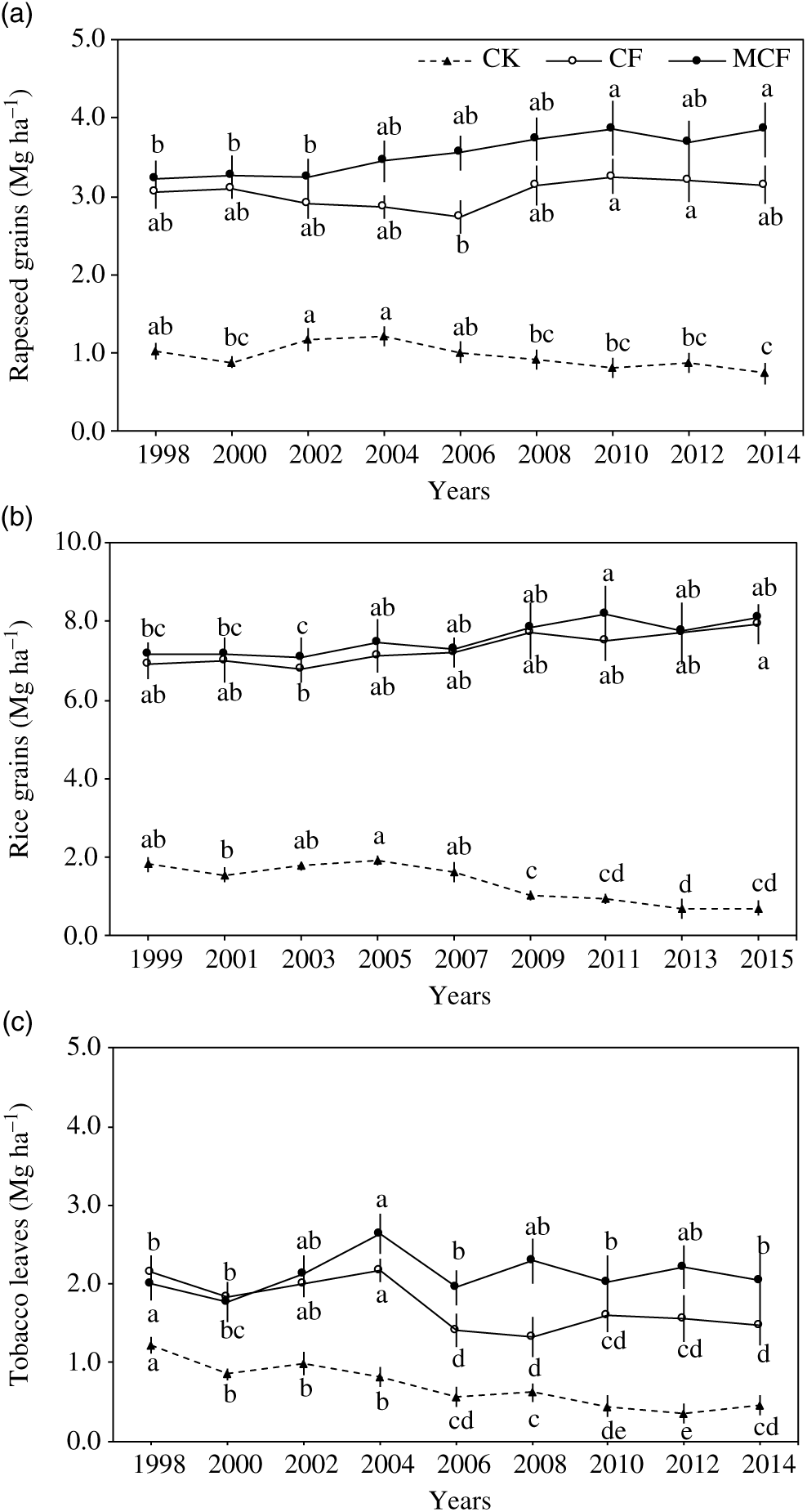
MCF increased the production of rapeseed grains and tobacco leaves compared to CF after 3 or 4 years of starting this field experiment, while rice yield varied little between MCF and CF except in 2011, when it was higher in MCF than in CF (Figure 1). Compared with CK, the mean yield of rapeseed from 1998 to 2015 increased by 216.7% (CF) and 268.8% (MCF), of rice by 445.5% (CF) and 464.9% (MCF) but differences were not significant between MCF and CF, and of tobacco by 220.4% (CF) and 292.6% (MCF).
Production of rapeseed grain (a), rice grain (b), and tobacco leaves (c) from 1998 to 2015 in response to fertilization treatments. Different small letters indicate significant differences among treatments at p < 0.05.

Soil chemical properties
OM and nutrients in soils at 0–15-cm depth varied significantly among treatments (Table 1). The soil OM contents (g kg–1) were 12.8 (MCF), 10.7 (prior to the experiment), 9.8 (CK), and 8.5 (CF). Soil supplied with MCF and the initial soil contained higher NaOH-hydrolyzed N (81.8–82.0 mg kg–1) than that with CF and without fertilizer (50.7–52.2 mg kg–1). The soil Olsen-P content ranged from 2.3 (CF) to 3.4 (MCF) times that of the initial soil. Soil exchangeable K decreased from 160.0 mg kg–1 (initial soil) to 135.5 mg kg–1 (CF), 118.3 mg kg–1 (MCF), and 34.1 mg kg–1 (CK).
Soil enzyme activities, MBC, and MBN
Enzyme activities also varied in soils at 0–15-cm depth among treatments (Table 2). Soil dehydrogenase activity was higher under MCF (8.75 mg TPF g–1 h–1), being followed by CF (7.54 mg TPF g–1 h–1) and then CK (5.81 mg TPF g–1 h–1). The activities of soil invertase and phosphatase followed a similar trend to dehydrogenase, with MCF showing the highest activities and CK showing the lowest. Urease activity remained stable (0.46–0.54 mg NH4+-N g–1 h–1) in all soils studied. The soil MBC was approximately 1.3 (CF) and 2.2 times (MCF) higher than that in CK, while the soil MBN was 25.9, 16.5, and 17.3 mg kg–1 under MCF, CF, and CK, respectively (Table 2).
Activities of enzymes and microbial biomasses in the soil under different fertilization treatments

In each column, the mean ± SDs followed by different small letters are significantly different at p < 0.05.
Soil bacterial communities – OTUs and diversity indexes
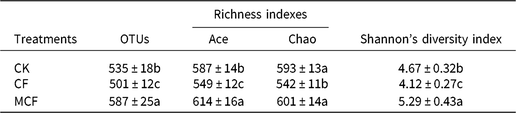
There were 535, 501, and 587 OTUs in the soils under CK, CF, and MCF treatments, respectively (Table 3). The Ace and Chao richness indexes evaluated at 3% dissimilarity, and Shannon’s diversity index followed a similar trend to OTUS, with MCF showing the highest richness and diversity indexes and CF showing the lowest.
OTUs and richness and diversity indexes of bacterial communities in the soil under different fertilization treatments

In each column, the mean ± SDs followed by different small letters are significantly different at p < 0.05.
Soil bacterial communities – bacterial phyla
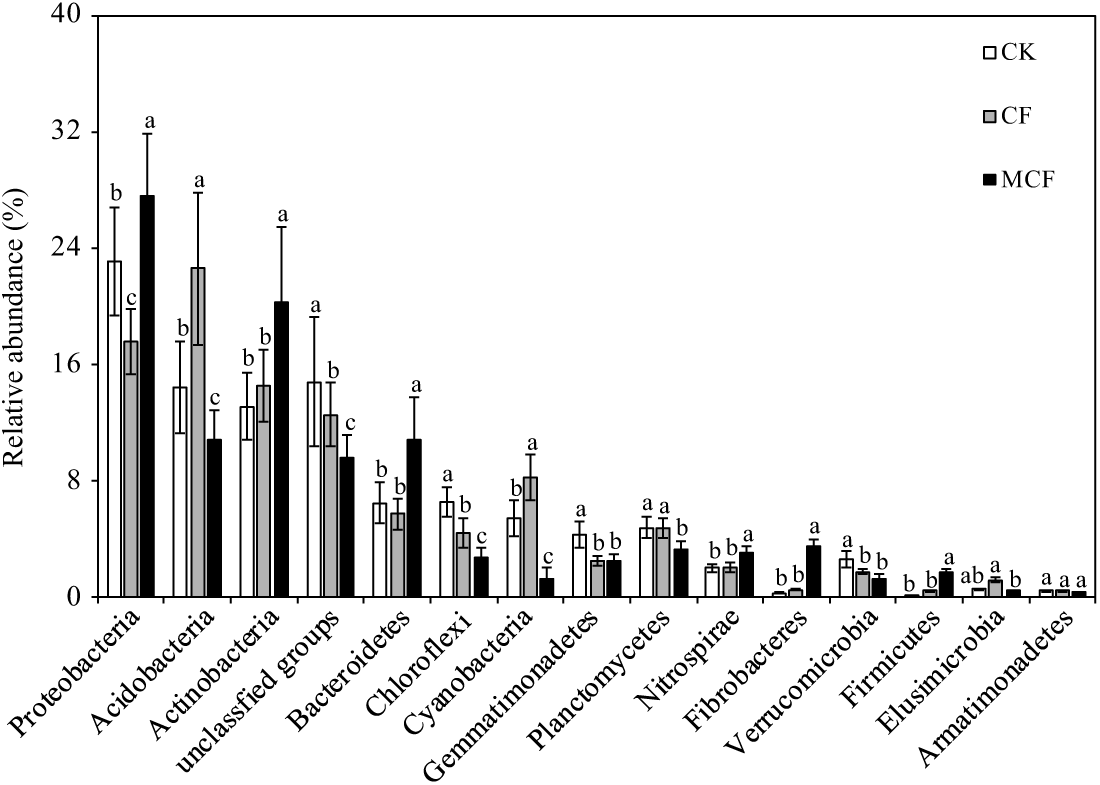
The bacteria in the studied soils picked up by MiSeq Illumina sequencing were mostly attributed to 15 phyla, as presented in Figure 2. The bacterial communities were dominated by four major phyla (Proteobacteria, Acidobacteria, Actinobacteria, and Unclassified groups), which accounted for approximately 70% of the 16S rDNA sequences in each of the soil samples examined. The soil receiving different fertilization treatments varied significantly in bacterial abundance at the phylum level. For example, the abundance of Proeobacteria was approximately 28% under MCF and 18% under CF, while the opposite trend was found for Acidobacteria, which were more predominant under CF than under MCF.
Bacterial phyla and their relative abundances in soils under varying fertilization management. Different small letters above the bars indicate significant differences among treatments at p < 0.05.

Soil bacterial communities – predominant bacteria
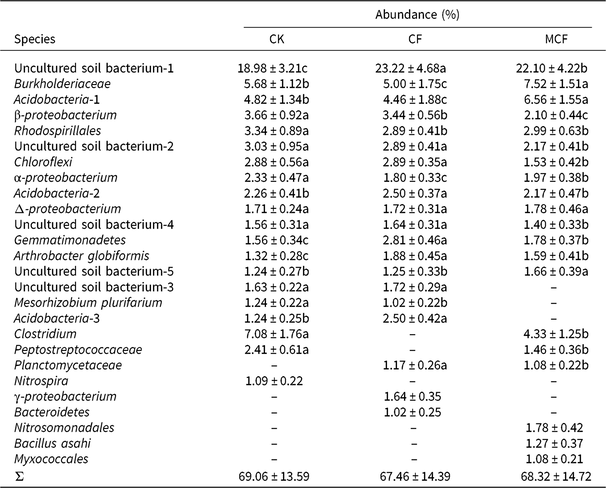
Among the top 20 predominant bacteria evaluated, the following 14 bacteria were common in all treatments: Uncultured soil bacterium-1, Burkholderiaceae, Acidobacteria-1, β-proteobacterium, Rhodospirillales, Uncultured soil bacterium-2, Chloroflexi, α-proteobacterium, Acidobacteria-2, Δ-proteobacterium, Uncultured soil bacterium-4, Gemmatimonadetes, Arthrobacter globiformis, and Uncultured soil bacterium-5 (Table 4). In the MCF treatment, unique soil bacteria were Nitrosomonadales, Bacillus asahi, and Myxococcales, while γ-proteobacterium and Bacteroidetes were unique in the CF treatment, and Nitrospira in CK. In addition, the top 20 dominant bacteria accounted for approximately 70% of the total in each of the soil samples examined. Similar to the bacterial phyla, the top 20 dominant bacteria showed differences in their abundance in response to the soil fertilization treatments. For instance, the abundance of Arthrobacter globiformis was 1.20 and 1.42 times higher in MCF and CF, respectively, compared to CK. The abundance of Clostridium was approximately 7% in the soil without fertilizer, and no samples were found in the CF treatment.
The top 20 dominant bacteria in the soil under different fertilization treatments

In each column, the mean ± SDs followed by different small letters are significantly different at p < 0.05.
Discussion
In comparison with CF, the application of MCF increased the production of rapeseed grains and tobacco leaves after 3 or 4 years from the beginning of the experiment (Figure 1). This indicated a time-dependent course of soil improvement by organic fertilizers and reinforced the necessity to carry out long-term experiments to understand fertilizer effects. Many researchers have reported higher yields of wheat and maize with balanced use of organic and inorganic fertilizers in long-term field experiments (Chen et al., Reference Chen, Hao and Zhang2006; Duan et al., Reference Duan, Xu, Wang, Yang, Huang and Gao2011; Rasool et al., Reference Rasool, Kukal and Hira2007). However, our experiment showed no significant differences in rice yield between MCF and CF, except in 2011, when yield was higher in MCF than in CF. Overall, our data indicate that CF also sustained high rice yield in the paddy-upland rotation. It is likely that organic nutrient sources are not able to synchronize the required supply of nutrients to the growing rice plants because less plant-available nutrients were applied and more time is needed for mineralization to release nutrients in the anaerobic paddy soil environment. The results suggest that it could be better to use all manure types on drylands in a paddy-upland rotation system, and application of CF at the right time and amount could also sustain high rice yield, as under MCF.
As shown in Table 1, higher OM, NaOH-hydrolyzed N, and Olsen-P were found under MCF than under CF-fertilized soil, implying the improvement of soil physical properties and available nutrient pools. Similar results were also obtained by Liu et al. (Reference Liu, Yan, Mei, He, Bing, Ding, Liu, Liu and Fan2010), who reported high soil C and N contents in the farmyard manure treatments over a long period of mineral–organic fertilizer application. Rathod et al. (Reference Rathod, Rathod, Patel and Patel2013) also studied the influence of fertilization on crop yields in wheat–maize rotation and found that crop yields increased following the application of farmyard manure and vermicompost in combination with chemical fertilizers, which increased soil OM and N reserves.
N obtained by NaOH hydrolysis from soils mainly includes nitrate-N, ammonium-N, and organic-N contained in easily mineralized OM (Pansu and Gautheyrou, Reference Pansu and Gautheyrou2007), and thus might be plant available. Most OM that remains in tropical and subtropical soils, particularly with intensive cropping and frequent tillage, is quite stable. As a result, NaOH-hydrolyzed N obtained from soils in our experiment did not increase with increasing OM. This could be one of the important reasons for similar NaOH-hydrolyzed N but high OM in soils receiving MCF compared to the initial soil condition.
Soil enzymes are derived primarily from soil microorganisms (Liu et al., Reference Liu, Xia, Chen, Mao, Che and Li2011), and extracellular enzymes stabilized in the soil matrix are no longer associated with viable cells. In addition, the enzymatic assays used in the present experiment cannot distinguish the intracellular and extracellular enzymes within soils. In the MCF treatment, therefore, the soil showed higher activities of phosphatase and invertase, probably due to the long-term cumulative effect of extracellular enzymes and/or large numbers of viable microbes (intracellular enzymes) (Table 2). Invertase, the enzyme that catalyzes the hydrolysis of sucrose to glucose and fructose, is partially responsible for the breakdown of OM and plant litter in soils (Kotroczó et al., Reference Kotroczó, Veres, Fekete, Krakomperger, Tóth, Lajtha and Tóthmérész2014; Zhang et al., Reference Zhang, Jia and Xi2014). Phosphatases, groups of enzymes catalyzing the hydrolysis of both esters and anhydrides of phosphoric acid, are important in organic P cycling in soils and plant P supply. Therefore, the activities of these two enzymes could be effective indicators of organic carbon and P mineralization in soils (Crouse et al., Reference Crouse, Sierzputowska-Gracz, Mikkelsen and Wollum2002; Turner et al., Reference Turner, Condron, Richardson, Peltzer and Allison2007; Wyngaard et al., Reference Wyngaard, Cabrera, Jarosch and Bünemann2016). Enzyme assays measure the total activity of a soil sample and approximately 40–60% of total enzyme activity can come from the stabilized in soils (Knight and Dick, Reference Knight and Dick2004; Skujiņš, Reference Skujiņš and Burns1978). This implies that the activities of urease found here did not necessarily correlate with microbial biomass. On the other hand, dehydrogenase removes hydrogen atoms from substances and transfers them to acceptors. In theory, this enzymatic reaction can only occur in viable cells and not in stabilized soil complexes. Thus, dehydrogenase activity reflects the metabolism and number of viable cells, particularly bacteria (García et al., Reference García, Hernandez and Costa1997; Velmourougane et al., Reference Velmourougane, Venugopalan, Bhattacharyya, Sarkar, Pal, Sahu, Ray, Nair, Prasad and Singh2013). The higher activity of dehydrogenase in soil supplied with MCF suggests that it contained a large number of living bacteria, which were carrying out the metabolic processes related to cellular respiration, oxidation-reduction reaction, OM decomposition, and so forth.
Compared with CK, MCF increased MBC, MBN, OTUs, and richness and diversity indexes of bacterial communities, in contrast to CF, which behaved otherwise (Tables 2 and 3). Our results are consistent with those of Escuadra et al. (Reference Escuadra, Usami and Amemiya2008) and Su et al. (Reference Su, Yin, Fu, Chen and Hong2009), who studied the effectiveness of farmyard manure using the plate counting method and found that soil supplied with manure had a larger number of bacteria, including Actinomycetes. The bacterial diversities reported here were also in agreement with distinct bacterial DNA banding patterns found in soils supplied with organic and inorganic fertilizers (Zhen et al., Reference Zhen, Liu, Wang, Guo, Meng, Ding, Wu and Jiang2014). It is also necessary to note that 501–587 species of bacteria were identified by MiSeq Illumina sequencing used in our study. These numbers would have been impossible with traditional plate counting and DNA cloning techniques. Herein, all the studied soils were dominated by Proteobacteria, Acidobacteria, Actinobacteria, and Unclassified groups, irrespective of the fertilizer treatment (Figure 2). Fourteen of the top 20 predominant bacteria at various taxonomic levels were commonly present in all studied soils (Table 4). Bossio et al. (Reference Bossio, Scow, Gunapala and Graham1998) and Wei et al. (Reference Wei, Yang, Zhang, Wang, Chen, Zhang and Li2008) also reported that soil type was the most important determinant of microbial communities and that most soil microorganisms are stable and not influenced by fertilization. The bacteria in the top three phyla may be important contributors to soil ecosystems, as they are also particularly abundant in other soils (Chodak et al., Reference Chodak, Gołębiewski, Morawska-Płoskonka, Kuduk and Niklińska2015; Janssen, Reference Janssen2006; Troxler et al., Reference Troxler, Ikenaga, Scinto, Boyer, Condit, Perez, Gann and Childers2012; Wang et al., Reference Wang, Wang, Zhang, Shao, Zou, Liu, Zhou, Wan, Rao, Li and Fu2016). Proteobacteria show extreme metabolic diversity and might therefore be linked to multiple soil functions (Kuramae et al., Reference Kuramae, Yergeau, Wong, Pijl, van Veen and Kowalchuk2012; Nacke et al., Reference Nacke, Thürmer, Wollherr, Will, Hodac, Herold, Schöning, Schrumpf and Daniel2011; Zhang et al., Reference Zhang, Jia and Xi2014). In soil, Acidobacteria are highly diverse and physiologically active in situ. However, their individual functions are still unclear because they are rarely cultured (Dimitriu and Grayston, Reference Dimitriu and Grayston2010). Actinobacteria include the bacteria responsible for OM decomposition (Margesin et al., Reference Margesin, Moertelmaier and Mair2013; Tanahashi et al., Reference Tanahashi, Murase, Matsuya, Hayashi, Kimura and Asakawa2005), Actinomycetes produce hyphal threads to bind soil particles together (Kennedy, Reference Kennedy1999), and Actinobacillus have the ability to synthesize antibiotics, such as actinomycin by Actinomyces and streptomycin by Streptomyces griseus (Fazeli et al., Reference Fazeli, Cove and Baumberg1995; Waksman and Tishler, Reference Waksman and Tishler1942). Therefore, bacteria in these three major phyla are of great importance to multiple soil processes, including OM decomposition, humus synthesis, nutrient recycling, structure development, exogenous pollutant decomposition, and antagonistic effects against plant pathogenic microbes.
Most of the top 20 predominant bacteria have been found simultaneously in a variety of eutrophic lake sediments and other arid soils (Kalyuzhnaya et al., Reference Kalyuzhnaya, Lapidus, Ivanova, Copeland, McHardy, Szeto, Salamov, Grigoriev, Suciu and Levine2008; Saarenheimo et al., Reference Saarenheimo, Tiirola and Rissanen2015; Smith et al., Reference Smith, Thavamani, Ramadass, Naidu, Srivastava and Megharaj2015; Uroz et al., Reference Uroz, Buée, Murat, Frey‐Klett and Martin2010), indicating that they should be facultative anaerobes, which are quite different from bacterial groups present only in arid or paddy soils (Mueller et al., Reference Mueller, Belnap and Kuske2015; Zhang et al., Reference Zhang, Wang and Yao2007; Zhu et al., Reference Zhu, Wang, Wang, Wang, Risgaard-Petersen, Jetten and Yin2011). The ability of these bacteria to exist in a wide range of environments suggests an adaptation to both anaerobic and aerobic soil conditions in paddy-upland rotations. It is interesting to look at the dominant bacteria in the studied soils, such as α-proteobacteria. Many members in this class can form root nodules with legume plants and fix atmospheric N for use by the host. Provided α-proteobacteria picked up by our method were attributed to rhizobia, their ability to form nodules with hairy vetch roots could be of mutual benefit because the bacteria in the nodules obtain carbohydrates from the hosts and in return provide the hosts with N. Like some other species in Arthrobacter, A. globiformis has been found to perform several important functions such as the reduction of hexavalent chromium, degradation of agricultural pesticides, and the use of nitrate as a terminal electron acceptor in denitrification. Gemmatimonadetes have been found in many arid and alpine soils and make up approximately 2% of soil bacterial communities (DeBruyn et al., Reference DeBruyn, Nixon, Fawaz, Johnson and Radosevich2011; Janssen, Reference Janssen2006). However, there are currently only six cultured isolates, and one representative cultured in this phylum is Gemmatimonas aurantiaca, which is a polyphosphate-accumulating bacterium (Zhang et al., Reference Zhang, Sekiguchi, Hanada, Hugenholtz, Kim, Kamagata and Nakamura2003). The presence of this bacterium in soils might thus be important in P recycling.
Conclusion
In the paddy-upland rotation with multiple crops and frequent tillage, the use of MCF increased the rapeseed grain yield and production of tobacco leaves compared to the use of CF after 3 or 4 years of starting the fertilization. Although the application of CF and MCF caused similar rice yields, MCF improved the soil quality due to increases in OM, microbial biomass, and bacterial diversity, which were associated with increases in the activities of dehydrogenase, phosphatase, and invertase. Soils under fertilizer management were all dominated by Proteobacteria, Acidobacteria, Actinobacteria, and Unclassified groups, and most of them were facultative anaerobes. The presence of those bacteria was stable in the soil and to some extent was influenced by fertilizer treatments. Many soil bacteria are poorly studied, and additional research is needed to assess their roles, especially the dominant bacteria, in soil processes and functions.
Acknowledgements
This work was supported by the State Key Development Program of Basic Research of China (Project 2013CB127405), Chongqing Scientific Innovation Project for Postgraduates (Project CYB17064), and Chongqing Science and Technology Committee (Project cstc2018jscx-mszd0133 and Project cstc2017shms-xdny80084). We thank the anonymous reviewers very much for the valuable suggestions and Dr Chris Morant Penfold in School of Agriculture, Food and Wine, The University of Adelaide, Australia, for English review.
Financial support
None.