The cardiac surgeon, Bernard Tucker, compiled the book, First Clinical Conference on Congenital Heart Disease. This work reprinted the talks delivered at a seminar held at Childrens Hospital of Los Angeles in 1979. Tucker also recorded a dinner presentation as part of the symposium, this being a conversation between the special guest speaker, Helen Taussig, and Louis Martin, a mentor of Taussig at Johns Hopkins in the 1920s. In this dialogue, Helen Taussig explained how she began her career in paediatric cardiology, “When he [Edwards Park] came to Johns Hopkins, he thought the children in the hospital received superb care, but the children in the dispensary were used only for teaching. He thought that the chronically ill children suffered most. I think you all realizse that specialty clinics are part of … all medical centers and certainly all pediatric centers. Dr. Park was the person who started them in Baltimore, amid unbelievably strong opposition from the staff. The special clinic would ruin the dispensary, and ruin the teaching, and the staff opposed this. Dr. Park thought the better care would bring more patients to the dispensary. So Dr. Park went over, as he always did, to seek help from anyone in any field that he felt had any suggestions to offer …. He went over to Dr. [Edward] Carter [an early cardiologist in the Department of Medicine of Johns Hopkins], and asked if he would help start a clinic. Dr. Carter sent over Dr. Harris, one of the senior fellows who was working there then, and I tagged along and that was my beginning of pediatric cardiology”.Reference Tucker, Lindesmith and Takahashi3 On 1 December, 1927, a few months after Park was appointed to the chair of paediatrics, he wrote a letter to Benedict R. Harris, “The heart clinic is to begin on Saturday of this week. I have written Dr. Swift [Homer Swift at the Rockefeller Institute] in New York City to obtain cardiac record histories. Can you rake up enough of the cardiac record histories to get along this coming Saturday? Moreover, this Saturday I have not assigned any one to assist you so that you and Dr. Taussig must take care of yourselves”.Reference Park4 This letter corroborated the retelling by Taussig of her beginnings in paediatric cardiology, and it related the initial collaboration between Edwards Park and the Rockefeller Institute in setting up a clinic for children with cardiac disease at Johns Hopkins.
Previously, I reported how Edwards Park, with the assistance of Edward Carter from the Department of Medicine, first launched a cardiac clinic for children at Johns Hopkins in the outpatient dispensary. Then, in the Fall of 1928, Park undertook a second effort to establish a permanent clinic for paediatric cardiology within the walls of the Harriet Lane Home first under the direction of Clifton Briggs Leech.Reference Evans5 In this article, I describe the driving force of Edwards Park and his quest to create a clinic for cardiac care, aided by the collaborative relationships of individuals and institutions. I also explore how Helen Taussig became the successor to Clifton Leech as the director of the cardiac clinic at the Harriet Lane Home. I base this article largely on unpublished letters by Helen Taussig, Edwards Park, and Alfred Cohn at the Rockefeller Institute.
In American Cardiology: the History of a Specialty and Its College (1996), Bruce Fye wrote extensively about the importantance of specialty clinics in defining the discipline of cardiology in the early 1900s. In the United States of America, Richard Cabot established the first such clinics in internal medicine departments in Boston at the Massachusetts General Hospital; they were also established at several institutions in New York City.Reference Fye6 In New York City, key physicians with deep interest in cardiac disease organised the Association for the Prevention and Relief of Heart Disease in 1915.Reference Hull7 Owing to the efforts of individuals associated with this organisation, several cardiac clinics opened in New York City institutions. Some of the earliest clinics included those established at Cornell University by Lewis Conner, at Bellevue Hospital by John Wyckoff, and at the Rockefeller Institute by Alfred Cohn.Reference Fye6
Before antibiotics, rheumatic fever was the most common cause of cardiac disease in children. The first paediatric clinics for rheumatic cardiac disease in the United States of America began in 1915 at St Luke’s Hospital in New York City, affiliated with Columbia University, under the direction of William St LawrenceReference St Lawrence8; and in 1916 at Cornell University in New York City, under the direction of May G. Wilson.Reference Wilson and Lim9 Reflecting the work of the Association for the Prevention and Relief of Heart Disease, and later the American Heart Association, founded in 1924, heart disease clinics for adults and children were opened at institutions throughout the United States of America.Reference Fye6
In contrast to children with rheumatic cardiac disease, there were fewer patients with congenital malformations who were often ignored in the early 20th century. Their care required special circumstances that were present at Johns Hopkins by the Fall of 1930. They included the visionary leadership of Edwards Park and the determination of Helen Taussig, whose early encounter and later relationship with the famed cardiac morphologist, Maude Abbott, probably played roles in Taussig’s accepting the directorship of the clinic in 1930 and in her developing a passion for children with congenital cardiac defects. With the support of Edwards Park and the resolve of Helen Taussig, the second cardiac clinic for children at Johns Hopkins that became an integral part of the Harriet Lane Home would later evolve into a Mecca for children with congenital cardiac disease.
Medical philanthropy and institutional partnerships
The Johns Hopkins University, its School of Medicine, and the Harriet Lane Home for Invalid Children were born out of philanthropy based on the convictions of individuals and influenced by family tragedies. Upon the death in 1873 of a Baltimore Quaker and businessman, Johns Hopkins, he willed 7 million dollars, equivalent to about 100 million dollars in 2009, to build a hospital and university from riches he made in the wholesale grocery industry, railroads, real estate, and a brand of whiskey known as “Hopkins Best”. This donation was the largest philanthropic gift in the United States of America up to that time. Yet, The Johns Hopkins School of Medicine did not open until 1893, as the institution ran short of funds. Further donations came from a progressive group of wealthy women headed by Mary Elizabeth Garrett.Reference Chesney and Howell10 The founding of the Harriet Lane Home is a convoluted story that is best told in the book by Park et al.Reference Park, Littlefield, Seidel and Wissow11 Briefly, Harriet Lane was the niece of the President of the United States of America, James Buchanan, the predecessor of Abraham Lincoln. After the Civil War, Harriet Lane married Henry Elliot Johnston, a Baltimore banker. The Harriet Lane Home for Invalid Children was incorporated in 1883, stimulated by the deaths of the only two children of Harriet and Henry Johnston, Buck and Henry, who both died in different years of rheumatic fever. The affiliation agreement with the Johns Hopkins Hospital, however, was not signed, and no funds for the structure bearing the name of the incorporation were available until after the death of both Harriet Lane Johnston in 1903, and her brother-in-law Josiah Johnston in 1906, about 23 years later. The Harriet Lane Home for Invalid Children finally opened its doors in the Fall of 1912.Reference Corner12
In the first part of the 20th century, The Johns Hopkins School of Medicine and its Harriet Lane Home allied with the Rockefeller Institute and the Commonwealth Fund. These three organisations became linked by professional relationships and support derived from significant philanthropy for medical education and research. John D. Rockefeller, Sr amassed the largest private fortune in the world through his Standard Oil Company. In December, 1900, his first grandson, 3-year-old John Rockefeller McCormick, was diagnosed with scarlet fever, lingering a few weeks before he died in January, 1901.Reference Corner12 It is unknown whether this child ultimately died of post-streptococcal cardiac disease. At the time, clinicians recognised the lethality of both scarlet fever and rheumatic fever, and assigned them as distinct causes of acquired cardiac disease, because even though their streptococcal commonality was suspected, their pathophysiology was unclear.Reference Poynton13
Rockefeller, a disciple of homoeopathy, distrusted mainstream medicine, but the death of his grandson was a catalyst that heightened his passion to push forward the creation of an institute for medical research as advocated by his advisor, Fredrick T. Gates. The support by Rockefeller led to the birth of the Rockefeller Institute in New York City, which is now the Rockefeller University. William H. Welch, Professor of Pathology at The Johns Hopkins Medical School, was selected as the first chairman of the board of the institute.Reference Corner12 Then, in 1918, Anna M. Richardson Harkness established the Commonwealth Fund, with her son Edward at the helm. Anna was heir to her husband, Stephen Harkness, an original investor with John D. Rockefeller, Sr in the Standard Oil Company. The mandate of the Commonwealth Fund was to “do something for the welfare of mankind”, by supporting research fellows and the collaborative work of institutions with common goals.14, Reference Davis15
Edwards Park and his desire for a cardiac clinic
Following the death of John Howland in 1926, who was the Professor of Paediatrics to oversee an operational Harriet Lane Home, the minutes of the Board of Managers for 16 May, 1927 noted, “Upon motion duly made, seconded and carried, Dr. Edwards A. Park was elected Director of the Home, he having been recently elected Pediatrician in Chief of the Johns Hopkins hospital, he to receive the same salary as Dr. Howland…, commencing July 1, 1927”.16
Edwards Park, born in 1878, attended the Columbia University College of Physicians and Surgeons. After graduation, Park trained with the influential paediatrician and board member of the Rockefeller Institute, L. Emmett Holt, Sr at the Babies and Foundling Hospitals in New York City, where Park first met the inspiring John Howland.Reference Taussig17, Reference Childs18 Park also worked with the Professor of Medicine at Columbia University, and later at Johns Hopkins, Theodore Caldwell Janeway, son of Edward Gamaliel Janeway, who is now remembered for his description of Janeway lesions in endocarditis.Reference Prutkin and Fye19 Through their collaboration, Park alone and with Janeway published three papers on vasoconstriction.Reference Janeway and Park20–Reference Janeway and Park22 Edwards Park’s early research interests pointed to an enthusiasm for cardiovascular physiology and cardiac disease, even though he would turn to the biochemistry of rickets years later. After his training in New York, Park sailed to Germany for extra experience in basic science.
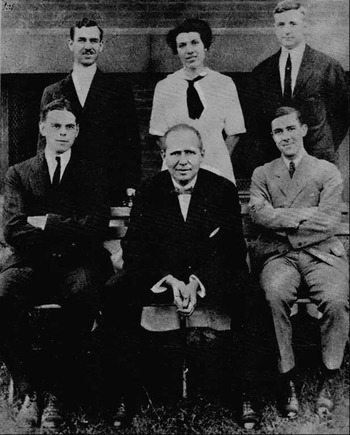
In 1912, John Howland invited Park to Baltimore to join him as the first full-time member of the paediatric faculty at Johns Hopkins, along with the first interns and the first resident, Kenneth Blackfan, later to become head of paediatrics at Boston Children’s Hospital (Fig 1). In 1913, the Rockefeller Foundation provided endowments to the Johns Hopkins School of Medicine for full-time salaried appointments in all major clinical departments, eliminating the need for professors to supplement their incomes with fees from private practice.Reference Park, Littlefield, Seidel and Wissow11 Park remained at Johns Hopkins until 1921, when Yale recruited him to start a department of paediatrics, which he directed until returning to Johns Hopkins in July, 1927Reference Taussig17, Reference Childs18 during which Helen Taussig graduated from the medical school. As evidence of the interest Park had for congenital cardiac disease, he communicated with Maude Abbott even before the first cardiac clinic began. On 7 November, 1927, Park requested a series of reprints of works by Abbott, including reports of endocarditis, and the clinical classification of congenitally malformed hearts.Reference Park23
The first Harriet Lane Staff in 1912. Front left to right: Edwards A. Park, John Howland, Kenneth Blackfan. Back left to right: interns Arthur L. Walters, Eleanor B. Wolfe, William B. McClure.Reference Chesney and Howell10

Despite his opting for the initial cardiac clinic to be based in the dispensary, headed by an internal medicine fellow, Benedict Harris, and assisted by a recent medical graduate, Helen Taussig, Park had bigger plans. Barely 6 months after arriving at Johns Hopkins, and only a month after initiating his first attempt at a cardiac clinic, Park wrote to his friend, Alfred Cohn, at the Rockefeller Institute, “Enclosed is a letter which I wrote to the Commonwealth Fund in regard to our heart clinic. I wonder if you could help us from your end. I have exhausted the possibilities of obtaining a social service worker here for the cardiac clinic. Next year I lose Collis – he is a Research Council Fellow – and have no one especially interested in heart work who will be available to us.”Reference Park24 This short letter speaks volumes. First, Park and Cohn had most likely known each other for more than 20 years, with Cohn graduating from Columbia University in the class of 1904,25 and Park in the class of 1905.Reference Childs18 Second, the note exemplified the relationships between Johns Hopkins, the Rockefeller Institute, and the Commonwealth Fund. Third, Park was exploring all options to properly fund his cardiac clinic including a social worker, still an important issue in current programmes for paediatric cardiology. Fourth, Park was already hoping to replace the dispensary clinic under internal medicine direction with a physician trained in paediatrics. “Collis” was William Robert Fitzgerald Collis, known as Robert, who was from Ireland, and returned there after a 2-year fellowship with Park. Robert Collis would later be the innovator of nasogastric feedings in premature infants.Reference Collis and Majekodunmi26 Collis was both a famed Irish paediatrician and writer.Reference Boylan27 In his expressively written article, “The Chief”, Collis describes Edwards Park and his time at Johns Hopkins. He also depicts his first day with Park as they toured the hospital, “We soon met Emmett Holt, the other associate professor, and the son of the famous old Holt, Still’s counterpart in America, [the famed British paediatrician Sir George Frederic Still of Still’s murmur], and then a string of others: a man with a wide smile and very intelligent eyes who seemed balanced and at peace with himself like Park, Rustin McInstosh; a restless Swede of the curious name of Dr. Count Bengt Hamilton who made me feel uneasy; Hugh Josephs, a research worker of fame; an alarming little man with an unpronounceable Hungarian name, and a lot of residents, among the latter being a shy lady doctor with a diffident smile, Helen Taussig”.Reference Collis28
In the above letter to Alfred Cohn, Park also alludes to his correspondence with the Commonwealth Fund requesting a grant. On 19 January, 1928, Cohn wrote a letter to Barry Smith, Director of the Commonwealth Fund, to support the request by Park, “Dr. Edwards A. Park … has applied … for aid in carrying on his investigations in heart diseases and that he has requested the Commonwealth Fund to aid him the extent of supplying the salary of a social worker and fellow … You remember no doubt that the Commonwealth Fund made a grant to the Heart Committee [see below] of the New York Tuberculosis and Health Association … We have been able to enlist the cooperation of Professor Park in our enterprise so that in his clinic the methods of examination, recording and tabulation developed by us … We have moreover been able to be useful to him to the extent of lending Miss Lingg, the Statistical Secretary of our Committee …”.Reference Cohn29 In February, 1928, the Commonwealth Fund approved a grant of $3800, $2000 for the salary of a physician and $1800 for the social worker.Reference Evans5
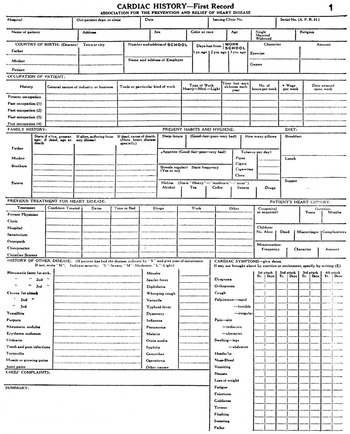
By April, 1928, the paediatric physicians at Johns Hopkins expressed disenchantment with the forms for tabulating data on patients (Fig 2). Alfred Cohn and members of the Association for the Prevention and Relief of Heart Disease were responsible for developing these comprehensive forms.Reference Cohn30 This organisation became the New York Heart Association in 1924, and in 1925 temporarily merged with the New York Tuberculosis and Health Association as its Heart Committee.Reference Hull7 Park noted the discontent of the staff at Johns Hopkins over the forms for data collection in a letter sent to Alfred Cohn on 21 April, “We are having quite a lot of trouble in our heart clinic with the form. All the younger men rebel in regard to the use of the form and I am having a good deal of difficulty in forcing the use of the form upon them”.Reference Park31
This is the first page of the five pages of forms for documenting data on cardiac patients that was developed by Alfred Cohn and associates at the New York Association for the Prevention and Relief of Heart Disease. The full set of forms was published in the Journal of the American Medical Association in 1922.Reference Cohn29

Then in May, 1928, Benedict Harris wrote to Park, “Due to the fact that I had to made a sudden change in my plans about returning to New Haven it was not possible for me to talk over personally with you the recommended changes in the cardiac history form embodied in the rough draft I gave Miss Richards [secretary to Park] … May I take this opportunity of expressing my extreme gratitude to you for the privilege of having worked in the children’s cardiac clinic …”Reference Harris32 The resignation of Harris essentially ended the first attempt by Park at establishing a cardiac clinic for children. In early June, 1928, Park wrote to Alfred Cohn, “I am leaving June ninth for Europe but am sending to you the criticisms [of the cardiac history forms] made by Dr. Harris … and Dr. Taussig …. They are both of them internists in Dr. Carter’s department but have been working during the past year in our cardiac clinic …. We will obtain, I hope, an extremely able man, Dr. Leech … to head our cardiac clinic. In case he comes to us, and I hope he will do, it might be best to delay changes in the forms until he has had some experience with the forms. I am exceedingly anxious that he meet you and Swift before he takes up his work here which will be on October first. I am not absolutely certain that we can get him but think that we can …. In general I wish it were possible to have separate forms for children …. Our cardiac clinic is more or less lapsing during the summer, though our social worker begins on July 1, but will start with a rush I hope on November 1”.Reference Park33 Clifton Leech assumed his responsibilities in the Fall of 1928.Reference St Lawrence8 By this time, Helen Taussig was a first-year paediatric intern, after a year’s study in the “heart station” at Johns Hopkins under the tutelage of Edward Carter.
At the time Park was in Europe during the Summer of 1928, Alfred Cohn and L. Emmett Holt, Jr acting as chief in the absence of Park, exchanged several letters. These letters discussed the new-found need for additional financial support for a secretary for the cardiac clinic.Reference Holt34–Reference Holt36 These letters did not solve this issue, which required the return of Edwards Park. Park and Cohn exchanged an additional series of letters from October through November, 1928, which resulted in Alfred Cohn advising Park to request additional grant support from the Commonwealth Fund for the clinic secretary and expenses undertaken by the social worker.Reference Cohn37–Reference Cohn41 Quoting from the letter of 20 October, Park wrote, “I believe the Heart Clinic is about to be a great success. Leach (sic) is completely converted to the forms, in principle, as they now stand. He is not only a man of very considerable ability but has displayed a great deal of tact and patience. I am quite sure that you can take an optimistic view of the situation here as regards the cardiac clinic and can count on it as furnishing to you a steady supply of accurate statistics.”Reference Park38 On 22 November, 1928, Park wrote to Barry Smith requesting $1400 of additional funds for the clinic, which was approved by the Commonwealth Fund Board of Directors on 28 December, 1928.Reference Park42
Helen Brooke Taussig accepts the directorship of the cardiac clinic
Helen Taussig began her paediatric residency in July, 1928. As in the previous year, she continued to assist in the cardiac clinic during her residency training from 1928 to 1930. In my earlier work on Clifton Leech, I discussed how Leech noted in correspondence that Taussig worked in the cardiac clinic during this time.Reference St Lawrence8 In January, 1929, Taussig was in New York City, undertaking an extramural experience at the Willard Parker Hospital for Communicable Diseases. Edwards Park penned a letter to her on 23 January, “I wonder how your are. Are the sky scrapers (sic) of New York City shaking with your whoops? Won’t you write me in regard to your health and in regard to the value of the Willard Parker to you? Would you consider the possibility of succeeding Dr. Leech as head of the Cardiac Clinic on July first? If so I shall look forward to discussing the entire matter with you on your return home from your wanderings in the desert”.Reference Park43 At this point in 1929, Park was uncertain whether Clifton Leech would agree to stay longer. Leech ultimately did decide to stay until the Summer of 1930.Reference St Lawrence8 On account of its significance, I have reproduced her reply from 28 January, 1929 in its entiretyReference Taussig44:
My dear Dr. Park,28 January
Thank you very much for your friendly letter of the Jan. 24th (sic). The first of your several inquiries is the easily answered. The New York sky scrappers (sic) are so solid that I’ve nearly given up attempting to shake them!
The second is not so easy. One sees a lot of contagious diseases and gets some conception of the variety of their manifestations. To my mind that is very important. The service is disappointing in that the interns are allowed so little responsibility that they are little more than clinical clerks. However, I am sure I shall always be glad of these six weeks.
Your third question is hardest of all. I fear it is not for the best interest of any concerned for me to accept your offer. In the first place I realize my own limitation too keenly and I need more hospital experience. My experience in dealing with acute cardiac conditions in children is virtually nil. Why should my classmates especially value my opinion? Yet if the cardiac clinic is to be successful it must be popular with the house-staff. The New York Heart Assoc. charts are, as you realize, a bug-bear to most of the house-staff. They are designed primarily for the collection of statistical data and not for following the various vicissitudes of the child. This is, I think, one reason why so much opposition to the charts. As the charts contribute nothing to the popularity of the clinic, the person at the head of it must contribute a great deal. My background is too much the same as theirs and my experience too small to be able to contribute much to the clinic.
Also I must confess a tiny problem of one’s own is much more fun than collecting statistics for others. Further more the reliability of data collected in that way seems to me open to question. For example Dr. Cohn told me he considers any consciousness of heart beat as palpitation. I have never considered the rapid forceful heart beat which most of us experience after a strenuous set of tennis as palpitation [Taussig was an avid tennis player]. Dr. Cohn does. What value are my charts to him? Certainly the person at the head of the clinic if obligated to use the charts, should be convinced of their positive value.
After these confessions I hope you will not misunderstand my refusal. The field does interest me tremendously and I very much appreciate your asking me.
Very sincerely yours,
Helen Taussig.
This is a fascinating letter. First, both Park and Taussig wrote warmly to each other. Second, Taussig was correct about her experience, as her year with Edward Carter was spent in evaluating adult patients, and her activities in the cardiac clinic for children were up to then limited, coupled with the fact that she was only in her first year of paediatric residency training. Third, she offered a reasoned explanation regarding negative aspects of the data collection activities in the clinic by way of forms that were complex and primarily oriented to adult patients. Fourth, she failed to mention Clifton Leech, which leads to the speculation that their relationship was not close.
Edwards Park replied to Taussig with bluntness, “I think your ideas in regard to the opportunity which the Cardiac Clinic in this Department offers to you are mistaken ones …. Dr. Leech came to me a few days ago and surprised me by saying that he very probably would like to stay on for another year. I should prefer, of course, to have the clinic in charge of you, who have had pediatric experience …. Perhaps you will take this clinic over the following year, provided I can get sufficient funds. At present the Clinic is supported by the Commonwealth Fund on the ground of the use of the charts. The Cardiac Clinic could not exist at present without the support of the Commonwealth Fund and, therefore, could not exist without the use of the charts …. I do not believe your criticism of the charts was quite just ….”Reference Park45 Despite the directness of Park, Taussig wrote back, “…. I hope Dr. Leech will stay on for another year …. I do appreciate the opportunity it [the clinic] offers to me but my feeling is that I do not offer it enough to make it the success I want to see it …. I shall be very glad to be back in your department at Hopkins again and am looking forward to seeing you.”Reference Taussig46 There are no letters between Park and Taussig in the Alan Chesney Archives for the remainder of 1929 until the spring of 1930, when Helen Taussig was then at Boston Children’s Hospital undertaking another extramural educational and research experience.
In April, 1930, Taussig wrote to Park from her family home in Cambridge, Massachusetts. With left-handed writing, as she had injured her right arm in an accident, Helen wrote, “You asked me to let you know how things were going – slowly I regret to say as I was ill in February & now have [redacted by the Alan Chesney Archives, but likely describing her arm injury] …. This has been a bad blow to research work as I was just beginning to get under way. Altho (sic) I am afraid their opinion of me is very low, this much is certain – Dr. Mallory [probably Tracy B. Mallory, Chief of Pathology, Massachusetts General Hospital] & his assistants certainly teach one a lot of techniques …. Dr. [Kenneth] Blackfan has been extraordinarily kind to me. He very kindly arranged for me to work in his cardiac clinic which Dr. [Paul] Emerson and Dr. [Hyman] Greene run. Their heart clinic meets once a week and that morning they see about 25 to 35 children [By June 1929 the Harriet Lane cardiac clinic met 3 afternoons a weekReference Leech47] …. Also the discussion with the other men is most valuable …. They have also very kindly introduced me to another group of “cardiologists” who meet one evening a week at Dr. Paul White’s laboratory [at Massachusetts General Hospital (MGH)] ….”Reference Taussig48 The cardiac clinic run by Emerson and Greene played an important part in the history of paediatric cardiology, even though the story has been forgotten. In 1936, a Commonwealth Fund-sponsored fellow, John Perry Hubbard, came to work with Emerson and Greene. The three of them began to identify children with patent arterial ducts that Hubbard presented to Robert Gross, convincing him to operate on the first one.Reference Gross and Hubbard49–Reference Levit51 It is unclear why Taussig placed quotation marks around the word cardiologists; possibly she felt that the term was relatively new then, or that not everyone who attended was a specialist in cardiac disease. This letter also seems to convey a sense of isolation in the all-male environment Helen Taussig found at Massachusetts General Hospital and Boston Children’s Hospital.
Park wrote to Taussig on 12 April, 1930, “I feel certain the plans for Heart Clinic are going to go through [after the departure of Clifton Leech] …. I am filled with enthusiasm at the thought of your being here in charge of the Heart Clinic …. I shall let you reorganize things in any way that seems best …. I do not feel any more enthusiasm about any new development than about your return in charge of the Heart Clinic. I have the greatest confidence in you and believe you are your father’s daughter [Frank William Taussig was a famed Professor of Economics at Harvard then]”.Reference Park52 The enthusiasm expressed by Park was not matched by Taussig, as she had not yet agreed to become the clinic director after the departure of Leech. She replied days later, “Please do not misunderstand what I am going to say, for I want to come back & I think I shall probably see my way to it. You will understand, however, that the situation at home has been changed by my step-mother’s death in that it leaves my father totally alone … my father and I both believe in the right of everyone, men & women alike, to live their own lives and he does not want me to sacrifice mine to him. All he wants to know is that there is nothing around here which hold equal opportunities for me. Truthfully I don’t believe there is …. Please do not let this letter dampen your enthusiasm or disappoint you …. I shall write again very soon and hope to tell you how gladly I’ll come back in September.”Reference Taussig53 Her angst was evident. Then something unexpected happened. Six days later, she wrote to Park, “…. Last night there was an interesting informal meeting in Dr. Paul White’s laboratory at which Dr. Maude Abbott showed a most extraordinary heart [Probably a complex congenital malformation].”Reference Taussig54 In her diary for 21 April, 1930, Maude Abbott entered “Mass Gen Hosp …. Heart conference in the evening”.55
Previously, I reported that the earliest documented encounter between Abbott and Taussig occurred in October, 1931.Reference Evans56 The letter of 21 April, 1930 from Taussig now confirms that their first meeting was over a year earlier. Just a few days later, Taussig wrote to Park, “The dye was cast last night in favor of Baltimore. You know without me telling you, that professionally I am tremendously glad to come back to your department & very much appreciate the opportunity you offer me. I hope & shall try hard to make the most of my opportunities & not disappoint you.”Reference Taussig57 I believe that 1 year of pursuit by Edwards Park, and 1 year of measured indecision by Helen Taussig over the issue of the directorship of the cardiac clinic, appeared to be settled rather quickly after her first encounter with Maude Abbott. In the academic world then ruled by men, did this encounter with Maude Abbott push her finally to make a decision? It does seem plausible. As I recounted in my previous work, Taussig and Abbott developed a close but complicated relationship over the next 10 years.Reference Evans56 Yet, for Helen Brooke Taussig, during this one night in the company of Paul Dudley White and the other men in cardiology, the atmosphere was pierced by the exuberant force of an impressive female role model.
Conclusions
The contributions of Helen Taussig were fundamental to the founding of paediatric cardiology. She did not, however, suddenly appear upon the historical stage wrapped in fame. Great enterprises, such as the founding of a new specialty, required then as now a collaboration of institutions and individuals coupled with passion, moments of personal illumination, and hard work.
Acknowledgements
I thank Marjorie Kehoe of the Alan Mason Chesney Medical Archives at the Johns Hopkins Medical Institutions; Monica Blank of the Rockefeller Archive Center; and the McGill University Archives.