GSA Archives & Collections (A&C)
Glasgow School of Art's (GSA) archives span the history of the institution from its establishment in 1845 to the present day. Material is acquired directly from internal departments and through donations from alumni, staff and the wider public. Although some gaps in the records exist, GSA's holdings represent one of the most comprehensive archives of any UK art school. This material is co-managed with the School's museum holdings by the A&C service, which, along with the School's Library, forms part of GSA's Learning Resources Department. Material relating to the School's fashion show comes in a variety of formats, from news cuttings, photographic material and ephemera to audio-visual records and examples of garments. Each of these provide different types of information, whether text and/or image-based, about the event, and the material is regularly accessed by current students as part of their preparation for the annual fashion show. The archives have been an invaluable resource for tracing the history of the fashion show as it approaches its 70th anniversary.
News cuttings (GSAA/NEW/1/1)
GSA's collection of news cuttings contains extracts from local and national newspapers relating to the School's activities, students, staff and alumni. The collection comprises 10 bound volumes covering the period 1864–1968 and folders (arranged by subject) covering the 1960s–2000s. Extracts relating to the fashion show are spread throughout the news cuttings volumes and there is also a folder of news cuttings dedicated to this activity. Unfortunately, this material is incredibly fragile and so use of it is heavily restricted. However, plans are currently in place to digitize the collection during 2017–2018.
Photographs (GSAA/P)
The archives hold a series of loose photographs relating to the School, its buildings, staff and students (GSAA/P/1). In total there are some 2500 images, however those relating to the fashion show only represent a tiny proportion of the overall collection (circa 1.3%). Most of these images were taken by members of staff and used by the School for publicity purposes; many of them also appear in the School's prospectuses. In addition to these loose photographs, the archives hold a set of 9 photograph albums (GSAA/P/2) commissioned in the early 1950s by the School's Deputy Director Harry Barnes (1915–1982) seemingly to document the different activities of the School. Two of these albums relate to the 1952 and 1953 fashion shows respectively.
Another aspect of A&C's photography holdings is a set of negatives created by the photographic section of the School's Graphics department between 1969–1999. These images were taken to record the work and events of the School, however they were only processed into actual photographs upon request. Although catalogue descriptions for this material are not yet available online, the Graphic department's ‘job book’ provides a written list of all of the jobs taken and as such acts as an index to this collection. In recent years images have been made available online via GSA's Flickr pagesFootnote 1 .
Prospectuses (GSAA/REG/1)
The earliest prospectus held by A&C dates from 1893 and from that point onwards the School holds an almost continuous run of this publication. Like present-day prospectuses, these volumes contain information about the School's courses, facilities, staff and extra-curricular activities. Photographs begin to regularly appear in the prospectuses from the 1960s onwards and these can include images from the fashion show with brief information about the organization of this event.
Ephemera (GSAA/EPH)
A&C ephemera holdings date from the 1890s to the present day and comprise catalogues, programmes, flyers, tickets and posters for GSA exhibitions, pageants, lectures and theatrical events, as well as for Activities Weeks and fashion shows (GSAA/EPH/1 and GSAA/EPH/10). The 1950s–1980s fashion shows are particularly well represented in this area of the collection.
Audio Visual
The A&C's audio-visual holdings include a number of recordings of student activities including short dramatic pieces, fashion shows and Activities Weeks, mainly dating from the early 1980s. This material has only recently come to light as a result of digitizing a set of VHS tapes. It is yet to be fully catalogued, however titles and dates written on the tapes have provided some clues to the contents. A Heritage Lottery Fund Skills for the Future Trainee will undertake an initial assessment with a view to cataloguing some of this material during 2017. It is foreseen that this will encourage greater accessibility and use.
Collecting and Accessioning
Despite the wealth of information provided by the above material, it provides little information on the preparation of the GSA fashion show, the ideas that informed its styling, and the experience of the participants. Moreover, until recently, A&C did not hold any examples of garments from past shows. With this in mind, in 2016 staff from A&C, Department of Fashion & Textiles, and Alumni Relations decided to contact alumni with a plea for information and if possible new materials. Initially an email was sent out to alumni who may have taken part in the fashion show, asking for their memories of this event, as well as for any related material which could be added to the A&C's holdings. The School received 45 responses to this initial call out and approximately 25% of these have led to material being deposited with or scanned by A&C. An initial deadline of the end of September 2016 was set for receiving new deposits so that researchers working on the anniversary exhibition could use this material. However, items, including garments, programmes and photographs, continue to be sent into the School!
Textiles & Fashion at GSA
The study, design and creation of textiles have been part of the activities of GSA since its formation in 1845. The collecting of textiles and clothing to support learning and teaching is thought to have commenced in 1894, with the instigation of the Embroidery DepartmentFootnote 2 . Taught as minor courses, fashion illustration commenced in 1907, later replaced by fashion plate drawing, costume and fashion drawing and by the 1930s, elements of costume and fashion design. As a distinct area of study resulting in a qualification, fashion only entered GSA's portfolio of programmes at postgraduate level in 2004 and undergraduate level in 2010. However, the earliest reference to a fashion show is from 1947. Post-World War II, it is likely that the GSA fashion show evolved from the popularity of costume making and fancy dress parades which were often part of the ‘Christmas Ball’, a popular social event for GSA staff and students.
1940s–1950s Early Events
On the 14 January 1947, students from the Art School and College of Domestic Science came together in aid of Charities Week, to present a mannequin parade of more than 30 different specially made outfits. At this time Charities Week was important to the city of Glasgow and students were involved with collecting donations from shops and officesFootnote 3 .
How pleased their grandmothers would have been to see how handy the modern girls at Art School are with needle and thread. At their mannequin display…eighteen lovelies, all between 18 and 22, from the School of Art and College of Domestic Science, modelled garments they had designed and made for themselves.Footnote 4
The fashion show ran again in 1948 with local press commenting on the different styles of garments, varying from 18th-century dress to modern swimsuits. Recreating historic dress continued for the 1949 show as students ‘…worked from original sketches…’ by a School of Art historic costume lecturer with emphasis on fabric reuse including ‘old Army blankets’ and ‘velvet curtains’Footnote 5 . The extra-curricula nature of the fashion show is apparent, with students noted as working during the holidays. By the early 1950s press interest had heightened:
Take a number of pretty girls, some brand new costumes, an admiring audience, mix well with a little sweet music, and you have the recipe for a fashion show. Stir in amateur enthusiasm and it becomes the Glasgow Art Students’ Charities Fashion Parade.Footnote 6
Reports from the 1952 fashion show mention a student committee charged with organization. This show, held in GSA's Assembly Hall was the first to feature male mannequins. Documented through a series of (unpublished) Picture Post photographs, capturing student advertising, interior design, back stage preparations and mannequins on stage, the images depict a professionally coordinated show. Picture Post also photographed the coronation themed 1953 show, for which A&C hold both a flyer and programme (Fig. 1). This lists a convenor and a team including associates, stage director, publicists, treasurer, electricians, compere, graphic designer and mannequins. The programme also promotes the fashion shows sponsors’ as ‘Lancôme of Paris’ for make-up and ‘Kayzer Bondor’ for nylon stockings,
For weeks before the show the school is seething with ideas. Not only are the dresses designed and made by the girls, but some of the fabrics are printed and woven in the school. Even the jewellery is made in the school silversmiths’ department.Footnote 7
GSA fashion show programme cover, 1953. Design by Peter Perritt. Courtesy of The Glasgow School of Art Archives & Collections, GSAA/EPH/1.

The tone of the fashion show appears to differ depending on audience, with public shows highly regarded by Glasgow citizens and student shows lively and sometimes raucous eventsFootnote 8 . Up until 1958 the annual fashion show took place in January, but at this time the date changed to March. The event continued to raise money for charity but Charities Week is no longer mentioned. For example, the 1960 profits were divided between 3 different charities, the 1961 show was in aid of the Royal Glasgow Institute of Fine Art Centenary fund and the 1963 poster (the earliest held by A&C) indicates funds going to ‘War on Want’ (GSAA/EPH/10).
1960s Industry and Geometrics
Early 1960s GSA fashion show programmes indicate an increase in the scale of the event with more individuals involved. Unusual materials and accessories, in particular headwear, commonly feature in shows of the late 1950s and early 1960s:
About 70 dresses, nearly all with matching hats, will be on show next week. These girls don't stop at ordinary fabrics, oh dear me, no. Wood shavings, cigarette packets…nylons…they've all been used to make the most eye-catching fashions Glasgow's seen for a long time…Crazy? Of course they're crazy. Wonderfully crazy.Footnote 9
Headgear is a natural target for fun, and hats include an inverted puppy basket, nylon stockings with built-in sunglasses, and 2000 drinking straws made into a porcupine style. Most charming is a delicate hat of real beech leaves on a wire frame.Footnote 10
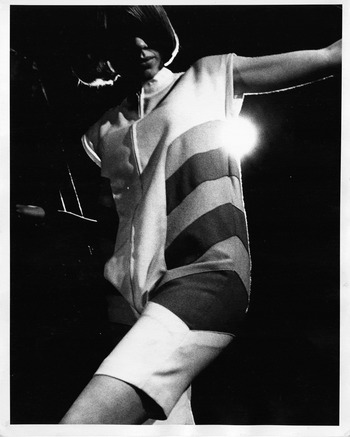
Fashion show photographs from the mid to late 1960s present more wearable and functional garments, often displaying geometric patterning (Fig. 2). Newspapers reporting on the shows feature commercial fashions and mention fabrics developed due to industry connections and success in competitions. Industry links tended to come from GSA staff.
It used to be good for a giggle, [the]…fashion show…remains excellent entertainment, but it can no longer be dismissed as a joke in mixed taste. Gone are the dresses of sacking held together by staples and splashed with last-minute patterns of poster paint. In their place appears a collection of outfits which would deserve attention in any setting.Footnote 11
Photograph of model, GSA Fashion Show 1966. Garment by Eric Masterton. Photo: Robert Burns. Courtesy of The Glasgow School of Art Archives & Collections, GSAA/P/2.

GSA's 1968/69 prospectus first mentions the annual fashion show, ‘…the culmination of many months of designing, cutting and making. The entire organization and modelling is undertaken by the students in their own time.’Footnote 12 The director and producer for the 1968 show highlighted: ‘The fashion show itself is an essential part of the practical training of students…’ which ‘…will be valuable…later [when]…starting…in the fashion world.’Footnote 13 During the 1960s the venue for the event relocated from GSA's Assembly Hall, to various venues including the Mackintosh Building, with shows in the Lecture Theatre (1963, 1967), Mackintosh Room (1965) and Museum (1968). Shows were also held at venues external to GSA including Culzean Castle (1968) and the Scottish Design Centre (1969). The 1970 show moved from March to May and used GSA's Haldane Building, a regular choice for events throughout the 1970s.
1970s Themes and Identities
This year's fashion show at the Glasgow School of Art is rather a spectacular occasion. Flashing lights in psychedelic patterns and colours are the background to space-age cloaks and tunics designed and modelled by the students.Footnote 14
Large-scale placement prints, embroidered motifs, oversized garments, robes for men and examples of costumes feature in the shows of the early 1970s. It is evident that from the mid to late 1970s the theme of the fashion shows, decided upon by the organizing student cohort (usually from the 3rd Year of a 4-year course of study), directs event design. The programme for the 1976 fashion show (held at the Third Eye Centre in March) has a graphic cover available in different colours. The 1977 programme is geometric in design and this show themed ‘Fashion Circus’, took place in the Haldane Building. Models paraded on a floor of sawdust and a gorilla costume featured:
….the scope provided by the circus theme has revealed rich reserves of innovation plus plenty of technical know-how. If it's true that fashion reflects the wearer's life and personality, then these fashions indicate that art school life, despite the stringency of grants, is full of optimism and zest.Footnote 15
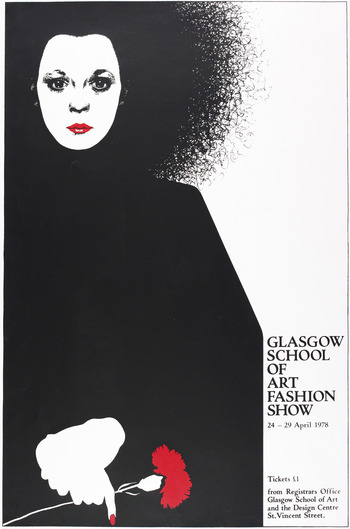
Due to recent donations, A&C now hold posters and programmes for the 1978, 1979 and 1980 fashion shows. The visual identity for each of these shows is individual and full of impact. For 1978, the graphics depict a silhouette wearing a red carnation (Fig. 3); this detail follows through to the programme, ticket and corsage worn by the show's compere. A postgraduate diploma student, John Skinner, created the bold black and white patterns for the 1979 screen-printed fabric poster, programme and catwalk back-drop for this show held in GSA's Bourdon Assembly Hall (now home to the GSA Library). The 1980s show includes graphic backdrops and exquisite bold poster and programme design, by David Band. The programmes from this period state that garments can be purchased from students via the relevant department.
GSA fashion show poster, 1978. Graphics by Colin Wilson, printed by Jack Fordy and Bob Finnie. Courtesy of The Glasgow School of Art Archives & Collections, GSAA/EPH/10.

1980s Making Statements
The 1980 fashion show is well documented through a range of materials. However, documentation of other shows from this period is lacking. Press cuttings tend to comprise photographs of models with only brief descriptions, although A&C do hold posters for the 1984–1987 shows. At this time, the first known audio-visual recording of the event is from 1982; this and other recordings (1984, 1985 and 1986) show a range of outfits from costumes to more wearable garments. Throughout this period shows appear to engage with topical, social and political themes, through performance-like presentations. For example, a model smoking, wears a dress made out of cigarette packets and for another act models dance down the catwalk to the song Free Nelson Mandela by The Specials. The 1983 show organizer explained, ‘We want to take the art school into the streets and to tell people that we do get jobs and we are worth while.’Footnote 16 Recalling a mid-80s fashion show, a GSA tutor describes a coat, hand-painted with a map of Scotland highlighting American cruise missile production in Helensburgh, coming down the catwalk as ‘…a call to arms…’ and centaurs emblazoned with ‘…four insignia of political power…’ as ‘…utterly terrifying.’Footnote 17
The majority of 1980s shows took place in the Assembly Hall, the Students Union, indicating support for the event from GSA's Students Association. Throughout the history of the fashion show the involvement of students from departments across GSA is apparent, particularly when associated with GSA's school-wide Activities Week. The collaborative nature of the event is particularly evident during the 1980s:
The main work is done by Textiles and Embroidery students, but there is hardly a department in the School whose students have not contributed. The entire organization is undertaken by the students in their own time.Footnote 18
In a 1989 newspaper article, the show organizer explained:
The students organize all aspects of the show, including the stage management, lighting and promotion…the 150 outfits on display have been designed by 80 students from various disciplines.Footnote 19
1990s Increasing Impact
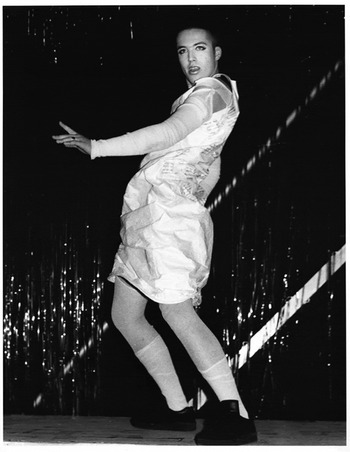
From the records reviewed to date, minimal documentation exists relating to early 1990s GSA fashion shows. This is perhaps due to the fact that these shows appear to be small scale and take place during different months from year to year. Photographs from 1994 and 1997 in the Mackintosh Lecture Theatre show plain fabric backdrops, in front of which a mix of multiple material outfits are paraded. A&C hold 3 photographs capturing a party like atmosphere of the 1995 show (fig. 4). At this time, the teaching of textiles at GSA was divided into ‘Printed & Knitted Textiles’ and ‘Embroidered & Woven Textiles’Footnote 20 . Shows were organized by printed and knitted textiles with involvement optional for embroidered and woven textiles. Within this period the design aspect of the fashion show became more integrated into the undergraduate curriculum, although many aspects of the organization remained extra-curricula.
Photograph of Calum Elliot, GSA fashion show 1995. Photo: Rathbone C.I. Media Productions 95. Courtesy of The Glasgow School of Art Archives & Collections, GSAA/P/2.

By the late 1990s, as build up to Glasgow's year as City of Architecture and Design 1999, there was a dramatic shift in terms of the scale of the show and large venues were used around the city. Themed ‘Morphogeneis’, the 1998 show held at the Tramway included 40 collections, ‘…paraded on a purpose-built catwalk…The unfettered fashion flaunt…complemented with projections of ten video works by…interior designers.’Footnote 21 In 1999 GSA's 2 textile departments were amalgamated into a single Department of Textiles combining embroidery, weave, print and knitFootnote 22 . For the fashion show of this year collaboration between GSA's departments of Textiles and Interior Design continued and the shows, which took place at the Arches were ‘…billed as…a multi-media extravaganza.’Footnote 23 GSA prospectuses of the time mention the addition of special performances for school pupils and this continues to this day.
2000s New Millennium, New Medias
At the start of the new millennium, large-scale fashion shows continued, taking place in the Fruitmarket in Glasgow's Merchant City (2000, 2001) and the Arches (2002, 2003). These shows brought in sponsorship, media attention and editorial features but were costly to produce. In an article published by the 2001 media sponsor a student explained: ‘We have to form committees in all the different departments and organize everything from publicity to getting a venue and sponsors.’Footnote 24 In order to make the event profitable, the show moved back to GSA's Assembly Hall in 2004. The fashion show ‘boutique’ was introduced to raise additional funds, for this students design and make multiple items to sell. Due to curriculum change the organizational aspects of the event became integrated into the undergraduate textile design curriculum. This is still the case today, students work in groups to organize the event as part of their work-related learning. To enhance employability, aspects of the project are delivered by GSA's Careers Service.
This recent era of shows have provided opportunities to work on live projects with external organizations and companies, or with practising designers. For example, 2006 involved collaboration with a film company to create garments for their production and for 2007 students were challenged to break away from the sameness of mass-produced fashion by repurposing garments selected from 450 bags of rag donated by Cancer Research. For the fashion show, students have created window displays, blogs, websites, appeared on local television, compiled short films, and have been recorded by a music and film company.Footnote 25 Dissemination of the event through multi-media channels has continued to increase with the rise of social media and audience recordings uploaded to sites such as YouTube.
2010s Fashion Textiles Celebrations
The organizational structure of recent fashion shows has been similar to previous years. Students apply to and work in either sponsorship and fundraising, visual identity and marketing, event design or show production. The fashion show and accompanying boutique are still fundraising activities, although now essential to support participation in graduate shows. Collaboration with other departments differs from year to year, whether working with student architects for staging and set design or communication design for graphics and posters. The Students’ Union, renamed ‘The Art School’ continues to be used as the venue for the show, although external sites were used during the development of GSA's Reid Building from 2012–2013. The introduction of undergraduate fashion design at GSA in 2010 has meant that garments by 2nd and 3rd year fashion student are shown alongside those produced by 3rd year textile students. Themes of recent shows have challenged students to consider the role fashion can play in the perpetuation of cultural stereotypes, explored issues of cultural appreciation (not appropriation), ancient cultural traditions (versus transient fashion) and non-western world dress traditions. The 2016 show addressed gender neutrality from both design and organizational perspectives.
For the 70th Anniversary fashion show (22–23 March 2017)Footnote 26 , 3rd-year fashion and textiles students selected a period between ‘1947–2017’ to research and projects are based on social or political changes; science and technology; music, fashion, film and television; art, literature and architecture. Certain students have chosen to select inspiration from GSA A&C and in particular past fashion shows. An exhibition celebrating 70 years (4–26 March 2017, Reid Building) depicted a visual historiography of the fashion show through photographs, film, ephemera and news cuttingsFootnote 27 . The exhibition private view offered an opportunity for data collection with researchers on hand to record insights provided by GSA alumni and those involved with the event over the years.
Conclusions
This article provides insight into records surrounding the GSA fashion show and an overview of the events development; this is evolving as items continue to be discovered. To date, newspaper cuttings have proved a useful source, however some of the early extracts, cut up and compiled into books have been incorrectly dated or the date is unknown. Often cuttings do not contain the full name of the newspaper, author or page numbers, and on occasion, date, making it problematic to trace the original source.
GSA prospectuses and annual reports can occasionally assist with date clarification. Papers relating to GSA's School of Design, such as minutes of meetings and boards have yet to be viewed as these records are extensive and not fully catalogued. Programmes, flyers, tickets and posters are visually rich references that give insight into fashion show theme, visual identity, organizing committees and participants. Programmes can list designers and brief descriptions of garments and this has been useful when dating certain photographs. Where photographic records exist, images can communicate the atmosphere of a show and particular era.
The 1980s audio-visual material captures ambience through music, choreography, audience sound and the ability to view garments from different perspectives, depending on the position of the filmmaker. Currently, there are gaps within the records particularly for late 1960s and early 1980s shows. This project has highlighted the necessity to keep a more purposeful record of future shows. Methods for capturing and assimilating digital material and online features from websites, blogs, Youtube and vimeo recordings, instagram, twitter and facebook feeds are required. Banerjee's study into GSA's School of Fine Art pedagogy resulted in a series of podcastsFootnote 28 capturing former staff and student insights. Oral histories surrounding the fashion show would add a further dimension to existing records.
Undertaking a project about a local event has indicated areas for further investigation. There is scope to position and discuss the GSA fashion show within the wider context of fashion, textiles and design and to examine relationships between the role of art schools in cities and connections to society through such events. Only recently has fashion become a distinct subject at GSA and for many years the fashion show existed outside of the curriculum. Today, students work beyond the project's core hours to ensure a successful event. Also, GSA's undergraduate fashion show is predominately for 3rd Years; it has never been equivalent to a presentation of graduate work but a tool for learning and teaching. Therefore, there is scope to study fashion shows as pedagogy within design curriculums and the role of extra-curricula activities as methods for professional skill development. At this time we do not know if GSA was unique in introducing the fashion show to design education in the 1940s and this would be insightful to establish. The model used for the research project presented through this article, involving collaboration between archives and libraries, alumni relations and networks, subject and discipline specific staff, to study a local event in order to scope out areas for further investigation is potentially duplicable. This could be used within GSA and art schools generally, to further connect learning, teaching and research.
Acknowledgements
Special thanks go to those who responded to the GSA fashion show call for items and information.