The natural history of patients with a complex congenital cardiac malformation associated with heterotaxy is poor and mortality remains high.Reference Driscoll, Offord, Feldt, Schaff, Puga and Danielson1–Reference Gilljam, McCrindle, Smallhorn, Williams and Freedom5. However, the outlook for patients with heterotaxy syndrome has dramatically improved over the past decade. There are many causes for these mortalities and morbidities after the stage I operation. Factors that have been associated with increased operative risk include abnormalities of the total anomalous pulmonary venous connection, atrioventricular valvar regurgitation, and a morphological right ventricle supporting the systemic circulation.Reference Humed, Feldt, Porter, Julsrud, Puga and Danielson6, Reference Culbertson, George, Day, Laks and Williams7 In addition, the sinus node and the conduction system abnormalities are found in virtually all patients with heterotaxy syndrome and may increase the risk of early or late postoperative arrhythmia.Reference Smith, Ho, Anderson, Connell, Arnold and Wilkinsion8 Many of these factors are interrelated and might form feedback loops, which serve to propagate their adverse effects on patients with heterotaxy syndrome. Atrioventricular valvar regurgitation is still a cause of high mortality.Reference Kim, Kim and Lee9, Reference Van Praagh, Santini, Sanders and Flyler10 Atrioventricular valvar regurgitation is of particular interest because it is one potential area in which surgical intervention might improve outcomes. Atrioventricular valvar regurgitation might be due to an intrinsic abnormality of valvar anatomy, or it might be due to any of the factors outlined above, such as right ventricle dysfunction or dilatation. In addition, the morphologic common atrioventricular valve is subjected to systemic pressure rather than pulmonary workloads. The purpose of this study was to determine and compare the early and late outcomes for atrioventricular valvar regurgitation in patients with heterotaxy syndrome, as well as explore the procedural and anatomic variables that may be predictive of a successful repair.
Materials and methods
A retrospective analysis was performed on all patients with heterotaxy syndrome undergoing atrioventricular valve repair. The study hypothesis was that atrioventricular valve repair is an effective means of treating atrioventricular valvar regurgitation in patients with heterotaxy syndrome. The primary endpoint was the degree of atrioventricular valvar regurgitation present at the most recent follow-up, irrespective of non-valve-related death. Atrioventricular valvar regurgitation was characterised on a 0–4 grading scale, which is similar to that commonly used for mitral regurgitation. The grading scale was defined as 0: none; 1: mild, which includes narrow regurgitant jet at the orifice, single jet; 2: mild to moderate, which icludes wider jet area at orifice, multiple jets, or both, mild atrial enlargement; 3: moderate to severe, which includes wide jet orifice, jet reaches back wall of atrium, moderate atrial enlargement; and 4: severe, which includes, wide jet orifice, jet reaches back wall of atrium, reversal of flow in the pulmonary or hepatic veins, and severe atrial enlargement. A successful outcome was defined as 0–2 atrioventricular valvar regurgitation and an unsuccessful outcome as 3–4 atrioventricular valvar regurgitation. The valvar anatomy responsible for the atrioventricular valvar regurgitation, such as leaflet prolapse or cleft formation, was noted. A single echocardiographic team in our children’s hospital reviewed all echocardiograms. Secondary aims involved comparing the groups with a successful and unsuccessful result as defined above. Variables for comparison included patient demographics, valvar anatomy, operative technique, and immediate postoperative result. The other secondary aims were to evaluate the durability of the successful repairs and to determine the survival of these patients.
Patients
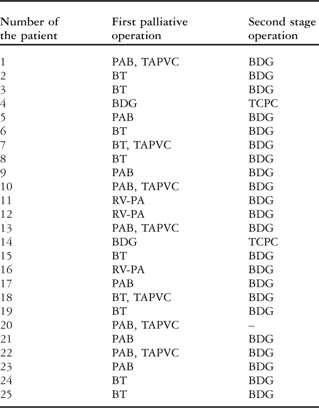
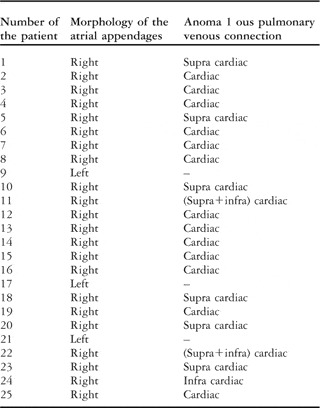
From July, 1994 to January, 2007, we performed surgery in 71 patients, out of which 52 have right isomerism and 19 left isomerism, with heterotaxy syndrome at the Shizuoka Children’s Hospital. Of these patients, 25 (35.2%) had undergone repair of the common atrioventricular valve for greater-than-moderate regurgitation, graded at greater than 2 on the sliding scale. Out of 25 patients 7 had an atrioventricular valve repair at the first palliation and 18 patients at the second stage operation (Tables 1 and 2). Patients with heterotaxy syndrome were further classified as having either a right isomerism or left isomerism base on reviews of echocardiograhic and operative findings using the criteria proposed by Anderson and colleaguesReference Uemura, Ho, Devine, Kilpatrick and Anderson11–Reference Jacobs, Anderson and Weinberg13 (Table 3). All these 25 patients were functionally univentricular hearts. The demographics recorded included the age and weight at repair, the stage of palliation, and the length of follow-up. Surgical variables included the type of repair, concomitant procedures, and operative morbidity or mortality.
The staged operation for each patient.
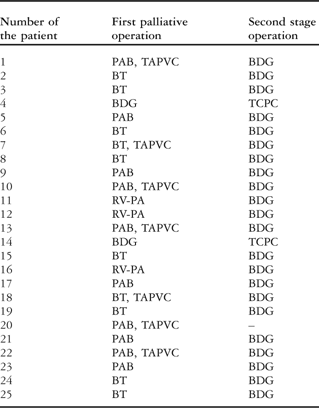
BDG, bi-directional glenn; BT, shunt; PAB, pulmonary artery banding; RV-PA ventricle-pulmonary artery conduit shunt; TAPVC, total anomalous pulmonary venous connection repair; TCPC, total cavo pulmonary connection
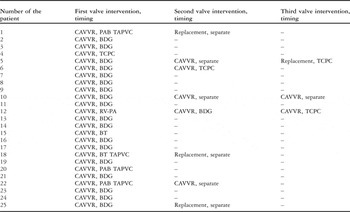
The timing of the common atrioventricular valve repair and replacement.

BDG, bi-directional glenn; BT, shunt; CAVVR, common atrioventricular valve repair; PAB, pulmonary artery banding; RV-PA, ventricle-pulmonary artery conduit shunt; TAPVC, total anomalous pulmonary venous connection repair; TCPC, total cavopulmonary connection
Findings in cardiac morphology.

Surgical techniques
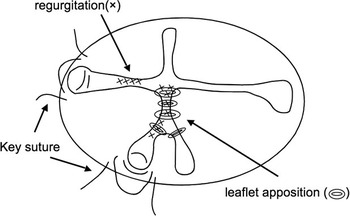
Surgical techniques were individualised to the patient’s valve pathology on the basis of the opinion of the operating surgeon. Standard methods of cardiopulmonary bypass were used, with initial examination of the common atrioventricular valve performed by filling the ventricle with saline after cardioplegic arrest of the heart. Intraoperative determination was made of locations of regurgitation, the diameter of the annulus, leaflet prolapse, and leaflet tethering. Coupled with the preoperative echocardiogram, intraoperative transesophageal echocardiogram, or both, appropriate methods of repair were then selected. Partial annuloplasty was commonly used for patients with leaflet prolapse or annular dilation with failure of coaptation of the leaflets and generalised central regurgitation. This technique involves a Kay sutureReference Kay and Egerton14 and edge-to-edge anastomosis techniques. Annuloplasty was also employed using the De Vega technique, sometimes in association with an Alfieri repair. In the leaflet apposition technique, the individual clefts or defects in the leaflets were closed primarily. Localised areas of leaflet prolapse were repaired by using the leaflet apposition suture. The adjacent leaflets or scallops were sutured to one another along the entirety of their zone of apposition, effectively reducing the number of separately mobile leaflets. When reducing the annular diameter of the univentricular heart, we reduced it to 100% of the normal diameter of the tricuspid valve (calculated from the equation by Rowlatt et alReference Rowlatt, Rimoldi and Lev15) before the Glenn operation, and 80% of normal diameter of the tricuspid valve and 80% of normal diameter of the mitral valve after the Fontan operation. Before the Fontan operation, less frequently used techniques included shortening of tendinous cords in three patients and papillotomy in two patients. The techniques were not mutually exclusive, and any individual patient may have undergone more than one method of repair (Fig 1).
Operative schema.

Results
Patients
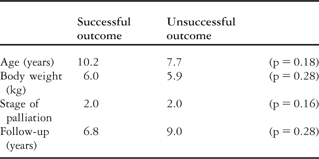
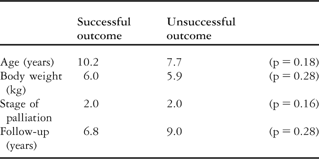
Follow-up was 100% complete. Median follow-up for the entire group was 6.2 years with a range from 0.5 to 12.7 years. The patients were subsequently classified as having successful or unsuccessful outcome on the basis of whether they had 0–2+ atrioventricular valvar regurgitation at the last follow-up, which was considered as successful, or 3–4+ atrioventricular valvar regurgitation, which was considered as unsuccessful. A successful outcome was achieved in 17 patients (67%) at a median follow-up of 6.4 years with a range from 1.4 to 13.6 years. The remaining eight patients (33%) had an unsuccessful outcome at a median follow-up of 8.7 years with a range from 3.7 to 11.0 years. Median age at repair, weight at repair, stage of palliation, and length of follow-up were found to be not significantly different between the two groups (Table 4).
No significant variables.
Repair technique
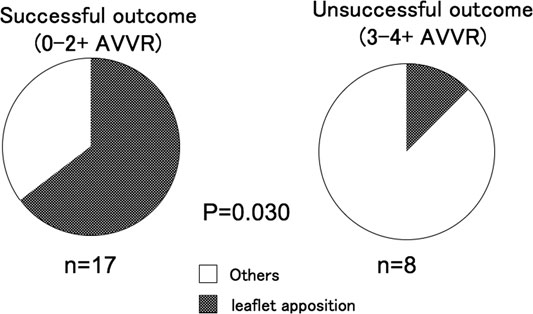
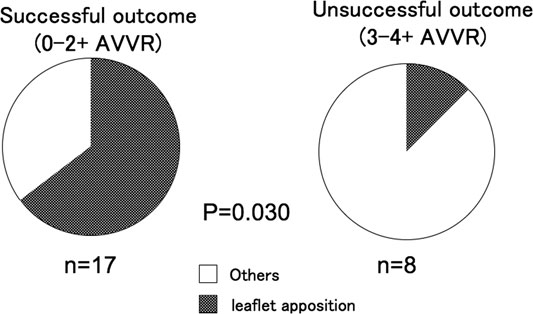
The technique of leaflet apposition for the localised areas of leaflet prolapse, used in 12 patients, was the most frequently used repair technique. A Kay suture was performed in 11 patients. De Vega annuloplasty was performed in 10 patients. The Alfieri technique was used in three patients. Chordal shortening was used in three patients and papillotomy was performed in two patients. The repair technique of leaflet apposition, when compared with any other method or combination of other methods, was significantly associated with a successful outcome, that is, achievement of 0–2+ atrioventricular valvar regurgitation, at late follow-up (p = 0.03, Fig 2).
Comparison of patients with a successful outcome and an unsuccessful outcome, revealing a significant difference between leaflet apposition technique alone or combination with other techniques and any other repair techniques (p = 0.03); AVVR: atrioventricular valve regurgitation.
Atrioventricular valvar regurgitation
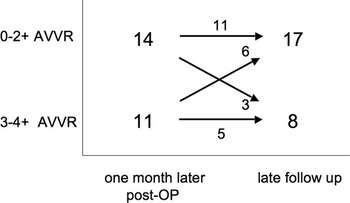
All patients had a 3–4+ atrioventricular valvar regurgitation before valve repair. After atrioventricular valve repair, 14 patients had an early successful result as defined by 0–2+ atrioventricular valvar regurgitation 1 month after surgery. Of these 14 patients, 11 maintained durable repair at late follow-up, and three had late progression to 3–4+ regurgitation. In all, 11 patients had an early unsuccessful repair, five of whom continue to have a poor result at the latest follow-up. The remaining six patients with an unsuccessful repair in the early postoperative period improved to a successful status of repair at the late follow-up (Fig 3) Of these six patients, three underwent successful re-repair of the valve and three underwent valve replacement. Two patients in whom the initial repair had achieved a successful outcome later experienced progression of valvar regurgitation and underwent subsequent re-repair of the valve. Three patients underwent a third valve intervention – one valve replacement and two valve repairs (Table 2).
Diagram of the early and late atrioventricular valve regurgitation (atrioventricular valve regugitation) after repair. The number of patients in each group and the number of patients crossing over between groups are indicated. (AVVR: Atrioventricular valve regurgitation).

Patient outcomes
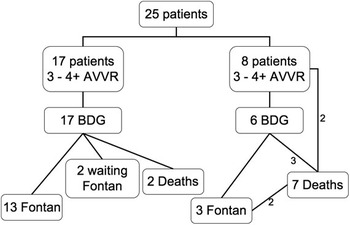
Of the 17 patients with a successful repair at late follow-up, 13 had undergone the Fontan operation (Fig 4). Among this group, there were no late deaths after the Fontan operation. Two patients were at a bi-directional Glenn stage. They are waiting for the Fontan operation and are considered to be good Fontan candidates. In all, five of the fifteen survivors have required an attempted re-repair or replacement with a mechanical valve (three patients). The remaining two patients died at an interstage. Both mortalities were not related to atrioventricular valvar regurgitation. One patient died from a pulmonary hypertension crisis, and the other died from infection.
Outcomes of the patients with successful late repair or unsuccessful late repair. (AVVR: Atrioventricular valve regurgitation, BDG: Bi-directional Glenn).

There were eight patients with an unsuccessful repair at late follow-up (Fig 4), and seven of these patients died. There were no operative mortalities. There were seven late deaths: two pulmonary venous obstruction, one flu infection, two right ventricular failure, and two PH (pulmonary hypertension) crisis, one of which had mechanical valve replacement. One of the eight patients in this group is a late survivor, who has achieved a successful Fontan procedure. This patient has had an attempted re-repair with residual 3+ atrioventricular valvar regurgitation, has normal right ventricular function, and remains in New York Heart Association class II. Overall survival for the entire cohort was 64% (16/25). For patients with a successful status of repair at the most recent follow-up, survival was 88% (15/17). In contrast, patients with 3–4+ TR (tricuspid regurgitation) at follow-up had a survival of 12%, that is, one out of eight patients, a difference that was statistically significant (p<0.01). Of the 16 late survivors, 15 are in New York Heart Association class I, and one is in New York Heart Association class II.
Discussion
The early and midterm outcomes for children with functionally univentricular hearts have markedly improved in recent years, even in patients with heterotaxy syndrome.Reference Stamm, Friehs and Duebener16 Heterotaxy syndrome, which is often associated with total anomalous pulmonary venous connection and common atrioventricular valve, has been considered a risk factor for surgical repair. In a recent report, Gaynor et alReference Gaynor, Collins, Rychik, Gaughan and Spray4 suggested that factors influencing the survival of patients with heterotaxy syndrome undergoing the Fontan procedure included greater than mild atrioventricular valvar regurgitation.
Atrioventricular valvar regurgitation is known to be a risk factor for the Fontan operation.Reference Moak and Gersony17 The natural history of common atrioventricular valvar regurgitation in patients with functionally univentricular hearts is poor. Moak and GersonyReference Moak and Gersony17 reported that atrioventricular valvar regurgitation was a significant and specific complicating factor that developed in patients with “single ventricle” and common atrioventricular valve. In a similar report of 242 patients undergoing a Fontan procedure including 99 patients with atrioventricular valvar regurgitation, Imai et alReference Imai, Takanashi, Hoshino, Terada, Aoki and Ohta18 reported a significantly higher mortality rate in children who had atrioventricular valvar regurgitation compared with those without atrioventricular valvar regurgitation, even if valve repair was attempted. It has been reported that the risk factors of the Fontan operation in this group are atrioventricular valvar regurgitation, hypoplastic pulmonary arteries, and a mean pulmonary artery pressure of greater than 15 millimetres of mercury.Reference Culbertson, George, Day, Laks and Williams7
We are committed to the belief that repair of the atrioventricular valve can be successfully accomplished in the majority of patients with the heterotaxy syndrome, even in the face of severe regurgitation. Repair can be performed as a sole procedure, or in conjunction with a stage I operation, bi-directional Glenn or Fontan procedure. If the valve leaflets are mobile and regurgitation is associated with valve prolapse, the leaflet apposition technique was found to be significantly associated with a successful late outcome. If the chordae are short, it is difficult to reduce the regurgitation and papillotomy may be helpful. Atrioventricular valve repair, particularly in the setting of heterotaxy syndrome, is the result of several complex and interrelated variables. Right ventricular function appears to be one of the variables that have an important role in the natural history of atrioventricular valvar regurgitation, especially in the heterotaxy syndrome. Patients with an early successful repair followed by late failure had more complications of pulmonary venous obstruction and pulmonary hypertension, suggesting that right ventricular dysfunction may have played an important role in the late deterioration of the atrioventricular valve. As we have shown, however, the repair of the valve can be successfully performed, and contributes to improved outcomes. Overall, the percentage of patients progressing successfully to conversion to the Fontan circulation, and overall survival following valvar repair is excellent in this high-risk subpopulation of patients with heterotaxy syndrome. Patients with an initial poor result from repair but no concomitant disease can achieve a good result with a re-repair.
This study has several limitations. It is retrospective, and the data are limited by the review of the medical records. To ensure inclusion of all patients, we reviewed multiple sources including the echocardiography and surgical databases.
In conclusion, this study shows that children having complex forms of heterotaxy syndrome, including atrioventricular valvar regurgitation, can be treated with reasonable risk for surgery. Atrioventricular valve repair can be accomplished in this challenging patient population with excellent results. If leaflet mobility is adequate, the combination of leaflet apposition technique and Kay suture can be performed with an excellent outcome in the majority of patients with heterotaxy syndrome, even with significant atrioventricular valvar regurgitation.