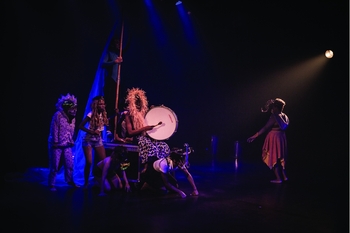
Title of show: Cidade Correria (City Rat Race)
Producing company: Coletivo Bonobando
Director/text: Adriana Schneider and Lucas Oradovschi/Coletivo Bonobando
Actors: Daniela Joyce, Hugo Bernardo, Igor da Silva, Jardila Baptista, Karla Suarez, Livia Laso, Marcelo Magano, Patrick Sonata, Thiago Rosa, Vanessa Rocha
Venue, city and date of performance reviewed: Teatro Sérgio Porto, Rio de Janeiro, 7–30 May 2016
Cidade Correria. Photographer: Maíra Barilla.

The play Cidade Correria (City Rat Race) from Rio de Janeiro is my point of departure for a study of tragedy in contemporary theatre from the perspective of decolonization. A colonial mentality blanketed the New World with a white, male, heterosexual rationality whose universalizing pretensions would usher the native peoples ‘who had no writing or history’ into ‘civilization’. Dismantling this structure today requires connecting heterogeneities and dissonances. In the theatre, narratives demolish dramatic structure, proposing unstable compositions where figures pass by charting a cartography for today. Accordingly, Cidade Correria brings those from the periphery and the favelas, who have historically been excluded from mainstream narratives, into the urban fabric.
Decolonization imposes the urgency of new subjectivities; the breaking down of hierarchies of gender, sex, religion and race; and new epistemologies that recognize non-European kinds of knowledge. The structure–superstructure duality is transformed into complex networks, overcoming the culture/economy divide.
Social movements take strength from the crowds that cannot be swayed by programmes to seize power. Aesthetic sensibility rejects classical mimesis, establishing a vision in which breaks in space discontinue time. Releases of the body without organs (Artaud) reveal reversibilities; discourse frays into actions and processes of subjectification and insubmission. In the cityscape, the crowd is a dissonant chorus, a future minority, nomos – a custom that when deterritorialized demands change and remakes ethics. The mob is uncontrollably opposed to authority.
The crowd undermines but also remakes the stage where spaces of power (monuments, institutions) house countervailing powers: whirlwinds originating in the alleyways and favelas. Cidade humorously says that it will ‘represent the periphery in Europe’. Borders between types of knowledge are dissolved with the shock of identities. In the play, yellow and black police barricade tape demarcates power breached in an attempt to re-create the city out of the rubble of ancestral shacks. Bodies are slaughtered in the restricted areas. A ballerina alludes to ‘O bebê de tarlatana rosa’ (The Baby in Rose Tarlatan), a short story by João do Rio which takes place during carnaval; a dandy plays seduction games with a woman dressed up as a baby.Footnote 2 At the peak of desire, under a prosthetic nose she reveals a missing nose. Shocked, the dandy disappears, for terror breaks the spell and makes a monstrosity of otherness.
The short story metaphorizes the ‘wondrous city’ from a century ago just as in the present day.Footnote 3 Funk and passinho pervade the soundtrack and choreography with which bodies demarcate borders (southern and northern zones of Rio, favelas).Footnote 4 Carnaval is a celebration of incompleteness. Between the mask and the face, the faceless population stands out. The city, built on blood, transmutes the scream of terror at the daily cascade of bullets into wonder; it demolishes walls built against civilization's ‘other’ (poor; resident of a ‘favela within the favela’). To be black or white is to be geographically marked: ‘I'm white, but I'm from Sampaio [favela]’; the antithesis equalizes the traits; are black people blacker because they live in Sampaio? Are white people more white for the same reason?
Civilizing missions with a rhetoric of salvation in opposition to ‘barbarism’ have always been anchored in political–military strength. Cidade Correria battles Eurocentric fortresses. Types of knowledge intensify, appropriating the forces of domination and causing them to double back on themselves. Tensions, movements, sonorities throb, amalgams of reality in whose interstices fictions gleam. Carnaval (via sacra of splendour and horror) emerges from daily life to make fun of ugliness, as in the work of the author João do Rio. Monstrosity is to deny seeing, or making oneself invisible; not receiving whatever escapes from the hegemonic norm. Excesses catalyse fears and a fascination with the prodigious. An Afro-Brazilian god with rainbow skirts dances to celebrate the world's diversity.
Oswald de Andrade and anthropophagy return to myths of origin in order to promote clashes between dominators and dominated. The black, native and white body of Mário de Andrade's novel Macunaíma arises from rejections and spells.Footnote 5 In opposition to the Romantics, the modernist cause was the legitimization of the ‘savage's logic’ in combination with techno-industrial logic. Oswald states, ‘We were never catechized. What we made was carnaval’.Footnote 6 Macunaíma pretends to adopt the masks of the other, to mock them. Revisiting the Andrades is encouraged in order to reprocess the devourings in postmodern terms.
Cidade Correria celebrates the joy of being the other's other. We have always been hybrids, monsters, retrogrades of excellence. Padre Anchieta's moralizing devil is a perversion of the popular medieval guffaw.Footnote 7 But he is present now, in an episteme created from the encounter with poesis.