1 Introduction
The adaptations of loanwords have long been a source of insights into the workings of phonology at the intersection of two or more language systems (e.g. Hyman Reference Hyman1970, Silverman Reference Silverman1992, Davidson Reference Davidson2007). In this study, we investigate the repair strategies employed to adapt Arabic and Dutch loanwords to the more restrictive set of phonotactics in Indonesian. A set of Arabic and Dutch loanwords containing initial and final consonant clusters was elicited from 24 participants and analyzed for syllabic repairs, such as consonant deletion and vowel epenthesis (Batais Reference Batais2013). We find that speakers use both deletion and epenthesis to modify words to fit the phonotactics of Indonesian. These phonotactics include not only a ban on complex onsets and codas, clearly evident in the native vocabulary, but also a minimal word-size constraint and a preference for sonority to fall across syllable boundaries, which are violable. However, additional data on borrowed monosyllabic words (Jones Reference Jones2008) raise a problem for an Optimality Theory approach using strict domination in constraint ranking, as a subminimal word without a complex margin does not trigger epenthesis. We use these data to support a Harmonic Grammar approach in which constraints have weighted values, allowing lower weighted constraints to ‘gang up’ and overrule higher constraints (e.g. Smolensky & Legendre Reference Smolensky and Legendre2006, Pater, Bhatt & Potts Reference Pater, Bhatt and Potts2007, Pater Reference Pater2009).
Furthermore, we note that the syllabic repairs are guided by phonology. For example, by virtue of Indonesian’s bisyllabic minimality preference coupled with its restriction against complex codas, word-initial and word-final clusters of monosyllabic inputs are targeted by vowel epenthesis (e.g. Arabic /fikr/ ‘to think’ becomes Indonesian [pikir]), whereas consonant clusters of polysyllabic inputs are simplified by consonantal deletion if they are word-final (e.g. Dutch /vərbɑnd/ ‘bandage’ becomes Indonesian [pərban]) or remain unadapted if they are word-initial (e.g. Dutch /sxɑndal/ ‘scandal’ becomes Indonesian [skandal]). Moreover, the location of the epenthetic vowel (medial epenthesis vs. edge epenthesis) in word-final clusters is determined by their sonority (i.e. Murray & Vennemann’s (Reference Murray and Vennemann1983) syllable contact constraint). These findings support the phonological stance that loanword adaptation is phonologically guided (Itô & Mester Reference Itô, Mester and Goldsmith1995, Reference Itô, Mester and Tsujimura1999; Paradis & LaCharité Reference Paradis and LaCharité1997, Reference Paradis and LaCharité2001, Reference Paradis and LaCharité2002, Reference Paradis and LaCharité2005, Reference Paradis and LaCharité2008; Uffmann Reference Uffmann2006; Paradis & Tremblay Reference Paradis and Tremblay2009), not purely phonetically/perceptually motivated (as in e.g. Peperkamp & Dupoux Reference Peperkamp and Dupoux2003, Peperkamp Reference Peperkamp2005, Peperkamp, Vendelin & Nakamura Reference Peperkamp, Vendelin and Nakamura2008).
Our study aims to contribute to research on loanword phonology in several ways. First, we contribute to the area of Indonesian loanword phonology, which is relatively poorly studied despite extensive borrowing in the language. Second, we cast our analysis in terms of a phonological framework and argue against a purely perceptual approach to borrowing. Finally, our phonological analysis provides an example in support of a constraint-based grammar in which constraints are allowed to join forces, rather than having strict domination relationships.
The remainder of the paper is organized as follows: Section 2 provides background on the different theoretical frameworks for loanword adaptation, the interactions of Modern Standard Arabic, Standard Dutch, and Standard Indonesian, and the syllable inventories of each language. Section 3 describes the data collection method, a profile summary of the study participants, and the source syllabic structures to be adapted. Section 4 reports the key results, while Section 5 provides a standard Optimality Theoretic analysis and motivates the need for a Harmonic Grammar approach. The final section relates the analysis to the models of loanword adaptation.
2 Background
This section provides a summary of major views concerning loanword adaptation, followed by a brief history of the introduction of Arabic and Dutch into Indonesia, and concluding with descriptions of permissible syllable structures in Modern Standard Arabic, Dutch, and Indonesian.
2.1 Theoretical approaches to loanword adaptation
Ever since Hyman’s (Reference Hyman1970) traditional phonological rule-based analysis of the loanword adaptation processes, a range of views have arisen concerning how adaptation is accomplished. One extreme holds that adaptation occurs during production only and that perception plays a minimal, or no, role in loanword adaptation, as argued by Itô & Mester (Reference Itô, Mester and Goldsmith1995, Reference Itô, Mester and Tsujimura1999), Paradis & LaCharité (Reference Paradis and LaCharité1997, Reference Paradis and LaCharité2001, Reference Paradis and LaCharité2002, Reference Paradis and LaCharité2005, Reference Paradis and LaCharité2008), Uffmann (Reference Uffmann2006), and Paradis & Tremblay (Reference Paradis and Tremblay2009). Accordingly, loanword adaptation is purely phonological and is done by bilingual speakers (i.e. main adapters). This means that the speakers can access the phonological structure of the source language; consequently, the source phonological representation, not the phonetic output, is mapped directly onto a native representation (L1 input) via the phonological system. At the opposite extreme, a purely perceptual position argues that the loanword adaptation takes place in perception and is susceptible to the phonetics of the source input, that borrowing speakers have no knowledge of the borrowing language, and that the input to perception is merely a superficial acoustic signal. In this view, loanword adaptation is not defined by phonology at all (Peperkamp & Dupoux Reference Peperkamp and Dupoux2002, Reference Peperkamp and Dupoux2003; Peperkamp Reference Peperkamp2005; Vendelin & Peperkamp Reference Vendelin and Peperkamp2006; Davidson Reference Davidson2007; Peperkamp et al. Reference Peperkamp, Vendelin and Nakamura2008).
Other approaches allow a mixture of phonological and phonetic processing. One such model holds that loanword adaptation occurs at two distinct and ordered tiers (hence, multi-scansion), namely, Perceptual Level/perception grammar and Operative Level/production grammar (Silverman Reference Silverman1992, Yip Reference Yip1993, Kenstowicz Reference Kenstowicz2003, Broselow Reference Broselow2004). A fourth approach incorporates perception (perceptual similarity) into the production grammar (Steriade Reference Steriade2001; Yip Reference Yip2002, Reference Yip2006; Kang Reference Kang2003, Reference Kang2010; Adler Reference Adler2006; Kenstowicz & Suchato Reference Kenstowicz and Suchato2006; Kenstowicz Reference Kenstowicz2007; H. Kim Reference Kim2008, Reference Kim2009; Kenstowicz & Louriz Reference Kenstowicz and Louriz2009; K. Kim Reference Kim2009). Finally, a fifth approach is known as the phonological perception approach, according to which speech perception is phonological, because it is guided by structural constraints (Boersma & Hamann Reference Boersma and Hamann2009).
Thus major questions remain as to whether phonology is involved in loanword adaptation at all, and if so, at what point in the process. We focus on arguing that, in answer to the first question, phonology does play a role in determining the location and type of change from the source language; our argument is based on Indonesian adaptations of Arabic and Dutch loanwords.
2.2 Contact and loans
Loanwords constitute about 34% of the Indonesian vocabulary (Tadmor Reference Tadmor, Haspelmath and Tadmor2009), owing to prior contacts between the Malay language and foreign languages such as Sanskrit, Arabic, Dutch, etc., as well as indigenous languages such as Javanese. Dutch and Arabic together contribute about 12% of the vocabulary, or about one-third of the loanwords in Indonesian.
Historians have documented the arrival of Arab traders in the seventh century, and over the following ten centuries or so, a growing number settled, engaged in exogamy, and spread Islam (e.g. Tjandrasasmita Reference Tjandrasasmita, Soebadio and du Marchie Sarvaas1978, Ricklefs Reference Ricklefs1981, Mandal Reference Mandal1994, Clarence-Smith Reference Clarence-Smith1997, Othman Reference Othman1997, Jacobsen Reference Jacobsen2009). Loanwords from Arabic notably abound in domains associated with Islam, as well as domains of literature, scholarship, and daily vocabulary. Examples of Arabic loanwords in Indonesian are paham ‘to understand’, pikir ‘to think’, ikhlas ‘sincere’, sabar ‘patience’, awal ‘early’, hewan ‘animal’, Senin ‘Monday’, Selasa ‘Tuesday’, zakat ‘tithe’, ibadah ‘worshipping’, khitan ‘circumcision’, majalah ‘magazine’, makalah ‘article’, kamus ‘dictionary’, ilmu ‘science’, kimia ‘chemistry’, and filsafat ‘philosphy’,
The Dutch arrived later, by the close of the sixteenth century, and stayed for about 350 years (e.g. Legge Reference Legge1965, Abdurachman Reference Abdurachman, Soebadio and du Marchie Sarvaas1978, Ricklefs Reference Ricklefs1981, Sneddon Reference Sneddon2003, Wiarda Reference Wiarda2007). The Dutch in general had fewer interactions with the locals, but their language did acquire prestige in the twentieth century as a door to success and educational opportunities overseas, and words from Dutch were appropriated especially in scientific and technological fields. Examples of Dutch borrowings in Indonesian are kantor ‘office’, kol ‘cabbage’, kopi ‘coffee’, helm ‘helmet’, Maret ‘March’, Desember ‘December’, listrik ‘electricity’, mobil ‘car’, pabrik ‘factory’, setrum ‘current (electricity)’, rem ‘brake’, salep ‘ointment’, suster ‘nurse’, and televisi ‘television’. Borrowing from each language was initiated by bilingual speakers who had access to the phonology of the source Arabic or Dutch.
2.3 Syllable phonotactics
A comparison of the syllable phonotactics of Arabic, Dutch, and Indonesian reveals significant differences. In Modern Standard Arabic (MSA),Footnote [2] all syllables require a consonantal onset, while a coda consonant is optional (e.g. Al-Ani Reference Al-Ani1970, McCarthy Reference McCarthy1979, Abu-Salim Reference Abu-Salim1982, El Azzabi Reference El Azzabi and Fatihi2001). Both onset and coda are limited to a single consonant word-internally, giving a syllable template of CV(V/C), although consonant clusters are allowed word-finally after a short vowel in MSA (CVCC). Examples include [sir] (CVC) ‘secret’, [tiin] (CVVC ‘fig’, [sʕabr] (CVCC) ‘patience’, [fi] (CV) ‘in’, [ka.ram] (CV.CVC) ‘generosity’, and [jaq.tʕiːn] (CVC.CVVC) ‘pumpkin’.
In Standard Dutch (referred to as Algemeen Beschaafd Nederlands ‘General Civilized Dutch’, ABNFootnote
[3]
), the maximal ABN syllable is C
 $_{0}^{3}$
VC
 $_{0}^{4}$
. That is, the onset can hold from zero to three consonants, and if there are three consonants, the first must be /s/, whereas the coda can include from zero to four consonants. The onset and coda clusters generally conform with sonority sequencing constraints, with exceptions where /s/ is part of the cluster (Trommelen Reference Trommelen1983: 62; Booij Reference Booij1995; Waals Reference Waals1999). The possible ABN syllable structures can be illustrated by the following: [ɛi] (V) ‘egg’, [la] (CV) ‘drawer’, [ɔm] (VC) ‘about’, [ʒɛm] (CVC) ‘marmalade’, [krɑx] (CCVC) ‘crash’, [kɔrt] (CVCC) ‘short’, [sxʌlt] (CCVCC) ‘debt’, [stroːm] (CCCVC) ‘stream’, and [ɪŋkt] (VCCC) ‘ink’.
By contrast, Standard Indonesian has a much simpler syllable structure in its native lexical items. Both onsets and codas are optional, and each is limited to a single consonant, so that the maximum syllable template in native Indonesian words is (C)V(C). The maximum sequence of consonants allowed is therefore CC, and that only word-internally. In native lexical items in Indonesian, a syllable can be closed only by one of the following consonants: /p t k ʔ s h r l y m n ŋ/ (Macdonald Reference Macdonald1976: 19). With the introduction of many foreign borrowings in Indonesian, some native syllabic constraints on the onsets are relaxed in borrowings, as will be discussed; however, constraints against final consonant clusters are uniformly adhered to. While native Indonesian words can be of any size, only a small number are monosyllabic. According to Lapoliwa (Reference Lapoliwa1981), bisyllabic lexical items are the most frequent, followed second by polysyllabic words, and lastly by the monosyllabic lexical items (e.g. jam ‘hour’, di ‘in’, dan ‘and’). In the small data set Lapoliwa presents from Bahasa Indonesian lexical stems (n
 $=$
202), he finds 93.1% bisyllabic, 6.4% trisyllabic, and 0.5% monosyllabic. Of all bisyllabic structures, CVCVC is the most common.
3 Methodology
3.1 Participants
The original aim was to examine any changes to Arabic and Dutch loanwords by native speakers of Indonesian. These loanwords, originally imported by bilinguals, are now established in modern Indonesian and familiar to monolinguals. In order to obtain accurate and detailed data on the current pronunciation of such words, 24 monolingual speakers of Indonesian were recruited, ranging from 17 to 41 years old, and balanced for sex, age (Teenager vs. Adult) and language(s) spoken by their parents (Indonesian vs. Regional). As these factors did not affect their repairs of syllables, they will not be further discussed. The speaker set was chosen to rule out effects of higher education or work that might involve contact with or proficiency in other languages. All twelve teenagers were high school students, while the adults held a high school diploma only and worked unskilled jobs or were unemployed. Furthermore, all of the participants were born, raised, and lived in Jakarta, the capital city of the Republic of Indonesia. Much of Jakarta’s population speaks only Indonesian; in other major Indonesian cities, most inhabitants speak one or more regional languages in addition to Indonesian.
None of the participants were ever heavily exposed to Arabic, Dutch, or even English and hence cannot speak them, nor could their parents.Footnote [4]
3.2 Elicitation
The targeted Arabic and Dutch loanwords were drawn from two sources. The first is a list of loanwords which the first author had gathered since 2004, by noting the types of loanwords Indonesians commonly use. The second source is Jones’ (Reference Jones2008) Loanwords in Indonesian and Malay, a comprehensive etymological dictionary of words borrowed from various source languages into Indonesian and Malay. The total number of loanwords collected was 111, of which 59 were Arabic loanwords and 52 were Dutch loanwords. (See Appendix for a complete list of elicited loanwords.) Of these, 15 Arabic and 16 Dutch loanwords ended with clusters, and 20 Dutch loanwords began with clusters; these are the words analyzed here. All of the Arabic and Dutch loanwords selected are well-established lexical items in Indonesian. To verify this, before embarking on the study, the first author presented the selected list of loanwords in writing to four Indonesian adults (non-participants) who speak Indonesian as a first language, live in the Jakarta area, and hold a high school diploma. All confirmed that the selected words were quite familiar to them, the majority being common nouns.
Each of the 111 loanwords was elicited once from each of the 24 participant speakers. Each participant was individually interviewed by a 32-year old female native speaker of Indonesian, while the first author was an observer and made recordings using a digital recorder (Marantz PMD660). The interviewer elicited from each participant the list of 111 words through tasks such as fill-in-the-blanks, and only the pronunciation of each target loanword was digitally recorded. If the participant failed to guess and hence pronounce the word, the interviewer would pronounce it and ask the participant whether s/he was familiar with the word. If so, the participant was asked to pronounce it. Loanwords thus pronounced were recorded, although marked to differentiate them from the words which were spontaneously pronounced. Participants were not asked to pronounce words they described as unfamiliar. The loanwords were transcribed by the first author after all recordings were completed.
3.3 Target consonant clusters
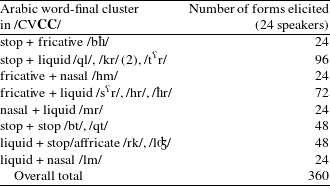
The target forms have syllable-initial and/or syllable-final consonant clusters, and, for analysis, were divided according to the source languages, MSA or ABN. The target Arabic forms are all word-final since MSA permits word-final clusters only. As illustrated in Table 1, the total number of the target Arabic forms we collected, using 15 words with final consonant clusters and 24 speakers, is 360, as all forms were produced by all speakers.
Targeted Arabic word-final consonant clusters.

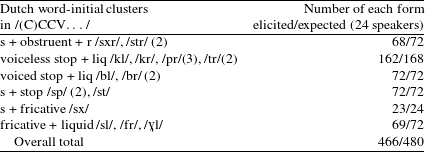
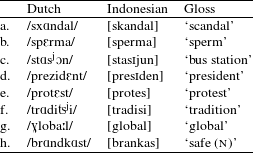
As Dutch allows consonant clusters in both word/syllable-initial and word/syllable-final positions, we used target forms with clusters in each position. As a result, we have more Dutch forms in the data than Arabic, even though not every word was produced by every speaker, unlike the Arabic targets. For word-initial clusters, provided in Table 2, there were fifteen types, with four occurring more than once, for a total of twenty words.
Targeted Dutch word-initial consonant clusters.

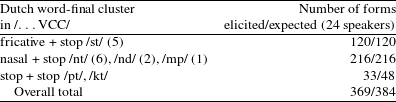
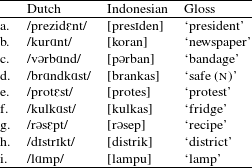
There are three basic types of word-final clusters, all ending in stops, but preceded by a fricative, nasal, or another stop, as shown in Table 3. Again, some words with stop + stop clusters word-finally in Dutch were unfamiliar to the speakers, so that not all sixteen words were produced by all speakers.
Targeted Dutch word-final consonant clusters.

4 Results
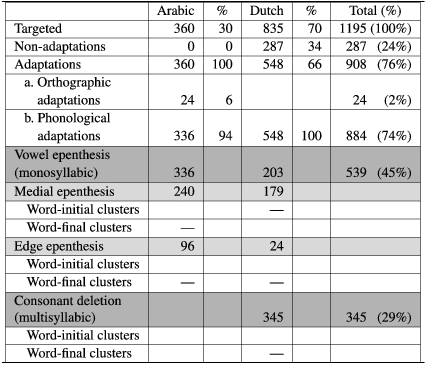
Generally, each non-native syllabic form was consistently mapped onto a single form in Indonesian; that is, the 24 speakers produced the same output, as far as syllable structure is concerned, for each target.Footnote [5] As shown in Table 4, nearly three-quarters of the 1195 forms are repaired to conform with the Indonesian phonotactic constraints. Arabic final clusters are always repaired, while two-thirds of the Dutch clusters were simplified and one-third remain unchanged (‘non-adapted’) in Indonesian. The unchanged clusters all appear in onsets of polysyllabic targets.
Overall results of adaptations. (Dark grey marks the two repair strategies; light grey marks the two locations of the epenthetic vowels)

In the analyses to follow, the goal is to account for the changes from the Arabic and Dutch original forms to the current Indonesian forms. As the current monolinguals have been exposed only to the already adapted forms, it is likely that their underlying forms now match their surface forms rather than the original foreign sources. The analysis below focuses on the initial stage of borrowing, when foreign forms had to be adapted to meet Indonesian requirements.
4.1 Arabic loanwords
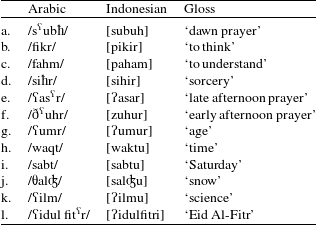
All the MSA illicit consonant clusters in the data are word-final clusters, and each Arabic cluster is consistently simplified into well-formed syllables in Indonesian. Vowel insertion is the only strategy used to rescue Arabic word-final clusters, although we note that the source forms are all monosyllables. There are two potential locations for the epenthesis, and each is used in a distinct subset of words, as can be seen in Table 5. When the word-final cluster had a rise in sonority between the two consonants, as in two-thirds of the cases (a–g), the vowel of the source was copied and inserted between the two consonants. For the remaining cases, in which the final consonants had equal or falling sonority (h–k), the vowel /u/ was epenthesized after the cluster.Footnote [6] The final example also has final vowel insertion; however, the epenthetic vowel is /i/, not /u/. We consider this /i/ to be an effect of the source orthography and do not analyze it further here.Footnote [7] To summarize, vowel insertion is the only strategy employed to rescue Arabic word-final clusters in monosyllabic words.
Final clusters in Arabic loanwords in Indonesian.

4.2 Dutch loanwords
For Dutch loans, we have consonant clusters in both initial and final positions, and in both monosyllables and polysyllabic words.Footnote [8] For both types of clusters, we find epenthesis in monosyllables. In words that have two or more syllables in Dutch, the borrowed Indonesian forms treat initial and final clusters differently: initial clusters are tolerated unchanged, while final clusters lose a consonant.
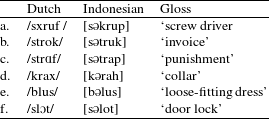
First, in onset clusters in monosyllables, we always find epenthesis between the initial and second consonant in the cluster, as in Table 6.Footnote
[9]
This epenthetic schwa in the Dutch monosyllabic loanwords examined in the data is uniformly spelled with
 ${<}$
e
 ${>}$
in the Indonesian orthography, indicating that it is likely part of the phonemic representations of these words. In polysyllables with initial clusters, however, the consonant cluster remains unchanged (Table 7).
Initial clusters in Dutch monosyllables.

Initial clusters in Dutch polysyllables.

In word-final clusters of Arabic monosyllables, we saw epenthesis, and this also appears in the one Dutch monosyllable with a final cluster (see Table 8(i)). However, in the polysyllables of Table 8, the final consonant of a cluster is deleted instead.
Final clusters in Dutch polysyllables and monosyllables.

To summarize, we found epenthesis in two cases: word-final and word-initial clusters, both in monosyllabic words only. In polysyllabic words, word-final clusters are repaired by deletion, while word-initial clusters are tolerated unchanged.
5 Analysis in Optimality Theory
We begin (in Section 5.1) by providing an account for our data which involve consonant clusters in the source forms, using a standard Optimality Theory (OT) approach and determining the factors involved in the choice of optimal outputs. We will then (in Section 5.2) examine monosyllabic borrowings without clusters in the source language, and find that no compatible ranking can be determined within standard OT to handle the data in both sections. We then propose to resolve the apparent incompatibility using a Harmonic Grammar analysis, which allows constraints to ‘gang up’ through weighting rather than strict domination.
5.1 Standard Optimality Theory account of cluster data
The data we collected reveal the importance of both bisyllabic word-size and consonant clusters, leading to epenthesis in monosyllables vs. deletion in polysyllables for final clusters, and epenthesis in monosyllables vs. toleration in polysyllables for initial clusters. To address these factors in standard Optimality Theory (Prince & Smolensky Reference Prince and Smolensky1993), we require two common markedness constraints:

Given that epenthesis and deletion both result when the target input violates the constraints in (1), we need to rank these constraints with respect to the correspondence constraints in (2):

As shown in the tableaux in (3), the ranking of MinWord above Dep-IO(V) motivates epenthesis as a resolution to words that are too small.

*Complex constraint violations, whether in onset or coda, are resolved by this epenthesis in monosyllabic forms, but the lack of epenthesis in polysyllabic words reveals that *Complex alone cannot motivate violations of Dep-IO(V), as in (4).

In polysyllabic Dutch words, when MinWord is not at stake, we find instead that clusters in codas are resolved by deletion as below in the winning candidate in (5), [pərban], satisfying *Complex Coda but violating Max-IO(C). Clusters in onsets are tolerated, as below in the winning candidate in (6), [skandal], satisfying Max-IO(C), but violating *Complex Onset .


Therefore, with MinWord ranked above Dep-IO(V) to ensure epenthesis in monosyllables, we need not rank either of the *Complex constraints higher than Dep-IO(V). We know that Max-IO(C) must rank between *Complex Coda and *Complex Onset , to trigger deletion in coda but not onset clusters, but we cannot determine a ranking between MinWord and *Complex Coda . In order to linearize the ranking for illustration in tableaux, we use the compatible overall ranking as in (7):

The tableau in (8) illustrates that this ranking prefers epenthesis to resolve a final consonant cluster in a monosyllable, while a bisyllabic input is resolved with deletion by the same ranking in Tableau (9), as MinWord is not at issue. However, the constraint set is incomplete, as it cannot decide between the two tied winners (8b) and (8c).

When epenthesis occurs, the epenthetic vowel interrupts a cluster in which there is a sonority rise, while appearing after a cluster in which sonority falls. Using lower sonority /k/ and higher sonority /r/ to illustrate, and with ‘.’ to indicate syllable boundaries, we see that the epenthetic vowel is preferred cluster-internally in /kr/
 $\rightarrow$
[.kVr.] (compare *[k.rV.]) and cluster-finally in /rk/
 $\rightarrow$
[r.kV] (compare *[.rVk.]). In the latter case, the second consonant begins a new syllable with the epenthetic vowel ([.kV], and the output form has a syllable boundary between the consonants in the cluster ([r.k]). This output is avoided in the first case (*[k.rV]) in favor of an output in which the epenthetic vowel appears between two segments that are contiguous in the input ([kVr]). The location of epenthesis follows from a markedness constraint that prefers falling sonority across syllable boundaries, which finds [r.k] acceptable but [k.r] objectionable; we will call this constraint SylCont,Footnote
[10]
and rank it above a faithfulness constraint that penalizes interrupting material that is adjacent in input, Contiguity-IO.

In clusters where the syllable contact constraint is not violated, as in a cluster [nd], it is left to Contiguity-IO to choose the output based on a preference for not interrupting the underlying material.
The relative ranking of these two constraints (SylCont above Contiguity-IO) is clear, and for the borrowing data the two could rank anywhere in the hierarchy in (7) above, as these two constraints work to break a tie and determine the location of epenthesis, when epenthesis is required. However, in medial clusters in native Indonesian words, such as coblos ‘pierce’, goblok ‘stupid’, and cakram ‘disc’, SylCont does not trigger epenthesis or deletion in any cluster with rising sonority, so that it ranks at least below Dep-IO(V) and Max-IO(C).
The overall ranking, illustrated in the tableaux in (11) and (12), provides for epenthesis to fix monosyllables with clusters in onsets or codas, and the location of epenthesis furthermore improves syllable contact.

The examples show that monosyllabic forms that cannot be imported faithfully (candidates (11a), (12a)), nor improved by deletion (candidates (11d), (12d)), are improved by epenthesis, with the location of epenthesis determined by the ranking between syllable contact and contiguity, preferring (11b), (12b) over (11c), (12c).
In (12), with a cluster in the onset rather than the coda, low ranking *Complex Onset is improved in (12b). However, it is MinWord that results in epenthesis, as demonstrated by polysyllabic forms, where coda clusters are repaired by deletion while onset clusters are tolerated. In both cases, MinWord cannot force epenthesis, so lower ranked Max-IO(C) and *Complex Onset are violated (in Tableaux (13) and (14)). Tableau (14) shows a bisyllabic form with clusters at each end, justifying the ranking *Complex Onset below Max-IO(C) and *Complex coda above it: complex onsets are tolerated, while complex codas are simplified by deletion.

It is always the final consonant which is deleted from a cluster, and in the data here, that final consonant is a /t/ or a /d/. Technically we can rule out candidates which preserve the final consonant at the expense of the previous one using our Contiguity-IO constraint, although preferring to keep the [s] from /st/ or the [n] from /nd/ can also be accounted for by a perceptual similarity or P-Map approach (Steriade Reference Steriade2001). We leave that aspect of the analysis for future research.
In (15), we summarize the crucial rankings of the analysis thus far, with a Hasse diagram to illustrate.

5.2 Harmonic Grammar analysis for all the data
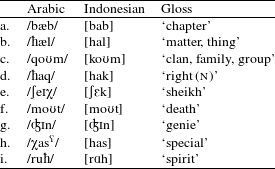
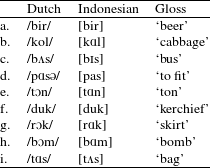
While this analysis works beautifully for the words with clusters borrowed into Indonesian (i.e. the data gathered for our study), an incompatibility arises when we consider previously existing descriptions of both Indonesian native words and borrowed monosyllables that lack clusters in the source language. First, despite the apparent importance of the MinWord requirement, there are exceptions in the native vocabulary, with approximately 1% of Indonesian vocabulary being monosyllabic ([jam] ‘hour’ and [mas] ‘a term of address’), without epenthesis. Second, in borrowed monosyllabic words which do not contain any onset or coda clusters in the source language, we find no epenthetic vowel in their Indonesian counterpart despite their subminimal size. Arabic and Dutch examples from Jones (Reference Jones2008) are provided in Tables 9 and 10, respectively.
Monosyllable Arabic borrowings without CC# (Jones Reference Jones2008).

Monosyllable Dutch borrowings without #CC or CC# (Jones Reference Jones2008).

The existence of such words calls into question the ranking of MinWord above Dep-IO(V), which predicts epenthesis here, just as in words with clusters, as shown in the tableaux in (16).

However, a ranking which accounts for these monosyllabic cases by ranking Dep-IO(V) over MinWord would then make the wrong predictions for monosyllabic cases with clusters, as shown by outcomes in (17).

We have previously shown that clusters alone could not uniformly lead to epenthesis without the involvement of MinWord, as polysyllabic forms did not choose epenthesis as optimal. Thus a consistent ranking cannot be found for all the data. The monosyllabic forms without clusters and without epenthesis show that MinWord alone is not sufficient to cause epenthesis; the added motivation of a cluster in the source form is required.
We cannot capture this intuition in standard Optimality Theory, in which a strict domination approach cannot paradoxically rank MinWord both above and below Dep-IO(V). MinWord is unable to be sensitive to the presence of clusters, as *Complex Coda and *Complex Onset are too low ranked. In the model of Harmonic Grammar, on the other hand, each constraint has a weight, and the harmony of a given candidate is the sum of the weighted violations (Pater et al. Reference Pater, Bhatt and Potts2007, Pater Reference Pater2009, Potts et al. Reference Potts, Pater, Jesney, Bhatt and Becker2010). Constraints that have a lower weight can still contribute to the evaluation of a candidate, which allows constraints to gang up: constraints that are individually weighted lower can together overrule a more heavily weighted. In the case at hand, while MinWord is not strong enough to force epenthesis in the absence of a cluster, a MinWord violation in combination with the weight of a violation of *Complex Coda or *Complex Onset can force a violation of Dep-IO(V).
In Harmonic Grammar, each candidate gets a numerical violation score to be compared with other candidates. With each constraint (Ck) associated with a weight (wk), a candidate’s violation score is the number of violations of each constraint (sk) multiplied by the weight (sk) and summed, as in the equation in (18). The sum closest to zero indicates the optimal form.

The computer program OT-Help (Becker, Pater & Potts Reference Becker, Pater and Potts2007) was used to determine whether standard Optimality Theory and Harmonic Grammar analyses were available; if so, the program would provide rankings and/or weights consistent with an input set of data, their outputs, and the relevant constraints and their violations. Taking as input the Indonesian borrowings, both those with clusters and those without, with candidates and their violations of the above constraints, OT-Help reported that no strict dominance Optimality Theory grammar could be found. However, it generated a Harmonic Grammar set of weightings for the constraints MinWord, Dep-IO(V), Max-IO(C), *Complex Coda and *Complex Onset . These weightings are listed above each constraint in (19).

To illustrate the gang effect of the weighting (Pater Reference Pater2009), we first consider two simple cases. The weighting for Dep-IO(V) is higher than that of MinWord, correctly resulting in no epenthesis for monosyllabic words that lack clusters in (20).

The weighting for Dep-IO(V) is also higher than that of *Complex Onset , resulting in no epenthesis in polysyllabic words that have a complex onset, as in (21).

However, when a MinWord violation is combined with a violation of *Complex Onset (or *Complex Coda ), as in (22), Dep-IO(V) is outweighed and a candidate with epenthesis is preferred.

Thus violations of two lighter constraints can gang up to outweigh a single constraint with a greater weight.
This full set of weightings is illustrated below, for all the types of data. In the tableau in (23), a monosyllable with final cluster is repaired by epenthesis.

Candidates (23a) and (23c) each violate two constraints, whose summed weight is higher than the most harmonic candidate, (23b).
As seen in (24) below, a monosyllable with an initial cluster is likewise fixed by epenthesis, because a *Complex Onset violation plus a MinWord violation is worse than a Dep-IO(V) violation; note that deletion, with a Max-IO(C) plus MinWord violation, is also unsuccessful.

In the polysyllabic case with a cluster at each end, shown in (25), we see that no combination of other constraints is enough to trigger epenthesis; final deletion and initial complex onsets result in the most harmonic candidate, (25b).

The preceding tables showed cases which standard Optimality Theory could handle with a single ranking, but that ranking would not be consistent with the ranking needed for monosyllables without clusters and without epenthesis. The Harmonic Grammar weighting can account for all cases with a consistent weighting. In the absence of any cluster violation, MinWord alone does not trigger epenthesis, so the faithful candidate is the optimal one in (26).

6 Discussion and conclusion
Within the field of loanword phonology, a prolific literature has greatly contributed both empirical evidence and theoretical developments to the debate as to what linguistic framework best accounts for the phonological adaptation of foreign sounds and structures when entering the native phonology. In this analysis, we have accounted for distinct adaptations motivated by the same markedness constraints; we believe that this corroborates the view that the Indonesian syllabic adaptation is at least partly a phonological process, not a purely phonetic operation relying solely on salience/perception (Silverman Reference Silverman1992; Yip Reference Yip1993, Reference Yip2006; Peperkamp & Dupoux Reference Peperkamp and Dupoux2003; Peperkamp Reference Peperkamp2005).
While phonetics and perception certainly play some role in borrowing, we can argue from our data that there are cases in which phonology seems to be the primary motivation for distinct adaptations such as vowel epenthesis (into and after clusters) or consonant deletion in different phonological circumstances. The treatment of clusters in monosyllables (epenthesis) vs. polysyllables (deletion finally/tolerance initially) varies, depending on the needs of MinWord, rather than perception alone. If the adaptations were based on perception (or perceptual deafness) alone, we would expect word-final obstruents in forms like Arabic /sabt/ ‘Saturday’ and /waqt/ ‘time’ or Dutch /lɑmp/ ‘lamp’ to be lost, as these are the most difficult to perceive. At the very least, we would expect similar clusters in similar positions to be repaired similarly so that by analogy to the repairs of /sabt/ ‘Saturday’ to [sabtu], /waqt/ ‘time’ to [waktu], and /lɑmp/ ‘lamp’ to [lɑmpu], we might expect Dutch coda clusters in /rəsɛpt/ and /vərbɑnd/ to be repaired to *[rəsɛptu] and *[pərbandu] instead of [rəsɛp] and [pərban]. In the word-final case of epenthesis in monosyllables vs. deletion in polysyllables, an argument could be made that there are differences in polysyllabic forms which lead to perceptual differences resulting in deletion; a perceptual study would help to determine if such differences exist.
It is harder, however, to make a perceptual argument for the word-initial clusters, as both consonants of the cluster survive in the outputs. If there were no role for MinWord, we would expect /krax/ and /protɛst/ to be equally adapted through vowel epenthesis into [kərah] and *[pərotɛs] or the clusters to be equally tolerated as *[krah] and [protɛs]. The preference for bisyllabic minimality decides whether vowel insertion must operate, not the nature of the cluster or its perceptibility. Therefore, we believe this shows a major role for phonology in loanword adaptation.
No research study is without limitations, and one weakness of our study is the lack of a wider variety of clusters in all positions. For example, the final consonant in a cluster in a polysyllabic word in Dutch, the ones subject to deletion when borrowed into Indonesian, tend to be /t/ and /d/.Footnote [11] Although it is difficult to find clusters with other final consonants, we do have a monosyllable ending in /mp/ from Dutch, and could pursue further examples using compound words. For an even wider variety of clusters word-finally in the source language, we may need to look at borrowings into Indonesian from a wider variety of sources or conduct a nonce-word study.
However, we believe this study has contributed to research on Indonesian phonology and loanword phonology by an investigation of the phonology of the Arabic and Dutch loanwords in Indonesian, couching the findings of the study within a phonological framework. The syllabic repairs of Arabic and Dutch loanwords borrowed into Indonesian lend support to a Harmonic Grammar weighted approach for constraint satisfaction. While standard Optimality Theory and Harmonic Grammar can both account for the distinct treatments of clusters at the beginnings or ends of monosyllables vs. polysyllables, no consistent ranking of constraints with strict domination can account for the distinct treatment of monosyllabic forms with clusters in onsets or codas, which require epenthesis, vs. monosyllabic forms without either, which are tolerated. A Harmonic Grammar approach with weighted constraints accounts for all the data.
APPENDIX
All elicited loanwords