In a 1905 article, “Cultural Ideals and Womanhood,” Henriette Fürth (1861–1938) argued that women—and mothers—should gain new opportunities to participate in the professions.Footnote 1 Of Jewish middle-class origins, a social democrat after 1896, and active in the radical League for the Protection of Mothers, Fürth wrote two hundred articles and more than thirty independent publications on fields related to women's questions and social questions. After her husband's business failed, she became the family breadwinner through her speaking engagements and her published work. The mother of eight children, she held meetings in her kitchen and spent hours each day at her desk with children running through her office. She not only lived this life that combined work and family but also argued publicly that such a life would be best for women, best for families, and best for Germany. High-quality schools and day care could provide enrichment for children and enhance the time that the family could spend together. Fürth used logic and humor to call into question turn-of-the-century gender norms and argued, “It would not occur to anyone to speak of fatherhood as a profession; instead one is of the opinion that the father could reasonably meet all of the requirements of fatherhood on a part-time basis.”Footnote 2 Henriette Fürth believed that women who gained an education and worked outside of the home improved their lives in ways that made them better wives and parents. In this way, mothers pursuing their own professions would allow for a “deepening and enriching of family life.” To the question: Marriage or profession? Fürth answered: Marriage and profession.Footnote 3
This article presents data about and stories of women leaders like Henriette Fürth who challenged middle-class norms in which women had to choose marriage or profession. This research furthermore reveals the significant differences in the marriage rates of highly successful women of Jewish descent and other central European women. Simply put, these women of Jewish descent were more likely than other women to combine a productive career with a long and stable marriage.
Our project began as research on the early new women and gender roles at the turn of the century and our surprise at the many pioneering married Jewish women we encountered, women who combined professional work, marriage, and motherhood. Unlike well-known unmarried women, many of our study subjects of Jewish descent instead seem to follow a path that mixed the influence of the society in which they lived—marriage or profession—with historic Jewish traditions in which ideally all individuals married. The same factors that shaped the success of Jewish men—including strong group ties, a far-flung network, urban Jewish subcultures, outsider status, and faith in education—allowed women of Jewish descent in our study to challenge existing norms and continue to pursue their professions as well as marry.
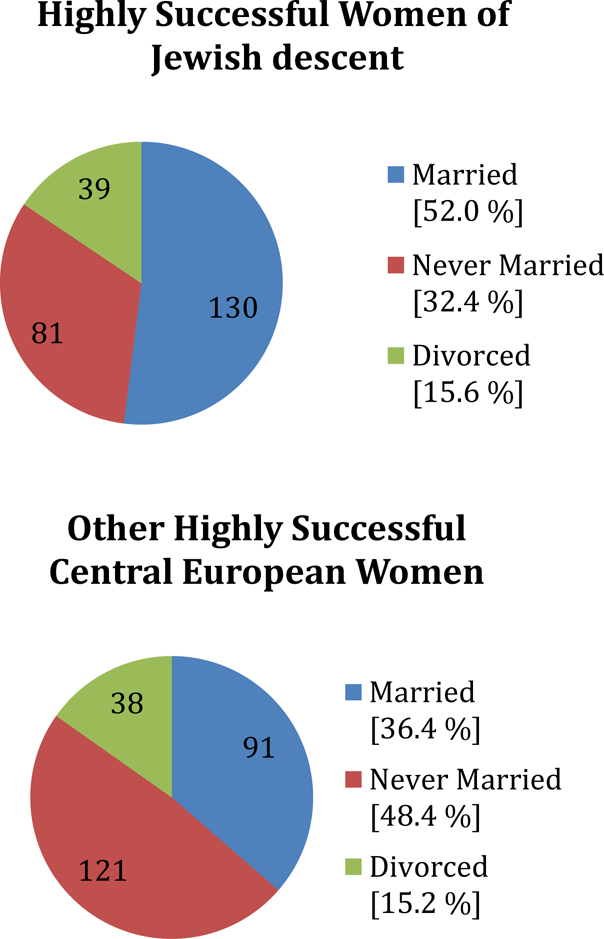
Together with six undergraduate students at Indiana University, South Bend, we crafted a study that would seek data about the extent to which high-achieving, pioneering women in this period married. Over the course of our research using a variety of lexicons, encyclopedias, and biographical dictionaries, we gathered the names of 298 women of Jewish descent and 391 other women from German-speaking central Europe. In order to have an equal pool of subjects, we narrowed our groups using the criteria of the Biographisches Handbuch der deutschsprachigen Emigration nach 1933 (position, publication record, recognition, creativity) to five hundred highly successful women, with half of them being of Jewish descent (see the appendix for details). Our research confirms our initial insights, and this data set reveals suggestive evidence of differences in marriage patterns. Of the high-achieving women in our study, two-thirds of women of Jewish descent married (67.6 percent); in contrast, only half of the other women married (51.6 percent).Footnote 4
Married and never-married women of Jewish descent and other central European women.

The research in this article unfolds as follows: after introducing our study, we present our data and consider factors that could help explain these differences in marriage rates, especially the contrast between marriage as a duty within Judaism against the possibilities of a life of celibacy within Christian traditions. We then offer demographic data on marriage and divorce in central Europe that put our findings in the context of the marriage patterns in central Europe and discuss the factors that shaped the diverging marriage data at the core of the study. We close with stories of Protestant and Catholic women to highlight with examples the ways that these patterns played out in individuals’ lives.
What is at stake in these findings? For these women, a chance to pursue a career while married would add decades of work life and opportunities for professional advancement for the ambitious nineteenth-century woman. If, as it seems, Jewish subcultures were more open to combining work and marriage, this finding could help explain Jewish women's high levels of professional success in a variety of fields. In the late-nineteenth and early-twentieth century, women of Jewish descent had begun to play leading roles in academia, science, politics, music, film, and theater. For example, in 1917, at a time when Jewish women were 1 percent of the German female population, three of the seven members of the managing board of directors of the Federation of German Women's Associations (Bund Deutscher Frauenvereine), the largest women's organization in Germany, were of Jewish descent (Alice Salomon, Elisabeth Altmann-Gottheiner, Alice Bensheimer).Footnote 5 In 1925, one-third of women doctors in Germany were Jewish or of Jewish descent.Footnote 6 Marline Otte describes the “overwhelming and at times pathbreaking involvement of German Jews,” men and women, in the entertainment industry.Footnote 7 Many women of Jewish descent were among the first generation of women university professors. In 1933, according to one count there were eighty women teaching at German universities, and at least thirty-two were forced out of their positions because they were classified as Jewish or had one Jewish parent.Footnote 8
The women in our study—of Jewish descent and others—worked against middle-class norms that held that women who married should stay at home and care for children. At the same time, by 1907, 44.5 percent of German women ages fourteen to seventy were counted by the census as working. They labored in a family business or worked for pay as servants, in agriculture, in factories, or at home doing piecework or other diverse tasks.Footnote 9 Women in the middle and upper classes were also taking up work—all the more surprising in an era when the cult of motherhood was at its height. Societal norms held that the proper place for a middle-class woman was in the home and married to a husband who could provide for her, and new expectations for early childhood education at the turn of the century meant that many believed that the demands for such nurturing as middle-class mothers were now expected to do were incompatible with full-time work in a demanding profession.Footnote 10
Even some feminist leaders in pre-1914 Germany argued that the combination of a professional career and motherhood was an option only for a small number of extraordinary women. Gertrud Bäumer, who edited the Handbook of the Women's Movement 1901–1906 and who led the largest women's organization, the Federation of German Women's Associations after 1910, expressed a yet more pessimistic view: for many the solution to the problem of marriage and career “was none other than [the woman's] abandonment of a profession.” Although she accompanied her claims with qualifications and called for freedom for all, Bäumer predicted that “in the future, as women's general social responsibilities, we are not likely to see the union of marriage and professional work.”Footnote 11
Political leaders such as Helene Lange (1848–1930) extolled “spiritual motherhood” (geistige Mütterlichkeit), which involved a mission of nurturing and care for others that women could fulfill either in the home with their own children or in public through social and welfare work. Marianne Weber argued that once her child was born, it was the mother's duty to dedicate 100 percent of herself to her children.Footnote 12 Many of the best-known women leaders in this period were unmarried, women such as feminist activist Emmy Beckmann (1880–1967), the doctor and eugenicist Agnes Bluhm (1862–1943), the feminist Luise Büchner (1821–1877), the politician Gertrud Bäumer (1873–1954), painter Ida Gerhardi (1862–1927), cofounder of the General German Women's Association (Allgemeiner Deutscher Frauenverein) Auguste Schmidt (1833–1902), pioneer in social work Alice Salomon (1872–1948), activist Helene Stöcker (1869–1943), early medical doctor Franziksa Tiburtius (1843–1927), and scientist Therese von Bayern (1850–1925).
This project builds on the literature about women in German-speaking central Europe, which has drawn on ego documents like diaries and memoirs, to describe pioneering women, their experiences, and their ideas.Footnote 13 Histories of single women have shed new light on the perception of a “surplus” of marriageable women in Imperial Germany.Footnote 14 There has been less focus, however, on understanding the women who continued to pursue their work while married, as well as their experiences and the cultures from which they came. In addition, our research is explicitly comparative in a way that other studies are not. Our sources have allowed us to draw together lists of women who were pioneers and leaders and to shed light on the differences between life paths of women of Jewish descent and other central European women.
Cultural norms that required middle-class women to abandon their careers when they married had usually meant that, unless they waited until their mid- to late-thirties to marry, women would leave their work just as they might have started to achieve professional success and recognition. Some of the non-Jewish women in our study pursued professions or creative activity after their marriages ended. Other non-Jewish women in our study only gained the opportunity to work (or indeed were forced to work) once they became widows: women such as the anti-alcohol reformer Susanna von Orelli (1845–1939), the left liberal activist Minna Cauer (1841–1922), or the writer Sophie Wörishöffer (1838–1890). Other successful non-Jewish women waited until late in their lives to marry. For example, Professor Margarete von Wrangell (1877–1932), of an aristocratic Baltic family, was the first female “Ordinaria” or full professor, ran her own institute, and married her childhood friend Duke Wladimir Andronikow—at age fifty-two.Footnote 15 But for most heterosexual women who aspired to a respectable life in the middle class, choosing a career had meant giving up the opportunity to have a sexual life and create a family.
Being part of a subculture in which women pursued their careers as well as married and had children might well have shaped young women's early educational decisions. For some, pursuing a university education or the training to become a musician, for example, would not necessarily have cut off the possibility of marriage and family. In contrast, the stories of some non-Jewish women at the end of this article reveal how the parents of similarly promising non-Jewish women feared that by allowing their daughters to follow their calling and do the work that they loved, they would be putting in jeopardy a happy future of marriage and motherhood. The accounts of non-Jewish women that are included here bring to light the barriers that some of them faced in pursuing work outside the home and help to explain the different rates of marriage between gifted women of Jewish descent and other highly successful women. Finally, it is important to remember that the majority of these study subjects had access to education, networks, and opportunities not available to the vast majority of German-speaking central European women. Poor and working-class women worked by necessity.
Criteria for Selecting the Subjects and Defining the Parameters of the Study
Our study focuses on women with life experiences in the second half of the nineteenth century (1850–1900). They could be included in our study if they were still alive in 1850 or were born before 1900. Our initial data collection suggested that most highly successful women born after 1900 (whether of Jewish descent or not) did in fact combine marriage with their career. In contrast, data about women born before 1900 revealed significant differences between women of Jewish descent and other women, which makes comparing these two groups of women, Jewish and non-Jewish, more interesting and the findings clearer than if we also included women who were born later. Also, because many professionally successful women married in their thirties, including women of Jewish descent born after 1900 would have resulted in including women displaced and murdered by the National Socialists at the very age that they would have considered marriage, thus skewing our results. Therefore, we decided to include only women born before 1900 in our study. This study does include, however, women who spent substantial time outside of German-speaking central Europe (Austria, Germany, Switzerland) if National Socialists forced them out or if they continued primarily to produce work in the German language. It does not include women such as Therese Tietjens (1831–1877), an opera singer who made England her home after the 1850s.
Our selection of the women who should be included was guided by our study of key reference works and encyclopedias. Women in science became part of our study if they held positions, won prizes, or made discoveries recognized as significant to their field. Women in politics were included if they held positions or produced work that shaped their political communities. Women in the arts and letters were for the most part included if their works were popular, such as Hedwig Courths-Mahler (1867–1950), whose 1912 novel Die wilde Ursula sold 1 million copies, or if despite living in obscurity during their lives, their writing or art is now studied and remembered. For opera singers, stage actresses, and film stars, we relied on the secondary source literature and reference works to determine the final group of each woman. For example, the wildly successful performances of Marie Geistinger (1833–1903) played an important role in gaining new attention for Johann Strauss's works. Core reference works and lexicons consulted for this study are listed in the appendix. Additional references that we consulted can be found in the footnotes.
It was often difficult to uncover if our subjects had officially left the Jewish community or if they merely lived secular lives distant from religion. We did find concrete information about eight subjects whose parents had converted to Christianity, ten women who had only one Jewish parent, and fifty-three women who were baptized, converted to Christianity, or officially registered as konfessionslos (without confession). As is common in the histories of European Jewish communities, we include apostates in our study together with women who identified as Jewish.Footnote 16 Apostates are listed in the Leo Baeck Archives, the Jewish Women's Encyclopedia, and in Dick and Sassenberg's Jüdische Frauen im 19. und 20. Jahrhundert. Moreover, as was the case in avant-garde circles, many of our subjects disdained the respectability conferred upon those who identified with a religious community. Scientists, socialists, poets, actresses, and artists were among those central Europeans most likely to embrace a secular perspective from ideological, intellectual, professional, or cultural reasons; as a result, it would be surprising if many of our subjects of Jewish descent were not also secular.
Among our study subjects of Jewish descent, we found considerable diversity in attitudes toward their Jewish heritage. Certainly, some of our subjects proudly self-identified as Jewish ethnically and religiously. Jenny Apolant, a women's activist in Frankfurt, claimed, “I possess the most beautiful thing that a person can have; I am a German and a Jew.”Footnote 17 For others, their Jewish identity might have been primarily an ethnic identity or may have only emerged at certain points in time. Till van Rahden's description of Jewish “situational ethnicity” in Germany is a useful frame for understanding the diverse perspectives of these women.Footnote 18 Even Jewish-born converts to Christianity might still see themselves as ethnically Jewish because of their family backgrounds and the social circles in which they moved. The historian Fritz Stern, whose mother Catherine Stern (1894–1973) was an important figure in psychology and education as well as one of our study subjects, describes the complicated Christian and Jewish identities of his grandparents. They were part of circles of Jewish Germans in Breslau who had baptized their children or converted, and they tended to continue to socialize primarily with others of Jewish descent who had converted or been baptized. His paternal grandparents did convert but remained, in Stern's view, “more conscious of their Jewishness” than his maternal grandparents, who did not officially convert but whose correspondence “expresses their affinity to a Christian outlook.”Footnote 19 For others, it is difficult to determine if they saw themselves as Jewish. The scientist Charlotte Auerbach (1899–1994), for example, describes herself as being raised in a secular home and declared herself “Nichtgläubige,” a nonbeliever, although we do not have specific evidence that she converted to Christianity or became officially konfessionslos. At the same time, she found herself particularly moved at her first Seder in Israel with friends when she was almost eighty.Footnote 20 To truly understand the extent to which the women in our study saw themselves as Jewish, we would need much more information than has been passed down to us. For this comparative research project, it makes sense to consider Jews together with apostates because a matrix of difficult to pin down factors influenced the women who sought success as professors, politicians, activists, scientists, or artists. Those factors could include family cultures, social circles, ideological perspectives, and gendered models that would influence apostates as well as women who remained within the Jewish community.
Harriet Freidenreich's quantitative and qualitative study of women academics of Jewish descent, Female, Jewish, and Educated, is the research most similar to our own, and she also includes women with a wide range of attitudes toward Judaism. Her fine and convincing study draws from memoirs, autobiographies, and interviews from 460 university-educated women. Freidenreich estimates that these women made up approximately 10 percent of the women of Jewish descent who studied in Germany and Austria before 1933. Her project differs from ours in that she focuses on women of Jewish descent instead of comparing women of Jewish descent and other central European women as we do. Our research includes women who were university educated as well as successful writers, musicians, artists, activists, actors, and others who did not attend university. Although we only consider women born before 1900, she examines a later period with 225 of her subjects being born before 1900, and 235 born after 1900.Footnote 21
Freidenreich's sample of university-educated women of Jewish descent includes a ratio of married to unmarried women of Jewish descent that is similar to our findings: 72 percent married and 28 percent never married. Like our research, “Former Jews” made up a large number of Freidenreich's sample, 126 of 460, or 27.4 percent. Of these women, 57 percent married, and 37 percent remained single. Of the Jews, 75 percent married, and 25 percent remained single. The higher marriage rate of Jews over “former Jews” in Freidenreich's work is consistent with our findings that women of Jewish descent were more likely to marry than other central European women. Of her study subjects, 46.7 percent came from families with one or two children, a contrast with the average family size in Imperial Germany of 4.7 children per family for marriages before 1905. This data point provides suggestive evidence for the possibility that family investment in daughters—as a result of small family size—helped make possible the later work of highly successful women. Overall, Freidenreich's data on women of Jewish descent are consistent with and complementary to our comparative research.Footnote 22
A second small study by Ute Gerhard focuses on forty German women leaders active in the moderate women's movement around the turn of the century.Footnote 23 She finds that 85 percent of this group came from middle-class families and describes as “surprising” that a “high percentage” of her study subjects were married, 40 percent; she also lists 20 percent as living in a long-term relationship with a woman. Like Gerhard, we were surprised by the contrast between the well-known single women at the head of the women's movement and the large number of married women that we found in our research. At this time when approximately 1 percent of Germans were Jewish, a large number of these women leaders were Jewish (one-fourth of her sample), a finding that she describes as “remarkable.”Footnote 24
What Accounts for the Differences between the Marriage Patterns of Central European Women of Jewish Descent and Other Highly Successful Women?
Now we face the difficult challenge of connecting the life stories of the five hundred study subjects with the factors that help explain this data. Our study includes Zionists and socialists, Orthodox, Reform, secular Jewish women, women who declared themselves konfessionlos, as well as women who converted to Catholicism and became nuns. The project includes women who considered themselves outcasts or iconoclasts, as well as celebrated stage stars or scientists. Some women wrote multiple memoirs; others left no records of their lives; in some cases, National Socialists deliberately destroyed the documents that might tell these women's stories. This article draws on secondary sources and the ego documents that we have from these women to try to piece together some of the factors that shaped these marriage patterns. The next part of this article describes circumstances that helped to shape these patterns, especially traditional religious interpretations of marriage and celibacy.
Celibacy, Marriage, and Divorce
We start with the differences between Jews and Christians in religious proscriptions and cultural leanings toward celibacy or marriage. Certainly, Jewish traditional attitudes toward marriage played a more important role in the lives of the subjects who were rabbis’ wives than they would among more secular women. At the same time, the stark differences in historical attitudes toward marriage and celibacy between Judaism and Christianity suggest that these aspects of religious culture should be considered as part of the explanation for the differences in marriage rates between pioneering women of Jewish descent and other women. As we will discuss at the end of the section, however, demographic data about marriage rates overall among Jews and Christians in central Europe complicate this story.
Jewish religious texts describe marriage as a religious duty. In Genesis 1:28, the first words that God spoke to man were “be fruitful and multiply,” and Jewish religious interpretations direct that all Jews should follow this command by marrying and bearing children. In his article on remarriage, Shaul Stampfer states flatly: “Marriage in Judaism is a universal ideal. Jewish law obligates all males to procreate, therefore to marry. A man who does not marry and have children is committing a sin of omission.”Footnote 25 Marriage is not only a religious requirement but, in Jewish interpretations, a key to happiness. In his examination of marriage and Judaism, David Feldman describes how in Jewish tradition, “an unmarried man is only half a man, abiding without joy, without peace, without good.”Footnote 26
In the modern period, homogenously Jewish communities have seen very high marriage rates. Demographers have described how the eastern European Jews of the nineteenth century almost uniformly married, and if their spouses died, they remarried at high rates.Footnote 27 For eastern European Jews, the religious and cultural norms that encouraged male widowers and female widows to marry each other (as opposed to male widowers marrying never-married women) also helped to create a marriage market that allowed almost all individuals a chance to marry, the “lid for every pot.” Cultural norms within eastern European Jewish communities reinforced these religious duties: in literature from the period, the adult unmarried man could still be called a “na‘ar” (boy/servant in Hebrew and Yiddish), and the unmarried man did not wear a prayer shawl in religious service, which marked him as different from other men.Footnote 28 Like the world of eastern European Jewry, but also because of the legacy of the Holocaust, marriage patterns in post-1945 Israel also exhibit very high marriage rates, so high to make Israel unique among wealthy nations in universal marriage, surprisingly young ages at marriage, and low rates of divorce.Footnote 29
Although early Christians followed Jewish practice and tradition, by the fourth century Christian leaders and missionaries began to require celibacy of priests, a spiritual discipline that was also found in other religions in the Greek and Roman worlds. The tenth and eleventh centuries with the restructuring and reform of Christianity led by leaders of monastic orders gave rise to a new emphasis on celibacy. The New Testament's Matthew 19:10–12 and Corinthians 7:7 32–33 praise celibacy as a part of a special calling. Although celibacy has been required of priests and the members of Roman Catholic orders, celibacy is in twentieth-century Pope Paul VI's words a “precious jewel,” a form of perfection, and a spiritual union with Jesus Christ to which all Roman Catholics may strive. Corinthians 7:7 34 specifically references women: “An unmarried woman or virgin is concerned about the Lord's affairs: Her aim is to be devoted to the Lord in both body and spirit. But a married woman is concerned about the affairs of this world—how she can please her husband.”Footnote 30 Both Christian leaders and lowly servants of the faith could focus their entire efforts on their faith (as opposed to spouses or children), especially if they joined religious orders. Increasing numbers of nineteenth-century women did choose to dedicate their lives to their faith and serving their communities. According to one count, in Germany in 1866, 7,794 women were members of religious orders; by 1908, that number had reached almost fifty thousand. Catholic sisters and women who made careers as celibate teachers made up large numbers of the teaching personnel of Catholic schools exposing students to the celibate ideal throughout their education.Footnote 31
Striking examples of the possibilities for personal growth, professional responsibility, deep piety, and a celibate life can be found in the lives of Christian women missionaries and leaders of international assistance organizations such as the Protestant Anna Harnack (1859–1924), who managed the Deutsche Orient Mission in Persia from 1902 and published translations from Armenian poetry as well as scholarly work. Emperor Wilhelm II of Germany awarded her the Frauenverdienstkreuz (Women's Merit Cross) for her work with orphans and refugees. Other women who did similar work in these kinds of international organizations published scientific studies, managed staff and budgets, networked with fundraisers, gave speeches, and drafted materials that would bring in money to support their operations.Footnote 32
Now, however, we should pause and be reminded that after the Reformation, Protestants, who made up about two-thirds of Germans, more than half of the Swiss, and a small minority of Austrians, did embrace marriage and abandon clerical celibacy, even if they often remained suspicious of sex. Because of social and economic factors, however, for most secular-leaning middle-class central Europeans, there was no socially appropriate position for these women outside of marriage. Secular-leaning middle-class Protestant women faced special pressure to marry and, as Catherine Dollard in The Surplus Woman has powerfully described, faced stigma for remaining unmarried. Even in the nineteenth century, however, for religious Protestants as well as Roman Catholics, a celibate life of service to others was a path that had status and support.
In contrast, because of the importance of marriage within Jewish cultures, individuals faced pressure to marry from their entire social network: from parents, extended family, friends, and the Jewish community or local Jewish subculture. As a result, even intellectually ambitious Jewish women would be pushed to marry, and given similar pressures on them, Jewish men were not going to rule out a woman just because she was ambitious. Of course, many Jewish middle-class men as well as their families did prefer that wives and mothers stay at home and care primarily for home and hearth. A revealing story from the memoir of the Zionist and medical doctor Rahel Straus (1880–1963) sheds light on this dynamic. She remembered a conversation with her future husband, Eli, as follows:
When Eli asked me what I wanted to study, I told him naturally medicine! And then in response he said, “You'll never marry.” I understood well what he meant, that he found it impossible to marry a woman doctor. But that simply made me more defiant and determined, and I explained to him that I did not care for such views.Footnote 33
Although Jewish tradition supported marriage for all individuals (as opposed to the possibilities of celibacy and a life of service for religious Protestant and Catholic circles), this support for marriage did not necessarily mean support for a married woman pursuing a profession. Research on middle-class Jewish families of the pre-1914 period also emphasizes middle-class expectations that required women to relinquish their profession when they married. In her study of university-educated women, Harriet Freidenreich describes how the “norm for both Jewish and non-Jewish women was to marry by their mid-twenties and then stay home and raise their children.” In The Making of the Jewish Middle Class, Marion Kaplan argues: “Bourgeois marriage depended on both parties’ putting the husband's career first. A potential two-career household implied serious conflicts or compromises.” Although women in Jewish families also worked without pay inside the home in family small businesses and were responsible for duties such as running shops, keeping accounts, handling correspondence, organizing inventory, as well as myriad other tasks that women could do discretely behind the scenes, most Jewish, Catholic, and Protestant middle-class men and women believed, in Marion Kaplan's words, that gainful employment outside the home was “unladylike and improper for their daughters.” Even worse, sending a daughter to be trained or to work for pay might lead to gossip that perhaps the family had fallen on hard times or that no dowry was available to secure her a comfortable marriage.Footnote 34 To summarize: cultural support for marriage among Jews does not provide a full explanation for these diverging marriage patterns among highly successful women because it does not help us understand why these women continued to embrace their profession after they married. We return to the factors that help explain Jewish women's striking rates of professional success in the following section.
An additional complicating factor comes with the demographic marriage data from modern central Europe. In contrast to Jewish religious cultures that provide such strong support for marriage, in central Europe fewer Jewish women than Christian women married.Footnote 35 In 1905 in Germany, demographers counted more marriages among Christians (86 among 10,000 Christians) than Jews (74 among 10,000 Jews).Footnote 36 A “snapshot” of women ages forty to forty-nine is imperfect in that these women could include divorced and widowed women, along with the never married. But at a minimum, this data point does give a sense of the different rates of marriage between Jews and non-Jews: in 1925, among Prussian women between the ages of forty-five and forty-nine, demographers counted 15.5 percent of Jewish women as unmarried in contrast to 10.5 percent of non-Jewish women. Statistical material from the period before 1914 suggests that Jews were also less likely than non-Jews to marry a second or third time. Causes for this lower marriage rate include the larger number of Jewish men than Jewish women who married Christians (reducing the number of Jewish partners for Jewish women), the gender imbalance in central European small towns with more Jewish women than Jewish men, and the importance of dowries within central European Jewish marriage cultures.Footnote 37 A Jewish family whose members could not provide financial resources for a dowry or had too many daughters for dowries for their girls might not be able to find marriage partners for their daughters. This context of marriage patterns in Europe creates an important contrast for our research. If among the general population, Jewish women were less likely to marry than non-Jewish women, our findings, two-thirds of pioneering women of Jewish descent married (67.6 percent) whereas half of the other women married (51.6 percent), are even more surprising.
In European history going back to the sixteenth century, 15 percent of the population never married, a pattern that set Europe apart from other societies past and present in which, in general, most people married. Using census numbers in the 1930s and 1940s, John Hajnal reports that in Japan in 1920, 2 percent of women age forty-five to forty-nine were single; in Turkey in 1935, 3 percent of women ages forty-five to forty-nine were single, and in India in 1931, 1 percent of women were single. In Germany, by contrast, in the second half of the nineteenth century, 8 percent of men and 11 percent of women never married.Footnote 38 The data in our study show that many more highly successful women never married in comparison to other women. In German-speaking central Europe among our study subjects, 32.4 percent of high-achieving women of Jewish descent and 48.4 percent of other high-achieving women never married.Footnote 39
In this same period, overall divorce rates were also relatively low. Numbers from Germany in 1905 show 2.4 percent of marriages between two Catholics, 4.1 percent of marriages between two Protestants, and 4.7 percent of marriages between two Jews had ended in divorce. Here as well, we might consider the role of religious teachings. As opposed to Jewish tradition, which explicitly allowed for divorce and remarriage, in the New Testament Jesus teaches that “a man shall leave his father and mother and be joined to his wife and the two shall become one flesh. So they are no longer two, but one flesh. What therefore God has joined together, let no man separate” (Matthew 19:5–6). The lower rates of divorce are among Catholics as opposed to Protestants and Jews related in part to the interpretations of religious texts, with the Catholic interpretation as the most opposed to divorce.
Just as these rates differed among religious groups, they also differed quite dramatically between rural and urban areas. People who lived in cities, as did most of the women of Jewish descent in our study, were much more likely to divorce than people who lived in rural areas. Between 1900 and 1906, Hamburg statistics reveal thirteen marriages to every divorce, and, in contrast, in the state of Bavaria, eighty-three marriages to every divorce. These statistics mean that in Hamburg, said to be the state with the lowest church attendance in Germany, divorce was six times more common than in the predominantly Catholic state of Bavaria.Footnote 40 In the Weimar Republic, when the divorce rates increased approximately 2.5 times, the rates per 100,000 of the population was 1.79 in rural Prussia, 9.85 in Prussian towns, and 14.26 in Prussian cities. In addition to the prevalence of traditional perspectives against divorce in rural areas, the lack of economic opportunities for women in sparsely populated areas may have made it difficult for some women to leave unhappy marriages.Footnote 41
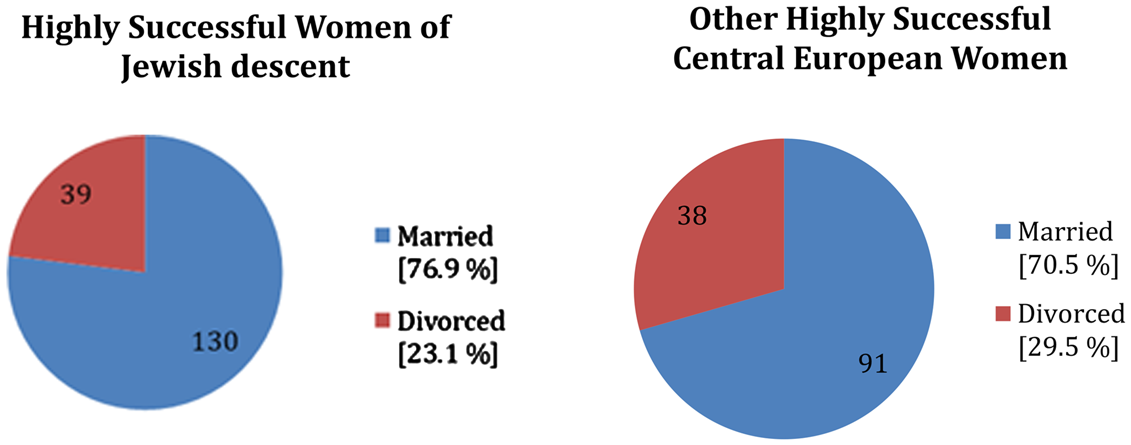
The highly successful women in our study divorced at significantly higher rates than other women in German-speaking central Europe. At the same time, the data reveal that marriages that included a woman of Jewish descent were more likely to be “successful” (that is, not end in divorce) than the marriages of other pioneering central European women. In contrast to the data described here—more Jewish women divorced than non-Jewish women; more urban people divorced than rural people—among our study subjects, fewer of the highly successful women of Jewish descent divorced than the other central European women. Of the women we researched, 22.9 percent of women of Jewish descent experienced at least one divorce, and, in contrast, 29.5 percent of other women experienced at least one divorce.
Divorced women among married study subjects.

Married, divorced, and never-married women of Jewish descent and other central European women.

These data provide nuance that enhance the literature that discusses high divorce rates among Jews as stemming from arranged marriages among Jews, the difficulties of urban living, or the emotional upheaval of preserving a marriage under National Socialist rule or exile. As opposed to the literature that emphasizes the prevalence of divorce among Jewish central Europeans, these data show that divorce was slightly less common in the marriages of highly successful women of Jewish descent than the marriages of other highly successful women.Footnote 42
Factors that Help Explain Success among Married Women of Jewish Descent: Left-Leaning Politics, Women's Education, Family Size, Class Background, Urban Jewish Subcultures, Outsider Status
Thus far, we have presented suggestive evidence for the significance of marriage within central European Jewish subcultures. Other factors will be important in helping to understand the ambition and the creative activities of these married Jewish women. Of first importance must be the centrality of learning and education within middle-class German Jewish circles, primarily for men and boys. At the same time, girls too would hear the guests who talked about ideas, read the books laying around a middle-class home, and thus learn about the world of ideas. Our findings make sense in light of other research, for example, that details the large number of Jewish women among the first generation of women to enter the university and the important role of education for Jewish girls. Left-leaning politics and openness to steps toward equality between men and women within Jewish circles might have allowed for some women to move beyond middle-class norms. Many Jews voted for left liberal parties, whose leaders favored the opening of professional opportunities for women and new political rights for women. Connected to both of these trends, we found, as Freidenreich did with her university women, that Jewish families were some of the first to adopt modern family forms of one to three children.Footnote 43 Smaller families also allowed for modern forms of parenting with intensive investment in each child and emotional connections between parents and children. In a period when most middle-class people assumed raising children fell in the women's sphere, small families allowed more autonomy and independence for mothers than larger families would. Although Marion Kaplan's scholarship shows most middle-class Jewish families followed class norms for proper women's roles requiring women to leave paid employment when they married, our survey of memoir literature of the high achieving Jewish women in our study suggests instead that study subjects’ Jewish families often supported the aspirations of their daughters and helped to pave the way for their later success.Footnote 44 The actress Ida Ehre (1900–1989), for example, writes movingly about the role that her mother played in supporting all her achievements:
You were and always will be my guide, and I will never forget you. I'll never be able to do what you have done—you with your endless goodness, with your humor that comes from the deepest places in the heart and makes the mournful laugh … Whatever I do, I always have a little conversation with you. And when things go well, I tell myself that you approve, and I am infinitely thankful. My experiences, the best of them, are connected to you … You are anchored in me—for always—as my guide and my deepest experience!!Footnote 45
Unlike many of the non-Jewish women's families that will be described later in this article, Ehre's mother provided tremendous support for her efforts to make a career in the theatre. Ida Ehre, whose accomplishments were recognized when she became the first female honorary citizen of Hamburg, had in her mother a mentor, coach, and loving partner for Ehre's efforts.
Similarly, Charlotte Berend-Corinth (1880–1967) describes the support that she received from her father. Her father initially opposed her desire to become a painter because he feared that she would become an “old maid.” She told him that she was determined to pursue painting, and at that point, as she remembers, he put his head in his hands. When he brought his head up again, his eyes were red and teary, and “he looked at me with such an expression of deep and naked love that I am deeply affected when I think of it.” He then told her slowly and quietly, “You want it so much. It will be difficult for me, more difficult than you understand. Child! I will not stand in the way of your happiness. Follow your ideals. I acquiesce.”Footnote 46 A form of modern intensive parenting that was adopted early by Jewish families and eventually would be adopted by most elite and upper-middle class families played a role in the successes of many of the women in our study.Footnote 47
Selma Kurz (1874–1933) found a version of Berend-Corinth's family support at her synagogue and in the Jewish community. For Kurz, a Jewish network helped to pave the way for her to grow her talent. Unlike most of our study subjects, who were children of elite urban or academic families, Selma Kurz grew up in a poor family, one of eleven children of an umbrella repairman in Galicia, and she started an apprenticeship as a seamstress. The cantor at her synagogue discovered her beautiful singing voice and collected money from the Jewish community to pay for a train ticket to Vienna, where her voice could be heard. A patron paid for her lessons, which then allowed her to develop her voice and become an opera singer who performed across Europe and the world in the most diverse of roles, with 992 performances at the Vienna opera alone. Selma Kurz had many suitors, but she held them off, especially those who wished that she follow what was often seen as convention and retire from the stage. In 1910, at the age of thirty-six, she married Dr. Josef Halban, a professor at Vienna University and medical specialist, and, as she wished, continued to perform. Her love of music, her tremendous success, and her skill led her to insist on continuing her work. Even her fellow soprano Maria Jeritza described how, standing next to Selma on stage, “I did not know if I should keep singing or applaud.”Footnote 48 The same forces that led diverse men and women of Jewish descent to strive toward their goals, to hone their skills, and to insist on recognition shaped decisions like those of Selma Kurz to continue performing after she had married and had a child.
In The Jewish Century, perhaps the most important recent work that aims to understand Jewish striking success in the modern world, Yuri Slezkine connects the experiences of Jews to other mobile, trade-oriented, insular minorities like the Inadan of the Sahara, the Armenians in the Ottoman Empire, the Roma in Europe, the Parsis of India, the Old Believers in Russia, Southeast Asians in the United States, the Chinese in Southeast Asia, and the Lebanese in Latin America, among others. The combination of strong group ties, faith in education, and a far-flung diaspora network can increase chances of success even despite discrimination. Slezkine emphasizes how “strangeness could be an asset” because of the ways that it could cement group ties. Gender and sex roles offer an area that minorities could solidify their contrast with majority cultures; Slezkine describes the examples of Roma and eastern European Jewish women who were “often considered sexually provocative or socially aggressive—a perception that they occasionally reinforce by deliberate displays.” A provocative “display” might well be offensive to the middle-class women who made up most of our study subjects and were strongly influenced by middle-class expectations about proper women's roles. At the same time, Slezkine's point also suggests that for Jewish women, moves beyond cultural norms, for example to take up a profession, might have been just one more way that Jewish women would be perceived as different or even “strange.” Perhaps the leap to the professional world was a shorter distance for women of Jewish descent than for other women more strongly and securely ensconced in the middle class.Footnote 49
Slezkine explains how a sense of difference and strangeness was set within a matrix of “universal and mutually complementary opposites: mind versus body, head versus heart, outsider versus insider, nomadic versus settled.” In another thread of Slezkine's rich analysis, he describes how the mutual stereotypes of majorities and minorities shaped perception of the “other.” What majorities might view as cunning and greed, minorities might see instead as smart, future-oriented, successful, and sophisticated. From the Pale of Settlement, Slezkine quotes Mark Zborowski and Elizabeth Herzog, who interviewed former shtetl residents and found that even children knew the distinctions between Jews and non-Jews,
Among Jews he expects to find emphasis on intellect, sense of moderation, cherishing of spiritual values, cultivation of rational goal-oriented activities, a “beautiful” family life. Among gentiles, he looks for the opposite of each item: emphasis on the body, excess, blind instinct, sexual license, and ruthless force.Footnote 50
Certainly, these are stereotypes. And yet, these are just the kind of values that if cultivated and assumed to be one's own could support a combination of family and professional or creative work for women.
One striking example of the lengths to which a family might go to educate daughters comes from the memoir of the writer and art critic Berta Zuckerkandl (1864–1945). When she grew up in 1880s Vienna, academic girls’ schools were not yet available. As a result, her father, the editor of the Neues Wiener Tagblatt, arranged to have his reporters among the tutors for his two daughters.Footnote 51 This expectation that daughters would gain an in-depth education shaped the milieu of Viennese elite Jewish families within which Zuckerkandl moved. Of course, living in Vienna created opportunities that women in rural Austria would not have had. Simply living in cities, as more Jewish central Europeans did than non-Jews, allowed for more contact with educational institutions than if one lived in the countryside. The high numbers of Jewish men and women who studied at universities might, in part, be explained by the access of these individuals to institutions of higher education. Also, Jewish families’ over-representation within the upper middle class, among urban central Europeans, and among academic families helps provide an explanation for the overrepresentation of women of Jewish descent among highly successful women. These families had the resources and the connections to support not only their sons but their daughters in pursuing work outside the home.
These factors created a dynamic in which, for at least some families, women could pursue their work and still have the potential to marry and build a family. Within Jewish tradition, the great value placed on marriage and family, as well as the importance of education and “intellect,” combined to craft a different model of marriage for women of Jewish descent that, in the right circumstances, could allow women to depart from expected roles. Just as Jewish men overcame obstacles of antisemitism and class prejudice to gain professional and creative success, Jewish women, too, went beyond the bounds of behavior considered expected and appropriate. The willingness to risk failure, to be open to the new, stemmed from Jewish outsider status and could trump cultural norms, including the proper roles for women. Many of the women of Jewish descent in this study displayed a commitment to education, achievement, and family that channeled a form of Jewish tradition and created a model that would help them achieve success.
Illustrating Our Findings: Stories of Women of Jewish Descent and Other Highly Successful Central European Women
The large number of non-Jewish women in our study who completed their most important work after their husbands’ deaths, divorced after brief marriages, or stopped working after they married point to the challenges that women experienced in combining work and an ambitious career. Social norms put stress on middle-class marriages that included a woman who sought success in her profession; even feminist leaders believed that women must make a choice between a highly successful professional life and marriage. In the words of the historian Dietlinde Peters, “For the majority of the members of the moderate women's movement, gainful employment meant eschewal of marriage; the women were faced with the (voluntary, conscious?) choice between two life paths.”Footnote 52 These cases, which suggest the fate of thousands of Jewish and non-Jewish women, reveal parental, cultural, institutional, and legal barriers to professional success for women in the period before 1914. Some examples from non-Jewish women's lives help to illustrate these women's life trajectories. Grete Wiesenthal (1885–1970), who created innovative choreography and was an international dancing star, even the “ambassador of waltz,” married Nils Sifverskjold in 1923 but divorced in 1927. The Neue Sachlichkeit painter Gerta Overbeck (1898–1977) had a son with the photographer Gustav Schenk (1905–1969), then married him in 1937, and divorced him in 1940. The writer Ida Hahn-Hahn (1805–1880) married her cousin in 1826 and divorced in 1829. Luise Kiesselbach (1863–1929) was widowed at age thirty-nine in 1902, and her most important political accomplishments occurred after her husband's death, including serving in the Munich city council between 1919–1927. Agnes Neuhaus (1854–1944) led Catholic women's organizations and served as a member of the constitutional assembly of the Weimar Republic for the Center Party and as a Reichstag representative for the Center Party from 1920–1930—all after her husband's 1905 death. Minna Cauer (1841–1922) led the left wing of the middle-class women's movement from the end of the nineteenth century. During her marriage she moved in intellectual circles and came into contact with leading liberals, even Crown Prince Frederick Wilhelm and his wife, Victoria. Only after she was widowed for the second time in 1881 did she enter politics and play leadership roles in women's organizations. Agnes Günther (1863–1911) married the Protestant pastor Rudolf Günther and worked as a pastor's wife between 1891 and 1906. She wrote religiously inspired and melodramatic poetry and stories primarily for herself in her periods of sickness. Her most popular novel, Die Heilige und ihr Narr—which sold more than a million copies and went through more than 150 editions—was published only after her death. Sophie Cruvelli (1826–1907) had such a beautiful voice that Verdi composed operas with her in mind for the leading parts. She married Baron George Vigier in 1856 and, like many opera singers, then retired from performing. To summarize, the large number of divorced and widowed among highly successful women provides evidence for the challenges of combining work and marriage.
Our research has also uncovered dramatic accounts of the difficulties these women faced in pursuing their careers. Grete Albrecht (b. 1893) studied medicine, played a leading role in medical organizations including the Hamburg Medical Board, and was vice president of the German Medical Women's International Association (1958–1963). From an early age, Albrecht had determined that she wished to study medicine, but “her father flatly forbade her to think of such a profession.” The family physician once struck her for being a “silly brat” who would not settle into the notion that “a girl like you gets married.” Only after the death of her father in 1908 could she pursue her wish to become a medical doctor.Footnote 53 Fanny Moser (1872–1953) enrolled as the first woman student at Freiburg University and remained the only woman student until 1901. Her studies in zoology led the Prussian Royal Academy to send her to collect specimens in France and Italy before 1914. Her later works in the fields of parapsychology are still studied today, but her desire to pursue her work in science led to “violent conflict” with her mother.Footnote 54 The pioneering writer and explorer Ida Pfeiffer (1797–1858) so hated the needlework and piano practice forced on her by her wealthy parents that she cut her fingers as a form of protest.Footnote 55 Ruth Beutler (1897–1959) collaborated closely with her mentor, Karl von Frisch, who directed her work in zoology. He also published some of her findings on bees and bee communication under his own name.Footnote 56
The first German woman professor in botany, Rose Stoppel (1874–1970), spent twelve years working as a domestic servant in East Prussia. Her father had died when she was young, and she was only able to extract her mother's blessing to study when her mother was on her deathbed. Although facing many challenges, including poor pay and the opposition of many professors in her field—she was once even thrown out of a university physics class—she was finally able to complete her studies with the second dissertation necessary for a German academic position, the habilitation, at age fifty with the University of Hamburg.Footnote 57 The pilot Thea Rasche was pressed into marriage by her parents. After the death of her two brothers in World War I, her parents were determined that she marry and produce an heir. Rasche ran away to enter a professional training program in agriculture and only returned to her parents’ home because of her mother's poor health. Her father then insisted she marry. After much persuasion, Rasche agreed, only to refuse to follow through half an hour before the wedding was to begin. Later she sold her jewelry in order to put together enough money to rent an apartment and find a position as a secretary. Rasche would become the first woman in Germany to obtain a pilot's license.Footnote 58
Together with Franziska Tiburtius (1843–1927), Emilie Lehmus (1841–1932) began a medical practice and eventually opened a clinic for women in 1887. There women could receive care, even if they could not pay. For fifteen years, Tiburtius and Lehmus were the only women medical doctors in Berlin, despite the fact that middle-class norms for women's modest behavior made health discussions difficult, especially for almost anything related to sexual systems or the digestive tract. Lehmus and Tiburtius had to battle long and hard to win permission to practice medicine in Berlin. Initially, in 1876, they were not allowed to take the exam for midwives. Even after they began their practices, they were not allowed to prescribe medicine. Lehmus was one of six sisters and came from a long line of theologians. Lehmus's parents, having no sons, gave their daughters an unusually broad education for girls in this period; her father supported her plans and began to teach her Latin after she expressed interest in university study. Her family supported her in other ways as well; she lived with her sister and her sister's family in Berlin and often spent time with her extended family, who all loved music and played passionately. In addition to her close family relationships, her partnership with Tiburtius played an essential role in her success. In her diary, Tiburtius wrote that she and Lehmus knew that they could and should rely on each other absolutely.Footnote 59
Like Emilie Lehmus and Franziska Tiburtius, many pioneering women's most important relationships were outside of the marriage bond. Faced with a choice between marriage or a fulfilling medical practice, Tiburtius and Lehmus chose their practice and their patients. The high number of single women among non-Jewish accomplished women suggests that Tiburtius and Lehmus were not alone. Our quantitative data reveal that among pioneering women like Tiburtius and Lehmus, many women in German-speaking central Europe were not able to find a path for themselves that combined a career and marriage.
Conclusion
Although this research has revealed significant differences in the marriage rates of study subjects of Jewish descent and those of non-Jewish women, it is important to avoid overemphasizing these differences. The continuing prejudice against women, especially married women, meant that many women of Jewish descent also could not balance rewarding work and marriage. Nelly Wolffheim (1879–1965), of Jewish descent, founded her own kindergarten and pursued research in psychology. She noted that from an early age she had decided against marriage and wanted to pursue a life of independence and fulfilling work outside of the home. Hilda Geiringer (1893–1973) married a fellow scientist and eventually was hired as a professor at Wheaton College in Massachusetts, where her teaching and service obligations often kept her away from her research. She would have preferred to join her husband, Richard von Mises, who held a position at Harvard. No doubt, her Jewish origins and her gender helped shape a context in which she was not able to find a position at a research institution. In this particularly interesting case, Hilda Geiringer and Richard von Mises married when he was sixty and she fifty, and further illustrating the barriers to all women (Jewish and non-Jewish): Harvard did not hire its first woman professor until 1947, at which age Hilda would have been sixty-four. All women in academia, science, literature, and the arts in the nineteenth and early twentieth centuries faced discrimination as they stepped into new roles that were perceived as outside of their proper sphere.
Although the non-Jewish subjects in this study were less likely than women of Jewish descent to combine a highly successful career and marriage, some Catholic and Protestant women overcame prejudice and pursued their work as well as married. Catholic Josephine Lang (1815–1880) grew up in a family of professional musicians and became one of the best-known composers of the nineteenth century. She married the law professor and poet Christian Reinhold Köstlin in 1842 and had six children with him. She continued composing throughout their marriage as well as after her husband's death in 1856. Protestant Clara Mundt (pseudonym Luise Mühlbach, 1814–1873) was the author of fifty historical novels. She married a history professor, Theodore Mundt (1808–1861), and the income that she earned supported the family during his illnesses and after his death. A Catholic, Paula von Preradović (1887–1951), was a poet, and one of her poems became the words to the Austrian national anthem. She married the historian and journalist Ernst Molden and had two sons with him.
The life stories of these women also suggest trends that we have seen throughout our research. Many highly successful nineteenth-century non-Jewish women came from creative families like Josephine Lang's, whose mother was an opera singer and father a musician; Paula von Preradović's grandfather was one of the most popular nineteenth-century Croatian poets. Furthermore, many of the highly successful non-Jewish study subjects who married were of noble birth, such as Paula von Preradović. Other women were encouraged by artists or radical thinkers, such as Clara Mundt's husband, Theodore, who was under police surveillance because of his political ideas.
Nevertheless, the research in this article suggests differences between the experiences of women of Jewish descent and of other women in German-speaking central Europe in the areas of work and marriage. The results of our quantitative study of five hundred women—67.6 percent of women of Jewish descent married versus 51.6 percent of other women—provide a unique body of data that complements and contributes to research by Marion Kaplan, Harriet Freidenreich, Luise Hirsch, and Till van Rahden that identifies distinctive aspects of the central European Jewish life patterns and gender roles: the high number of Jewish women university students, the importance of leading women of Jewish descent in a number of academic fields, support among Jews for women's equality, Jewish entrepreneurial cultures that involved women directly (but behind the scenes) in significant parts of economic activity, and Jewish families as early adopters of modern family forms with a small number of children and intensive investment in each child. Jewish men and women cherishing knowledge, esteeming marriage, and striving for excellence despite outsider status helped shape a dynamic and a subculture in which women of Jewish descent could pursue their creative work at the same time they married and created a family. The possibility that a woman could continue to work after marrying and having children added many years of creative activity to her adult life and may help explain the large number of women of Jewish descent in fields such as academia, entertainment, the arts, and politics.
Even in our twenty-first century, women face a family penalty. A recent study drawing on the National Longitudinal Survey of Youth from 1979 to 2006 found that while unmarried childless women earned ninety-six cents for every dollar men earned, married mothers earned only seventy-six cents.Footnote 60 The highly successful women who were the study subjects for this research had to fight to merely have the chance to pursue their professions as opposed to hoping for equal pay for themselves. We have come a long way. Still, in the modern West, combining work and family is the challenge that most clearly bars the way to full equality between men and women. In this light, the experiences and the lives of these central European women can provide insights about a key moment in the creation of modern gender roles.
Appendix
This study focuses on five hundred high-achieving women from German-speaking central Europe; half of the study subjects are of Jewish descent. In central Europe at birth children were declared Catholic, Jewish, Protestant, or without confession. Individuals who wished to change their religious identification, to convert, or to become “konfessionslos” (without confession) filed government documents to declare their intentions.Footnote 61
As we studied these women's stories, we were mindful that many of these women had class privileges, elite status, and educational opportunities that put them in a position to pursue their careers in ways that were not open to the vast majority of German-speaking central European women. In some cases, access to cultural capital and educational opportunities, combined with a climate of antisemitic prejudice, spurred Jewish women to want to prove their abilities and thus motivated them to seek achievement in the arts, science, or politics.
Because many women moved between Austria, Germany, and Switzerland, we included women from all three countries. Over the course of our research, we gathered the names of 294 women of Jewish descent and 391 other women from German-speaking central Europe. The list of women included in our study follows below. We welcome readers’ comments about women whom we missed or suggestions for women who should not be included. We drew from the selection criteria of Biographisches Handbuch der deutschsprachigen Emigration nach 1933 to choose the women who would be part of our study. Selection criteria included 1) position of responsibility in organizations or institutions, 2) publications, performances, or other creative or research product, 3) prizes and public recognition, 4) innovations in research or creative work. The following sources were particularly important for the project: Anne Commire ed., Women in World History: A Biographical Encyclopedia 17 volumes (1999–2002); Ursula Köhler-Lutterbeck and Monika Siedentopf, Lexikon der 1000 Frauen (2000); Luise F. Pusch and Susanne Gretter, Berühmte Frauen: Dreihundert Porträts (2001); Maya Irmgard Fassmann, Jüdinnen in der deutschen Frauenbewegung (1996); Jutta Dick and Maria Sassenberg, Jüdische Frauen im 19. und 20. Jahrhundert (1993); Walter Tetzlaff, 2000 Kurzbiographien bedeutender deutscher Juden des 20. Jahrhunderts (1982); and the Jewish Women's Archive. Finally, as Jews made up about 1 percent of German society in 1900, between 4 and 5 percent of Austria-Hungary in 1900, and less than .5 percent of the population in Switzerland in 1900, our study subjects of Jewish descent may well be less well-known than our non-Jewish study subjects. Our goal overall was to create equal numbers of women of Jewish descent and non-Jewish women.
In a small number of cases, we did not have enough information to determine if a subject had married or if she was of Jewish descent. For example, rumors circulated about the Jewish origins of Renée Sintenis (1888–1965), the first woman sculptor to be elected to the Prussian Academy of Arts in 1931. Because we were not able to locate definitive information about her background, she was not included in our study. We did not include women who had only one grandparent who was Jewish in either list. For example, we also did not include the feminist Marie Baum (1874–1964), whose baptized maternal grandmother, Rebekka Mendelssohn-Bartholdy, came from a prominent Jewish family in Germany. After the National Socialists took power in 1933, Baum lost her position as a professor at Heidelberg and had no opportunity to publish because of her grandmother, the only one of her four grandparents who had Jewish roots.Footnote 62
Our research turned up a number of pioneering and highly successful non-Jewish women who married Jewish men. We debated whether to include them in our study. Two prominent examples include the SPD activists and journalists Lily Braun (1865–1916) in Germany and Emmy Freundlich (1878–1948) in Austria. One of the first women composers, Ilse Fromm-Michaels (1888–1986), married the Jewish judge Walter Michaels. The writer Clara Viebig (1860–1952), whose works were translated into twelve languages and who produced a novel or collection of stories almost every year between 1898 and 1934, married Jewish publisher Fritz Cohn. Silent film star Henny Porten (1890–1960) married Dr. Wilhelm von Kaufmann-Asser, who was of Jewish descent. Elena Gerhardt (1883–1961), an accomplished Lieder singer, married the Jewish radio director in Leipzig Fritz Kohl. The following women in addition, as far as we could tell, were of not of Jewish descent and married Jewish men: Rahel Sanzara, actress, dancer, novelist (1894–1936); Alma Seidler, actress (1899–1977), Hertha Sponer, scientist (1895–1968), Helene Thimig, actress (1889–1974). Aspects of central European Jewish culture favorable to women's careers may well have led some of these husbands to encourage their wives to follow their career ambitions or at least not to stand in their way. The family and personal contacts of these Jewish husbands might also have been supportive to their wives, enabling them to continue to work after they married. The non-Jewish women who married these Jewish men might have received backing for continuing to pursue their profession from supportive in-laws. As a result, non-Jewish women who married Jewish men were not included in this study.Footnote 63
Because we drew names from lexicons, dictionaries, and encyclopedias, study subjects who were well known are overrepresented as opposed to women who worked quietly behind the scenes. One particular group who may well have been overlooked are religious women, who as nuns or Protestant deaconesses directed social service work, missionary efforts, and schools. These women would have the same types of skills and strengths as some of the women who entered academia, business, or government service. As these nuns and deaconesses would be overwhelmingly unmarried, including them would seem to make the differences between women of Jewish descent and other women more stark than the differences we found. As is, our study includes six Catholic and Protestant women who founded or joined religious orders as well as Edith Stein, of Jewish descent, who became a Discalced Carmelite nun.Footnote 64
As we evaluated our results, we took into consideration the distinctive marriage patterns within the different professions. We divided our sample into the following groups: academia, arts, letters, politics, science, and stage and screen. Women in the arts, especially stage and screen, were much more likely to be married than highly successful women in other fields (of forty-four women, thirty-nine married, five did not marry). Women in science were less likely to be married (of forty-eight women, sixteen married, thirty-two did not marry). We also separated out a few groups that have distinctive marriage patterns: medicine, psychology, social work, and socialism. Our sample did not allow us to have equal numbers for each category because in some fields, women of Jewish descent were overrepresented, as in social work or psychology, and in other fields, women of Jewish descent were underrepresented, as in politics. Our analysis of our samples divided by profession, however, does not suggest that the variable of profession was determinative in our findings. The list of women in the “socialism” category, with twenty-four married women and thirteen unmarried women, included fewer women of Jewish descent than other women. The “humanities and social sciences” category, with fourteen married women and twenty unmarried, included more women of Jewish descent than other women.
Of our study subjects, one hundred women of Jewish descent and forty-six other women were born after 1890.
Accomplished Married, Never-Married, and Divorced Women of Jewish Descent

Other Accomplished Married, Never-Married, and Divorced Women

Did the proportionally larger group of women of Jewish descent who were born after 1890 (as opposed to those born before 1890) determine the differences we found in the divergent marriage rates of accomplished women of Jewish descent versus other accomplished women? Our evidence shows that marriage rates did not seem to differ between those born before and after 1890. Divorce rates did go up for women of Jewish descent born after 1890 and go down for other women born after 1890. The small sample sizes of divorced women and the relatively small differences in the changes, however, would suggest that we should be cautious about drawing conclusions about larger trends based on these numbers.
Although the increasing acceptance of women's ambitions in the Weimar Republic might have opened opportunities for a marriage and career for women born after 1890, for Jewish women the possibilities for marriage in the 1920s might have decreased. Steven Lowenstein even sees a “Jewish marriage crisis” in the Weimar Republic with decreasing numbers of marriages overall, increased Jewish-Christian marriage by men (but not women), and a Jewish male-to-female ratio of 100 to 109.3. The financial crises that wiped out the wealth that many families used for their daughters’ dowries, Lowenstein suggests, may have played a role in decreased marriage rates and increased Jewish-Christian marriages among men.
Study Subjects
What follows is a list of the subjects of this study divided by profession. In some cases, women might have been placed in two or even three categories. For example, Lily Ehrenfried (1896–1987, also known as Lydia, Lilli) studied medicine and worked as a doctor, but she embraced socialism and even was part of a delegation from the Verein sozialistischer Ärzte to visit the USSR. Despite the difficulties in determining which category best fits each subject, we list our study subjects here by professional category to allow readers to get a sense of the mix of better-known and lesser-known women included in this study. Details about the selection of subjects can be found in the appendix.
Arts—Women of Jewish Descent (28)
• Albers, Anni 1899–1994
• Albert–Lasard, Lou 1885–1969
• Barbakoff, Tatjana 1899–1944
• Berend-Corinth, Charlotte 1880–1967
• Bernstein, Felicie 1852–1908
• Bieber, Emilie 1810–1884
• Biermann, Aenne 1898–1933
• Bing, Ilse 1899–1998
• Bodenwieser, Gertrud 1890–1959
• Breslau, Louise Catherine 1856–1927
• Dehmel, Ida 1870–1942
• Dicker-Brandeis, Friedl 1898–1944
• Fleischmann, Trude 1895–1990
• Gert, Valeska 1892–1978
• Haskil, Clara 1895–1960
• Hess, Carry 1889–1957
• Hess, Nini 1884–1942
• Jacobi, Lotte 1896–1990
• Kallmus, Dora 1881–1963
• Krull, Germaine 1897–1985
• Landowska, Wanda 1879–1959
• Moholy, Lucia 1894–1989
• Oppenheimer, Olga 1886–1941
• Pritzel, Lotte 1887–1952
• Rée, Anita 1885–1933
• Weigl, Vally 1894–1982
• Weiss-Mann, Edith 1885–1951
• Wohlwill, Gretchen 1878–1962
Arts—Other Women from German-Speaking Central Europe (32)
• Ellenrieder, Marie 1791–1863
• Elßler, Fanny 1810–1884
• Ey, Johanna 1864–1947
• Gerhardi, Ida 1862–1927
• Goudstikker, Sophia 1865–1924
• Hitz, Dora 1856–1924
• Höch, Hannah 1889–1978
• Holm, Hanya 1893–1992
• Jürgens, Grethe 1899–1981
• Kerkovius, Ida 1879–1970
• Kollwitz, Käthe 1867–1945
• Lang, Josephine 1815–1880
• Le Beau, Luise Adolpha 1850–1927
• Lohse–Wächtler, Elfriede 1899–1940
• Mammen, Jeanne 1890–1976
• Modersohn–Becker, Paula 1876–1907
• Münter, Gabriele 1877–1962
• Ney, Elisabet 1833–1907
• Overbeck, Gerta 1898–1977
• Reich, Lilly 1885–1947
• Reiniger, Lotte 1899–1981
• Roeder, Emy 1890–1971
• Roederstein, Ottilie 1859–1937
• Schumann, Clara 1819–1896
• Strauß und Torney, Lulu von 1873–1956
• Taeuber-Arp, Sophie 1889–1943
• Treskow, Elisabeth 1898–1992
• Unger, Caroline 1803–1877
• Wagner, Cosima 1837–1930
• Wiesenthal, Grete 1885–1970
• Wigman, Mary 1886–1973
• Wisinger–Florian, Olga 1844–1926
Education, Entrepreneurship, Law, Sports, Athletics, Fashion—Women of Jewish Descent (11)
• Auerbach, Ella 1900–1999
• Berent, Margarete 1887–1965
• Henoch, Lilli 1899–1942
• Jacobs, Dore 1894–1979
• Katz, Hanna 1895–1982
• Kaufmann, Luise 1896–1992
• Mosse, Emilie 1851–1924
• Munk, Marie 1885–1978
• Richter, Cornelie 1842–1922
• Speyer, Franziska 1844–1909
• Wolff, Marguerite 1883–1964
Education, Entrepreneurship, Law, Sports, Athletics, Fashion—Other Women from German-Speaking Central Europe (19)
• Bähnisch, Theanolte 1899–1973
• Beese, Amelie 1886–1925
• Droescher, Lili 1871–1944
• Duensing, Frieda 1864–1921
• Flöge, Emilie 1874–1952
• Kempin–Spyri, Emilie 1853–1901
• Knobelsdorff, Elisabeth von 1877–1959
• Krumme, Elisabeth 1897–1984
• Krupp, Bertha 1886–1957
• Kruse, Käthe 1883–1968
• Loeper-Housselle, Marie 1837–1916
• Lepsius, Sabine 1864–1942
• Marenholtz-Bülow, Bertha von 1810–1893
• Rasche, Thea 1899–1971
• Sacher, Anna 1859–1930
• Schrader-Breymann, Henriette 1827–1899
• Schütte–Lihotzky, Margarete 1897–2000
• Steiff, Margarete 1847–1909
• Winkelmann, Emilie 1875–1951
Humanities and Social Sciences, Academia—Women of Jewish Descent (29)
• Altmann-Gottheiner, Elisabeth 1874–1930
• Berliner, Cora 1890–1942
• Bieber, Margarete 1879–1978
• Biram, Else 1883–1949
• Blochmann, Elisabeth 1892–1972
• Braun-Vogelstein, Julie 1883–1971
• Burgheim, Hedwig 1887–1943
• Conrad-Martius, Hedwig 1888–1966
• Edinger, Dora 1890–1977
• Fiesel, Eva 1891–1937
• Flitner, Elisabeth 1894–1988
• Gerhard, Melitta 1891–1981
• Hamburger, Käte 1896–1992
• Heimann, Betty 1888–1961
• Hellmann, Hanna 1877–1942
• Hintze, Hedwig 1884–1942
• Kantorowicz, Gertrud 1876–1945
• Landmann–Kalischer, Edith 1877–1951
• Lasch, Agathe 1879–1942
• Leubuscher, Charlotte 1888–1961
• Richter, Elise 1865–1943
• Stern, Käthe 1894–1973
• Stern–Täubler, Selma 1890–1981
• Straus–Ernst, Luise 1893–1944
• Tumarkin, Anna 1875–1951
• Wachenheim, Hedwig 1891–1969
• Wieruszowski, Helene 1893–1978
• Wischnitzer, Rahel 1885–1989
• Wunderlich, Frieda 1884–1965
Humanities and Social Sciences, Academia—Other Women from German-Speaking Central Europe (5)
• Dietrich, Charlotte 1887–1976
• Druskowitz, Helene von 1856–1918
• Nörenberg, Marie 1872–1962
• Selenka, Margarethe Lenore 1860–1922
• Vaerting, Mathilde 1884–1977
Letters—Women of Jewish Descent (50)
• Adler, Emma 1858–1935
• Alsen, Ola 1880–1956
• Assing, Ludmilla 1821–1880
• Baum, Vicki 1888–1960
• Berend, Alice 1875–1938
• Bernstein, Elsa 1866–1949
• Blumenthal-Weiss, Ilse 1899–1987
• Brachvogel, Carry 1864–1942
• Croner, Else 1878–1942
• Dehmel, Paula 1862–1918
• Dohm, Hedwig 1831–1919
• Dormitzer, Else 1877–1958
• Eisner, Lotte 1896–1983
• Frischauf, Mariea 1882–1966
• Goll, Claire 1891–1977
• Hauschner, Auguste 1850–1924
• Herrmann, Helene 1877–1944
• Herwegh, Emma 1817–1904
• Isolani, Gertrud 1899–1988
• Kautsky, Luise 1864–1944
• Kempner, Friederike 1836–1904
• Koenig, Alma Johanna 1887–1942
• Kolmar, Gertrud 1894–1943
• Körber, Lilli 1897–1982
• Lachmann, Hedwig 1865–1918
• Landau, Lola 1892–1990
• Langgässer, Elisabeth 1899–1950
• Lask, Berta 1878–1967
• Lasker-Schüler, Else 1869–1945
• Leitner, Maria 1892–1942
• Lepman, Jella 1891–1970
• Luft, Gerda 1898–1986
• Mann, Katia 1883–1980
• Muehsam-Edelheim, Margarete 1891–1975
• Rühle-Gerstel, Alice 1894–1943
• Sachs, Nelly 1891–1970
• Seghers, Anna 1900–1983
• Simon-Sonnemann, Theresa 1834–1911
• Spies, Gerty 1897–1997
• Spira, Mela 1893–1967
• Stolper, Toni 1890–1988
• Strauch, Hertha 1897–1980
• Susman, Margarete 1872–1966
• Tergit, Gabriele 1894–1982
• Ullmann, Regina 1884–1961
• Ury, Else 1877–1943
• Wied, Martina (Ps.) 1882–1957
• Winkler, Paula 1887–1958
• Wittner, Doris 1880–1937
• Zuckerkandl-Szeps, Berta 1864–1945
Letters—Other Women from German-Speaking Central Europe (50)
• Adlersfeld-Ballestrem, Eufemia von 1854–1941
• Andreas-Salomé, Lou 1861–1937
• Arnim, Bettina von 1785–1859
• Aston, Louise 1814–1871
• Boveri, Margret 1900–1975
• Boy-Ed, Ida 1852–1928
• Bré, Ruth (Ps.) 1862–1911
• Bunsen, Marie von 1860–1941
• Courths-Mahler, Hedwig 1867–1950
• Davidis, Henriette 1801–1876
• Ebner-Eschenbach, Marie von 1830–1916
• Förster-Nietzsche, Elisabeth 1846–1935
• François, Louise von 1817–1893
• Günther, Agnes 1863–1911
• Hahn-Hahn, Ida von 1805–1880
• Handel-Mazzetti, Enrica von 1871–1955
• Harbou, Thea von 1888–1954
• Hauptmann, Elisabeth 1897–1973
• Hensel, Luise Maria 1798–1876
• Huch, Ricarda 1864–1947
• Kaiser, Isabelle 1866–1925
• Kirchbach, Esther von 1894–1946
• Kolb, Annette 1870–1967
• Kurz, Isolde Marie 1853–1944
• Le Fort, Gertrud von 1876–1971
• Lipsius, Marie 1837–1927
• Ludwig, Paula 1900–1974
• Marlitt, Eugenie 1825–1887
• Mensch, Ella 1859–1935
• Miegel, Agnes 1879–1964
• Mühlbach, Luise (Ps.) 1814–1873
• Müller, Elisabeth 1885–1977
• Niese, Charlotte 1851–1935
• Olfers, Marie von 1826–1924
• Paoli, Betty (Ps.) 1814–1894
• Pfeiffer, Ida Laura 1797–1858
• Plothow, Anna 1853–1924
• Preradović, Paula von 1887–1951
• Reicke, Ilse 1893–1989
• Reuter, Gabriele 1859–1941
• Reventlow, Fanny Gräfin zu 1871–1918
• Salis, Meta von 1855–1929
• Schoppe, Amalia 1791–1858
• Seidel, Ina 1885–1974
• Spyri, Johanna 1827–1901
• Suttner, Bertha von 1843–1914
• Thommen, Elisabeth 1888–1960
• Waser, Maria 1878–1939
• Winsloe, Christa 1888–1944
• Wörishöffer, Sophie 1838–1890
Medicine—Women of Jewish Descent (10)
• Adelsberger, Lucie 1895–1971
• Bieber, Annemarie 1884–1957
• Brupbacher, Paulette 1880–1967
• Cori, Gerty 1896–1957
• Ehrenfried, Lily 1896–1994
• Maier, Pauline 1877–1942
• Müller, Elisabeth 1895–1941
• Nathorff, Hertha 1895–1993
• Oppler, Therese 1871–1941
• Straus, Rahel 1880–1963
Medicine—Other Women from German-Speaking Central Europe (11)
• Bluhm, Agnes 1862–1943
• Esdorn, Ilse 1897–1985
• Hartmann, Adele 1881–1937
• Heim-Vögtlin, Marie 1845–1916
• Heusler-Edenhuizen, Hermine 1872–1955
• Hirschfeld-Tiburtius, Henriette 1834–1911
• Langsdorff, Toni von 1884–1976
• Lehmus, Emilie 1841–1932
• Mangold, Hilde 1898–1924
• Possanner von Ehrenthal, Gabriele 1860–1940
• Tiburtius, Franziska 1843–1927
Politics—Women of Jewish Descent (37)
• Apolant, Jenny 1874–1925
• Badt-Strauss, Bertha 1885–1970
• Baer, Gertrud 1890–1981
• Bensheimer, Alice 1864–1935
• Bernays, Marie 1883–1939
• Burjan, Hildegard 1883–1933
• Deutsch, Regine 1860–1938/1939
• Erdinger, Anna 1863–1929
• Eschelbacher, Ernestine 1858–1931
• Fürst, Paula 1894–1942
• Fürth, Henriette 1861–1938
• Gerhard, Adele 1868–1956
• Gierke, Anna von 1874–1943
• Goldschmidt, Henriette 1825–1920
• Goldschmidt, Johanna 1807–1884
• Guggenheim-Grünberg, Florence 1896–1989
• Hertzka, Jella 1873–1948
• Hirsch, Jenny 1829–1902
• Hirschfeld, Dorothea 1877–1966
• Ichenhaeuser, Eliza 1869–1932
• Isler, Emma 1816–1886
• Karminski, Hannah 1897–1943
• Lazarus, Nahida Remy 1849–1928
• Levy-Rathenau, Josephine 1877–1921
• Lewald, Fanny 1811–1889
• Löwenherz, Johanna 1857–1937
• Lütkens, Charlotte 1896–1967
• May, Henriette 1862–1928
• Morgenstern, Lina 1830–1909
• Pappenheim, Bertha 1859–1936
• Reichmann, Eva Gabriele 1897–1998
• Rosenheim, Käte 1892–1979
• Samulon-Guttmann, Else Rahel 1898–1944
• Schönewald, Ottilie 1883–1940
• Schwarzwald, Eugenie 1872–1940
• Schwerin, Jeanette 1852–1899
• Simon, Helene 1862–1947
Politics—Other Women from German-Speaking Central Europe (46)
• Augspurg, Anita 1857–1943
• Bäumer, Gertrud 1873–1954
• Beckmann, Emmy 1880–1967
• Behm, Margarete1860–1929
• Boehm, Elisabet 1859–1943
• Boos-Jegher, Emma 1857–1932
• Bülow, Frieda von 1857–1909
• Calm, Marie 1832–1887
• Cauer, Minna 1841–1922
• Dittmar, Louise 1807–1884
• Dransfeld, Hedwig 1871–1925
• Elberskirchen, Johanna 1864–1943
• Freudenberg, Ika 1858–1912
• Gnauck-Kühne, Elisabeth 1850–1917
• Haemmerli-Schindler, Gertrud 1893–1978
• Hainisch, Marianne 1839–1936
• Heuss-Knapp, Elly 1881–1952
• Heyl, Hedwig 1850–1934
• Heymann, Lida Gustava 1868–1943
• Kardoff-Oheimb, Katharina 1879–1962
• Kettler, Hedwig 1851–1937
• Kiesselbach, Luise 1863–1929
• Kortzfleisch, Ida von 1850–1915
• Lange, Helene 1848–1930
• Laube, Iduna 1808–1879
• Lüders, Marie-Elisabeth 1878–1966
• Mayreder, Rosa 1858–1938
• Müller-Otfried, Paula 1865–1946
• Neuhaus, Agnes 1854–1944
• Orelli, Susanna von 1845–1939
• Otto-Peters, Louise 1819–1895
• Pappritz, Anna 1861–1939
• Schirmacher, Käthe 1865–1930
• Schmidt, Auguste 1833–1902
• Somazzi, Ida 1882–1963
• Starhemberg, Fanny 1875–1943
• Steinmann, Adelheid 1866–1925
• Stöcker, Helene 1869–1943
• Stritt, Marie 1855–1928
• Teusch, Christine 1888–1968
• Ulich–Beil, Else 1886–1965
• Weber, Helene 1881–1962
• Weber, Marianne 1870–1954
• Wegscheider, Hildegard 1871–1953
• Wessel, Helene 1898–1969
• Zahn-Harnack, Agnes von 1884–1950
Psychology—Women of Jewish Descent (10)
• Baumgarten-Tramer, Franziska 1883–1970
• Benedek, Therese 1892–1977
• Bibring-Lehner, Grete 1899–1977
• Bühler, Charlotte 1893–1974
• Deutsch, Helene 1884–1982
• Freud, Anna 1895–1982
• Fromm-Reichmann, Frieda 1889–1957
• Klein, Melanie 1882–1960
• Mahler, Margaret 1897–1985
• Wolffheim, Nelly 1879–1965
Psychology—Other Women from German-Speaking Central Europe (3)
• Horney, Karen 1885–1952
• Hug-Hellmuth, Hermine von 1871–1924
• Muchow, Martha 1892–1933
Religion—Women of Jewish Descent (2)
• Neuda, Fanny 1819–1894
• Stein, Edith 1891–1942
Religion—Other Women from German-Speaking Central Europe (6)
• Assor, Albertine 1863–1953
• Fey, Klara 1815–1894
• Gutknecht, Rosa 1885–1959
• Lehnert, Pascalina 1894–1983
• Mallinckrodt, Pauline von 1817–1881
• Tiele-Winckler, Eva von 1866–1930
Science—Women of Jewish Descent (21)
• Auerbach, Charlotte 1899–1994
• Blau, Marietta 1894–1970
• Edinger, Tilly 1897–1967
• Geiringer, Hilda 1893–1973
• Hirsch, Rahel 1870–1953
• Immerwahr, Clara 1870–1915
• Kahn, Margarete 1880–1942
• Klieneberger-Nobel, Emmy 1892–1985
• Kohn, Hedwig 1887–1964
• Kornfeld, Gertrud 1891–1955
• Löbenstein, Klara 1883–1968
• Loewenfeld, Claire 1899–1974
• Meitner, Lise 1878–1968
• Neumann, Elsa 1872–1902
• Neumann, Nelly 1886–1942
• Noether, Emmy 1882–1935
• Ottenstein, Berta 1891–1956
• Rabinowitsch-Kempner, Lydia 1871–1935
• Ubisch, Gerta von 1882–1965
• Wolff, Charlotte 1897–1986
• Zuelzer, Margarete 1877–1943
Science—Other Women from German-Speaking Central Europe (27)
• Albrecht, Grete 1893–1987
• Altmann, Margaret 1900–1984
• Bayern, Theresa Charlotte Maria Auguste von 1850–1925
• Beutler, Ruth 1897–1959
• Cremer, Erika 1900–1996
• Dietrich, Amalie 1821–1891
• Doreck, Hertha 1899–1991
• Erdmann, Rhoda 1870–1935
• Hausser, Isolde 1889–1951
• Heinroth, Katharina 1897–1989
• Hertwig, Paula 1889–1983
• Hofmann, Elise 1889–1955
• Kobel, Maria 1897–1996
• Linden, Maria Gräfin von 1869–1936
• Maurizio, Anna 1900–1993
• Möller, Lotte 1893–1973
• Moser, Fanny 1872–1953
• Noddack, Ida Eva 1896–1978
• Plehn, Marianne 1863–1946
• Pockels, Agnes 1862–1935
• Schiemann, Elisabeth 1881–1972
• Seidl, Franziska 1892–1983
• Stein, Emmy 1879–1954
• Stoppel, Rose 1874–1970
• Straßmann Heckter, Maria 1888–1956
• Woker, Gertrud Johanna 1878–1968
• Wrangell, Margarethe von 1876–1932
Social Reform and Social Work—Women of Jewish Descent (15)
• Arendt, Henriette 1874–1922
• Freier, Recha 1892–1984
• Freund, Elisabeth 1898–1982
• Grunwald-Eisfelder, Hanna 1900–1994
• Israel, Clara 1876–1942
• Kraus, Hertha 1897–1968
• Lion, Hilde 1893–1970
• Mende, Käthe 1878–1963
• Müller-Cohen, Anitta 1890–1962
• Salomon, Alice 1872–1948
• Schlesinger, Bella 1898–?
• Sichel, Frieda H.1889–1976
• Staudinger, Else 1890–1966
• Turnowsky-Pinner, Margarete 1894–1982
• Wronsky, Sidonie 1883–1947
Social Reform and Social Work—Other Women from German-Speaking Central Europe (7)
• Büchner, Luise 1821–1877
• Guillaume-Schack, Gertrude 1845–1903
• Harnack, Elisabet von 1892–1976
• Luckner, Gertrud 1900–1995
• Moser, Mentona 1874–1971
• Schepeler-Lette, Anna 1827–1897
• Sieveking, Amalie Wilhelmine 1794–1859
Socialism—Women of Jewish Descent (13)
• Fischer, Ruth (Ps.) 1895–1961
• Frankenthal, Käte 1889–1976
• Jacob, Mathilde 1873–1943
• Jourdan, Berta 1892–1981
• Leichter, Käthe 1895–1942
• Luxemburg, Rosa 1871–1919
• Platiel, Nora 1896–1979
• Schlesinger-Eckstein, Therese 1863–1940
• Schreiber-Kreiger, Adele 1872–1957
• Sender, Toni 1888–1964
• Wolff, Jeanette 1888–1976
• Wolfstein-Fröhlich, Rosi
• Wurm, Mathilde 1874–1935
Socialism—Other Women from German-Speaking Central Europe (24)
• Anneke, Mathilde Franziska 1817–1884
• Arendsee, Martha 1885–1953
• Baader, Ottilie 1847–1925
• Bohm-Schuch, Clara 1879–1936
• Bollmann, Minna 1876–1935
• Boschek, Anna 1874–1957
• Flossmann, Ferdinanda 1888–1964
• Fuchs, Martha 1892–1966
• Ihrer, Emma 1857–1911
• Juchacz, Marie 1879–1956
• Kähler, Luise 1869–1955
• Köstler, Marie 1879–1965
• Lore, Agnes 1876–1953
• Märten, Lu 1879–1970
• Nadig, Frieda 1897–1970
• Overlach, Helene 1894–1983
• Pfülf, Toni 1877–1933
• Popp, Adelheid 1869–1939
• Proft, Gabriele 1879–1971
• Schroeder, Louise Dorothea 1887–1957
• Selbert, Elisabeth 1896–1986
• Tesch, Johanna Friederike 1875–1945
• Thälmann, Rosa 1890–1962
• Zietz, Luise 1865–1922
Stage and Screen—Women of Jewish Descent (24)
• Bergner, Elisabeth 1897–1986
• Ehre, Ida 1900–1989
• Giehse, Therese 1898–1975
• Gomperz-Bettelheim, Caroline von 1845–1925
• Kaus, Gina 1893–1985
• Kurt, Melanie 1880–1941
• Kurz, Selma 1874–1933
• Lehmann, Lilli 1848–1929
• Leonard, Lotte 1884–1976
• Lucca, Pauline 1841–1908
• Mannheim, Lucie 1899–1976
• Massary, Fritzi 1882–1969
• Metzger-Lattermann, Ottilie 1878–1943
• Münzer, Friedl 1892–1967
• Orska, Maria 1893–1930
• Pringsheim, Hedwig 1855–1942
• Sagan, Leontine 1889–1974
• Schöne, Lotte 1891–1977
• Schumann-Heink, Ernestine 1861–1936
• Triesch, Irene 1975–1964
• Valetti, Rosa 1876–1937
• Weigel, Helene 1900–1971
• Werbezirk, Gisela 1875–1956
• Zoff, Marianne Josephine 1893–1984
Stage and Screen—Other Women from German-Speaking Central Europe (20)
• Albach-Retty, Rosa 1874–1980
• Ball-Hennings, Emmy 1885–1948
• Berger, Erna 1900–1990
• Bleibtreu, Hedwig 1868–1958
• Busch, Paula 1886–1973
• Cruvelli, Sophie 1826–1907
• Dagover, Lil 1887–1980
• Dumont, Louise 1862–1932
• Eysoldt, Gertrud 1870–1955
• Fillunger, Marie 1850–1930
• Geistinger, Marie 1833–1903
• Haid, Liane 1895–2000
• Karlstadt, Liesl 1892–1960
• Körner, Hermine 1878–1960
• Lehmann, Lotte 1888–1976
• Lemnitz, Tiana 1897–1994
• Loos, Lina 1882–1950
• Menter, Sophie 1846–1918
• Neher, Carola 1900–1942
• Waldoff, Claire 1884–1957