Scholarship on Christian conversion in indigenous societies has highlighted the ways in which many missionaries have considered their effectiveness to derive from their representation of universal truth. Claiming to speak for the universally true God, and teaching people how to read about God as well as speak to him in prayer, missionaries have often justified their efforts and explained their success with reference to truth versus falsehood. Local audiences, however, have not always correlated truth and efficacy in the same way, as shown in recent work on Christian conversion in colonial and neocolonial contexts (Comaroff and Comaroff Reference Comaroff and Comaroff1991; Reference Comaroff and Comaroff1997; Keane Reference Keane2007; Rafael Reference Rafael1988; Robbins Reference Robbins2004). Indeed, for missionized subjects, distinguishing between truth and efficacy, and evaluating their alignment, can be critical tasks whose execution shapes the mission encounter.
Debates over truth and efficacy often draw participants’ attention to particular kinds of language use. In preaching, praying, catechizing, and introducing literacy through teaching Scripture, Christian missionaries have introduced new practices in countless societies; they have also introduced, or attempted to introduce, new frames for interpreting such practices. Thus distinctions of truth and efficacy are often conditioned by ideologies of what language is, how it works, and who can use it in specific ways. In this article, I show how accounts of indigenous Fijian Christian conversions in the nineteenth century indicate that Fijians were attempting to come to terms with missionaries’ different language-ideological principles, distinguishing and coordinating newly emerging judgments of the relationship between speaking truthfully and speaking with effectiveness.
The article is divided into two sections. In the first, I examine the relationship between efficacy (mana) and truth (dina) in Fijian discourse in order to illuminate the gaps in translation that provoked and troubled participants in missionary encounters, and to show that what Fijians thought was at stake in the encounters was not the same as what Methodist missionaries thought was at stake. In the second section, I focus on the language ideologies at play in these encounters, showing how different configurations of authorship and agency—in short, different expectations of who could speak effectively, and why—resulted in “moments of silence” at key instances during conversion. The historical data in the second part comes from Kadavu Island in Fiji's south, the locus of my ethnographic research.
EFFICACY AND TRUTH
“Truth” as an object of discourse is treated in distinct ways by different Christian congregations cross-culturally. As seen in the recent efflorescence of the ethnography of Christianity, many Christian groups tie truth to Scripture, the words believed to be transmitted from God to humanity. For example, according to Protestant fundamentalists in the United States, the Bible's literal truthfulness makes it authoritative and sufficient for all understanding (Crapanzano Reference Crapanzano2000). Similarly, Seventh-day Adventists in Madagascar hold that people must study the Bible in order to learn God's truth, which Satan hides: “To study the Bible is to literally uncover the truth buried beneath Satan's veil of lies” (Keller Reference Keller2005: 166). In stark contrast to these examples, however, Cecelia Busby describes how Catholics in Kerala suspend questions of truth. Instead, they treat Christianity almost exclusively as a matter of affiliation: “People's own descriptions of their religion seem to imply that they see it as just one among a number of possible variants, rather than as the one true faith. For most people, they are Christians because Christ is their God. Rather than seeing Christianity as a religion that negates all others, that makes other beliefs simply wrong, paganism or worse, Mukkuvar Catholics present it more as a question of a choice, that they have chosen to worship Christ and the Christian saints out of all the possibilities and that this distinguishes them from people who have, rather, chosen to worship the Hindu deities” (2006: 94). Discourse about truth does not, then, always dominate Christian self-understandings. Truth becomes ethnographically relevant when it is configured as an object of analysis in relation to categories such as identity, agency, morality, and efficacy.
In this regard, the Fijian juxtaposition of mana and dina merits close attention. Scholars of Fiji have long observed the intimate connection between the two terms, both of which played a significant role in nineteenth-century missionary encounters. Mana is a verb that can be translated as “works, succeeds,” and an adjective that can be translated as “effective.” A monolingual Fijian dictionary defines mana as “achieving its intended purpose” (yaco dina na kena inaki; Qereti n.d.). Sometimes mana is nominalized, becoming a noun meaning “effectiveness.” I have argued elsewhere that processes of biblical translation helped foster mana's nominalization in modern Fijian usage (Tomlinson Reference Tomlinson2006). As a result, Fijians at present sometimes speak of mana in ways that resonate with classic anthropological descriptions of Oceanic mana as an impersonal power that can be channeled through people and objects.Footnote 1
Dina is a verb meaning “to tell the truth” and an adjective meaning “true”; the transitive verb dinata means “believe in, think true” (Dixon Reference Dixon1988: 360). Like English “true,” dina has a negative counterpart (lasu, the verb for telling lies, and adjective meaning “false”). Dina can also indicate something's status as a paradigmatic kind. For example, an article in a Fijian newspaper that warned farmers not to plant fast-growing “Tongan kava” (Piper anducum) in place of Fijian kava (Piper methysticum) was titled “Tongan Kava Is Not True Kava” (Na Yaqona ni Toga e Sega ni Yaqona Dina; Raibevu Reference Raibevu1998: 11). As with English “true,” so also with Fijian dina there exists a gap between contextualized and restricted usages (e.g., one's koro dina, “true village,” is the village of one's father, and not necessarily a “true” village for others) and generalized, universalized declarations of what Truth is (e.g., a missionary's statement which I will quote below on “the true God,” meant to be valid throughout the cosmos and for all people). Finally, dina can be used as an adverb intensifying an adjective, for example, mosimosi means “painful” and mosimosi dina means “truly painful, really painful.”
Provisionally, then, the relationship between mana and dina might be understood as one between efficacy and truth. Missionary David Hazlewood presented it this way in his pioneering Fijian dictionary of Reference Hazlewood1850, defining dina as “true, efficient, effectual, worthy,” thereby linking it conceptually both to mana and worthiness (1850: 37). A. M. Hocart in his work treated mana as synonymous with dina, quoting an informant who said, “If it is true (ndina [an Anglicized spelling]), it is mana; if it is not true, it is not mana” (Reference Hocart1914: 98). Hocart added, “In fact, the words are almost interchangeable,” but in a footnote he explained, “When the missionary speaks of God as ndina, he means that all other gods are non-existent. The native understands that He is the only effective, reliable god; the others may be effective at times, but are not to be depended upon” (ibid.; see also Hocart Reference Hocart1922). Marshall Sahlins (Reference Sahlins1985: 37–38) cites Hocart in claiming that “the Fijian ‘true’ (dina) is a gloss of mana,” and he quotes a memorable line from the journal of David Cargill, one of the first two resident European missionaries in Fiji, in which the paramount chief of Cakaudrove asserts, “Everything is true that comes from the white man's country; muskets & gunpowder are true, & your religion must be true” (Cargill Reference Cargill and Schütz1977: 95). Finally, the Japanese anthropologist Naoki Kasuga has described the relationship as bluntly as possible: “The Fijian word mana is synonymous with ‘true’ or ndina and it signifies the ability to make manifest the true, pure condition of things” (Reference Kasuga2007: 156).Footnote 2
The association seems straightforward: truth and efficacy are almost a single characteristic. Although they are distinct terms, mana and dina are so closely intertwined that it is nearly impossible to disentangle them. But, returning to Hocart, a close reading of his assertions raises difficult questions, and one begins to wonder if the claim that mana and dina are “almost interchangeable” is more of a careless overstatement than a closely observed fact. First, if there is considerable overlap between the terms, there must be zones of divergence as well, although Hocart does not indicate what they might be. Nor does he acknowledge that slight differences might be crucial ones. For an obvious but telling example, dina can be applied to things that are characterized as ineffective: one man in Tavuki village, Kadavu Island, prayed as he led the morning service at the Methodist church on 3 January 1999, “Lord, hear our prayer, help us, [it is] true that we are weak people, ignorant people, sinful people…” (Turaga ni rogoca na neimami masu, ni vukei keimami, dinaga ni keimami tamata malumalumu[,] tamata lecaika, tamata ivalavala ca…). In applying the adjective for “true” to his claim about negative qualities (as an English speaker also might), he was emphasizing the assertion that we are weak, ignorant, and sinful—the opposite of mana, as it were.
Second, Hocart's claim that missionaries believed “all other gods are non-existent” is profoundly incorrect, and points to a larger misunderstanding of the ways religious actors read spiritual presence in material signs. Missionaries recast local spirits as “demons,” denying their transcendent power but nonetheless giving them a spiritual bailiwick.Footnote 3 Indeed, evangelists could grow anxious in the presence of non-Christian spiritual figures, betraying uneasiness about their presence and effects. Alan Tippett, a Methodist missionary turned anthropologist who worked in Kadavu in the 1940s, recalls in his autobiography:
Every peculiar rock formation in Kadavu has its folklore. One can walk round the coastline for a fortnight and never run out of stories and legendary epics and origin myths. … Then suddenly out of this tradition one is immediately confronted by some pastoral issue that shines through in a currently felt spiritual need. One learns an unusual vocabulary. One is immersed in a world view not his own; and then strangely one is led back into some strange place in the Old Testament, and here there shows up a path from that Old Testament idea into the New Testament world. One is taken right out of himself and now in a forest clearing he finds himself in the midst of a spiritual situation that is completely meaningless to him. It is a conflict between black and white magic. One is sensitive to a chilling drop in temperature. The trees one knows, the cleared space, the little formation of stones. One knows that someone has returned to his ‘Canaanite gods’ and that the pastor or the catechist in this next village has to deal with it, and he needs a special word from you right there and then. Of course one can travel by boat or canoe and escape all this. But along the forest trails you use your eyes and you feel, and you learn a vocabulary of fears, and emotions, and stresses, and felt needs. And your pastor has to deal with it. You stop saying ‘This is just superstition’ (Reference Tippett1988: 163).
The passage is engagingly poetic, as Tippett paints a scene of dark forest trails, their eerie coolness and crawling shadows. The passage is also cautious, as he hesitates to refer to the spirits directly as spirits—they are displaced into the nouns “fears,” “emotions,” “stresses,” and “needs.” But note how Tippett also alludes to “Canaanite gods,” albeit in quotation marks as if to take the sting out of this anxious revelation. He follows a long Wesleyan tradition in treating occult forces seriously and not dismissively. John Wesley was firmly convinced of Satan's active existence, and, for him, “The evil spirits which infected mankind with ‘sin and death’ were, if not materially tangible, much more real than any metaphor; if not figures of flesh and blood, much more than figures of speech” (Ayling Reference Ayling1979: 107). Because the Bible mentions evil spirits and witchcraft, Wesley was dismayed that his fellow Englishmen refused to believe in them anymore (J. Wesley Reference Wesley1906: 329–30).Footnote 4
In present-day Fijian Methodism, ancestral spirits are thought to act effectively but sometimes maliciously, cursing people and punishing violations of respectful custom. (A term for their spiritual power, sau, is often used in Fijian utterances in parallel construction with mana; see Tomlinson Reference Tomlinson2006.) Hocart acknowledges this crucial fact in his throwaway line that Fijian spirits “may be effective at times, but are not to be depended upon.” In disrupting people's lives at present through causing illness, lack of education, and general failure to thrive, spirits are evidently mana.
Hocart's assertion that mana and dina are “almost interchangeable” is thus an overstatement that obscures more than it reveals. The terms are not, pace Hocart, Sahlins, and Kasuga, synonyms. There is, however, one context in which the terms are brought together in a specific way. During certain formal ceremonial presentations, participants call out “mana” and “dina” during others’ speeches, and the ritual concludes with the formulaic announcement, often uttered at great volume by all men present, “Mana. E dina,” or “Mana. Ei dina.” Tippett (Reference Tippett1976: 161) and Tuwere (Reference Tuwere2002: 137) translate the phrase as “Power! It is true” (see also Arno Reference Arno1993; Reference Arno2005; Turner Reference Turner1987).Footnote 5 The pronouncement of this phrase helps to complete a ceremonial transaction, and can be likened to uttering “amen” at the end of a prayer (Tuwere Reference Tuwere2002: 137). This poetic and performative conjunction of mana and dina was described elegantly by Ilaitia Sevati Tuwere, a theologian and former president of the Methodist Church in Fiji, in an interview I conducted with him in July 2007. I asked for his thoughts on the relationship between mana and dina, mentioning the example above from David Cargill's journal where the paramount chief Tui Cakau linked gunpowder and religion as “true” things. In response, Tuwere referred to Alan Tippett's work on mana, explaining that three things needed to be present “if a ceremony is to be … mana”: (1) the appropriate physical objects, such as whale teeth and big kava roots; (2) appropriate speech, especially the correct enunciation of traditional names and titles; and (3) the appropriate speakers—those licensed to perform in such contexts. Tuwere concluded:
And all in all, it means that the mana is a right ordering, right relationship, right encounter, right … relatedness, connectedness, [it] is to be done the right way, right way, going together with respect, and love, and … justice, when mana would be translated. And then when the presentation is done, the whole community are with the presenter. … There is that listening part, there is that silence, there is this, the moving of the spirit to, to that hill, to that mountain, where the expression “mana” is collected, “e dina,” is the, the spirit of the community assembled. “True!” And it gets across to the … visitor or dignitary or the chief, the one who has just been installed. It's really a community thing. And in that community you will find those three things working together where—the “mana,” power, and the “e dina,” “yes it is true”—those two are connected, related.Footnote 6
Conceptually, then, mana and dina have a close association in ritual language used in traditional performance. This particular linkage goes back to pre-Christian ritual (Tomlinson Reference Tomlinson2006: 175), so it is not a “modern” conjunction.
To understand the relationship between conceptions of efficacy and truth is a core task for theorizing practice in missionary encounters. In the Fijian case, it is misleading to assert that mana and dina are the same thing, thereby reducing indigenous engagements with Christianity to a sort of simplistic practicality, a version of Sabine Baring-Gould's theological position that “Christianity was true because it worked” (Purcell Reference Purcell1957: 92). There are evidently times when efficacy is not necessarily considered “true” by converts (or potential converts), and vice versa, and pre-Christian Fijian claims about truth were not universal ones. Tippett recognized this, pointing out that the pre-Christian term for a “false god,” kalou lasu, “had no bearing on truth,” and that when Fijians bid their “false” gods farewell (see below), they would leave “the way open for return” (Tippett Reference Tippett1954a: 12). An especially apt expression of the complicated relationship between concepts of efficacy and truth in Fiji comes from an unnamed speaker who told missionary William Cross, about Christianity, “Whether this religion is true or not, we know it is good because its effects are good” (Thornley Reference Thornley2005: 157). The speaker clearly distinguished between the effective and the true, while allowing for their possible reconciliation. Missionaries, in contrast, believed that they were effective actors precisely because they represented the universal “true God.”
Evidence and Senses of Inevitability
How, then, did Fijians recognize and evaluate material signs of spiritual efficacy and spiritual truth? For chiefs, political dominance could be interpreted as evidence of divine sanction. In Fiji's major war of the nineteenth century, the conversion of Bau's paramount chief Ratu Cakobau gave the conflict a “transcendental level” (Sahlins Reference Sahlins2004: 19, n. 6) in which the gods themselves were being tested. Ratu Cakobau had converted the year before his forces’ decisive victory over Rewa at the Battle of Kaba in 1855, which ended twelve years of fighting and transformed Fijian religious history (although once Cakobau defeated his enemies, some who had previously wanted to convert now disliked Christianity because of its new reputation as “the religion of [Cakobau]” [Waterhouse Reference Waterhouse1997: 190]). In an unpublished manuscript, Joseph Waterhouse recounted Fijian visions of the war's relationship to divine agency:
One important result of the successful attack on Kaba was the consolidation of the peace with Rewa. The pacific party had already showed the sincerity of its professions by renouncing heathenism. The two principal ministers of state bowed in worship to the true God and their partisans endeavoured to help forward a change in the national religion. One of the chief priests publicly announced a dream which he had had. In his vision he saw the Rewa deities sitting together low down, and he saw, also, the true God, very great and high—so high that he saw only the lower parts: His head was hidden in the clouds. “This,” said he, “is the only true God.” Thus did this heathen priest endeavour to lead his people to the truth, and the population apparently attached more importance to his words than to the more rational instructions of the Christian missionary. Another priest declared that the gods had held a conference respecting the wonderful and startling spread of Christianity. “It grows and grows, and rises and rises,” said some: “what must we do?” The majority of the gods decided that they could not hinder it; and that they must await a more favourable season for their interference. The destruction of Kaba, the safety and invincibility of which had been pledged by the gods and their priests, decided the question in the minds of thousands (Waterhouse n.d.: 2–3; see also Thornley Reference Thornley2002: 80).
The two scenarios are strikingly different. The first vision Waterhouse describes is a moment of silence in which the gods are mute. The Fijian deities and the Christian one do not interact, but their relative statuses are evident in their size and placement, with Jehovah towering over the local gods. The symbolism is particularly resonant in Fijian ideology with its thoroughgoing hierarchy of space (Toren Reference Toren1990; Reference Toren1999), and when the traditional priest described this vision to his audience, they would have grasped its significance immediately. The second vision, in contrast, centers on a verbal encounter, a conversation in which most (but apparently not all) gods decide among themselves that they cannot stop the spread of Jehovah's influence, and they agree to wait for a sign of what to do. The stories do share a conceptual keystone: a belief in the new religion's efficacy, as shown by the Christian god's size, strength, and position in the first example, and the Fijian gods’ observation that Christianity “grows and grows, and rises and rises” in the second.Footnote 7
The priests mentioned by Waterhouse were often the leading figures of local resistance to Christianity. Priests (bete) were devoted to particular gods, and often engaged missionaries in debates and contests of proof for their claims.Footnote 8 A common site of contest was the natural environment. Traditionally, hereditary Fijian priests could “use formal ritual to control weather” (Quain Reference Quain1948: 229), and after the arrival of Christian missionaries they tended to interpret cataclysmic rain and wind as a sign of the Fijian gods’ anger toward the interlopers (Cargill Reference Cargill and Schütz1977: 69; Thornley Reference Thornley2005: 152; Tuwere Reference Tuwere2002: 152).Footnote 9 Missionaries, in turn, sometimes interpreted bad weather as a sign of Jehovah's punishment of Fijians who refused to accept their authority. Fijians also looked for proof of spiritual efficacy in humble local sites, such as certain trees that are considered loci of spiritual presence (Deane Reference Deane1921: 33; Hashimoto Reference Hashimoto1989: 13–14; Quain Reference Quain1948: 176; Tippett Reference Tippett1944: 293–94). In 1863, when a high chief of Tavuki village in Kadavu “ordered a large sacred vesi tree to be cut down for the lali (worship drum),” some people “feared the worst,” expecting spiritual retribution for cutting it down. In response, the chief declared, “If the God is in the tree, the axe will be spoilt, but if the axe cuts it, that will be proof the tree is only wood.” The tree fell, and thus the “religious test went in favour of Christianity” (Thornley Reference Thornley2002: 233).Footnote 10
Perhaps the most compelling sign for Fijian converts and skeptics alike was health. Cargill put it succinctly: “Most of the Rewa people have imbibed the notion that the design of Xianity is to heal disease, & to prolong the life of the body,” he wrote, adding, “We are doing all we can to disabuse the minds of the people of this notion” (1977: 162). In expecting Christianity to heal and give life, Fijians were treating missionaries as they treated bete, who also received appeals for curing. The presence of missionaries therefore opened up new possibilities for contest, with healers’ efficacy manifest in the bodies of ill patients who recovered. Some Fijian observers saw chiefs’ illnesses as opportunities to test different kinds of healing and related claims to religious authority. For example, Richard Lyth (Reference Lyth1842) described how the people of Cakaudrove responded to the illness of their paramount chief Tui Cakau: “They have prayed to their gods till they are almost tired. They had a consultation some days ago whether he [should] not lotu as they call embracing Christianity, and see what that will do for him.” Such an ingenious strategy centered both the proof and the decision in the same body, as the chief's subjects could not convert until he had done so. In discussing whether the Tui Cakau should try converting as a means of saving his own life, his followers could display their allegiance to the traditional order while also raising the possibility of radical social change. As Cargill admitted, missionaries were often uncomfortable with healing being used as a motivation for conversion, knowing that illness and death might be taken as signs of Christianity's inefficacy. Moreover, if Christian medicine were proven effective in some cases, then future deaths might be attributed to Christian evildoing.
In comparing the efficacy of Christianity with that of traditional religious practices, some Fijians declared that Christianity would triumph. Missionaries seemed to bear novel signs of new mana, and, as Joel Robbins has argued (2004: 84–88; see also Hefner Reference Hefner and Hefner1993), early stages of conversion may be dominated by utilitarian concerns rather than intellectual ones. However, those who made statements about Christianity's future ascendancy often refused to become Christians themselves. This is one of the most intriguing features of the missionary literature in Fiji, emerging time and again: people speak of Christianity in terms of its inevitable success, but they add that they will not yet embrace it themselves. Many of these statements reflect people's difficult social and political positions, especially their subordination within hierarchies of gender, rank, and region. Thornley (Reference Thornley2005: 341) observes that women tended to be attracted to Christianity more than men were, but that they had to wait for their spouses to lead the way into the new religion. Regionally, many chiefs felt they could not convert until a superior chief did so. When a village in Rewa was burnt in opposition to the paramount chief Roko Tui Dreketi's protection of missionary William Cross, the chief entered into discussion with elders on the subject of Christianity's presence in the land. Some men worried that Cross’ presence was just the beginning, and that more foreigners would follow him, “ ‘take our land from us and rule over us.’ Rokotui Dreketi responded with a more pragmatic outlook: ‘Christianity has taken hold of the land and we cannot send it away or stop its progress and I would now attend to it but at present I wait for Tanoa and his son’ ” (Thornley Reference Thornley2000: 69). In other words, the chief of Rewa would not convert until the chief of Bau did so. Ratu Tanoa of Bau, however, was also hesitant: Christianity “is very good,” he said to the missionaries, “but I am not ready yet. Wait a little, till I have killed off three towns” (ibid.: 433).
Missionaries generally discouraged warfare, although they did appreciate the occasional support of foreign ships and their firepower. For Fijian traditionalists, however, it made little sense to convert to Christianity unless it would help them win battles. Richard Lyth wrote sarcastically to his father in Reference Lyth1843, “ ‘Death to Netewa [Natewa]’ is their only motto. Death to Netewa and then lotu [convert]! is their answer to the Gospel call” (R. Lyth Reference Lyth1843: 3). His wife wrote of the village in Cakaudrove where they lived, “Somosomo we will have to mourn over, they will not come to the point, they admit Religion is a good thing but when pressed to decide they excuse themselves, and say when the war is over or something else” (M. Lyth Reference Lyth1843: 2).Footnote 11
Such statements reveal Fijian evaluations of efficacy that are apparently disengaged from questions of what is true. For the Methodists, however, questions of efficacy were necessarily linked to questions of universal truth: they were effective actors precisely because they spoke for the only true god, as they saw it. Missionaries were passionately concerned that Fijians accept Jehovah as the universally true god, over and against Fijian spiritual figures: “The truth or otherwise of the gods was a central issue in these days when religious loyalties were being tested. Cross and Cargill [the first two European missionaries, who arrived in 1835] spoke of Jehovah as the ‘God of truth’ and interpreted events in that way” (Thornley Reference Thornley2005: 157), as seen in the account by Waterhouse quoted above.
The relationship between efficacy and truth becomes especially tangled in talk about spiritual agents, talk that is troubled by competing claims over “signs mistaken for real things (and vice versa)” (Keane Reference Keane2007: 232). As already described, missionaries were not sure that Fijian spirits did not exist, but they insisted that Jehovah alone was true. Fijian interlocutors judged matters of spiritual efficacy and truth in different ways. Some remained vigorously resistant. The Tui Cakau “once asked, in a fit of anger, ‘Is Jehovah the god of bodies killed to be eaten?’ intimating that as Na Tavasara was so, he must be the superior deity” (Williams Reference Williams and Rowe1982: 231). For the Tui Cakau, divinity was made evident in domination, and questions of truth were beside the point. In contrast, for the Tui Nayau (paramount chief of Lau), questions of truth were evidently pressing, but unresolved: “He eulogised the wisdom of the Feejeeans and extolled the power and magnificence of the god whom they worship; adding, ‘we cannot see him, and therefore are uncertain, whether he is a true or false god’—and asking—‘can you see your God?’ ” (Thornley Reference Thornley2005: 157). A third example, different again, comes from Bau: soon after Ratu Cakobau's momentous conversion, “Some of the older men readily acknowledged that Jehovah was the true God: ‘This is the link our fathers lost. Of course the gods have one who rules over them all’ ” (Thornley Reference Thornley2002: 71). Even in this seemingly unequivocal statement about truth, however, efficacy is a key concept: Jehovah's identification as the true God is based on his commanding authority over other deities.
Pre-Christian Fijians are hardly the only religious subjects to treat “truth” in ways that trouble Western assumptions. As mentioned above, Kerala Catholics see their religion not as a singularly true faith, but as a chosen identity that marks them off from Hindus whose religion is not considered less valid. Similarly, in 1847 John Hunt wrote that Fijian converts were “not so much convinced that their gods were false as that ours is true” (Thornley Reference Thornley1979: 135). This statement sounds paradoxical until one realizes that Fijian uses of dina were not universalist claims and were not necessarily tied to mana. Methodist missionaries introduced the term “truth” in its universal sense and linked it firmly to efficacy: speaking about truth gave one religious authority. Apprehending the missionaries’ new alignment of efficacy, truth, and spiritual agency, some Fijian observers responded by affirming what would happen while resisting its enactment.
LANGUAGE IDEOLOGIES AND MOMENTS OF SILENCE
To illuminate the ways in which religious conversion is a contested, incomplete, and ongoing process, anthropologists have recently examined the use of particular kinds of language. For example, Susan Harding describes conversion as “a process of acquiring a specific religious language or dialect” (Reference Harding2000: 34; cf. Luhrmann Reference Luhrmann2004), and Peter Stromberg (Reference Stromberg1993) argues that repeated stories about conversion constitute “conversion” itself. Narratives about conversion, told after the fact, can be performances that seem to “fix” open-ended processes, condensing them into sleek and propulsive forms which, in turn, become emblems of individual or community identities (White Reference White1991; see also Dureau Reference Dureau and Mageo2001; Gewertz and Errington Reference Gewertz and Errington1991; Tuzin Reference Tuzin1997; Young Reference Young, Otto and Thomas1997).
The ideologies embedded in particular forms of linguistic practice are integral to the transformations of conversion, and to the perceived effectiveness of religious performance generally. Language ideologies are the “sets of beliefs about language articulated by the users as a rationalization or justification of perceived language structure and use” (Silverstein Reference Silverstein, Clyne, Hanks and Hofbauer1979: 193); they are distinct attitudes toward language's characteristics, employment, and effects. For example, an English speaker's implicit understanding of language “as a device of propositional reference” tends to separate language from “reality ‘out there,’ ” which “language codes and categorizes” (ibid.: 203). In casting language as a system of labeling and proposition, speakers are enfolded in an ideology of truth and sincerity, in which a person's “inner state” can be evaluated by their language's iconic relationship with external situations (Keane Reference Keane2002). In Protestantism, such views of language intimately shape notions of belief, belonging, and conversion (Keane Reference Keane2007).
John Wesley and his preachers consciously tried to speak in a deliberately “plain,” unlearned, and self-consciously simple way in order to convey their understandings of God's truth as directly as possible. The preface to his Sermons on Several Occasions, published in 1746, is worth quoting at length for Wesley's explicit articulation of his ideology of preaching:
Nothing here appears in an elaborate, elegant, or oratorical dress. If it had been my desire or design to write thus, my leisure would not permit. But, in truth, I, at present, designed nothing less; for I now write, as I generally speak, ad populum,—to the bulk of mankind, to those who neither relish nor understand the art of speaking; but who, notwithstanding, are competent judges of those truths which are necessary to present and future happiness. …
I design plain truth for plain people: Therefore, of set purpose, I abstain from all nice and philosophical speculations; from all perplexed and intricate reasonings; and, as far as possible, from even the show of learning, unless in sometimes citing the original Scripture. I labour to avoid all words which are not easy to be understood, all which are not used in common life; and, in particular, those kinds of technical terms that so frequently occur in Bodies of Divinity; those modes of speaking which men of reading are intimately acquainted with, but which to common people are an unknown tongue (Heitzenrater Reference Heitzenrater1984: 148).
Wesley apparently did not notice the irony of using the Latin phrase ad populum to describe his populism, but he was consistent in the practical application of his ideology. Not only did he want “plain language” to be delivered from the pulpit, he wanted plain people to deliver it, and he developed a church structure that encouraged lay preaching, including women's preaching.
The relationship of language ideologies to effective ritual action can be a key point of contention, or at least discomfiture, in missionary encounters. For example, Joel Robbins describes the travails of Urapmin in highland Papua New Guinea who converted to Christianity through the influence of the Australian Baptist Mission beginning in the late 1970s. Although Urapmin are passionately committed to their new faith, they are disturbed by “the Christian promotion of speech to the center of religious life” (Reference Robbins2001: 905). New understandings of language as a vector from inner self to outer world clash with preexisting Urapmin beliefs that language cannot reveal a person's inner state. They resolve their dilemma, but only partly and provisionally, with an intense focus on prayer. Prayer, spoken aloud, bridges old and new linguistic ideologies through the interposition of God as listener (ibid.: 907; see also Robbins Reference Robbins2004).
In pre-Christian Fiji, certain people were believed to speak with mana, that is, to utter words that carried automatic efficacy. Chiefs especially could do this. An old Fijian riddle forged a metaphorical link between chiefs’ speech and the power of a weapon: The question is, “There is a chief who only speaks, and fowls, and pigs and men fall dead before him,” and the answer is “A gun” (Fison Reference Fison1882: 408). In 1911, Native Commissioner William Sutherland wrote that chiefs in Tavuki, Kadavu, were upset with the local government-appointed Fijian leader, and he commented, “Times have changed, and, like the chiefs at [politically dominant] Bau, they are discontented at the passing of … the good old days, when they had simply to speak and it was done” (Sutherland Reference Sutherland1911: 179). Their speech was effective partly because of the speakers’ propensity to violence, but their words could also be suffused with magical efficacy (see, e.g., Tuwere Reference Tuwere1992: 14).
Chiefs were not the only powerful speakers in Fiji. Semi Seruvakula, writing in Fijian, makes the general claim that an earlier generation “believed that the elders were endowed with ‘mana,’ or the ability to make things happen by saying them” (Reference Seruvakula2000: 120). A specific group expected to speak this way was the bete who delivered pronouncements in the voices of the deities who possessed them. One charismatic prophet was more effective than most, and took the name “Navosavakadua,” which, as a colonial official noted, means “the man who speaks only once and must be obeyed” (Kaplan Reference Kaplan1995: 4).Footnote 12 The official added, “The Chief Justice of the colony … holds this title of honor amongst Fijians”; like a chief justice, when Navosavakadua spoke, his words would be carried into effect. The prophet's miracle-working is remembered reverentially by his descendants, one of whom told Martha Kaplan, “He would speak once, then the command would be fulfilled” (ibid.: 8).
These examples suggest a pre-Christian Fijian language ideology of effective speech that stood at odds with a referential European model (see also Rosaldo Reference Rosaldo1982). However, the Wesleyan and Fijian understandings were not incommensurate. Missionaries held Jehovah's speech, as reported in the Bible, to be automatically effective, and distinctions between authors and speakers could be blurred in the reported speech used in Christian sermons and texts such as the Lord's Prayer (given by Jesus in Matthew 6: 9–13 and Luke 11: 2–4). In other words, the missionaries’ views of language and indigenous Fijians’ views of language overlapped in one crucial respect: both believed that certain speakers’ words carried automatic practical force. Missionaries reserved this force for the words of the “true” God and those who uttered them, whereas indigenous Fijians expected it of chiefs’ words and priests’ messages from spirits. Thus, when missionaries arrived and spoke about—and for—new forms of truth and power, they were attempting to silence other speakers’ claims to do so.
These attempts at silencing effective speech were largely successful, but never in simple or straightforward ways. The moments of silence described below, in which people are told that their words are no longer effective and spirits actively mute themselves, can be seen as acts of resistance in some cases and capitulation in others. Cross-culturally, ethnographers have recorded extensive diversity in silence's significance (see, e.g., Basso Reference Basso1970; Gal Reference Gal and diLeonardo1991; Tannen and Saville-Troike Reference Tannen and Saville-Troike1985); within the broad spectrum of Christian ritual practice, sometimes silence is considered the key to successful performance (Bauman Reference Bauman1983) and sometimes it is considered profoundly disturbing, even antithetical, to ritual efficacy (Coleman Reference Coleman, Engelke and Tomlinson2006). Silence can indicate resistance (Jolly Reference Jolly and van der Veer1996) or acquiescence (Saville-Troike Reference Saville-Troike, Tannen and Saville-Troike1985: 8–9); it can suggest deep appreciation or confounded perplexity. The cases described below show the dynamics of silence and its relationship to mana in pivotal moments of missionary encounters.
Mission Encounters in Kadavu
In the published missionary literature, Kadavu is first mentioned in a report to the Wesleyan Methodist Magazine describing the visit of John Waterhouse and David Cargill in July 1840.Footnote 13 Signs for the Wesleyan cause seemed encouraging, with a chief stating, “It was very good for a great Chief from another land to come in love to see him; and that it would be very good to have a Missionary there” (Waterhouse Reference Waterhouse1841: 438).Footnote 14 The first sustained work took place in 1841, when the paramount chief of Rewa allowed two Christian teachers to be sent to the village of Suesue. They “were sufficiently successful to get a small group together” (Tippett Reference Tippett1967: 66), but were pulled out in March 1842 because of fighting in the area (Thornley Reference Thornley2000: 156; see also Calvert Reference Calvert and Rowe1985; Keesing-Styles and Keesing-Styles Reference Keesing-Styles and Keesing-Styles1988; Tippett Reference Tippett1954a).Footnote 15 In 1844, John Hunt observed that many Christians in Rewa had fled to Kadavu to escape the fighting between Rewa and Bau (Thornley Reference Thornley2000: 317). Two years later, Methodists in Kadavu appealed to Hunt to send them a Christian teacher (Tippett Reference Tippett1967: 66). One apparently went, but war prevented inter-island communication, and the status of the converts was unknown until Richard Lyth sailed to Kadavu in October 1848. He “found both chiefs and people easy of access and favourably disposed to Christianity” (Lyth Reference Lyth1848: 462), but only counted “a society [of Christians] consisting of eleven members besides our two teachers and their wives” (Lyth Reference Lyth1848–1850: 18). He married four couples, baptized eleven adults and eight children, and concluded that “Kadavu … is a wide field for mission labour, and … every place is open to us” (ibid.: 19).
“Our cause at Kandavu,” Lyth wrote at the time, “is but in a purely infant state, having had to contend against severe persecution and many obstacles, before it got any hold in the land” (ibid.: 18). Vigorous church growth did not begin until Rewa and Bau ceased fighting in 1855, and two figures arrived in Kadavu: the Tongan teacher Paula Vea and the first permanent European missionary, James S. H. Royce. Vea had worked as an evangelist in Samoa and Rotuma, and was already based in Fiji when he was sent to Kadavu in the early 1850s.Footnote 16 His arrival in the chiefdom of Yale is legendary, and will be described below. Royce established the mission station in Tavuki village, arriving there on 11 November 1858 to find “a strong native house built for us and roughly fenced in, the people were mightily pleased at our coming among them” (Royce Reference Royce1855–1862: 256). In his first annual circuit report, he wrote, “Although we cannot tell of Pentecostal showers, of signs and of wonders; yet we can speak of some fruit: chapels have been opened in almost every district and filled with attentive hearers; 512 marriages have been solemnized among them some chiefs of rank: 1866 adults and children have been baptized” (Reference Royce1859). By 1861, almost all of Kadavu had converted to Methodism, with 10,381 adherents in all (Royce and Baird Reference Royce and Baird1861).
In this rapidly changing social milieu, moments of silence—both metaphorical and literal—mark Fijian reactions to various transformations that they anticipated. I turn now to examine three specific cases.
Case 1: Silencing Chiefs’ Effectiveness. In February 1842, the missionary Thomas Jaggar reported that a teacher named Abraham and his colleague had been forbidden from sailing for Kadavu, apparently on the orders of the paramount chief of Rewa. “That if he persisted in remaining on board,” Jaggar wrote, “the canoe should not sail, and that if the other teacher was not fetched away quickly that he [would] be killed.”
The teacher replied “You have said that I shall not go in this canoe therefore I go ashore, but that the lotu [Christianity] shall not reach Kandavoo are your words only, the words of a chief but a man, the lotu is a thing of the True God and therefore it will spread to Kandavoo & every other land; no man can prevent the accomplishment of the words of God.” The chief and others with him at this were very angry.—On my learning this from the Teacher I immediately waited on the chief and informed him of my great surprise at the account made known to me by the Teacher. I endeavoured to show the impropriety of using efforts to hinder the work of Jehovah. He said that it was the intention of certain persons at KadavuFootnote 17 not to allow the people of [the village of] Suesue to lotu [convert to Christianity]; that if they lotu'd they would do nothing but read books and no riches [would] thereby be obtained from that town. … When I left him he appeared of a good mind. (I found out since that much that he told me was false and that he was at the bottom of it all.) (Keesing-Styles and Keesing-Styles Reference Keesing-Styles and Keesing-Styles1988: 88).
The teacher denigrates “the words of a chief but a man,” devaluing their significance because of their human authorship. In doing so, Abraham challenges the ideology of chiefs’ inherently effective verbal action, insisting on a newly aligned nexus of language, efficacy, and truth. Now, the only words that will be mana are those of Jehovah and his authorized speakers. Not surprisingly, the chief is furious.Footnote 18 Jaggar concludes by noting that the chief had lied, adding the insult of falsehood to the injury of ineffectiveness.
Early confrontations between church and chiefs could be analyzed according to the performative forces at play in various kinds of speech events: blessings and curses, prophecy and prayer, narrated visions, sermons, and so forth. This would entail an analysis of the ways in which Christian worship services, like ritual generally, “are acts of power in the fashioning of structures” (Kelly and Kaplan Reference Kelly and Kaplan1990: 140), methods of authorizing new speakers. Here, my point is simply to show with a single case how the introduction of Christianity did not only add new thoughts, terms, and practices to the Fijian universe; missionaries and their agents also attempted to subtract, to mute the effectiveness of non-Christian speakers’ words. Very early in the mission encounter, church and chiefs learned to depend on—and exploit—each other's strengths; but in this scene from 1842, consequential differences in language ideologies became apparent when the chief was told that his words no longer resounded with force.Footnote 19
Case 2:“None Were Responding”. In the mid-1850s the chiefdom of Yale in Kadavu was embroiled in war, and the chief Tui Yale appealed for outside help. His request was received by Ratu Varani of Viwa. Ratu Varani, a Christian, did not help with troops and weapons, but instead, “sent an army with only one soldier” (Nacagilevu Reference Nacagilevu, Thornley and Vulaono1996: 266). This soldier was Paula Vea, the Tongan missionary.
This story, as recounted by a Tavuki chief and printed in an edited collection on Fijian Methodist history (Thornley and Vulaono Reference Thornley and Vulaono1996), is a dramatic tale of confrontation. The author describes how Fijian spirits recognized the incoming power of Christianity and informed people of the religious transformation about to take place:
When Ratu Varani received the request, he said that it was too late, and he had sent an army with only one soldier to go to Yale. He also said that he had already prepared [literally, dressed properly] the departing soldier, who was to fight on behalf of Yale… . He had sent a man named Paula Vea, a Tongan, who was ‘dressed’ in Christian knowledge.Footnote 20
The men of Yale were making magic to ask their priest again about the man who was coming. The priest told them that he was trying with all his might to get in touch with the ancestral spirits, but none were responding. …
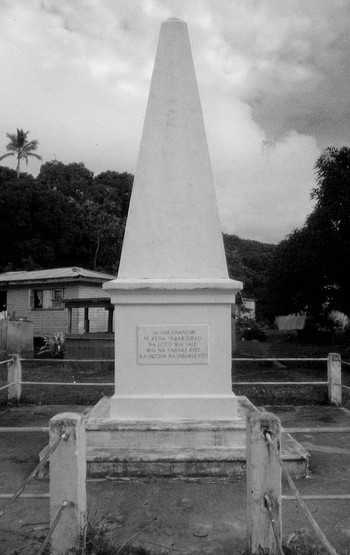
From that time until today a memorial has stood in the noble land of Yale to mark the coming of the Church from Viwa to Yale (Nacagilevu Reference Nacagilevu, Thornley and Vulaono1996: 266–67).Footnote 21
Tui Yale's subjects, anxious about what sort of help would arrive, had asked a hereditary priest to consult the spirits about what was coming from the north. Apparently, the spirits had already informed them that a single man would appear. When they asked again (taroga lesu vua), they were told at that point that no spirits are answering.
This second case is noteworthy for being the iconic scene of conversion remembered today in Kadavu. As Ratu Nacagilevu mentions, a monument stands today in the village of Rakiraki, Yale, to commemorate Christianity's arrival there. I heard versions of this story from the superintendent Methodist minister in Tavuki and a villager from Nagonedau, with the latter telling me that his knowledge about it came from a meke, a ceremonial chant in which histories are sometimes cast. He described how “demon(s) of war” (timoni ni valu), consulted by the hereditary priest, told the priest that the new power arriving on Ratu Varani's incoming ship was too strong and the only option was to surrender. Tippett described the Yale tale as a “tradition,” adding, “it fits the known facts and dates” (1967: 67, n. 5).Footnote 22 To borrow the phrasing of Joseph Conrad in Lord Jim, the events at Yale “seemed to live, with a sort of uncanny vitality, in the minds of men, on the tips of their tongues.” The story on the tips of people's tongues, however, tells how tongues were stilled: “none were responding.” Foreseeing Christianity, the local spirits had announced their surrender and then fallen silent. This is a literal moment of silence, in which the spirits become mute and the priest can no longer give voice to their words (see figure 1).
Memorial to Christianity's Arrival, Rakiraki, Yale, Kadavu (author's photo).

In some cases, spirits were told by their living adherents that they were no longer welcome. Thornley (Reference Thornley2002: 343) gives the example of “the foremost pagan spirit” of Vunibua, in Vitilevu, being ceremonially dismissed by his former adherents with the words, “Thou goest, we used to worship you formerly, but now we do no more, for we are now Christian, adieu… .”Footnote 23 This kind of ceremonial farewell reveals a moral dimension in people's relationships with the old spirits, some of whom were kin. Their “truth” was not in doubt, and their continued efficacy was an open question—still not fully resolved, 150 years later—so they were dismissed respectfully.Footnote 24 Conversely, deities could order their followers to leave their traditional ways and embrace Christianity: “There are not many heathens left in our neighbourhood,” a god in Nakorotubu, Vitilevu, announced in the mid-1860s. “And you must all lotu [convert], everyone. If any of you refuse, I shall have my eye upon him and ere long he shall be baked for me to eat” (Thornley Reference Thornley2002: 231–32).Footnote 25
Case 3: From Shouts to Moans. Although Wesleyan missionaries did not seek wild and hysterical enthusiasm in their congregations, they worried when conversion did not seem emotional enough. With their firm belief in human depravity, the evangelists wanted Fijians to display signs revealing recognition of their fallen state and a determination to overcome it: “Who is sufficient to get at their hearts so as to make their whole frame tremble and force them to cry, ‘what shall we do,’ ” Royce mused in his journal in January 1859. “A process of enlightening would seem necessary to the Feejeean in order that he might discover his miserable condition. This is done by the plain preaching of the gospel” (1855–1862: 277). Such plain preaching could be aggressive, even menacing: E. P. Thompson noted how “Methodist preachers perfected techniques to arouse paroxysms of fear of death and of the unlimited pains of Hell” (Reference Thompson1991: 410).
For the Wesleyans, conversion was seen as a process of development. John Wesley had identified various stages of Christian subjectivity, with the first being “justification,” when one's sins are forgiven, and the second being “regeneration,” or “the renewal of human nature by the grace of God” (Thornley Reference Thornley2000: 19). The third stage is “sanctification,” in which one strives for greater holiness in the state of “Christian perfection” (Ayling Reference Ayling1979: 208). But the path to perfection could double back on itself as “backsliding” Christians fell into sin and reversed their spiritual progress. As an ongoing and uncertain process, conversion could be monitored and evaluated at different moments by the missionaries, who seem to have been perpetually dissatisfied with local spiritual progress: first they despaired over heathen darkness, later they complained that the new Christians were not Christian enough. For the missionaries, a key sign of the (in)adequacy of conversion was how converts spoke of the experience, displaying their inner state verbally. Royce complained in December 1860, “In meeting some of the chiefs lately, I have felt somewhat dissatisfied with many. They seem to speak of salvation as though it was some ordinary, every day affair, and not like being plucked out of the fire” (1855–1862: 468).Footnote 26 Some missionaries did inspire outbursts among members of their congregations, but too much enthusiasm was just as problematic for Wesleyans as too little. In the early 1760s, John Wesley was disturbed when his friend and student Thomas Maxfield led a movement of Methodists who considered themselves to be “in … potently intimate contact with the Deity,” with spectacular proof of their exalted status in visions, miracles, and predictions of the world's end (Ayling Reference Ayling1979: 211). Charles Wesley, John's brother, complained that “Satan … had made ‘mad havoc’; there was acute danger of their whole movement being overwhelmed in ‘a flood of enthusiasm’ ” (ibid.).
As noted above, the first Methodist missionary visit to Kadavu was a relatively placid event, with a friendly chief saying, “that it would be very good to have a Missionary there” (Waterhouse Reference Waterhouse1841: 438). Over time, however, local evangelization became a more turbulent “pentecostal type of movement” (Tippett Reference Tippett1967: 69). Tippett gives the following account of such a movement in Kadavu, describing a memorable confrontation:
During such a movement some 30 young pagan warriors banded themselves together to put a stop to it. Some of them were betrothed to women who were among the penitents and [the warriors] feared complications about their marriages. They marched round the chapel shouting out their intention of breaking up the service, and with lifted clubs entered the place where the Christians were at prayer. They called some by name to come out or be killed. The prayers continued, and one by one as they came in they swooned and fell “prostrate, every nerve quivering convulsively, and the perspiration running from their bodies. Their veins stood out like whipcord and they moaned as if in agony” (ibid.: 69–70, quotation from Joseph Nettleton; see also Tippett Reference Tippett1977: 33–34).
In this encounter, a cacophony of voices is resolved in the wracked, miserable bodies of the “pagans” as they “quiver convulsively.” They are not entirely silent, but their verbal aggression is severely dampened as the warriors are reduced from shouts to moans. The words of Christian prayer triumph over the yells and challenges of the attackers. It is not clear how precisely Tippett is using the term “warrior,” for this is a hereditary role in Fiji—along with other distinct roles such as chiefs, priests, carpenters, and fishers—and he might be using the term simply to indicate a group of belligerent men. I argue that it is likely, however, that a chief or chiefs had initiated this challenge by sending these “warriors” on their task. If I am correct, then the fighters’ dumbstruck, shaking bodies were caught between fear of violating a chief's command, respect for the Christians’ appeal to a new deity, and a practical strategy about how not to lose their future wives.
In other words, quivering silence may have been the warriors’ best option, a way to avoid attacking their betrothed without directly opposing a chief's command. This claim could be pushed further: the men, sent on an unwanted errand, were actively shaping the unfolding situation through a form of silence. In support of this interpretation, I must point out a fact that Tippett missed in his account: the warriors were evidently imitating pre-Christian spirit possession. As described by the missionary Thomas Williams, when Fijians wanted a priest to get in touch with a spirit, they first offered a whale's tooth. The priest would look at the tooth “with deep and serious attention,” and then, “Unbroken silence follows.” Williams continues:
The priest becomes absorbed in thought, and all eyes watch him with unblinking steadiness. In a few minutes he trembles; slight distortions are seen in his face, and twitching movements in his limbs. These increase to a violent muscular action, which spreads until the whole frame is strongly convulsed, and the man shivers as with a strong ague fit. In some instances this is accompanied with murmurs and sobs, the veins are greatly enlarged, and the circulation of the blood quickened. The priest is now possessed by his god, and all his words and actions are considered as no longer his own, but those of the deity who has entered into him (1982: 224).
The warriors, I argue, were apparently becoming “possessed” as they had seen hereditary Fijian priests become possessed. In doing so, they were refusing to challenge the Christians’ ritual performance. In their mediated verbal performance, the warriors represent the ascendance of Christianity over the traditional spirits as they give voice to the anguished moans of the latter.
The shared characteristic of these three cases is that those who claim to speak for universal truth do so actively, and are heard. In contrast, those who treat speaking as effective performance are muted or silenced. In each case, silence bears a different kind of significance and shapes different outcomes. In the first example, the chief's authority is challenged, and he is furious; and, although Rewa's traditional power over Kadavu is still recognized today, the teacher Abraham was correct in stating that the chief could not stop Christianity from taking hold of Kadavu. In the second one, spirits fall silent as they leave their priests’ people to the new code of Christianity. Although the old spirits are no longer worshipped in Kadavu, some of them maintain an unsettling presence, flickering through dreams and marginal spaces, being blamed for curses afflicting families. In the third case, warriors who threaten Christians at prayer are struck down. They vibrate in painful arrest, caught in a moment of transformation where silence seems to be both surrender and strategy. They become possessed but refuse to speak.Footnote 27
CONCLUSION
Early missionary encounters in Fiji were sites in which various forms of knowledge and power met discordantly. Wesleyan Methodist missionaries claimed to represent a “true” God while challenging a Fijian model of speaking with mana. As a result, “moments of silence” occurred in which one side of the encounter was literally or metaphorically muted by its engagement with the other: chiefs were told that their words were no longer effective, traditional spirits fell silent, warriors collapsed quivering and moaning. These moments of silence call attention to the ways that conversion can be seen as a process of learning how to think about new linguistic practices. That is, these silences are religious reflections on the use of particular kinds of language, specifically language that makes humans effective agents and connects them to powerful unseen realms. The significance of the moments of silence considered here lies in their transformative force, in the ways they both mark and effect significant shifts between human and divine power—spoken in local voices, erupting in shouts and dying to moans, trailing off into a faint echo.