


1. Introduction
The integration of economic migrants into the labor market decisively shapes distributional and political outcomes in receiving countries. Historians depict 1900s Uruguay as a highly integrated society, characterized by relatively low inequality, progressive politics, and some features of a welfare state, having benefited from an early (by Latin American and global standards) schooling revolution in the late nineteenth century. Real wages were by 1913 three times higher than in Mediterranean Europe, and immigrants from across the Atlantic (and from nearer by) showed up in numbers, accounting up to a third of the total population, a higher share than in the United States (Williamson, Reference Williamson1999; Sánchez Alonso, Reference Sánchez Alonso2007). How egalitarian was Uruguay from the perspective of these economic migrants? What economic opportunities were open for them?
A lack of quantitative sources from the era of mass migration has impeded answers. Only one census was conducted in Uruguay between 1870 and 1962, which provides very limited cross-tabulated returns (the microdata were destroyed). The approach we introduce in this paper overcomes that limitation and opens a whole new trove of data for historians, economists, and social scientists of Uruguay. The systematic examination of individual-level civil registration records can fill the gaps created by the lack of demographic censuses, which has long prevented scholars from answering basic questions about the country’s historical development, such as when Uruguay became a predominantly urban nation. Through a collaboration with Uruguay’s Civil Registry, we are the first scholars to access these archives in full, including the original index books listing all records, which we can use to draw random samples.
The contribution of this paper is threefold: first, to make available to researchers a comprehensive database of our sample of birth records for the year 1908; second, to show how random sampling can be used to produce reliable datasets from other administrative records in Uruguay (marriage and death certificates); and finally, to carry out a first analysis of this source. Specifically, we examine the labor market dynamics of Uruguayan and migrant workers through their occupational descriptors. In highly stratified societies such as those of Latin America at the turn of the twentieth century, it is possible to get a very good sense of someone’s status from their occupational descriptor. Occupational gaps between migrants and locals (and across different groups of migrants) have already been examined by several scholars for the other so-called “settler societies” which received large inflows of migrants during the First Globalization (Argentina, Australia, Canada, New Zealand, the United States),Footnote 1 although there is no previous systematic study on Uruguay.
Our main findings suggest that the occupations of foreign-born men (using a random sample of fathers as a proxy) were, in general, like that of their Uruguayan counterparts, with the important exception of non-manual high-status occupations (hacendado, i.e. “rancher”), for which being Uruguayan remained a statistically significant advantage after controlling for age, literacy, and location. These results reflect both the success and the limits of Uruguay’s relatively egalitarian society: most immigrants were eagerly integrated into a wide range of professions but found it much more difficult to reach the top of the occupational structure, as key resources (notably land) remained highly concentrated in the hands of a local elite. We argue that this limited egalitarianism is partially explained by a Uruguayan peculiarity that made it an unusual settler economy: the agricultural frontier was already closed by the last quarter of the nineteenth century.
After this introduction, Section 2 provides historical context and situates our study within the comparative empirical literature on migrants’ occupational attainment during the First Globalization. Section 3 describes our data and methods. Section 4 presents and discusses our main results. Section 5 offers a brief discussion. Section 6 concludes.
2. Context
The age of mass migration during the First Globalization saw over 60 million Europeans leave their continent in search of economic opportunity elsewhere, notably in lightly populated and temperate “settler economies.” Australia, Canada, New Zealand, and the United States were prime destinations, as were Argentina and Uruguay (Figure 1). Like their English-speaking counterparts, the River Plate economies had comparatively high wages and low-income inequality in the last quarter of the nineteenth century. These mass migratory flows were bound to have a substantial impact on labor markets and economic inequality, as most migrants were adults with low levels of education and high rates of labor force participation, thereby pushing down unskilled wages in settler economies (Williamson, Reference Williamson1997). As O’Rourke (Reference O’Rourke2001) argued, the outcome of this immigration was reduced inequality in the sending countries (mainly in Europe) and increased inequality in receiving countries.
Yearly immigration flows as % of population in settler economies, 1875–1913.

1 Long description
The x-axis represents the years and the y-axis represents immigration flows as a percentage of population. The graph includes data for Argentina, Canada, United States, Australia, New Zealand and Uruguay. Each country is represented by a different colored line. The graph shows fluctuations in immigration rates over time, with notable peaks and troughs for each country. Argentina and Canada show significant peaks around 1890, while the United States and Australia have more stable trends. New Zealand and Uruguay display varied patterns with occasional spikes.
Scholars have found that landownership structures help explain the extent to which inequality increased as a result of mass immigration of unskilled workers, because large landowners were typically situated at the higher end of the income distribution (Williamson, Reference Williamson2002). The impact on inequality would be greater where land ownership was more concentrated, as in Argentina or Uruguay, and lower in societies where family farm ownership predominated, such as in Canada, Australia, New Zealand, and the northern United States (Denoon, Reference Denoon1983; Fogarty, Reference Fogarty, Platt and Di Tella1985; Álvarez et al., Reference Álvarez, Bértola and Porcile2007; Willebald, Reference Willebald2011). The evidence presented by Williamson indicates that in Latin American countries between 1870 and 1913 the unequal distribution of productive factors led to globalization reducing wage-to-land rent ratios, thereby increasing inequality (Williamson, Reference Williamson1999).
Were immigrants to Uruguay able to become large landowners and access other high-status occupations? By the standards of the First Globalization era, Uruguay was rich, egalitarian, and even progressive. By 1870, Uruguay’s income Gini was 0.48 (about the same as Canada and Australia, lower than Argentina and the United States), and its GDP per capita was among the highest in the world (similar to France’s or Denmark’s), sustained by high international prices for beef and wool.Footnote 2 Moreover, a schooling reform establishing free, secular, and mandatory primary education led to Latin America’s highest literacy rate (c. 60% in 1908) for women as well as men (Sokoloff and Engerman, Reference Sokoloff and Engerman2000), while social legislation was, in some respects, ahead of Western democracies (the death penalty was abolished in 1907, the 8-hour workday was established in 1911, and women won the right to divorce in 1912).Footnote 3 Nevertheless, in Uruguay’s rural hinterland, landownership was concentrated, and the agricultural frontier was closed to a greater extent than in other settler economies, leaving considerable scope for inequality to increase.Footnote 4 And it did: the wage-land rent ratio was 10 times smaller in 1913 than it had been in 1870 (Bértola et al., Reference Bértola, Calicchio, Camou and Porcile1999).
During the two decades before 1910, Uruguay received, relative to population, more immigrants than the United States and ranked only behind Argentina and Canada in global immigration rates (Sánchez Alonso, Reference Sánchez Alonso2007, p. 400). Natural population growth contributed as much to population increases as immigration, as fertility rates remained at pre-demographic transition levels while mortality decreased (Pellegrino and Pollero, Reference Pellegrino, Pollero, Celton, Miró and Sánchez-Albornoz1998). As shown in Table 1, foreign-born people represented a substantial share of the population. Immigration rates reached their historical maximums between 1875 and 1895: most were Italian (about 35%) and Spanish (about 30%), followed by the French (15%) and other Europeans (Mourat, Reference Mourat1969). Non-Europeans, mostly Brazilians and Argentinians, made up about 20% of arrivals (Rial, Reference Rial1983). As first shown by Mourat (Reference Mourat1969), from the 1930s onward, the trend reversed, with immigrants steadily declining as a share of the total population.
Percentage of foreign-born people in Uruguay and Montevideo

Table 1 Long description
The table presents the percentage of foreign-born individuals in Uruguay and its capital, Montevideo, across selected years from 1860 to 1963. In 1860, a significant portion of the population was foreign-born, with 33.5% in Uruguay and 47.7% in Montevideo. By 1908, these percentages had decreased to 17.4% and 30.4%, respectively. The trend continued downward, reaching 8% for Uruguay and 13.5% for Montevideo by 1963. Notably, data for Uruguay in 1884 and 1889 is missing, but Montevideo's figures show a slight fluctuation during these years. Overall, the data indicates a clear decline in the foreign-born population over the century, with Montevideo consistently having a higher percentage than the national average.
Source: National censuses.
European immigrants were predominantly single men of working age who settled in Montevideo. Rial and Klaczko argued that the first wave of European immigrants largely comprised individuals with experience in factory work, retail trade, or military service (Rial and Klaczko, Reference Rial and Klaczko1981). According to these scholars, rural occupations were, therefore, less attractive to European migrants to Uruguay. Others argued (albeit without systematic evidence) that migrants from the Mediterranean found little economic opportunity in the Uruguayan hinterland, as land concentration made access to a plot almost impossible in most areas (Finch, Reference Finch and Cohen1995). Meanwhile, crop farmers working smaller holdings in the south of the country were generally too poor to employ more workers. Across the “latifundia/minifundia” divide, the rural economy expelled immigrant workers rather than attract them (Millot and Bertino, Reference Millot and Bertino1996, pp. 48–55),Footnote 5 and even led to widespread rural poverty among Uruguayans and rural-to-urban migration (Barrán and Nahum, Reference Barrán and Nahum1972, pp. 21–47; Moraes, Reference Moraes2008, pp. 91–93). Therefore, the urban bias of immigration flows contributed to the country’s early (by Latin American standards) demographic transition, already completed by the 1960s (Pellegrino, Reference Pellegrino2010). This pattern would also be explained by Montevideo’s agglomeration advantages and public policy choices in the early 1900s, which led to the highest levels of urban primacy in Latin America (and one of the highest in the world) (Travieso and Herranz-Loncan, Reference Travieso, Herranz-Loncan and Caicedo2023).
Beyond this general picture, the scarcity of sources has severely limited the development of historical demography in Uruguay (Pollero, Reference Pollero2016). National censuses were conducted in 1852, 1860, 1908, 1963, 1975, 1996, 2004, 2011, and 2023, with additional censuses for Montevideo in 1884, 1889, and 1930. The absence of censuses between 1860 and 1908, and particularly between 1908 and 1963, is notable, especially when contrasted with the regular livestock censuses conducted every 6–8 years. Access to other data sources in Uruguay has until now also proven extremely challenging, resulting in reliance on rough population estimates between 1908 and 1963. These estimates have often led to large discrepancies.
Among studies providing population estimates for Uruguay between 1908 and 1963, the most recent and comprehensive work comes from the Population Program at Universidad de la República. For 1887–1962, Pellegrino presents quinquennial age-segment estimates, while Cabella and Pollero offer annual age-segment estimates for 1885-1962 (Pellegrino, Reference Pellegrino2013). For the economically active population, the most widely cited study is Pereira and Trajtenberg’s Evolución de la Población total y activa en el Uruguay 1908–1957. Subsequent studies covering part of the intercensal period (1908–1963) have often used Pereira and Trajtenberg’s estimates as a foundation. For instance, Rial (Reference Rial1983) employed them in his analysis of population structure from 1850 to 1930, while Noya, Pereira, and Prieto (Reference Noya, Pereira and Prieto2003) used them to examine the role of human capital in economic growth in Uruguay between 1942 and 1999. More recently, Fleitas and Román (Reference Fleitas and Román2010) provided estimates for the economically active population between 1908 and 1996. In all cases, economic historians and historical demographers base their results on guesstimates of population variables for the decades without censuses.
In the following sections, we exploit our newly digitized individual-level source to examine the occupational profiles of foreign-born and Uruguayan fathers in 1900s Uruguay. The approach we introduce in this article can produce actual data on demographic variables for Uruguay in the decades without censuses, thereby providing social scientists with a much better empirical foundation for their analyses of sociodemographic behavior and changes in family structures.
3. Data and method
3.1. Sources and sampling Footnote 6
The priorities guiding census-taking became emblematic of the perceived hierarchy between natural and human resources, and in particular of governments’ ideas about where the nation’s wealth lay: the Uruguayan state counted cattle and sheep herds far more often than people, to the great dismay of several generations of scholars. Fortunately, when seeking new sources on Uruguay’s political past, the record turns out to be very generous to the quantitative historian. As a result of the relatively—by Latin American standards—short-lived colonial period (less than a century passed between the foundation of Montevideo and the start of the independence revolution), the Uruguayan Catholic Church did not wield temporal power comparable with the influence it enjoyed elsewhere on the continent. It could be said that the Church’s hold on the country was, much like the Spanish colonial state’s, “weak because it was tardy” (Caetano and Rilla, Reference Caetano and Rilla1994, p. 17). By the late nineteenth century, Uruguay was, to borrow Real de Azúa’s (Reference Real de Azúa1984, p. 21) eloquent definition, “the faintest star in the Catholic firmament of Latin America.” It was, therefore, politically feasible for successive governments to progressively assume functions and spaces the Church once monopolized (graveyards, schools, hospitals, record-keeping), establish mandatory attendance at secular schools, and eventually define Uruguay as a completely secular state in the 1918 constitution, all without facing great opposition (Barrán, Reference Barrán1988; Caetano and Geymonat, Reference Caetano and Geymonat1997). This matters for present purposes because in 1879 the national state took over vital registration from the Church: births, marriages, and deaths had to be recorded with the newly created Registro de Estado Civil (Civil Registry) before any religious sacraments took place. Birth registration was mandatory within 20 days (10 days in urban areas), free of charge, and issued by Justices of the Peace in each court district. A copy of the certificate was sent to each provincial capital and to the national record office in Montevideo, where they remain to this day. This government takeover of registration proved to be much more than a change of management, forms, and stamps: it pioneered the first drive toward full vital registration in Latin America (Breckenridge and Szreter, Reference Breckenridge, Szreter, Breckenridge and Szreter2012, p. 26).Footnote 7
The new secular birth records, unlike the previous religious ones, included children born out of wedlock and, crucially, recorded the father’s occupation. Another significant advantage is that they were centrally processed and kept, so the rate of source survival does not depend on the circumstances of the district where the birth was recorded. The records follow a narrative template that includes information about the place of birth, as well as the nationality, age, and occupation of parents, grandparents, and witnesses to the registration. The father was asked to declare his own age and to sign the register. Despite the wealth of individual-level data offered by the birth records, the court clerks’ very readable handwriting, and the almost perfect rate and conditions of source survival, scholars have never explored them systematically as a source, other than for reconstructing individual family histories or tracing particular lineages.
The reasons for such neglect lie beyond the scope of this paper, but at least two factors should be noted. First, these sources are held in a civil registration office, an arena more familiar to lawyers and notaries than to historians and economists, and one where access to records is normally not free of charge. The second problem is that insights from this large corpus, comprising millions of individual manuscript records from 1879 to 2013 (when files became digital), can be gained only by systematically extracting large amounts of information, which requires a significant time investment by expert staff, as some contextual knowledge is required for effective transcription. A large team of scholars and a significant research grant would be needed to fully extract the data contained in all the records. The alternative is to work with representative samples. Given that the seminal historiography on this period was written before personal computers and statistical software were widely available, and that most historians remain unfamiliar with the potential and limitations of sampling methodologies, neither path has been explored until now, and the potential of birth records emerging from the early years of state-led registration and recognition remains untapped.
A crucial question regarding the usefulness of these birth records as sources, at least from the perspective of quantitative history, concerns the extent and quality of their coverage. Even if some under-registration of births, particularly in rural areas, must have occurred, scholars have generally regarded the coverage of vital statistics in Uruguay through individual records in this period as reliable by international standards (Birn, Reference Birn, Breckenridge and Szreter2012, pp. 419–422). Moreover, the implied fertility rates calculated on the basis of these records (131 live births per 1,000 women of reproductive age in 1908, or about 6 live children per woman throughout her life) are consistent with what can be expected of a pre-demographic transition society, which is how historical demographers have characterized Uruguay in this period (Pellegrino and Pollero, Reference Pellegrino, Pollero, Celton, Miró and Sánchez-Albornoz1998). This scenario of high fertility rates also increases the likelihood that fathers (and their occupations) will be representative of men in general, as it makes it more likely that men in a fertile relationship will appear in the birth records as fathers.
The quality of the occupational data derived from these birth records depends not only on the reliability of the registration practices that produced the underlying data (which we have reason to think was relatively high) and on the fertility and age specificity of different occupations (which demographic scholarship and the 1908 census’ age cohort data suggest does not produce large distortions), but also on the method used to extract information. Ideally, a quasi-census of fathers could be constructed by extracting the father’s occupation from each birth record. Indeed, this method could (and hopefully will in the future) make up at least partially for the census hiatus in Uruguayan history. However, such an approach is simply impracticable without very substantial funding. Fortunately, a random sample that is large enough can give a reasonably representative image of the whole population of fathers who appear in the records.Footnote 8
This Civil Registry maintains books listing all these certificates alphabetically, enabling us to gather the necessary information to obtain a sample of birth records from various years in Uruguay. From 1879 to 1915, these books are organized by province (“departamentos”) and alphabetically by surnames. However, after 1916, this listing was discontinued, and information regarding each birth is contained only in individual files, significantly limiting the ability to construct a comprehensive list and sample. The books with birth record lists resumed in 1935. These books are not digitized, and some pages need to be handled carefully due to damage. Despite the complete coverage provided, the books and birth records are not stored under optimal conditions and are at risk of deterioration.
The sampling strategy used stratified random samples from Montevideo and the rest of the country. Given the total population of births (approximately 30,000 at the beginning of the century), we estimated a sample size of 388 for the capital city, Montevideo, and 1,300 for the rest of the country. Notably, underreporting of births is not considered an issue in Uruguay, and all selected birth records in the sample are available in the Registry, so we can consider the sample free from bias that would require correction. The sample was drawn in R, following standard parameters in the literature (95% confidence interval, 5% oversampling, and an anticipated response distribution of 0.5).Footnote 9
The decision to start in 1908 was intentional, allowing us to compare the sample results with data from Uruguay’s 1908 population census to test the validity of the selected sampling methodology. Below we present some descriptive statistics comparing both sources (1908 census and 1908 sample), which are encouraging. Table 2 shows the distribution of Uruguayan and migrant adult population for both sexes, according to the census and sample, demonstrating that the sample tracks the census results well.
Distribution of female and male adults 15–39, Uruguayan and migrants, census vs our random sample, 1908

Table 2 Long description
The table compares the distribution of Uruguayan and migrant adults aged 15 to 39 based on the 1908 census and a sample of birth records from the same year. In the census, Uruguayan men and women make up 78% and 86% respectively, while migrants account for 22% of men and 14% of women. The sample indicates a slight increase in migrant representation, with 26% of men and 17% of women being migrants. This suggests a higher proportion of migrants in the sample compared to the census data, particularly among men. The data highlights differences in population distribution between the census and the sample, which may reflect sampling variability or demographic shifts.
Source: Estimates based on census 1908 and our sample of birth records 1908 (see text).
When focusing on mothers aged 15–54 and differentiating between Uruguayan and migrant women, we observe that the distribution between married and single mothers is identical across both data sources (the 1908 census and the 1908 sample). The proportion of single mothers among Uruguayan women is three times higher than among foreign-born women, which may reflect the more vulnerable conditions of the former (Table 3). During this period, being a single mother may be associated with having a child out of wedlock and raising the child alone. This observation can be further explored by analyzing the ages of single mothers, their family context (for example, their parents’ jobs and whether they are daughters of single mothers), and their educational level (approximated by their ability to sign the birth certificate). Regarding this last variable, in our sample we can examine a proxy for literacy among the group of women who registered the child: only 28% of single mothers could sign their names, compared with 65% of married mothers.Footnote 10
Distribution of single and married mothers, Uruguayan and migrants, census vs our random sample, 1908

Table 3 Long description
The table compares the marital status of Uruguayan and migrant mothers aged 15 to 54 in 1908, using both census data and a random sample. Among Uruguayan mothers, 19.4% were single in both the sample and census, while for migrant mothers, the sample showed 6.2% were single compared to 5.9% in the census. The total number of married Uruguayan mothers was significantly higher than single mothers, with 920 in the sample and 64,890 in the census. Migrant mothers also showed a higher number of married individuals, with 212 in the sample and 24,225 in the census. The data suggests a consistent pattern of higher marriage rates among both Uruguayan and migrant mothers, with a slightly higher percentage of single mothers in the sample compared to the census for migrants.
Source: Estimates based on census 1908 and our sample of birth records 1908 (see text).
Finally, we compared the occupational distribution of male workers (aged 20–59) in Uruguay and Montevideo. As Table 4 shows, the differences between the two sources do not alter the main message: the highest proportion of workers are in trade and industry, with the share in Montevideo higher than in Uruguay as a whole. This is an expected result, as the capital concentrated the development of services and manufacturing production. On the other hand, in Uruguay as a whole, according to the census, 30% of workers were employed in agriculture, whereas in our sample, this percentage reaches 40%. In Montevideo, these figures are considerably lower (7% in both sources). Hence, the group of ‘liberal professionals’ is significantly more important in Montevideo than in the rest of the country.
Distribution of male workers aged 20–59, Uruguay and Montevideo, census vs our random sample, 1908

Table 4 Long description
The table compares the distribution of male workers aged 20-59 across various sectors in Uruguay and Montevideo in 1908, using both census data and a random sample. Trade and industry had the highest employment, with 54% of workers in Uruguay and 78% in Montevideo according to the census, while the sample showed slightly lower percentages. Agriculture and ranching had lower employment rates, with agriculture accounting for 16% in Uruguay and 6% in Montevideo, and ranching at 14% and 1% respectively, according to census data. The sample indicated higher percentages for agriculture and ranching in Uruguay but similar trends in Montevideo. Liberal professions showed a notable difference, with the sample indicating a higher percentage in Montevideo compared to the census. These variations suggest potential sampling biases or differences in data collection methods.
Source: Estimates based on census 1908 and our sample of birth records 1908 (see text).
Notes: Liberal professions exclude students. Hacendados are included under ranching.
Because our analysis focuses on occupational attainment, we classified each occupation declared in the birth record using HISCLASS. This classification is based on HISCO, a historical version of the 1968 International Standard Classification of Occupations (ISCO), developed by the International Labour Organization. While HISCO classifies 1,600 occupations, the original HISCLASS reduces these to a manageable set of 12 socioeconomic groups using theoretical and specific criteria. Each group in HISCLASS includes divisions by manual vs non-manual work, skill level, degree of supervision, and economic sector. As suggested by the comparative empirical literature (Silvestre et al., Reference Silvestre, Ayuda and Pinilla2015; Westland, 2021), we combined the 12 HISCLASS categories into 4 groups. This reclassification is useful when modeling and dealing with few observations in some categories. Following the presentation in Silvestre et al. (2025), Table 4 shows how the 12 HISCLASS categories (column II) have been converted into the ones used in our study (column I).
In our sample, we recorded 78 occupations for male workers (i.e., the fathers of the newborn babies). The final column in Table 5 shows the most common occupations in each of our final categories. The occupation with the most observations is “day laborer” (332 observations out of a total of 1,353 with occupational data). In Uruguay, as in other countries, this occupation (jornalero in Spanish) refers to workers paid on a daily basis, but it does not indicate a specific sectoral employment (whether in farms, factories, or construction).
Occupational classification, following HISCLASS groups

Table 5 Long description
The table categorizes occupations based on HISCLASS groups, highlighting a range from unskilled manual workers to high-skilled non-manual professionals. Group I includes unskilled manual laborers such as laborers and farm workers. Group II covers low to medium-skilled manual workers, including blacksmiths, farmers, and carpenters. Group III consists of low to medium-skilled non-manual roles like drivers and traders. Group IV features high-skilled non-manual professionals, including ranchers and educators. The classification illustrates the diversity of occupational skills and roles, emphasizing the progression from manual to non-manual and from unskilled to highly skilled professions.
Source: HISCLASS using the proposal written by Silvestre et al. (Reference Silvestre, Ayuda and Pinilla2015).
Finally, as women’s occupations were largely recorded as “(domestic) labor,” we focused only on men, for whom observations with unreported occupations are negligible.Footnote 11
3.2. Method
To address our research question, we use a multinomial logit (MNL) model to estimate the occupational attainment of male workers in Uruguay in 1908, controlling for relevant variables such as literacy, place of residence, marital status, and place of origin. The MNL model is commonly used when the outcome variable is nominal, i.e., when its categories do not have a natural order. Although our classification (Table 5) may appear hierarchical, this is not the case for the “low and medium skilled, manual” and “low and medium skilled, non-manual” categories: these cannot be ordered in a clear-cut way in terms of income or social status in the historical context we are studying.
The determinants of occupational attainment in our regression model include two human capital attributes, namely age and literacy, as well as other variables such as family structure, place of origin, and place of residence. Age may be used as a proxy for experience, while age squared captures the possibility of decreasing returns to experience in occupational attainment. Literacy is defined as the ability to sign (a dummy variable set to 1 for literate respondents). On the other hand, marital status (dummy variable for married vs not married) is also included as a family structure variable. Finally, the variable place of origin indicates whether the worker is Uruguayan or an immigrant (immigrant = 1), and the variable place of residence is a dummy variable where Montevideo is 1 and any other place in the country is 0.
In formal terms, the MNL model is an extension of the binary logit model for predicting categorical outcomes with more than two categories. For each category j (except one reference category), the MNL function is defined as follows:
 \begin{equation}log\left( {\frac{{P({Y_i} = {\text{j}}\mid {\text{ }}{X_i}}}{{P({Y_i} = 0\mid {\text{ }}{X_i}}}} \right) = {X_i}{\beta _j}\,for{\text{ }}j = 1,{\text{ }}2,\,\ldots\ldots J - 1.\end{equation}
To obtain the probabilities for category j, we use the following formula:
 \begin{equation}P\left( {{Y_i} = j{\text{|}}{X_i}} \right) = \frac{{{e^{{X_i}{\beta _j}}}}}{{1 + \mathop \sum \nolimits_{k = 1}^{J - 1} {e^{{X_i}{\beta _k}}}}}\,for\ j = 1, 2,\ldots\ldots J - 1.\end{equation}
And for the reference category 0:
 \begin{equation}P\left( {{Y_i} = 0{\text{|}}{X_i}} \right) = \frac{1}{{1 + \mathop \sum \nolimits_{k = 1}^{J - 1} {e^{{X_i}{\beta _k}}}}}\,for\ j = 1, 2, \ldots \ldots J - 1.\end{equation}
4. Results
As we are interested in the differences or similarities in the occupational attainment of local and migrant workers, we describe some variables in our sample, dividing both groups by occupational skills (into the four groups defined above). Table 6 shows that in the “unskilled” and “low and medium skilled, manual” groups, the distribution between Uruguayans and immigrants is quite similar (around 25% and 45%, respectively). We observe a higher proportion of immigrants in Group III (“low and medium skilled, non-manual”) and, on the other hand, a lower presence of immigrants in Group IV (“high skilled”). Therefore, immigrants were well integrated in the labor market across almost all these broad categories and were overrepresented in urban activities associated with higher human capital (Group III).
Summary descriptive of male workers, Uruguayan, and migrants, by occupational skills, sample Uruguay 1908

Table 6 Long description
The table compares Uruguayan and migrant male workers in Uruguay in 1908 by occupational skills, nationality, and other demographics. Uruguayan workers are mostly in skill level II, making up nearly half of their total, while migrants are more evenly spread, with a significant portion in skill levels I and II. Italians and Spaniards are the most literate among migrants, with high percentages able to sign. Migrants have a higher percentage of European parentage compared to Uruguayans. A larger share of migrants resides in Montevideo, with skill level III being the most common among them. Marital status shows a high percentage of married individuals across all groups, with migrants less likely to be married to Uruguayans compared to their Uruguayan counterparts.
Source: our estimates from 1908 birth records sampling (see text).
Note: “European parents” equals 1 whether at least one of the male worker’s parents was born in Europe.
When considering other variables, in Group I, we find the lowest proportions of married workers (though much lower for locals: 67% compared with migrants’ 82%), literate workers (50% and 65% respectively), and those born with at least one European parent (17% and 61%). Among nationalities, Argentinian and Brazilian workers are overrepresented in this group (46% and 39%, respectively). We could infer that this group has accumulated less human capital, and, taking marriage and European lineage as evidence of expanding social networks, less social capital as well. If we analyze whom these male workers marry, we observe that in Group I, 90% of natives marry Uruguayan women, while among migrants the figure is 50%, the lowest among the four occupational categories. In other words, lower-skilled migrants were also the least integrated in terms of marriage. Importantly, the kind of low-skill work that migrants and locals did was often different. Uruguayans lived mainly outside the capital in mostly rural settlements (82%), whereas migrants were concentrated in Montevideo (51%). Thus, the work that day laborers actually did was presumably different (Uruguayans more involved in farm and ranch work, and migrants in construction, public works, and factories).
Almost half of workers, regardless of origin, were in low- and medium-skilled manual occupations. In this Group (II), a higher proportion of workers were married (91% and 90% for Uruguayans and migrants, respectively), and literacy was higher (69% and 73%) than in Group I (but, with some exceptions, lower than in Groups III and IV). Contrary to Group I, in this group, workers born in Spain or Italy are overrepresented (46% and 50%, respectively).
The group of low- and medium-skilled non-manual workers (Group III), for both locals and migrants, is characterized by the highest literacy levels (94% and 89%) and the highest share of workers living in Montevideo (42% and 59%). Furthermore, workers in Group III record very high marriage rates (82% and 97%) and a high share of European descent (47%, even among Uruguayans). This latter is correlated with the higher representation of Spaniards and Italians (31% and 21%, respectively). Contrary to Group I, we could infer that men in this occupation had accumulated more human and social capital, and it may be suggested that immigrants found in the capital city an environment more conducive to occupational integration.
Finally, the group of high-skilled, high-status workers has a higher share of workers living outside the capital city (90% and 82% for Uruguayans and migrants, respectively), which is strongly associated with the “rancher” occupation. They are also married at high rates (92% and 76%), and migrants in this group are much more likely to be married to Uruguayan women (76%) than migrants in the other occupational groups. Their literacy levels were well above the average (83% and 77%), while being less likely to have one European parent (33% among Uruguayans). However, when analyzing by nationality, we find a high share of Argentinians and Brazilians associated with this occupational skill. To sum up, this group is strongly associated with the “rancher” occupational descriptor and is composed largely of those born in Uruguay. We may also suspect some social mobility driven by intermarriage for a very select group of migrants (6%).
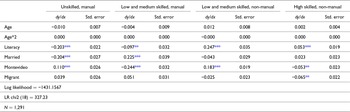
Turning to a more systematic analysis, the main results of the MNL models are presented in Table 7. The coefficients represent the average marginal effect on the predicted probability of a father belonging to a particular occupational category. For continuous variables, the coefficient indicates the effect of a one-unit increase; for binary variables, it indicates the effect of a discrete change (from 0 to 1). We ran likelihood-ratio tests, which rejected the null hypothesis.
Multinomial logit model of occupational attainment for male workers in 1908

Table 7 Long description
The table presents a multinomial logit model analyzing factors affecting occupational attainment for male workers in 1908. Key findings include literacy having a strong positive impact on high-skilled non-manual occupations, while being married significantly increases the likelihood of low and medium-skilled manual jobs. Age has a minor negative effect on unskilled manual occupations and a positive effect on high-skilled non-manual jobs. Living in Montevideo increases the likelihood of unskilled manual and high-skilled non-manual occupations but decreases the likelihood of low and medium-skilled manual jobs. Migrant status shows a slight positive effect on low and medium-skilled manual jobs but a negative effect on high-skilled non-manual occupations. Statistical significance is noted at various levels, indicating robust findings.
Notes: *** indicates statistical significance at the 1% level, ** indicates statistical significance at the 5% level. The regression includes an intercept term and is estimated using heteroskedasticity-robust standard errors. dy/dx refers to the marginal impact.
First, the results for the age variables are reasonable. Each additional year of age, as a proxy for experience, reduces the probability of belonging to one of the two manual categories. These results suggest that experience increases the probability of belonging to a non-manual category. However, the effects are not statistically significant. Turning to literacy, we obtain significant results across the four categories. The predicted probability of belonging to the “unskilled, manual” category is 20% lower at the mean for a literate individual, and 10% lower in the “low and medium skilled, manual” category. By contrast, the predicted probabilities at the mean for literate individuals are 22% and 6% higher in the two non-manual categories. The relatively low impact of human capital in the “high skilled, non-manual” category may suggest that other elements, such as further education, existing wealth, or social networks, are necessary to attain occupations in this group.
When comparing residence in the capital city with residence elsewhere outside Montevideo, all results are statistically significant. The predicted probability of belonging to the “unskilled, manual” category is 11% higher for a worker in Montevideo and 18% higher in the “low and medium skilled, non-manual” category. This result is reasonable, as employment in Montevideo is highly correlated with services, trade and liberal professions, and it also concentrates a higher proportion of day laborers. On the other hand, the predicted probabilities are 24% lower in the “low and medium skilled, manual” category and 5% lower in the more skilled group of workers. The variable “married” shows significant results in the first two groups. If the worker is married, the predicted probability of belonging to the “unskilled, manual” category is 20% lower, and conversely, the probability of belonging to the “low and medium skilled, manual” group is 21% higher.
Finally, the variable “migrant” yields interesting results. In comparison with the reference group of Uruguayans, the migrant status has a negative and significant effect among high-skilled workers when controlling for age, literacy, location, and marital status. Therefore, this result confirms that migrants faced a disadvantage in accessing the very top of the occupational structure. In future studies, it may be interesting to analyze whether this changed over the decades as the immigration flow ebbed.
5. Discussion
In addition to offering the first analysis of occupational attainment during Uruguay’s belle époque, our results contribute to the broader empirical literature on occupational attainment and the economic outcomes of migrants during the First Globalization. Scholars have compared the occupations of migrants and locals, focusing on migrants’ ability to move into higher-status jobs after settling in host countries. They often construct longitudinal panels by linking individuals across censuses, and sometimes even across other sources such as passenger lists of arrivals. Some of the literature also relies on occupational income scores to estimate earnings gaps, based on the potential income associated with different jobs. While these two methodological paths are not open to economic historians of Uruguay given source limitations, we are able to exploit an individual-level source that provides us with additional variables for each of our observations.
We find that in the 1900s immigrants were typically employed in similar occupations to native-born Uruguayans (across occupational Groups I–III), as was the case in the United States during the same period (Abramitzky and Boustan, Reference Abramitzky and Boustan2017). Nevertheless, this pattern does not hold when we zoom in on the highest-status occupations, especially “rancher.” This significant yet incomplete integration of migrants into the upper levels of occupational status also aligns with findings from Silvestre, Ayuda, and Pinilla’s study of Barcelona in 1930 (Silvestre et al., Reference Silvestre, Ayuda and Pinilla2015).
In the case of Uruguay, this was largely explained by migrants’ limited access to land. As in neighboring Argentina, European migrants concentrated in urban areas, where Italians, in particular, achieved absolute upward mobility in Buenos Aires and economic integration through access to relatively high-paying jobs (Pérez, Reference Pérez2017; Arroyo Abad et al., Reference Arroyo Abad, Maurer and Sánchez‐Alonso2021). Given that the agricultural frontier was closed in Uruguay, migrants were even more concentrated in urban occupations, less likely to become large landowners, and therefore comparatively less present in high-status occupations in the countryside (where most people still lived in the 1900s).
This result should not be taken to mean that access to the rural elite was impossible for foreigners. Since Real de Azúa’s seminal study of Uruguayan elites, scholars have argued that, in the wake of the economic dislocation caused by the long cycle of post-independence wars (ending with the Guerra Grande in 1851), a “new rural upper class” emerged, in which foreigners played a larger role than in the “old patrician class” (Real de Azúa, Reference Real de Azúa1961; Barrán and Nahum, Reference Barrán and Nahum1967, pp. 317–330; Sims, Reference Sims2014, p. 185). The economic impact of foreign landowners (notably the Basque, Catalan, British, French, and German) has been debated: while it was traditionally argued that they were an enlightened group of entrepreneurs who led agricultural innovations, recent quantitative research has questioned this assumption in the case of cattle improvement (Barrán and Nahum, Reference Barrán and Nahum1973, pp. 205–206; Millot and Bertino, Reference Millot and Bertino1996, p. 101; Travieso, Reference Travieso2023). By 1908, foreigners accounted for 30% of landowners, substantially above their overall share of the population (17.4%) and presumably representing a substantial increase from the mid-nineteenth century. How does this fit with our results? We would argue that foreigners were overrepresented in the bottom half of the landownership distribution but underrepresented among very large landowners. We cannot test this directly because the microdata from the agricultural censuses have not survived. However, our evidence from birth records does offer some indication of this. The occupational descriptor we have translated as “rancher” (hacendado) could also be rendered as “breeder” or “ranch owner,” and it implies a much higher status than “farmer” and ownership of a substantially larger landholding. According to a contemporary Uruguayan dictionary, hacendado was synonymous with estanciero, and it meant “someone who has one or several estancias” (i.e. cattle or sheep ranches) (Granada, Reference Granada1889, p. 48). This is because, in the Río de la Plata region, hacienda meant, above all, livestock. Smaller landowning farmers were normally described as labrador or agricultor, and among them migrants were relatively more common. As has noted for the case of Argentina, there was a substantial difference in income between these two agricultural occupational descriptors in the late nineteenth and early twentieth centuries.
On that note, how unusual was Uruguay in terms of the occupational assimilation of immigrants compared with other settler societies? Belle époque Uruguay shares, to some extent, the pattern observed in the United States at the time, where the average immigrant generally accessed the same occupations as the average native-born worker (Abramitzky and Boustan, Reference Abramitzky and Boustan2017). In the case of Canada, there is also data on the intended occupational distribution of migrants in the 1910s (i.e., the occupations they aspired to in the host country), which was very similar to that of the native workforce. By 1921, some migrants had moved away from farming, but their non-agricultural occupational structure remained very similar to that of native Canadians (Green and Green, Reference Green and Green2016). In the case of Argentina, the occupational pattern of immigrants and natives differed, with farming being much more common among natives and shopkeeping more prevalent among immigrants, who, like in Uruguay, were concentrated in urban areas (Pérez, Reference Pérez2017). Moreover, immigrants went on to achieve more upward occupational and earnings mobility across generations than native-born families (Pérez, Reference Pérez2017).
In sum, Uruguay did not fundamentally diverge from most other settler economies, insofar as immigrants were generally able to access the same occupations as locals, especially in the urban economy, where natives were relatively more present in farming. Nevertheless, the specific gap in high-status occupations seems larger in the Uruguayan case than in other settler economies.
6. Conclusion
We have demonstrated the feasibility and effectiveness of using random samples of Uruguayan birth records for historical research, which we hope will help fill the largest evidential gap in modern Uruguayan economic and social history. Armed with these new data, our study provided new insights into the labor market of belle époque Uruguay, focusing on the different occupational attainments of Uruguayan and migrant workers.
We found that the occupations of foreign-born fathers were, in general, similar to those of their Uruguayan counterparts, with the important exception of non-manual high-status occupations (“rancher” being the most common), where being a Uruguayan remained a statistically significant advantage after controlling for age, literacy, and location. This reflects both the success and the limits of Uruguay’s comparatively egalitarian economy, by Latin American standards. Most economic migrants were eagerly integrated into a wide range of occupational paths but were, at the same time, less able to reach the top of an occupational structure where key resources (notably land) remained highly concentrated in the hands of a local elite. In this respect, Uruguay proved less egalitarian than other settler societies at the time (and since).
In future research, we will extract samples for additional benchmark years and include more demographic variables to build a comprehensive picture of the long decades without censuses in Uruguay. In so doing, we will advocate for improved archival practices to preserve valuable historical data for future research: the sources we use in this paper are still available but are rapidly deteriorating because they are not kept in a historical archive. By continuing this line of research, we aim to enhance our understanding of historical demographic patterns. Further studies may examine intergenerational mobility by place of origin, particularly among migrants, and the marriage market, including links to social endogamy and by nationality.
Acknowledgements
We want to thank Julieta Ferreira, William Travieso, and the staff of the Civil Registry of Uruguay for their support during the data collection process. We also extend our gratitude to the anonymous reviewers for their constructive feedback on earlier versions of this article.