Introduction
In today’s political world, news outlets deliver ideas and information critical to both public and policymaker decisionmaking. The news media in a democracy “serves a civic forum encouraging pluralistic debate about public affairs, as a watchdog against the abuse of power, and as a mobilizing agent encouraging public learning and participation in the political process” (Norris Reference Norris2000, 12). Yet, despite the importance of the news media, the forces that help determine cross-national variance in media agendas remain largely unexplored. Here, we present an idea that is both straightforward and important: between media systems linked by freedom of the press, journalistic operating procedures – such as beat reporting and, of key relevance here, reporters’ incentive-driven relationships with government officials – can yield considerable variance in the nature of the news produced above and beyond the role of events and politics topical to each country. Specifically, compared with nations where journalists and government officials tend to be geographically and socially removed from one another, nations where the norm is for journalists and government officials to work closely together should be more strongly characterised by news that gives disproportionately high representation to government officials relative to their degree of representation in the policymaking community.
We examine this idea by comparing the topics and actors mentioned in all front-page news stories in the year 2008 in the leading daily papers in South Korea (hereafter Korea) and the United States (US) the Hankyoreh Daily and the New York Times (NYT), respectively. In each country, we compare the distribution of political actors’ news coverage relative to their actual policy participation.
We find that US news is, in fact, much less representative of the relative degree of participation of different actors in the policymaking process, which may give us normative reason for pause. At the same time though, when we compare the nature of the gap between actors’ policymaking activity and news coverage in Korea, we find that the Hankyoreh Daily puts a strongly disproportionate focus on the actions of government insiders and their perspectives. Although the NYT also gives greater representation to the views of the bureaucracy and experts than to citizens and other actors, it also over-represents a wider range of groups and individuals from both inside and outside the government, thus illustrating more pluralism in the course of its disproportionate representation.
These findings hold important implications for comparative political communication and policymaking research. Our findings suggest that, while actors’ representation in the news may never reflect their underlying participation in the policy community, in countries where journalists maintain close relations with their government sources, this disproportionate representation will take a particular form, privileging state actors especially. Non-government actors consequently have a harder time gaining access to the media agenda in these countries, thereby limiting the diversity of policy perspectives conveyed to citizens. Freedom of the press may be a necessary condition for a media forum offering a pluralism of perspectives in a democracy, but it is not a sufficient one. Journalistic operating procedures also matter. Specifically, the housing of reporters (i.e. inside government agencies) affects press–government interactions and, subsequently, the diversity of the policy-community views delivered to the public in the news.
Testing this causal story – that journalistic operating procedures are at least partially responsible for the differences we observe in media attention given to policymakers in these two countries – is beyond the scope of this paper. Korea and the US are very different nations, with many complex variables at work. Still, our theoretical story is a solid and sensible one, reinforced through discussion of Korean and US journalistic operating procedures and the descriptive evidence we present. In addition, whatever the precise combination of mechanisms behind the differences we find in Korean and US media representation of political actors, these differences are politically meaningful. Our study demonstrates empirically that neither Korean nor US citizens see media signals that are representative of political actors’ participation in the policymaking community. Furthermore, these media signals are asymmetrically unrepresentative between the two states.
A comparative perspective on news coverage
In democracies, the role of media reaches beyond providing information that contributes to the quality of citizen decisionmaking (on mediation, see Mazzoleni and Schulz Reference Mazzoleni and Schulz1999). The media is also essential to a democratic system due to the twin roles it serves: as a public forum for discussion and as a watchdog (see Norris Reference Norris2004). Media promotes government transparency by revealing information to the public and, in doing so, holding policymakers accountable. Additionally, channels of mass communication offer room for debate by facilitating discussions about the most important policy issues. Gaining media attention is thus important for policymakers in order to win support (Domke et al. Reference Domke, Graham, Coe, John and Coopman2006), because news coverage greatly impacts public perceptions of policy problems (Iyengar and Kinder Reference Iyengar and Kinder1987; Wolfsfeld Reference Wolfsfeld1997). Similarly, through media attention, groups outside the government can influence policy debates (Andrews and Edwards Reference Andrews and Edwards2004). As Schudson notes, “media in liberal societies carry out a wider variety of roles, cheerleading the established order, alarming the citizenry about flaws in that order, providing a civic forum for political debate, and serving as a battleground among contesting elites” (Reference Ferree, Gamson, Gerhards and Rucht2002, 254).
By contrast, the state-influenced mass media in authoritarian political systems performs a very different role. Specifically, the media in non-democratic governments reinforces state control of the public by limiting information and, more generally, the public forum available for discussion and deliberation. Typically, journalists in authoritarian systems are prevented from offering public criticisms of the state; press freedom is simply not guaranteed (Grant Reference Grant1988). Examples of such practices can be found in Latin America, where news organisations are subject to indirect control by the state (Waisbord Reference Waisbord2000), and in China, where the state censors coverage of anti-government activities (Zhao Reference Zhao1998).
In sum, research in comparative political communication argues that having a media system independent of state control is key to democracy, since a free press provides a public forum where diverse viewpoints are offered and in which the public may keep tabs on government (Dahlgren Reference Dahlgren1995). Indeed, cross-national studies offer empirical evidence that press freedom correlates highly with several indicators of democratic performance: greater political stability, rule of law, government efficiency, human development index, per capita income and lower corruption (Freedom House 2000; Hallin and Papathanassopoulos Reference Hallin and Papathanassopoulos2002).
Yet, beyond highlighting different functions of the media in free-press states versus media systems in countries where the state directly or indirectly controls the press, studies in comparative political communication have only just begun to examine how (and why) the nature of media attention may vary among those nations that have press freedom (see e.g. Pfetsch Reference Pfetsch2001; van Dalen Reference van Dalen2012). Although these studies recognise the presence of distinct media cultures across political systems, it is unclear whether different journalistic norms affect policy voices featured in the news, and subsequently impact how public policy debates unfold (for an exception, see Ferree et al. Reference Ferree, Gamson, Gerhards and Rucht2002). Furthermore, comparative media studies, though growing rapidly, remain largely isolated from cross-national public policy studies. Thus, our paper takes an important step in establishing the link between comparative political communication research and comparative public policy research.
Specifically, we argue that the proximity of reporters to government matters. Agency-based press offices produce an over-representation of the president and other executive branch actors in the news and an under-representation of voices of opposition parties and outside groups. In contrast, more disparate office arrangements of press–government relations result in news that, while no more proportional to levels of participation in the policymaking process, represents a more diverse array of viewpoints.
In short, the characteristics of media attention – namely, the topics that are covered and the actors whose views are included – look strikingly dissimilar across democratic systems, beyond the variance that would be explained simply by differences in policy problems, events and perspectives topical to each nation, or by each nation’s role in the larger global context (e.g. the US being one of the largest international players). We argue that distinct journalistic operating procedures across political systems accentuate the nature of the discrepancy in each nation between actors’ policymaking participation and their representation in the news.
The forces that shape political actors’ representation in the news
Early political communication studies explored the news as largely a mirror of political reality (Lippman Reference Lippmann1922). According to this view, news is a straightforward depiction of politics and events; the topics appearing in the news reflect the underlying problems at hand, as well as those actors central to the policy debates. Normatively, the ideal media in a democracy represents the voices of all key interests in policy debates, allowing citizens to hear and then assess a plurality of viewpoints.
Yet, in many ways, the notion of news coverage as a mirror of underlying social and political phenomena, including the distribution of actors’ participation in the policymaking process, simply is not true (or plausible). In reality, news provides a reconstructed view of the actual policy debates due to a host of institutional and societal factors that influence individual journalists, news outlets and each nation’s media system as a whole. Below, we summarise three of the many factors that shape media portrayals of policy debates and policy actors: news values, institutional incentives and – our key variable of interest – journalistic operating procedures. These three factors are, of course, highly inter-related, and they are often conditional on events, different types of which can trigger different kinds of media coverage (e.g. Kingdon Reference Kingdon1995; Birkland Reference Birkland1997; Lawrence Reference Lawrence2000). In the important context of these other factors, we argue that differences in journalistic operating procedures between free-press states help to predict and explain differences in the extent to which types of political actors are “over”- or “under”-represented in each country’s news relative to these actors’ participation in the policymaking community.
News values
Journalism standards estimate the relative newsworthiness of different news items and actors based on several criteria, such as the degrees of sensationalism and conflict, the social and geographical proximity to the public, and the fame of the actors involved (Galtung and Ruge Reference Galtung and Ruge1965; Herbert Reference Herbert2000; Harcup and O’Neill Reference Harcup and O’Neill2001; Gans Reference Gans2004; Cook Reference Cook2005). In line with this view, certain characteristics of actors and groups, such as prominence, prestige and resource, have consistently proven to be useful predictors of which actors and groups are included in the news (Danielian and Page Reference Danielian and Page1994; Sellers and Schaffner Reference Sellers and Schaffner2007; Tresch Reference Tresch2009). Thus, news coverage of policy issues is shaped not only by events but also by which events – and which actors’ voices – are deemed most newsworthy by a country’s journalists and editors (Schudson Reference Schudson2002). Relative standards of newsworthiness – or news values – are influenced by the particular institutional structure of each media system, as well as by social norms (Hallin and Mancini Reference Hallin and Mancini2004).
Institutional incentives
Institutional incentives – such as the particular financial incentives each news outlet has to scoop its competitors on a breaking story, and the professional incentives each journalist has to land a front-page story – affect nearly every aspect of the news generation process. For instance, the financial strength of a country’s news outlets in relation to government subsidies and marketplace competition yields economic incentives unique to that country’s news outlets (Cook Reference Cook2005; Hamilton Reference Hamilton2006). Many other incentives derive from the particular institutional setup of each country’s media system, such as state intervention, political parallelism and historical development of the country’s media market (Hallin and Mancini Reference Hallin and Mancini2004). In these ways, news coverage is directly affected by the institutional – and social – context in which journalists and media outlets operate. We are particularly interested in how different institutional contexts lead to different journalistic operating procedures, which in turn shape the policy topics and political actors that end up in the news.
Journalistic operating procedures
Building on the established significance of news values and institutional incentives, we argue on a more fine-grained level that the particular journalistic operating procedures within a country also shape the news generation process. Specifically, we expect different journalistic operating procedures to yield different patterns in the degree to which policy issues and political actors are represented in the news. Our definition of journalistic operating procedures encapsulates two distinct components: first, organisational structures and standard operating procedures relevant to the news gathering process and, second, professional ideas and norms that are created in tandem with such procedures. Examples of standard procedures include the beat system of designating reporters to cover particular geographic or policy areas, industry standards of checking facts with multiple independent sources, utilisation of information subsidies provided by political actors and even journalists’ habits of conferring with colleagues assigned to nearby desks in the news room (e.g. Lawrence Reference Lawrence2000; Gans Reference Gans2004; Cook Reference Cook2005; Iyengar and McGrady Reference Iyengar and McGrady2007; Boydstun Reference Boydstun2013).
Of particular relevance to our discussion, journalists across most free-press states are socially conditioned and institutionally incentivised to index elite perspectives in reporting the news (Bennett Reference Bennett1990; Bennett et al. Reference Bennett, Lawrence and Livingston2007). These operating procedures reinforce particular patterns of institutional incentives, such as professional advancement, journalistic integrity, and ease and efficiency – broadly termed as journalistic culture: “a particular set of ideas and practices by which journalists, consciously or unconsciously, legitimate journalists’ role in society and render their work meaningful for themselves and others” (Hanitzch Reference Hanitzsch2007, 369; see also Esser Reference Esser2008).
We focus here on one unique set of journalistic operational procedures that shape the way in which information is (sought out and) selected into each day’s news stories: reporter/official relations and the professional norms and ethos that result. In particular, close interactions between journalists and their governmental sources result in journalistic norms of giving frequent access to public officials and politicians (Cohen Reference Cohen1963; Wolfsfeld and Sheafer Reference Wolfsfeld and Sheafer2006). Importantly, many factors shape reporter/official relations within each country, such as the historical development of journalism as a profession in connection to state organisations and actors (Pharr and Krauss Reference Pharr and Krauss1996). We take note of the fact that reporter/official relations are far more routinised in some countries than others. Similarly, norm- and incentive-governing interactions between the press and government insiders vary widely across countries (and to a lesser extent, but still importantly, within countries; Norris Reference Norris2009). In sum, we argue that journalistic operating procedures – in overlapping conjunction with events, news values, and institutional and societal factors – help shape which topics and actors dominate the news.
Two free-press systems, different journalistic operating procedures
We analyse the composition of the newspapers of record in Korea and the US – two political systems that share the common feature of an independent press but differ starkly in their journalistic operating procedures. Although it is often difficult to compare systematically across borders (Blumer and Gurevitch Reference Blumer and Gurevitch1975), our analysis is made feasible by directly comparable data sets of front-page news coverage in Korea and the US. Using two country cases to test our set of general expectations has important drawbacks (Tarrow Reference Tarrow2010). At the same time, our Korea/US study offers many benefits, chief among these the ability to compare the distinct features the two political systems represent – specifically, the distinct journalistic norms governing the respective news organisations.
Looking closely into institutional structures relevant to the policy process, the two countries differ in a number of aspects. Most importantly, policymaking authority is largely concentrated in the central government in Korea (Kil and Moon Reference Kil and Moon2001). In the US, by contrast, powers are shared between federal, state and local governments (Kernell et al. Reference Kernell, Jacobson and Kousser2011). Similarly, studies show policy disagreement among political elites and parties to be more common and visible in the US than in Korea. For instance, contrary to increasing polarisation in US policymaking across party lines over time (McCarthy et al. Reference McCarthy, Poole and Rosenthal2006), the evidence is somewhat mixed in Korea, with traditional studies finding policy views of major political parties indistinct (Kwon Reference Kwon2005), while more recent evidence suggests emerging partisan differences in key Korean policy debates (Choi Reference Choi2011).
Yet, beyond these differences, the US and Korea serve as excellent test cases for examining how variances in journalistic operating procedures shape media attention to policy actors. Both the US and Korea are presidential systems where the executive – elected independently from the legislature – names and directs the composition of the government (Shugart and Carey Reference Shugart and Carey1992, 19). Thus, the president, as the central figure in the policymaking process, enjoys being the centre of media attention during fixed office terms (Domke et al. Reference Domke, Graham, Coe, John and Coopman2006). Additionally, both countries have two effective political parties, which alternate power to dominate both the executive and legislative branches of government (Golder Reference Golder2004). The two-party system in each case suggests that the actors and policy perspectives of these major political parties should dominate media attention (Sellers and Schaffner Reference Sellers and Schaffner2007; Tresch Reference Tresch2009). In addition, according to Norris’ map of media systems around the globe, both Korea and the US are ranked high on dimensions of media independence and access.Footnote 1 Overall, despite important differences in institutional structures, the Korean and US governments overlap fundamentally in important dimensions, offering parallel comparisons.
The two countries differ dramatically, however, in their journalistic operating procedures. Specifically, the very different nature of the routinised interactions between government sources and journalists in these two countries help explain differences in the topic content and the diversity of actor perspectives offered in the news.
Korean news revolves around journalist rooms, where reporters are assigned to government departments and agencies. Reporters from a number of news outlets are given exclusive membership to enter and work in these rooms – rooms that are literally located inside central and local government agency buildings.Footnote 2 Government agencies are highly proactive in running the rooms, not only providing the office space for a total of approximately 30 journalist rooms across the country, but also necessary amenities – such as computers and phone service – paid for out of the government’s budget (Kim Reference Kim2001). These journalist rooms were modelled after, and function similarly to, the Japanese kisha kurabu (reporters’ clubs). The kisha kurabu, dating back to the early twentieth century, serve as formal associations of reporters from different media sources that operate within governmental bodies (e.g. executive ministries) and thereby are granted privileged access to high-ranking officials. The routinised reporter/official relations endemic to journalist rooms produce a particular kind of professional norm in which journalists tend to defer to actors of high rank inside the government.
Considering Korean journalist rooms simply in terms of the geographical proximity between journalists and government insiders – similar to the White House press room, for instance – fails to capture the strong connections that these rooms institutionalise and foster between journalists and their government sources (and among journalists themselves). Critics of Korean media argue that such close interactions result in two related forms of news production: pack journalism, wherein journalists who are assigned to the same agency (usually one or two dozen journalists per agency) tend to act in groups, coordinating both the amount and the content of news coverage (Kim Reference Kim2001; see also Chang et al. Reference Chang, Kim and Ahn2007); and messenger journalism, wherein journalists produce news designed to reflect the views of government agencies. The dual phenomena of pack and messenger journalism help explain why stories introducing multiple perspectives and additional commentary are, arguably, rare in Korean news, since reporters become accustomed to writing stories based only on information that government sources provide (Chang Reference Chang1999).
In some ways, journalist relations with government sources in the US can also become somewhat symbiotic. For instance, scholars frequently speak of US beat reporters who develop stable relations with the government sources they cover (e.g. Gans Reference Gans2004). Similarly, empirical studies show that US journalists mostly turn to high-ranking state officials when writing their stories, often relying on government-crafted events and texts, such as press releases, press conferences and congressional hearings (Gans Reference Gans2004). Again, Bennett’s indexing theory supports this idea, pointing to the institutional and societal incentives journalists have to draw stories not only from what is happening in the world in general, but also from what political actors – and elites in particular – are saying about it (Gandy Reference Gandy1982; Sigal Reference Sigal1986; Bennett Reference Bennett1990; Iyengar and McGrady Reference Iyengar and McGrady2007). Agenda-setting studies further demonstrate how the attention that political elites give to a policy issue can directly affect media attention to that issue (e.g. Berkowitz Reference Berkowitz1992; Edwards and Wood Reference Edwards and Wood1999; Flemming et al. Reference Flemming, Wood and Bohte1999; Peake and Eshbaugh-Soha Reference Peake and Eshbaugh-Soha2008). In addition, in times of crisis in particular, US journalists have demonstrated a tendency to stay closely aligned to the government’s messages (Bennett et al. 2007; Glazier and Boydstun Reference Glazier and Boydstun2012).
Yet, while US journalists work to build strong ties with their sources, they also tend to have adversarial relationships with the officials they cover (Donsbach and Patterson Reference Donsbach and Patterson2004). The relationship between US journalists and officials is often characterised as a tug-of-war, signifying a type of press independence that is fundamentally stronger than that which exists in Korea. Indeed, the US media is considered a kind of fourth branch of US government (Cook Reference Cook2005). Furthermore, US journalists have strong professional incentives to report original information before their competitors, and these incentives can lead them to pursue stories that are unflattering to their sources (Sigal Reference Sigal1973). Similarly, it is important to realise that the operating procedure of beat reporting is not as fixed in the US as it is in Korea. The famous Watergate scandal, for example, was investigated by two beat reporters – but by beat reporters assigned to the city desk, not a political beat that would carry close ties to the actors involved (Bernstein and Woodward Reference Bernstein and Woodward1994).
Expectations
The discussion above yields three distinct expectations about patterns that the US and Korean news agendas should exhibit. First, we expect that the political context and policymaking process of each country strongly shape the distribution of that country’s media attention across policy topics and political actors. Given the different political roles of Korea and the US in the larger global context (i.e. the US is a major world power, whereas Korea is much less so), Korean news should feature more domestic stories than US news. Thus, Expectation 1: Korean news should exhibit more concentrated attention to domestic stories relative to US news, which should display more diversity in the domestic and international policy topics featured.
Second, we expect the political actors appearing in the news to reflect the actors at play in each country. In both countries, the most central policymaking bodies – whether the executive or legislative branch – should receive the most media attention. In Korea, the policymaking community is dominated by the president and the bureaucracy, with relatively little mobilisation by non-government groups (Kil and Moon Reference Kil and Moon2001). By contrast, in the US, policymaking powers are more evenly distributed among separate branches and levels of government, as well as non-government groups (Kernell et al. Reference Kernell, Jacobson and Kousser2011). So, media attention to government insiders should be greater in Korea. Expectation 2: Korean news should exhibit more concentrated attention to the president and executive relative to US news, which should display more diversity in the policy actors featured, such as legislative and non-government actors.
Third and finally, we expect that the journalistic operating procedures of each country produce a discrepancy between the degree to which political actors are involved in the policymaking process and the degree to which they are represented in the news. We do not expect either the Korean or US news systems to give voice to actors in direct proportion to the actors’ policy participation, but we do expect the nature of these “mis”-representations to differ. The over- and under-representations of actors relative to their actual participation in the policymaking process are likely to be more severe in US news, where journalists’ discretion comes into play more frequently in deciding whose voices to include. However, the strong reporter/source relations in Korea should increase the relative representation that government actors in particular receive in Korean news, whereas the relative independence of American journalists from their sources suggests that US news should be spread across a more diverse set of political actors. Thus, Expectation 3: The over-representation of policy actors in Korean news should be more concentrated around government actors relative to US news, in which the over-representation of policy actors should take a more varied form.
Data
Front-page news coverage
Key to testing our expectations is choosing the appropriate news sources in the two countries under consideration.Footnote 3 We focus on policy topic news coverage on the front pages of the leading newspaper in each country – the Hankyoreh Daily (Hankyoreh) in Korea and the NYT in the US.Footnote 4 Approximately four and eight stories appear on the front pages of the Hankyoreh and the NYT each day, respectively. No single news source can offer a perfect proxy for a nation’s multifaceted media agenda, and the Hankyoreh, with its perceived liberal bias, might not be considered the best source. Yet, while having a relatively shorter history and lower circulation rates in comparison to major right-leaning print media outlets ChoongAng, DongA and Chosun (Banerjee Reference Banerjee2007) – Hankyoreh enjoys prestige among policymakers and intellectuals as one of the leading print media sources, stressing inclusion of voices of under-represented groups in their news (Lee et al. Reference Lee, Song, Chung and Lee2010). Given these characteristics, we expect the Hankyoreh to be more independent from its government sources in the current conservative party-run administration. In other words, the Hankyoreh serves as the strictest test of our expectation that the differences in journalistic operating procedures between the US and Korea should result in asymmetric discrepancies between political actors’ policymaking and media representation in the two countries.
In the case of the US, we rely on the NYT, because research consistently indicates that the NYT is the best single indicator of national media coverage and, moreover, that the NYT continues to drive the agendas of other newspapers, including local, national, cable and internet news (Althaus et al. Reference Althaus, Edy and Phalen2001; Van Belle Reference Van Belle2003; Druckman Reference Druckman2005). For instance, in the case of the death penalty, a comparison of the NYT with other major newspapers shows that the NYT is highly representative, both in terms of the amount of attention paid to the topic and the frames adopted (Baumgartner et al. Reference Baumgartner, De Boef and Boydstun2008). Most importantly, we expect the NYT – also perceived to have a liberal bias (Kuypers Reference Kuypers2006) – to behave in a similar manner as the Hankyoreh.
Specifically, we content analyse a total of 3,372 front-page news stories to test our expectations: all 2,167 NYT and 1,205 Hankyoreh front-page stories from 2008.Footnote 5 Analysing the full census of front-page stories covered over this focused time period allows us to generalise about the comparison between media agendas beyond a single topic or policy area. However, limiting our analysis to front pages – with their accompanying higher salience thresholds, higher concentration of attention to some policy areas over others, and the tendency to report bad news over good news (Wolfe et al. Reference Wolfe, Boydstun and Baumgartner2009) – means our study is perhaps less generalisable to comparisons between the full media agendas of the two nations. On the other hand, although the layout of newspapers (e.g. which topics appear on which page) is typically organised differently in each case, what appears on the first page of a newspaper in a given country is similar, namely those topics of utmost perceived concern (from a news values perspective) on any given day regardless of the topic. In this sense, the stories featured on the respective front pages provide the most parallel comparison. Furthermore, both Korea and the US experienced government transitions following the presidential and parliamentary elections in 2008, meaning both sources devoted a significant portion of their front-page space to covering the upcoming elections.
We conducted manual content analysis of these 3,372 front-page stories as follows. We first coded each story according to its primary topic by assigning the story one (and only one) topic code from the 27 topic categories in the extended Policy Agendas Topic Codebook developed by Baumgartner and Jones (http://www.policyagendas.org/). Inter-coder reliability was high within the US data set and across the US and Korean data sets.Footnote 6 We also used a binary variable to code whether each story was relevant to ongoing discussions of specific policy proposals (as opposed to “soft news” stories about sports, weather, horserace election coverage, human interest items, etc.) in order to differentiate between policy coverage only and all front-page coverage in some of our findings below.Footnote 7 Next, we recorded the names of up to ten actors mentioned in each story, defining a mention as any direct quote or paraphrase from an actor or a statement referring to an action taken (or to be taken) by the actor. We coded each actor mention by actor type using categories we will display in our findings below.Footnote 8 However, an actor’s appearance in a news story was not counted when the focus of the story was purely foreign (e.g. military conflict between India and Pakistan) or exclusively on election campaigns (e.g. primaries, fundraising, etc.). Such stories tend to involve multiple mentions of international actors and campaign managers, which deviate from our overall research goal to investigate which actors dominate a country’s news in general.
Additionally, we distinguished in our coding between the leading (i.e. first) actor mentioned in each story versus all other actors, arguing that subsequent actors do not contribute equally to the story. News stories often begin with a summary of an action or a quote from an actor. In this sense, the leading actor is central to the development of a story, typically giving cues about the overall issue debate, and thus generally receiving a disproportionately large amount of attention – in the story itself and by readers in turn – in comparison to other actors appearing in the story.Footnote 9
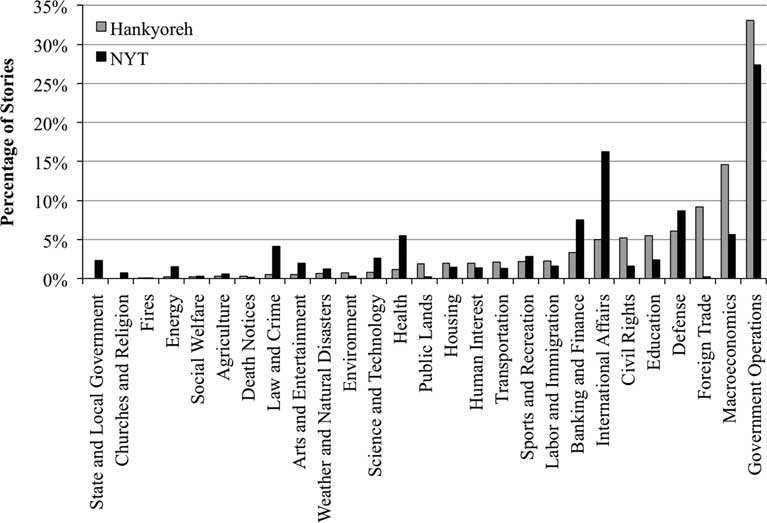
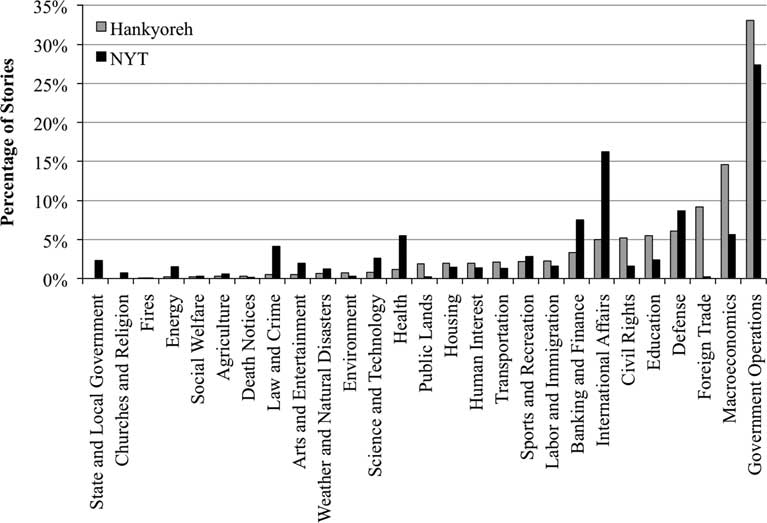
To provide a descriptive view of the media data sets, Figure 1 shows the topic content of Hankyoreh and NYT front-page news (all stories) in 2008. The three topics receiving the most coverage in Korea were government operations (33 per cent), macroeconomics (15 per cent) and foreign trade (9 per cent). The three most prevalent topics in the NYT were government operations (27 per cent), international affairs (16 per cent) and defense (9 per cent). Common across the two papers, however, is a marked concentration in attention – few topics dominated coverage, whereas many other important topics received only little – reinforcing previous findings that the media (and other) agendas exhibited a skewed distribution of attention (e.g. Baumgartner and Jones Reference Baumgartner and Leech1993; Boydstun Reference Boydstun2013). In each outlet, the top three topics accounted for more than half of the total front-page coverage (57 per cent in Korea, 52 per cent in the US).
Topics receiving attention in front-page news: Korea and the US compared. Source: All Hankyoreh and New York Times (NYT) front-page stories in 2008. Note: Topics are sorted according to the amount of attention in the Korean Hankyoreh Daily (from right).
Actor participation in the policymaking process
Our third expectation discussed above relates to the proportion of news coverage of actors relative to these actors’ proportion of participation in the policymaking process. To estimate the actual participation in policymaking, we borrowed data from two projects that analysed patterns of actors’ participation in representative sets of policy issues from the current policy community: 43 in Korea and 98 in the US (Baumgartner et al. Reference Baumgartner, Berry, Hojnacki, Kimball and Leech2009; Yoon Reference Yoon2010). In order to facilitate comparisons of the policymaking process in Korea and the US, the two projects used identical data collection methods, which included personal interviews with policymakers and a content analysis of official documents and newspaper stories.
To include the broadest range of issues from each policy community, both projects began by randomly drawing the samples of actors from the respective universes of policy advocates involved in the policymaking process. Specifically, the US policymaking project built a universe of advocates using the database created from the Lobbying Reports for 1996, from which 98 actors were randomly selected.Footnote 10 Similarly, the Korean project constructed two separate populations of policy advocates: one consisting of bureaucrats in executive ministries and the other including members of five opposition parties in the current National Assembly,Footnote 11 with a total of 33 and ten actors randomly drawn from each population, respectively.Footnote 12
During the interviews with the selected actors, the actors were asked to discuss “the most recent policy issue that they have worked on”, focusing on the background and the major actors playing important roles in the issue debate.Footnote 13 These issues, as described by the interview subjects, formed the random sample of issues. The goal in considering a wide range of issues in this way was to be able to generalise about the average policy process in a political system across policy areas (e.g. macroeconomics, health, agriculture) and issue attributes (e.g. degree of conflict, visibility). Having identified representative sets of issues, additional face-to-face interviews were conducted with an average of two other major actors in each issue debate (a total of 107 in Korea and 315 in the US, including initial interviews) using a snowball sampling strategy. The subjects of additional interviews could be any kind of actor, including bureaucrats, politicians and NGO representatives. The content of these additional interviews were identical to the initial interviews, but instead of asking interviewees to list the most recent policy issue they had worked on, interviewees were asked to describe their involvement in issue X. These personal interviews were the only way to learn about the details of issue debates, which were not always clearly revealed in public. In the next step, interviews were supplemented by conducting small-sized case studies using a set of keywords developed for each debate to search publicly available sources, such as websites of related executive agencies, legislative members and non-governmental groups, as well as news coverage (e.g. Korea Integrated News Database, LexisNexis News). These case studies provided comprehensive background on each policy issue, allowing us to locate the major actors in the policy communities of each country. In total, 457 and 2,117 participants were identified in the Korean and US data sets, respectively.
Although the data sets of actor participation in the policymaking process we used are established in the literature (Baumgartner et al. Reference Baumgartner, Berry, Hojnacki, Kimball and Leech2009; Yoon Reference Yoon2010), it is worth examining three potential concerns related to their measurements. The first is the categorisation of interest group actors. We distinguished different kinds of groups based on the unique kind of interest each group represents (e.g. specific industries, professions, social issues), namely “trade groups”, “business corporations”, “professional associations”, “citizen groups” and “issue coalitions”. Rather than combining all of these indicators together into an “interest group system” category, we relied on the mutually exclusive categories that have been used repeatedly in interest group research in order to understand the diverse sets of interests operating in a policy community at a given point in time (Baumgartner and Leech 1998).
A second potential issue is the validity of our measurements, namely, whether our measure of policy participation captures what it intends to measure – the actual participation of formal and informal actors in the policy process. We argue that the measure offers an accurate snapshot of participation patterns in the overall policy communities of the two countries. For example, the courts can indeed play a significant policy role in some issue debates (e.g. abortion in the US), but may not be as visible across the randomly drawn sample of 98 national policy issue debates at a given point in time. Still, overall, the snapshot is a reasonable portrayal of the general distribution of policymaking participation across actor types.
Finally, there is the issue of the reliability of coding. Some of the perceived disparities between the US and Korea may be due to raters’ different interpretations of the categories available to them. It would have been ideal if multiple researchers were engaged in the policy advocacy projects in the two political systems in order to offer measures of reliability. Unfortunately, this approach is hardly possible in cross-national projects involving interviews with hundreds of actors and text coding of thousands of newspaper articles in native languages. However, the researcher who collected the Korean data sets (policy participation and news) was well familiar with the US data, and again, a high level of inter-coder reliability was achieved between the US and Korean news data sets.
The resulting data sets give us an estimate of the relative degree of participation by different types of actors in the policymaking communities in Korea and the US. We do not intend to overstate the accuracy of these measures of policymaking participation; they are certainly imperfect measures. Yet, they are the best available indicators of the actual participation patterns in each policymaking community – and compared with other indicators of policymaking activity, they are fairly good.Footnote 14 Moreover, note that our aim here is not to isolate the precise degree of correspondence between actor participation and news coverage in each country. Rather, we want to compare Korea and the US broadly to see whether the discrepancies between actor participation in the policy process and news coverage of these actors play out similarly in the two countries or, as we suspect, asymmetrically.
Thus, with allowances for measurement error, we employ the participation patterns found in the studies of Korean and US policy communities as the baseline from which to compare the representation of actors in policy-related news. Specifically, we isolate the subset of news stories about policy (again, as opposed to soft news stories) and then examine the mentions of actors occurring therein. In the section below, we demonstrate a stark discrepancy between the two countries consistent with our theoretical argument about journalistic operating procedures. This discrepancy cannot be explained away entirely by potential errors in either or both of our policymaking participation and news coverage measures. Rather, our findings point to meaningful differences between Korean and US patterns of news coverage – differences that we have argued stem from different journalistic operating procedures.
Findings
In this section, we compare the topics and actors appearing in Korean and US news. Although we find that news largely reflects differences in the policymaking processes in the two countries, our results suggest that journalistic operating procedures – specifically, professional norms created as a result of reporter/source relations – also shape which policy topics and which political actors’ voices are covered in the news.
Expectation 1: Korean news pays more concentrated attention to domestic affairs than US news
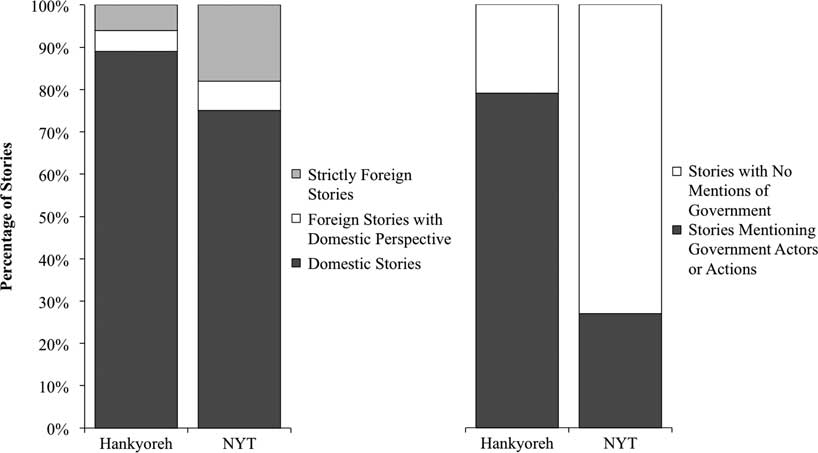
Looking at the overall focus of the front pages (policy and non-policy stories combined), we find many commonalities, but also sharp dissimilarities between the two countries. As indicated in Figure 2, the focus is predominantly domestic in the Korean paper (almost 90 per cent), supporting our expectation. Relative to the Hankyoreh, the NYT reported relatively fewer domestic stories (75 per cent) and more foreign stories (18 per cent), such as political violence in Pakistan, as well as foreign stories with a US perspective (7 per cent), such as insurgencies in Afghanistan and Iraq. This difference is in line with our expectation: Korean news pays more attention to domestic affairs relative to US news, mirroring in part the different policymaking processes of the two nations.
Overview of types of topics and actors in the news. Note: Strictly foreign stories have no discussion of the nation’s involvement or concern. Foreign stories with domestic perspectives include actions of the country abroad, such as war. Domestic stories include territories abroad, such as Puerto Rico for the US. Government is defined narrowly as the actors working for government organisations, such as actors inside the executive agency as well as elected representatives.
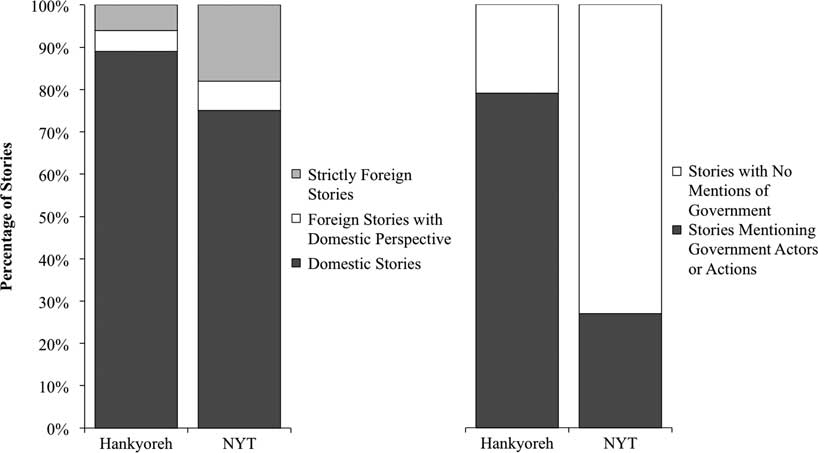
The two news outlets also differ in how much attention is paid to government actors. The overview in Figure 2 shows that 79 per cent of the Hanyoreh front-page stories include mentions of government actors compared with only 27 per cent of the NYT stories. In other words, readers are nearly three times as likely to encounter actors inside the government in Korean front-page news than US front-page news.
Expectation 2: Korean news pays more concentrated attention to executive branch actors than US news
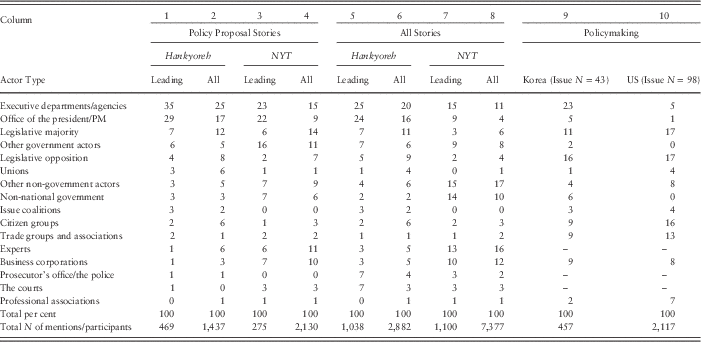
Table 1 highlights an asymmetry in the amount of agenda space occupied by stories about policy topics in the two newspapers. In the Hankyoreh in 2008, 479 out of the total 1,205 stories (40 per cent) were related to an ongoing policy debate, compared with 292 out of 2,167 stories (13 per cent) in the NYT. Additionally, the first eight columns of Table 1 offer a detailed view of all actors mentioned (government and non-government alike) in Korean and US news, first within policy-related news stories and then across all stories from 2008. Looking first at the Hankyoreh policy stories, we see that Korean policy news coverage was led, a total of 64 per cent of the time, by voices of government insiders in the bureaucracy (35 per cent) and the office of the president (29 per cent). In the US, government insiders in the executive departments and agencies (23 per cent) and the office of the president (22 per cent) are also the most frequent leading actors in policy stories, but here the concentration is much weaker (a total of 45 per cent).
Actors’ representation in the news and in policymaking

Note: Values indicate the percentages of news mentions (Columns 1–8) and of policy participation (Columns 9 and 10) for each type of actor out of all actors total, sorted according to the attention actors received in the policy proposal stories of Hankyoreh (Columns 1 and 2). Columns 1–4 show news mentions in stories specifically about policy proposals [a total of 479 stories in the Hankyoreh and 292 stories in the New York Times (NYT)]. Columns 5–8 show news mentions in all front-page stories. For each type of news story, we report findings calculated both as the percentage of leading actors mentioned (Columns 1, 3, 5 and 7) and as the percentage of all actors mentioned (Columns 2, 4, 6 and 8). Columns 9 and 10 show data from two separate projects on the policymaking process of Korea and the US (see Baumgartner et al. Reference Baumgartner, Berry, Hojnacki, Kimball and Leech2009; Yoon Reference Yoon2010).
Similar patterns are found when we consider all stories on each agenda in 2008 (Columns 5–8 of Table 1). Here, we see that the office of the president and the executive ministries are the most widely mentioned actors across all stories in Korea; together, they lead the front-page stories 49 per cent of the time. In the NYT, the president and executive are the leading actors in 24 per cent of all stories. In sum, our key findings remain intact across the first eight columns of Table 1, supporting our expectation that Korean news places greater emphasis on the voices of the president and bureaucrats. Next, we describe how news is reconstructed, with a particular focus on government-centred policymaking reflective of the strong reporter/source relations that characterise journalistic operating procedures in Korea.
Expectation 3: The over-representation of policy actors in Korean news is more concentrated around government actors than in the US, where over- and under-representation of policy actors is more varied
We turn now to analysing the actors represented in the public forum of front-page news, as compared with their relative degree of participation in the policymaking community. We begin by examining actual distributions of actor participation in the policy communities in the two countries using the data sets of US and Korean policy communities described above.
The last two columns of Table 1 show a side-by-side comparison of these distributions. The two countries vary in terms of participation of government actors and non-government actors in the policy process. In Korea, executive ministries are highly involved in the policy process (23 per cent), along with the legislative opposition (16 per cent), the legislative majority (11 per cent) and the president (5 per cent). In the US though, executive ministries account for only 5 per cent of total participation. By contrast, US congressional members together (majority and opposition) account for 34 per cent of actor involvement in policymaking. Participation of non-government groups, however, is surprisingly similar in the two countries. The most frequent non-government participants are trade associations (9 per cent in Korea and 13 per cent in the US), business corporations (9 per cent in Korea and 8 per cent in the US) and professional associations (2 per cent in Korea and 7 per cent in the US), as well as citizen groups (9 per cent in Korea and 16 per cent in the US) and issue coalitions (3 per cent in Korea and 4 per cent in the US).
To what degree does front-page coverage mirror this distribution of participation in the policymaking community? We address this question by looking across Table 1, comparing actors’ policymaking participation (Columns 9 and 10) with their leading mentions in front-page policy stories (Columns 1 and 3).
Column 9 shows that executive ministries are the most frequent leaders of topics in the Korean policy community, as well as legislative majority and opposition, though to a lesser degree. The same bodies are also given considerable attention in Korean front-page news. Looking at Column 1, we see that Korean executive agencies and the president lead news coverage on policy debates – to an even stronger degree than their participation in policymaking.
Among non-government groups in Korea, Column 9 shows that the key advocates found in the public policymaking project are citizen groups (9 per cent), business corporations (9 per cent), trade associations (9 per cent) and professional associations (15 per cent). Yet, Column 1 shows that their policymaking presence is not mirrored on the front page of the Hankyoreh. Also possible, however, is that small industry-specific trade groups might be active in the community, but have little interest in the big debates appearing in the front pages. Finally, expert opinions (6 per cent) are covered frequently in the news along with unions (6 per cent).
In the US, Column 10 shows that democratic and republican legislators are frequent participants in the actual policymaking process (each register as participants 17 per cent of the time), with executive departments (5 per cent) and the president (1 per cent) participating to a lesser degree. Among non-government groups, trade groups (13 per cent) and citizen groups (16 per cent) are key players in the non-government sector. The picture provided in US front-page coverage, however, does not mirror such trends. Column 3 shows that neither members of the majority party (6 per cent) nor the opposition party (2 per cent) frequently lead front-page policy stories.
Our research design does not allow us to tease out the effects of political context variables (e.g. central policymaking bodies in each political system) on media attention to policy actors as distinct from the effects of journalistic operating procedures. That is to say, the concentrated attention to executive branch actors generally found in Korean front-page news can surely be attributed in part to the concentrated policymaking powers of the president and ministry bureaucrats on the one hand and to journalistic procedures on the other. We believe, however, that the gap between media attention to policy actors and their participation in the actual policymaking process goes a long way towards demonstrating the isolated impact of journalistic operating procedures on media attention to policy actors in each political system.
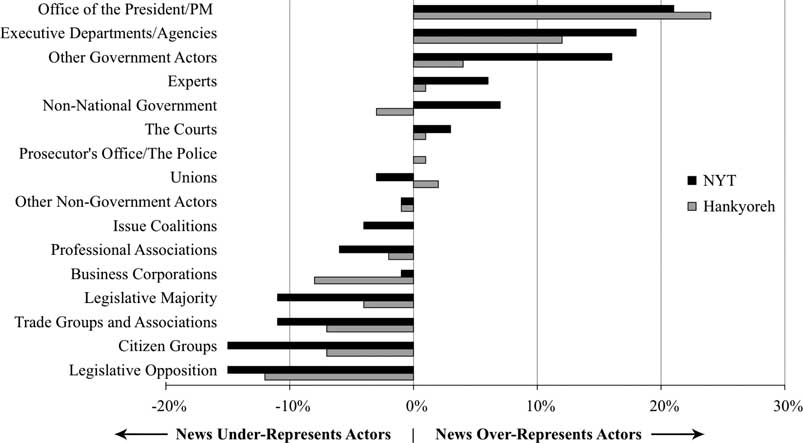
We bring these discrepancies between front-page coverage and actual policy participation into final focus by looking at Figure 3, which shows the difference for each actor type between the percentage of policymaking activity that actor represents and the percentage of policy-related news coverage that leads with a mention of the actor. The figure is sorted according to the sum of the Hankyoreh and NYT values from positive to negative. Bars to the right of the 0 per cent line indicate over-representation in the news relative to policymaking, while bars to the left indicate under-representation. This figure shows that, in line with our expectations, neither Korean nor US front-page news is strongly representative of actors’ participation in their respective policy communities. In both countries, the president and executive departments receive much more leading coverage than their proportional participation in policymaking would suggest. At the other end of the spectrum, legislative opposition, citizen groups and trade groups all receive much less front-page leading attention than is arguably warranted by the extent of their policy participation.
Actors’ representation in leading news coverage of policy proposals relative to actors’ actual policymaking participation. Note: Values are the difference between the percentage of leading mentions each actor received in policy news (Table 1, Columns 1 and 3) and the percentage of participation the actor constituted in the policy community (Table 1, Columns 9 and 10). Negative values indicate “under”-representation of actors in the news relative to policymaking, while positive values indicate “over”-representation.
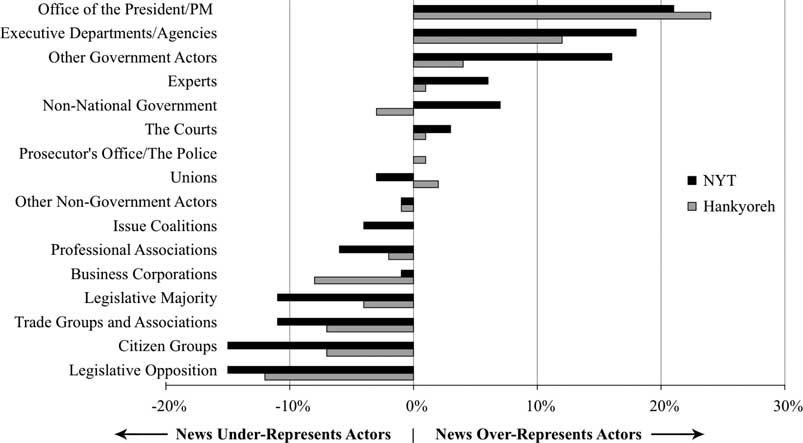
At the same time, the discrepancies Figure 3 shows between actors’ policy participation and representation in the news are asymmetric between the two countries. Figure 3 shows that US news is, in general, much less representative of policymaking reality than Korean news. Summing across all the over- and under-representation values, the US totals 134 percentage points, compared with 87 for Korea. Yet, looking closer to focus only on the relative portion of each outlet’s “mis”-representation captured by each actor type, we see that, whereas US news exhibits more over- and under-representation overall, it is much more evenly spread across actor types. By contrast, the discrepancies between actors’ policy participation and news coverage in Korea are starkly concentrated around, on the one hand, an over-representation of the president and executive and, on the other, an under-representation of the legislative opposition, corporations and trade and citizen groups.
Conclusion
In this paper, we compared the composition of front-page news in Korea and the US. Comparative political communication studies highlight the importance of independent media for accurately portraying debates taking place in the policy community. Normatively speaking, it is preferred that the topics and voices included in the news in free press nations largely reflect the actual distribution of topics and voices taking place in the political system. In fact, we find that news does coincide with political realities in Korea and the US to some degree. At the same time, however, we see marked discrepancies between our baseline measure of actor policy participation in each country and the proportion of media attention these actors receive. The NYT is, in general, much less representative of the distribution of policymaking activity as compared with the Hankyoreh. This finding supports our understanding that US reporters have more discretion and independence from their sources than do Korean reporters.
When we dig into the nature of these discrepancies, however, we see that Korean news pays excessive attention to the executive ministries and the president. On the one hand, the high attention to the executive is a reflection of reality. These bodies remain dominant in Korea, despite the growing policy activities of legislative members and the rise of civil society groups. However, the front-page attention paid to the Korean executive is disproportionately high relative to its policymaking involvement. In particular, Hankyoreh’s over-representation of the president and under-representation of the opposition constitutes the bulk of the total discrepancy between actors’ policy participation and news coverage. We attribute this finding, in part, to journalistic operating procedures in Korea, where reporters are institutionally and socially incentivised to maintain tighter relations with the government bodies they cover.
These conclusions are based on analysis of the complete front pages of the Hankyoreh and the NYT for a full calendar year. Many issues across different policy areas rose and fell on these agendas in 2008, suggesting that our findings would remain stable using other years. Still, due to the particular salience and importance of front-page news, we expect the concentrated coverage of the topics and actors most relevant to each state is amplified in this context.
Our results suggest that the US print media maintains internal pluralism relative to Korea, giving voice to a more diverse array of viewpoints. Scholars have previously noted that the content of news coverage impacts policy outcomes (Baumgartner et al. Reference Baumgartner, De Boef and Boydstun2008). On the premise that who is featured in the news also affects how policy topics are understood, the diversity in the views represented also relates to the scope of public debate (Baumgartner and Jones Reference Baumgartner and Leech1993; Boydstun Reference Boydstun2013). When the scope of a debate remains narrow, the debate remains focused on policy experts, whereas when the scope of the debate is large, the discussion remains general, inviting a wider audience (Schattschneider Reference Schattschneider1960).
Few studies in political science and public policy pay attention to how journalists interact with the policy process, ultimately shaping how the press delivers the policy community to the public through news. Our findings from the NYT suggest that journalistic operating procedures highlighting reporters’ independence may correlate with a considerable (and normatively concerning) discrepancy between the degree to which actors participate in the policy community and the representation they have in the news. At the same time, as indicated in our Hankyoreh findings, tight reporter/source relations can lead even news outlets committed to representing opponents of the administration to vastly over-represent government majority actors and under-represent other policy actor types, such as the legislative opposition. These results have implications for understanding the role of media in democracies. Concentrated media attention to a narrow set of policymakers limits the diversity of topics and perspectives conveyed to citizens. We thus urge scholars to give more consideration to the missing link of journalistic operating procedures in comparative political communication studies and public policy research.
Acknowledgements
The authors thank Frank Baumgartner, Christoffer Green-Pedersen, Brandon Zicha and anonymous reviewers for very helpful comments.