INTRODUCTION
The blue land crab, Cardisoma guanhumi (Brachyura: Gecarcinidae) is a species highly adapted to terrestrial life that is found in estuarine areas throughout tropical and subtropical regions in the Atlantic Coast of the New World, from the state of Florida (USA) to the state of Santa Catarina (southern Brazil). It is an important food resource due to its large body size, which often exceeds 11 cm in carapace length. In Brazil, its highest consumption takes place in the north-eastern states, where it has considerable economic importance (Amaral & Jablonski, Reference Amaral and Jablonski2005; Ministério do Meio Ambiente, 2005). Cardisoma guanhumi is not considered to be under threat of extinction, yet in some areas it became rare and its average body size decreased (Amaral & Jablonsky, 2005), resulting in a reduction in its commercialization and reducing the importance of this fishery resource. As a consequence, C. guanhumi has been included in the list of overexploited species of the Brazilian Ministry of Environment (Ministério do Meio Ambiente, 2004).
The life-cycle of C. guanhumi is presumably similar to other semi-terrestrial crustaceans that live in or near mangrove areas. During the reproductive season, such crabs release thousands of larvae into the water during high tide of full moon. These larvae are carried to open waters, where they remain for several weeks until returning to an estuary (Gifford, Reference Gifford1962). Genetic flow between populations of the species is accomplished by the dispersal of larvae, since the adults present reduced horizontal displacements. The distance between mangroves, the flow of water currents, and the shape of the estuaries vary considerably along the Brazilian coast, yet the influence of these factors on the dispersal potential of planktonic larvae is poorly known.
An understanding of the degree of gene flow, genetic diversity, and effective population size is the basis for the establishment of efficient conservation strategies (Frankham et al., Reference Frankham, Ballou and Briscoe2002). It has been usually thought that animals with this type of life cycle, with pelagic and marine larvae, would show little genetic differentiation due to the high level of gene flow. However, studies on brachyurans have shown genetic differentiation levels ranging from negligible (McMillen-Jackson & Bert, Reference McMillen-Jackson and Bert2004; Cassone & Boulding, 2005; Pfeiler et al., Reference Pfeiler, Hurtado, Knowles, Torre-Cosío, Bourillón-Moreno, Márquez-Farías and Montemayor-López2005; Oliveira-Neto et al., Reference Oliveira-Neto, Boeger, Pie, Ostrensky and Hungria2007, Reference Oliveira-Neto, Pie, Boeger, Ostrensky and Baggio2008) to intermediate or high (Weber & Levy, Reference Weber and Levy2000; Fratini & Vannini, Reference Fratini and Vannini2002; Weinberg et al., Reference Weinberg, Dahlgren, Trowbridge and Halanych2003; Roman & Palumbi, Reference Roman and Palumbi2004).
A recent study on the ocypodid Ucides cordatus, a species largely sympatric with the blue land crab, failed to show any evidence of genetic structure in populations south of the River Amazon (Oliveira-Neto et al., Reference Oliveira-Neto, Boeger, Pie, Ostrensky and Hungria2007). The goal of the present study is to characterize and compare the genetic structure of C. guanhumi along the Brazilian coast using sequences of the control region of the mitochondrial DNA, a fragment characterized by high mutation rate that is particularly suitable for population genetic studies.
MATERIALS AND METHODS
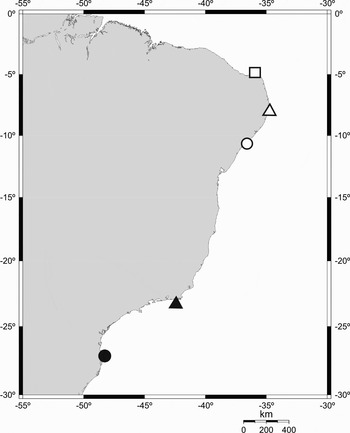
Samples were obtained from five states along the Brazilian coast: Rio Grande do Norte (N = 10), Pernambuco (N = 19), Sergipe (N = 21), Rio de Janeiro (N = 20), and Santa Catarina (N = 23) (Figure 1). Distances between the studied estuaries vary from 400 to 5000 km and are separated from one another by sandy beaches and other estuaries. The approximately 5000 km of coast encompassed in the present study represent approximately a third of the distribution of C. guanhumi. There is a bifurcation of the South Equatorial Current in north-eastern Brazil near 16°S, with one branch heading northwards as the Guyana Current and the other heading south as the Brazil Current, a phenomenon that could potentially affect larval distribution, even though near-shore waters can be more influenced by coastal currents that are more variable in space and time (Miranda, Reference Miranda1970; Mesquita & Hatari, 1969; Silva et al., Reference Silva, Araújo and Bourlès2005).
Sites included in the present study for the collection of specimens of Cardisoma guanhumi along the Brazilian coast. Symbols indicate the following states, from top to bottom: Rio Grande do Norte, Pernambuco, Sergipe, Rio de Janeiro and Santa Catarina. The same symbols are used in Figure 2.

A fragment of muscle tissue of the pereiopods was removed, preserved in an EDTA–DMSO buffer (Seutin et al., Reference Seutin, White and Boag1991), and maintained at −20ºC. Genomic DNA was extracted using the ChargeSwitch® kit (Invitrogen) according to the manufacturer's instructions. The primers 12SUCAF3 (5′–CCA GTA NRC CTA CTA TGT TAC GAC TTA T–3′) and ILEUCAR3 (5′–GCT AYC CTT TTA AAT CAG GCA C–3′) were used to amplify a ≈1.6 kb fragment including the entire control region of the mtDNA (Oliveira-Neto et al., Reference Oliveira-Neto, Boeger, Pie, Ostrensky and Hungria2007). Each 25-μl PCR solution had the following final concentrations: 6 mM of MgCl2, 0.25 mM of each dNTP, 0.1 U/μl of Taq polymerase, 1X buffer, 2 µM of each primer, and 1.2 ng/μl of genomic DNA. Thermocycling settings included the following steps: 95ºC for 2 minutes, followed by 35 cycles of 95ºC for 20 seconds, 56ºC for 30 seconds, and 72ºC for 90 seconds, followed by a final extension of 72ºC for 2 minutes. A 2 µl aliquot of each PCR product was electrophoresed in a 1.5% agarose gel, stained with EtBr, and photographed under UV-light. Successfully amplified products were purified using the MinElute kit (Qiagen) and sequenced using the internal primers ILEUCAR2: 5′–CCT TTT AAA TCA GGC ACT ATA–3′, and DLUSSAF1: 5′–GTA TAA CCG CGA ATG CTG GCA C–3′) (Oliveira-Neto et al., Reference Oliveira-Neto, Boeger, Pie, Ostrensky and Hungria2007), generating a ≈850 pb fragment. Each 10 µl cycle-sequencing reaction included the following: 0.16 µM of primer, 0.15X of buffer, 0.5 µl of BigDye (Applied Biosystems), and 20 ng of the PCR product. The resulting solution was purified using Sephadex G50 and processed using an ABI3130 automatic sequencer. The obtained sequences were aligned unambiguously by eye.
The occurrence of geographical structure in the genetic variability of populations was tested using F-statistics and analysis of molecular variance (AMOVA). The null distribution of pairwise Fst values under the hypothesis of no difference between the populations was obtained by permuting haplotypes between populations. Similarly, the AMOVA was calculated based on a matrix of haplotype distances, thus allowing for comparing groups of samples. Samples from Rio de Janeiro and Santa Catarina were grouped as ‘southern samples’, whereas those from the remaining states were grouped as ‘northern samples’, to increase the statistical power of the AMOVA. This distinction took into account the distance among the collection points and their respective climatic and geomorphological characteristics, given that the regions where southern samples were obtained are colder and have fewer estuaries than the regions in the north. These analyses were complemented by a nested clade analysis (NCA), as implemented in the program GeoDis (Posada et al., Reference Posada, Crandall and Templeton2000) according to the methods of Templeton et al. (Reference Templeton, Routman and Phillips1995). This program calculates the clade distances D c (average distance between the location of the members of the clade and the geographical centre of the clade) and the nested clade distances D n (the average spatial distance between the members of each clade and the geographical centre of the entire nesting clade). Additionally, the measures of average distance between tip and interior clades within the nested group (Int–Tip)c and the tip to interior distance for the nesting clade (Int–Tip)n are estimated. The assessment of whether any of these distances are significantly smaller or larger than expected by chance was carried out by 10,000 permutation resamplings. Interpretation of the results followed the method given in Templeton et al. (Reference Templeton, Routman and Phillips1995).
Inferences on past demographic history of the blue land crab were assessed using the mismatch distribution analysis (Slatkin & Hudson, 1991; Rogers & Harpending, Reference Rogers and Harpending1992). Three parameters are estimated using Rogers & Harpending's (1992) model: θ0 = 2N 0u, θ1 = 2N 1u, and τ = 2ut, where an initial population of effective size N 0 is assumed to grow rapidly to a new size of N 1 at a time t generations before the present, and u is the per-generation probability that a mutation strikes a particular nucleotide in the region under study. These parameters were estimated using the generalized non-linear least-square approach developed by Schneider & Excoffier (Reference Schneider and Excoffier1999). Also, the degree of approximation between the observed mismatch distribution and that expected under population growth was tested using Harpending's (Reference Harpending1994) raggedness statistic.
Departures from mutation–drift or mutation–selection equilibrium were tested using Tajima's D and Fu's F s. In Tajima's (Reference Tajima1989) test, the parameter θ is independently estimated twice, once from the number of polymorphic sites and once from the average mismatch of the sample. Differences between the two estimates are then attributed to selection or to the demographic history of the population studied. Similarly, Fu's (Reference Fu1997) F s statistic compares the observed number of alleles in a sample with the number of alleles expected if the population has kept a constant size. The significance of D and F s was tested by randomization. D and F s are calculated for each simulated dataset to obtain an empirical null distribution of these statistics and hence the probability of the observed D and F s under the hypothesis of demographic stationarity. A recent population expansion would produce negative values for both statistics. Unless otherwise stated, all analyses were carried out as implemented in ARLEQUIN 3.1 (Excoffier et al., Reference Excoffier, Laval and Schneider2005).
RESULTS
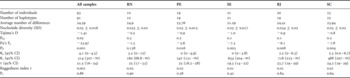
A total of 95 sequences (≈750 bp) were obtained, including a hypervariable domain of the control region of the mtDNA of C. guanhumi (GenBank accession numbers EU598560–EU598653). There was considerable genetic variation in all sampled locations. Only four individuals shared haplotypes: two in Rio de Janeiro and two in Santa Catarina (Table 1). No haplotype was shared among locations. Nucleotide diversity was around 0.03 in all locations, with the average number of nucleotide differences ranging from 21.3 in Sergipe to 24.9 in Rio Grande do Norte.
Descriptive statistics of the studied fragment and respective parameter estimates. See text for details.

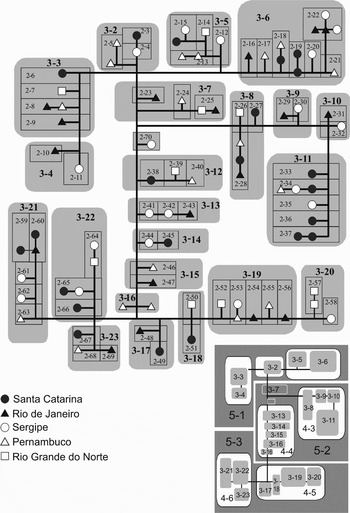
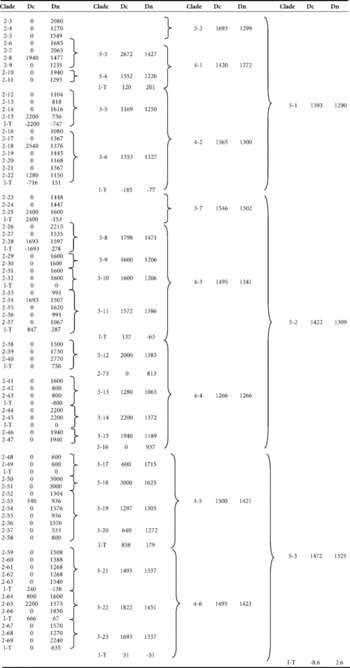
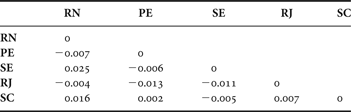
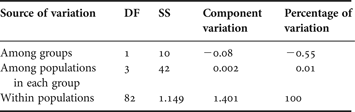
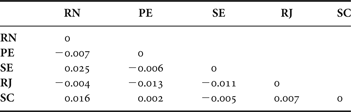
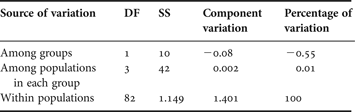
There was no statistically significant geographical structure in the pattern of genetic variability among the studied locations according to the NCA (Figure 2; Table 2). The lowest observed P value was 0.035, which becomes non-significant after adjusting the critical value to account for the high number of separate statistical tests involved in NCA using a procedure such as the Bonferroni correction. Similar results were obtained using F-statistics, where none of the Fst values differed significantly from zero (Table 3), as well as according to the AMOVA (Table 4).
Minimum-spanning tree obtained from 95 specimens of Cardisoma guanhumi collected along the Brazilian coast. The tree was divided into lineages of several levels for the application of the nested clade analysis.

Nested clade analysis of the variation in the control region of the mtDNA of Cardisoma guanhumi (Dc, average distance between the location of the members of the clade and geographical centre of the clade; Dn, the average spacial distance between the members of each clade and the geographical centre of the entire nesting clade. I-T, the average distance between tip and interior clades within the clade or nested group).

F st estimates between the studied samples of Cardisoma guanhumi. All estimates did not differ statistically from 0 (P > 0.05 in all comparisons). RN, Rio Grande do Norte; PE, Pernambuco; SE, Sergipe; RJ, Rio de Janeiro; SC, Santa Catarina.
Analysis of molecular variance (AMOVA) based on a distance matrix between haplotypes. The studied samples were separated between southern (Rio de Janeiro and Santa Catarina) and northern states (Rio Grande do Norte, Pernambuco and Sergipe).
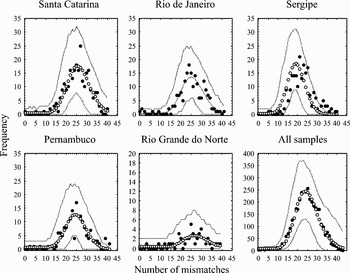
The mismatch distribution was consistent with a simple unimodal pattern, either when all samples were combined or when each location was analysed separately, as shown by the non-significant raggedness indices (Figure 3; Table 1). Such a pattern is an indication of the occurrence of population expansion. This conclusion is supported by the negative values of all estimates of Tajima's D and Fu's Fs, although only the latter reached statistical significance (the only exception is the population in Rio Grande do Norte, which might be artefactual due to the smaller sample size).
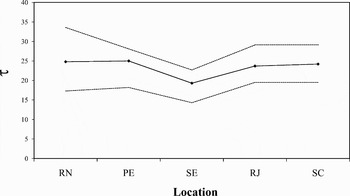
Variation in estimates of τ among the studied sites (solid line) and their respective 95% confidence intervals.

An interesting pattern becomes evident when one compares the estimates of τ along a latitudinal axis. As indicated above, τ is directly proportional to the per-generation probability of mutation in the studied DNA fragment multiplied by the time of population expansion in terms of number of generations. The oldest populations are located in the northernmost and southernmost sites, whereas the youngest population is located in the latitudinally intermediate location (Sergipe) (Figure 4). However, the broad overlap among confidence intervals suggests that this result should be interpreted with caution.
Mismatch distribution analysis of the studied fragment of mtDNA of Cardisoma guanhumi for each location, as well for the combined dataset.

DISCUSSION
Populations of the blue land crab are characterized by a high level of genetic variability that is homogeneously distributed throughout the entire studied region along the Brazilian coast. High genetic diversity is thought to result from a combination of high mutation rate in the study fragment and the large population size of the species (Avise et al., Reference Avise, Neigel and Arnold1984), as observed in other crustacean species (e.g. McMillen-Jackson & Bert, Reference McMillen-Jackson and Bert2004; Diniz et al., Reference Diniz, Maclean, Ogawa, Cintra and Bentzen2005; Cassone & Boulding, Reference Cassone and Boulding2006). Moreover, the unimodal mismatch distributions and the estimates of Fu's F s indicate an inferred population expansion during the recent evolutionary history of C. guanhumi. The patterns observed in this species are particularly comparable to those obtained for U. cordatus (Brachyura: Ocypodidae) in a study carried out using the same DNA fragment (Oliveira-Neto et al., Reference Oliveira-Neto, Boeger, Pie, Ostrensky and Hungria2007). These species share similar geographical ranges, from southern USA to southern Brazil, as well as several biological characteristics, such as a semiterrestrial habit near estuarine waters which are used for both spawning and larval development (Oliveira, Reference Oliveira1946; Melo, Reference Melo1996; Hill, Reference Hill2001). Both species do not seem to experience obstacles for gene flow in the region encompassed by their studies. The dispersal capacity of their larvae is probably amplified through coastal currents, such that the genetic compositions of populations in different estuaries are homogenized. It is important to note that successive migration among adjacent estuaries should be sufficient for such effect, so that dispersal over very long distances in a single generation does not have to be invoked.
The implications of the extensive gene flow throughout the distribution of the blue land crab have important implications for their conservation. First, populations along the coast do not seem to be organized into discrete evolutionarily significant units (Moritz, Reference Moritz1994), which greatly facilitates management efforts. For instance, severely depressed populations can be enhanced by restocking efforts through laboratory mass rearing and adult translocation, so that movement of individuals among geographical regions should not compromise the genetic composition of local populations. However, gene flow over evolutionary time does not necessarily mean that populations are strongly linked in demographic terms, given that recruitment among adjacent estuaries might in fact take place at a very low rate. Recent Bayesian methods to estimate recent migration rates might be particularly useful to elucidate this issue (Wilson & Rannala, Reference Wilson and Rannala2003).
In spite of the above mentioned similarities, C. guanhumi and U. cordatus show intriguing differences in the inferred population dynamics. Both species show clear evidence of unimodal mismatch distributions, which are consistent with population expansion. However, the estimates of τ, the parameter that describes the time since the onset of population expansion, are markedly different between both species, with the expansion of C. guanhumi being considerably older than that of U. cordatus (21.5 and 16.6, respectively). The latitudinal variation in the estimates of τ are also markedly different, with U. cordatus showing a clear decrease in τ toward higher latitudes (Oliveira-Neto et al., Reference Oliveira-Neto, Boeger, Pie, Ostrensky and Hungria2007), whereas the present study indicated the lowest τ estimates at intermediate latitudes. We hypothesize that the latter might represent a secondary contact in the region of Sergipe following a transient subdivision in the range of the species, as opposed to the simple north-to-south expansion in the case of U. cordatus. Finally, the estimates of θ1 using all samples were also markedly different (191.6 in U. cordatus and 514.0 in C. guanhumi). This parameter is proportional to the population size after the expansion multiplied by the per-generation mutation rate for the studied fragment. Given that both studies focused on the same DNA fragment and that the species are members of phylogenetically close families, there is no reason to suspect that differences in mutation rate alone would account for the obtained results. Rather, there are important ecological differences between U. cordatus and C. guanhumi that might account for the observed discrepancies. It has been known for long that C. guanhumi is not as strongly associated with the intertidal region as U. cordatus, frequently showing preference for the drier conditions of the upper shore (e.g. Oliveira, Reference Oliveira1946 and references therein). Consequently, the population responses of each species to changes in mangrove areas would be markedly different. Further genetic studies on other crustacean species, as well as on species of mangrove trees, are necessary to discriminate species-specific features from the evolutionary dynamics of the mangrove environment itself.
ACKNOWLEDGEMENTS
The Conselho Nacional de Desenvolvimento Científico e Tecnológico (CNPq) provided partial funding for the study and assistantships to M.R.P., W.A.B., and J.F.O.N. Additional funding was provided by the Government of the State of Paraná through the Secretaria de Estado da Ciência, Tecnologia e Ensino Superior (SETI). We are grateful to a variety of colleagues who provided samples from Rio Grande do Norte and Pernambuco (M.W. Pil), Sergipe (R.O. Ribeiro) and Santa Catarina (T.V. Oliveira and G.O. Langner). Luciana Patella provided valuable laboratory support.