Introduction
The threat of terrorism has led in recent years to changes in prehospital medical practices. Experiences reported by professional rescuers have directly influenced methods in patient care.
Attacks can take various forms: suicide bombings, shootings, hostage-taking, and more. In the case of explosions, several issues can be identified: confined attacks kill more people than in an open environmentReference Leibovici, Gofrit and Stein 1 and with higher levels of severity.Reference Golan, Soffer, Givon and Peleg 2 In the case of injury due to an explosive device, the head region is the most commonly affected areaReference Aschkenasy-Steuer, Shamir and Rivkind 3 with a primary blast causing, in particular, otologic lesions. This is particularly true in a closed environment.Reference Golan, Soffer, Givon and Peleg 2 , Reference Leibovici, Gofrit and Shapira 4 , Reference Rozenfeld, Givon, Shenhar, Renert and Peleg 5 Forty percent of persons exposed to bomb blasts and up to 67% of the most severely injured patients suffer otologic lesions.Reference de Ceballos, Turégano-Fuentes, Perez-Diaz, Sanz-Sanchez, Martin-Llorente and Guerrero-Sanz 6 Exposure also causes problems ranging from isolated tinnitus to complete deafness. The result is a loss of conductive hearing, perception, or a combination of both.Reference Leibovici, Gofrit and Shapira 4 , Reference Darley and Kellman 7 Up to one-third of the victims of suicide attacks in Pakistan between 2007 and 2010 were affected by this condition.Reference Yasin, Nasreen and Malik 8
The impact of hearing loss on initial triage and evacuation of victims has not been studied. First aid responders consistently report deafness in explosion victims rendering them unable to communicate, which results in a disruption of triage and evacuation, particularly with regard to conscious victims who may be potential survivors.Reference de Ceballos, Turégano-Fuentes, Perez-Diaz, Sanz-Sanchez, Martin-Llorente and Guerrero-Sanz 6 Feedback from the Brussels (Belgium) bombings in Zaventem Airport demonstrated the inefficiency of traditional triage methods, where confused and disoriented victims could not understand simple instructions and were even more difficult to manage as a result of being deafened. This factor consumed both the time and attention of emergency workers at the scene.
Report and Discussion
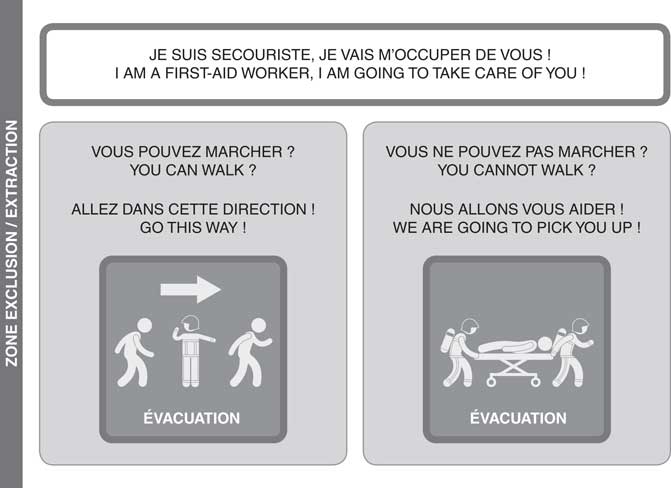
To overcome this problem, Paris Fire Brigade (Paris, France) has deployed communication cards using keywords and colorful universal pictograms as a tool for the first responders. All cards are written both in French and English. This tool is used initially in an “exclusion zone” to ensure the rapid evacuation of conscious victims. This first deployment of the cards with clear directional instruction benefits the initial triage (Figure 1).
Evacuation Cards.

A second series of cards has been designed for the “controlled area” or “gathering point for victims.” Their purpose is to assess the injuries, reassure the victims, and explain their management. Finally, a card is deployed to inquire of possible victim’s companions.
This tool was originally developed in partnership with personnel from the 3rd Marine Infantry Regiment. All first responders from the Paris Fire Brigade have been equipped with it since 2016. It comes in a pocket-sized format and can be carried in the responder’s uniform. It remains optional and available to the first commander of operations who solely decides on the advisability of implementation.
Conclusion
Given the current persistence of the terrorist threat and the diversity of modes of action, it is essential to innovate in the design of new adaptive and evolving responses. Communication cards are one of Paris Fire Brigade’s operational responses to this necessary adaptation.