Introduction
Welfare reform has been a dominant theme on political agendas across the OECD region in recent years (Gilbert and Besharov, Reference Gilbert and Besharov2011), with a particular policy focus on efforts to move people off benefits and into the paid labour market. In the UK, David Cameron's Coalition Government has been concentrating considerable resources and rhetorical emphasis upon their efforts to reform welfare, promising to end ‘welfare dependency’ and ‘make work pay’ (Reference Cameron2012). This paper presents findings from a small-scale qualitative study into the lived experiences of welfare reform under the Coalition. Critically, the research set out to compare Government rhetoric with lived reality in order to assess how far the Coalition's conceptualisation of welfare dependency, work motivations and the whole welfare-to-work domain matched individual lived experiences. Importantly, this paper seeks to forefront these experiences, which have often been missing from government and media discussions of welfare reform (Garthwaite, Reference Garthwaite2013).
Following a brief overview of the policy context, and the valorisation of paid employment in which much of the policy discourse can be rooted, the approach taken in the study is outlined. Research findings are then presented, with a particular focus on the clash between ideas of benefits as a lifestyle choice and lived experiences, as well as a discussion of the very hard work which ‘getting by’ (Lister, Reference Lister2004) on benefits entails. The varied forms of socially valuable contribution in which many of the participants were engaged is also highlighted, as is their attitude towards, and experiences of, paid employment. The findings from this study demonstrate the value of listening to, and engaging with, the lived experiences of those directly affected by programmes of welfare reform. Governmental discourse, as currently conceptualised, fails to reflect lived reality, instead serving to stigmatise and arguably (de)moralise out-of-work benefit claimants.
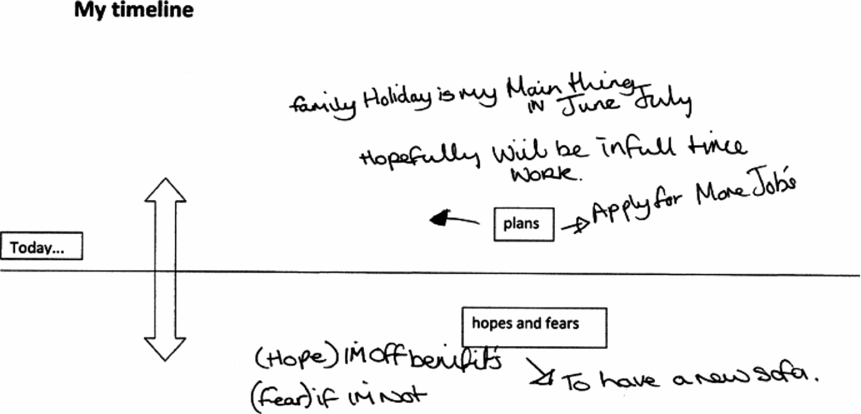
Sophie's timeline

Policy context
While a comprehensive review of the Coalition's welfare reform approach cannot be provided here, it is important briefly to summarise its main characteristics and historical antecedents. The Coalition proclaims that their ‘tough’ new approach represents a radical departure, but the reality is of substantial continuity with their New Labour predecessor. Commentators have observed marked similarities in all three main political parties’ approaches to welfare, with Lister and Bennett (Reference Lister and Bennett2010) describing a process of ‘policy leapfrog’ while McKay and Rowlingson (Reference Mckay, Rowlingson and Bochel2011) characterise the Coalition's broad strategy on social security as one of ‘continuation with intensification’. Today, there is almost universal consensus among mainstream politicians of the need to address ‘welfare dependency’, which is consistently characterised as inherently problematic and narrowly equated with reliance on out-of-work benefits (Lister, Reference Lister2004). The tools of welfare conditionality and tough benefit sanctions in efforts to ‘help’ individuals off benefits and into work are widely utilised, while there is also a consistent and continual emphasis on seeking to ‘make work pay’.
In praising ‘hard-working families’, the Coalition continues New Labour's marked emphasis on paid work as both ‘the best form of welfare’ and the primary duty of the responsible citizen (Patrick, Reference Patrick2013). The whole welfare-to-work agenda is premised on the importance of ‘activating’ individuals from benefit ‘dependence’ to formal employment in the paid labour market. This approach relies on the argument that paid work is the surest route out of poverty, neglecting the reality that it is by no means a guaranteed one, given the enduring existence of substantial in-work poverty (Crisp et al., Reference Crisp, Batty, Cole and Robinson2009). The Government describes paid work as a transformative activity that not only delivers pecuniary rewards but can also improve self-esteem, physical and mental health and family life, as well as helping address problematic behaviours such as offending and substance misuse (Duncan Smith, Reference Duncan Smith2013).
Importantly, the Government's approach is firmly focused on the supply-side of the labour market – on the steps individuals need to take to become ‘work-ready’ and get into the ‘habit of work’ – with a concurrent neglect of demand-side and structural barriers to work, such as the availability of jobs, suitable child care, and employer discrimination towards disabled people (Newman, Reference Newman2011). Employing welfare conditionality suggests that compulsion and the threat of sanctions are required to incentivise and motivate individuals into work. Together, the supply-side focus and reliance on welfare conditionality operate to ‘individualise the social’ (Ferge, Reference Ferge1997); implying that out-of-work benefit claimants are largely responsible for their non-work and subsequent poverty (Newman, Reference Newman2011).
While there is marked continuity between the Coalition and New Labour's approaches to welfare reform, there is no doubt that the Coalition is overseeing a significant ratcheting up of the pace and extent of change. Substantial cuts to the social security budget (£18bn between 2010 and 2014/15) have seen the value of many benefits fall in real terms, while reforms to housing and disability benefits limit and restrict eligibility for social welfare. The Welfare Reform Act 2012 legislated for a significant extension and intensification of welfare conditionality, including the ultimate sanction of three years without benefits for those who fail three times to comply with various work-related conditions.
From the ‘deserving’ and ‘undeserving’ to ‘strivers’ and ‘shirkers’?
As well as substantial changes to the welfare offer, the Coalition has also been responsible for an intensification in the vilification and stigmatisation of benefit claimants via a notable increase in the use of derogatory language to describe and even (de)moralise out-of-work benefit claimants (Patrick, Reference Patrick2013). Applying negative rhetoric and stigmatising caricatures to those on out-of-work benefits has a long history, and has been a notable feature of attempts to undermine support for social welfare for many years, particularly via suggestions that the benefit system encourages idleness and the creation of an underclass cut off from mainstream society (Deacon, Reference Deacon1976; Bagguley and Mann, Reference Bagguley and Mann1992). Since the Poor Law (and beyond), efforts have been made to differentiate between those deemed worthy of state support and those judged undeserving, on the basis of behaviour(s), (dis)engagement with formal employment and reasons for non-work.
Today, Conservative Coalition Ministers employ stigmatising language to describe the ‘problem’ they perceive with a supposed ‘culture of welfare dependency’, with Chancellor of the Exchequer George Osborne describing benefit claimants ‘sleeping off a life on benefits’ (Reference Osborne2012). Frequently, an assumed passivity and inactive reliance on the state is contrasted with ‘hard-working families’ who are celebrated as the ‘beating heart of this nation’ (Duncan Smith, Reference Duncan Smith2010). This ‘strivers’ and ‘shirkers’ discourse is perhaps best conceptualised as a contemporary re-working of older distinctions between the ‘deserving’ and ‘undeserving’, with the ‘strivers’/‘shirkers’ dichotomy focused on determining deservingness based on engagement in the formal labour market. Arguably, this discourse could serve to exclude and ‘other’ those reliant on benefits for all or most of their income, while also helping generate public support for the Coalition's programme of welfare residualisation. There remain questions, however, as to whether this narrative is actually rooted in evidence about the lived realities and moral values of those reliant on out-of-work benefits for all or part of their income. It is questions such as these which this research aimed to explore.
Methodological approach
This paper reports on findings from a qualitative longitudinal study – ‘The Lived Experiences of Welfare Reform’ – which sought to generate both experiential and attitudinal data relating to welfare reform under the Coalition. By allowing researchers to ‘walk alongside’ participants as their lives unfold (Neale and Flowerdew, Reference Neale and Flowerdew2003), qualitative longitudinal research provides exciting scope to explore processes and dynamics of change, and the complex interplay of structure and individual agency (Corden and Millar, Reference Corden and Millar2007; Neale et al., Reference Neale, Henwood and Holland2012). In this study, participants were interviewed three times between Summer 2011 and Spring 2013. The repeated nature of the research encounters, alongside the necessity of sustaining contact with participants between interview waves, led to the creation of stronger research relationships and undoubtedly aided the generation of rich qualitative data.
A purposive sampling strategy was employed, with a focus on recruiting participants who would experience at least one welfare reform during the time of the study. In particular, the sample set out to capture the experiences of three groups of out-of-work benefit claimants: young jobseekers (aged between eighteen and twenty-five); disabled people likely to be affected by the migration of Incapacity Benefit (IB) claimants onto Employment and Support Allowance (ESA); and single parents moving from Income Support (IS) onto Jobseeker's Allowance (JSA). The sample was also selected to encompass the experiences of both long-term claimants and those who had only been reliant on benefits for a relatively short period of time. Based in a Northern city in England, the researcher recruited twenty-two participants by working with two gatekeeper organisations: a housing association and a charity providing support services. Of the twenty-two participants interviewed initially, fifteen were selected to follow longitudinally, on the basis of being most likely to experience welfare reforms during the course of the study. Interviews followed a semi-structured format and included the use of vignettes, timelines and various task-based methods. A commitment to good ethical practice was embedded in the whole research endeavour, with a particular emphasis placed on informed consent, confidentiality, anonymity and the avoidance of harm. To compensate them for time spent, participants received a £10 gift voucher for each interview. While the study was small-scale, and the sample cannot therefore be said to be representative, there was nonetheless potential to develop meaningful and rich findings based on a case study approach (Smart et al., Reference Smart, Neale and Wade2001). This paper presents findings from a thematic analysis built around a comparison between lived realities and the narratives developed by the Government in defending its welfare reform agenda.
‘Existing, not living’: benefits as a lifestyle choice?
In seeking to justify and defend a tightening of welfare conditionality and a reduction in the real value of many benefits, the Government has repeatedly returned to the idea of benefits as a lifestyle choice. George Osborne (Reference Osborne2010) used his first Conservative Party Conference as Chancellor of the Exchequer to argue that, for too many, benefits had become a ‘lifestyle choice’; while David Cameron asked: ‘Why has it become acceptable for many people to choose a life on benefits?’ (Reference Cameron2012). The characterisation of benefits as a lifestyle choice has material value in the Government's attempt to generate support for their measures to ensure that work always pays more than welfare, most often by reducing the value of benefits rather than by increasing the rewards of paid work. Relying on the model of man as rational economic actor, the ‘making work pay’ narrative suggests that, by creating a clearer fiscal incentive to work, the Government will make benefits a less attractive ‘choice’. The suggestion that some people ‘choose’ benefits also serves as a rationale for employing welfare conditionality to compel out-of-work benefit claimants to prepare for paid employment, with enforcement required to persuade individuals to make a better ‘choice’ by finding work.
While the narrative may provide a justification for the Government's welfare reform approach, it is a narrative that does not seem to be supported by the empirical evidence (Crisp et al., Reference Crisp, Batty, Cole and Robinson2009; Shildrick et al., Reference Shildrick, Macdonald, Webster and Garthwaite2012; Garthwaite, Reference Garthwaite2013). In the research outlined here, participants challenged the idea of benefits as a lifestyle choice; commonly employing strong negative language to describe the reality of life on benefits.
Interviewer: ‘How do you find living on benefits?’
‘Disgusting. I hate it. Scrimping and saving. It's horrible.’ (Sophie, single parent, W1Footnote 1)
Later in the same interview, Sophie explicitly countered the idea of benefits as a lifestyle choice:
People don't choose to live on benefits – it's not our choice. It's just the way that things have happened. We don't choose to live on benefits, we don't want to live on benefits.
Several of the participants actually questioned whether it was possible to have a ‘life’ on benefits:
[benefits] ain't a life choice, you don't want to be living like that. It's like a pigeon, innit, you’re just there pick pick pick, and that's it really. You’re just existing. (Dan, disability benefit claimant, W1)
[On benefits] . . . you’re just existing, not living. That's all you’re doing. You’re just another number, you’re not a person. (James, jobseeker, W3)
Further challenging the lifestyle choice rhetoric, it was remarkable how many of the research participants (eleven of the twenty two) when asked about their hopes for the future listed getting off benefits as their primary aspiration. This was a dominant narrative in many of the research participants’ accounts:
the main thing I want to change about my current situation is to get off benefits and go and get a job. (Sam, jobseeker, W3)
Following the participants longitudinally enabled a tracking of these aspirations over time, with this research uncovering individuals whose determination to leave benefits endured despite setbacks and challenges in efforts to secure work. Susan's aspiration to move off benefits and into work was a central theme in all three of our interviews:
My aim or my plan is not to be on benefits in a year's time. (Susan, single parent, W1)
I dream of it [leaving benefits] and I don't see it happening soon. I don't know. But I’m trying really hard to achieve it. (W2)
My key hopes are to get out of this house, most important, and get a job and settle down. (W3)
While the ‘benefits as a lifestyle choice’ descriptor did not appear well-suited to the participants in this study, its power perhaps lies in its capacity to ‘condition’ how individuals see themselves, increasing the sense of shame and stigmatisation that so often seemed to coincide with poverty and reliance on benefits. Furthermore, although the ‘benefits as lifestyle choice’ narrative did not coincide with how research participants described themselves, it was seen as having clear applicability in characterising ‘other’ ‘less deserving’ claimants. Previous research has consistently found a tendency amongst those living in poverty and/or reliant on benefits for all or most of their income to simultaneously characterise themselves as ‘deserving’ while identifying other claimants who are less deserving, and perhaps should not be entitled to state support (Batty and Flint, Reference Batty and Flint2010; Shildrick et al., Reference Shildrick, Macdonald, Webster and Garthwaite2012; Garthwaite, Reference Garthwaite2013; Walker et al., Reference Walker, Kyomuhendo, Chase, Choudry, Gubrium, Nicola, Lodemel, Mathew, Mwiine, Pellissery and Ming2013). Given the persistent and continual stigmatisation of those reliant on benefits, it is arguably easier to describe some ‘other’ who complies with the government's characterisation rather than trying to undermine and dismantle this characterisation entirely. This research found participants were often ready with anecdotes and examples of ‘other’ benefit claimants who did see benefits as a ‘lifestyle choice’, who claimed fraudulently, or received more than that to which they should be entitled. This was perhaps part of an attempt to distance themselves from the stigma and shame associated with welfare ‘dependency’ and poverty by deflecting it onto other people (Shildrick et al., Reference Shildrick, Macdonald, Webster and Garthwaite2012; Walker et al., Reference Walker, Kyomuhendo, Chase, Choudry, Gubrium, Nicola, Lodemel, Mathew, Mwiine, Pellissery and Ming2013).
Participants often spoke particularly negatively about the deservingness of migrants, and those with drug and alcohol misuse issues:
I’m not against immigrants or owt like that, but how it comes across on telly it does make people angry ‘cos how we see it is ‘these people are coming into our country, taking our jobs and a lot of them are doing two identities and taking our benefits as well’. (James, W1)
I think alcoholics and druggies, they shouldn't get [benefits]. (Chloe, single parent, W3)
These processes of stigmatising and ‘othering’ certain sub-sets of benefit claimants are inherently and inevitably divisive, and therefore reduce the possibility for those living in poverty to ‘get organised’ (Lister, Reference Lister2004) by challenging Governmental policy and rhetoric around welfare dependency.
Given that the notion of benefits as a lifestyle choice is increasingly accepted by the wider public (National Centre for Social Research, 2012), it is perhaps unsurprising that it is a policy narrative that is employed so frequently and with such political vigour. Arguably, its very potency is that no one interprets it as a description of themselves, but it is rather understood as a criticism of others, who are then seen as appropriate targets for Government ‘reform’.
Working on welfare (I): ‘getting by’ on benefits
Alongside the suggestion that many make a choice to rely on benefits rather than joining ‘hard-working families’ in employment, the Government often contrasts a passivity which supposedly characterises ‘welfare dependency’ with the active work of responsible citizens busy earning a wage. However, lived realities for individuals reliant on out-of-work benefits are far more complex (and busy) than suggested by David Cameron's description of benefit claimants: ‘sitting on their sofas waiting for their benefit cheques to arrive’ (Reference Cameron2010). Lister (Reference Lister2004) describes four responses to living in poverty, all of which involve active agency on behalf of ‘the poor’: ‘getting by’ (managing in poverty); ‘getting off’ (leaving poverty behind); ‘getting (back) at’ (everyday resistance against the system); and ‘getting organised’ (collective action to challenge the circumstance of being in poverty). In this study, the work and efforts involved in ‘getting by’ was a dominant theme, with participants variously displaying ingenuity and resourcefulness in their efforts to manage on what they received in out-of-work benefits. ‘Getting off’ was also an important aspiration and objective for many in the sample, and this is further discussed later in the paper (pp. 13–15).
Managing on benefits frequently entailed hard choices, as available money was often insufficient to purchase everything that the individual and/or their household required. James explained:
It's scary because obviously there's so much to do and you haven't got a right lot of money to do it with, so you’ve got to prioritise what comes first. Then sometimes it can be them shoes on her feet can last another weekend but that food in the kitchen won’t, so the food comes before the shoes, you know what I mean? (W1)
Closely connected with having to make difficult decisions was the necessity of simply ‘doing without’, particularly so that children could have what they needed. Two of the single mothers described not eating so that their children had enough to eat, while others spoke of managing without basic items such as a washing machine or proper heating.
I go without my meals sometimes. I have to save meals for me kids. So I’ll have, like a slice of toast and they’ll have a full meal. (Chloe, W3)
The work involved in managing on benefits was often time intensive, including activities such as hand washing clothes, collecting and selling scrap to try and make a few pounds, and going to several shops to make sure you paid the lowest price possible for your day-to-day essentials. Ridge (Reference Ridge2009) has written about the time expended by people living in poverty to search out bargains and low-cost items, and this was certainly the case amongst the research sample. Cath, a disability benefit claimant, described going to a number of shops in her effort to get the best deal, shopping almost daily to take advantage of the reduced food shelves in supermarkets, which contain food fast approaching the use-by date.
Over time, the struggle to ‘get by’ on benefits against a backdrop of welfare reforms sometimes resulted in a worsening of individuals’ financial circumstances and mental health. In her first interview, Chloe explained how she managed as a single parent on IS:
When I get paid, that's it, my money's gone. And then I have to start borrowing again.
It [benefits] just makes you plod along and gets you your essentials.
By the time of her third interview, Chloe had been migrated onto JSA and had been sanctioned for missing an interview at the Job Centre. She described deteriorating health and difficult financial conditions:
we’re paupers, we’re so poor. It's like we’re living in – you know where you see all these adverts – please feed our children – feed my bloody children . . . Me Dad asked me if I were on drugs the other day, and I said, ‘No’. He said I’m looking right withdrawn in face. I said, ‘Dad, I am stressed, you have to have money to get drugs, Dad’. So at the end of the day, no, it's stress, can't cope. (W3)
Debt was a fact of life for many in the study, with evidence of family and friends playing critical roles via informal lending and borrowing, and this was if anything more widespread than reliance on formal forms of credit. As well as financial chains of dependency between family members, James and Sophie both described ingenious ways in which they had learnt to manage their budgets by loaning out some of their benefit payment to friends who were also reliant on benefits. As James explained:
I get paid, I like to [lend] to people that get paid the following week. It's like saving, keep safe . . . I try to [lend] out every pay . . . If I [lend] it, I know that they won't get paid till the week after so if I want it back they ‘aven't got it. (W2)
In this way, James was able to ‘bank’ some of his benefit money with a friend in an effort to manage his very limited funds. James felt that if he kept all his money he would not be able to stop himself from spending it, so the informal lending arrangement was a way of self-regulating his behaviour in an effort to ‘get by’.
Given the very tight margins in efforts to manage on out-of-work benefits, even a relatively small change in participants’ financial circumstances could make a considerable difference to their lives. In her first interview, Cath talked about the steps she took to ‘get by’ on the money she received:
I have tea with sour milk and I do eat bread that's mouldy. But it's only like for two days before I get paid so I’m all right. I’m still here.
Between the second and third interview, Cath was awarded Disability Living Allowance (DLA) following a successful appeal to tribunal. In our third interview, she explained the difference this has made to her life:
Worry. Gone. Gone. No more stale bread, no more off milk, no more going without . . . a conversation of lack, constant lack is not here anymore . . . The worry has just gone, the constant worry. It was like constant rain. (W3)
While all of the participants in the study described getting by on benefits as a struggle, those who were on disability benefits, and particularly those who received DLA, were the most likely to say that they could just about manage. Critically, the extra income from DLA often gave them an (admittedly very small) financial cushion, particularly when contrasted with the almost impossible task of living on JSA, IS or ESA alone. This finding is pertinent, given that the Government is replacing DLA with Personal Independence Payments (PIPs); cutting expenditure on the new benefit by 20 per cent. This reform could have particularly adverse consequences for those who have previously received DLA, but are judged ineligible for PIP and so see their income reduced significantly. Some disabled people use DLA to help them meet costs associated with being in paid employment, so there are also fears that PIPs’ introduction could create a further barrier to disabled people's employment (Disability Rights UK, 2012).
Overall, the efforts involved in ‘getting by’ on benefits were time intensive, emotionally draining and often associated with feelings of shame and anxiety. While some participants did express pride at their ability to get by, for most this was just taken for granted – a necessary side effect of their reliance on out-of-work benefits. Agency, ingenuity and domestic management are all required in order to live on a low income (Ridge, Reference Ridge2009; Batty and Flint, Reference Batty and Flint2010). The very hard work, which ‘getting by’ entails, challenges the assumed ‘passivity’ of benefit claiming, and is thus a pertinent counter to the dominant government narrative. Given a contemporary context of ongoing welfare reform and mainstream political and media discourses that neglect experiences of everyday hardship for those in poverty (Shildrick et al., Reference Shildrick, Macdonald, Webster and Garthwaite2012; Wright, Reference Wright2012), it is particularly important to draw attention to this lived reality.
Working on welfare (II): other forms of socially valuable contribution
A citizenship discourse, that conceptualises paid work as the primary responsibility of the dutiful citizen, operates to neglect other forms of socially valuable contribution, such are care work, parenting and volunteering (Lister, Reference Lister2004; Dwyer, Reference Dwyer2010; Patrick, Reference Patrick2013). A narrow focus on paid work endures from New Labour to the Coalition, despite David Cameron's initial enthusiasm for a ‘Big Society’ where individuals would be more involved and engaged in their local communities.
The participants in this research were frequently active and engaged in forms of contribution other than formal employment via volunteering, caring and parenting work. Adrian explained how he volunteered between five and seven days a week at a local homeless hostel:
I proper love it [volunteering]. You feel satisfaction as well if someone's coming in really hungry. Give them some food, at least they’ve eaten for the night. (W1)
For Adrian, this voluntary work was also seen as an important stepping stone to employment and he hoped that the experience and skills he was gaining would assist him in his continued search for paid employment. His volunteering was particularly important due to Adrian's frequent benefit sanctions.
The hostel helps a lot. Because I volunteer there I can get my dinner there, I can take some food home for tea and everything. If it weren't for the hostel then I’d be pretty stuck. (W1)
Adrian continued to volunteer throughout the time period of the research, and gained additional qualifications through this work. The job that he hoped to find as a result of his volunteering did not materialise, however, and so he increasingly spoke of his objective to move on from the hostel and into paid work:
[My] mindset at the moment is finding a job and getting out of here [hostel]. (W3)
Volunteering as an activity that is both distinct from, and yet also a route into, employment could also be seen in the account of Kane, a disability benefits claimant who had a spell volunteering in the same hostel. He felt that there was less pressure attached to volunteering than being in paid work, and also saw it as an opportunity to gain experience as well as improving his confidence and self-esteem.
It [volunteering] was good for my self-esteem really, doing something. Helping people rather than just sat at home doing nowt. (W3)
The importance of volunteering for individuals’ self-esteem has been found to be significant in other research focused on low-income neighbourhoods (Batty and Flint, Reference Batty and Flint2010). Alongside considerable evidence of volunteering among the research sample, care work and, in particular, looking after family members, was also a common experience. Of the twenty-two people initially interviewed, seven spoke of the care work in which they were engaged. Jim, who himself had serious mental health challenges, described caring for his partner and brother, who both also had mental health issues:
That's [caring’s] all I do. I don't get any time apart from it, you know. (W1)
Beckie talked about the work that caring for her daughter involved:
I keep in touch with her on a daily basis, make sure that she's all right. Make sure she's had a bath and eaten . . . (disability benefit claimant, W1)
Participants rarely described their care work as a source of pride, but instead simply a necessary component of their day-to-day lives. By contrast, a number of participants described their work as parents as an important source of self-esteem and pride, again coinciding with findings from other studies (Duncan and Edwards, Reference Duncan and Edwards1999; Batty and Flint, Reference Batty and Flint2010).
Like my mum and dad, I know that they are so proud of Steven [son] because of how I’ve brought him up, and that's a buzz to me is that. (Rosie, single parent, W2)
Importantly, although value and importance was attached to their parenting roles, the single parents often felt angry that this work went unvalued by the wider society.
I think single mums are quite looked down at. (Sharon, W2)
[the government] just think that we sit at home on our backsides all day. They don't realise the cooking, the cleaning, looking after the kids and that lot. That's a full-time job in itself. (Sophie, W2)
Despite describing processes of stigmatisation and undermining of their role as single parents, the parents in this study continued to prioritise their parenting activities, often in the face of opposition and obstruction from agencies associated with the welfare state. Susan explained how the job centre had tried to make an appointment for her which clashed with the time of her daughter's swimming lesson:
And then she [job centre adviser] said: ‘are you aware you have an appointment on Friday at twenty past four?’ And I said, ‘oh, ok’. And then I remembered, I had just enrolled my daughter in swimming lessons on Fridays, 4.30. So I said, ‘Oh, no I can’t. I’ve just enrolled my daughter’ . . . and then she went and talked to someone. And then she came back, she said, ‘Sorry, we cannot accept such excuses’. I said, ‘It's not an excuse. Look, I’ve got her swimming costume and all that with me’. I got out the receipts. They were still in my purse, and I said, ‘There's the receipts as well’. Because it's not easy for me, to pay like £50. And then the man came as well, and he said ‘do you know that your priority is attending these appointments?’ I said, ‘I don't think so’, I said, ‘My priority is being a mother’. Because whether I’m drawing Job Seeker's Allowance, whether Income Support, nothing, my daughter will always be there (interviewee crying). (W1)
Susan reflected on this experience in two of her interviews, and it had clearly had a significant impact on her as she sought to juggle her parenting responsibilities with the expectations and demands made of her by the Job Centre.
What was notable in this study was how many of the participants were actively engaged in forms of contribution – parenting, volunteering and care work – which are all too often under-valued and neglected in government accounts that continue to conceptualise paid work alone as the route a to full, ‘active’ citizenship status.
From welfare to ‘work’: focusing on paid employment
The Government frequently describes supposed ‘cultures’ of worklessness and welfare dependency (cf. Cameron, Reference Cameron2011; Duncan Smith, Reference Duncan Smith2011), hinting at the existence of an underclass of welfare dependents with little or no experience of formal employment. Countering this, the study found that most participants did have historic experience(s) of paid work. While this study is based on a small sample, and cannot therefore claim to be representative, it was notable that across the diverse range of participants almost all had some prior experiences of paid employment. Participants had worked in a range of sectors, and commonly described deriving satisfaction from being in paid work.
During the course of the research, three of the participants left benefits for a short period of time after finding employment. Robert and Josh both had a series of spells in and out of work, with their experiences characteristic of the ‘low-pay, no-pay’ cycle identified in Shildrick et al’s (Reference Shildrick, Macdonald, Webster and Garthwaite2012) study. The work was badly paid, insecure and temporary, and did not enable them to escape poverty. Robert had a temporary job which attracted a fixed rate of pay of £30 a day, even though he sometimes had to work twelve-to-fourteen-hour days, while Josh received just £80 remuneration for working approximately 35 hours a week in a corner shop (£136.65 less than he was entitled to under the 2012 National Minimum Wage rate of £6.19 an hour). Josh explained why he accepted work which he knew was ‘kind of a rip off’:
It’s, it's all I can get at the minute, I can't seem to find anywhere else, I keep applying and nowhere seems to want me so I’ll take what I can get really. (W3)
Sophie also secured employment during the study, finding a sales job that she could combine with the parenting of her three children. Although Sophie enjoyed the job, when the school holidays arrived she was unable to access child care and so had no choice but to end her period of employment. For Robert, Josh and Sophie, there was an element of demoralisation in the experience of securing employment, only to lose it shortly afterwards (in each case due to demand side and structural barriers rather than anything connected with the individuals’ behaviour or conduct in work), but each of these participants remained committed to getting off benefits and into employment. While the Government's narrative implies the existence of static groups of ‘strivers’ and ‘shirkers’, the reality is much more fluid, with many individuals moving in and out of work, on and off benefits, as their employment and personal circumstances change over time (Shildrick et al., Reference Shildrick, Macdonald, Webster and Garthwaite2012).
For Rosie, the research period coincided with her transition into relatively secure employment, which included the prospect of career development and advancement. This shift from benefits to employment was described by Rosie as transformative:
[getting a job] made a big difference because I’ve worked all my life, and I don't do very well not working, because I feel like I’ve not got anything going for me, and I need something to keep me going, otherwise I end up in a bit of a depression state. It just felt amazing, the money as well, the fact that you’re getting up and getting dressed to go out the door, and you’re coming home and you’re glad to be at home, rather than sick of stuck in the house. It's great. I couldn't ever go back to [benefits]. (W3)
Rosie's enthusiasm for working was in notable contrast to her description of relying on out-of-work benefits:
It's not even about the money [being on benefits]. It's just this, not doing anything. I’m sick of it. I’m sick of not doing anything . . . Even like going out. It's not a rush to go anywhere . . . I feel like I want a routine in my life and it's just not happening on benefits, yeah. (W1)
Rosie characterised her time on benefits as one of inactivity and relative passivity, despite being busy searching for jobs and having sole care of her young son. This perhaps reflects – in part – an internalisation of government narratives that so often make a critical comparison between ‘inactive’ out-of-work benefit claimants and ‘hard-working’ families.
While four of the fifteen participants followed longitudinally did experience spells of employment during the research period, a greater proportion were actively involved in looking for work, albeit unsuccessfully. Indeed, the study found a strong work ethic across most of the sample, with almost all participants displaying strong orientations towards employment, where this was a realistic goal. For those for whom work was not currently an option, perhaps due to impairment(s) and/or caring responsibilities, it was still often spoken of as a long-term goal, or as an activity in which individuals were disappointed at not to be able to participate. Previous studies have also highlighted strong personal commitments to employment, even for those not currently working or those churning between jobs and benefits as part of the ‘low-pay, no-pay’ cycle (Crisp et al., Reference Crisp, Batty, Cole and Robinson2009; Shildrick et al., Reference Shildrick, Macdonald, Webster and Garthwaite2012).
Going further, this research has discovered that participants’ ambition to find work endures over time. Indeed, even those who experienced frequent rejections and lack of success in their job searches retained a strong commitment to securing employment. In his third interview, James described how important finding work remained to him, despite repeated setbacks:
[my hopes for the future are] to secure a job . . . I just want things to be normal. [I want] a career or summat. Summat to work for, summat to look forward to. Instead of, like I say, same old day, same old thing. You’re just stuck in a routine; it's same old shit, a different day.
Susan spent the whole research period seeking work, without success. She tried a number of different strategies, participating in welfare-to-work courses and volunteering to try and gain additional experience:
And still the jobs are not coming [laughs]. I’m trying and trying, and still I can't get a job. I am trying. (W2)
When describing their aspirations to work, participants often made an explicit contrast between the life available on benefits and the hoped-for life that might be theirs if they found employment. Indeed, work was often characterised as the antithesis of unemployment, a theme also evident in Shildrick et al.’s study (Reference Shildrick, Macdonald, Webster and Garthwaite2012). For example, in constructing a visual timeline of her hopes and fears for the next twelve months, Sophie placed ‘to get a job’ as her primary hope with her ‘fear’ that she would ‘stay on benefits’ (W2).
Sometimes participants also spoke negatively about their reliance on benefits, contrasting this with their desire to find employment. In two interviews, Sam described herself as ‘scrounging’, suggesting an internalisation of dominant media and government discourses.
I feel a bit weird when it comes to the jobseekers bit because I don't like scrounging off of people . . . I don't like scrounging money. (W2)
I need a job; because I’m sick of scrounging. (W3).
She explained how this feeling of being a ‘scrounger’ was motivating her to find work:
The main thing I want to change about my current situation is get off benefits and go and get a job . . . Onto a job and then I can get that feeling of being ashamed off me and them I’m all right then . . .(W3).
Sam's narrative powerfully hints at the stigma and shame associated with reliance on out-of-work benefits, stigma which is magnified by the treatment of benefit claimants in the popular media. Sam was trying hard to find work, and was active in her job search and yet she still felt ‘ashamed’ to be reliant on JSA.
In trying to unpick the various motivations behind the strong work ethic evident among the research participants, it is notable that while financial motivations played a part, they were rarely the only factor, and sometimes were actually described as subordinate to other reasons for seeking employment. When Sophie found work for a short time she was no better off, but explained that this did not matter to her:
It's not the money [that's motivating me] ‘cause you’re only like £20 better off anyway, which if you’ve got to travel, then that's your bus fare is that. (W3)
The Government's agenda prioritises ‘making work pay’, arguing that people often decide whether or not to work based on financial calculations of how their income will change if they enter employment. However, there was little evidence of people making decisions about work in this way. While the additional money available to those in work was mentioned as a distinct advantage of employment over reliance on benefits, particularly by Robert and Josh, others spoke more generally about the distinction between earning a wage and receiving a benefit cheque:
when you work for your money it's a lot different from receiving benefits, because you can kind of feel better to spend that money because you’ve earned it. (Rosie, W3)
Participants also spoke of the social and psychological advantages attached to engagement in paid work.
It's very important [for me to find a job]. I feel like I’m doing something with my time rather than just sat at home doing nothing. (Josh, W3)
Isobella, a disabled benefit claimant, was involved in ‘permitted work’ at the time of the first and second interviews, making and selling cards at craft fairs. She was worried about how she would manage when she had to give this work up due to worsening health and pressures associated with the impact of ongoing welfare reforms:
[the work] is occupational therapy because it gets me out. It gets me meeting people and it stops me watching daytime TV. If I didn't have that then the options would be quite bleak really . . . (W3)
Consistent with the findings of other studies (Crisp et al., Reference Crisp, Batty, Cole and Robinson2009; Batty and Flint, Reference Batty and Flint2010), work was conceptualised as being important for self-reliance and independence, and, again, a contrast was often here made between the independence of employment and the necessary dependence which was associated with being on benefits. A number of the single parents were partly motivated to work in order to provide strong role models for their children. Rosie explained:
I do want to work. I don't want him [son] to think that I’m a lazy mum. I’d like him to think, ‘oh, my mum's at work’. I don't want him to grow up and think that you can manage in life without a job because you can't . . . (W1)
The Government frequently describes the transformative potential of paid work (cf. Duncan Smith, Reference Duncan Smith2013), and there is no doubt that many of the participants did conceptualise employment as having the scope to significantly change and improve their lives for the better. Overall, what was notable across the sample was the endurance of a strong work ethic over time. This work ethic was present for those experiencing ‘poor work’ and ‘low-pay, no-pay’ churning, as well as for those who experienced repeated setbacks in their efforts to secure paid employment.
Discussion
This research exposes the central role of employment in people's lives, even for those not currently in paid work. What is not clear from this research is whether these orientations towards work are reflective of long-held perspectives, or are instead a consequence of the continued Government focus on paid work as the activity that most clearly demarcates the responsible citizen. Dwyer and Ellison (Reference Dwyer, Ellison and Giugni2009) have suggested that processes of welfare conditionality, and the associated rhetoric, could involve a parallel process of ‘conditioning’, where individuals internalise these discourses and self-regulate their own behaviour by prioritising engagement in paid employment. This scope for conditioning entails individuals self-governing, and engaging in DIY social policy (Klein and Millar, Reference Klein and Millar1995), as they increasingly focus on trying to find work. Whether self-conditioning was in evidence here is difficult to ascertain, though it was certainly the case that many participants seemed to have internalised the ‘spoiled-identity’ of a ‘scrounging’ benefit claimant (Wright, Reference Wright2012).
There are two main policy implications which emerge from the importance most of the participants in this study attached to securing paid employment. Firstly, while those participants who secured work during the time of the study unanimously described these experiences positively, in many instances there were examples of exploitation, insecure job contracts and low-pay. Although there are undoubted benefits to engagement in paid work, more needs to be done to try and develop ‘good jobs’ for all, and more emphasis needs to be placed on the responsibility of both employers and the state to take action to ensure that employment is, wherever possible, sustainable, flexible and capable of providing a secure route out of poverty.
Policy attention and research energies need to be focused towards exploring what most matters in distinguishing between ‘good’ and ‘bad’ work, with a more nuanced analysis of how best to deliver non-pecuniary employment rewards. This is not simply a case of trying to create and provide more highly skilled employment opportunities for all. Rather, there are more intangible qualities to ‘good’ jobs, such as flexibility, security and scope for individual autonomy (Wadell and Burton, Reference Wadell and Burton2006), which need to be given greater policy attention.
Secondly, this research suggests that the Government's welfare reform discourse is based on a false and misleading assessment of the behaviours and aspirations of those on out-of-work benefits. The Coalition's welfare conditionality regime implies that out-of-work benefit claimants require conditions and sanctions to activate them into employment. However, the empirical data generated in this study found individuals on out-of-work benefits who were both willing and able to work, and were often busy trying to find work. There are, of course, those who are not able to work currently – perhaps due to impairment or other responsibilities – but these individuals are arguably ill-served by a stigmatising discourse that continually equates benefit reliance with passivity and idleness. As Dean has argued (Reference Dean2010), perhaps we need to reframe the ‘responsibility to work’ as a ‘right’ – a right which is currently denied to many due to the lack of jobs and enduring structural barriers to work.
From a citizenship perspective, the Government's divisive rhetoric, which sets the ‘strivers’ against the ‘shirkers’, serves to implicitly classify those reliant on out-of-work benefits as second-class citizens. Arguably, the social rights and ‘equality of status’ – that at one time were regarded as core components of citizenship (Marshall, Reference Marshall, Marshall and Bottomore1949) – are being undermined by the negative rhetoric reserved for benefit recipients. Furthermore, the failure to give due recognition to the tensions and difficulties that make up the daily experiences of individuals reliant on out-of-work benefits – particularly perhaps the hard work that is required to ‘get by’ – is indicative of a wider collective failure to value the potential in social and labour market policies that stress the importance of social equality and greater social cohesion (Wilkinson and Pickett, Reference Wilkinson and Pickett2010). The focus on paid work as the only legitimate citizenship contribution (Dwyer, Reference Dwyer2010) crowds out the scope for those engaging in other forms of socially valuable contribution to be included in the citizenship community.
Conclusion
This paper has explored findings from ‘The Lived Experiences of Welfare Reform’ study, focusing on a comparison between government rhetoric and the lived reality for those struggling to survive on out-of-work benefits. The research findings suggest that there is a mismatch between rhetoric and reality, and that the Government's welfare reform discourse may be based on a number of flawed and unsubstantiated assumptions about the motivations and behaviours of those reliant on benefits for all or most of their income. Notions of benefits as a lifestyle choice, of reliance on welfare as a passive state, and of individuals requiring ‘help’ to get into the ‘habit of work’ are all undermined by the empirical evidence presented.
The findings from this research problematise the idea that those reliant on out-of-work benefits are in fact ‘other’, instead suggesting that they are most often also hard-working individuals with a strong work ethic who are engaged in ‘work’ which includes various forms of socially valuable contribution as well as the very hard work which ‘getting by’ on benefits entails. A more inclusive citizenship approach would better recognise and elevate an ethic of care which could sit alongside an ethic of work (Williams, Reference Williams2012). This ethic of care needs to emphasise human interdependence, as well as the reality that we are all ‘dependent’ and both givers and receivers of care at some point in our lives (2012). An inclusive citizenship framework would recognise other forms of contribution aside from paid employment, and should also exercise more caution in the language used to describe those not currently working, starting from the position that all should be treated with respect and recognition.
Most importantly, though, social policy academics have a responsibility to do more to forefront the lived experiences and attitudes of those on out-of-work benefits whose voices are all too often silent in government and media debates on these issues. There is a clear role for in-depth qualitative research, with particular scope for tracking people over time by employing qualitative longitudinal methodologies (Corden and Millar, Reference Corden and Millar2007). Lister's (Reference Lister2004) conclusion on the importance of listening to the perspectives of those living in poverty can equally be applied to those reliant on out-of-work benefits and experiencing welfare reform(s): ‘our understanding of poverty is enhanced, if we listen to what people experiencing it have to say’ (p. 180).
Acknowledgements
This work was supported by the Economic and Social Research Council [grant number ES/I903011/1]. I am grateful to Kate Brown, Nick Ellison, Bren Neale, Simon Prideaux and two anonymous referees for their helpful comments on earlier drafts of this paper.