The Volvo XC90: Its [sic] not just the performance that's been fine-tuned. Inside Leather-faced sports upholstery with R-DESIGN logo, unique instrument dials, sports floor mats and aluminium sports pedals put you in no doubt this is a car that means business […] So if you live your life in the eye of the storm then a Volvo XC90 is the ultimate piece of survival equipment.Footnote 1
This is a sample of the advertisement for Volvo's R-Design car line. As one reviewer of the car noted, ‘Theres [sic] a very good car underneath and with R-Design, its [sic] one that younger buyers will feel more inclined to discover.’Footnote 2 Indeed, the car underneath all this R-Design is the very same car Volvo sells in its S-line. The only difference is ‘cosmetic enhancements, upgraded interior trim and minor performance upgrades’.Footnote 3 The result is an R-Designed Volvo that is sold to sporty 30-somethings as ‘Designer Survival Equipment’.Footnote 4 By transforming a Volvo S-line car into ‘Designer Survival Equipment’, the R-Designed Volvo exemplifies how design is deployed not just to make a product fashionable but to make a product appear to be safe. When you buy an R-Designed Volvo, you are not just buying a car. You are also buying into the idea of the ‘consumption of protection’,Footnote 5 where design, technology, and security meet to make ‘securing by design’ possible, either superficially (as in the case of the R-Designed Volvo) or more profoundly (through the re-imagination and re-engineering of productions, services, and systems of security, safety, and protection).Footnote 6
Securing by design is a strategy pursued as much by states as it is by corporations. Indeed, the ‘secured by design’ project is the UK's ‘official Police flagship’ initiative to encourage individuals and organisations to ‘design out insecurity’ and ‘design in protection’ by drawing upon innovative technologies and design solutions.Footnote 7 What is interesting about many of these new ‘secured by design’ objects and services is that they do not necessarily focus on traditional security concerns like designing shields or bunkers or tank-like vehicles like the Volvo R-Design XC90.Footnote 8 Instead, they focus on connectivity, tagging, and personal ‘body armor’ – wearable security that combines everyday objects with new technologies of protection and that blends into everyday life as seamlessly as modern accessories like mobile phones and digital watches.Footnote 9 For example, one product recommended by the ‘secured by design’ project is designed to secure children on the go. It is the ‘Tag n Go’, a bright and playful-looking emergency device for children: ‘The basis of each Tag n Go solution is a silicon wrist brand which works in conjunction with a mobile phone. Each product is simple to implement, highly efficient, and brings peace of mind to those who use it’ by simplifying the process whereby children in an emergency are put in touch with family and carers.Footnote 10
Securing by design, then, multiplies the aspects of life that can be ‘secured’ and multiplies the possibilities for how a security device can be presented, how it looks or feels, and how it can be deployed by both corporations and states. This does not mean that these designs actually fulfil their promises to provide increased security, safety, and protection to consumers and citizens. Rather, Tag n Go and the R-Designed Volvo may well just be symptomatic of the perceived failures of neo-liberal states to provide their citizens with adequate protection, whether these threats are military (like the threat of nuclear proliferation) or economic (like the consequences of the crisis in the financial system that became apparent in 2008). Attempts at securing by design may also reflect the fear and paranoia of the affluent in ‘tame zones’Footnote 11 of ‘dangerous classes’, leading the affluent to seek protection in gated communities constructed by corporations or in civil-liberty-sacrificing national security agendas and regional orders constructed by states.Footnote 12 And so as much as consumers and citizens desire safety and protection, corporations and states attempt to fulfil their desires by securing by design (or at least to appear to be securing by design) by using innovative technology and slick designs to come up with more and more inventive security solutions.
All of this is necessary for two reasons. On the one hand, the state is socially contracted to provide security to its citizens, yet insecurity both haunts the state's ability to achieve security (an always elusive goal) and haunts what the state uses to mobilise its citizenry as anxious, uncertain, and desiring of state protection.Footnote 13 On the other hand, as new and unexpected threats and risks proliferate in contemporary life, modern citizens expect and demand increased levels of security, protection and comfort in all aspects of life – not just traditional military security but also transport, finance, health, and home – to a level that would have been unimaginable to past generations. The Volvo Ad is one example of how corporations are responding to this desire for protection. UK public policies that promise to ‘design out insecurity’ and ‘design in protection’ through a broad-based ‘secured by design’ agenda illustrate how states are doing the same.
Such strategies of securing by design hold the promise of delivering increased security, safety, and protection by using new and experimental technologies to ‘technologically fix’ security problems. Mobile technologies like cell phones, biotechnologies like cloning, and nanotechnologies like nanobots all feature in corporate and state designs for ‘safe living’. Yet each technological solution is potentially as insecuring as it is securing. For example, architectural critic Beatriz Colomina points out that those objects that were designed to make our everyday lives more liveable are being redeployed to take human life. As Colomina puts it, ‘If 9/11 in New York revealed the cell-phone as the last vestige of domesticity, 3/11 in Madrid revealed the cell-phone as a weapon, triggering the bombs in the trains.’Footnote 14 Similarly, radical philosopher Jacques Derrida argues that nanotechnologies are potentially ‘so much more powerful and invisible, uncontrollable, capable of creeping everywhere’ that ‘our unconscious already knows it, and that's what's scary’.Footnote 15 Even those invisible technologies of networked society that we have got used to continue to create unintended consequences for societies around the planet. As designers Anthony Dunne and Fiona Raby note, the electromagnetic spectrum has become the ‘central nervous system’ of our modern lives by not just enabling communication and connection but also surveillance, detection, and disconnection.Footnote 16 While new technologies definitely offer us some new material levels of security and safety compared to the past, they also insecure us physically, socially, and psychologically in increasingly new and complicated ways.Footnote 17 New technologies often increase our sense of anxiety at the same time as they promise to deliver us from insecurity. And this often fuels our desire to secure ourselves and our states by designing out insecurity and designing in protection. The dilemma, of course, is that because of the complex relationships between security and insecurity, security and safety, and security, safety, and design, these ‘design solutions’ can create as much insecurity and danger as they eliminate.
As scholars interested in contemporary security issues, we are asking questions about how design is being used to respond to real and imagined new insecurities and dangers and what new insecurities and dangers these ‘design solutions’ in turn create. Our understanding of design can be traced to both its etymology and its elaboration by design theorists. Etymologically, design refers to the process of marking out, indicating, or designating, as well as to the products of design and the effects of design. Design can mark something out as prestigious (how design is used to describe modern fashion or modern medical breakthroughs like ‘designer drugs’), or design can mark something or someone out as unworthy of inclusion (how states design systems of rights, privileges and benefits for its citizens that mark out non-citizens as excluded and unworthy).Footnote 18 In design theory, design is described as a ‘language of things’Footnote 19 that enables the manipulation of technologies, materials, colors, forms, and space to create different emotional and behavioral responses: efficiency, docility, desire, luxury, comfort, protection, fear, power, indifference. Design as a language of things shapes everything from the most mundane objects – such as a kitchen knife or bottle opener or ballot paper – through to more complex experiences and processes, such as the design of a technology and process that enfolds our bodies with pleasure and security (how we might feel in our new R-DESIGN Volvo XC-90 car) or enfolds our bodies with discomfort and insecurity (how we might feel when we are subjected to the processes of hyper-surveillance at state border-crossings). Our investigation of design in relation to security is located at the rich intersections between design as a practice of marking out, indicating, and designating and design as a ‘language of things’ that – through the creation of tangible and intangible products, processes, and experiences – intentionally and unintentionally infuses security discourse with complex systems of meaning and power.
As we ask critical questions about design and security, then, one of our central questions is this: How might we interrupt the seduction of politicians by technological fixes and by supposedly efficient design solutions to complex social, economic, and political problems? Certainly, governments are not going to stop marshalling the latest scientific expertise to try to make their citizens safer, nor should they. But we have concerns about how government desires for quick solutions, new technologies that promise these solutions at some future date, and designer expertise that makes these solutions salable to citizens now mix into what for us in an uncomfortable and potentially dangerous new agenda for ‘designing safe living’,Footnote 20 an agenda that is being realised today with a very specific vision of tomorrow in mind.
This potentially dangerous new agenda for designing ‘safe living’ cannot be adequately interrogated from within a traditional security studies perspective. This is because of how traditional security studies understands security, technology, design, and their relationships to one another and to the state. From a traditional security studies perspective, ‘security’ is typically about employing innovative problem-solving approaches on behalf of the state to find the most efficient and effective answers to how we might best achieve state security, without asking uncomfortable questions about how something gets designated/designed as a ‘problem’ and a ‘solution’, by whom, and on whose behalf – without asking, in other words, how ontopolitical assumptions circulate in the security imaginary rhetorically and materially.Footnote 21 While state-sponsored security experts provide what they see as the political/security problem and motivation for a security solution, it is technological innovation that holds the promise of solving these ‘security problems’. From this perspective, technological innovation is understood as a process where inevitable accidents and flaws in a design drive the future refinement and progress of our state's and society's ability to provide security.Footnote 22 Finally, ‘design’ is where traditional security agendas, ever more powerful new technologies, and imagination meet to produce defense, safety, and security on behalf of the state (not to mention profit on behalf of corporations).Footnote 23
From a traditional security studies perspective, then, design is the creative link between preconceived state-sponsored ‘security problems’ and newly conceived ‘technological fixes’ to these problems. It is where imaginative problem-solving melds technology into a specific solution to a specific state-sponsored security problem by putting aesthetics in the service of policing and securityFootnote 24 in an often centralised, authoritative, and top-down fashion. If it is successful, design does more than just imagine and manufacture state security solutions. It imagines and manufactures solutions in a manner that makes them acceptable, liveable and essential for our security of a state and its citizens, with the effect of depoliticising security, technology, design, and their relationships.Footnote 25 Design, then, is a space in which the political messiness of insecurity is reduced, stylised, and made ready to sell by sovereign nation-states, corporations, and public policymakers to everyday citizens and consumers as a slick, seductive, effective, and politically neutral product, service or assemblage.
Even so, the desire to ‘secure by design’ can trigger what Jacques Derrida understands as the auto-immunity response of the state. Confronted with insecurities that circulate inside the state, an auto-immune response kicks in, which often results in self-destructive (for example, the US-lead war in Iraq) or even suicidal policies and, we would add, spectacles of security and control designed to make a citizenry feel reassured (such as certain practices in airports that are more about responding to public anxieties rather than genuine measures to make people safer).Footnote 26 In this sense, attempts to ‘secure by design’ can over-intensify the areas of our bodies and lives that can be secured, turning our ‘First World’, industrialised states into the endo-colonised spaces Paul Virilio writes about as ‘laboratories of the future’.Footnote 27 This is among the many unintended consequences of ‘securing by design’.Footnote 28
As a result, design – whether successful or unsuccessful – can make security policies and practice seem to be more necessary, to the point that ‘securing by design’ becomes acceptable and even seductive to citizens and consumers as well as to states and corporations. However, instead of design functioning to smooth over the messiness of political life on behalf of the state or a seemingly benevolent corporation and render the security/technology relationship depoliticalised, the imaginative space of design in which security and technology meet can be mobilised to explore not only the operations of power and control in the present but also to open up innovative and often troubling questions about the future consequences of new technologies in times of ‘hype’Footnote 29 about the promise of ‘designing out insecurity’. A critical attitude toward design can illuminate the taken-for-granted assumptions, values, and projects designed into traditional security/technology/design relationships and throw them into doubt by raising questions like ‘Why has this specific relationship between security and technology been designed?’; ‘What are the political and economic projects inherent in this security/technology relationship?’; ‘Who does this design empower, and who does it disempower?’; and ‘What would its application mean for how we might live?’
From this critical perspective, then, design no longer necessarily functions as (just) an imaginative problem-solving space. Instead, design functions as an imaginative problem-making space, where concerns about the security/technology relationship can be rethought and reconfigured. In this way, design becomes a form of ‘critical design’.Footnote 30 And what is designed in this space of critical design are not techno-rational solutions to pre-given security problems but a whole range of political, social, and ethical questions/problems about how design works techno-rationally, techno-socially, and techno-psychically,Footnote 31 particularly in relation to how states and corporations attempt to design safe living presumably for their citizens and consumers but mainly for themselves.Footnote 32
Redesigning security
It is precisely design's potential to critically interrupt a traditional security/technology relationship that interests us. But how specifically can design be mobilised to enable a critical study of security? How can we apply the ideas, techniques, and methodologies of critical design to interrupt the often taken-for-granted relationship between security and technology? And, importantly, why should we make such a move?
One necessary move gestured toward above is to recognise that while our thinking is grounded in IR theory, it is not confined to it. So, for example, while we are aware that IR theory traditions like realism, neo-realism, and even some brands of constructivism have long been concerned with the problem of planning for insecure and uncertain futures, we are also aware of how these traditional approaches to IR have a tendency to focus on traditional geopolitical insecurities like the emergence of new Great Power peer competitors or the proliferation of nuclear capabilities.Footnote 33 What this means is that while adherents to these traditional IR approaches recognise that security threats are proliferating, they often misrecognise the variety of sources that generate these threats, including, for example, states, their security policy doctrines, and their plans to ‘design out insecurity’ and ‘design in protection’. Even Critical Security Studies, with its focus on emerging political and economic threats and actors, often falls prey to these same misrecognitions, albeit differently.Footnote 34 The result is that theorists and policymakers informed by these IR traditions all too often turn a blind eye toward the ethico-political problems created by the uses of new technologies to police and to secure everyday life.Footnote 35
With this in mind, we propose to outline a new research agenda we call Redesigning Security. A Redesigning Security Approach begins from a recognition that the achievement of security is more often than not illusive, which means that the desire for security is itself problematic. Rather than encouraging the design of traditional ‘security solutions’ – a securing by design – a Redesigning Security Approach explores how we might insecure security by design. In other words, this approach uses design as a vehicle through which to raise questions about security problems and security solutions by designing concrete material objects that themselves embody questions about traditional security and about traditional design practices that use technology to depoliticise how technology is deployed by states and corporations to make us ‘safe’.
Thinking about security problems and design through a Redesigning Security Approach provides an alternative to traditional IR approaches to security and design and to their relationships to technology. In so doing, it offers concrete ways to critically re-examine some of the abstract security threats and futures some realist, neo-realist, constructivist, and critical security scholars have identified. For by engaging with policy initiatives seeking to secure by design and engaging with the design world in all its complexity and diversity, this approach not only maps and problematises the rapidly changing messy terrain of bodies, gadgets, buildings, materials, technologies and desires. It also contributes to making visible the political and ethical assumptions bound up in tradition design ‘solutions’ offered by some IR scholars and policymakers as well as the technologies these ‘solutions’ are based upon. In so doing, it opens up a new series of questions about the future of security, design, and technology and the future of their relationship ethically and politically.
Before we elaborate this new research agenda more fully, we first want to explain why we think it is important to rethink traditional, critical, and new securities through critical design. To do this, we have chosen a number of examples that highlight the need to rethink contemporarily-designed policy problems and solutions ethically and politically, beginning with the problem of circulation.
The problem of circulation
It has long been the case that the perception, emergence, and/or creation of new dangers has lead policymakers to turn to designers for technological fixes to security problems. What tends to be ‘new’ in this combination of new dangers, new securities, and new designs are what needs to be managed and what technological form design ‘solutions’ to management ‘problems’ take. As intellectuals like Michel Foucault and Paul Virilio argue, in modernity states have turned increasingly complex flows of ‘circulation’ into a management problem that states must administer and control.Footnote 36 And so policymakers and designers have long been collaborating on how to ‘design out insecurities’ and ‘design in protection’ with respect to circulation. But what circulates, how it circulates, where it circulates, why it circulates, and at what speed it circulates have all been changing. So finding the balance between making life liveable and making life safe is an on-going challenge for states, for citizens, and for designers.
In works like Speed and Politics and Security, Territory, Population, Paul Virilio and Michel Foucault respectively make a seemingly obvious point about the world we live in – that this world is only possible due to the complex forms of circulation that surround us, be these the circulation of money, goods, food, machines, armies, diseases, animals, or ideas. As such, circulation is vital to modern life and to modern living. Yet unregulated circulation is often perceived by states as a security problem. So states (often collaborating with designers and architects) step in to carefully and ‘cost-effectively’ manage circulation. As Virilio and Foucault note, these management strategies are always political because they are always infused with the interests and desires of states.
Even so, some regulations on circulation seem to be unproblematic. For example, if we were allowed to drive our automobiles as fast as we wanted to, then fatalities on the roads would most likely increase. So it makes good sense to have enforced speed limits.Footnote 37 Yet other regulations are far more problematic. For example, many states currently justify the management of their territorial borders by arguing that if the global circulation of people crossing borders were unregulated, then some countries would be ‘swamped’ with undocumented bodies that states claim threaten their economy, security, and health.Footnote 38
States, then, face a predicament – how can states address the desires of their citizens for the accelerated mobility that modern circulatory systems can provide while at the same time putting in place controls devised to manage circulation that do not unduly irritate or impede the circulatory systems their citizens reply upon. One way is for states to regulate the speed of circulation. For example, the speed of the economic circulation of goods and services might be increased (through, for example, the quicker delivery of goods ordered online) while the speed of human circulation may be decreased at international borders to allow states to interrogate those people and packages whose transit the state may want to inhibit (whether they threaten to import disease, unemployment, or terror).
The management and control of circulation often relies upon ‘low-tech’ solutions, like speed bumps placed on roads or paper passports at border crossings. Yet as we move from a geopolitical to a metro-political era,Footnote 39 increasingly powerful technologies are becoming part of our everyday lives, in part because our daily lives are constantly recontextualised through old dangers like crimes perpetrated by ‘dangerous classes’ and new dangers like threats created by ‘terrorist networks’. This has the effect of increasing the number of products designed to protect our bodies and property from crime and terrorism through new ‘networked’ technology, smart materials, or biometric technologies like domestic surveillance, knife-proof clothing, or fingerprint activated laptops. At the same time, these technologies enable new ways of monitoring the circulation of people and products while making circulation faster, more efficient, and more individualised by using everything from RFid devices to ‘responsive environments’ of the sort seen in films like Minority Report.Footnote 40 In these ways, states attempt to ‘design out’ uncertainties, insecurities, and inconveniences while they ‘design in protection’.
Many of these designs have a connection to the military or the militarised mentality that modern citizens live with(in). For example, because the attainment of security seemed elusive for Cold War citizens, one of the prevailing imaginaries and technologies of ‘safe living’ during this period in US/Soviet history was for citizens to barricade themselves against a nuclear attack. On a low-tech level, school children were trained to ‘duck and cover’ when they saw a nuclear flash; on a high-tech level, nuclear shelters were built into backyards and mountain sides. In our contemporary world, though, moving around is often seen as safer than being a sitting duck (covered or not). As design theorist Susan Yelavich explains, ‘In the end, mobility appeared the better course than perpetual internment [like in a nuclear fall-out shelter], and the shelter became just another decoy.’Footnote 41 So new designs like Kosuke Tsumara's Final Home Jacket – a garment designed as a ‘nomadic home’ in times of disaster – were created that could protect mobile citizens from mobile dangers, something that makes more sense in our post-Cold War, post-9/11 era.
As Tsumara's Final Home Jacket illustrates, our relationships to everyday objects change when our military imaginaries and technologies change. The German designer and social theorist Stephan Trüby elaborates on this point:
With the advent of the new wars ‘things’ have moved into our field of awareness more than ever before. An array of low-tech products such as rucksacks, carpet knives, soles of shoes, containers for liquids and so on have for some time now posed a considerable threat. Also high-tech products like iPods and other gadgets are inconceivable without the power of innovation which is to improve a MOUT (Israeli ‘Military Operations in Urbanized Terrains’) agent's or IDF (Israel Defence Forces) soldier's chances of survival.Footnote 42
Trüby also notes that many ‘marketable design products’ (such as the R-Designed Volvo, for example) often have ‘a very close resemblance to military artifacts’,Footnote 43 as if the militarisation of the product provides emotional security and comfort from a dangerous world.Footnote 44
In addition to the everyday objects that we do see, there are everyday electronic impulses circulating through our environments and our bodies that we don't see – things like radio waves or micro waves that have their own spectral geography. These electromagnetic impulses make the circulation and exchange of data possible without us necessarily being aware of their invisible movements as they happen, yet we respond to them all the time – through broadcasts we watch, products we use to heat our food, and haptics (technologies that use touch to interface).Footnote 45 We are not just surrounded but permeated by these electromagnetic impulses, as we rely upon them to circulate the signals of modern life. Sometimes these signals have to do with security. In the US, for example, television viewers are familiar with the Emergency Broadcasting System that tests whether or not radio and television signals could be transmitted during a national emergency. A more playful recent example is FutureFarmers’ Homeland Security Blankets. ‘Each blanket is wirelessly networked to the internet and responds to the Homeland Security Acts fluxuating (sic) Color coded “Threat Levels”. As a means to “disseminate information”, these blankets disseminate temperature change and an indicating light which alerts the user of the current threat and comforts them accordingly.’Footnote 46
What designs like the Homeland Security Blanket illustrate are how designers make security intelligible and accessible to us and liveable for us, often through everyday objects that provide both information and comfort.Footnote 47 But the Homeland Security Blanket does something else. It also makes us hyperaware of the invisible electromagnetic security-space we occupy and that occupies us. As such, it embodies two critiques of what attempts to ‘design out insecurity’ and ‘design in protection’ do in our daily lives.
One critique suggests that these new technologies are themselves merely hype, designed to first make everyday citizens aware of what their states designate as dangers and then to make citizens feel comforted by their state's ability to provide them with ‘safety’. While states are very accomplished at achieving their first goal of instilling fear in their citizens, they are less good at providing actual protection and safety. For as Mike Davis writes in his history of the car bomb, ‘Although science writers like to fantasize about “vast networks of imaging or trace sensors deployed through cities,” such Orwellian systems, if they actually become available, will probably be too expensive to find widespread use, especially in poorer countries.’Footnote 48 In other words, the technologies we may really need to keep us safe from in our modern systems of circulation do not yet exist, and if they did exist, they would unlikely to be available to those who need them.
‘Security’, as the anthropologist Carolyn Nordstrom suggests, might be little more than a trompe l'oeil – a fooling of the eye – than a lived reality. She comes to this conclusion based on her research on US shipping ports. While she confesses to being lulled into a ‘sense of security well-being’ by the ‘formal’ voice of security,Footnote 49 she cannot escape the conclusion of her research that if ‘you want to believe in security, don't visit ports. A journey to these borderlands shows that security is an illusion. The notion of security is the magicians trick: smoke and mirrors, with a good dose of mis/direction.’Footnote 50
Yet the mere possibility that these technologies of surveillance, control and protection might exist and could function leads to a second critique of the security/technology relationship, which is that new technologies introduce new dangers into our daily lives rather than (as promised) eliminate new dangers. This position is shared by the Italian philosopher Giorgio Agamben. In his short essay ‘No to Bio-political Tattooing’ published in Le Monde in January 2004, Agamben explains why he cancelled a course he was meant to teach at New York University later that year. For Agamben, the fact that his visa and fingerprints would be placed on a file is an example of the state's control of circulation reaching ‘previously unimaginable levels’. Practices once considered inhumane or exceptional, designed for the control of ‘dangerous classes’, are becoming normalised, contributing to what Agamben sees as the progressive ‘animalization of man’, noting that tattooing at Auschwitz ‘undoubtedly seemed the most normal and economic way to regulate the enrollment of deported persons into concentration camps’.Footnote 51 So whereas Davis and Nordstrom view the use of new sophisticated techniques of surveillance and control as ‘hype’, Agamben sees ‘bio-political tattooing’ as another act of closing down the citizenry's ‘free and active participation in the public sphere’. And what is more, history ‘teaches us how practices first reserved for foreigners find themselves applied later to the rest of the citizenry’.Footnote 52
All this suggests that design may well provide us with too much security and too much convenience, which can end up making us less secure – physically, emotionally, ethically, and politically. Making visible the ethico-political dilemmas designed into everyday objects and processes of safety is what ethico-political and critical designers do. In so doing, these designers help us to think about how security-obsessed objects, architectures, and impulses not only shape our environments but shape us as contemporary subjects. As such, they present us with a whole range of new security questions, including ‘Do we need protection from what the state designates as “dangerous”’, or are we endangered by what the state tells us is ‘safe’? Consider the following examples.
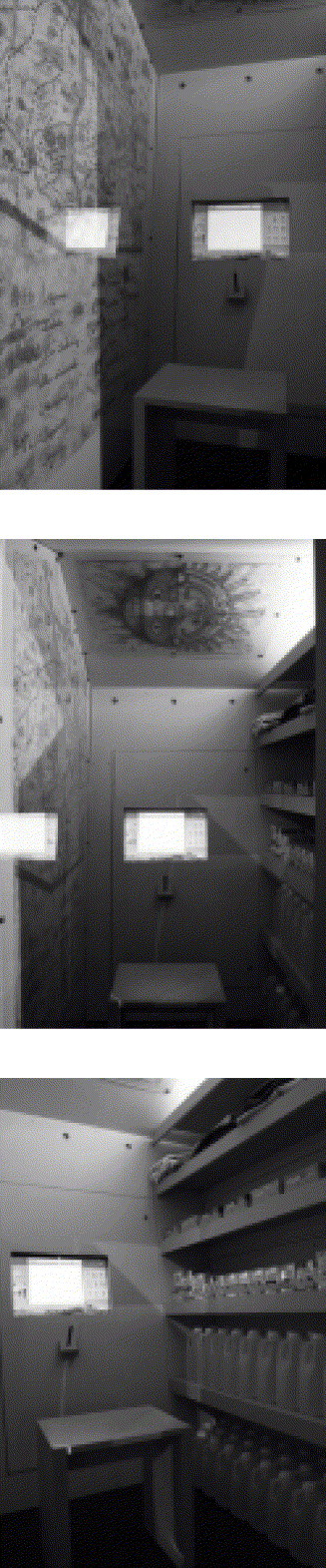
Casa Segura Interiors.

The first example, which addresses the flow of undocumented bodies across international borders, is media artist/designer Robert Ransick's Casa Segura (see Image 1). Casa Segura (Safe House) is a small, solar-powered shed-like structure stocked with non-perishable food and water. Designed to be located on private land in the Sonora desert in Southern Arizona, this unmanned shack can be used by undocumented migrants who have decided to cross this dangerous desert to try to avoid detection by US Border Patrol agents as they journey from Mexico to the US. Because of the harsh conditions of the Arizona desert and the general under-preparedness of crossers to make their journey, Casa Segura's shelter and provisions can mean the difference between life and death. But Casa Segura is more than just a transitional space that migrants can anonymously pass through. For Casa Segura also houses a computer touch screen that is linked (on a time delay) to the internet. Choosing between options ‘to draw, write messages, or make a pictogram from a set of ready-made graphical icons’, migrants using Casa Segura may not only mark their existence but also comment on their experience as they make their journey.
According to Ransick, ‘[…] Casa Segura engages three distinct groups: Mexican migrants crossing the border through this dangerous landscape, the property owners whose land they cross, and members of the general public interested in learning more about border issues and the intricate dynamics at play in this heavily trafficked region’.Footnote 53 In so doing, Casa Segura does not only provide a temporary refuge and site of engagement to migrants. It also ‘provides concerned private property owners on the border with an opportunity to create a life-saving beacon in the desert, a platform for engaging with the anonymous individuals crossing their land, and a non-aggressive means of protecting their homes’.Footnote 54 The overall effect of this project is to make ‘manifest the compassionate choices available to individuals who live within this highly charged border region. As an alternative to the future militarization of the border, Casa Segura offers a new method of engagement and free exchange. Shifting away from the abstract rhetoric of numbers, the project focuses on the anonymous – yet intimate – relationship between a property owner and the individual migrants walking their land’.Footnote 55
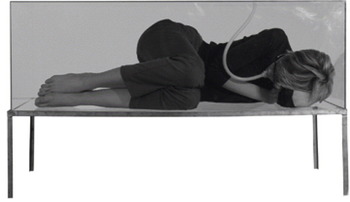
Faraday Chair.

A second, very different example is designers Anthony Dunne and Fiona Raby's Faraday Chair (see Image 2), which comes from their project Hertzian Tales Footnote 56 and addresses the flow of electromagnetic impulses, defamiliarising the familiar in the spaces we inhabit. Unlike designer Robert Ransick's Casa Segura which is made to actually function in the Arizona desert, Dunne and Raby's Faraday Chair is a non-functioning prototype that illustrates the sort of shelter we might actually need to keep us safe from the circulation of hidden electromagnetic fields that surround us everywhere. The prototype is a yellowish-tinted Perspex box large enough to house a person curled up in the foetal position. The box is elevated on steel legs and contains an air mask for ventilation. In line with much of Dunne and Raby's work, the Faraday Chair asks questions about ‘the social, cultural, and ethical impact of emerging pervasive technologies’.Footnote 57 Specifically, the question raised by the Faraday chair is if ‘[a]s electronic devises invade our houses, wave-free spaces may be our only refuge’.Footnote 58
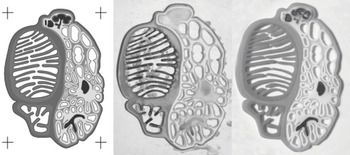
James King's In-Vitro Meat Project ‘Dressing the Meat of Tomorrow’.

The final example comes from Dunne and Raby's former student James King's In-Vitro Meat Project, ‘Dressing the Meat of Tomorrow’,Footnote 59 a project that considers the roles of design and technology in practices of food preparation and consumption. King's interest is in how existing technologies make it possible to clone edible meat without the need to clone and then slaughter an entire animal. This leads him to speculate on ‘how we might choose to give shape, texture and flavour to this new sort of food in order to better remind us where it came from’.Footnote 60 In his project, King designs in-vitro meat that in no way resembles the meat we are accustomed to eating these days, meat that is a discrete part of an animal like a leg or a breast. Instead, the meat King imagines might be served in the future is grown in-vitro in moulds to resemble colourful (almost candy-like) cross-sections of an animal's inner organs, what he calls ‘MRI steaks’ (see Image 3). By playing with ideas of taste and palatability, King's work challenges us to think about how existing technologies enable unforeseen relationships among humans, animals, and food. It raises questions like: ‘Should cloning meat replace herding and slaughtering animals for food?’; ‘If so, would cloning make animals safe from humans or would more species of animals become extinct because humans don't cultivate them?’; ‘Is cloned meat safe for human consumption?’; ‘If so, how might cloning meat introduce new practices of ethical eating beyond, say, vegetarianism?’; ‘And how will designers make these developments normal and acceptable?’
Structures like Casa Segura and objects like the Faraday Chair and MRI steaks are designed to hold social, cultural, political, and ethical values in ways that provoke questions. By building and/or circulating these designed structures and objects, ethico-political and critical designers are effectively circulating their questions, about the normal and the abnormal, the real and the imaginary, the possible and the impossible. It is for this reason that critical designers sometimes refer to their work as ‘design for debate’.Footnote 61 Included in this debate are not just the intended uses of designed objects, but also their unintended uses. For one never really knows how an object will be used in a specific context by a specific individual with all sorts of emotions, desires, and needs that commodified technology cannot or will not recognise.Footnote 62 Think again of Colomina's example of the cell phone, which was designed to enable communication and connection but which was used, misused or abused to trigger destruction in the Madrid bombings.
Overall, what these ethico-political and critical designs do is use the imaginative space of design in which security and technology meet to make politics, values, and ethics visible. They do this by illuminating many taken-for-granted assumptions, values, and utilities designed into this relationship and highlighting questions about why a particular security/technology relationship exists, on whose behalf, for what stated and unstated purpose, and for what intended and unintended use. In so doing, they allow us to think political, critically, and ethically about what the application of these everyday technologies of protection means for our ‘safe living’ right here and right now as we think about how we will live safely today and how we will live safely in the future.
‘Do you want to replace the existing normal?’Footnote 63
As the above discussion makes clear, the work of ethico-political and critical designers can embody unexpected and therefore disarming critiques about the relationship between security, technology, and design. It can do this by, in the words of critical designer Fiona Raby, ‘replacing the existing normal’ in terms of what design is supposed to do.Footnote 64 For critical designers like Raby, what traditional design is supposed to do is use technology to provide consumers with market-driven systems, services, and objects that are useful as well as aesthetically pleasing rather than raise questions about new technologies. From our new securities perspective,Footnote 65 what traditional design also does is smooth over and depoliticise the relationship between technology and security by providing slick, sellable technological ‘solutions’ to what mainly states but also corporations and individuals designate as security ‘problems’.
During 2007/2008, we began working with ethico-political and critical designers to learn about the protocols and procedures of doing ethico-political and critical design and to expose these designers to how we think about safety and security.Footnote 66 Just as we would not claim any expertise in the area of design, none of the ethico-political and critical designers we work with would claim any expertise in the area of security studies. Nor would these designers necessarily appreciate all of the ways their work occasionally interrupts traditional and even new ‘security dialogues’. So it is just as hit and miss that ethico-political and critical designers might direct their attention to traditional, critical, and new ‘security issues’ as it is that traditional, critical and new security scholars might stumble upon the insights of ethico-political and critical designers to help them ‘replace the existing normal’ in terms of what security studies is supposed to do. The challenge, then, is to create a new, sustained dialogue among ethico-political and critical designers and security studies scholars and practitioners so that they might work together to influence public policy agendas that claim to ‘design out insecurity’ and ‘design in protection’ now and in the future and to expose dangerous contradictions bound up in these security agendas.
One of the ways we are taking up this challenge is by developing a new approach to security studies, what we call Redesigning Security. A Redesigning Security Approach combines the insights of new security studies and the insights of ethico-political and critical design to rethink the security/technology relationship in ways that may influence security policy. More specifically, it involves three moves: (1) interrupting the conventional conversation about security by broadening who takes part in this conversation; (2) identifying new research questions that emerge from this conversation and, (3) combining new security studies insights and ethico-political and critical design practices and research methods/attitudes as a way to explore these new research questions. We will elaborate on each of these moves in turn.
Conversations about security tend to be limited to social/political science academics, government policymakers working directly on security issues, and scientists developing technologies that may be deployed to solve security problems. Occasionally, stakeholders like ‘the public’ or corporations are included. Our conversation about redesigning security draws upon these and three additional groups – (1) academics working on critical organisational management, critical science/technology studies, and critical humanities studies; (2) critical policy analysts working for independent public policy Think Tanks and, (3) design practitioners who understand themselves to be doing ethico-politically-motivated design or to be employing ‘critical design’ methods/attitudes in their practice of design. What these additional conversationalists add are alternative perspectives on what politics is and how it is practiced. These dialogues also broaden the resources we draw upon to re-imagine and therefore rethink what security is, what technology is, what design is, and what the security/technology/design relationship should be, particular on behalf of states and citizens. They do this through references to aspects of the ‘real world’ that traditional security studies scholars, analysts, and practitioners often neglect and through references to ‘other worlds’ in film, literature, art, music, and performance.
What is emerging from this refigured conversation are a range of research questions that are markedly different to those found in traditional, critical and new security studies because they require us to rethink security, technology and design separately and together. These questions are:
1. What products, services and assemblages are designers, scientists and policymakers imagining and proposing in order to ‘design out’ insecurity and ‘design in’ protection’?
2. How can we begin to use alternative practices and methods/attitudes – such as ‘critical design’ – to imagine how these new products, services, and systems will be used and (mis)used in the near future and to potentially interrupt and/or redirect these future applications of new technologies?
3. What are the ethico-political implications of these attempts to ‘design out’ insecurity and ‘design in protection’?
How we investigate these research questions is by combining new securities insights with ethico-political and critical design methods/attitudes. As our earlier discussion pointed out, a new securities perspective offers a number of insights about the relationships between security and insecurity, security and fear, and security and politics/ethics. One of the mantras of new security studies is that attempts to increase security are often also accompanied by increases in insecurity. At the same time, though, multiplying insecurities can be a policymaking technique (as we've seen in the so-called War on Terror). But it is a policymaking technique that always threatens to get out of hand. This is because the sorts of fears that bubble through all of the contemporary circulatory systems we discussed earlier are explicitly created, directed, containable, and predictable fears as well as unexpected, misdirected, uncontainable, and unpredictable fears. All responses to these insecurities and fears – whether we think they make us ‘safe’ or not – have ethico-political dimensions that are sometimes difficult to grasp when we are caught up in them (like the sometimes hidden histories of iris scanning technology in airport security ‘fast lanes’).Footnote 67
Much of the work of ethico-political and critical designers engages (either explicitly or implicitly) the ethico-political issues circulating through contemporary networks of security and insecurity. What these designers are very good at is making visible the relationships between security and insecurity through the production of material objects (like Casa Segura, the Faraday Chair, and MRI steaks). The reason why these objects are so effective at materialising relationships between security and insecurity (particularly in the realm of science and technology) is because these objects embody paradoxes about the circulation of securities and insecurities through technologies that either exist today (border patrols, electromagnetic waves) or that are being imagined to secure us in the future (Homeland Security blankets).
What we are calling ‘ethico-political design’ accomplishes its critique of the security/technology/design relationship by proposing self-consciously ethical and political designs that intentionally complicate prevailing knowledge about politics and the values contained in this political knowledge while (usually) offering alternative design solutions and/or ethical choices in the face of these political problems (as Casa Segura does, for example, in relation to the prevailing wisdom and practice of dealing with illegal immigrants). How what designers Anthony Dunne and Fiona Raby call ‘critical design’ accomplishes its critique of the security/technology/design relationship is by standing outside the prevailing knowledge about design (that design should offer marketable ‘solutions’ to pre-given ‘problems’). From this position, critical designers are able to design objects that are themselves questions about the ethico-political values and biases designed into everyday technologies and their intended uses, as well as questions about the traditional way of doing design. This position also allows critical designers to speculate not only about what appears to be normal in the present but also about what might become normal in the future, especially in relation to new sciences and technologies. And it also allows them to question how what is normal in the present is uncritically projected into the future by corporate (and we would add, state) futurologists.Footnote 68 On this point, Dunne and Raby argue,
Corporate [and state] futurologists force-feed us a ‘happy-ever-after’ portrayal of life where technology is the solution to every problem. There is no room for doubt or complexity in their techno-utopian visions. Everyone is a stereotype, and social and cultural roles remain unchanged. Despite the fact that technology is evolving, the imagined products that feature in their fantasies reassure us that nothing essential will change, everything will stay the same […] The resulting scenarios extend pre-existing reality into the future and so reinforce the status quo rather than challenging it.Footnote 69
Rather than buying into these conservative forecasting strategies, Dunne and Raby explore fantastical future scenarios that often have a bleaker quality, what they have sometimes referred to as ‘design noir’.Footnote 70 Of course, futurists and policymakers concerned with security also often develop bleak scenarios that stress the need for innovation to respond to the ‘state of emergency’. Yet what connects the corporate futurists with security futurists is a concern with designing out insecurity through technological innovation. Commenting on this practice, Anthony Dunne explains,
If we limit ourselves to only designing the present then the ‘future’ will just happen to us, and the one we get will be driven by technology and economics. We need to develop ways of speculating that are grounded in fact yet engage the imagination and allow us to debate different possible futures before they happen. The danger of course is that they become mere fantasies. So the challenge is how to maintain realism. Maybe it is related to the suspension of disbelief that filmmakers make use of. The social and ethical implications of technologies such as biotech and nanotech can only be explored through speculation.Footnote 71
Unconventional speculation and imagination about the future, then, are among the most important tools of critical designers. But, as Dunne points out, this speculation must be grounded in more than mere fantasy. For this reason, Dunne, Raby and their students in the Royal College of Arts Design Interaction Program work (critically) with top-notch nano – and material scientists, bioengineers, and emerging technologists, with corporations like Microsoft and BT, and with government departments like the Department of Trade and Industry. By ensuring that the science and technology they engage with is on the drawing board (if not already in the marketplace) critical designers ‘blur the boundaries between the real and the fictional, so that the conceptual becomes more real and the real is seen as just one limited possibility among many’.Footnote 72 Indeed, the slippage between the real and the fictional as attempts to secure by design intensify leads to a situation where critical design not only examines the future of our attempts to control and secure life but also creates a sense of anxiety and uncertainty as to what is real and what is fictional in our desire to secure by design, alerting us to our habituation to new innovations in the securitisation of the body and everyday life.
The results of critical design are objects that both fascinate and alienate, thrill and repel, aesthetically please and morally repulse. James King's MRI steaks are a good example of this. And all of this is, of course, intentional. It is what Fiona Raby calls ‘the space of dilemma’Footnote 73 and what we call ‘thinking space’. It is in these sorts of spaces, through some very unexpected encounters with objects, that we might create new opportunities to think again about the security/technology/design relationship.
Conclusion
Theodor Adorno was concerned with the connections between design, the built environments we live in, and the political. In Minima Moralia: Reflections on a Damaged Life, Adorno comments, in an extract that is worth quoting at length:
Do not knock – Technology is making gestures precise and brutal, and with them men. It expels from movements all hesitation, deliberation, civility. It subjects them to the implacable, as it were ahistorical demands of objects. Thus the ability is lost, for example, to close a door quietly and discreetly, yet firmly. Those of cars and refrigerators have to be slammed, others have the tendency to snap shut by themselves, imposing on those entering the bad manners of not looking behind them, not shielding the interior of the house which receives them. The new human type cannot be properly understood without awareness of what he is continuously exposed to from the world of things around him, even in his most secret innervations. What does it mean for the subject that there are no more casement windows open, but only sliding frames to shove, no gentle latches but turnable handles, no forecourt, no doorstep before the street, no wall around the garden? And which driver is not tempted, merely by the power of his engine to, to wipe out the vermin of the street, pedestrians, children and cyclists? The movements machines demand of their users already have the violent, hard-hitting, unresting jerkiness of Fascist Maltreatment.Footnote 74
To be sure, the connections Adorno makes between the design of windows, refrigerators, doors and fascism is perhaps overstated. But the point that Adorno is making is an important one. Updating Adorno's concerns, we might ask about today's world: What is the ‘new human type’ that emerges from worlds where the password is a thumbprint on a biometric border located not just at a border between sovereign nation-states but in a school or a bank or on the surface of an MP3 player? What ‘new human type’ emerges from worlds in which our ‘body armor’ is not only knife proof but networked, where we look for the most playful attempts to tag our children, where a designer bicycle helmet is modelled on a futuristic fighter pilot's helmet, where we travel in vehicles designed with a rugged and militaristic aesthetic of protection? Immersed in attempts to secure by design, what type of encounter with the world are we ‘new human types’ already prepared for? What does this mean for our sense of living with others? And what do future plans for securing by design tell us about our current political fears and desires?
These are the question that a new generation of designers is examining. These are difficult and often disturbing questions to explore, and some of the designs produced to explore these questions themselves have the ability to disturb and unsettle because of how they imagine the realisation and implementation of future technologies. The disturbing nature of critical design work in particular, like that of Dunne and Raby, is intensified by the fact it has been displayed in exhibitions in major museums and galleries that can verge on a celebration of new design solutions to address the insecurities of contemporary life. This point comes through in a New York Times review on MoMA's Design and the Elastic Mind titled ‘The Soul in the New Machines’. In it, Nicolai Ouroussoff celebrates the exhibition, commenting that ‘[t]he results can be scary, but they may also hold the key to paradise’.Footnote 75 In an obvious reference to the section that showcases the work of Dunne and Raby and their students, the critic writes, ‘If the show has a weakness, it's when it introduces artsy expressions of futuristic societies that tend to be technologically crude: images of heavy plastic tubes that potential sexual mates can use to sniff each other, for example, or robots that refuse to respond until they are lavished with affection.’Footnote 76
As this review suggest, amidst all the wonderful design solutions to make life better, the work on ‘design for debate’ can appear to be out of place. Yet this is precisely what makes this work so powerful. For its very purpose is to show how the future will exceed mainstream forecasts about how technology can be mobilised to solve human problems. It does this by revealing a disturbing ‘otherness’ that lurks within technology and our uses of it and that reminds us that rapid technological changes rarely unfold in linear, predictable fashions that can be controlled by humans. Instead, it underscores how technology changes not only our senses of security and insecurity, but our sense of self, pointing toward ‘new human types’ that might be generated from human/technology interactions.
This work has important implications for security agendas that attempt to secure by design. For by making tangible the limits of human control and technological progress, critical designs reminds us of the limits of policy agendas that promise to ‘design out insecurities’ and ‘design in protection’. What's more, critical designs shows how designers potentially figure so crucially in transforming unpalatable, untested technologies into palatable, reassuring design solutions. In so doing, critical designs alert us to how designs and designers can be co-opted and put in the service of states and corporations by, for example, designing more acceptable and tasteful forms of control that can be integrated into our daily lives as designs for ‘safe living’ and by designing ‘new human types’ who more easily accept emerging forms of control.
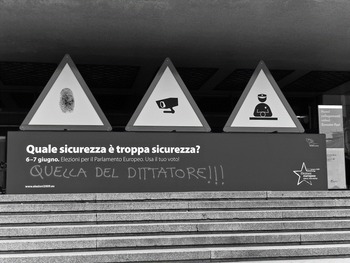
Photograph taken by Mark Lacy at Venezia Santa Lucia train station in April 2009.

Our goal in proposing a Redesigning Security Approach to an exploration of the security/technology/design relationship is to combine the ‘very concrete and down to earth language’ of designFootnote 77 – a language articulated mostly through material objects – with the insights of new security studies in ways that make visible the troubling conundrums bound up in securing by design. We recognise the potential for politics-as-usual to absorb the critiques offered by ethico-political and critical design and for design to shy away from doing politics. Indeed, provocative design can be used to mobilise debate within existing political discourse, like this large series of warning signs declaring ‘Which security is enough security?’ (see Image 4) created by the EU to mobilise interest in elections, and, as the graffiti response to this sign highlights (‘that of the dictator’), opens up a debate that its planners may not have intended. Yet at a time when policymakers, futurists and designers are often seduced by the promise of securing by design, our engagements with ethico-political and critical design open up alternative ways of interacting with technology and design, potentially transforming us from policy analysts who uncritically rely upon the latest technology to solve our security problems into ‘scout[s] sent on ahead to see if the water is drinkable or not’.Footnote 78