Career related concerns constitute an action exerted by many individuals and at different times of their lives (Magalhães & Bendassolli, Reference Magalhães, Bendassoli, Borges and Mourão2013). However, the socioeconomic changes on the world scene, such as the rapid technological advance, international competition, and the downsizing of the productive structures (Oliveira et al., Reference Oliveira, Zanon, Silva, Pinhatti, Gomes and Gauer2010) allowed the coexistence of different models of career guidance in today’s world.
The existence of new proposals parallel to the traditional career model, which values aspects such as the permanent jobs and a vertical progression in the hierarchy of the organization (Silva, Reference Silva2009), emphasize a greater individual accountability for conducting his/her own career and a greater independence from the organization (Campos, Reference Campos2006). According to Gerber, Wittekind, Grote, Conway, and Guest (Reference Gerber, Wittekind, Grote, Conway and Guest2009), on the other hand, there is not a dichotomy between “old” and “new” career models. The authors defend that different career guidance models can emerge based on cultural aspects and the economic context. Based on this they claim hybrid models are therefore possible, mixing traditional characteristics (e.g., safety at work) with aspects from the more recent models (e.g., career self-management).
According to Sullivan and Baruch (Reference Sullivan and Baruch2009), the protean career model, as well as the boundaryless career model, has had a great impact on the study of careers. Among these ones, however, we chose to investigate the protean model because we consider it to be more adequate and more easily applied to understand the careers of university students without previous work experiences. Despite its theoretical relevance, the boundaryless career model emphasizes physical mobility, which is the possibility to transition between different employers. Such a characteristic is uncommon, or is even absent in Brazilian university students.
Protean Career Model
According to Sullivan and Baruch (Reference Sullivan and Baruch2009), the protean career model was proposed by Hall in 1976, becoming well known only 20 years later when the author published “The career is dead – Long Live the Career”. The terminology “protean career” is based on the story of Proteus, a sea god featured in Homer’s Odyssey, by its ability to adapt to the challenges presented by the environment (Inkson, Reference Inkson2006). Based on this myth, Hall (Reference Hall1976) began to use the term “protean career” as an analogy for versatility, flexibility, and adaptability required of a contemporary professional by the labor market (Martins, Reference Martins2010).
The protean career model is based on a “values-driven” and “self-directedness” dimension. The first term alludes to the idea that an individual’s career is driven by one’s personal values, which also serve to measure one’s success (Briscoe, Hall, & DeMuth, Reference Briscoe, Hall and DeMuth2006). Nevertheless, to allow oneself to be driven by personal values demands previous self-knowledge. The identification of the values that are truly relevant for an individual requires thorough inner reflection, which is performed by only a few (Kopelman, Feldman, McDaniel, & Hall, Reference Kopelman, Feldman, McDaniel and Hall2012).
The self-directed dimension alludes to the individual’s autonomy in the direction of his or her career (Briscoe & Hall, Reference Briscoe and Hall2006). That dimension presupposes a sense of control in the individual and the feeling that one can make a difference (Kopelman et al., Reference Kopelman, Feldman, McDaniel and Hall2012). On this basis, according to Hall (Reference Hall1996), careers are designed by the individuals rather than by organizations and might be continuously redirected to meet each individual’s needs.
Aiming at evaluating self-directedness and the values-driven dimensions, Briscoe et al. (Reference Briscoe, Hall and DeMuth2006) elaborated a 14-item instrument known as the Protean Career Attitudes Scale. This instrument was validated with a sample of 561 Business undergraduate and MBA students working part-time, as well as managers and executives.
Different studies highlight the relevance of the protean career. Cao, Hirschi, and Deller (Reference Cao, Hirschi and Deller2013) conducted a survey mostly with some Chinese people who had voluntarily migrated to Germany. Their findings showed a positive relation between protean career attitudes and career satisfaction, life satisfaction and intention to remain in the host country, mediated by an adjustment to the new environment. Briscoe, Henagan, Burton, and Murphy (Reference Briscoe, Henagan, Burton and Murphy2012) suggested that protean attitudes help individuals to deal with moments of uncertainty in their careers. A recent example was the crisis on the financial system in 2008, which affected the labor market in the United States and several other countries, such as Brazil.
On the other hand, authors as Gubler, Arnold, and Coombs (Reference Gubler, Arnold and Coombs2014) have highlighted the limitations of the model, like the lack of research studies that emphasize the possible negative effects of adopting protean attitudes and the dependence of the instrument proposed by Briscoe et al. (Reference Briscoe, Hall and DeMuth2006). They still point out that most surveys are cross-sectional studies, which preclude the investigation of causal relationships and do not include meta-competencies of adaptability and identity suggested by Hall (Reference Hall2002).
Arnold and Cohen (Reference Arnold and Cohen2008), in turn, emphasize the contradictions between the myth of Proteus and the propositions of the protean career. According to the authors, Proteus only changed shape under great pressure to escape capture, which goes against the idea of a career that follows the path of the heart. Further, in this direction, Inkson (Reference Inkson2006) suggests that the metaphor leads to a greater focus on the adaptability aspect, leaving aside the complexity proposed by the definition of the protean career.
According to Briscoe et al. (Reference Briscoe, Hall and DeMuth2006), a better understanding of the theoretical model requires investigating how different aspects, such as aging, modernization, social identity, organizational culture, national culture, educational level, may influence the protean dimensions. In this sense, the present study reports a research conducted specifically in the Brazilian context, using a sample composed of university students.
The Protean Career in Brazil
Brazil is located in South America and has approximately 191 million inhabitants, distributed among five major geographical regions that present cultural, economic and social differences (IBGE, 2010a). Around 48% of the population’s age ranges between 0 and 29 years old (IBGE, 2013). The income inequality is the biggest difficulty that its population has to deal with, where 77% of the families have a monthly income per capita of up to two minimum wages, whereas 5% live with a monthly income per capita above five minimum wages. In relation to work, 57% of the working population above 16 years of age is in formal employment, whereas 43% are in informal jobs (IBGE, 2013).
The country’s educational system is composed by the basic and higher education (Law n° 9394, 1996). The basic education is composed by the early childhood education, for pupils aged from zero to five years old; the elementary school, which is mandatory to children from six years of age; and the high school, which is the final level of the basic education, for at least three years. After this cycle and through a selection process, students can enter higher education in public or private colleges or universities. However, up until 2010, less than 12% of the population above 25 years of age completed the higher education training (IBGE, 2010b).
Few investigations on the protean career have been conducted in Brazil in the last ten years. Andrade, Kilimnik, and Pardini (Reference Andrade, Kilimnik and Pardini2011), for example, conducted a study with undergraduate and postgraduate Business students who worked in different professional areas. They observed a greater tendency of career guidance according to protean aspects when compared to a traditional career model. In order to measure the participants’ choice for a protean or a traditional career model, the authors developed an instrument. However, there is no information on the psychometric properties of the scale presented in the study.
Oliveira et al. (Reference Oliveira, Zanon, Silva, Pinhatti, Gomes and Gauer2010) adapted the Briscoe et al. (Reference Briscoe, Hall and DeMuth2006) scale for collecting data with Brazilian professionals. The authors used a sample composed of 292 workers (mean age of 32 years) employed by different Brazilian organizations and the final version of the scale was composed by 11 items. Using this Brazilian version, Oliveira and Gomes (Reference Oliveira and Gomes2014) observed a positive relation between self-directedness and the autonomous reflexive and meta-reflexive styles, suggesting that professionals who cultivate the habit of reflecting on their own thoughts have a greater tendency to take responsibility for their own careers.
Conducting a qualitative study on the public sector, Silva, Balassiano, and Silva (Reference Silva, Balassiano and Silva2014) observed that some employees presented protean-like characteristics, such as seeking for continuous learning and an autonomous career management. This was observed despite the value they attribute to the stability associated with public-sector jobs.
Mostly, Brazilian studies have focused on professionals, except the study conducted by Andrade et al. (Reference Andrade, Kilimnik and Pardini2011) with undergraduate students. Notwithstanding, the students were also part-time workers, which provided them with more information on the demands of the job market. No national surveys were found with undergraduate students without professional experience.
This reality is not uncommon in Brazil, especially in public universities, where it is noteworthy the difficulty for working students to conclude higher education (Sales Jr., Reference Sales Junior2013). This finding can be illustrated by a study recently released by the Higher Education Census (INEP, 2013), which indicated a 5.6% reduction in the number of graduates of higher education, not to mention a reduction in the growth rate of the Brazilian Higher Education.
Especially for those students who have not had professional experience, Hall (Reference Hall2002) suggested that many young people have not received the proper training to suit the changing needs of the labor market, thus having a “reality shock” during the first professional experiences. The diploma is no longer enough to win a place in the job market, being necessary the development of specific skills, such as networking and the ability to adjust to different demands (Teixeira & Gomes, Reference Teixeira and Gomes2004). De Vos, De Clippeleer, and Dewilde (Reference De Vos, De Clippeleer and Dewilde2009), in turn, point out that the development of certain skills (e.g., career planning and networking) during the graduation period appear to have positive repercussions for the individual at the beginning of their professional life after the transition to the labor market.
Understanding the need to develop some skills during the graduation period suggests that it is important to extend this to the development of career behaviors that are self-managing and values-based, as proposed by the protean career. In order to evaluate these aspects, it is necessary to use appropriate measures for undergraduate students, which currently do not exist in the Brazilian context. Additionally, the simple application of contemporary career models to different cultures incurs a failure (Gerber et al., Reference Gerber, Wittekind, Grote, Conway and Guest2009).
Although the instrument proposed by Briscoe et al. (Reference Briscoe, Hall and DeMuth2006) has been validated with a subsample of undergraduate students, some of the items are adequate only to working individuals (e.g., “When development opportunities have not been offered by my company, I’ve sought them out on my own”). Due to this type of item, other researchers restricted their samples to professionals in the labor market (Enache, González, Castillo, & Lordan, Reference Enache, González, Castillo and Lordan2012; Oliveira et al., Reference Oliveira, Zanon, Silva, Pinhatti, Gomes and Gauer2010).
Thus, considering the assumptions of the protean career and the new requirements of the job market regarding a greater accountability of the individual for managing their own careers, there is a need for programs that better prepare students for these demands, attenuating the “shock” pointed out by Hall (Reference Hall2002). As the existing assessment of protean attitudes is not consistent with the reality of young people who have not had professional experience, it indicates the need for adapting the scale for that public, the central goal of this study.
Method
The adaptation of the Protean Career Attitudes Scale for Brazilian university students was performed in five stages related to the measures of the validity tests: (1) development and adaptation of items to the undergraduate context; (2) face validity (semantic evaluation of the items); (3) content validity (evaluation by specialists associating the items to the theoretical dimensions); (4) construct validity (empirical verification of the association between items and latent dimensions); and (5) discriminant validity (comparing and discriminating the measure from other variables). In addition, two assessments of precision were performed based on the calculation of the Cronbach’s alpha reliability coefficient.
Participants
In the preliminary stages of the instrument validity assessment, four students attending an undergraduate psychology course at a public university and one graduate psychology student at the same institution collected evidence related to the instrument’s face validity. Four specialists (two doctoral candidates, two individuals holding MAs and one MA candidate) were entrusted with the task of verifying the evidence on the instrument content validity.
Those stages were followed by an empirical stage devoted to the collection of indicators of construct validity. For that purpose, a sample composed of 902 students was recruited from two higher educational institutions in a state in southeastern Brazil. The students attended 34 different courses in seven main fields: arts (e.g., architecture and advertising), 12.8%; exact sciences (e.g., physics and chemistry), 8.0%; humanities and natural sciences (e.g., history and biology), 16.4%; law and economics, 28.5%; technology (e.g., civil engineering and computer science), 22.8%; education (e.g., pedagogy), 0.9% and physical education and sports, 9.6%. Only 1% of the participants did not indicate their study areas.
Approximately 48.78% (n = 440) of the participants were female, 50.11% (n = 452) were male and 1.11 % (n = 10) did not report their gender. The age of the participants varied from 18 to 30 years old, with an average of 22.52 (SD = 6.53).
The inclusion criteria were: (1) age older than 18 years; and (2) having completed at least four undergraduate course terms. The first criterion was established based on the norms of the National Ethics in Research Committee, Resolution 466/2012 (National Health Council, 2012), which establishes that participants under 18 years of age need permission by legal careers. The second criterion was included to restrict the sample to finalist students, the closest to face the transition from the university to the job market.
Instruments
The instrument used in the present study was a self-report questionnaire including the following socio-demographic questions and adapted psychological scales. Cronbach alpha values presented here were taken from literature.
Socio-demographic questionnaire
Consisting of 10 questions to characterize the sample and collect information regarding the participants’ sex, marital status and work or internship experience.
Protean Career Management Scale for University Students (PCMS-U)
Details about this measure are mentioned below.
Levenson Multidimensional Locus of Control Scales
Formulated by Levenson (Reference Levenson1974) and validated in Brazil by Dela Coleta (Reference Dela Coleta1987), it consists of 24 items that assess two dimensions: Internal (I) and External (E) locus of control, with the latter being divided into Chance (C) and Powerful Others (P). This scale presents Cronbach’s alphas of .50, .63 and .62, respectively.
Basic Values Questionnaire (BVQ)
Elaborated by Gouveia (Reference Gouveia2003), it consists of 18 items homogeneously distributed across six psychosocial functions (excitement, promotion, supra-personal, existence, interactive, and normative values) that correspond to the underlying theoretical model, the reliability indexes of which varied from .41 to .59 (Gouveia, Reference Gouveia2003; Gouveia, Milfont, & Guerra, Reference Gouveia, Milfont and Guerra2014).
Reduced Personality Markers
Elaborated by Hauk Filho, Machado, Teixeira and Bandeira (2012), this instrument is based on the Big Five personality traits theory, including conscientiousness, agreeableness, extraversion, neuroticism and openness. The instrument lists 25 adjectives, and its precision coefficients vary from .61 to .83 (Hauk et al., Reference Hauk Filho, Machado, Teixeira and Bandeira2012).
General Health Questionnaire
(GHQ-12; Goldberg, Reference Goldberg1972) short version. It consists of 12 items that assess the dimensions anxiety and depression (Gouveia, Chaves, et al., Reference Gouveia, Chaves, Oliveira, Dias, Gouveia and Andrade2003). The reliability indexes obtained in a Brazilian sample were .81 for depression and .66 for anxiety (Gouveia, Chaves et al., Reference Gouveia, Chaves, Oliveira, Dias, Gouveia and Andrade2003).
Satisfaction with Life Scale
Originally elaborated by Diener, Emmons, Larsen and Griffin (Reference Diener, Emmons, Larsen and Griffin1985), it was validated in Brazil by Giacomoni and Hutz (Reference Giacomoni and Hutz1997). This instrument consists of five items assessed on a five-point Likert scale that measure the individual’s self-evaluation of his or her subjective well-being. The internal consistency of the Brazilian version was .91 (Giacomoni & Hutz, Reference Giacomoni and Hutz1997).
Procedures for adapting Protean Career Management Scale for University Students (PCMS-U)
The developed version PCMS-U measure including adapted versions of items from Briscoe et al. (Reference Briscoe, Hall and DeMuth2006) and Oliveira et al. (Reference Oliveira, Zanon, Silva, Pinhatti, Gomes and Gauer2010), whereas other items were developed specifically for this scale based on theoretical construct definitions.
The original version of the instrument (Briscoe et al., Reference Briscoe, Hall and DeMuth2006) contains 14 items that assess the protean career’s self-directedness (e.g., When development opportunities have not been offered by my company, I’ve sought them out on my own) and values-driven dimensions (e.g., I navigate my own career, based on my personal priorities, as opposed to my employer’s priorities). Cronbach’s alphas are .75 and .70, respectively, which indicates satisfactory consistency. The first Brazilian version (Oliveira et al., Reference Oliveira, Zanon, Silva, Pinhatti, Gomes and Gauer2010), consists of 11 items, six of which assess the self-directedness dimension (α = .85) while five assess the values-driven dimension (α = 0.73).
Aiming at defining which items should be held and which ones should be modified in the present study, a committee of four experts analyzed the items of the two scales previously mentioned. Therefore, items such as “What’s most important to me is how I feel about my career success, not how other people feel.” present in the Brazilian version (Oliveira et al., Reference Oliveira, Zanon, Silva, Pinhatti, Gomes and Gauer2010) have undergone minor changes, being worded as follows: “The most important factor is my own assessment of my career success rather than other people’s opinions.” Other items needed more modifications. The original Protean career attitudes scale (Briscoe et al., Reference Briscoe, Hall and DeMuth2006) has the item: “In the past I have sided with my own values when the company has asked me to do something I don’t agree with”. To preserve an item capable of evaluating the conflict of values between the professional and the employer, among students who had not yet gone through professional experience, the sentence was restructured so that it referred to a future possibility: “I prefer to remain unemployed rather than entering a company the values of which oppose mine.” Besides the modifications, experts have developed new items in line with the propositions of the protean model (Hall, Reference Hall1996, Reference Hall2002), as the need to seek continuous learning: “I am constantly assessing the skills I must acquire to keep myself updated related to the job market.” These procedures provided a set of 31 items, which composed the first version of PCMS-U. The main goal of this instrument was that it could be understood and answered by students with or without previous professional experience. The first version of PCMS-U should be answered using a five-point Likert scale that varied from (1) it is not true for me to (5) it is completely true for me.
Procedures for data collection and analysis
This study complied with the ethical standards described in Resolution no. 466/2012 from the National Health Council (2012). It was approved by the Human Research Ethics Committee of the Federal University of Espírito Santo, protocol no. 248,810.
Initially, the preliminary version of the instrument was presented to the study sample for a qualitative assessment. Any comments regarding item comprehension were recorded, and changes in cases with semantic doubts were made. Data collection for content validity involved the participation of examiners, and a minimum of 80% of accordance was established for each item to be retained in the questionnaire. Items with less than 80% of accordance were altered or removed.
To administer the questionnaire, sessions were scheduled directly with the university lecturers. At the appointed times, the investigators presented the research, inviting the students to participate in the study. The completion of the questionnaire required approximately 30 minutes.
Following tabulation, responses were subjected to statistical analysis using SPSS software version 13.0 and Amos version 7.0. Descriptive analyses were conducted with all items. For exploratory and confirmatory factor analyses, the sample was divided into two subsamples (n 1 = 547; n 2 = 355). In the case of PCMS-U, the scale’s dimensional structure was assessed using principal component analysis followed by factor extraction using exploratory factor analysis with the first subsample. The reliability of the items in the resulting subscales was assessed using Cronbach’s alpha.
Data from the second subsample were used in confirmatory factor analysis (CFA), and to calculate the reliability of the resulting scales. Several criteria were used in CFA, as the diversity of indices tend to exhibit variable strong and weak points in the assessment of the model (Taylor, Bagby, & Parker, Reference Taylor, Bagby and Parker2003). Thus, estimator ML (maximum likelihood) was used, as were all the following indicators suggested by Byrne (Reference Byrne2010) and Hair Jr., Anderson, Tatham, and Black (Reference Hair, Anderson, Tatham and Black2005): (1) χ2, which indicates the odds that the selected model will fit the matrix data; (2) χ2/degrees of freedom ratio, which is an indicator of goodness-of-fit whose recommended value varies from two to three, although values up to five are also acceptable; (3) Comparative Fit Index (CFI), which is an indicator that compares models with respect to their fit and whose value might vary from zero to one, whereby values above .90 are required for a model to be accepted; (4) Root Mean Square Error of Approximation (RMSEA) is an indicator of residuals (the difference between the model and the data); its recommended values vary from .05 and .08 with 90% confidence interval, whereby values up to .10 are also acceptable; (5) Goodness-of-fit Index (GFI) and Adjusted Goodness-of-fit Index (AGFI) are indicators of weighted fit related to the proportion of variance/covariance of the data explained by the model; their values vary from zero to one, and values close to .90–.95 are required for a model to be accepted.
To investigate the instrument’s discriminant ability, comparisons using the t-test for independent samples were performed relative to the full study sample (n = 902). The aim of this procedure was to establish whether there were differences in certain variables, e.g., gender, relative to a protean career direction. Finally, correlations between the constructs included in the protean model with values, locus of control and personality traits were also investigated.
Results
Qualitative evidence of PCMS-U validity
The instrument’s first version was provided to four students attending an undergraduate psychology course at a public university and to one graduate psychology student at the same institution to read and comment on the items. The items that were difficult to understand were noted and later subjected to slight changes in content and grammar. The accordance of the examiners for the content validity analysis was 80% for 27 items but equal to or less than 60% for 4 items. Therefore, the following items were removed from the questionnaire: “I believe that career changes are interesting to think about only when it is actually necessary (e.g., loss of job or a better job proposal)”; “I do not consider other people’s opinions on my career choices relevant”; “I would hardly leave a company because of a conflict of values” and “I would sacrifice my personal life to professional growth”. The examiners suggested the inclusion of four additional items and the division of the text of one item into two sentences. Thus, following the stage of content validity verification, the final version of the instrument that was administered to the students consisted of 32 items (see Table 1).
Initial set of Items of the Protean Career Management Scale for University Students (PCMS-U) – Portuguese and English version

Exploratory analysis and indicators of reliability
The PCMS-U set of items was first subjected to principal component analysis to identify the factor composition of the data matrix. The Kaiser-Meyer-Olkin (KMO) index value was .77, and the result of Bartlett’s sphericity test was 2,615.717 (p < .001). Using the information generated by the scree plot as a parameter, the extraction of two and three factors was performed using principal axis factoring and promax rotation.
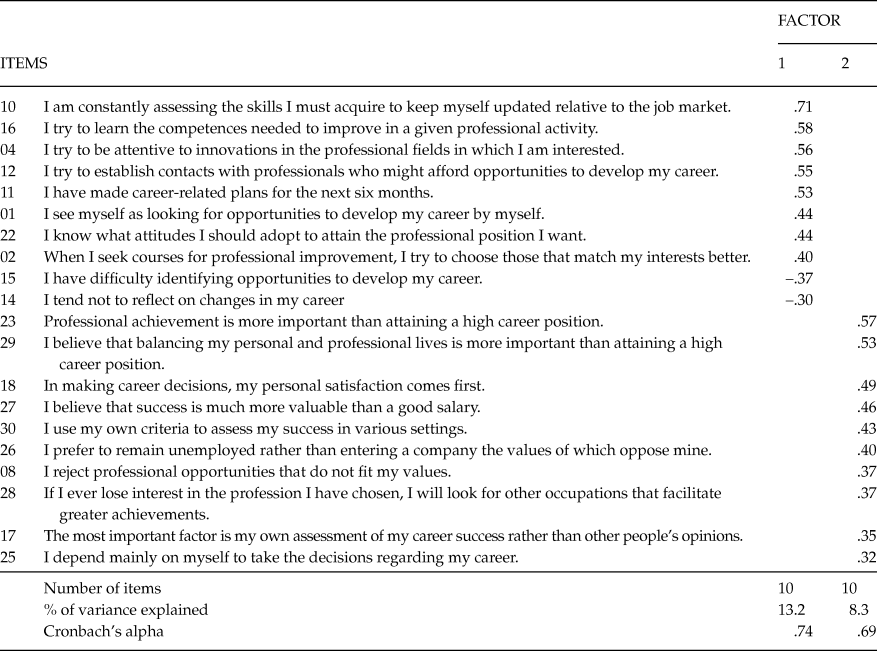
The three-factor solution presented a first factor with self-directedness items and two factors with the values-driven dimension items. Following the theoretical proposal, the extraction was restricted in two dimensions. Results of this analysis can be observed in Table 2, where items are distributed in the two factors with their respective factor loadings.
Factorial loading, explained variance and Cronbach’s alpha values of the Protean Career Management Scale - PCMS-U

In Table 2, the Factor 1 corresponds to the self-management dimension and factor 2, to the values-driven dimension. The items with loading lower than |0.30| were excluded from the final factor solution. Thus, each dimension consisted of ten items in the instrument’s final version. The total variance explained by the two factors together was 21.5%, and the Cronbach’s alpha was satisfactory: .74 for the self-management subscale and .69 for the values-driven subscale.
Confirmatory factor analysis and indicators of reliability
Aiming at verifying the stability of the factor structure, as well as its dimensionality for the undergraduate context, data from the second subsample (n = 355) were subjected to CFA, which tested the matrix that resulted from the exploratory study.
Goodness-of-fit indexes for this sample were adequate for the bidimensional structure: χ2 = 300.840, df = 134 (p < .001), χ2 /df = 1.78, RMR = 0.066, GFI = 0.92, AGFI = 0.90, CFI = 0.85, RMSEA (90%CI) = 0.047 (0.038 – 0.055). The second model with three dimensions also presented adequate indexes: χ2 = 314.393, df = 152 (p < .001), χ2 /df = 2.068, RMR = 0.090, GFI = 0.91, AGFI = 0.89, CFI = 0.82. In order to verify which model presented the best fit, we opted for the delta chi-square procedure, which suggested the two-factor model: Δχ² (2) = 13.551, p < .01 (see Figure 1).
Confirmatory factor structure of PCMS-U – Two- and Three-Factor Models.

The Cronbach’s alpha values resembled those found in the exploratory study: .74 for the self-directedness scale, and .65 for the values-driven scale, which are considered to be good and thus allow the use of the assessed instrument in research (Nunnally, Reference Nunnally1978).
Protean management: The construct’s converging and diverging features
The following results correspond to the analysis of the data relative to the full sample (N = 902). Regarding the demographic variables, no difference was found as a function of gender neither in the self-directedness scale, t = (891) = –0.89, p = .91, and in values-driven scale, t = (891) = –0.92, p = .36. Marital status (single versus married) was not influential on the degree of career self-directedness, t = (889) = 1.31, p = .19, or the values-driven tendency, t = (889) = 0.27, p = .79.
No difference was observed in the self-directedness dimension, t = (893) = 1.81, p < .07, and in the values-driven dimension, t = (893) = 1.80, p = .72, when comparing students who have already had experienced an internship with those who have never had that experience. Similarly, no differences were observed for self-directedness, t = (891) = 1.78, p = .07, and values-driven, t = (891) = 1.14, p = .25, when comparing students with work experience with students with no work experience.
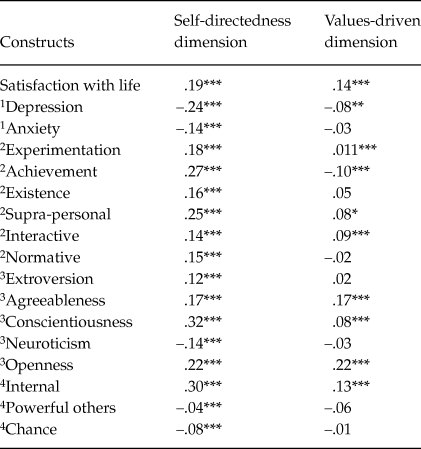
Finally, correlation analyses were conducted to investigate the association between the protean career management features and other psychosocial factors (see Table 3).
Correlation between protean dimensions and psychosocial variables

Note:
1 GHQ-12 (General Health Questionnaire) dimensions.
2 BVQ (Basic Values Questionnaire).
3 Reduced Personality Markers.
4 Locus of Control Scale dimensions.
* = p ≤ .05.
*** = p = .001.
As shown in Table 3, all of the investigated psychosocial variables exhibited correlation with the self-directedness dimension. Among the results, the positive and significant correlations between the self-directedness dimension and the following variables stand out: the psychosocial subfunctions of achievement (r = .27, p = .001) and supra-personal values (r = .25, p = .001); personality traits conscientiousness (r = .32, p = .001), openness (r = .22, p = .001) and perception of the internal locus of control (r = .30, p = .001). Additionally, the negative and significant correlation between career self-directedness and depression (r = –.24, p = .001) is worthy of attention.
Different from self-directedness, the values-driven dimension exhibited significant correlation with a small number of variables, among which the personality trait openness to experiences (r = .22, p = .001) stands out because it exhibited significant correlation with the two dimensions of the protean model.
Discussion
This study aimed to adapt and validate the PCAS for Brazilian undergraduate students. Based on the results, the two-factor model is considered adequate for the investigated sample of university students, which matches the results of previous studies that tested the construct with established professionals (Briscoe et al., Reference Briscoe, Hall and DeMuth2006; Oliveira et al., Reference Oliveira, Zanon, Silva, Pinhatti, Gomes and Gauer2010). Regarding the evidence of PCMS-U validity, the results are favorable in terms of the indicators found, and the indexes of precision are adequate (both above .65), which is considered to be satisfactory (Nunnally, Reference Nunnally1978). The two-factor solution, however, presented 21.5% of explained variance, a value that is lower than expected and observed by Oliveira et al. (Reference Oliveira, Zanon, Silva, Pinhatti, Gomes and Gauer2010) in a study with a sample of professionals. Such low value might be related to the fact that many university students in our sample have not developed their metacompetencies for the emergence of a protean orientation: adaptability and the notion of identity.
According to Hall (Reference Hall2002), the first of these two metacompetencies is related to the desire and ability to adapt to new situations in which autonomy, self-directedness and proactive behavior are highly valued. The latter is related to the ability to form accurate perceptions of oneself and to adjust one’s self-concept adequately based on received feedbacks. Consciousness of one’s own values and knowing their relevance in career management seems to develop with time as this characteristic is less evident in youngsters (Segers, Iceoglu, Vloeberghs, Bartram, & Henderickx, Reference Segers, Inceoglu, Vloeberghs, Bartram and Henderickx2008). Considering that metacompetencies are “overarching” competencies which facilitate adaptation and flexibility on the part of the organization and that are relevant to a wide range of work settings, future studies should test whether metacompetencies – specially adaptability and the notion of identity – form and develop in the early years of professional lives.
Concerning convergence and divergence aspects, no difference was observed between men and women regarding protean attitudes. Similar results were obtained by Briscoe et al. (Reference Briscoe, Hall and DeMuth2006), although they were different from results observed by Oliveira et al. (Reference Oliveira, Zanon, Silva, Pinhatti, Gomes and Gauer2010) whose findings showed that men presented higher scores in self-directedness. Similarly, no differences were observed in scores for students with and without work or internship experience. One possibility for this lack of differentiation is that working activities usually present no relation to college activities. Internal locus of control was positively related to both protean dimensions, suggesting these individuals present greater ability to assume the responsibilities of their own careers and to consider their own interests and values in the process. Generally, individuals with high internal locus of control tend to deal better with stress in unemployment situations (Brouskeli & Markos, Reference Brouskeli and Markos2013), express a positive current and future self-concept (Sagone & De Carol, Reference Sagone and De Caroli2014) and experience more subjective well-being aspects, such as low negative affect, high positive affect and high life satisfaction (Klonowicz, Reference Klonowicz2001).
This study’s results also highlight the association between conscientiousness, represented by aspects such as persistence, organization and determination (McCrae & Costa Jr., Reference McCrae and Costa2003) with self-directedness. The relevance of that trait was noted in studies on career adaptability (Teixeira, Bardagi, Lassance, Magalhães, & Duarte, Reference Teixeira, Bardagi, Lassance, Magalhães and Duarte2012; van Vianen, Klehe, Koen, & Dries, Reference van Vianen, Klehe, Koen and Dries2012) and is related to self-discipline, orientation toward the future and perception of one’s problem-solving ability as a significant factor with respect to the insertion of future professionals in the job market.
Additionally, the trait openness to experience exhibited correlation with career management in the present sample. Analysis of the results found positive correlation between this personality trait, which is associated with creativeness and innovation (Nunes, Hutz, & Nunes, Reference Nunes, Hutz and Nunes2010), and the self-directedness and values-driven dimensions. Furthermore, the results enable the inference that the trait openness to experiences acts as an individual facilitator in the performance of exploratory behavior and in changes of job and the development of an enterprising career profile.
In relation to human values, Gouveia, Milfont, Fischer, and Santos (Reference Gouveia, Milfont, Fisher, Santos and Teixeira2008) suggest they have two main functions: to guide human actions and to express an individual’s needs. In the present study, the psychosocial functions accomplishment and supra-personal exhibited strong correlation with the self-management factor. The achievement subfunction consists of elements that are specifically related to success, prestige and power, whereas the supra-personal subfunction emphasizes the importance of maturity and knowledge to the individual. Gouveia, Milfont, Fischer, and Coelho (Reference Gouveia, Milfont, Fisher and Coelho2009) observe that the supra-personal values are related to the quest for personal satisfaction and recognition as a useful human being. Accordingly, one might infer that the career self-management dimension involves values that are related to individual performance, admiration and prestige.
In what concerns to the features related to general health, the negative correlation that was found between self-directedness and the construct depression suggests that the perception of being in control of one’s career might act as a health-protective factor. This hypothesis is strengthened by the negative correlation found between self-directedness and the personality trait neuroticism. According to Nunes (Reference Nunes2000), the correlation between neuroticism and depression is strong, and in certain studies, the neuroticism was found to act as an accurate predictor of depression (Roberts & Kendler, Reference Robert and Kendler1999). Consequently, self-managed individuals are less predisposed to affective instability in addition to experiencing lower levels of negative and unpleasant feelings. No significant data were found relative to the values-driven dimension.
Regarding the instrument’s applicability and the direction of future studies, the instrument seems to be relevant to the assessment of the processes related to career orientation in youths. As determined by Menezes Filho (Reference Menezes Filho2012) based on data from the 2000 and 2010 Brazilian Census, it is possible to observe the difference between supply and demand of professionals from different areas, which ultimately is reflected in aspects such as job search in areas that are unrelated to the one pursued in higher education or even unemployment. For example, in 2010, 80% of individuals with training in Medicine have been working in this area, which is quite distinct from economists, who are working in their area only in 10% of the cases. Thus, it appears that in some areas with lower demand, it is required that professionals have greater skills to manage their own careers. The instrument proposed in the current study could be a useful tool to evaluate how the student is prepared to assume the responsibilities associated with the career of choice, as well as to generate different subsequent actions.
Sullivan and Baruch (Reference Sullivan and Baruch2009) observe that not all professionals can assume the responsibility for their own careers at times of job market instability. Thus, the identification of individuals who exhibit difficulty managing their careers or orienting themselves according to personal values might be an indicative of the need to orient themselves toward more stable and structured fields. On the other hand, another possibility would be the development of skills that enable the students to better self-manage their careers.
The correlations found between other constructs suggest a few topics (in particular, those related to autonomy) that could be addressed in career orientation programs. Interventions that target the development of an internal locus of control and that emphasize traits such as openness to experiences might strengthen that ability. Such interventions may sensitize university students toward several career alternatives, thus eventually contributing to: reduce the chance that studies would be abandoned, influence the choice of a second university course, avoiding the loss of a career and increasing overall satisfaction. It is noteworthy that the possible practical contributions from the use of the instrument are designed to Brazilian university students. Therefore, in accordance with Gerber et al. (Reference Gerber, Wittekind, Grote, Conway and Guest2009), caution is needed in generalizing the measure and its results from one country to another, given the peculiarities of each context.
Regarding limitations of the study, the lack of discrimination from sociodemographic variables suggests the need to include other data, for instance: family income, and parents’ education level and occupation. Moreover, a new data collection is also necessary with students from private universities, from other regions of the country and other levels of study within the course. The high level of social desirability of the construct in the academic context could also have acted as an intervening variable in the data. A longitudinal study that covers the end of graduation and the first years after the completion of college could remedy this limitation in the future.
In developing the new scale, we sought to create and adapt items that adequately describe the protean dimensions. This process, however, proved to be complex in view of the scope of the concepts (Gubler et al., Reference Gubler, Arnold and Coombs2014). It is possible that the new instrument do not encompass all the features related to each of the constructs proposed by the theory. We suggest the need of a theoretical review based on a set of behaviors that illustrate each protean dimension, favoring the development of items for future reviews of the scale. In other words, there is a need for a decomposition of the constructs related to the values-driven dimension (e.g., personal balance between work and life, work satisfaction, etc.) and the career self-management (e.g., seeking new opportunities independently, networking, seeking further qualification, etc.).
It is important to point out that although it is useful to understand if the individual has characteristics aligned to the protean model, the measure itself does not allow us to define whether the individual has only this orientation, as it is possible to find hybrid models in which there is a mix of different career orientation features (Gerber et al., Reference Gerber, Wittekind, Grote, Conway and Guest2009). Still, considering the transformations in the approaches to professional career management, we expect that this study can contribute to the development of future research and the formulation of programs designed to help students in the transition from university to the job market.