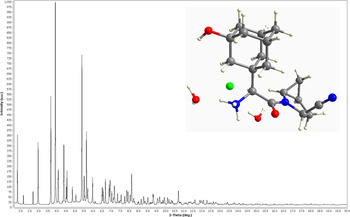
Saxagliptin hydrochloride dihydrate (marketed as Onglyza) is an orally active, reversible dipeptidyl peptidase-4 inhibitor used in the treatment of type-2 diabetes. Commercial saxagliptin hydrochloride dihydrate crystallizes in the monoclinic space group P21 (4), with a = 11.02654(7) Å, b = 6.83957(4) Å, c = 12.97996(7) Å, β = 95.7455(5)°, V = 973.990(10) Å3, and Z = 2. A reduced cell search in the Cambridge Structural Database yielded a previously reported crystal structure (Allen, Reference Allen2002), which did not include hydrogen (DiMarco et al., Reference DiMarco, Gougoutas, Jones, Malley, Savage, Vum, Wei, Yin and Yu2011). In this work, the sample was ordered from BrightGene Bio-Medical Technology Co., Ltd., and analyzed as received. The room-temperature crystal structure was refined using synchrotron (λ = 0.413676 Å) powder diffraction data, density functional theory, and Rietveld refinement techniques. Hydrogen positions were included as part of the structure in calculated positions, which were recalculated during the refinement. The diffraction data were collected on beamline 11-BM at the Advanced Photon Source, Argonne National Laboratory. Figure 1 shows the powder X-ray diffraction pattern of the compound. The pattern is included in the Powder Diffraction File as entry 00-065-1418.
(Color online) Powder X-ray diffraction pattern of saxagliptin hydrochloride dehydrate.

SUPPLEMENTARY MATERIALS AND METHODS
To view supplementary material for this article, please visit http://dx.doi.org/S0885715615000548
ACKNOWLEDGEMENTS
Use of the Advanced Photon Source at Argonne National Laboratory was supported by the U.S. Department of Energy, Office of Science, Office of Basic Energy Sciences, under Contract No. DE-AC02-06CH11357. This work was partially supported by the International Centre for Diffraction Data. The authors thank Lynn Ribaud for his assistance in data collection.