


1. Introduction
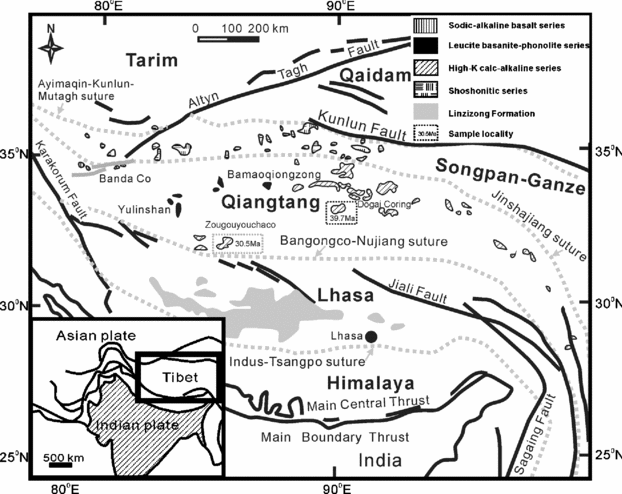
Post-collisional potassic volcanic rocks, following the late Cretaceous Indo-Asian collision (c. 70 Ma: Yin & Harrison, Reference Yin and Harrison2000), are widely distributed in the Lhasa, Qiangtang and Songpan–Ganzi blocks in the Tibetan Plateau (Coleman & Hodges, Reference Coleman and Hodges1995; Turner et al. Reference Turner, Arnaud, Liu, Rodgers, Hawkesworth, Harris, Kelley, van Calsteren and Deng1996; Chung et al. Reference Chung, Lo, Lee, Zhang, Xie, Li, Wang and Wang1998; Williams et al. Reference Williams, Turner, Kelley and Harris2001; Ding et al. Reference Ding, Kapp, Zhong and Deng2003, Reference Ding, Kapp, Yue and Lai2007). These ultrapotassic, potassic and high-potassium calc-alkaline series volcanic rocks (Deng, Reference Deng1989, Reference Deng1991, Reference Deng1998; Liu, Reference Liu1998) range in age from 65 Ma to <1 Ma, and provide important information to help decipher the geological evolution of the Tibetan Plateau and the thermal and compositional structure of the lithosphere. Previous work (Deng, Reference Deng1991; Arnaud et al. Reference Arnaud, Vidal, Tapponnier, Matte and Deng1992; Turner et al. Reference Turner, Arnaud, Liu, Rodgers, Hawkesworth, Harris, Kelley, van Calsteren and Deng1996; Ding et al. Reference Ding, Zhang, Zhou, Deng, Xu and Zhong1999; Miller et al. Reference Miller, Schuster, Klotzli and Purtscheller1999; Hacker et al. Reference Hacker, Gnos, Ratschbacher, Grove, McWilliams, Sobolev, Jiang and Wu2000; Lai & Liu, Reference Lai and Liu2001; Chung et al. Reference Chung, Liu, Ji, Chu, Lee, Wen, Lo, Lee, Qian and Zhang2003; Ding et al. Reference Ding, Kapp, Zhong and Deng2003, Reference Ding, Kapp, Yue and Lai2007) indicates that these volcanic rocks exhibit negative Nb, Ta and Ti anomalies, strong enrichment in incompatible elements, and relatively radiogenic Sr and Pb and unradiogenic Nd isotopic ratios, suggesting that the parental magmas were derived from an enriched lithospheric mantle source that has been isolated from the convecting asthenosphere since at least Proterozoic time (e.g. Turner et al. Reference Turner, Arnaud, Liu, Rodgers, Hawkesworth, Harris, Kelley, van Calsteren and Deng1996). However, it has been proposed that the parental magmas of some young lavas (0–3 Ma) were derived from a mafic granulitic or eclogitic lower-crustal source in thickened lower crust (Cooper et al. Reference Cooper, Reid, Dunbar and McIntosh2002). The rocks evolved from such parental magmas will have features similar to adakitic rocks formed by slab melting in terms of trace element composition (Atherton & Petford, Reference Atherton and Petford1993; Kay & Kay, Reference Kay and Kay1993; Xu et al. Reference Xu, Shinjio, Defant, Wang and Rapp2002). Some of the potassic adakitic rocks in the Lhasa, northern Qiangtang and the Songpan–Ganzi terranes are now interpreted as partial melts of the lower crust (Chung et al. Reference Chung, Liu, Ji, Chu, Lee, Wen, Lo, Lee, Qian and Zhang2003; Hou et al. Reference Hou, Gao, Qu, Rui and Mao2004; Lai, Qin & Li, Reference Lai, Qin and Li2007; Wang et al. Reference Wang, McDermott, Xu, Bellon and Zhu2005). Studies of Cenozoic adakitic rocks provide a good opportunity to investigate the thickening and foundering of lower continental crust beneath the Tibetan Plateau. However, little information exists on the adakitic rocks from the Qiangtang region. Here we report Nd, Sr, and Pb isotopic compositions and elemental concentrations of the volcanic rocks from two new localities (Zougouyouchaco and Dogai Coring) in the southern and middle Qiangtang region (Fig. 1), and compare our results with published data from post-collisional volcanic rocks from Qiangtang Terrane. Our objectives are: (1) to advance a better understanding of lower crustal magmatic processes of the Tibetan Plateau, (2) to report the newly discovered adakites in the northern Tibetan Plateau, and (3) to constrain their mechanism of formation.
Map of the Tibetan Plateau showing the major terranes, the distribution of Cenozoic volcanic rocks and some of the main faults (modified from Yin & Harrison, Reference Yin and Harrison2000).
2. Geological background and petrography
The Tibetan Plateau comprises six terranes, from south to north: Himalaya, Lhasa, Qiangtang, Songpan–Ganzi, Kunlun and Tarim (Fig. 1). The Tibetan Plateau has been created by collision of India–Asia since the early Cenozoic, about 55 Ma ago (Chung et al. Reference Chung, Lo, Lee, Zhang, Xie, Li, Wang and Wang1998; Yin & Harrison, Reference Yin and Harrison2000). The Qiangtang terrane is bounded by the Jinshajiang (or Jinsha) suture to the north, and Bangong suture to the south (Fig. 1). It is generally accepted that suturing of the Songpan–Ganzi and Qiangtang terranes occurred in pre-Jurassic time (Tapponnier et al. Reference Tapponnier, Xu, Roger, Meyer, Arnaud, Wittlinger and Yanh2001), and the Qiangtang terrane has been in an intra-continental setting since the Jurassic. Cenozoic lavas are widely distributed in the Qiangtang terrane (Pearce & Houjun, Reference Pearce and Houjun1993; Turner et al. Reference Turner, Arnaud, Liu, Rodgers, Hawkesworth, Harris, Kelley, van Calsteren and Deng1996; Deng, Reference Deng1998; Tan, Pan & Xu, Reference Tan, Pan and Xu2000; Lai & Liu, Reference Lai and Liu2001; Ding et al. Reference Ding, Zhang, Zhou, Deng, Xu and Zhong1999, Reference Ding, Kapp, Zhong and Deng2003; Yin et al. Reference Yin, Lin, Li, Zhao, Shi, Huang, Sun, Lai, Zhu and Zhao2004; Williams et al. Reference Williams, Turner, Pearce, Kelley and Harris2004; Lai et al. Reference Lai, Qin, Li and Liu2006), with ages from c. 65 Ma to c. 24 Ma, in three volcanic series: Na-rich alkaline basalt (65–40 Ma), leucite basanite–phonolite (29–24 Ma), and high-K calc-alkaline (40–29 Ma) (Chi et al. Reference Chi, Li, Jin, Liu and Yang1999). Samples for this study were collected from Zougouyouchaco and Dogai Coring, in the Qiangtang terrane (Fig. 1). 40Ar–39Ar ages of these rocks are 39.7 Ma (Dogai Coring) and 30.5 Ma (Zougouyouchaco: Chi et al. Reference Chi, Li, Jin, Liu and Yang1999; Li et al. Reference Li, Huang, Mou and Chi2006). In this paper, the 40Ar–39Ar ages for Zougouyouchaco and Dogai Coring are used for the age-correction of Nd, Sr and Pb isotopic compositions. Morphologically, the volcanic rocks are preserved as domes along with recent clastic alluvial deposits, suggesting subsequent tectonic uplift and erosion after eruption. The available data indicate that intermediate to acidic volcanic rocks are dominant in the Qiangtang area (Deng, Reference Deng1998) (Fig. 2), whereas mafic volcanic rocks are common in the western Qiangtang terrane (Deng, Reference Deng1998; Ding et al. Reference Ding, Zhang, Zhou, Deng, Xu and Zhong1999, Reference Ding, Kapp, Zhong and Deng2003). The adakitic volcanic rocks discussed here include trachyandesites, trachydacites and dacites from Zougouyouchaco, and trachydacites and dacites from Dogai Coring. All of these samples are porphyritic. Dacites from Dogai Coring and Zougouyouchaco contain phenocrysts of quartz, oligoclase and minor orthopyroxene and biotite, and groundmass with felsophyric texture consisting of oligoclase, sanidine and quartz. Trachydacites from Zougouyouchaco and Dogai Coring have the same mineralogy as the dacites but exhibit a trachytic groundmass texture.
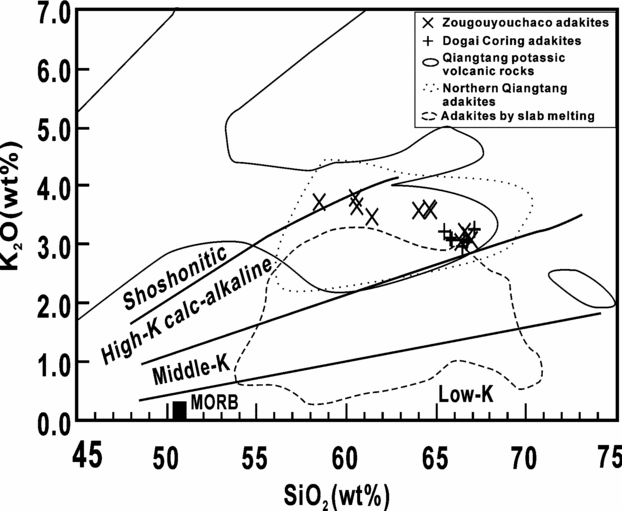
K2O v. SiO2 diagram of the Cenozoic volcanic rocks in northern Tibet. The Qiangtang potassic volcanic rocks are from Pearce & Houjun (Reference Pearce and Houjun1993); Turner et al. (Reference Turner, Arnaud, Liu, Rodgers, Hawkesworth, Harris, Kelley, van Calsteren and Deng1996); Deng (Reference Deng1998); Ding et al. (Reference Ding, Zhang, Zhou, Deng, Xu and Zhong1999, Reference Ding, Kapp, Zhong and Deng2003); Yin et al. (Reference Yin, Lin, Li, Zhao, Shi, Huang, Sun, Lai, Zhu and Zhao2004); Williams et al. (Reference Williams, Turner, Pearce, Kelley and Harris2004); Turner et al. (Reference Turner, Arnaud, Liu, Rodgers, Hawkesworth, Harris, Kelley, van Calsteren and Deng1996); Tan, Pan & Xu (Reference Tan, Pan and Xu2000); Lai & Liu (Reference Lai and Liu2001); Lai et al. (Reference Lai, Qin, Li and Liu2006). Northern Qiangtang adakitic rocks are from Lai, Qin & Li (Reference Lai, Qin and Li2007). Data field for adakites by slab melting is from published data (Defant & Drummond, Reference Defant and Drummond1990; Kay, Ramos & Marquez, Reference Kay, Ramos and Marquez1993; Stern & Kilian, Reference Stern and Kilian1996, and references therein).
3. Analytical methods
Major elements were determined by PANalytical Axios-advance X-ray fluorescence spectrometer (XRF) at the State Key Laboratory of Ore Deposit Geochemistry, Institute of Geochemistry, Chinese Academy of Sciences (IGCAS), using fused lithum-tetraborate glass pellets. Analytical precision as determined on the Chinese National Standard GSR-1 was generally around 1–5% (Table 1). Loss on ignition was obtained by weighing after 3 hours of combustion at 950°C.
Major oxides (wt %) of the volcanic rocks in Qiangtang, northern Tibet

LOI = Loss on Ignition, Mg no. = 100 × Mg/(Mg+ΣFe)
The trace elements were analysed using a Finnigan MAT ELEMENT inductively coupled plasma source mass spectrometer (ICP-MS) at the IGCAS, following procedures described by Qi, Hu & Gregoire (Reference Qi, Hu and Gregoire2000). Rh was used as an internal standard to monitor signal drift during counting. The international standards GBPG-1 and OU-6 were used for analytical quality control (Table 2). The analytical precision is generally better than 5% for trace elements.
Trace elements (ppm) of the volcanic rocks in Qiangtang, northern Tibet
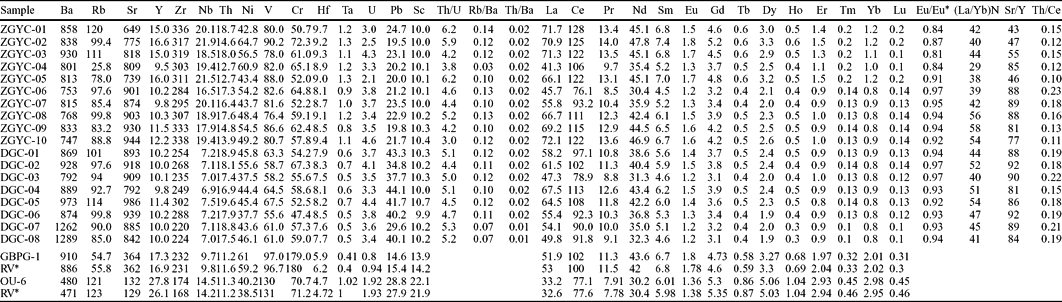
Eu/Eu* = EuN/(SmN+GdN)1/2; N – chondrite-normalized.
Sr and Nd isotopes were measured by a Micro-mass Isoprobe multicollector inductively coupled plasma mass spectrometry (MC-ICPMS) at Guangzhou Institute of Geochemistry, Chinese Academy of Sciences (GIGCAS). Measured Sr and Nd isotopic ratios were normalized to 86Sr/88Sr=0.1194 and 146Nd/144Nd=0.7219, respectively. The measured Nd and Sr isotope standard values are 143Nd/144Nd=0.512124±11 (2σ) for Shin Etou and 87Sr/86Sr=0.710243±14 (2σ) for NBS987. The detailed analytical procedures for Sr and Nd isotope measurement have been documented elsewhere (Liang et al. Reference Liang, Wang, Li and Liu2003).
Samples for Pb isotope analyses were dissolved using a HF+HClO4 mixture. Pb was extracted and purified using HBr and HCl anion microcolumn procedures. The Pb isotopes were determined using a MAT261 thermal ionization mass spectrometer at the Isotope Analysis Center of the Institute of Geology, Beijing Nuclear Industry. Pb isotopic ratios in samples have been corrected by reference to the analyses of NBS981 standard. Mass fractionation correction is 0.1% per atomic mass unit for 206Pb/204Pb, 207Pb/204Pb and 208Pb/204Pb. Procedural blanks were <100 pg for Nd, <1 ng for Sr, and <500 pg for Pb.
4. Analytical results
4.a. Major and trace elements
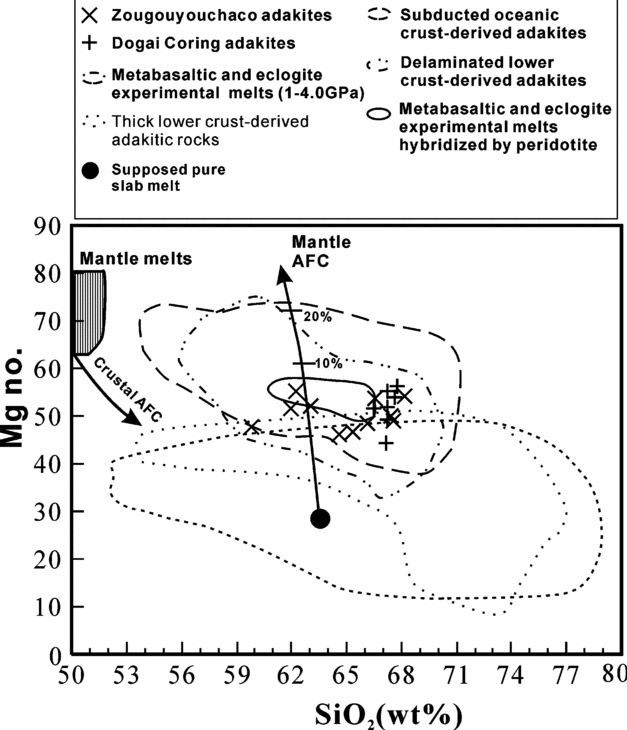
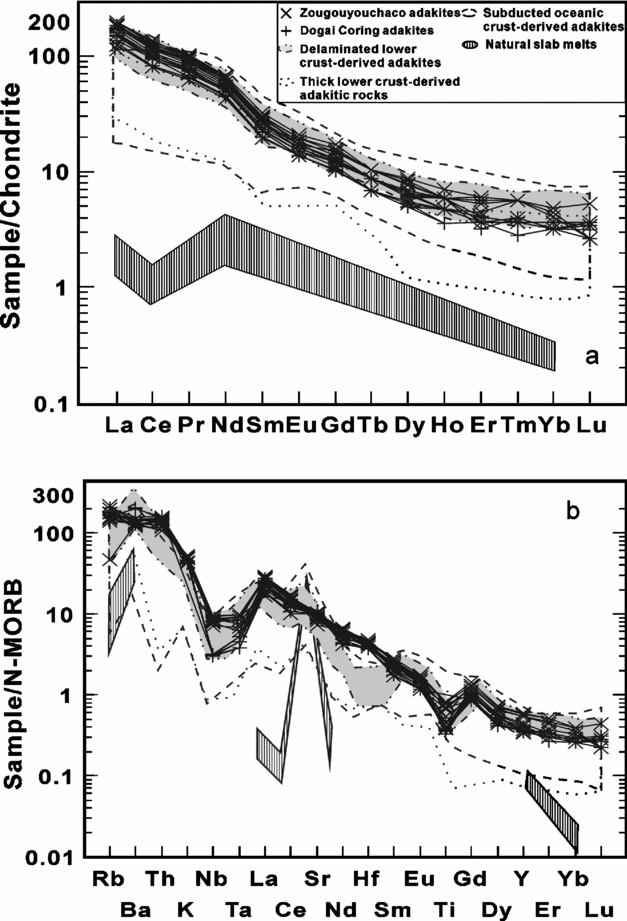
Major and trace element concentrations are given in Tables 1 and 2. The Zougouyouchaco and Dogai Coring volcanic rocks are classified as high-K calc-alkaline andesites and dacites (Fig. 2). They have high SiO2 (58.5–67.1 wt%), Al2O3 (15.1–15.9 wt%), K2O (2.97–3.81 wt%), Na2O (>3.6 wt%, K2O/Na2O<1.0), high Sr (650–890 ppm), and low HREE and Y contents (Yb: 0.8–1.2 ppm; Y: 9–17 ppm). They also display elevated Sr/Y (43–92) and La/Yb (29–58) ratios (Fig. 3a, b). Furthermore, the volcanic rocks exhibit relatively low FeOT/MgO (1.5–2.4) ratios and Yb contents, relatively high MgO (1.54–2.92 wt%), Mg no. (43–54), Cr (47.4–72.3 ppm) and Ni (37.5–64.7 ppm) contents (Figs 3b, 4a–h, 5; Tables 1, 2). In chondrite-normalized rare earth element (REE) diagrams, and in N-MORB normalized trace element diagrams (Fig. 6a, b), the volcanic rocks display significantly enriched light REE, strongly depleted heavy REE and no obvious Eu anomalies (Fig. 6a). They are strongly depleted in high field strength elements(HFSE)(Nb, Ta, and Ti), and relatively enriched in Rb, Th, La and Gd (Fig. 6b).
(a) Sr/Y v. Y and (b) (La/Yb)N v. YbN diagrams (Defant & Drummond, Reference Defant and Drummond1990) of the high-K calc-alkaline adakitic lavas from Qiangtang terrane, northern Tibet. Data for delaminated lower crust-derived adakitic rocks are from Xu et al. (Reference Xu, Shinjio, Defant, Wang and Rapp2002) and Wang et al. (Reference Wang, Xu, Zhao, Bao, Xu and Xiong2004a, Reference Wang, Zhao, Bao, Xu, Liu and Lib, Reference Wang, Xu, Jian, Bao, Zhao, Li, Xiong and Ma2006). Other data sources are same as in Figure 2.

Harker variation diagrams showing the major and trace element variations of the Qiangtang adakites. Data for delaminated lower crust-derived adakitic rocks are constructed using the same data sources as Figure 3. The data for subducted oceanic crust-derived adakites are from Defant & Drummond (Reference Defant and Drummond1990); Kay, Ramos & Marquez (Reference Kay, Ramos and Marquez1993); Drummond, Defant & Kepezhinskas (Reference Drummond, Defant and Kepezhinskas1996); Stern & Kilian (Reference Stern and Kilian1996); Sajona et al. (Reference Sajona, Naury, Pubellire, Leterrier, Bellon and Cotton2000); Defant et al. (Reference Defant, Kepezhinskas, Defant, Xu, Kepezhinskas, Wang, Zhang and Xiao2002); Aguillón-Robles et al. (Reference Aguillón-Robles, Caimus, Bellon, Maury, Cotton, Bourgois and Michaud2001); Martin et al. (Reference Martin, Smithies, Rapp, Moyen and Champion2005). Data for thick lower crust-derived adakitic rocks are from Atherton & Petford (Reference Atherton and Petford1993); Muir et al. (Reference Muir, Weaver, Bradshaw, Eby and Evans1995); Petford & Atherton (Reference Petford and Atherton1996); Johnson, Barnes & Miller (Reference Johnson, Barnes and Miller1997) and Xiong et al. (Reference Xiong, Li, Xu, Li, Zhao and Wang2003). Other data sources are same as in Figure 2.

Mg no. v. SiO2 diagram of Qiangtang adakites. Fields of delaminated lower crust-derived adakitic rocks, subducted oceanic crust-derived adakites and thick lower crust-derived adakitic rocks are constructed using the same data sources as those in Figure 3. The crustal AFC curve, mantle AFC curves and the supposed pure slab melts are after Stern & Killian (Reference Stern and Kilian1996). The field of metabasaltic and eclogite experimental melts (1–4.0 GPa) is from the following: Rapp, Watson & Miller (Reference Rapp, Watson and Miller1991); Rapp et al. (Reference Rapp, Shimizu, Norman and Applegate1999); Rapp, Xiao & Shimizu (Reference Rapp, Xiao and Shimizu2002); Sen & Dunn (Reference Sen and Dunn1994); Rapp & Watson (Reference Rapp and Watson1995); Prouteau et al. (Reference Prouteau, Scaillet, Pichavant and Maury1999); Skjerlie & Patino Douce (Reference Skjerlie and Douce2002), and references therein. The field of metabasaltic and eclogite experimental melts hybridized with peridotite is after Rapp et al. (Reference Rapp, Shimizu, Norman and Applegate1999).
(a) Chondrite-normalized and (b) N-MORB-normalized spidergrams of Qiangtang adakitic volcanic rocks, northern Tibet. Normalized values are after Sun & McDonough (Reference Sun, McDonough, Saunders and Norry1989). The REE and trace elment data for delaminated lower crust-derived adakitic rocks, subducted oceanic crust-derived adakites, thick lower crust-derived adakites are constructed using the same data sources as those in Figure 3. The natural slab melt data are from Kepezhinskas, Defant & Drummond (1995) and Sorensen & Grossman (Reference Sorensen and Grossman1989).
4.b. Sr, Nd and Pb isotope systematics
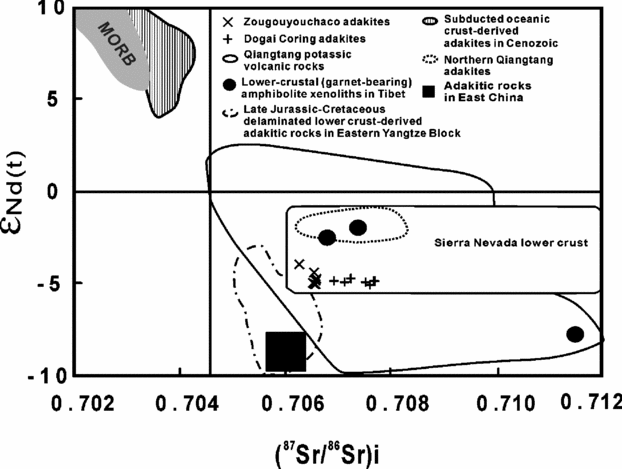
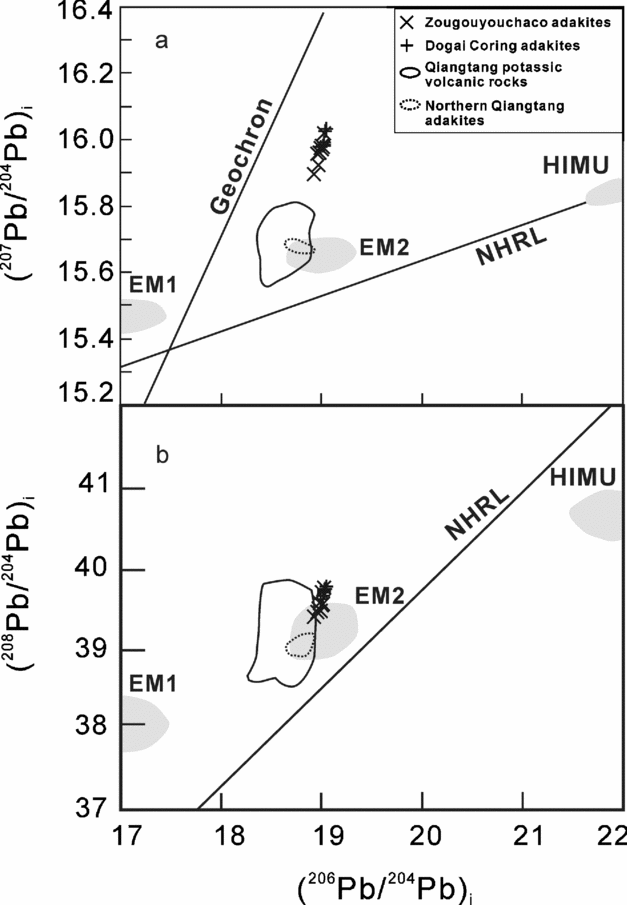
The Nd and Sr isotopic compositions of the volcanic rocks are characterized by high 87Sr/86Sr (0.7061–0.7077) and low 143Nd/144Nd (0.51233–0.51243) and thus negative εNd(t) values (−3.8 to −5.0) (Table 3; Fig. 7). The volcanic rocks also display highly radiogenic Pb isotopic compositions (Table 3). 207Pb/204Pb (15.895–16.031) and 208Pb/204Pb (39.411–39.786) in the rocks are unusually radiogenic and yield steep arrays that plot well above the Northern Hemisphere Reference Line (NHRL) (Hart, Reference Hart1984), parallel to, but shifted to higher values of 206Pb/204Pb (18.928–19.046) than the Geochron (4.55 Ga) (Fig. 8). Steep linear correlations between Pb isotopic ratios have been reported by previous researchers for other Tibetan lavas (Arnaud et al. Reference Arnaud, Vidal, Tapponnier, Matte and Deng1992; Turner et al. Reference Turner, Arnaud, Liu, Rodgers, Hawkesworth, Harris, Kelley, van Calsteren and Deng1996; Miller et al. Reference Miller, Schuster, Klotzli and Purtscheller1999; Ding et al. Reference Ding, Kapp, Zhong and Deng2003; Williams et al. Reference Williams, Turner, Pearce, Kelley and Harris2004). The more variable 207Pb/204Pb and 208Pb/204Pb are interpreted to be a characteristic of Tibetan potassic lavas.
Sr–Nd–Pb isotopic ratios of the volcanic rocks in Qiangtang, northern Tibet

Chondrite Uniform Reservoir (CHUR) values (87Rb/86Sr = 0.0847, 87Sr/86Sr = 0.7045, 147Sm/144Nd = 0.1967 143Nd/144Nd = 0.512638) are used for the calculation. λRb = 1.42×10⁻¹¹ year−1 (Steiger & Jäger, Reference Steiger and Jäger1977); λSm = 6.54×10⁻¹² year−1 (Lugmair & Harti, Reference Lugmair and Harti1978).
εNd(t) v. (87Sr/86Sr)i diagram of the adakitic volcanic rocks in Qiangtang terrane, northern Tibet. Data sources: Sierra Nevada lower crust from Ducea & Saleeby (Reference Ducea and Saleeby1998); lower crust (garnet-bearing) amphibolite xenoliths in Tibet from Deng (Reference Deng1998); adakitic rocks in East China from Xu et al. (Reference Xu, Shinjio, Defant, Wang and Rapp2002); subducted oceanic crust-derived adakites in Cenozoic after Defant et al. (Reference Defant, Jackson, Drummond, De Boer, Bellon and Feigenson1992), Kay, Ramos & Marquez (Reference Kay, Ramos and Marquez1993) and Sajona et al. (Reference Sajona, Naury, Pubellire, Leterrier, Bellon and Cotton2000). MORB from Zindler & Hart (Reference Zindler and Hart1986). Late Jurassic–Cretaceous delaminated lower crust-derived adakitic rocks in the eastern Yangtze block are from Wang et al. (Reference Wang, Xu, Jian, Bao, Zhao, Li, Xiong and Ma2006). Qiangtang potassic volcanic rock data are from Pearce & Houjun (Reference Pearce and Houjun1993); Turner et al. (Reference Turner, Arnaud, Liu, Rodgers, Hawkesworth, Harris, Kelley, van Calsteren and Deng1996); Deng (Reference Deng1998); Ding et al. (Reference Ding, Zhang, Zhou, Deng, Xu and Zhong1999, Reference Ding, Kapp, Zhong and Deng2003); Yin et al. (Reference Yin, Lin, Li, Zhao, Shi, Huang, Sun, Lai, Zhu and Zhao2004); Williams et al. (Reference Williams, Turner, Pearce, Kelley and Harris2004). Northern Qiangtang adakitic rocks are from Lai, Qin & Li (Reference Lai, Qin and Li2007).
(a) (207Pb/204Pb)i and (b) (208Pb/204Pb)i v. (206Pb/204Pb)i diagrams of the adakitic rocks in Qiangtang terrane, northern Tibet. NHRL is from Hart (Reference Hart1984), Geochron (4.55 Ga) and the mantle end-members HIMU, EM1 and EM2 are after Zindler & Hart (Reference Zindler and Hart1986). The Qiangtang potassic volcanic rocks are from Pearce & Houjun (Reference Pearce and Houjun1993); Turner et al. (Reference Turner, Arnaud, Liu, Rodgers, Hawkesworth, Harris, Kelley, van Calsteren and Deng1996); Deng (Reference Deng1998); Ding et al. (Reference Ding, Zhang, Zhou, Deng, Xu and Zhong1999, Reference Ding, Kapp, Zhong and Deng2003); Yin et al. (Reference Yin, Lin, Li, Zhao, Shi, Huang, Sun, Lai, Zhu and Zhao2004); Williams et al. (Reference Williams, Turner, Pearce, Kelley and Harris2004). Northern Qiangtang adakitic rocks are from Lai, Qin & Li (Reference Lai, Qin and Li2007).
5. Discussion
5.a. Petrogenesis
5.a.1. Genetic model
The post-collisional potassic rocks of the Qiangtang terrane possess consistent chemical compositions (Figs 4, 7, 9). However, in contrast to many of the Qiangtang potassic rocks, the volcanic rocks in this study have high K2O (2.97–3.81 wt%) and belong to the high-K calc-alkaline series (Table 1; Fig. 2). Furthermore, the high Sr and low HREE and Y contents (Tables 1, 2) result in elevated Sr/Y (43–92) and La/Yb (29–58) ratios, characteristic of typical adakites (Fig. 3a, b). Discussing the genesis of these adakitic rocks will be important for deciphering the tectonic evolution of the Tibetan Plateau.
Plot of La/Yb v. La for the adakitic volcanic rocks in Qiangtang terrane, northern Tibet. The Qiangtang potassic volcanic rocks are from Pearce & Houjun (Reference Pearce and Houjun1993); Turner et al. (Reference Turner, Arnaud, Liu, Rodgers, Hawkesworth, Harris, Kelley, van Calsteren and Deng1996); Deng (Reference Deng1998); Ding et al. (Reference Ding, Zhang, Zhou, Deng, Xu and Zhong1999, Reference Ding, Kapp, Zhong and Deng2003); Yin et al. (Reference Yin, Lin, Li, Zhao, Shi, Huang, Sun, Lai, Zhu and Zhao2004); Williams et al. (Reference Williams, Turner, Pearce, Kelley and Harris2004); Turner et al. (Reference Turner, Arnaud, Liu, Rodgers, Hawkesworth, Harris, Kelley, van Calsteren and Deng1996); Tan, Pan & Xu (Reference Tan, Pan and Xu2000); Lai & Liu (Reference Lai and Liu2001); Lai et al. (Reference Lai, Qin, Li and Liu2006). Northern Qiangtang adakitic rocks are from Lai, Qin & Li (Reference Lai, Qin and Li2007).
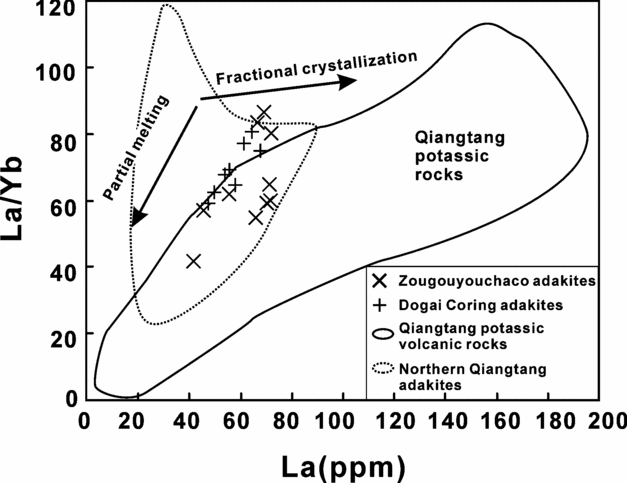
Five genetic models have been proposed for adakites: (1) partial melting of subducting oceanic slab (Defant & Drummond, Reference Defant and Drummond1990); (2) crustal assimilation and fractional crystallization (AFC) processes from parental basaltic magmas (Castillo, Janney & Solidum, Reference Castillo, Janney and Solidum1999); (3) partial melting of mafic rocks in the lower part of a thickened crust (Atherton & Petford, Reference Atherton and Petford1993; Xiong et al. Reference Xiong, Li, Xu, Li, Zhao and Wang2003); (4) partial melting of a stalled (or dead) slab in the mantle (Pe-Piper & Piper, Reference Pe-Piper and Piper1994; Defant et al. Reference Defant, Kepezhinskas, Defant, Xu, Kepezhinskas, Wang, Zhang and Xiao2002; Mungall, Reference Mungall2002; Qu, Hou & Li, Reference Qu, Hou and Li2004) and (5) partial melting of delaminated or foundered lower crust (Kay & Kay, Reference Kay and Kay1993; Xu et al. Reference Xu, Shinjio, Defant, Wang and Rapp2002; Gao et al. Reference Gao, Rudnick, Yuan, Liu, Liu, Xu, Ling, Ayers, Wang and Wang2004; Wang et al. Reference Wang, Xu, Zhao, Bao, Xu and Xiong2004a,Reference Wang, Zhao, Bao, Xu, Liu and Lib). The Qiangtang volcanic rocks have high Pb isotopic age-corrected ratios (206Pb/204Pb)i>18 (Table 3), similar to those of Mesozoic MORB and oceanic sediments in the West Pacific (Castillo, Pringle & Carlson, Reference Castillo, Pringle and Carlson1994; Shimoda et al. Reference Shimoda, Tatsumi, Nohda, Ishizaka and Jahn1998). The adakitic lavas show a range of K2O contents (2.97–3.81 wt%) (Table 1, Fig. 2), relatively high Th (12.7–18.9 ppm) and Rb (747–1289 ppm) contents, resulting in high Th/Ba (0.014–0.023), Th/U (3.0–6.2) and Rb/Ba (0.1–0.14, except three samples) ratios, relatively low Ba contents (747–1289 ppm) (Table 2) and no positive Sr anomalies (Table 2; Fig. 6b). These geochemical features exclude the first genetic hypothesis (Defant & Drummond, Reference Defant and Drummond1990), as well as the possibility that the adakitic rocks originated from a stalled slab in the mantle (Wang et al. Reference Wang, Xu, Jian, Bao, Zhao, Li, Xiong and Ma2006). Moreover, the low εNd(t) (−3.8 to −5.0) and high (87Sr/86Sr)i (0.7061–0.7077) features obviously distinguish them from adakites derived from partial melting of subducted oceanic slabs, such as those from Cook Island (Stern & Kilian, Reference Stern and Kilian1996), Adak Island (Kay, Reference Kay1978) and Cerro Pampa (Kay, Ramos & Marquez, Reference Kay, Ramos and Marquez1993), as these adakites have mid-ocean-ridge (MORB)-like Sr–Nd isotopic compositions (Gao et al. Reference Gao, Rudnick, Yuan, Liu, Liu, Xu, Ling, Ayers, Wang and Wang2004). Geophysical evidence (Owens & Zandt, Reference Owens and Zandt1997; Tilmann et al. Reference Tilmann and Ni2003) indicates that the N-trending subducted Indian plate and Tethyan oceanic slabs have not reached the southern boundary of the Qiangtang terrane (Bangong suture zone), suggesting that there was no subducted oceanic slab beneath the Qiangtang terrane when these adakitic rocks were generated. On a La/Yb v. La plot (Fig. 9), the adakitic rock compositions are more consistent with partial melting than a fractional crystallization trend, while their fairly high Mg no. (>45 except for DGC–02) (Table 1) indicates that assimilation and fractional crystallization could not have produced the geochemical variation within the adakitic rocks (Castillo, Janney & Solidum, Reference Castillo, Janney and Solidum1999). Moreover, there are no correlations between SiO2, Rb and initial Sr isotopic compositions, which is inconsistent with the evolved isotopic compositions resulting from assimilation and fractional crystallization (AFC)-like processes in the lower crust (Gao et al. Reference Gao, Rudnick, Yuan, Liu, Liu, Xu, Ling, Ayers, Wang and Wang2004). High Th/U is a feature of most Cenozoic volcanic rocks derived from the upper and lower crust and mantle within the Tibetan Plateau (McKenna & Walker, Reference McKenna and Walker1990; Turner et al. Reference Turner, Arnaud, Liu, Rodgers, Hawkesworth, Harris, Kelley, van Calsteren and Deng1996; Miller et al. Reference Miller, Schuster, Klotzli and Purtscheller1999). However, the Nd–Sr–Pb isotopic characteristics (Table 3; Figs 7, 8), the relatively high MgO, Cr and Ni contents as well as the low FeOT/MgO ratios (Fig. 4; Table 1) of the adakitic rocks confirm that a mantle component may have played an important role in their petrogenesis. The Pb isotopic patterns (Fig. 8) highlight the problem of crustal contamination, and an old piece of continental crust in the amphibolite facies, depleted in U with respect to Th (high Th/U ratios) but undepleted in Rb (Taylor, Jones & Moorbath, Reference Taylor, Jones and Moorbath1984) as observed in this study (Table 2; Fig. 6b). Furthermore, sample SiO2 contents are too high (60–68 wt%, except ZGYC–05) for magma produced directly by partial melting of mantle peridotite, which cannot yield melts more silicic than andesite or boninite (Green, Reference Green1980; Jahn & Zhang, Reference Jahn and Zhang1984; Baker et al. Reference Baker, Hischmann, Ghiorso and Stolper1995). Our samples also show geochemical characteristics distinct from the rhyolites derived from upper-crustal sources (McKenna & Walker, Reference McKenna and Walker1990; Wang et al. Reference Wang, McDermott, Xu, Bellon and Zhu2005). Therefore, lower-crustal melting is thought to be the most likely interpretation for the origin of the Qiangtang volcanic rocks discussed here. Nevertheless, a remaining question is whether model (3) or model (5) is more reasonable.
If the adakitic rocks are derived directly from partial melting of mafic rocks in the lower crust, they should have relatively low MgO contents and Mg no. similar to the experimental melts of Rapp & Watson (Reference Rapp and Watson1995). However, the adakitic volcanic rocks in this paper have relatively high MgO contents and Mg no. (Table 1; Figs 4d, 5), suggesting that pristine adakitic melts must have interacted to some extent with mantle peridotite (e.g. Kepezhinskas, Defant & Drummond, Reference Kepezhinskas, Defant and Drummond1995; Stern & Kilian, Reference Stern and Kilian1996; Rapp et al. Reference Rapp, Shimizu, Norman and Applegate1999; Smithies, Reference Smithies2000). In this case, the most likely scenario to explain the high MgO and Mg no. of the adakitic rocks seems to be foundering of the lower crust consisting of amphibole-bearing eclogitic materials, coinciding with dehydration melting of the delaminated crustal rocks in the hot mantle. Subsequently, the foundered crustal melts probably interacted with the surrounding mantle peridotite during emplacement.
5.a.2. Source features
The highly enriched N-MORB normalized abundance patterns of trace elements for Qiangtang adakitic rocks (Fig. 6b) may suggest the existence of garnet as a residue in the mantle source beneath northern Tibet (Defant & Drummond, Reference Defant and Drummond1990; Drummond, Defant & Kepezhinskas, Reference Drummond, Defant and Kepezhinskas1996; Defant & Kepezhinskas, Reference Defant and Kepezhinskas2001). The relative enrichment of Sr (up to 986 ppm) and the absence of significant Eu anomalies (Fig. 6) indicates either that plagioclase was not present in the source rock, or that it was completely consumed during melting. Nb partitions strongly into amphibole under equilibrium conditions (Pearce & Norry, Reference Pearce and Norry1979), whereas Ti partitions into rutile under hydrous mantle conditions (Tatsumi, Reference Tatsumi1986). However, both elements are strongly depleted in the Qiangtang adakitic rocks, which indicates that the source also has residual rutile and amphibole, and thus residues were most probably hydrous amphibole-bearing and rutile-bearing eclogites (Mahoney et al. Reference Mahoney, Frei, Tejada, Mo and Leat1998).
5.a.3. Dynamic mechanism
Experimental studies (e.g. Rapp & Watson, Reference Rapp and Watson1995; Rapp et al. Reference Rapp, Shimizu, Norman and Applegate1999; Rapp, Xiao & Shimizu, Reference Rapp, Xiao and Shimizu2002; Rapp, Shimizu & Norman, Reference Rapp, Shimizu and Norman2003) indicate that mafic crustal rocks can melt to produce adakitic liquids at sufficient depths (>40 km, that is, 1.2 GPa) for garnet to be stable within the residual assemblage (e.g. residues of garnet-amphibolite, amphibole-bearing eclogite and/or eclogite). The Qiangtang adakitic volcanic rocks display the typical adakitic affinities, such as high La/Yb, Sr/Y ratios and low Y and Yb contents (Table 2; Figs 3a, b, 6), implying that garnet was stable within the source residues when the adakitic magmas were segregated. Furthermore, rutile occurs at pressures higher than approximately 1.5 GPa (≥50 km crustal thickness), depending on H2O content (2–5 wt%) and bulk composition (especially with bulk TiO2: 1.72 wt% and K2O: 1.43 wt%), during partial melting of hydrated basalt (Xiong, Adam & Green, Reference Xiong, Adam and Green2005). Accordingly, the crustal thickness in the Qiangtang terrane must have been at least 50 km when the adakitic lavas were formed.
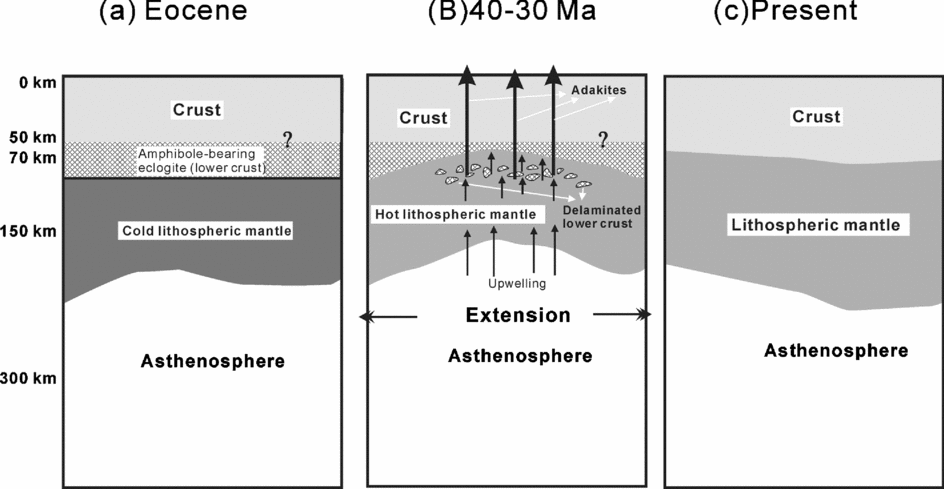
As a result of the collision between the Indian block and Asian block between Late Cretaceous and Early Cenozoic times (Yin & Harrison, Reference Yin and Harrison2000), the continental crust beneath Qiangtang was compressed and probably over-thickened (>70 km) in Eocene times (Tapponnier et al. Reference Tapponnier, Xu, Roger, Meyer, Arnaud, Wittlinger and Yanh2001) (Fig. 10a); the increase in pressure and temperature would have transformed the basaltic lower crust into amphibolite-bearing eclogite in a thickened crust region (Austrheim, Eramber & Engvik, Reference Austrheim, Eramber and Engvik1997) (Fig. 10a). Delamination is caused by the gabbro-eclogite transformation in the thickened continental lower crust (Sobolev & Babeyko, Reference Sobolev and Babeyko2005). Once this transformation was complete, the eclogitized lower crust would delaminate and sink into the mantle due to its negative buoyancy (Kay & Kay, Reference Kay and Kay1993; Gao et al. Reference Gao, Rudnick, Yuan, Liu, Liu, Xu, Ling, Ayers, Wang and Wang2004). This would be balanced by an upwelling of hot asthenosphere material (Tilmann et al. Reference Tilmann and Ni2003). Such an upward heat flow would provide a mechanism for heating the cold lithospheric mantle, delaminated crust and gradual erosion of remaining crust beneath Qiangtang terrane. After collision in the Early Cenozoic (Yin & Harrison, Reference Yin and Harrison2000), the release of stress led to extensional extension and thinning of the lithosphere beneath Qiangtang terrane at c. 40 Ma (Fig. 10b), allowing further upwelling flux from the asthenoshpere, and decompression melting of delaminated lower crust (amphibole-bearing eclogite materials) in hot mantle. Subsequently, significant chemical interaction will occur between mantle peridotite and the ascending crustal melt (Fig. 5), and produced the 40–30 Ma adakitic volcanic rocks in the Qiangtang terrane. However, amphibole-bearing and rutile-bearing eclogite would be left in the source, and cause strongly negative Nb and Ti anomalies.
A suggested model to produce the adakitic volcanic rocks in Qiangtang via partial melting of delaminated lower crust from 40 to 30 Ma (modified from Xu et al. Reference Xu, Shinjio, Defant, Wang and Rapp2002). (a) The relatively cold lithospheric mantle and thick crust during Eocene times (Tapponnier et al. Reference Tapponnier, Xu, Roger, Meyer, Arnaud, Wittlinger and Yanh2001). The thick lower crust is composed of amphibole-bearing eclogite. (b) The thick lower crust is removed through delamination or foundering due to density instability and has dived into the underlying hot lithospheric mantle, at the same time, the hot asthenospheric mantle wells up due to lithospheric delamination, extension and thinning. The adakitic melts are produced by dehydration melting of the delaminated lower crust (amphibole-bearing eclogite materials), which has been heated by the flux of heat from the hot lithospheric mantle and upwelling asthenosphere. The adakitic melts react with the surrounding mantle peridotite, enhancing their MgO, Cr and Ni contents. (c) The lithosphere framework beneath Qiangtang terrane at present (Wu, Xiao & Li, Reference Wu, Xiao and Li1989).
6. Conclusions
(1) The high-K calc-alkaline volcanic rocks from Zougouyouchaco and Docai Coring in the Qiangtang terrane are adakites that were generated by partial melting of delaminated lower continental crust with a composition similar to the amphibole-bearing eclogitic materials beneath the Qiangtang terrane.
(2) The Nd–Sr isotopic signatures, their relatively high MgO, Mg no., Cr and Ni contents as well as low FeOT/MgO ratios imply that the adakitic magmas include a significant mantle composition, and the existence of interaction between the delaminated lower crustal melts and the surrounding mantle peridotite.
Acknowledgements
We are grateful to T. F. Xiao, Y. Wang and J. Q. Liu for their helpful discussion and to the No. 2 Geology Team of Tibet for assistance with our fieldwork. We thank two anonymous reviewers, the editor David Pyle and the assistant editor Mrs Jane Holland for their constructive comments and suggestions that helped to improve the original manuscript. This work was supported by National Science Foundation of China (grant 40673029 and 40773020 to Liu, and 40634020 to Hu).



