Introduction
Differences in the carcass composition of pig genotypes must be understood if pig management and efficiency of feed use are to be optimized, the required carcass specification produced and environmental impact minimized (Fisher et al., Reference Fisher, Green, Whittemore, Wood and Schofield2003). Different breeds and lines have a predetermined propensity towards excellence in certain areas of carcass composition and meat quality (McLaren et al., Reference McLaren, Buchanan and Johnson1987; Ellis et al., Reference Ellis, Webb, Avery and Brown1996; Edwards et al., Reference Edwards, Bates and Osburn2003). In China, the Jinhua pig is the most important local breed. Jinhua pigs could be slaughtered with body weight (BW) 75 to 80 kg at the age of 240 days, and the meat of Jinhua pigs is the excellent raw material of Jinhua-Ham. According to previous results, the Jinhua pig is characterized by early sexual maturity, low prolificacy and reduced growth (Xu, Reference Xu1994). As shown in other local genotype such as Meishan pig (Bidanel et al., Reference Bidanel, Bonneau, Pointillard, Gruand, Mourot and Demade1991), Iberian pig (Serra et al., Reference Serra, Gil, Perez-Enciso, Oliver, Vazquez, Gispert, Díaz, Moreno, Latorre and Noguera1998) or Creole pig (Renaudeau and Mourot, Reference Renaudeau and Mourot2007), the absence of genetic selection with respect to lean content in Jinhua pigs may be associated with good meat quality. For the breed difference in growth potential, the Jinhua pig was significantly lighter than Landrace. No information has yet been published on the developmental changes in carcass composition, meat quality parameters and organ weight between the Jinhua pig and Landrace. So, the objectives of this study were to compare the developmental pattern of carcass composition, meat quality parameters and organ weight in the two breeds of swine from 35 to 125 days of age.
Material and methods
Animals and diets
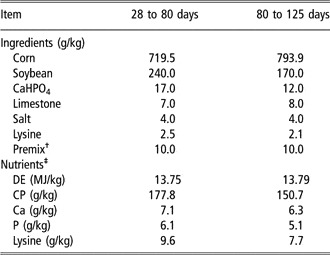
A total of 36 purebred piglets (sex balance in each breed, weaned at 28 days of age) were allotted to two groups according to breed. Each group has three replicates with six piglets (sex balance) in each replicate. The feeding experiment lasted for 90 days after 7 days of adaptation period. Jinhua pigs and Landrace were reared in the same conditions. All pigs had ad libitum access to a basal diet and water via nipple drinkers. The experimental diets were based on corn and soybean meal, and were formulated with CP concentrations, trace minerals and vitamins to meet or exceed National Research Council (NRC) recommendations for the different growth phases. Chemical analyses of the basal diet were carried out according to the methods of AOAC (1990). During the period from 28 to 125 days of age, the corn-soybean meal diet was offered to pigs as shown in Table 1.
Ingredients and nutrients of the basal experiment diets

DE = digestible energy; CP = crude protein.
†Provided the following (unit/kg): 10 mg of Cu, 80 mg of Fe, 30 mg of Mn, 80 mg of Zn, 0.5 mg of I and 0.3 mg of Se. 5850 IU of vitamin A, 1251 IU of vitamin D3, 20 IU of vitamin E, 1.86 mg of vitamin K3, 3 mg of vitamin B1, 3.6 mg of riboflavin, 1.5 mg of vitamin B6, 20 mg of vitamin B12, 18 mg of pantothenic acid, 26 mg of niacin and 56 mg of choline.
‡All data were analyzed values except digestible energy, which was calculated using swine National Research Council (NRC) (1998) values.
Carcass measurements and organ weights
At their predesignated slaughter age (at 35, 80 and 125 days of age), six purebred piglets (sex balance) of each breed were randomly selected and slaughtered to determine carcass composition according to the methods of Xiao et al. (Reference Xiao, Xu and Chen1999). Briefly, pigs were transported to abattoir. The pigs received no feed on the day of slaughter, but were allowed to rest for 2 h after about 1 h of transportation (including loading and unloading), after which they were electrically stunned (90 V, 10 s, and 50 Hz), exsanguinated, dehaired and eviscerated. The head was removed and the carcass was split longitudinally. After an overnight chill at 4°C, one-half of the carcasses was physically dissected into bone, muscle, subcutaneous fat and skin, and each of the dissected tissue was weighted to the nearest gram. The heart, liver and kidneys were removed and weighed. Longissimus muscle area was determined by tracing its surface area at the 10th-rib and by using a planimeter (Planix 5.6, Tamaya Digital Planimeter, Tamaya Tecnics Inc., Tokyo, Japan). The average backfat thickness was taken in the midline with a sliding caliper, and the average of three backfat thickness, measured on the first rib, last rib and last lumbar vertebrae. Carcass dressing percentage was determined from the live weight (Fasted for 24 h and weighted at farm) and the hot carcass weight. Drip loss was defined as the weight loss of a meat sample (50 g), placed on a flat plastic grid and wrapped in foil, after a storage time of 24 h (24 to 48 h post mortem) in a refrigerator (4°C). Subjective colour (1 to 5) and marbling scores (National Pork Produces Council (NPPC), 2000) were evaluated approximately at 48 h post mortem, colour scores ranged from 1 (pale pinkish to grey) to 5 (dark purplish to red). The analysis of intramuscular fat (IMF) of the longissimus muscle was according to the AOAC (1990) procedures.
Instrumental colour
Colour measurements were made following the recommendations on colour determination of the American Meat Science Association (AMSA, 1991). The following colour coordinates were determined: lightness (L*), redness (a*, red ± green) and yellowness (b*, yellow ± blue). Colour parameters were determined using a Minolta CR-300 colourimeter (Minolta Camera, Osaka, Japan) with an illuminant D65, a 0° standard observer and a 2.5 cm port/viewing area. The colourimeter was standardized before use with a white tile. In addition, hue angle, which describes the hue or colour, was calculated (H° = arctg b*/a* × 360/2π) as well as the saturation index or chroma (C*) (C = (a*2 + b*2)0.5), which describes the brightness or vividness of colour. The measurements were repeated at five randomly selected places on each slice and averaged.
Statistical analyses
Statistical analysis was performed using the ANOVA procedure of Statistical Product and Service Solutions (SPSS) 11.5. Comparisons among age groups with the same breed were made by the least significant difference (LSD) and the Dunnett test. And comparison between breed groups with the same age was determined by the t-test. All data are presented as mean ± s.e.; a significant level of 0.05 was used.
Results
Carcass composition
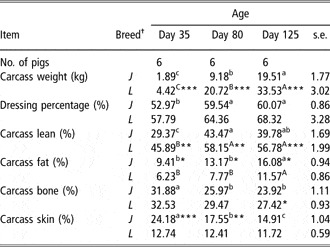
Carcass characteristics in Jinhua pigs and Landrace are shown in Table 2. Carcasses of the Jinhua pig were lighter (P < 0.001); meanwhile, it contained less lean meat (P < 0.01) and more carcass fat (P < 0.05) than did carcasses of the Landrace during the whole experiment. In addition, Jinhua pigs had more carcass skin compared with Landrace at the age of 35 days (P < 0.001) and 80 days (P < 0.01). In contrary, Jinhua pigs had less carcass bone compared with Landrace at 125 days of age (P < 0.05). Although no significant differences in dressing percentage were attributable to breed during the whole experiment, a high trend of dressing percentage was shown in Landrace. In addition, the developmental changes of carcass weight, carcass lean and carcass fat in the two breeds followed the same age-dependent patterns, which increased with age.
Developmental changes of carcass characteristics in the Jinhua pig and Landrace

s.e.: standard error of the mean.
Mean without a common letter (the lower case for Jinhua pigs and the capital for Landraces) differs significantly between ages, P < 0.05.
*P < 0.05, **P < 0.01, ***P < 0.001, significantly different between the two breeds at the same age.
†J = Jinhua pigs, L = Landraces.
Meat quality parameters
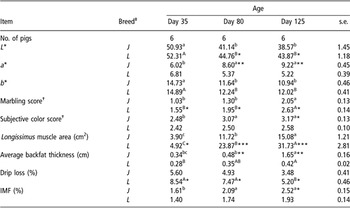
As shown in Table 3, regarding instrumental colour, no significant differences were found in L*-value between two breeds at 35 and 80 days of age, whereas L*-values were higher in Landrace than in Jinhua pigs at 125 days of age (P < 0.05), which indicates that meat from Landrace was paler compared with the Jinhua pig. In addition, Jinhua pigs had higher a*-value compared with Landrace at the age of 80 days (P < 0.01) and 125 days (P < 0.01), respectively, which indicates that meat from Jinhua pigs were redder compared with the Landrace. No significant differences were found in b*-value due to breed. In addition, except for a*-value, developmental changes of the L*- and b*-value followed same trends in the two species during the whole experiment. Subjective scores for colour showed that Jinhua pigs were darker (P < 0.05) compared with Landrace at 125 days of age, and marbling scores were less marbled (P < 0.05) during growth. IMF in longissimus muscle exhibited growth patterns with age and breed effects, which increased as age increased. Jinhua pigs had higher (P < 0.05) IMF compared with Landrace at 125 days of age. In addition, the differences in meat quality between the two breeds were also visible in drip loss. In Jinhua pigs, drip loss was lower (P < 0.05) than in Landrace during the whole experiment.
Developmental changes of pork quality in the Jinhua pig and Landrace

Mean without a common letter (the lower case for Jinhua pigs and the capital for Landraces) differs significantly between ages, P < 0.05.
*P < 0.05, **P < 0.01, ***P < 0.001, significantly different between the two breeds at the same age.
s.e.: standard error of the mean; L* = lightness; a* = redness; b* = yellowness; IMF = intramuscular fat.
†National Pork Produces Council (NPPC) (2000).
‡J = Jinhua pigs, L = Landraces.
Weight of organs
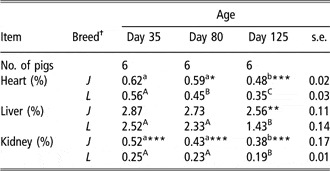
As shown in Table 4, the relative weight of organs decreased with age and displayed breed differences. The Jinhua pig had higher relative weight of the heart compared with Landrace at 80 days (P < 0.05) and 125 days (P < 0.001) of age, respectively, and had higher relative weight of the liver at the age of 125 days (P < 0.01). In addition, the relative weight of the kidney was more in the Jinhua pig than in the Landrace (P < 0.001) during the whole experimental period.
Developmental changes of relative organ weight in the Jinhua pig and Landrace

s.e.: standard error of the mean.
Mean without a common letter (the lower case for Jinhua pigs and the capital for Landraces) differs significantly between ages, P < 0.05.
*P < 0.05, **P < 0.01, ***P < 0.001, significantly different between the two breeds at the same age.
†J = Jinhua pigs; L = Landraces.
Discussion
Carcass composition
The present study demonstrated for the first time the developmental changes of the carcass composition of Jinhua pigs and Landrace. The parameter of the pig carcass composition is determined, and there are big differences between breeds. In the present study, the Jinhua pig carcasses had lower lean proportion, carcass weight, bone proportion and higher skin and fat proportion compared with Landrace during growth. These results are in accordance with previous reports (Xu, Reference Xu1994), which expressed that the Jinhua pig is characterized by stronger fatty deposition, lower lean meat percentage and reduced growth performance compared with Landrace. Gispert et al. (Reference Gispert, Font i Furnols, Gil, Velarde, Diestre, Carrión, Sosnicki and Plastow2007) compared five different genetic types of pig (Landrace, Large White, Duroc, Pietrain and Meishan) and found differences in the carcass weight, lean meat, intermuscular fat and bones. Wanger et al. (Reference Wanger, Schinckel, Chen, Forrest and Coe1999) also found differences in the carcass composition from different genetic types of swine. The higher backfat thickness and lower carcass lean content in Jinhua pigs were related to their lower muscle growth potential. The greater ability of Jinhua pigs to deposit lipids is probably related to an indirect effect of concomitant breed difference in protein accretion and an increase of extra energy available for lipid synthesis (Renaudeau and Mourot, Reference Renaudeau and Mourot2007). Similar results were reported when Meishan (White et al., Reference White, Lan, McKeith, McLaren, Novakofski, Wheeler and Kasser1993), Iberian pigs (Morales et al., Reference Morales, Baucells, Pérez, Mourot and Gasa2003) or Creole pigs (Renaudeau and Mourot, Reference Renaudeau and Mourot2007) were compared with conventional lean pigs. In addition, carcass composition displayed developmental changes in the Jinhua pig and Landrace, and developmental changes of carcass composition followed the same trends in the two breeds during the study. These results are in accordance with previous results reported in the references (Landgraf et al., Reference Landgraf, Susenbeth, Knap, Looft, Plastow, Kalm and Roehe2006), which observed that dressing percentage increased, whereas the percentage of carcass bones decreased from 20 to 120 kg. Wanger et al. (Reference Wanger, Schinckel, Chen, Forrest and Coe1999) also found that dressing percentage, carcass lean and carcass fat of five different genetic types of pig had significant changes over a live weight range of 25 to 125 kg. Carr et al. (Reference Carr, Walters and Whiteman1978) and Correa et al. (Reference Correa, Faucitano, Laforest, Rivest, Marcoux and Gariépy2006) also reported that the total lean, fat and bone content increased with slaughter weight. In addition, developmental changes of carcass lean percentage in the two breeds are in agreement with previous reports (Shields et al., Reference Shields, Mahan and Graham1983; Ferrell and Cornelius, Reference Ferrell and Cornelius1984; White et al., Reference White, Lan, McKeith, Novakofski, Wheeler and McLaren1995), who observed that empty body protein and fat-free carcass lean percentages increase from birth to approximately 45 to 65 kg as percentage of water decrease. Xu (Reference Xu1994) found that the Jinhua pig is an early-maturing type, which had higher percentages of body fat. In our study, carcass fat percentage was higher than the Landrace, implying that this was a type maturing at a relatively low weight regarding fat development while the Landrace type matured at a relatively high weight. Gu et al. (Reference Gu, Schinckel and Martin1992) suggested that carcass composition is influenced by age at maturity, with later-maturing animals having greater lean content than earlier-maturing pigs.
Meat quality parameters
Meat quality traits were affected by age and breed. Previous studies showed some or no effect of slaughter weight on meat quality traits (Latorre et al., Reference Latorre, Lázaro, Valencia, Medel and Mateos2004; Piao et al., Reference Piao, Tian, Kim, Choi, Kim and Han2004; Correa et al., Reference Correa, Faucitano, Laforest, Rivest, Marcoux and Gariépy2006). However, the present study demonstrated the developmental changes of meat quality parameters of Jinhua pigs and Landrace, and breed differences. The IMF content is one muscle parameter that influences meat and meat product quality, and IMF depended on the genotype of pigs (Affentranger et al., Reference Affentranger, Gerwig, Seewer, Schwörer and Künzi1996). Generally, fat is an important holder of flavour. Consequently, the IMF content seems to have a decisive influence on tenderness, juiciness and flavour of pig meat. Meat with a low fat content is insipid, strawy and dry. In the present study, Jinhua pigs had higher IMF (2.52%) compared with Landrace (1.93%), which indicated that Jinhua pigs had better quality characteristics in the meat than Landrace. From these results, one can assume that Jinhua pigs have a higher level of lipid synthesis activity than Landrace. Similarly, an increase in lipogenic enzyme activities in adipose and muscle tissue was reported by Serra et al. (Reference Serra, Gil, Perez-Enciso, Oliver, Vazquez, Gispert, Díaz, Moreno, Latorre and Noguera1998) and Morales et al. (Reference Morales, Baucells, Pérez, Mourot and Gasa2003) when Iberian pigs were compared with Landrace pigs.
In this experiment, average backfat thickness and longissimus muscle area increased with age from 35 to 125 days. These data agree with Carr et al. (Reference Carr, Walters and Whiteman1978), who reported increased backfat thickness and longissimus muscle area as slaughter weights increased from 68.2 to 138.4 kg. In addition, Landrace had less average backfat thickness and larger longissimus muscle area compared with Jinhua pigs; these results are in agreement with previous report (Friesen et al., Reference Friesen, Nelssen, Unruh, Goodband and Tokach1994), who observed that high-lean pigs had larger longissimus muscle area and less average backfat thickness compared with medium-lean pigs.
In the present study, the Jinhua pig meat tended to be darker than that of Landrace, which indicated that Jinhua pigs had better meat quality. The effect of breed was significant for L* and a* measured on longissimus muscle. Similar results were reported between Iberian and Landrace pigs (Serra et al., Reference Serra, Gil, Perez-Enciso, Oliver, Vazquez, Gispert, Díaz, Moreno, Latorre and Noguera1998) or between Creole pig and Large white (Renaudeau and Mourot, Reference Renaudeau and Mourot2007). Ramírez and Cava (Reference Ramírez and Cava2007) also found that L*-value was influenced by the genotype of pigs, but no significant differences were found in a*- and b*-values due to genotype. However, these results conflict with earlier studies (Edwards et al., Reference Edwards, Bates and Osburn2003), which observed that objective L*- and a*-values were not different between breeds of pig (Duroc- and Pietrain-sired pigs). In addition, the present study demonstrated that the developmental changes of meat quality parameters of the Jinhua pig and Landrace, and the developmental changes of objective colour parameters in the two breeds followed similar age-dependent patterns. Both marbling score and subjective colour score were also influenced by age and breeds of pig. Marbling score was lower in the Jinhua pig than in Landrace. However, subjective colour score was higher in the former than in the latter. Jinhua pigs had lower carcass drip loss compared with Landrace during growth from 35 to 125 days of age. The incidence of pale soft exudative (PSE) meat is one of the main quality problems in pork (Oliver et al., Reference Oliver, Gispert and Diesdre1993). PSE meat is characterized by its intense paleness, low pH, low consistency and intense exudation (Briskey, Reference Briskey1964). The Landrace showed the characteristics of PSE meat since they were paler, and had higher drip loss compared with Jinhua pigs. Jinhua pigs had higher IMF contents than that of Landrace in longissimus muscle; therefore, meat from Jinhua pigs has better characteristics for the manufacture of high-quality meat products, in which an increase in IMF supposes a marked enhancement of quality (Gandemer, Reference Gandemer2002).
This work shows the particular characteristics of Jinhua pigs as compared with a high lean growth line. According to the breed differences in meat quality indicators, the present study confirms that the Jinhua pig has better meat quality than that of Landrace. From our results, it can be suggested that this Chinese native breed could be used in extensive production systems to provide high taste quality niche products to the market.
Weight of organs
Several factors have been reported to influence both the actual and relative organ weights of slaughter pigs (Chen et al., Reference Chen, Lewis, Miller and Yen1999). Relative heart weight declines linearly from birth to maturity. At birth, it approaches 1% of BW and gradually declines to 0.25% to 0.3% at the live weight of 90 kg, and may be even lower in obese individuals (Pond and Houpt, Reference Pond and Houpt1978). In the present study, developmental changes of relative heart weight in relation to live weight were similar in the two breeds. These results are in accordance with the previous findings reported (Pond and Houpt, Reference Pond and Houpt1978). In addition, relative heart weight observed was higher in Jinhua pigs than in Landrace, which may be due to the fact that Jinhua pigs are characterized by earlier sexual maturity and reduced growth performance compared with Landrace. Our results are in accordance with previous findings reported (Ruusunen et al., Reference Ruusunen, Partanen, Pösö and Puolanne2007), which elucidated that the relative weight of heart was influenced by breeds of pig at 165 days of age. In the present study, developmental changes of relative weights of liver and kidney were similar in the two breeds, and at 35 days of age, relative liver weight of Jinhua pigs and Landrace were 2.87% and 2.52%, respectively, and declines to 2.56% and 1.43%, respectively, at 125 days of age. In addition, at 35 days of age, relative kidney weights of Jinhua pigs and Landrace were 0.52% and 0.25%, respectively, and declines to 0.38% and 0.19%, respectively, at 125 days of age. These findings are in agreement with previous reports (Pond and Houpt, Reference Pond and Houpt1978), who observed that in a newborn pig, the relative weights of liver and kidney were 3.1% and 1.0%, and in an adult pig, 1.4% and 0.25%, respectively. In addition, Jinhua pigs had higher relative weights of liver and kidney compared with Landrace, which indicates that relative weights of liver and kidney displayed breed differences. These findings are not inconsistent with other results reported in the reference (Ruusunen et al., Reference Ruusunen, Partanen, Pösö and Puolanne2007), which elucidated that the relative weights of liver and kidneys did not differ significantly between breeds of pigs at the age of 165 days. The selection for leaner carcasses and faster growth rate produces pigs with larger hearts, livers and kidneys (Cliplef and McKay, 1993; Yang and Lin, Reference Yang and Lin1997).
Above all, this study indicates that carcass composition, meat quality parameters and organ weight are influenced by breed and age of pigs. The present study provides evidence that the developmental changes of carcass composition, meat quality parameters and organ weight followed breed-specific patterns.
Acknowledgements
The authors are grateful to Mr Zhi-gang Yang and Mr Cheng for conducting feeding trial. We also appreciate Dr Hai-zhi Quan, Dr Fei Zhu, Dr Wen-li Du, Dr Long-ying Zha, Dr Chen-li Fan and Dr Liang-ying Gu for assistance in this experiment.