Introduction
The gymnophallid Meiogymnophallus minutus occurs in sheltered soft-sediment habitats across Europe and northern Africa (see de Montaudouin et al., Reference de Montaudouin, Thieltges, Gam, Krakau, Pina, Bazaïri, Dabouineau, Russell-Pinto and Jensen2009). Like the majority of digenean trematodes, it exhibits a three-host life cycle, exploiting the peppery furrow shell Scrobicularia plana as first intermediate host, the edible cockle Cerastoderma edule as second intermediate host and the oystercatcher Haematopus ostralegus as final host (Bowers et al., Reference Bowers, Bartoli, Russell-Pinto and James1996). In S. plana, sporocysts and daughter sporocysts of the gymnophallid invade the digestive gland and gonads. The metacercarial stage found in C. edule remains unencysted and occurs beneath the hinge and surrounding extrapallial space, enveloped by host mantle epithelium. A remarkable aspect is that metacercariae of M. minutus have regularly been found to be hyperinfected by the microsporidian Unikaryon legeri (Bowers & James, Reference Bowers and James1967; Canning & Nicholas, Reference Canning and Nicholas1974; Azevedo & Canning, Reference Azevedo and Canning1987; Goater, Reference Goater1993; Gam et al., Reference Gam, Bazaïri, Jensen and de Montaudouin2008, Reference Gam, de Montaudouin and Bazaïri2009; Fermer et al., Reference Fermer, Culloty, Kelly and O'Riordan2009).
Whereas detailed information is available on the spatial distribution and abundance of M. minutus (Bowers & James, Reference Bowers and James1967; Russell-Pinto, Reference Russell-Pinto1990; Goater, Reference Goater1993; Thieltges et al., Reference Thieltges, Krakau, Andresen, Fottner and Reise2006; Gam et al., Reference Gam, Bazaïri, Jensen and de Montaudouin2008) as well as effects of intermediate host size and age on the intrapopulational distribution of infections (Bowers & James, Reference Bowers and James1967; Goater, Reference Goater1993; Fermer et al., Reference Fermer, Culloty, Kelly and O'Riordan2009), temporal infection patterns have received comparatively little attention so far, although studies on other parasite–host systems have shown a strong influence of season (Køie, Reference Køie1975; Lang & Dennis, Reference Lang and Dennis1976; Sannia & James, Reference Sannia and James1978; Field & Irwin, Reference Field and Irwin1999; Kube et al., Reference Kube, Kube and Bick2002; Thieltges & Rick, Reference Thieltges and Rick2006). Previous studies investigating the seasonality of M. minutus infections in C. edule either found hardly comprehensible infection dynamics (Bowers & James, Reference Bowers and James1967) or were restricted to several months of the year (Goater, Reference Goater1993). No information is available on M. minutus infections in the first intermediate host S. plana in this context. The present study therefore aimed to reveal whether there are fluctuations in M. minutus infections in the first and second intermediate host over the year. Furthermore, development of daughter sporocysts was monitored with respect to season in order to identify the period of cercarial maturation and transmission.
Materials and methods
Sampling and parasitological procedures
Between 50 and 56 peppery furrow shells S. plana (range 30.0–35.0 mm in shell length, mean ± SD 32.3 ± 0.4 mm) and 30 edible cockles C. edule (two annual growth rings) were collected monthly between April 2008 and March 2009 from an intertidal flat at Flaxfort Strand, Courtmacsherry Bay, Co. Cork, Ireland (51°38′N, 8°41′W), where these bivalves occur sympatrically. Whilst annual growth rings are conspicuous in C. edule, they are indistinct in older S. plana and additional rings may appear as a result of disturbances (Green, Reference Green1957; Sola, Reference Sola1997). It was thus not feasible to determine precisely the age and follow a cohort of the latter species. Therefore, it was decided to standardize monthly samples with regard to shell length. According to Sola (Reference Sola1997) annual growth of S. plana of the selected size class and recruitment are marginal. Since the sampling site at Flaxfort Strand is located in the high intertidal zone, the time of submersion is very short (1–2 h on neap tide, 3–4 h on spring tide). The sediment surface is well drained shortly after the tide uncovers the flat, which restricts the time available to S. plana for feeding to the short period around high tide. Therefore, the increase in shell length within 1 year is presumably very small. Accordingly, results are most likely neither affected by seasonal growth of the selected shell length class nor by recruitment. Water temperature was recorded every hour using a temperature logger, positioned in the subtidal zone in close vicinity to the sampling site to ensure permanent submersion. Monthly mean water temperature was calculated from the recordings.
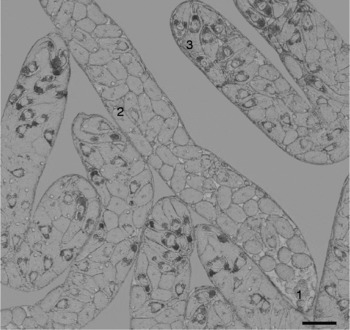
In the laboratory, the shell length of S. plana was measured and shells were opened. The digestive gland and gonads were dissected and screened for M. minutus daughter sporocyst infections under an incident light stereomicroscope. The digestive glands of five infected S. plana taken haphazardly from the sample were individually placed in dishes filled with seawater. In order to isolate the parthenitae from the digestive gland, the tissue was dissected using pins and ten daughter sporocysts per dish were selected randomly and transferred to a pressure glass using a pipette. Preparations were observed under a stereomicroscope with transmitted illumination and sporocyst length was measured using an eyepiece micrometer. The number of developmental stages per daughter sporocyst was determined. In order to assess the maturity of infection, we differentiated between the following developmental stages (fig. 1): (1) germinal balls; (2) cercarial embryos in various developmental stages, from ‘basic cercarial shape evident’ to ‘cercariae with suckers and tail, but still not mature’; (3) completely developed cercariae with a prominent excretory vesicle, actively moving in daughter sporocysts.
Meiogymnophallus minutus daughter sporocysts containing germinal balls (1), cercarial embryos (2), and completely developed cercariae (3). Scale bar 100 μm.

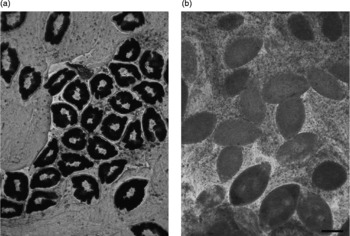
Edible cockles C. edule were frozen prior to the parasitological analysis. Shell length was measured and the ligament and adductor muscles were severed using a scalpel. The left valve was detached and the frozen mass of tightly packed M. minutus metacercariae and host epithelium was transferred to a pressure glass provided with a counting grid. Preparations were examined under a stereomicroscope with transmitted illumination. Numbers of both healthy metacercariae and metacercariae hyperinfected with U. legeri were counted. Uninfected metacercarial stages (fig. 2a) are transparent apart from the prominent excretory vesicle entirely filled with conspicuous granules, appearing blackish in the transmitted light. In contrast, metacercariae hyperparasitized by U. legeri (fig. 2b) are readily distinguishable through being enlarged, opaque and greyish white or brownish in colour. Hyperinfected M. minutus metacercariae were included in the counts provided that the metacercarial shape was still evident.
Metacercariae of Meiogymnophallus minutus. Uninfected (a) and hyperinfected with Unikaryon legeri (b). Scale bar 120 μm.

Statistical analysis
Analyses were performed using the statistical software SPSS (SPSS Inc., Chicago, Illinois, USA). All data were checked for normality and homogeneity of variance. Data were transformed when the assumptions of parametric tests were violated. If distribution was still non-normal following the transformation, non-parametric tests were applied. Monthly variation in prevalence of daughter sporocyst infections in S. plana was analysed using a χ2 test. Differences in M. minutus daughter sporocyst lengths and the total number of metacercarial infections (healthy and hyperinfected metacercariae) were tested using one-way ANOVAs. Data were log-transformed before the analyses. Numbers of healthy metacercariae were analysed with a Kruskal–Wallis test, after monthly counts had been square root transformed. A linear regression analysis was applied to reveal whether the percentage proportion of completely developed cercariae in daughter sporocysts is correlated with water temperature. Data were arcsine-transformed prior to the analysis. Monthly differences in the total number of developmental stages (germinal balls, cercarial embryos and fully developed cercariae) per daughter sporocyst were analysed using a Kruskal–Wallis test. Counts were square root transformed before the analysis was performed.
Results
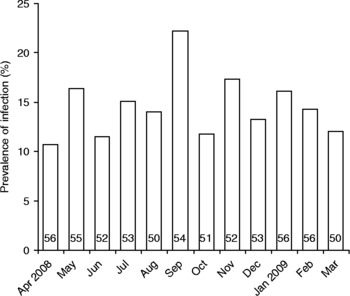
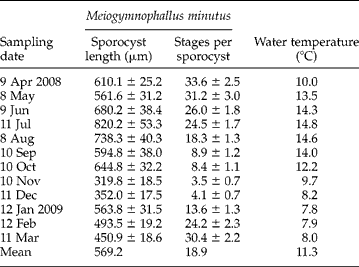
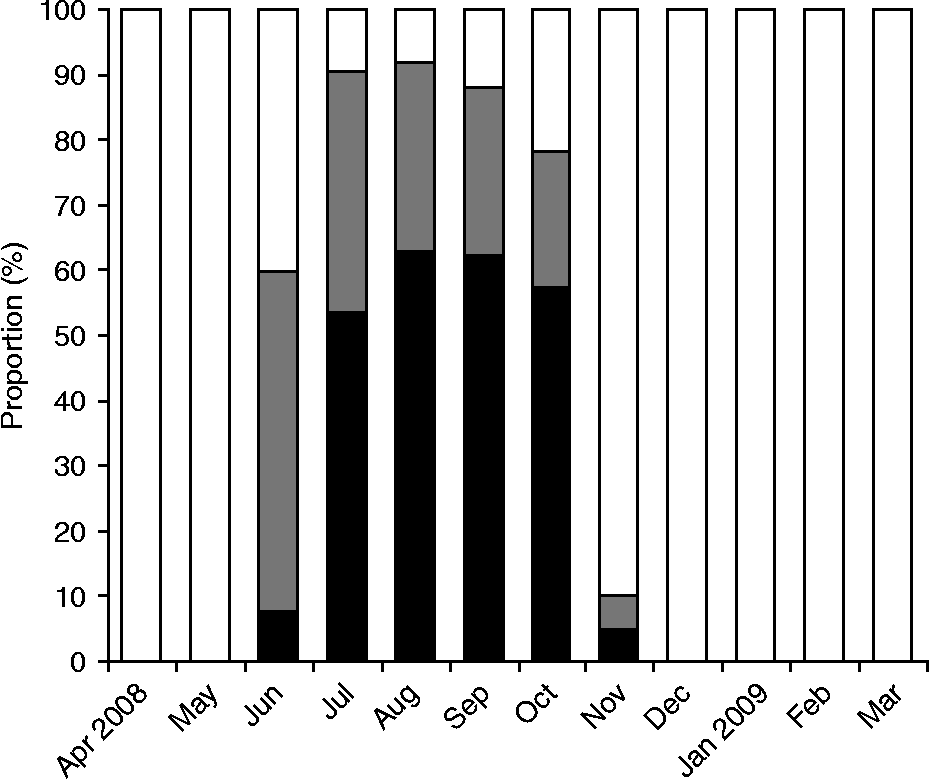
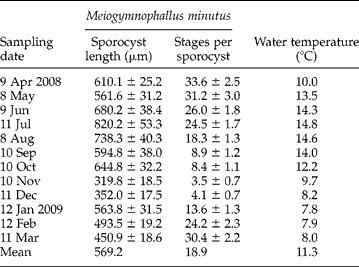
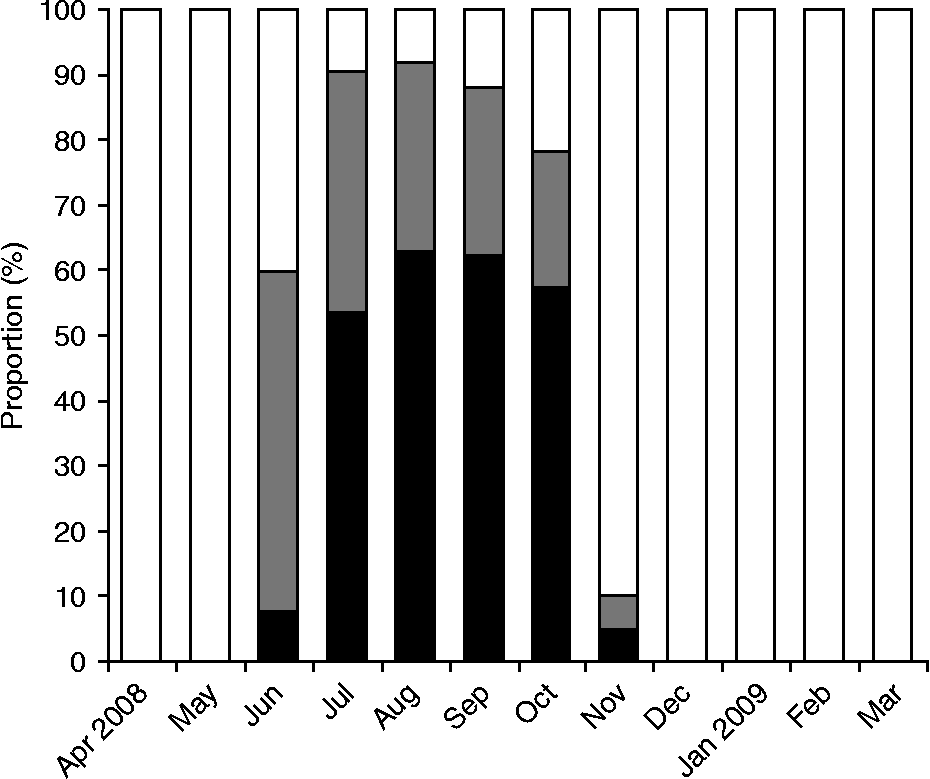
Infection rates in S. plana varied between months (fig. 3). However, no distinct seasonal pattern was apparent and differences were not statistically significant (χ2 test; P>0.05). Mean ± SD prevalence of infection over the year was 14.5 ± 3.2%. Daughter sporocyst length progressively increased from April to July, then decreased to reach a low in November and increased again from December to March (table 1). Differences were highly significant among monthly samples (one-way ANOVA; F 11,588 = 24.1, P < 0.001). Development of M. minutus cercariae showed distinct seasonality (fig. 4). While daughter sporocysts exclusively contained germinal balls in April and May, cercarial embryos in various developmental stages were most abundant in June. Completely developed cercariae, actively moving and swimming after having been artificially released from daughter sporocysts, appeared between June and November. They were the dominant developmental stage from July to October. During the remaining study period, germinal balls were prevailing. Monthly mean water temperatures were highest from June to September (table 1). The proportion of mature cercariae was positively correlated with water temperature (linear regression; r 2 = 0.541, P = 0.006). The total number of developmental stages (germinal balls, cercarial embryos and fully developed cercariae) per daughter sporocyst significantly decreased from May to November and then increased again from December to March (table 1). Differences between monthly counts were highly significant (Kruskal–Wallis test; χ2 = 278.5, P < 0.001).
Monthly prevalence of Meiogymnophallus minutus infections in Scrobicularia plana from Courtmacsherry Bay between April 2008 and March 2009. The respective sample size (n) is given at the bottom of each bar.

Monthly mean water temperature, Meiogymnophallus minutus daughter sporocyst length (mean±SE) and total number of developmental stages per daughter sporocyst (mean±SE) (n=50).
Proportion of germinal balls (white bars), cercarial embryos (grey bars), and completely developed cercariae (black bars) in Meiogymnophallus minutus daughter sporocysts between April 2008 and March 2009 (n = 50).
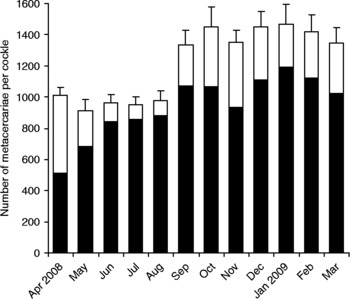
Prevalence of M. minutus metacercarial infections in C. edule reached 100% in every month. Intensity of infection showed significant seasonal variation (one-way ANOVA; F 11,348 = 5.2, P < 0.001). Mean numbers of metacercariae per cockle host did not fluctuate between April and August, but considerably increased in September and remained at this high level until March (fig. 5). The number of healthy metacercariae was relatively high in April, but then drastically decreased over the following months to reach a low in August. Following a strong increase in September, numbers remained relatively constant until March (fig. 5). Differences in numbers of healthy metacercariae between monthly samples were highly significant (Kruskal–Wallis test; χ2 = 126.6, P < 0.001).
Numbers of metacercariae of Meiogymnophallus minutus in Cerastoderma edule from Courtmacsherry Bay between April 2008 and March 2009 (mean+SE; SE is given for the total number of metacercariae). Uninfected (white bars) and hyperinfected with Unikaryon legeri (black bars) (n = 30).

Discussion
Infection rates of M. minutus in S. plana showed some variation over the year. However, changes neither followed a distinct seasonal pattern nor were they statistically significant. Monthly fluctuations might partly be the result of the methodological design of our study. A greater sample size would have presumably reduced variation in the data and thus statistical uncertainty. However, with regard to the limited availability of peppery furrow shells of the selected shell length class at the sampling site, it was not feasible to collect more individuals per month.
Distinct seasonal changes, with infection rates in summer being four to five times higher than in winter, have been reported from some marine host–parasite systems (Lang & Dennis, Reference Lang and Dennis1976; Sannia & James, Reference Sannia and James1978; Field & Irwin, Reference Field and Irwin1999; Kube et al., Reference Kube, Kube and Bick2002). We assume that such pronounced differences would have been detected by our study. While seasonal infection dynamics in short-living molluscs are generally pronounced and chiefly can be explained by life-history traits of the host (Esch & Fernandez, Reference Esch and Fernandez1994; Field & Irwin, Reference Field and Irwin1999; Kube et al., Reference Kube, Kube and Bick2002), temporal fluctuations in long-living molluscs are often inconsistent and much of the variation cannot be explained adequately (Sindermann & Farrin, Reference Sindermann and Farrin1962; Køie, Reference Køie1975; Ngo & Choi, Reference Ngo and Choi2004). Peppery furrow shells are long-living bivalves with some specimens possibly living for up to 16–18 years (Green, Reference Green1957). Fermer et al. (Reference Fermer, Culloty, Kelly and O'Riordan2009) detected a gradual increase in the frequency of M. minutus daughter sporocyst infections with shell length of S. plana. It thus can be assumed that prevalence of infection in a given cohort progressively increases with host age over years as a result of a longer period of exposure to infective miracidial stages and accumulation of infections. This presumably makes it difficult to reveal seasonal infection patterns in aged peppery furrow shells. To determine precisely the period of the year when new daughter sporocyst infections occur in S. plana, a very young cohort, in which the infection rate is initially low and many new infections can be expected to occur in the following time, has to be studied. Alternatively, the transplantation of large numbers of marked individuals known to be uninfected to a heavily infected host population and regular screening for the incidence of infections would give valuable information in this regard. It is most likely that new M. minutus daughter sporocyst infections appeared in S. plana during the course of our study. The final host of M. minutus, the oystercatcher H. ostralegus, is known to be present all year round at Flaxfort Strand (pers. obs.). The infectivity of miracidia has been shown to be positively correlated with water temperature (Upatham, Reference Upatham1973; Prah & James, Reference Prah and James1977; Vanoverschelde, Reference Vanoverschelde1982). Therefore, miracidial invasions are presumably confined to the warmer period of the year. However, parasite-induced host mortality is also known to peak in spring and summer, when infected individuals are additionally stressed by high temperatures, as reported from other parasite–host systems (Jonsson & André, Reference Jonsson and André1992; Huxham et al., Reference Huxham, Raffaelli and Pike1993; Thieltges, Reference Thieltges2006). It can be inferred from the reduction in the frequency of M. minutus infections among S. plana belonging to the shell length class 30–35 mm (Fermer et al., Reference Fermer, Culloty, Kelly and O'Riordan2009) that parasite-induced mortality plays a quite important role in large host individuals. Assuming that new miracidial infections in the host population and mortality of infected hosts or loss of infections coincide in the summer months, and that these incidences are relatively balanced, variation of M. minutus infection rates in S. plana would be comparatively little over the year, as observed in the present study. An alternative explanation would be that few new infections occur in large peppery furrow shells, which are frequently parasitized already, within 1 year.
Our findings showed the production of fully developed cercariae of M. minutus in the first intermediate host S. plana to be positively correlated with water temperature, as known from other digenean trematodes (Køie, Reference Køie1975; Ataev, Reference Ataev1991). Although daughter sporocysts exclusively contained germinal balls in April and May, some ripe M. minutus cercariae appeared in June, which suggests that, once commenced, maturation is quite rapid. Numbers of mature infective stages in the parthenitae peaked in July and August when monthly mean water temperatures had reached 15°C. This temperature has been identified as the threshold for enhanced cercarial emergence and infectivity by a number of laboratory and field studies (Lo & Lee, Reference Lo and Lee1996; McCarthy, Reference McCarthy1999; Fingerut et al., Reference Fingerut, Zimmer and Zimmer2003; Thieltges & Rick, Reference Thieltges and Rick2006; Prinz et al., Reference Prinz, Kelly, O'Riordan and Culloty2009). Mean length of daughter sporocysts fluctuated significantly over the year. Daughter sporocyst length increased with the maturation of the contained cercariae, considerably decreased after the majority of infective stages had been liberated and slightly increased again after production of new germinal balls had commenced. The total number of developmental stages per parthenita strongly decreased during the summer as a result of the release of infective stages and considerably rose in autumn and winter due to the production of germinal balls. It cannot be deduced from our findings, whether daughter sporocysts that have released all cercariae die and are replaced by newly produced parthenitae in autumn or if they survive for longer periods of time. However, at least some daughter sporocysts are perennial, which can be concluded from the observation of single, completely developed cercariae from the previous summer besides newly developing germinal balls in autumn and winter.
Compared to other host–parasite systems from European coastal waters (Thieltges & Rick, Reference Thieltges and Rick2006), we found M. minutus infection levels in the second intermediate host C. edule to increase unusually late in the year, which is concordant with previous findings by Bowers & James (Reference Bowers and James1967) and Goater (Reference Goater1993). This is surprising, especially with regard to our results on the production of fully developed cercariae, which suggest that infective larval stages emerge from the first intermediate host somewhat earlier in the year. The supposed time lag can possibly be explained by the results of a recent laboratory experiment (Fermer et al., Reference Fermer, Culloty, Kelly and O'Riordansubmitted), which revealed that following invasion of the second intermediate host, metacercariae of M. minutus initially occur in the peripheral extrapallial space between the mantle and shell and in folds of the mantle margin, as already speculated by Lauckner (1971) and Loos-Frank (Reference Loos-Frank1971). Between 1 and 2 months after invasion of the second intermediate host, they aggregate in the wedge-shaped cavity of the shell beneath the hinge, which is the known microhabitat (Bowers et al., Reference Bowers, Bartoli, Russell-Pinto and James1996). The scattered occurrence of metacercariae shortly after infection, and aggregation in another microhabitat after a while, has also been described from Meiogymnophallus fossarum in Tapes decussatus (Bartoli, 1974 in Lauckner, Reference Lauckner and Kinne1983).
The microsporidian U. legeri was present throughout the year. The number of healthy M. minutus metacercariae strongly decreased from April to August, due to spreading of hyperinfections from infected metacercariae to neighbouring ones. In September, the proportion of uninfected metacercariae increased again as a result of recent metacercarial immigration. A similar seasonal pattern in U. legeri hyperinfections has been found by Goater (Reference Goater1993), who monitored M. minutus infections in C. edule between April and September. Our study revealed that numbers of healthy metacercariae remained relatively constant from October to March, suggesting that spreading of U. legeri hyperinfections is confined to spring and summer, possibly due to higher water temperatures. Newly settled metacercariae are not affected by U. legeri hyperparasitism and apparently retain their infectivity for at least half a year. Thus, the proportion of metacercariae infectious to the avian final host is highest in autumn and winter. Our findings further indicate that, due to hyperparasite-induced mortality, the entire metacercarial population has to rebuild every year. Hyperparasitism is thus a very important factor controlling parasite population size and dynamics of M. minutus.
Acknowledgements
J.F. received funding from The Embark Initiative, operated by the Irish Research Council for Science, Engineering and Technology (IRCSET).