Creating a way of writing the many indigenous languages in New Spain was a major task for the first friars after their arrival in the sixteenth century. The results and their application in the production of texts were a true accomplishment from which we draw much information and use today. Texts written in the various languages contribute to our understanding of the Mesoamerican past and of the meeting of the two cultures; as do toponyms and loanwords into Mexican Spanish. It was not an easy task for the friars to reproduce the spoken word in written form since languages vary in their inventory of distinctive units of sounds, called phonemes; and many of the Mesoamerican languages have phonemes foreign to Spanish. Often the friars had to combine two letters—create a digraph—to render one such phoneme. Digraphs however, were not a new invention, since Spanish already made—and makes—use of several digraphs, such as <ch> for /č/ and <qu> for /k/. The work of the friars lived on; we are still today confronted with some of the choices of letters which the friars made, primarily in toponyms, although toponyms are occasionally modernized (Xalapa vs Jalapa, etc.). In this paper I shall concentrate on the friars' work with the language of the naua-speaking groups which they encountered, and I shall focus on one specific feature.
TWO CONVENTIONS
When the Spaniards began to write the language of the Aztecs, there was at first much variation in the choice of letters. But after a few decades certain standards can be recognized in the texts to which we have access today. These standards did not rely on strict orthographic rules. Random, individual, and local variation persisted through the centuries. The friars, who were the first to use the Latin alphabet for writing Nauatl, and who produced a wealth of documents in Nauatl in the sixteenth and seventeenth centuries, naturally used Spanish as their model. Thus for example, the phoneme /k/Footnote 1 was written <c> before /a/ and /o/ and the digraph <qu> was used before /i/ and /e/. For phonemes unknown in Spanish, new digraphs were created, <tz> is an example of this. In this paper I focus on two standards for writing /w/, a phoneme which was rare and only emerging in Spanish of the sixteenth century.
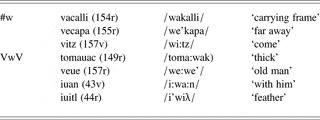
The convention of writing word initial and prevocalic /w/ with <hu> in Classical Nauatl, such as huacal 'carrying frame', Huauhchinango, nahuatl, macehualli ‘commoner’, or Iztaccihuatl, is today generally accepted. It is a convention adopted in the major grammars, dictionaries, and most other material written about Classical Nauatl in the twentieth and twenty-first centuries (Andrews Reference Andrews1975; Bierhorst Reference Bierhorst1985; Campbell Reference Campbell1985; Dyckerhoff and Prem Reference Dyckerhoff and Prem1990; Garibay Reference Garibay1940; Karttunen Reference Karttunen1983; Launey Reference Launey1979; Lockhart Reference Lockhart2001; Schoembs Reference Schoembs1949 [inconsistently applied]; Sullivan Reference Sullivan1976; Wimmer Reference Wimmer2007). Exceptions are linguists who write <w> (Kaufman Reference Kaufman, Moseley and Asher1994; Kaufman and Justeson Reference Kaufman and Justeson2003; Newman Reference Newman and McQuown1967). There are also other noteworthy exceptions to which I shall return after the main discussion. For reasons which this paper should make clear I choose to write <u> for /w/ in prevocalic position.
In documents from the sixteenth century, however, there was no established orthography, no uniform writing convention. Writing Nauatl with the Latin alphabet was a new invention and quickly became widespread. It was the achievement of friars to begin the process of assigning Latin letters to spoken Nauatl, a process which was undoubtedly begun very early and in more than one place, including Tlaxcala, Tlatelolco, Tenochtitlan, and Cuernavaca. We can imagine how the friars who had learned to speak Nauatl, and who later taught young speakers of Nauatl how to write their own language—as well as Spanish and in some cases also Latin—pondered and discussed among themselves how words sounded, and which letters to assign to the sounds. The friars, however, were not one unified group, and we should not forget that in those days communication was primarily oral and thereby restricted to close circles. However these discussions, about which we can only speculate, were carried out, several trends in the choice of letters seem to have evolved in the course of the sixteenth century, and these trends depended, I claim, to some extent on the dialects spoken where the friars worked. Apart from such explicable and more or less systematic variation, we also find a great deal of random and idiosyncratic variation in the early Nauatl documents.
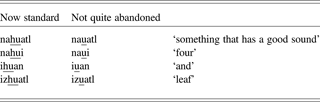
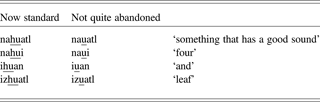
The topic of this paper is limited to how the phoneme /w/, which is highly frequent in Nauatl, was written, and it focuses on two distinct conventions for how that phoneme was rendered in word initial position and in general before a vowel. An explanation for these two conventions is advanced. The more common one today writes prevocalic /w/ with <hu>, whereas the other convention, not quite abandoned yet, writes it with a simple <u> (see Table 1).
Two standards.
/w/Before a Consonant or in Word Final Position
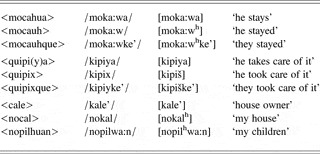
There is little variation in how /w/ was—and is—rendered before another consonant and in word final position. As a rule we find <uh> in both of these contexts:
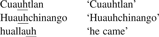
It is obvious that the friars listened to the language and used letters that to them represented the Nauatl pronunciation best. This explains why they all agreed on writing /w/ with <uh> in word final position and before a consonant since in those contexts /w/ was devoiced. This devoicing is confirmed by descriptions from the sixteenth and seventeenth centuries (Carochi Reference Carochi1983 [1645]:f. 1r-v, 30v; Olmos Reference de Olmos1972 [1547]:169, Reference de Olmos2002 [1547]:f. 97r). This is also how syllable final /w/ is pronounced in some dialects of Nauatl spoken today: in the rest of contemporary dialects the development has gone further, and /w/ before a consonant or in word final position is now pronounced [h] in those dialects. The Spaniards clearly heard the devoicing and wrote it accordingly—viz with an accompanying <h>. In sixteenth-century Spanish <h> was not mute but represented a phoneme, a glottal fricative. The word meaning ‘he came' /wa:llaw/, for example, ends in a devoiced /w/ that almost sounds like a slight whistle, along the lines of [wa:lhlawh].
/w/Word Initially or Before a Vowel
In the position before a vowel, both word initially and in the middle of words, /w/ was not devoiced. It was (and is in all dialects today) pronounced as a plain voiced /w/.
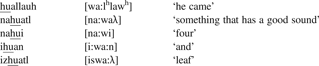
In other words, today's prevalent convention of rendering word initial and medial /w/ with <hu> in no way reflects the pronunciation since no devoicing ever occurred—nor occurs today—in these positions. So where does the <hu> spelling come from?
Some have suggested that it is a tradition taken over from Spanish orthography. In a footnote of his edition of Carochi, James Lockhart (Reference Lockhart2001:21) relates, “[t]he first dominant convention for prevocalic [w] in Nahuatl writing was v/u, but, affected by Spanish trends, the original practice nearly disappeared by Carochi's time in favor of using hu.” Lockhart (Reference Lockhart2001:21) further supports this assumption by explaining that: “Most Spaniards of the sixteenth century represented [w] as hu, but a minority, especially ecclesiastics, used v or u.”
This convention of spelling /w/ with <hu> in Spanish should possibly be taken back to Nebrija (Reference de Nebrija1977 [1517]) who was aware of the ambiguity of initial <v/u> which in the fifteenth and sixteenth centuries could stand for both /b/ and /w/. If huerta is written <verta>, one might pronounce it [berta]. In discussing the function of the letter <h>, Nebrija says,
La .h. tiene tres officios: … El segundo officio de la .h. es quãdo se pone antes d'la .u. La qual por alas vezes es vocal y alas vezes consonãte: anteponemos la .h. no portẽga sonido algũo: mas pa d'mostrar que la .u. es vocal y no consonante: como diziẽdo huerto .hueuo .huesped.; porque si la .h. no se antepusiesse, por ventura leerias .verto., .veuo., .vesped., por u consonante; y entonces no es letra, ni le compete la difinicion de letra, pues que no representa boz alguna, ni otro algún vso tiene, sino el que diximos. (Nebrija Reference de Nebrija1977 [1517]:7v)
h has three functions. … The second function of h is when it is placed before u. This is because u is sometimes a vowel and sometimes a consonant. We place h before it not because it has any sound, but in order to show that the u is a vowel and not a consonant, like in saying huerto .hueuo .huesped, because if no h is placed before it, you might read it as the consonantal u, verto., .veuo., . vesped, and thus it is not a letter, nor does it satisfy the definition of a letter since it does not represent any sound. Nor does it have any other use than the one we have mentioned. [translation by author]
In explaining the digraph <hu>, Carochi (Reference Carochi1983 [1645]:f.1) seems implicitly to refer to Nebrija's argument,
los varones no pronuncian la v, consonante, como en la lengua Castellana se pronuncian las dos v, v, de la palabra viuo, por que toca vn poco en la pronunciacion de la v, vocal: pero tan poco que no haze syllaba de por si; y assi esta palabra vēuētl, que significa atabal, ò tamboril, es de dos syllabas, y no de quatro: y para que no se pronuncie esta v, consonante, como en Castellano, se le suele anteponer vna h, como huēhuētl, y huēuê, viejo. … La h, antepuesta à esta u, no la aspira, porque en la lengua Mexicana no ay esta aspiracion, sino es en algunas palabras, quando al fin dellas se pospone à la u, como auh, y iniuh, nāuh, mi agua. (Carochi Reference Carochi1983 [1645]:f.1)
the men do not pronounce consonantal v as the two v's in the word viuo are pronounced in the Spanish language, because it resembles a bit the pronunciation of vocalic v, but so little that it does not form a separate syllable, and thus the word vēuētl which means drum or tambour, has two syllables and not four, and in order that this consonantal v will not be pronounced as in Spanish, it is customary to put an h before it, like huēhuētl, and huēuê, old man. … h placed before this u is not [pronounced] with aspiration because in the Mexican language there is no aspiration, except in some words when at the end of them [in word final position] it is placed after the u, such as auh, and iniuh, nāuh, my water. [translation by author]
Nebrija's explanation is obviously less appropriate for Nauatl since there is no phoneme /b/ and thus no risk of ambiguity. But Carochi himself has undoubtedly searched for an explanation of this <h> which had become the norm in his days, and which was not pronounced; he surely also had in mind the Spaniards who were to learn the language.
However, I do not find this explanation for initial and medial <hu> in Nauatl orthography convincing. Two factors make it an unlikely explanation:
– /w/is a rare phoneme in Spanish. In the sixteenth century there were only about a dozen Spanish words beginning with /w/; and they all began with /we/. Furthermore, they were not written consistently with <hu> in the sixteenth century.
– <hu> for /w/ is generally not the convention used for other Mesoamerican languages that were written in the early part of the Colonial period.
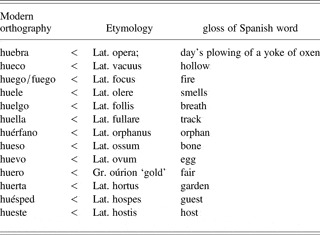
The 13 Spanish words that were in use in the sixteenth century, and that began with /w/, are listed below (Table 2). The etymologies cited show that less than half of these words originally began with /h/ or /f/.
Spanish words beginning with /w/ in the sixteenth century.

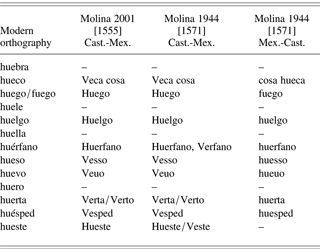
Out of the nine of these thirteen words that are included in Molina's (2001 [1555]) dictionary from 1555, five have an initial <v> and the remaining four begin with <hu>. In the Castellano-Mexicano of the 1571 edition five are written with initial <v>, two are entered both under <hu> and <v>, and <huego> and <huelgo> appear only with initial <hu>. However, in the Mexicano-Castellano part they all begin with <hu> - except for <fuego>. Could he have been told that this was a more correct spelling and asked to use those forms in the second part which was printed for the first time in 1571 (Table 3)?
Spanish words beginning with /w/, as written by Molina.
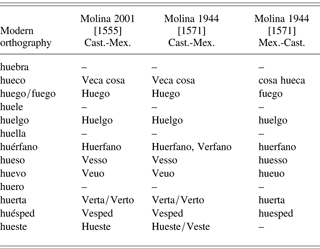
In other documents from New Spain where these words appear, we also find the spelling <üe-> (Boyd-Bowman Reference Boyd-Bowman1971). In other words, the orthographic conventions for Spanish were far from stable in this period, and the few words that began with /w/ could hardly have had decisive influence.
My second argument against the suggestion that the <hu> spelling had its origin in Spanish orthography, is that the phoneme /w/ in other indigenous languages in New Spain was written <v> or <u> and not <hu>. This is true of for example Totonac (Autor desconocido Reference Autor desconocido1990 [sixteenth century]), Tarascan/P'urhepecha (Gilberti Reference Gilberti and Monzón2004 [1558], Reference Gilberti1990 [1559]), K'iche (Ximénez Reference Ximénez1944 [1694–1730]), Tzeldal (Ara Reference de Ara1986 [sixteenth century]), Ch'olti' (Morán Reference Morán1935 [1625/1695]), and Yucatec Maya. Tozzer (Reference Tozzer1921:21) has set up a chart of 16 sources for Maya, starting with the grammar by Juan Coronel from 1621 and ending with a manuscript by William Gates from the early twentieth century. They all use <u> and/or <v> for /w/.
Zapotec and Mixtec are exceptions, but that is undoubtedly because friars who dealt with these languages were advised by those who worked with Nauatl (Smith-Stark Reference Smith-Stark1993, Reference Smith-Stark and Frizzi2003).
HYPOTHESIS FOR THE ORIGIN OF WORD INITIAL AND MEDIAL <hu>
I have argued that the digraph of <hu> for the highly frequent phoneme /w/ word initially and between vowels in Nauatl was not an obvious choice for the Spanish friars. So why did they—or why did some of them—make this unexpected choice? How did it start? And why did it have such an overwhelming success?
I shall demonstrate that this spelling has several origins, and that in two cases the presence of <h> can be explained phonologically, but without providing phonetic support to the pronunciation of /w/, and where <h> has a function outside of the digraph <hu>.
/w/ after /l/
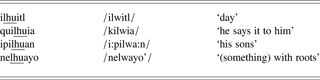
The first context to be discussed is where /w/ follows an /l/ (Table 4).
Words with /l/ before /w/.
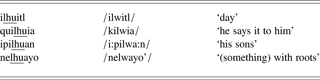
In this context, the generally accepted way of writing /lw/ is <-lhu->, and this is how it has been written from the very beginning, in Olmos' grammar from 1547 and on. Today it is universally assumed that <h> is part of the digraph <hu> discussed above. However, the function of the <h> in this context originally had nothing to do with how /w/ was pronounced. In fact, it had nothing to do with the pronunciation of /w/ at all. It simply served to indicate that /l/ is devoiced preconsonantally, [ilh-wiλ].
According to a general rule in Nauatl, all voiced consonants are devoiced in syllable final position—except the two nasals, m and n. There are in Nauatl three non-nasal, voiced consonants, /w/, /y/, and /l/ (see Table 5).
Voiced consonants are devoiced in syllable final position.

The rendering of devoiced /w/ in syllable final position was already discussed above; it is universally written <uh> in agreement with the pronunciation. The devoicing of /y/ has a more dramatic result than that of /w/ and /l/ since devoiced /y/ is pronounced exactly like another phoneme in the language, namely /x/. This becomes apparent in alternating forms of the same root, qui-piya ‘he takes care of it' qui-pix ‘he took care of it'. In fact few have recognized this phonetic connection between /y/ and /x/, and the two forms, <quipi(y)a> and <quipix> are explained as two variants of the stem. Newman (Reference Newman and McQuown1967:191) talks about stem modification: “Some verbs whose simple stem ended in -ya or -ia dropped the final syllable—the total syllable -ya, the final -a of -ia—and adds s or x: o·-istas, ‘it became white' (istaya ‘to become white'), … o·-ni-k-pix ‘I held it' (pia ‘to hold, to have').” However, this devoicing of <y> creates no variation in the orthography.
That the phoneme /l/ was devoiced in the quoted contexts we know from the grammar of Andrés de Olmos (Reference de Olmos1972 [1547], 2002 [1547]) who systematically wrote word final /l/ <lh>, like in <nocalh> ‘my house'. For some reason Olmos' final <lh> was never adopted, and his <lh> before another consonant is hardly found anywhere except precisely before /w/ where it appears to have been an almost universally accepted and recognized way of writing /l/.
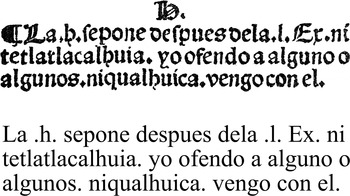
About this way of spelling /l/, Molina (Reference de Molina1945 [1571]:f. 26r, Reference de Molina1886 [1571]:216) says in his chapter VII on “Phrasis y maneras de hablar de la Lengua Mexicana Y primeramente de la orthographia y sincopa” (see Figure 1):
Molina (Reference de Molina1945 [1571]:Chapter 7, f. 26r). Molina here clearly states that h is inserted after l, and he exemplifies it.

“La. h. sepone despues dela. l. Ex. nitetlatlacalhuia. yo ofendo a alguno o algunos. niqualhuica. vengo con el.”
h is placed after l, Ex. nitetlatlacalhuia ‘I offend someone or someones', niqualhuia ‘I come with him' [translation by author].
In other words, Molina sees this as an orthographic rule concerning <l>, but he fails to note that it is in force only before /w/.
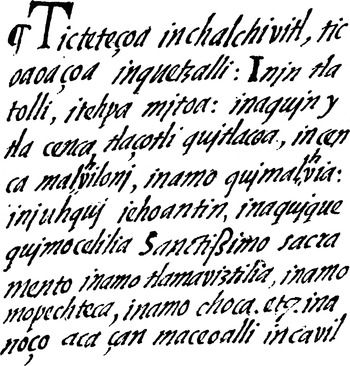
Other revealing evidence of this spelling is found in the Florentine Codex (Figure 2) where an <h> is inserted between <l> and <u/v> in certain passages as a correction (line 5 <malhvilonj> and <qujmalhvia>).
Florentine Codex, Book 6 (Dibble and Anderson Reference Dibble and Anderson1969:f. 199v). In line five a letter h is, in two cases, inserted between l and v. Since no h is inserted before v in other contexts (see lines one, eight, and ten) this shows that the inserted h serves to devoice the preceding l.

The passage from the Florentine Codex also documents that no <h> is inserted before intervocalic /w/, written <v> or <o> (<inchalchivitl> in the first line, and <maceoalli> and <incavil[qujxtilia]> in the last line). Nor is <h> inserted between <l> and <ch>, chalchivitl. This is not the only place in the Florentine Codex where an <h> is inserted between <l> and <v> as a correction. However, this can only be observed in the original manuscript since such inserted letters are included as regular letters without comments in Dibble and Anderson's (1969:199) paleography.
In other words, originally the <h> between <l> and /w/ was meant to indicate the devoicing of <l> and did not form part of the <hu> digraph. Molina's example, <niqualhuica> ‘I bring it' should be divided into syllables in the following way, <niq-ualh-ui-ca> /nik-wa:l-wi:-ka/, pronounced [nikwa:lh-wi:ka].
In today's dialects devoicing of /w/ and /l/ is heard most distinctly before another voiced consonant. The fact that devoicing of <l> was indicated orthographically in the sixteenth century only before /w/ seems to indicate that the devoicing of /l/ was most noticeable in that context. Olmos occasionally indicates this devoicing also before /m/, for example, in <xiualhmovica> (Olmos Reference de Olmos1972 [1547]:197).
In his dictionary, Molina consistently writes <lhu>, representing [lhw], <ilhuitl> /ilwitl/ ‘day', <nelhuayo> /nelwayo'/ ‘with roots', whereas the devoicing of /l/ is not indicated before any other consonant. That the <h> in fact serves to indicate the devoicing of <l> in Molina's orthography is supported by the observation that we do not find <hu> word initially, nor between vowels in his dictionary (Table 6).
/w/ word initially and between vowels in Molina's dictionary (Molina Reference de Molina1945 [1971b]).

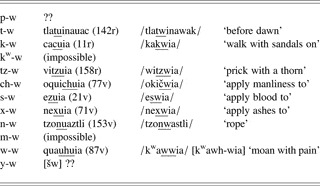
Nor does <hu> occur after any other consonant than <l>, with the exception of /w/ which is also a voiced consonant (Table 7). In other words, in <quauhuia> (87v) ‘moan with pain' the <h> belongs to the first syllable, and serves to indicate devoicing of the first /w/, [kwawh-wia].
/w/ after all consonants, except /l/.

The misinterpretation—or rather reinterpretation—of the letter sequence <lhu> in, for example <nelhuayo> ‘with roots' from <nelh-uayo> to <nel-huayo>, plays a crucial role in the history of <hu> for /w/ initially and medially. The success of this reinterpretation undoubtedly owes its strength to the high frequency of occurrence of the sequence /lw/ which again is explained by its appearance in some common words and due to some frequently used suffixes beginning with /w/:
– The word /ilwitl/ ‘day, fiesta' appears in its simple form (i.e., not compounded with some numeral) 95 times in the Florentine Codex and many more times in compounds.
– The suffix that forms applicatives from transitive verbs ending in -oa, always takes the form /-lwia-/ due to a metathesis (Canger Reference Canger1980:Chapter 4).

– Another suffix, /wia/, derives transitive verbs from nouns
– to indicate that the object to which the noun refers, is applied to something, from te-tl ‘stone' we get te-wia ‘apply stone to' (Launey Reference Launey1992:272); thus <qui-te-huia> means ‘he applies stone to it', and from tla:l-li ‘earth' we get <qui-tla:l-huia> ‘he throws earth on it'. Most of the examples in Table 7 belong to this class of derived verbs.
– Also the suffix indicating plural of a possessed noun, /-wa:n/, like in <ipil-huan> ‘his sons', is frequent.
<hu> in Emphatic Pronouns
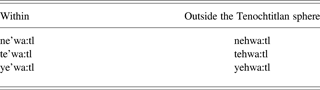
In the emphatic pronouns, <nehuatl> ‘I', <tehuatl> ‘you', <yehuatl> ‘he, she, it', etc. we have a second context where the <h> can be explained phonologically without involving the pronunciation of /w/; in other words <h> and <u> do not represent a digraph here, but two separate letters, and two phonemes. In these pronouns, <h> represents what is known as saltillo: /ne'wa:tl/, /te'wa:tl/, and /ye'wa:tl/. It is well known that the so-called saltillo or glottal stop was generally not written in texts from the sixteenth and seventeenth centuries. In Common Nauatl (the early form of Nauatl from which all later dialects—including Classical Nauatl—have developed), there was no glottal stop. In words where Classical Nauatl has a glottal stop, Common Nauatl had /h/. Despite the often encountered assumption that the glottal stop is the original realization of this phoneme, the change from <h> to glottal stop can be shown to be an innovation in Nauatl of Tenochtitlan and vicinities, probably initiated some time in the fifteenth century. This innovation did not spread far beyond the narrow Valley of Mexico. In all other varieties of Nauatl we find <h>. This is profusely documented in Yolanda Lastra's (Reference Lastra de Suárez1986) book on dialect areas of modern Nauatl . The original /h/ is also documented in the sixteenth and seventeenth centuries, especially in texts from Tlaxcala, Puebla, and other areas at a short distance from Tenochtitlan. This shows that the friars were well aware of this pronunciation and registered it where it was in fact used (Table 8). The occurrence of this /h/ is commonly mentioned in descriptions of the language from the sixteenth and seventeenth centuries.
Emphatic pronouns and the realization of saltillo vs. [h].
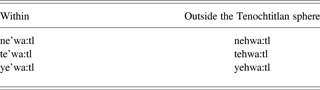
It is unclear why the provincial orthographic version of the emphatic pronouns <nehuatl>, etc. won over the expected central area one, <neuatl>, at an early stage, but that seems to be the case.
However, spelling these pronouns with an <h> is common, also in documents that do not elsewhere write <hu> for /w/ between vowels. I suggest that the origin of <h> in the emphatic pronouns stems from the way they were—and are—pronounced in most dialects outside of the narrow area around Tenochtitlan.
/w/ in the Beginning of Words or Between Vowels
So far I have demonstrated that in the sequence <-lhu-> and in <-hu-> in emphatic pronouns <h> can be explained phonologically without directly involving the following /w/, and I have suggested that <hu> in these two cases has been reinterpreted as representing /w/. <ipilh-uan> and <neh-uatl> are reinterpreted as <ipil-huan> and <ye-huatl>. But how about <hu> in the beginning of words and between vowels, like in Huexotzingo and Nahuatl? In those contexts no phonological (or other) explanation is possible.
Let me suggest a hypothesis which is, however, speculative since I have no evidence to support it. The hypothesis is that some friars were not very good phoneticians, and that they cared more about regularity and elegance than about an orthography that rendered the details of spoken Nauatl. The digraph, <hu>, was to them known from the two frequently occurring cases I have presented, and they also knew it from the few Spanish words that were written with initial <hu> (Table 2). Finally, I suggest that they liked the symmetry of <uh> for [wh] and <hu> for [w], neatly exemplified in the word <huallauh>, ‘he comes’.
The process of <hu> entering the scene and its victory over plain <u/v> for /w/, can be traced in documents from the sixteenth century. I am working on a detailed study of this process in a number of longer and shorter documents from the period. But even at this point a fairly clear picture emerges from the material. Based on the occurrence of <v/u> versus <hu>, the documents can be grouped into three categories: in the first category, word initial /w/ and /w/ between vowels is never written <hu>; in the second it is always written <hu>; and in the third category there is variation between the two possibilities. Chronology plays a natural role in this picture: <u/v> is by far the prevalent way of writing /w/ until after 1565 when <hu> gradually takes over. Some longer documents seem to reveal a tendency based on other factors, such as individual authors. Thus, the following documents (and authors) all belong to the first category, which we can call the early tradition, which always renders /w/ in question with <u/v>: Olmos' Arte from 1547, Actas de Cabildo de Tlaxcala 1547–1567 (Celestino Solís et al. Reference Celestino Solís, Valencia R. and Medina Lima1985), the Doctrina Christiana of the Dominicans (1944 [1548]), Molina (Reference de Molina2001 [1555] and 1886 [1571], Códice Sierra from the Oaxaca area (León Reference León1933 [1550–1564]), Historia Tolteca Chichimeca (1560–1570) (Kirchhoff et al. Reference Kirchoff, Güemes and García1976), the Florentine Codex (1979 [1579]) and other writings by Sahagún, and Codex Aubin 1576–1596 (Lehmann and Kutscher Reference Lehmann and Kutscher1981). In the second category with <hu> as the preferred way of writing /w/ in word initial position and between vowels, I have found fewer long documents. They are Gante (Reference de Gante1981 [1553]), Codex Osuna (Chávez Orozco Reference Chávez Orozco1947 [1563–1566]), Anales de Juan Bautista (1564–1569) (Reyes García Reference Reyes García2001), and Juan Bautista's Huehuetlatolli from 1600.
Pedro de Gante's (1981 [1553]) Doctrina Christiana with consistent <hu> everywhere stands out as an exceptionally early source with surprisingly little orthographic variation, and in glaring contrast to the Dominican Doctrina from 1546 which has next to no cases of <hu> for /w/. I suggest that Pedro de Gante was the prime promoter of the <hu> movement. The arguments for this hypothesis are:
– his Doctrina Christiana is the earliest document which systematically uses <hu> word initially and before a consonant - almost without exception.
– Pedro de Gante had the influence necessary to have his convention spread; he was a teacher for the young already in the 1520s, and he wrote in Nauatl.
– he stuttered, a defect that I suggest may have affected his ability to transfer the spoken language to writing since he would have been unable to check it with his own pronunciation.
This last feature is rarely mentioned, but documented in Mendieta's (1971) Historia Eclesiastica Indiana. Mendieta (Reference Mendieta1971:609) says about Pedro de Gante:
“Predicaba cuando no habia sacerdote que supiese la lengua de los indios, la cual él supo muy bien, puesto que era naturalmente tartamudo, que por maravilla los frailes le entendían, ni en la lengua mexicana los que la sabian, ni en la propria nuestra.”
He preached when there was no priest who knew the language of the Indians, which he knew very well. Since by nature he stuttered so much that it was a wonder the friars understood him, nor did anyone who knew the Mexican language or our own. [translation by author]
SUMMATION
In the early period of the sixteenth century there was much variation in how Nauatl was written, and a general uncertainty in the choice of letters for many phonemes was common. Later, two traditions for how to write prevocalic /w/ emerged: the most widespread choice was <hu > , according to my analysis, promoted by Pedro de Gante.
But simple <u> continues to be found in a good portion of documents after the initial period. The distribution of the two traditions is not random: documents with simple <u> are found extensively in the Puebla and Tlaxcala regions which share another orthographic feature, namely <h> corresponding to glottal stop in the central area. In sixteenth-century documents from Puebla and Tlaxcala, <h> appears frequently—although in no way consistently—in words that had a glottal stop in Classical Nauatl, such as <tlahtoani>, <tlahtoque>, <quihtoa>, <mihto>, <totahtzin>, <yhquac>, <mouicaqueh>, <yahqui>. These words are taken from Anales de Tecamachalco (Peñafiel Reference Peñafiel1981 [1903]), but similar examples can be found in the documents from Cuauhtinchan (Reyes García Reference Reyes García1988) and to a greater or lesser degree in other documents from Puebla and Tlaxcala. I have already mentioned that the glottal stop was restricted to dialects spoken in the central area, whereas /h/ is found elsewhere. It thus makes sense that this orthographic <h> is found in dialect areas where [h] was actually pronounced. It makes just as much sense that the tradition for representing /w/ by <hu> was avoided in these same areas. Because in contrast to the problematic function of <h> in <hu>, <h> here had a phonetic value. It was pronounced wherever it occurred, also in <uh>. In other words, wherever <h> appeared in documents from those areas, it was pronounced. That may well be the reason why Luis Reyes García and his students insist on writing prevocalic /w/ <u>. Reyes García (Reference Reyes García2001:13) says in footnote 1:
“La forma de escribir esta palabra [náuatl] en textos en español es náhuatl por la imposición de las reglas ortográficas españolas. Sin embargo, aquí se prefiere eliminar la letra "h", como aparece en el diccionario de Alonso de Molina.”
The way of writing this word [náuatl] in texts in Spanish is náhuatl by the imposition of the Spanish rules of orthography. Nevertheless here it is preferred to eliminate the letter “h”, as it appears in Molina's dictionary. [translation by author]
In the twentieth century a somewhat similar development has taken place: the German scholars who were primarily interested in the content of the documents, quoted the Nauatl words as they found them in the texts, and in general they stuck to Molina's orthography. But the moment scholars began to analyze Nauatl and write about the language in isolation from its use in texts, they were forced to decide on a consistent way of rendering the phonemes. They could not accept that a given word would be written in more than one way. As it turned out Horacio Carochi's orthography was chosen over and above Alonso de Molina's—possibly due to the perspicacity, the clarity, and the consistency found in Carochi's grammar.
Following Luis Reyes García's example and in protest against the dysfunctional <h> in word initial and prevocalic <hu>, I suggest that we begin to write Nauatl either with a <w> or, at best, with a <u> initially and between vowels.
CONSEQUENCES
The victory of word initial and prevocalic <hu> over <u> in the sixteenth-seventeenth centuries has had several far-reaching consequences:
– In Santamaría's (Reference Santamaría1959) Diccionario de Mejicanismos we today find not a dozen words that begin with <hu>, but 240 words. Many of these words—if not most of them—are borrowed from Nauatl.
– Toponyms in other Latin American countries have also adopted the convention of writing <hu> for prevocalic /w/.
– Modern scholars, for example Aschmann (Reference Aschmann1973) and Reid and Bishop (Reference Reid and Bishop1974), who have assigned practical orthography to Totonac, have chosen to write /w/ with <hu> word initially, this in spite of the fact that the Totonac inventory of phonemes includes /h/ as a phoneme, appearing in the following contexts, V__V, #__V, and __#. They thereby acquire the same confusing symmetry that we know from the Nauatl convention, but this is not the way /w/ was written in the colonial Totonac grammars. In an anonymous gramar from around 1625 (f. 32r), we find <u> word initially and intervocalically, and <uh> word finally, a convention that apparently reflects the pronunciation. Levy (Reference Levy1987:54) says about the pronunciation of /w/, “En posición final de emisión se ensordece.” In final position it devoices. [translation by author]
– Most people who do not know anything about Nauatl or Mexico, have problems pronouncing words that contain the digraph <hu > .
RESUMEN
En el mundo académico de habla inglés dos normas de escribir la lengua de los aztecas han emergido. Según esta norma el fonema /w/ se escribe <hu> en la posición antes de vocal, nahuatl, ahuacatl ‘aguacate’. Existe la alternativa de escribir /w/ con <u> (or <v>), una tradición que fue común junto a <hu> en el siglo XVI y hacia adelante. Argumento que <hu> no representa la pronunciación de la lengua, muestro el origen de este <hu>, y sugiero que Pedro de Gante fue el promotor principal de <hu>.
ACKNOWLEDGEMENTS
I have presented previous versions of this paper under various titles, at the Universidad Autónoma de México and at the Biblioteca Francisco de Burgoa in Oaxaca in August 2007, and February 2008 at the Instituto de Investigaciones Estéticas, UNAM in Oaxaca. Christophe Helmke has read a previous version and provided useful comments for which I am grateful. Four reviewers, John Justeson, Frances Karttunen and two anonymous readers provided constructive and helpful advice and comments; particularly those by John Justeson were to the point. They have all contributed to improving the text. The remaining inconsistencies and errors are, obviously, all mine.