In the focal article “Getting Rid of Performance Ratings: Genius or Folly? A Debate,” two groups of authors argued the merits of performance ratings (Adler et al., Reference Adler, Campion, Colquitt, Grubb, Murphy, Ollander-Krane and Pulakos2016). Despite varied views, both sides noted the importance of including multiple raters to obtain more accurate performance ratings. As the pro side noted, “if ratings can be pooled across many similarly situated raters, it should be possible to obtain quite reliable assessments” (Adler et al., p. 236). Even the con side noted, “In theory, it is possible to obtain ratings from multiple raters and pool them to eliminate some types of interrater agreement” (Adler et al., p. 225), although this side was certainly less optimistic about the merits of multiple raters. In the broader industrial–organizational psychology literature, authors have repeatedly heralded the benefits of adding additional raters for performance ratings, some even treating it as a panacea for inaccurate ratings. Although these authors extol the virtues of multiple raters, an important question is often omitted from relevant discussions of performance ratings: To what extent do additional raters actually improve performance ratings? Does adding an additional rater double the validity of performance ratings? Does an additional rater increase the validity of performance ratings by a constant value? Or is the answer something else altogether?
It is possible, if not probable, that many researchers and practitioners do not exactly know the benefits of adding additional raters, and some authors may be blindly overemphasizing the importance of multiple raters. For this reason, in the following, I provide quantitative inferences about the actual impact of adding additional raters on the validity of performance ratings. In doing so, I also provide useful tables that future researchers and practitioners can use to determine whether adding additional raters to their performance rating systems would result in benefits that might outweigh the costs. To conclude, I discuss four primary inferences about the relationship of adding additional raters and the validity of performance ratings. From achieving these objectives, I provide a more accurate view of the benefits obtained from adding additional raters to a rating system, thereby allowing researchers and practitioners to more accurately determine whether getting rid of performance ratings is, in fact, genius or folly.
Determining the Impact of Adding Additional Raters
To determine the impact of adding additional raters to a rating system, a classic psychometric formula can be applied. Ghiselli (Reference Ghiselli1964) created an equation to determine the validity of a test as the number of test items increases, but the same equation can compute the validity of a composite rater as the number of raters increases (Hogarth, Reference Hogarth1978; Tsujimoto, Hamilton, & Berger, Reference Tsujimoto, Hamilton and Berger1990). When applying the formula for the latter purpose, it is as follows:
Whereas m is the number of raters, rjx is the average correlation between each rater and true performance, rij is the average correlation between the raters, and rmjx is the correlation between the average of the raters (composite rater) and true performance. In this article, the rmjx is labeled the validity coefficient, and it represents the accuracy of a rating system. When assuming that all shared variance between raters is through true performance (i.e., no systematic error), the average correlation between raters is the indirect effect via true performance. For example, if the correlation between each of two raters and true performance is .20, and no other shared variance is assumed, then the correlation between the two raters is .04 (.20*.20). Thus, when assuming that all shared variance between raters is via true performance, the formula can be rewritten as
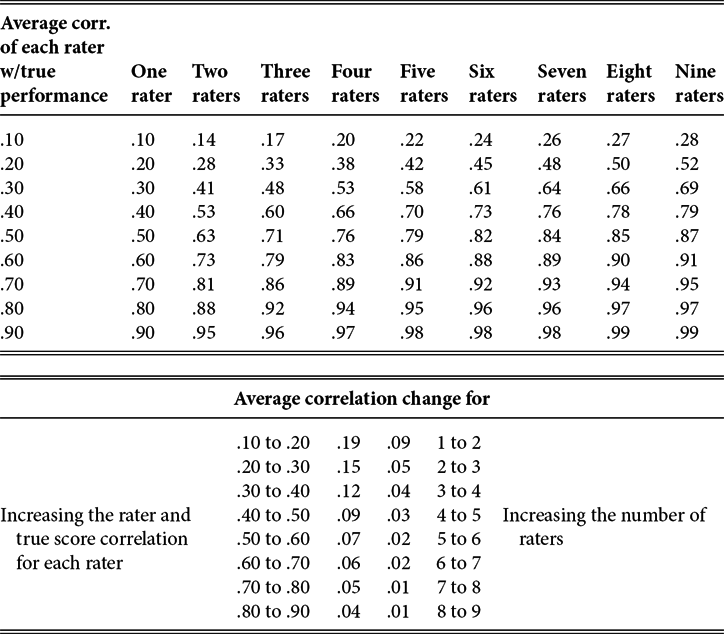
The only difference between Formulas 1 and 2 is that rij is replaced by rjx 2, reflecting that the average correlation between raters is solely through the indirect effect of true performance. Using this formula, we can determine the validity coefficient when the rating accuracy and number of raters varies (see Table 1). Before analyzing such results and drawing inferences about adding additional raters, however, another important factor should be considered.
Table 1.Correlation Between Average Observed Score and True Score (Validity Coefficient) Assuming No Systematic Error
The results in Table 1 assume that raters are independent and no systematic error exists, but many authors have demonstrated that this assumption is rarely held in practice (Murphy, Cleveland, & Mohler, Reference Murphy, Cleveland, Mohler, Bracken, Timmreck and Church2001; Ones, Viswesvaran, & Schmidt, Reference Ones, Viswesvaran and Schmidt2008; Viswesvaran, Ones, & Schmidt, Reference Viswesvaran, Ones and Schmidt1996). Raters often demonstrate systematic variance that is independent of true performance, especially when ratings are provided from the same organizational level (i.e., peer, subordinate, supervisor, etc.), and this systematic variance decreases the validity coefficient. Ignoring this variance would depict an inaccurate view of performance ratings.
In a noteworthy study, Hoffman, Lance, Bynum, and Gentry (Reference Hoffman, Lance, Bynum and Gentry2010) demonstrated that rater source effects account for approximately 22% of the shared variance between raters. Taking this figure, we can assume that the correlation between raters that is solely due to rater source effects is .469 ( $\sqrt{.22}$), and the total correlation between raters is an additive function of these source effects and the indirect effect of true performance. Given this, the prior formula can be modified to determine the validity coefficient when accounting for rater source effects. The modified formula is as follows:
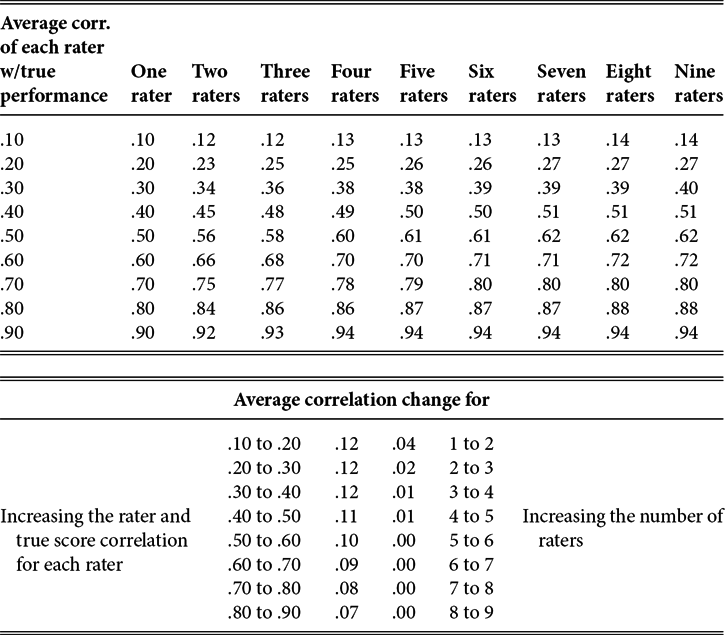
The only difference between Formulas 2 and 3 is that the rater source effect (.469) is included in the calculation of the average correlation between raters. Using this formula, we can once again determine the validity coefficient when the rating accuracy and number of raters varies—this time accounting for rater source effects. Table 2 includes these validity coefficients. Four primary inferences should be taken from these results.
Table 2.Correlation Between Average Observed Score and True Score (Validity Coefficient) Assuming Rater Source Effects
First, the impact of adding raters may be smaller than many would expect. As mentioned, many researchers and practitioners believe that adding raters is a panacea for inaccurate ratings. At best, however, adding an additional rater only increases the validity coefficient by .06. On average, adding an additional rater only improved the validity coefficient by .01. Although explaining any additional variance in performance is valuable, these results are almost assuredly smaller than many expectations, and additional raters are almost certainly not a panacea for inaccurate ratings.
Second, the benefits of adding raters decrease as the number of raters increases. For example, when increasing the number of raters from one to two when the average correlation between each of the raters and true performance is .50, the validity coefficient increases from .50 to .56; however, when increasing the number of raters from eight to nine, the validity coefficient remains virtually constant at .62. When inspecting Table 2, it appears the benefits of adding raters begin to bottom out after three. Therefore, diminishing returns are received when adding raters, and authors should strongly consider whether the small benefits of including more than two or three raters outweigh the costs.
Third, the benefit of additional raters is decreased when rating accuracy is either high or low. For example, when the correlation between each of the raters and true performance is .10, increasing the number of raters from one to two only increases the validity coefficient from .10 to .12. When the correlation is .90, increasing the number of raters from one to two only increases the validity coefficient from .90 to .92. When the correlation is .50, however, increasing the number of raters from one to two increases the validity coefficient from .50 to .56. It appears that, when ratings are inaccurate, additional raters are unable to provide additional meaningful information, and when ratings are extremely accurate, additional raters do not provide additional novel information. Thus, researchers and practitioners should heavily consider whether adding additional raters sufficiently improves performance ratings, such as through analyzing the accuracy of their current ratings, or whether they should allocate their resources toward other aspects of their rating systems.
Fourth, the impact of adding raters is smaller than improving measures. At best, improving the correlation of each rater with true performance by .10 results in a .16 increase in the validity coefficient. On average, improving the correlation of each rater with true performance by .10 results in a .10 increase to the validity coefficient. Although it is largely impossible to precisely increase each rater's correlation with true performance by .10, these results nevertheless show that improving rating accuracy is as effective as expectations. In almost any circumstance, researchers and practitioners receive their expected benefits from improving rating accuracy, which is not the case with increasing the number of raters. Once again, it may be more beneficial to allocate resources toward developing better measures and rating systems to improve performance ratings, rather than adding additional raters.
Together, these four inferences suggest that adding additional raters to a rating system may not actually provide noteworthy improvements to rating accuracy, contrary to common thought on the topic. These inferences do not explicitly show that adding getting rid of performance ratings is genius, but assuming that adding additional raters is a solution to this debate is a folly.





In the focal article “Getting Rid of Performance Ratings: Genius or Folly? A Debate,” two groups of authors argued the merits of performance ratings (Adler et al., Reference Adler, Campion, Colquitt, Grubb, Murphy, Ollander-Krane and Pulakos2016). Despite varied views, both sides noted the importance of including multiple raters to obtain more accurate performance ratings. As the pro side noted, “if ratings can be pooled across many similarly situated raters, it should be possible to obtain quite reliable assessments” (Adler et al., p. 236). Even the con side noted, “In theory, it is possible to obtain ratings from multiple raters and pool them to eliminate some types of interrater agreement” (Adler et al., p. 225), although this side was certainly less optimistic about the merits of multiple raters. In the broader industrial–organizational psychology literature, authors have repeatedly heralded the benefits of adding additional raters for performance ratings, some even treating it as a panacea for inaccurate ratings. Although these authors extol the virtues of multiple raters, an important question is often omitted from relevant discussions of performance ratings: To what extent do additional raters actually improve performance ratings? Does adding an additional rater double the validity of performance ratings? Does an additional rater increase the validity of performance ratings by a constant value? Or is the answer something else altogether?
It is possible, if not probable, that many researchers and practitioners do not exactly know the benefits of adding additional raters, and some authors may be blindly overemphasizing the importance of multiple raters. For this reason, in the following, I provide quantitative inferences about the actual impact of adding additional raters on the validity of performance ratings. In doing so, I also provide useful tables that future researchers and practitioners can use to determine whether adding additional raters to their performance rating systems would result in benefits that might outweigh the costs. To conclude, I discuss four primary inferences about the relationship of adding additional raters and the validity of performance ratings. From achieving these objectives, I provide a more accurate view of the benefits obtained from adding additional raters to a rating system, thereby allowing researchers and practitioners to more accurately determine whether getting rid of performance ratings is, in fact, genius or folly.
Determining the Impact of Adding Additional Raters
To determine the impact of adding additional raters to a rating system, a classic psychometric formula can be applied. Ghiselli (Reference Ghiselli1964) created an equation to determine the validity of a test as the number of test items increases, but the same equation can compute the validity of a composite rater as the number of raters increases (Hogarth, Reference Hogarth1978; Tsujimoto, Hamilton, & Berger, Reference Tsujimoto, Hamilton and Berger1990). When applying the formula for the latter purpose, it is as follows:
Whereas m is the number of raters, rjx is the average correlation between each rater and true performance, rij is the average correlation between the raters, and rmjx is the correlation between the average of the raters (composite rater) and true performance. In this article, the rmjx is labeled the validity coefficient, and it represents the accuracy of a rating system. When assuming that all shared variance between raters is through true performance (i.e., no systematic error), the average correlation between raters is the indirect effect via true performance. For example, if the correlation between each of two raters and true performance is .20, and no other shared variance is assumed, then the correlation between the two raters is .04 (.20*.20). Thus, when assuming that all shared variance between raters is via true performance, the formula can be rewritten as
The only difference between Formulas 1 and 2 is that rij is replaced by rjx 2, reflecting that the average correlation between raters is solely through the indirect effect of true performance. Using this formula, we can determine the validity coefficient when the rating accuracy and number of raters varies (see Table 1). Before analyzing such results and drawing inferences about adding additional raters, however, another important factor should be considered.
Correlation Between Average Observed Score and True Score (Validity Coefficient) Assuming No Systematic Error
The results in Table 1 assume that raters are independent and no systematic error exists, but many authors have demonstrated that this assumption is rarely held in practice (Murphy, Cleveland, & Mohler, Reference Murphy, Cleveland, Mohler, Bracken, Timmreck and Church2001; Ones, Viswesvaran, & Schmidt, Reference Ones, Viswesvaran and Schmidt2008; Viswesvaran, Ones, & Schmidt, Reference Viswesvaran, Ones and Schmidt1996). Raters often demonstrate systematic variance that is independent of true performance, especially when ratings are provided from the same organizational level (i.e., peer, subordinate, supervisor, etc.), and this systematic variance decreases the validity coefficient. Ignoring this variance would depict an inaccurate view of performance ratings.
In a noteworthy study, Hoffman, Lance, Bynum, and Gentry (Reference Hoffman, Lance, Bynum and Gentry2010) demonstrated that rater source effects account for approximately 22% of the shared variance between raters. Taking this figure, we can assume that the correlation between raters that is solely due to rater source effects is .469 ( $\sqrt{.22}$), and the total correlation between raters is an additive function of these source effects and the indirect effect of true performance. Given this, the prior formula can be modified to determine the validity coefficient when accounting for rater source effects. The modified formula is as follows:
The only difference between Formulas 2 and 3 is that the rater source effect (.469) is included in the calculation of the average correlation between raters. Using this formula, we can once again determine the validity coefficient when the rating accuracy and number of raters varies—this time accounting for rater source effects. Table 2 includes these validity coefficients. Four primary inferences should be taken from these results.
Correlation Between Average Observed Score and True Score (Validity Coefficient) Assuming Rater Source Effects
First, the impact of adding raters may be smaller than many would expect. As mentioned, many researchers and practitioners believe that adding raters is a panacea for inaccurate ratings. At best, however, adding an additional rater only increases the validity coefficient by .06. On average, adding an additional rater only improved the validity coefficient by .01. Although explaining any additional variance in performance is valuable, these results are almost assuredly smaller than many expectations, and additional raters are almost certainly not a panacea for inaccurate ratings.
Second, the benefits of adding raters decrease as the number of raters increases. For example, when increasing the number of raters from one to two when the average correlation between each of the raters and true performance is .50, the validity coefficient increases from .50 to .56; however, when increasing the number of raters from eight to nine, the validity coefficient remains virtually constant at .62. When inspecting Table 2, it appears the benefits of adding raters begin to bottom out after three. Therefore, diminishing returns are received when adding raters, and authors should strongly consider whether the small benefits of including more than two or three raters outweigh the costs.
Third, the benefit of additional raters is decreased when rating accuracy is either high or low. For example, when the correlation between each of the raters and true performance is .10, increasing the number of raters from one to two only increases the validity coefficient from .10 to .12. When the correlation is .90, increasing the number of raters from one to two only increases the validity coefficient from .90 to .92. When the correlation is .50, however, increasing the number of raters from one to two increases the validity coefficient from .50 to .56. It appears that, when ratings are inaccurate, additional raters are unable to provide additional meaningful information, and when ratings are extremely accurate, additional raters do not provide additional novel information. Thus, researchers and practitioners should heavily consider whether adding additional raters sufficiently improves performance ratings, such as through analyzing the accuracy of their current ratings, or whether they should allocate their resources toward other aspects of their rating systems.
Fourth, the impact of adding raters is smaller than improving measures. At best, improving the correlation of each rater with true performance by .10 results in a .16 increase in the validity coefficient. On average, improving the correlation of each rater with true performance by .10 results in a .10 increase to the validity coefficient. Although it is largely impossible to precisely increase each rater's correlation with true performance by .10, these results nevertheless show that improving rating accuracy is as effective as expectations. In almost any circumstance, researchers and practitioners receive their expected benefits from improving rating accuracy, which is not the case with increasing the number of raters. Once again, it may be more beneficial to allocate resources toward developing better measures and rating systems to improve performance ratings, rather than adding additional raters.
Together, these four inferences suggest that adding additional raters to a rating system may not actually provide noteworthy improvements to rating accuracy, contrary to common thought on the topic. These inferences do not explicitly show that adding getting rid of performance ratings is genius, but assuming that adding additional raters is a solution to this debate is a folly.
Conclusion
The goal of the current article was to reevaluate common thought about adding additional raters to performance rating systems. As the results of Ghiselli's (Reference Ghiselli1964) classic formula demonstrated, adding additional raters may not provide as much of a benefit as commonly believed. Further, adding additional raters beyond two or three provides marginal benefits to performance ratings, and extremely inaccurate or accurate ratings systems likewise receive few benefits from adding additional raters. Nevertheless, improving the accuracy of ratings almost always provides the expected benefits. Together, whereas many authors laud the importance of multiple raters, the results of this commentary showed that adding raters might only provide marginal benefits to the validity of a rating system. Although these results may not argue that removing performance ratings is genius, they certainly demonstrate that even the most lauded strengths of performance ratings have serious concerns.