The alfalfa weevil, Hypera postica (Gyllenhal) (Coleoptera: Curculionidae), is a widespread and destructive pest of alfalfa (Medicago sativa Linnaeus; Fabaceae) worldwide, including most of the continental United States of America (White et al. Reference White, Allen, Moffitt and Kingsley1995). Due to its widespread historical impact, it was the target of a national biological control programme carried out by the United States Department of Agriculture, during which nine agents that attack various weevil life stages were successfully established in the United States of America (Bryan et al. Reference Bryan, Dysart and Burger1993; Radcliffe and Flanders Reference Radcliffe and Flanders1998). Four species are considered key parasitoids of the alfalfa weevil (Radcliffe and Flanders Reference Radcliffe and Flanders1998), including three larval parasitoids, Bathyplectes curculionis (Thomson) (Hymenoptera: Ichneumonidae), Bathyplectes anurus (Thomson) (Hymenoptera: Ichneumonidae), and Oomyzus incertus (Ratzenberg) (Hymenoptera: Eulophidae), and one adult parasitoid, Microctonus aethiopoides Loan (Hymenoptera: Braconidae). Despite extensive redistribution of a number of parasitoid species throughout the 1970–1980s (Bryan et al. Reference Bryan, Dysart and Burger1993) there remains little post release data on their permanent establishment in many regions. The only existing surveys for alfalfa weevil parasitoids carried out in the northern Great Plains have focussed on larval parasitoids. Bathyplectes curculionis was the only species recovered in all states that have been surveyed: Montana, North Dakota, and Wyoming (Brewer et al. Reference Brewer, Donahue and Morrison1997; Rand Reference Rand2013). Two additional Bathyplectes Förster species (B. anurus and B. stenostigma (Thomson)) have been reported from Wyoming, while the gregarious parasitoid, O. incertus, was recovered only in Montana and North Dakota (Brewer et al. Reference Brewer, Donahue and Morrison1997; Rand Reference Rand2013). All three Bathyplectes species have also been recovered farther south in Colorado (Al Ayedh et al. Reference Al Ayedh, Kondratieff, Blodgett and Peairs1996). In contrast, no surveys for parasitoids that attack the adult stages have been conducted in the region following the initial post-release assessments of establishment in the 1980s (Bryan et al. Reference Bryan, Dysart and Burger1993).
Two species of Microctonus Wesmael (Hymenoptera: Braconidae), M. aethiopoides and M. colesi Drea, that attack weevil adults became established in the United States of America, with M. aethiopoides considered the most effective (Radcliffe and Flanders Reference Radcliffe and Flanders1998). This species was initially recovered from two counties in Montana (Flathead and Petroleum), one in Wyoming (Platte), and one in South Dakota (Brookings), while it was not recovered in North Dakota despite releases in two counties there (Bryan et al. Reference Bryan, Dysart and Burger1993). Our objective was to resurvey the counties in which M. aethiopoides had been initially recovered to gauge whether this species has become permanently established and, if so, assess levels of parasitism in the field.
The natural history of M. aethiopoides is summarised in Radcliffe and Flanders (Reference Radcliffe and Flanders1998). Briefly, M. aethiopoides is a bivoltine endoparastioid that attacks alfalfa weevil adults. First instars overwinter within their hosts, complete development and pupate in the early spring. Emerging adults parasitise surviving overwintered adult alfalfa weevils to produce a non-diapausing second generation that completes development in the late spring in time to parasitise the new generation weevil adults.
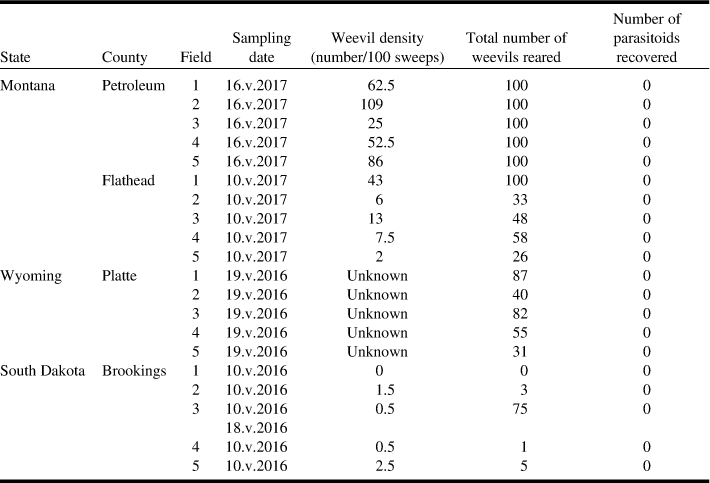
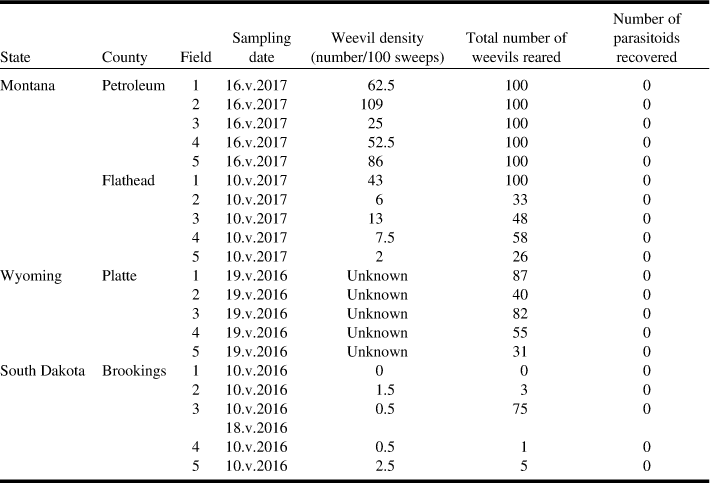
We collected overwintered adult weevils in the field in the early spring with sampling targeted at ~200 growing degree days (base 9 °C, with a start date of 1 March), following the approach of Flanders et al. (Reference Flanders, Radcliffe and Krueger1994). We sampled five alfalfa fields, ⩾5 km apart from one another in each of the four counties in which the parasitoid, M. aethiopoides, was previously recovered in Montana, Wyoming, and South Dakota (Bryan et al. Reference Bryan, Dysart and Burger1993). Most samples were collected in May of 2016, with the exception of Flathead County, Montana, which was sampled in May 2017. In each sampled field, we took four quantitative sweep samples consisting of 50, 180° arc sweeps with a 38-cm-diameter sweep net along a 50-m sampling transect. Each transect was initiated 25 m in from the field edge to avoid edge effects, and replicate transects ran perpendicular to the field edge and parallel to one another with 25 m spacing between them. Additional sweeps were done as necessary in an attempt to reach a sample size of 100 individuals per field (range: 200–15 000 total sweeps per field). In some cases densities were so low that this target was not achieved (see Table 1). In South Dakota, collecting adequate numbers from all fields was not logistically feasible due to extremely low densities. In this case, one field (field 3) was revisited and extensively sampled (~15 000 sweeps) to reach higher sample sizes necessary to confidently gauge parasitism levels.
Microctonus aethiopoides parasitoids recovered from adult alfalfa weevils collected across three states in the United States of America (Montana, Wyoming, South Dakota).
Each 50-sweep sample was inverted into a sealable 7.6-L plastic bag and placed into a field cooler until returned to the laboratory. Adult weevils were then removed, and placed in paper grocery bags (maximum of 50 per bag) lined with paper towels. In most cases weevil densities were low, and all adult weevils were removed from sweeps. Where densities were higher, we removed the first 25 individuals encountered from each successive sweep sample until a sample size of 100 adult weevils was reached. Rearing bags were kept at room temperature (20–22 °C), adding fresh alfalfa foliage two to three times per week, for 4–6 weeks. The weevils were then removed from bags, and foliage, paper towels, and the inside of rearing bags were scanned carefully for parasitoids (cocoons, larvae, or adults). Any dead weevils were also scanned for characteristic exit holes made by parasitoid larvae upon leaving their host.
No parasitoids were recovered from any of the locations sampled in our study, suggesting a widespread failure of M. aethiopoides to persist in the region, following initial establishment (Bryan et al. Reference Bryan, Dysart and Burger1993). This contrasts with a similar survey by Flanders et al. (Reference Flanders, Radcliffe and Krueger1994) in which M. aethiopoides was recovered from 90% of sampled fields in Minnesota when weevil densities were high (exceeding 10 weevils per 100 sweeps). Microctonus aethiopoides was recovered from over half (58%) of sampled fields even when weevil densities were lower (3.1–10.0 weevils per 100 sweeps). Parasitism levels in that study averaged 14–16%. It should be noted, however, that the timing of the Minnesota survey, which was carried out in 1984–1985, corresponds with the timing of the surveys of initial recoveries from our study regions that were done from 1980–1989 (Bryan et al. Reference Bryan, Dysart and Burger1993). Thus whether M. aethiopoides persists in Minnesota remains an open question.
Failure to recover parasitoids at very low weevil densities and/or low parasitism rates could result from insufficient sampling intensity. In our survey, weevil densities were highest in Montana, with all sites in Petroleum County exceeding 10 weevils/100 sweeps and two of five fields exceeding those densities in Flathead County (Table 1). Thus, failure to recover parasitoids in these areas, if they were present, seems highly unlikely. In contrast, weevil densities in Brookings County, South Dakota were extremely low (Table 1), all fields had fewer than three weevils per 100 sweeps, and we were only able to rear a total of 84 weevils. Thus, firm conclusions regarding the presence or absence of M. aethiopoides in South Dakota will require additional sampling. While data on weevil densities from Wyoming were not recorded, numbers were also likely relatively low, given that carrying out extra sweeps (i.e., above the 200 used in quantitative sampling) was not sufficient to reach our target rearing number of 100 weevils per site. Given a sample size of 25 weevils, parasitoid presence (emergence of at least one individual) would be detectable at parasitism levels of just 4%, below the levels typically observed for this species in early spring collected individuals (Flanders et al. Reference Flanders, Radcliffe and Krueger1994). Thus, sample sizes in Wyoming and Montana (30–100 per site; Table 1) should have been sufficient to detect the presence of parasitoids unless levels of parasitism were unusually low.
The failure to recover M. aethiopoides in the sampled counties was unexpected given initial post release recoveries there. However, biological control releases are essentially engineered invasions, and as often noted in the invasion and restoration literatures, initial establishment does not necessarily equate with longer-term persistence (Fauvergue et al. Reference Fauvergue, Vercken, Malausa and Hufbauer2012; Rinella et al. Reference Rinella, Mangold, Espeland, Sheley and Jacobs2012). Multiple factors can result in population extinctions following initial establishment, including demographic stochasticity or frequent disturbance that characterises agricultural systems (Fauvergue et al. Reference Fauvergue, Vercken, Malausa and Hufbauer2012). The absence of parasitoids across the wide geographic extent of our surveyed sites (spanning ~1400 km) suggests that broader scale, perhaps climactic, factors may have been important. More intensive surveys will be required to assess the extent of the current distributional limits of this species in the region. However, our initial survey suggests that, despite being one of the most abundant and effective agents in other regions (Radcliffe and Flanders Reference Radcliffe and Flanders1998), M. aethiopoides is not currently an important part of the parasitoid complex attacking alfalfa weevil in the northern Great Plains.
Acknowledgements
The authors would like to thank the many growers who generously allowed them to sample insects in their fields. Additional thanks are given to Kayleigh Hauri and Ellen Titus for their assitance rearing weevils in the laboratory.