INTRODUCTION
On a global scale there has been substantial progress in reducing malaria morbidity and mortality with both decreasing by 37 and 48%, respectively in the past decade (WHO, 2015). Overall countries in the Asia-Pacific region have reduced their malaria cases by 76% (Cotter et al. Reference Cotter, Sturrock, Hsiang, Liu, Phillips, Hwang, Gueye, Fullman, Gosling and Feachem2013). Thus, most countries in the Asia-Pacific region are now working towards elimination of malaria (Cotter et al. Reference Cotter, Sturrock, Hsiang, Liu, Phillips, Hwang, Gueye, Fullman, Gosling and Feachem2013). However, Plasmodium knowlesi, a simian malaria parasite has been found infecting humans in all countries in Southeast Asia with the exception of Lao PDR and Timor Leste (Jongwutiwes et al. Reference Jongwutiwes, Putaporntip, Iwasaki, Sata and Kanbara2004; Singh et al. Reference Singh, Sung, Matusop, Radhakrishnan, Shamsul, Cox-Singh, Thomas and Conway2004; Cox Singh et al. Reference Cox Singh, Davis, Lee, Shamsul, Matusop, Ratnam, Rahman, Conway and Singh2008; Luchavez et al. Reference Luchavez, Espino, Curameng, Espina, Bell, Chiodini, Nolder, Sutherland, Lee and Singh2008; Ng et al. Reference Ng, Ooi, Lee, Lee, Ng, Pei, Tu, Loh and Leo2008; Vythilingam et al. Reference Vythilingam, Noorazian, Huat, Jiram, Yusri, Azahari, Norparina, Noorrain and Lokmanhakim2008; Eede et al. Reference Eede, Van, Van Overmeir, Vythilingam, Duc, Hung, Manh, Anné, D'alessandro and Erhart2009; Figtree et al. Reference Figtree, Lee, Bain, Kennedy, Mackertich, Urban, Cheng and Hudson2010; Jiang et al. Reference Jiang, Chang, Sun, Lu, Yin, Zhang, Wahlgren and Chen2010; Khim et al. Reference Khim, Siv, Kim, Mueller, Fleischmann, Singh, Divis, Steenkeste, Duval and Bouchier2011; William et al. Reference William, Rahman, Jelip, Ibrahim, Menon, Grigg, Yeo, Anstey and Barber2013; Yusof et al. Reference Yusof, Lau, Mahmud, Fong, Jelip, Ngian, Mustakim, Hussin, Arzuki and Ali2014). In Malaysia, P. knowlesi forms 38% of the reported malaria cases (MOH, 2012).
The success of the malaria control programme has been due to active case detection, better diagnosis and treatment coupled with vector control measures such as indoor residual spraying and insecticide-treated bed nets (Yukich et al. Reference Yukich, Lengeler, Tediosi, Brown, Mulligan, Chavasse, Stevens, Justino, Conteh and Maharaj2008). Anopheles mosquitoes are responsible for the spread of malaria and the species responsible have been well documented (Sinka et al. Reference Sinka, Bangs, Manguin, Chareonviriyaphap, Patil, Temperley, Gething, Elyazar, Kabaria and Harbach2011). Knowlesi malaria, which is a zoonosis, is currently reported from countries where Leucosphyrus group of Anopheles mosquitoes are present along with the simian hosts the long-tailed and the pig-tailed macaques (Moyes et al. Reference Moyes, Henry, Golding, Huang, Singh, Baird, Newton, Huffman, Duda and Drakeley2014).
Incrimination of the vectors of simian malaria is the first step in understanding their role and subsequently choosing appropriate control measures required to target their specific behaviour. However, although cases of knowlesi malaria have been reported throughout Malaysia and Southeast Asia, studies on the vectors of P. knowlesi are limited (Vythilingam, Reference Vythilingam2012; Vythilingam and Hii, Reference Vythilingam, Hii and Manguin2013). Due to this paucity of data risk factors associated with P. knowlesi remain unknown.
VECTORIAL STATUS AND GEOGRAPHIC DISTRIBUTION OF LEUCOSPHYRUS GROUP OF ANOPHELES MOSQUITOES
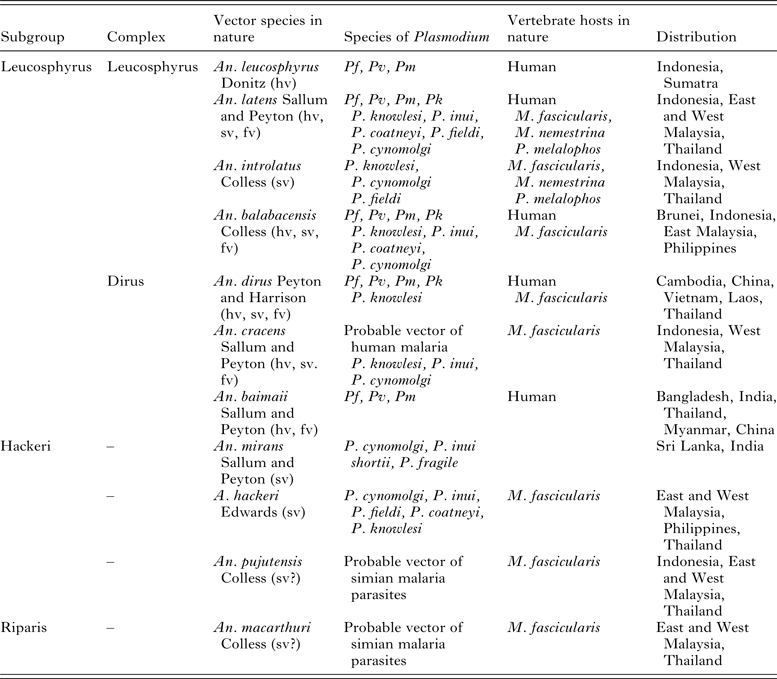
Only Anopheles mosquitoes belonging to the Leucosphyrus group have been reported as vectors of simian malaria (Vythilingam and Hii, Reference Vythilingam, Hii and Manguin2013). The Leucosphyrus group consists of three subgroups: Leucosphyrus, Hackeri and Riparis. According to (Sallum et al. Reference Sallum, Peyton, Harrison and Wilkerson2005; Manguin et al. Reference Manguin, Garros, Dusfour, Harbach and Coosemans2008), the Leucosphyrus subgroup consists of the Dirus and Leucosphyrus complexes, which includes eight and five sibling species, respectively. Species belonging to the Leucosphyrus complex are also important vectors of human malaria and lymphatic filariasis (Manguin et al. Reference Manguin, Bangs, Pothikasikorn and Chareonviriyaphap2010) and are distributed in the South and Southeast Asia regions. The current vectorial status and geographical distribution of the Leucosphyrus group are listed in Table 1 which has been modified and updated from (Sallum et al. Reference Sallum, Peyton, Harrison and Wilkerson2005; Vythilingam and Hii, Reference Vythilingam, Hii and Manguin2013).
Simian malaria parasites of Southeast Asia: their natural vectors of the Leucosphyrus group, hosts and geographical distribution (modified from Sallum et al. Reference Sallum, Peyton, Harrison and Wilkerson2005; Vythilingam and Hii, Reference Vythilingam, Hii and Manguin2013)

hv, sv and fv indicate human, simian and lymphatic filariasis vectors; sv? indicates vectorial status awaiting confirmation.
HISTORY OF NATURAL INFECTION IN MOSQUITOES
Simian malaria was detected in long tailed macaques in 1901 (Daniels, Reference Daniels1908), yet the vectors responsible for the transmission remained unknown until the 1960s. When the first case of P. knowlesi was reported in an American surveyor working in the jungles of Pahang by Chin et al. (Reference Chin, Contacos, Coatney and Kimball1965); American scientists along with their counterparts from the Institute for Medical Research, Malaysia carried out entomological surveys in Pahang and other areas of peninsular Malaysia. Unfortunately they could not identify the vectors.
Extensive studies were carried out in Selangor and only Anopheles hackeri was incriminated as the vector from the mangrove swamp areas of Rantau Panjang (Wharton and Eyles, Reference Wharton and Eyles1961). Besides, An. hackeri was also incriminated as the vector of all the other simian malaria parasites namely Plasmodium cynomolgi, Plasmodium coatneyi, Plasmodium fieldi and Plasmodium inui (Warren and Wharton, Reference Warren and Wharton1963). However, it was found that An. hackeri had a definite preference for monkey bait compared with human and preferred to feed at canopy compared with ground (Wharton et al. Reference Wharton, Eyles and Warren1963). In those days, the sporozoites were identified by inoculating them into the rhesus monkeys. In earlier studies also in the same area An. hackeri (eight out of 399) and Anopheles pujutensis (two out of 83) were found with sporozoites, but the species were not determined (Reid and Weitz, Reference Reid and Weitz1961). In Hulu Gombak (Selangor) Anopheles latens (known at that time as Anopheles leucosphyrus) was found positive for P. inui (Wharton et al. Reference Wharton, Eyles, Warren and Cheong1964), and An. introlatus was positive for P. cynomolgi and P. fieldi (Eyles et al. Reference Eyles, Cwarren, Guinn, Wharton and Ramachandran1963). Besides the Leucosphyrus group, Anopheles maculatus ss was positive for sporozoites but proved negative when inoculated into rhesus monkeys (Wharton et al. Reference Wharton, Eyles, Warren and Cheong1964). Anopheles maculatus is the predominant vector for Plasmodium falciparum and Plasmodium vivax in peninsular Malaysia (Reid, Reference Reid1968).
Studies conducted in Perlis, the Northern most state of peninsular Malaysia, incriminated Anopheles cracens (known at that time as Anopheles balabacensis) to be the vector of P. inui (Cheong et al. Reference Cheong, Warren, Omar and Mahadevan1965). Most of the studies at that time were carried out in Malaya (peninsular Malaysia) which was covered with tropical rain forest and in the 1960s two-thirds of the country was virgin forest (Warren et al. Reference Warren, Cheong, Fredericks and Coatney1970). The above studies have shown that it is possible for the mosquitoes to be infected with more than one species. Although sporozoite identification was a laborious task during those days, the work carried out was of great significance.
A similar study was also carried out in the monsoon forest region of Cambodia and it was found that Anopheles dirus sl (known at that time as An. balabacensis) was responsible for 50% of malaria prevalence in humans. It was interesting to note that An. dirus fed almost equally at ground level on humans and on monkeys in the forest canopy. Eyles and co-workers proved that An. dirus was responsible for human malaria but were not able to isolate simian malaria from infected mosquitoes (Eyles et al. Reference Eyles, Wharton, Cheong and Warren1964).
In studies conducted in the 1970s in Palawan Island in the Philippines, Tsukamoto and co-workers suspected An. balabacensis to be the vector of simian malaria. They found An. balabacensis was more attracted to a monkey-baited trap than traps baited with water buffalo or humans and individuals host seeking on macaques had oocyst and sporozoites (although malaria species unconfirmed) (Tsukamoto et al. Reference Tsukamoto, Miyata and Miyagi1978). Wild An. balabacensis (obtained from larvae in the field) fed on macaques were able to develop sporozoites; however, the species of simian malaria was not determined (Tsukamoto et al. Reference Tsukamoto, Miyata and Miyagi1978). It at least showed that An. balabacensis could develop the simian malaria parasites to the infective stage.
LABORATORY STUDIES ON MOSQUITO INFECTION
Most of the experimental studies on mosquito infection were carried out in the 1960s. Infection studies with P. cynomolgi showed that the following non Leucosphyrus group of mosquitoes were able to produce sporozoites and were successful in transmission: Anopheles kochi, Anopheles lesteri, Anopheles letifer, An. maculatus, Anopheles sinensis, Anopheles subpictus, Anopheles sundaicus and Anopheles vagus (Warren and Wharton, Reference Warren and Wharton1963). However, studies with An. dirus sl and An. maculatus sl showed that An. dirus was very susceptible to P. knowlesi, while only a few An. maculatus (three out of 57) were able to produce sporozoites (Collins et al. Reference Collins, Contacos and Guinn1967). Further studies conducted by the same author confirmed An. dirus to be a successful vector in the transmission of P. knowlesi (Collins et al. Reference Collins, Contacos, Skinner and Guinn1971).
Although laboratory studies have shown that some of the Anopheles species besides Leucosphyrus group can transmit simian malaria, thus far no natural infection has been recorded from published studies. For example although in one study An. kochi comprised ~30% of the mosquitoes found in monkey-baited traps, none were infected (Jiram et al. Reference Jiram, Vythilingam, Noorazian, Yusof, Azahari and Fong2012). Now that human cases of P. knowlesi malaria are on the increase it is timely for more studies to be carried out to identify the vectors involved in transmitting this parasite from its simian host to the humans.
IMPACT OF FOREST AND FARMS ON VECTORS OF KNOWLESI MALARIA TO-DATE IN MALAYSIA
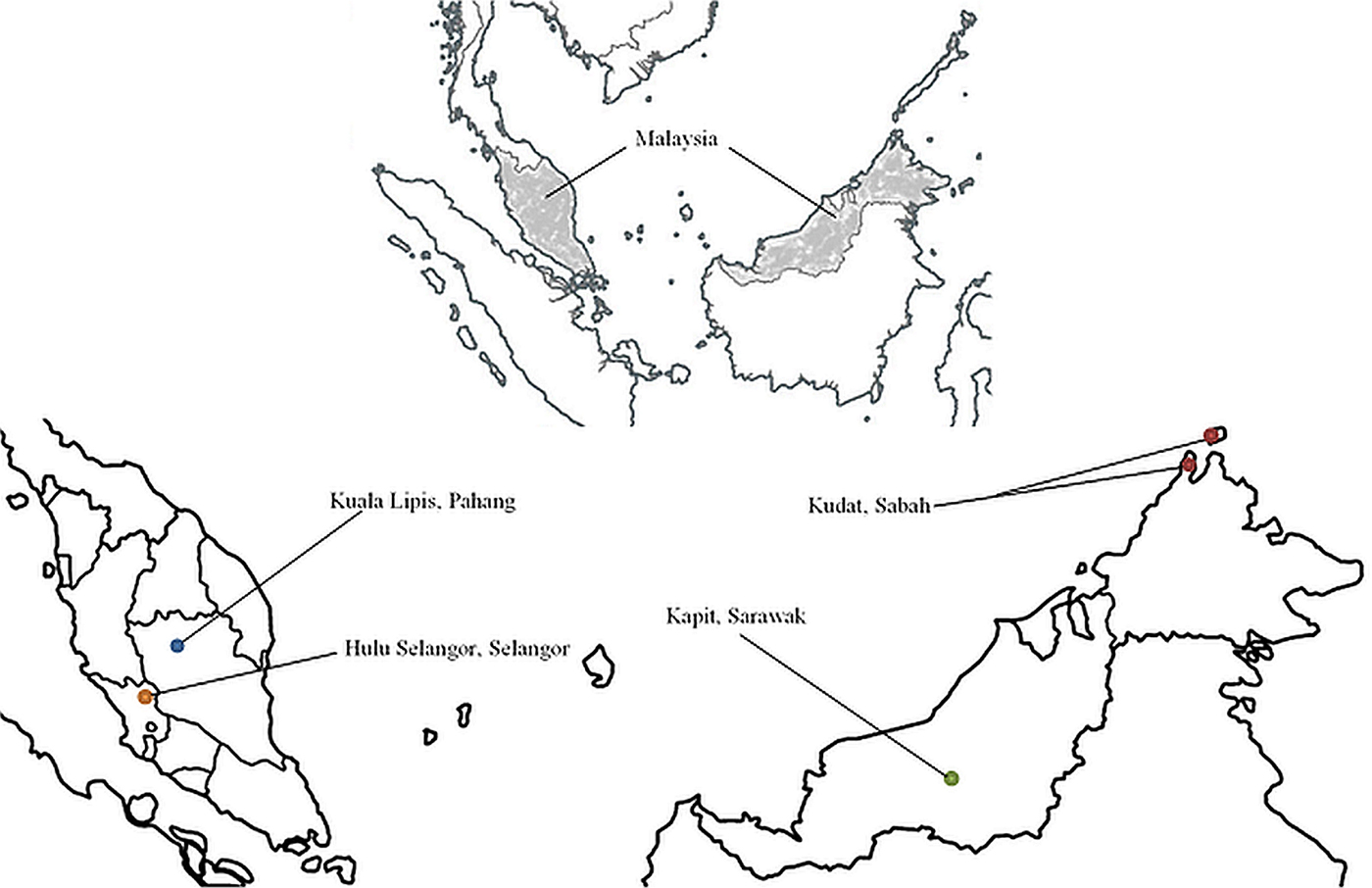
Since the report of a large focus of P. knowlesi cases in Kapit, Sarawak, in 2004 (Singh et al. Reference Singh, Sung, Matusop, Radhakrishnan, Shamsul, Cox-Singh, Thomas and Conway2004), studies have been conducted in various parts of Malaysia (Fig. 1) especially in forest, farms and villages where people were suspected to have been infected. Only Anopheles mosquitoes belonging to the Leucosphyrus group have been incriminated as vectors: An. latens (Vythilingam et al. Reference Vythilingam, Tan, Asmad, Chan, Lee and Singh2006) in Kapit; An. cracens (Vythilingam et al. Reference Vythilingam, Noorazian, Huat, Jiram, Yusri, Azahari, Norparina, Noorrain and Lokmanhakim2008) in Kuala Lipis, An. introlatus (Vythilingam et al. Reference Vythilingam, Lim, Venugopalan, Ngui, Leong, Wong, Khaw, Goh, Yap and Sulaiman2014) in Hulu Selangor and An. balabacensis (Wong et al. Reference Wong, Chua, Leong, Khaw, Fornace, Wan-Sulaiman, William, Drakeley, Ferguson and Vythilingam2015) in Kudat and Banggi Island. Of these An. latens and An. balabacensis are also vectors of human malaria (Pf and Pv) in Sarawak and Sabah, respectively (Hii et al. Reference Hii, Kan, Pereria, Parmar, Campos and Chan1988; Chang et al. Reference Chang, Doraisingam, Hardin and Nagum1995). In peninsular Malaysia An. maculatus was the predominant mosquito species in malarious areas in Pahang and Leucosphyrus group of mosquitoes were seldom obtained during collections in those areas (Vythilingam et al. Reference Vythilingam, Foo, Chiang, Chan, Eng, Mahadevan, Mak and Singh1995). However, with occurrence of knowlesi malaria in humans, An. cracens has become the predominant species obtained in Pahang (Jiram et al. Reference Jiram, Vythilingam, Noorazian, Yusof, Azahari and Fong2012). These mosquitoes were considered as forest mosquitoes and were rarely found in villages in the 1960s. Studies carried out in Sarawak and Sabah in the 1990s after environmental changes (forest converted to plantation) it was found that Anopheles donaldi was the predominant species which replaced An. latens and An. balabacensis, respectively (Chang et al. Reference Chang, Doraisingam, Hardin and Nagum1995; Vythilingam et al. Reference Vythilingam, Chan, Shanmugratnam, Tanrang and Chooi2005). However, deforestation and land use change have been associated with malaria vectors and incidence of malaria globally (Guerra et al. Reference Guerra, Snow and Hay2006). A recent study in Sabah showed that historical forest loss was more significantly associated with P. knowlesi incidence than forest loss occurring during the same year of reported incidence, suggesting that increased transmission is related to long-term changes in vector, host or human populations involved (Fornace et al. Reference Fornace, Abidin, Alexander, Brock, Grigg, William, Menon, Drakeley and Cox2016).
Map showing study sites of knowlesi malaria vectors in Malaysia.

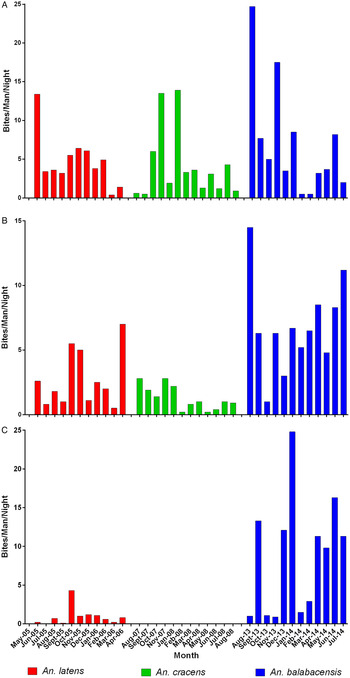
In Malaysia deforestation has caused the movement of the long-tailed macaques from forested areas to farms and semi-urban areas. The mosquitoes may have followed their host and adapted to forest edge and farms. Figure 2 below shows consolidated data that has been published and it is obvious that most of these vector species are now predominant in farms followed by forest and village. However, An. balabacensis was still predominant in villages in the studied areas (Wong et al. Reference Wong, Chua, Leong, Khaw, Fornace, Wan-Sulaiman, William, Drakeley, Ferguson and Vythilingam2015).
Man biting rate of Anopheles latens (Kapit), Anopheles cracens (Kuala Lipis) and Anopheles balabacensis (Kudat and Banggi Island) collected from different study sites (A) farm, (B) forest and (C) village. The first author was involved in all the studies and the methods used were the same.

Biting habits of vectors
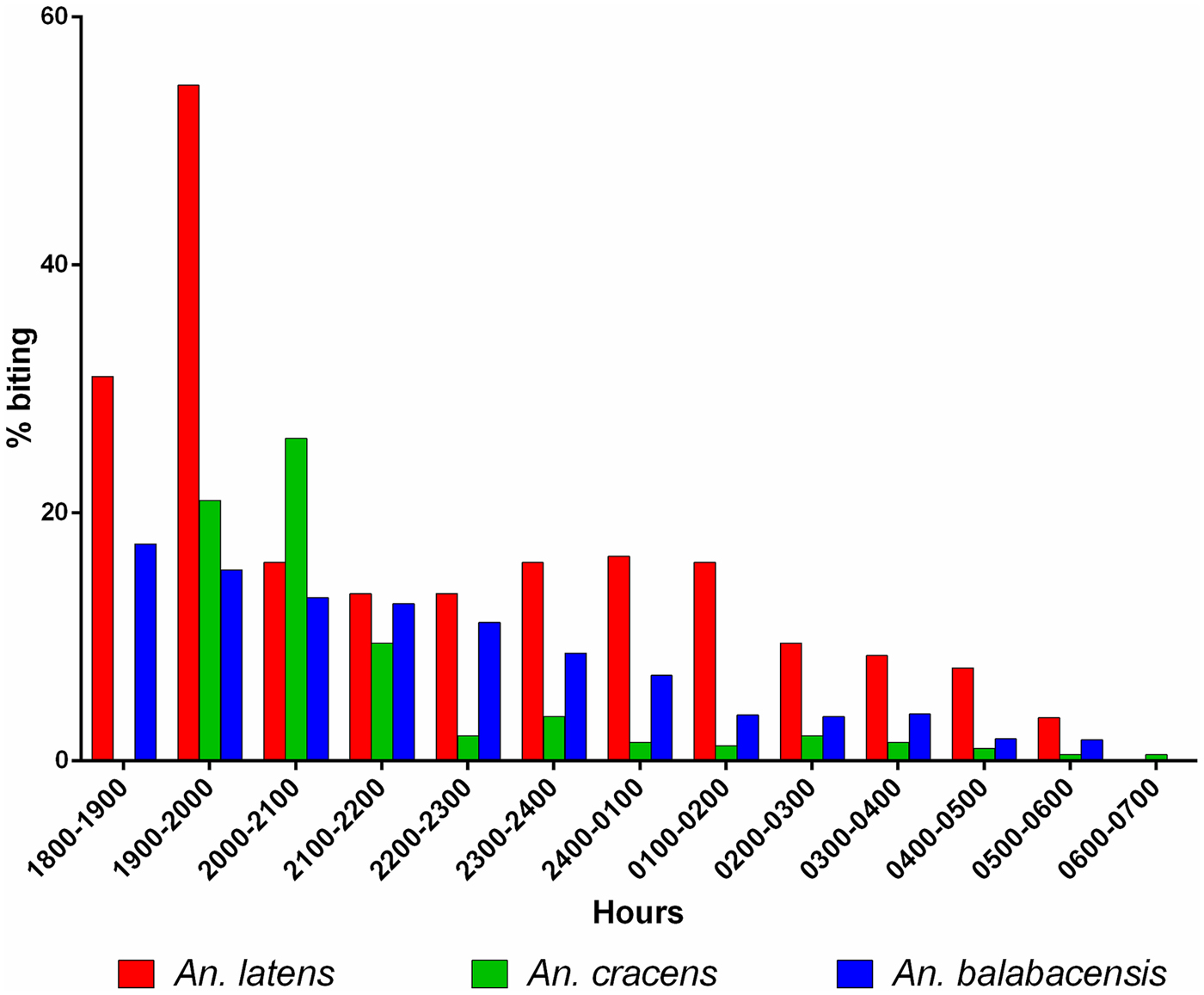
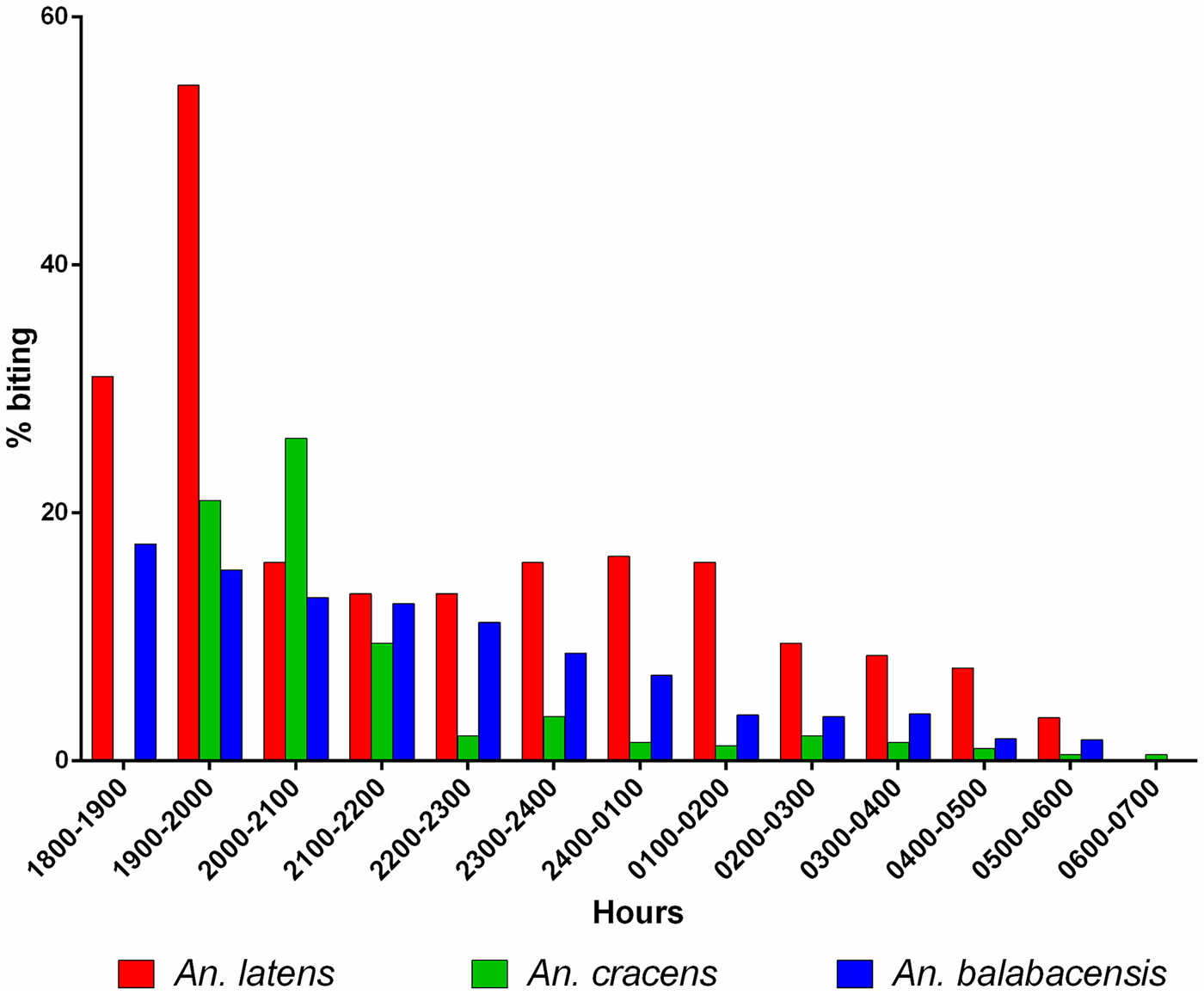
Current studies have shown that the biting times of the vectors have changed. As seen in Fig. 3 all species were biting in the early part of the night (in Sabah and Sarawak it gets dark early around 6 pm compared with peninsular Malaysia where it gets dark around 7 pm) where most people would be either outside their houses or returning home after working in the farms. The fact that there have been no reports of epidemics of P. knowlesi in any area coupled with low or zero sporozoite rates in mosquitoes from the villages suggest that people were getting infected in forest or farming areas.
Biting cycles of Anopheles latens, Anopheles cracens and Anopheles balabacensis in study sites. Anopheles latens collected from Kapit, Sarawak; Anopheles cracens collected from Kuala Lipis, Pahang; and Anopheles balabacensis collected from Kudat, Sabah. The first author was involved in all the studies and the methods of collection were the same.
Biological characteristics of vectors
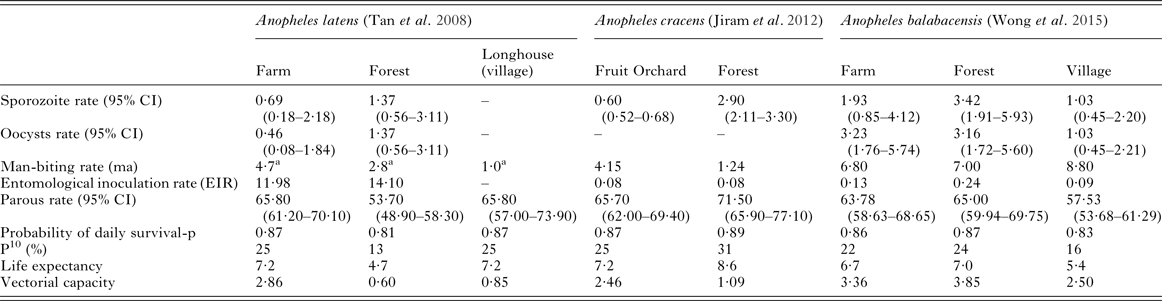
Table 2 shows the biological characteristics of the vectors from published studies. The sporozoite rate for all vectors has been highest in the forest areas. However, human biting rate for An. latens and An. cracens has been highest in farms while for An. balabacensis it appears to bite humans most often in the villages. The parous rate of all the vectors was more than 50% in all sites and thus the daily survival rate was more than 0·8. On the whole more than 20% of the vectors were able to live the 10 days necessary for P. knowlesi to develop into transmission stage sporozoite, with the exception of An. latens in the forest (13%) and An. balabacensis in the village (16%). Those surviving the 10 days had a further life expectancy ranging from 4·7 to 8·6 days. The vectorial capacity was highest in An. balabacensis (3·85) from the forest area.
Biological characteristic of the known vectors of knowlesi malaria

a Man-biting rate was calculated based on Tan et al. (Reference Tan, Vythilingam, Matusop, Chan and Singh2008).
P10 Percentage of population expected to live long enough to become infective with an extrinsic cycle of 10 days based on P. knowlesi extrinsic incubation period.
From the above published results, the relatively high survival and sporozoite rates in these vectors coupled with the potentially increased contact of human–vector–macaques have likely made major contributions to the increase in P. knowlesi cases in these areas. It is obvious that current vector control measures have little impact on these vectors.
Anopheles dirus and P. knowlesi transmission in Vietnam
Besides Malaysia, Vietnam has also made efforts to identify the vectors of P. knowlesi. Anopheles dirus has been incriminated as the vector of P. knowlesi (Nakazawa et al. Reference Nakazawa, Marchand, Quang, Culleton, Manh and Maeno2009), and it is also the vector of human malaria in countries in the Mekong region (Trung et al. Reference Trung, Van Bortel, Sochantha, Keokenchanh, Quang, Cong and Coosemans2004). However, only in Vietnam both human malarias (Pf and Pv) and P. knowlesi were present in An. dirus (Marchand et al. Reference Marchand, Culleton, Maeno, Quang and Nakazawa2011). The average annual entomological inoculation rate of An. dirus was 25·4 (all species) infective bites per person per year (Marchand et al. Reference Marchand, Culleton, Maeno, Quang and Nakazawa2011). Of the 86 sporozoite-positive mosquitoes, 73 underwent PCR analysis for malaria parasite detection, of which 72 were successfully assayed. Thirty-one (43%) of these 72 salivary glands were PCR positive for P. knowlesi csp and for P. knowlesi 18S rRNA.
CHALLENGES ASSOCIATED WITH VECTOR STUDIES
The way forward
One of the greatest challenges associated with vector studies is the method of collecting these vector mosquitoes. Unfortunately in Malaysia, the human landing catch method remains the best method for collecting these mosquitoes. Recent studies have shown that light trap is not as efficient as human landing catch method (Rohani et al. Reference Rohani, Azahary, Zurainee, Najdah, Zamree, Hanif, Ariffin, Zuhaizam, Suzilah and Lee2015). Both human landing catches and monkey-baited traps come with associated ethical problems yet for these particular vector species light traps do not provide a good alternative method. Indeed, for a successful knowlesi vector study, monkey traps ideally should be placed at different canopy heights. Work is therefore urgently needed to find sampling methods that can match the efficacy of both monkey traps and human bait.
It is still not clear if there are certain species of the vector mosquitoes biting only the monkeys. Studies in the 1960s did prove that An. hackeri was only attracted to monkeys (Wharton et al. Reference Wharton, Eyles, Warren and Cheong1964). However, in a longitudinal study carried out in Kuala Lipis the infection rate in An. cracens was very low but the infection in long-tailed macaques was very high (Vythilingam et al. Reference Vythilingam, Noorazian, Huat, Jiram, Yusri, Azahari, Norparina, Noorrain and Lokmanhakim2008; Jiram et al. Reference Jiram, Vythilingam, Noorazian, Yusof, Azahari and Fong2012). A previous laboratory study has shown one infective mosquito bite can infect human (Chin et al. Reference Chin, Contacos, Collins, Jeter and Alpert1968) and similarly a recent study showed it was sufficient to infect a monkey as well (Murphy et al. Reference Murphy, Weiss, Fryauff, Dowler, Savransky, Stoyanov, Muratova, Lambert, Orr-Gonzalez and Zeleski2014). Perhaps there are other species biting macaques deeper in the forest. Thus, extensive studies need to be carried out at various distances into the forest and at various heights using monkey-baited traps. This would provide a better understanding of the behaviour of the vectors which in turn can be used for better control strategies to manage the vectors. Data on habitat preferences, movement patterns and social dynamics of macaques are important factors in P. knowlesi transmission (Brock et al. Reference Brock, Fornace, Parmiter, Cox, Drakeley, Ferguson and Kao2015).
It is also not known if vector mosquitoes can pick up the knowlesi parasites from humans and transmit to other humans or long-tailed macaques. Experimental studies should be conducted by feeding infected human blood through membrane feeders to mosquitoes. By this method at least it can be established if the mosquitoes will be able to develop the sporozoites. If sporozoites can develop within those infected mosquitoes, human-to-human transmission can occur. This will be a step closer to prove that human-to-human transmission can take place.
The utilization of modern analytical tools such as GIS is crucial in estimating hotspot areas for targeted control strategies. With the elimination of human malaria, cases of knowlesi malaria are on the increase as shown in Malaysia (Vythilingam et al. Reference Vythilingam, Lim, Venugopalan, Ngui, Leong, Wong, Khaw, Goh, Yap and Sulaiman2014; William et al. Reference William, Jelip, Menon, Anderios, Mohammad, Mohammad, Grigg, Yeo, Anstey and Barber2014; Yusof et al. Reference Yusof, Lau, Mahmud, Fong, Jelip, Ngian, Mustakim, Hussin, Arzuki and Ali2014; Rajahram et al. Reference Rajahram, Barber, William, Grigg, Menon, Yeo and Anstey2016). Thus, there is a greater need for multidisciplinary research to combat simian malaria affecting humans. Besides, it is also important to use molecular-based species identification methods and to have a more precise geographical distribution maps coupled with descriptions of behaviour and ecology of specific species of vectors as carried out in Thailand for human malaria vectors (Tainchum et al. Reference Tainchum, Kongmee, Manguin, Bangs and Chareonviriyaphap2015).
Concluding remarks
Currently it has been shown that the Leucosphyrus group mosquitoes are able to transmit P. knowlesi. However, data on the distribution of the vectors throughout peninsular Malaysia remain scarce. In many areas, the prevalence of the parasites in the macaques are high (Ho et al. Reference Ho, Lee, Abie, Zainuddin, Japnin, Topani, Sumita and Sharma2010; Akter et al. Reference Akter, Vythilingam, Khaw, Qvist, Lim, Sitam, Venugopalan and Sekaran2015), but the vectors remain unknown. Vector species may vary across the regions.
The limited studies that have been carried out seem to demonstrate that knowlesi malaria is a problem in the forest and farming areas. People seem to get infected while working in the forest or farms since infected mosquitoes have been obtained in these areas. The problem of P. knowlesi malaria is compounded by the hidden reservoirs of malaria parasites in the macaques which have not been fully addressed. This is further complicated by the unknown vectors and the changing environment.
It is also known that the above-mentioned vectors can also harbour the other simian malaria parasites; thus they could be the conduit for other zoonotic malaria spillovers to humans. As most countries in Southeast Asia are moving towards malaria elimination, it is timely to map the vector distribution, determine the home range of the macaques and carry out sero-epidemiological studies so as to prevent emergence of this epidemic zoonosis.
ACKNOWLEDGEMENTS
The authors thank the staff of Department of Parasitology, University of Malaya for their support and Chris Drakeley from the Monkey Bar team.
FINANCIAL SUPPORT
The authors acknowledge the University of Malaya for student Grant IPP 105-2014A to M. L. W., and the Medical Research Council, Natural Environment Research Council, Economic and Social Research Council and Biotechnology and Biosciences Research Council for the funding received for this project through the Environmental and Social Ecology of Human Infectious Diseases Initiative (ESEI), MRC Grant Number: G1100796 to I. V.