Introduction
Parasites are ubiquitous components of animal communities and have been shown to regulate the populations of their hosts by affecting their fitness, survival and behaviour (Park, Reference Park1948; Bedhomme et al., Reference Bedhomme, Agnew, Vital, Sidobre and Michalakis2005). Free-living species, particularly closely related species, within a community may share the same parasite taxa. However, host susceptibility and tolerance to parasites may vary within and among species (Park, Reference Park1948; Freeland, Reference Freeland1983). Infection levels are influenced by factors such as host sex, age, size, genetics, and social and nutritional status, but also by abiotic factors, such as environmental temperature and salinity (Côté & Poulin, Reference Côté and Poulin1995; Zuk & McKean, Reference Zuk and McKean1996; Morand & Poulin, Reference Morand and Poulin1998; Pietrock & Marcogliese, Reference Pietrock and Marcogliese2003).
As hosts are constantly encountering parasites, multiple defence mechanisms have evolved to avoid and/or eliminate infections (Hafner et al., Reference Hafner, Sudman, Villablanca, Spradling, Demastes and Nadler1994; Danilova, Reference Danilova2006; Schmid-Hempel, Reference Schmid-Hempel2009). Although the immune system may represent one of the most powerful defence mechanisms, the list of behavioural adaptations is extensive (Hart, Reference Hart1990; Stevenson et al., Reference Stevenson, Case and Oaten2011). Changes in behaviour by a host can reduce the probability of exposure to parasites, and hosts can shift habitats (Poulin & FitzGerald, Reference Poulin and FitzGerald1989) or change their activity patterns (Orr, Reference Orr1992), amongst other adaptations (Parker et al., Reference Parker, Barribeau, Laughton, de Roode and Gerardo2011). As behavioural defences can often be hard to verify experimentally, evidence of these changes has often been based on observational studies (e.g. Hart, Reference Hart1992).
Defence mechanisms have developed as a result of a long co-evolutionary arms race between host species and their parasites (Ladle, Reference Ladle1992). However, it is suggested that each type of defence mechanism often does not operate alone but as part of an intricate defence strategy (Zuk & Stoehr, Reference Zuk and Stoehr2002), of which the full complexity is yet poorly understood for many organisms. To understand these interspecific interactions better, we need to disentangle and study these individual defence mechanisms in detail. For this, digenean trematodes offer an ideal model system to study specific host–parasite interactions because of their ubiquitous presence and the wide range of host species with which they have co-evolved (Cribb et al., Reference Cribb, Bray and Littlewood2001).
The trematode life cycle is highly complex and typically includes several different intermediate and definitive hosts. During a trematode's life cycle, infective free-living stages (miracidia and cercariae) are released into the environment, where they need to find and infect a suitable host to ensure the continuation of the life cycle. The life cycle of the microphallid trematode Maritrema poulini includes three hosts: waterfowl (definitive host), the New Zealand mud snail, Potamopyrgus antipodarum (first intermediate host), and crustaceans, isopods (Austridotea annectens or Austridotea lacustris) or amphipods (Paracorophium excavatum or Paracalliope fluviatilis) (second intermediate host; Presswell et al., Reference Presswell, Blasco-Costa and Kostadinova2014).
In New Zealand freshwater ecosystems, the isopod species A. annectens and A. lacustris have been shown to differ drastically in the prevalence and abundance of M. poulini. Whereas a prevalence of 71–88% is reported for A. annectens, only 1.3% of A. lacustris have been found to be infected in recent surveys since 2015 (Presswell et al., Reference Presswell, Blasco-Costa and Kostadinova2014; Friesen et al., Reference Friesen, Poulin and Lagrue2017, Reference Friesen, Poulin and Lagrue2018). Although both host species have almost identical body sizes, food preferences, predators and macrohabitats, they are not found in the same microhabitats (Friesen et al., Reference Friesen, Poulin and Lagrue2018). However, as the first intermediate host, P. antipodarum, is distributed ubiquitously within the macrohabitat, exposure to M. poulini cercariae and infection risks should be similar for both host species. The low prevalence of M. poulini in A. lacustris raises the question of the mechanism(s) behind this discrepancy. It is possible that the cercariae have trouble infecting A. lacustris. Better defences, either behavioural (e.g. evasive defensive movements) or physiological (e.g. impenetrable cuticle or immune function), may explain the low prevalence in A. lacustris. To disentangle the roles of behaviour and physiology in parasite resistance, we performed experimental infections of A. lacustris with M. poulini, using either paralysed or non-paralysed A. lacustris individuals. If a behavioural defence mechanism is exclusively responsible for preventing M. poulini infections in A. lacustris, individuals treated with a paralysing agent, carbonated water, which acts on the principle of asphyxia and causes the temporal narcotization of individuals, should become infected more easily as their defences are knocked out. However, if there is no difference between groups, it may suggest that another factor, such as an innate immune response, may account for low infection success.
Materials and methods
Field sampling and trematode identification
We collected samples of Austridotea lacustris by hand from stones along the shores of Lake Waihola (46°01′14′′S, 170°05′05′′E) and Tomahawk Lagoon (45°54′S, 170°33′E), South Island, New Zealand during April–May 2017. Previous studies have indicated that infections in A. lacustris are extremely unlikely in these lakes (Presswell et al., Reference Presswell, Blasco-Costa and Kostadinova2014; Friesen et al., Reference Friesen, Poulin and Lagrue2018). The mud snail, P. antipodarum, was also collected from macrophytes, sediment and stones along the shoreline of Lake Waihola using a dip net. Additionally, we had successfully infected both A. annectens and P. fluviatilis in previous experiments (Lagrue & Poulin, Reference Lagrue and Poulin2007, unpublished data). Further, the final bird host of M. poulini is able to migrate easily between sample locations. As such, we are confident M. poulini from Lake Waihola can infect animals from Tomahawk Lagoon.
Animals were kept alive and brought back to the laboratory in 2 l plastic containers filled with lake water. Isopods were transferred to and maintained in 10 l tanks containing aerated lake water. Animals were kept at room temperature (16 ± 1°C) and provided with aquatic plants (Myriophyllum triphyllum and Elodea canadensis) for food, and under a controlled photoperiod (12 hours dark and light) before and after experimental infections.
Snails were separated into wells of 12-well tissue culture plates, with five individuals and approximately 2 ml of filtered lake water per well. To trigger the emergence of cercariae, snails were incubated for at least 3 h at 20°C with a light source. Cercariae were identified based on morphological features, using the keys of Hechinger (Reference Hechinger2012) and Presswell et al. (Reference Presswell, Blasco-Costa and Kostadinova2014). All snails shedding M. poulini cercariae were subsequently isolated and maintained in 250 ml plastic containers with aquatic plants (as mentioned above) until they were needed. Isopods were identified visually based on differences in the shape of the pleotelson (Chadderton et al., Reference Chadderton, Ryan and Winterbourn2003).
Experimental exposure of Austridotea lacustris
To shed some light on which mechanism may prevent M. poulini infections in A. lacustris, isopods were artificially exposed to cercariae. To assess whether a behavioural defence mechanism, an internal defence mechanism, or a combination of both is responsible for preventing M. poulini infections in A. lacustris, two groups of isopods were paralysed temporarily by placing them in freshly opened carbonated water (Pams Value Soda Water, 1.5 l, made from spring water) for 10 minutes, which was sufficient time for isopods to stop moving. In parallel, another two groups of isopods were treated with filtered lake water. Within each treatment, one group of isopods was exposed to M. poulini cercariae and the other two groups were controls (no exposure to M. poulini cercariae).
We used a total of 100 isopods, 24 collected from Lake Waihola and 76 from Tomahawk Lagoon. Isopods were distributed equally among the four treatment groups. Immediately prior to experimental infections of the isopods, snails were isolated into individual wells of a 12-well plate containing 2 ml of filtered lake water for at least 3 h at 20°C, with a light source to induce cercarial shedding. We subsequently transferred each of 20 freshly shed cercariae into a well of another 24-well plate, with 2 ml of filtered lake water in each well. Isopods were separated into individual wells of a 12-well plate containing 2 ml of either carbonated water or filtered lake water. Once body movement of isopods stopped completely in the carbonated water, all individuals were transferred to the previously prepared 24-well plates filled with lake water (one isopod per well), and half of all wells contained cercariae. Each group of isopods consisted of 25 individuals. Isopods were exposed for 3 h at room temperature under a light source. Temporary paralysis lasted the duration of exposure. Once exposure experiments were completed, each well was re-checked to determine the number of remaining M. poulini cercariae. After exposure, isopods were transferred into 2 l plastic containers (separated based on their treatment type) with sand and stones, and kept at 16 ± 1°C for a week to allow the development and identification of trematode metacercariae (Benjamin & James, Reference Benjamin and James1987; Presswell et al., Reference Presswell, Blasco-Costa and Kostadinova2014).
Dissection of isopods
A week after exposure, isopods were killed in 70% ethanol and rinsed with distilled water. Before dissection, animals were sexed and measured (total body length). For each isopod, the number of M. poulini metacercariae was recorded to estimate parasite prevalence and abundance. We also examined each individual for other macroparasite infections, to control for the possibility of other infections confounding our results. In this study, prevalence refers to the percentage of infected animals and abundance refers to the number of metacercariae found within a single individual (Bush et al., Reference Bush, Lafferty, Lotz and Shostak1997).
Results and discussion
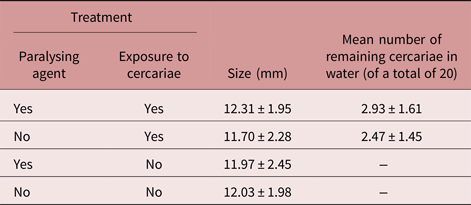
Evaluation of the experimental infections revealed that 96 of a total of 100 isopods survived the experiments; of the four dead isopods, three were exposed to carbonated water and one was not. Overall mortality rates did not differ among treatments, which suggests that our treatment with carbonated water is harmless to A. lacustris. In addition, there were no differences in the number of remaining cercariae (table 1). We did not observe any M. poulini infections in A. lacustris following experimental exposure to cercariae (table 1). No pre-infections with M. poulini (acquired naturally in the field) or other macroparasites were found.
Details of experimental exposures of Austridotea lacustris to Maritrema poulini. Samples were collected from Lake Waihola and Tomahawk Lagoon, South Island, New Zealand during April–May 2017; 25 isopods were used in each exposure and the % infection success in each was zero. Mean values are ± SD.

Our investigation of possible defence mechanisms against trematode infection in A. lacustris suggests that behavioural mechanisms are unlikely to be responsible for the very low prevalence of M. poulini in A. lacustris in natural populations (Presswell et al., Reference Presswell, Blasco-Costa and Kostadinova2014); no infection was recorded in anaesthetized and immobile individuals. The low numbers of cercariae remaining in wells after the experiments suggest that M. poulini penetrates A. lacustris but does not successfully form metacercarial stages. Although we did not check isopods for signs of penetration for confirmation, the low numbers of remaining cercariae in both paralysed and unparalysed treatments support this explanation. Direct consumption of free-living parasite stages, such as cercariae, by predators is a possibility in many systems and has been shown to play a significant role in shaping parasite transmission success (e.g. Welsh et al., Reference Welsh, Liddell, Van der Meer and Thieltges2017). However, we were able to exclude the possibility of predation on cercariae within the paralysed group, as they were incapable of movement. As we did not observe any difference in the number of remaining cercariae in the well plates between paralysed and unparalysed groups, we conclude that predation is not the cause of the lack of infections in A. lacustris. Our results therefore suggest that a non-behavioural defence mechanism, such as an immunological response, may be reducing the chances of successful infection by the parasite.
Taken together, the inability of cercariae to develop successfully in A. lacustris in laboratory experiments and the very rare occurrence of M. poulini infections in natural populations suggest that A. lacustris is a poor intermediate host for the trematode. As M. poulini cercariae may not be able to differentiate between A. lacustris and A. annectens, attempting to infect the unsuitable isopod species would lead to the death of the cercariae. Such processes are well known from other trematodes, such as avian schistosomes that die upon penetration of an unsuitable mammalian host (Soldánová et al., Reference Soldánová, Selbach, Kalbe, Kostadinova and Sures2013; Horák et al., Reference Horák, Mikeš, Lichtenbergová, Skála, Soldánová and Brant2015). At the ecosystem level, this could lead to a reduction in the number of infective stages in the habitat, and to a parasite ‘dilution effect’, in which increased species diversity, including non- or low-competency hosts, leads to reduced risk of disease (Keesing et al., Reference Keesing, Holt and Ostfeld2006). Dilution effects have been observed and described for diverse ecological communities that can mediate infection levels (Morand & Guégan, Reference Morand and Guégan2008; Johnson & Thieltges, Reference Johnson and Thieltges2010), as well as in the context of biological invasions, in which introduced species can lead to reduced parasite transmission in a system (reviewed in Poulin et al., Reference Poulin, Paterson, Townsend, Tompkins and Kelly2011; Goedknegt et al., Reference Goedknegt, Feis, Wegner, Luttikhuizen, Buschbaum, Camphuysen, van der Meer and Thieltges2016; Lagrue, Reference Lagrue2017). In our case the dilution effect would be a result of an endemic species being a low-competency or dead-end host, and could therefore play an important role in the transmission dynamics of trematodes in the ecosystem. Although prevalence of M. poulini in the sympatric species A. annectens reaches 71–88% (Friesen et al., Reference Friesen, Poulin and Lagrue2017), a potential dilution effect by A. lacustris could slow down the incidence rate by some degree.
This is currently only hypothetical, but mesocosm experiments with both isopod species and infected snails could shed some light on such potential interactions and whether they may be playing a role in shaping the host–parasite community structure. Furthermore, recent molecular studies have revealed high intraspecific genetic diversity within A. lacustris and A. annectens, indicating these may be cryptic species complexes (McGaughran et al., Reference McGaughran, Hogg, Stevens, Chadderton and Winterbourn2006). Further investigations of different host populations across New Zealand could examine possible differences in host–parasite dynamics amongst closely related species. Based on the findings of the present study and previously published data, further research should be conducted to elucidate the mechanisms responsible for preventing M. poulini infections in A. lacustris, any mechanisms present in the congeneric A. annectens, and their potential consequences at the ecosystem level.
Acknowledgements
We thank R. Poulin for support and guidance throughout the experiment. Field and laboratory assistance was provided by B. Presswell. Special thanks to R. Poulin and C. Lagrue for comments and advice on earlier drafts of this manuscript. We thank the two anonymous reviewers for their constructive feedback.
Financial support
This work was supported by the Promos scholarship from the German Exchange Program DAAD (SG); the University of Otago Doctoral Scholarship (OCF); the Department of Zoology, University of Otago (OCF); and a postdoctoral fellowship from the German Research Foundation DFG (CS, Grant number SE 2728/1-1).
Conflict of interest
None.
Ethical standards
The authors assert that all procedures contributing to this work comply with the ethical standards of the relevant national and institutional guidelines on the care and use of laboratory animals.