Introduction
Cephalopods and especially pelagic squids are important links in many food chains, acting as both predators and prey within ecosystems (Boyle & Rodhouse, Reference Boyle and Rodhouse2005). Within the Southern Ocean, squid are particularly important in linking lower trophic levels with top predators (Abreu et al., Reference Abreu, Phillips, Ceia, Ireland, Paiva and Xavier2020). However, a recent review has found that cephalopods are generally inadequately incorporated into ecosystem models (de la Chesnais et al., Reference de la Chesnais, Tracey and Pecl2019). Data needed for incorporating squids into ecosystem models, including trophic position, biomass, production and energy flow, continue to be scarce (Coll et al., Reference Coll, Navarro, Olson and Christensen2013). This reveals that there is much yet to understand in terms of the role of cephalopods in marine ecosystems. Hoving et al. (Reference Hoving, Perez, Bolstad, Braid, Evans, Fuchs, Judkins, Kelly, Marian, Nakajima, Piatkowski, Reid, Vecchione and Xavier2014) has recently reviewed the advances that have been made specifically in deep-sea cephalopod biology, particularly in the 21st century, but again has highlighted the many ‘holes’ still in understanding the biology of deep-sea cephalopods. Potential solutions to filling these data holes will involve interdisciplinary collaboration to understand important aspects of reproduction and the life cycle, ecology, and spatial and temporal trophic roles of deep-sea cephalopods (Hoving et al., Reference Hoving, Perez, Bolstad, Braid, Evans, Fuchs, Judkins, Kelly, Marian, Nakajima, Piatkowski, Reid, Vecchione and Xavier2014).
Many studies of deepwater squid have had to rely on information indirectly from predator studies (e.g. Cherel & Duhamel, Reference Cherel and Duhamel2004; Cherel et al., Reference Cherel, Ridoux, Spitz and Richard2009; Xavier et al., Reference Xavier, Allcock, Cherel, Lipinski, Pierce, Rodhouse, Rosa, Shea, Strugnell, Vidal, Villanueva and Ziegler2015) or direct undersea observations (Roper & Vecchione, Reference Roper and Vecchione1997; Kubodera et al., Reference Kubodera, Koyama and Mori2007). For many deepwater species (including those that are relatively abundant) it has been difficult or almost impossible to obtain substantial samples to undertake biological examinations.
Mastigoteuthids are some of the most abundant squid in the deep water below the photic zone (Hoving et al., Reference Hoving, Perez, Bolstad, Braid, Evans, Fuchs, Judkins, Kelly, Marian, Nakajima, Piatkowski, Reid, Vecchione and Xavier2014). It has been suggested that mastigoteuthids lack the ability for rapid jet propulsion, but have near-neutral buoyancy due to vesicles of ammonium ions in the tissues on the mantle head and ventral arms (Reid, Reference Reid2016). Despite their abundance, there has been considerable confusion in the taxonomy of this group. However, newer studies including the combination of morphological with genetic techniques are helping to resolve taxonomic issues (Braid & Bolstad, Reference Braid and Bolstad2014, Reference Braid and Bolstad2015; Braid et al., Reference Braid, McBride and Bolstad2014). Salcedo-Vargas & Okutani (Reference Salcedo-Vargas and Okutani1994) revised the group and established two genera, Mastigoteuthis and Idioteuthis. More recently Braid et al. (Reference Braid, McBride and Bolstad2014) conducted a detailed genetic analysis of the group and suggested five valid genera of which Idioteuthis is one. Subsequently a sixth genus has been added, Mastigotragus (Young et al., Reference Young, Vecchione and Braid2014). Although Idioteuthis shares some features with other mastigoteuthids, there are a number of features that are unique. This species is by far the largest of all mastigoteuthids with a mantle length at least five times greater than other mastigoteuthids, reaching a size of over 1 m in mantle length and 75 kg in weight (Braid & Bolstad, Reference Braid and Bolstad2014). Genetic analysis (Braid et al., Reference Braid, Kubodera and Bolstad2017) has revealed at least two species of Idioteuthis. Specimens from Japanese waters are distinct from those captured in New Zealand waters. Braid et al. (Reference Braid, Kubodera and Bolstad2017) conservatively attributed the New Zealand specimens as I. cf cordiformis but further work is needed to resolve what is likely a species complex for I. cordiformis. In this study we refer to the Australian species as I. cordiformis.
Idioteuthis cordiformis has a widespread distribution in the Indo-West Pacific including Australian and New Zealand waters (Reid, Reference Reid2016). Australia has a diverse cephalopod fauna and I. cordiformis is known to occur in deep water around Tasmania and has been captured in commercial trawls along with other pelagic and deepwater species (e.g. Lepidoteuthis grimaldi, Jackson & O'Shea, Reference Jackson and O'Shea2003; Moroteuthopsis ingens, Jackson & Jackson, Reference Jackson and Jackson2004; Pholidoteuthis massyae, O'Shea et al., Reference O'Shea, Jackson and Bolstad2007; and Todarodes filippovae, Jackson et al., Reference Jackson, Wotherspoon and Jackson2007a; Kojadinovic et al., Reference Kojadinovic, Jackson, Cherel, Jackson and Bustamante2011). It is also found around northern New Zealand in association with seamounts such as in the Bay of Plenty and on the Chatham Rise where it has been caught between 750–1500 m (Braid & Bolstad, Reference Braid and Bolstad2014). Individuals of I. cordiformis have likewise been obtained as bycatch in deepwater fishing operations in New Zealand (Braid et al., Reference Braid, McBride and Bolstad2014).
Observations in New Zealand have revealed a decline in the numbers of I. cordiformis in recent years. This decline has been suggested to be human induced, although populations were reported as secure overseas (Hitchmough et al., Reference Hitchmough, Bull and Cromarty2007). This contrasts with pelagic and shallow-water cephalopods which have been observed to be increasing in recent years (Doubleday et al., Reference Doubleday, Prowse, Arkhipkin, Pierce, Semmens, Steer, Leporati, Lourenco, Quetglas, Sauer and Gillanders2016). Freeman et al. (Reference Freeman, Schnabel, Marshall, Gordon, Wing, Tracey and Hitchmough2013) reported the species as ‘threatened’ with ongoing or predicted decline because of fishing impacts. This places I. cordiformis within the top 10 species in New Zealand in danger of local extinction (Braid & Bolstad, Reference Braid and Bolstad2014). Deepwater trawl fishing appears to have resulted in substantial population declines of this species (Freeman et al., Reference Freeman, Marshall, Anyong, Wing and Hitchmough2010).
Obtaining a better understanding of the biology of I. cordiformis is important given its potential vulnerability. This study reports on data collected from individuals of I. cordiformis off Tasmania, Australia. Our aim was to explore (1) the sexual dimorphism, including growth of the mantle, fins and reproductive organs of this species; (2) sex and seasonal variation in morphological measurements; (3) maturity; and (4) examination of ingested contents within the caecum of the digestive system. The Tasmanian dataset provided a unique opportunity to directly explore important biological parameters of this poorly known deepwater squid.
Materials and methods
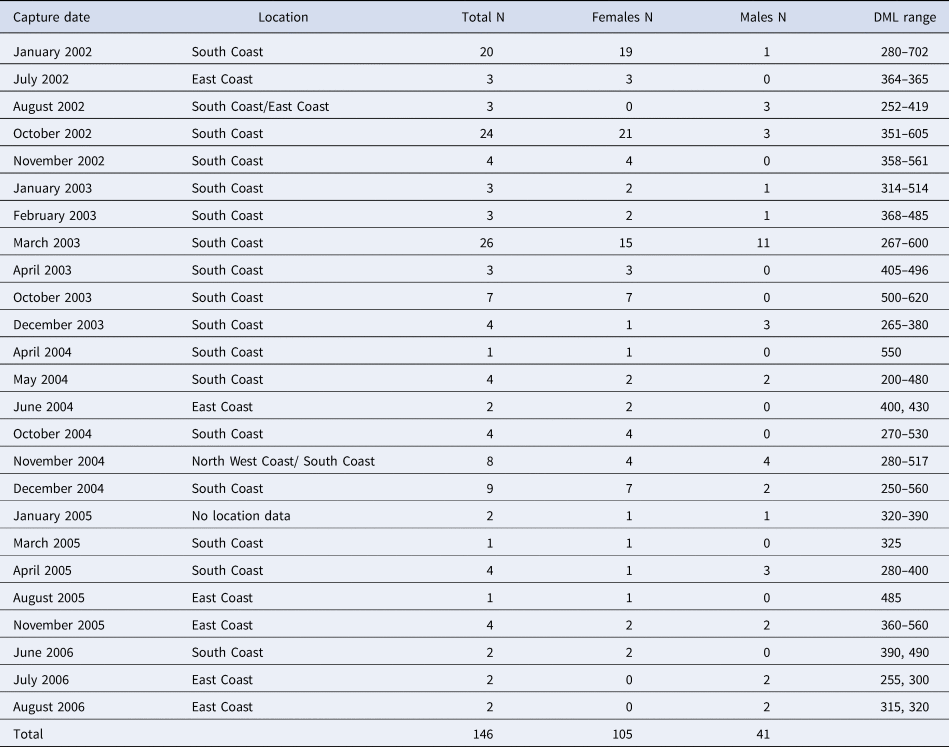
Squid were obtained over five years between the summer of January 2002 and the winter of August 2006 as bycatch from the deepwater trawler, ‘Adriatic Pearl’. The gear used was a cut-away wing demersal trawl with a headline height of 6 m. Trawling depth was typically between 700 and 1200 m, which was undertaken off the coast of Southern Tasmania including in the regions of Maatsuyker Island, Pedra Branca and the Cascade Plateau (145–152°E 44–46°S). The majority of squid were obtained from these south coast regions. However, some specimens were obtained from the east coast (~149°E 41°S) and the north-west coast of Tasmania (Table 1).
Collection details for Idioteuthis cordiformis in this study

Specimens were either frozen onboard ship or immediately upon arrival at port, prior to being defrosted and dissected. All weights and measurements were taken on defrosted specimens with no fixing of tissues. Parameters recorded include sex, maturity stage (after Lipinski Reference Lipinski1979), total weight (TW) to the nearest g, and mantle length (ML) to the nearest mm. Weights of ovary and testis, mantle weight (MW) and fin weight (FW) were also measured to the nearest 0.1 g. For 18 males and 24 females, the fluid in the caecum was measured by carefully pouring the fluid into a graduated cylinder and measuring the water and oil component in ml.
Two-way full factorial ANOVAs were carried out with sex and season as factors of interest on log transformed ML, TW, MW and FW separately. Individuals were pooled across five years of sampling into the austral season of capture. Where there was a significant effect, Tukey's multiple comparisons were used to determine where the differences lay. Values were reported as means and standard deviations (SD). Statistical analyses were undertaken using the SPSS statistical package version 27.
Results
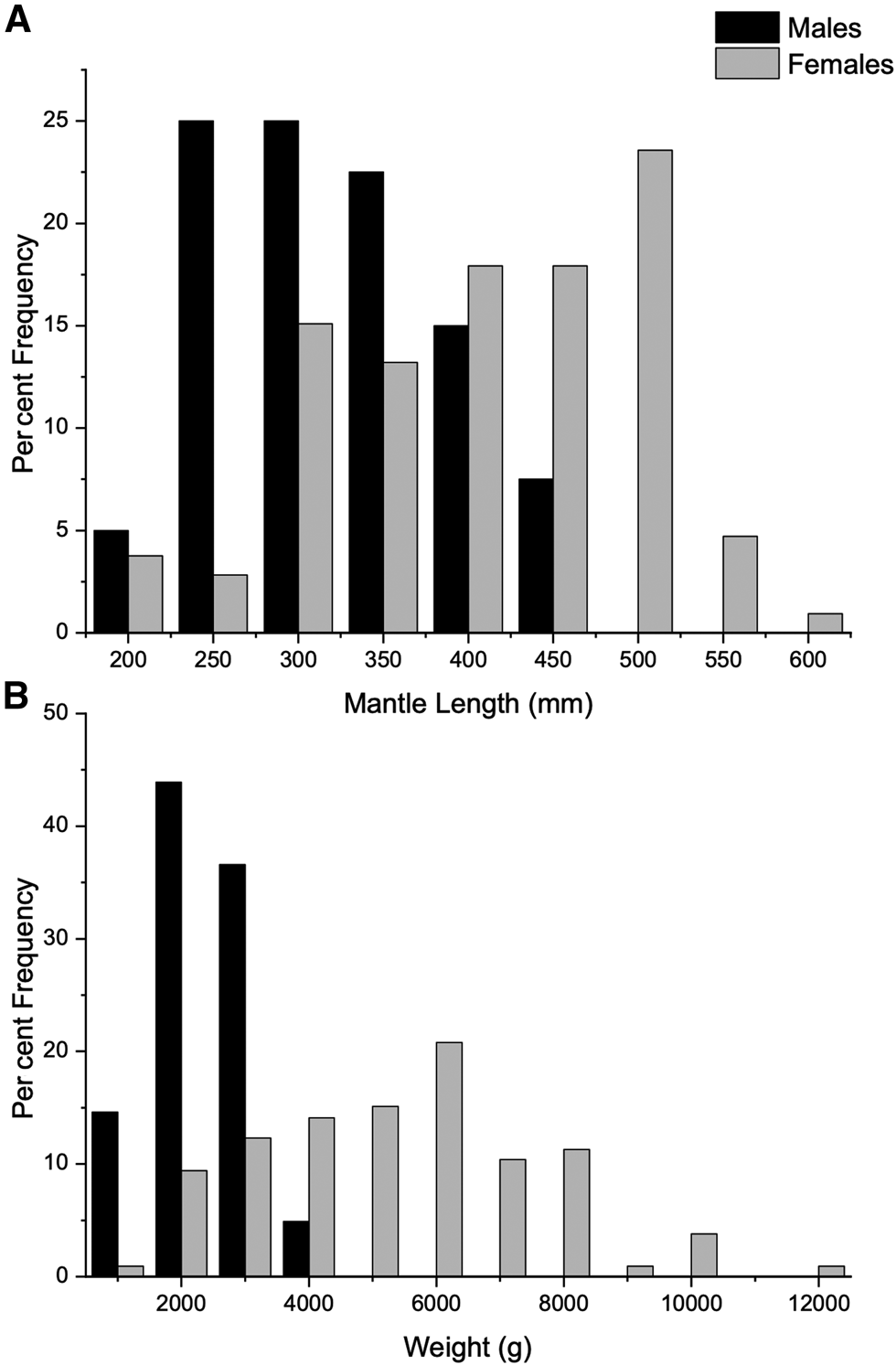
A total of 105 females and 41 males were collected from January 2002 to August 2006. This species showed marked sexual dimorphism in size with females growing larger than males. Mantle lengths ranged from 200–500 mm and 270–702 mm, for males and females, respectively (Figure 1A). As should be expected, this sexual dimorphism was more marked in total weight. The weight range for males was 394–3913 g whereas females ranged from 843–11 925 g (Figure 1B).
The per cent frequency distribution in mantle length (A) and weight (B) for I. cordiformis collected in Tasmanian waters.

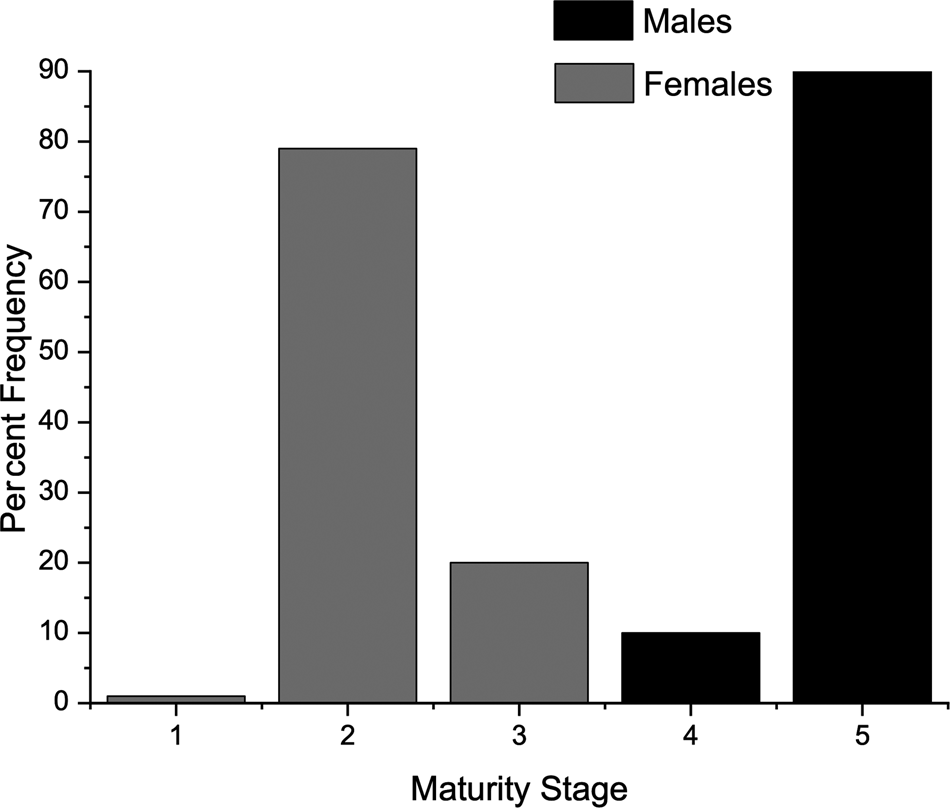
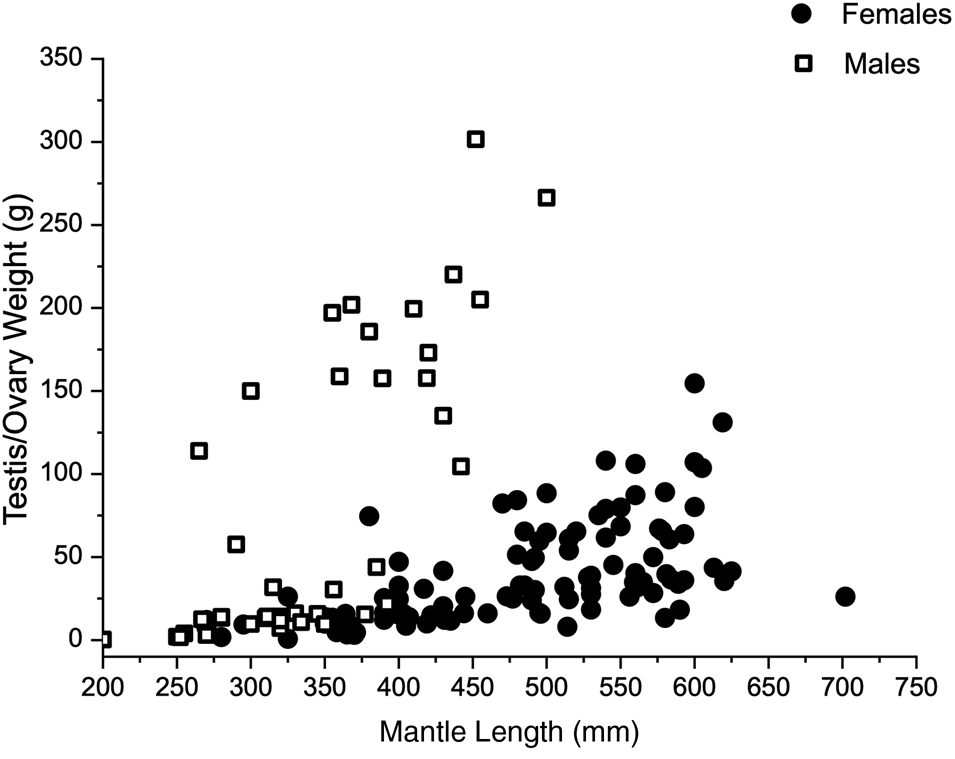
The majority of males were mature (stage 5). However, even though females reached a much larger size than males, none of the females were mature with the majority only at stage 2 and only a few individuals reaching stage 3 (Figure 2). The weight of the male testis reached over 300 g while females had very undeveloped ovaries below 200 g with many individuals having ovaries less than 100 g (Figure 3).
The frequency distribution of maturity stages of male and female individuals of I. cordiformis.

The relationship between I. cordiformis mantle length and male testis weight and mantle length and female ovary weight.

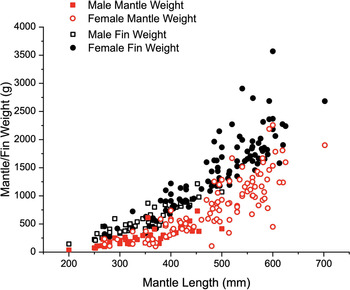
Idioteuthis cordiformis has very large fins in relation to body size. The fins in fact were fused to form a single large organ to which the mantle was attached from below. The fin weight was always greater than mantle weight on any individual. This could be visualized by comparing the fin and mantle weight with increasing squid ML (Figure 4). Mantle weight ranged from 37–730 g and 103–2258.3 g for males and females, respectively while fin weight ranged from 145–1215 g and 272–3570 g for males and females, respectively. In comparing the mantle weight as a percentage of fin weight for each individual, male mean per cent mantle weight (44.8 ± 11.2) was significantly lower than mean female per cent mantle weight (55.2 ± 15.3) (t = 4.5(99), P < 0.0001).
The relationship between I. cordiformis mantle length and mantle weight and mantle length and fin weight for males and females.

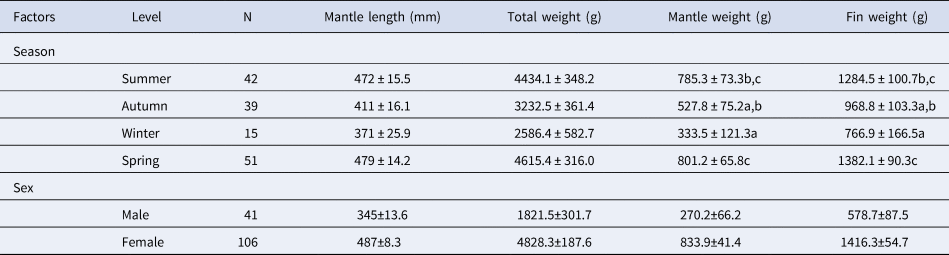
There was a significant sex effect accounting for 27–33% of the variation between samples. Females had greater TW (F (1139) = 68.59, P < 0.001), ML (F (1138) = 59.12, P < 0.001), MW (F (1138) = 51.56, P < 0.001) and FW (F (1138) = 63.42, P < 0.001) (Table 2). There was a smaller season effect for just MW (F (3138) = 2.84, P < 0.05) and FW (F (1138) = 2.89, P < 0.05) (Table 2). Tukey's comparisons revealed that MW and FW separated into three main groups; winter and autumn; autumn and summer; summer and spring. Furthermore, for MW and FW, autumn differed from spring; spring differed from winter; and summer differed from winter. However, the biological significance of these groupings along with the differences are unclear as both accounted for only 6% of the variation. It is possible that the small seasonal differences of MW and FW could have been due to the greater number of females in some samples, as the mean MW and FW (Table 2) follow a similar consistent pattern of greatest weights for spring and summer, lower weights for winter and intermediate weights for winter.
Two-way full factorial ANOVA with sex and season as a factor of interest

Letters indicate similarity based on Tukey's multiple comparisons.
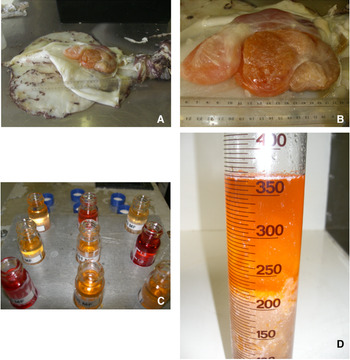
There were rarely any obvious gut contents found within squid dissected to explore the diet of I. cordiformis. However, individual squid typically had considerable fluid within their relatively large caecum. In many cases the fluid was bright orange and sometimes of a more brick red colour (Figures 5A–C). Within the fluid there was a clear separation between a water component and an oil component (Figure 5D). Total caecum fluid varied from 23–230 ml for males and 20–550 ml for females. The oil ranged from 1 ml (just a few drops of oil noted) to 55 ml for males and 15–170 ml for females. As a per cent of total caecum fluid, the oil component ranged from 6.9–50% for males (mean 24.4 ± 14.7) and from 10.8–50% for females (mean 26.5 ± 11.3). There was no significant difference in the mean per cent caecum oil content between males and females.
The caecum oil in I. cordiformis. (A) A dissected squid showing the large caecum with orange oil; (B) a close up of the caecum; (C) vials of caecum oil extracted for lipid and fatty acid analysis showing the variety of orange and red coloured oil; (D) caecum fluid showing the clear demarcation in water content (in the lower section of the graduated cylinder with the orange oil sitting on top).

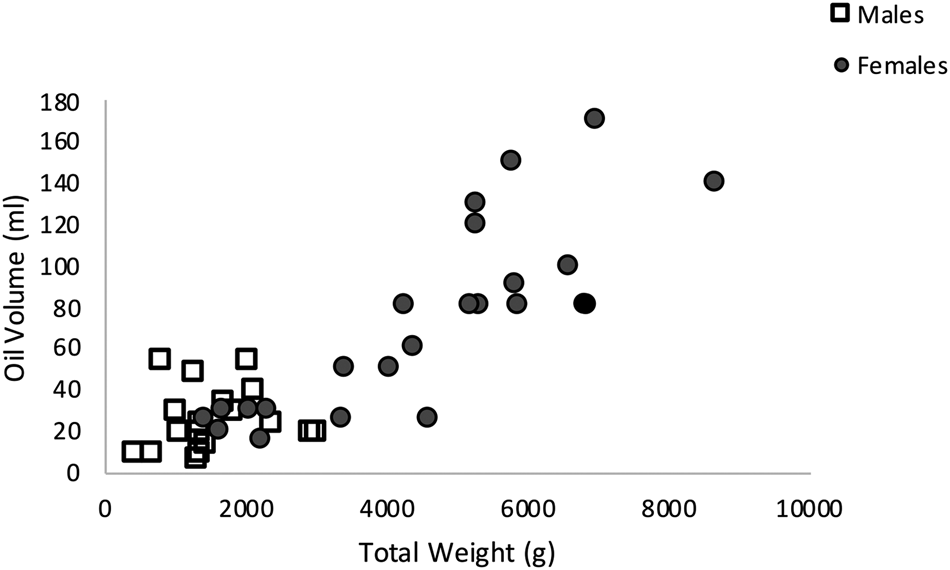
The total volume of caecum oil was also explored in relation to squid size (Figure 6). There was a significant relationship between total weight and oil volume for males and females combined; y = −0.023 + 0.016x, F (1,40) = 92.38, P < 0.001, adjusted r 2 = 0.69. The relationship was also significant for the female data only; Y = −12.036 + 0.018x, F (1,22) = 42.92, df 1,22, P < 0.001, adjusted r 2 = 0.65.
The relationship between total weight of I. cordiformis males and females and caecum oil volume.

Discussion
Obtaining biological information on deepwater cephalopods including squids continues to be challenging. A variety of new techniques and technologies continue to advance our understanding of oceanic and deepwater squids. Often these techniques have involved indirect methods (e.g. beak analyses, stable isotopes, lipids and fatty acids, or other molecular analyses from small or limited samples) (Jackson et al., Reference Jackson, Bustamante, Cherel, Fulton, Grist, Jackson, Nichols, Pethybridge, Phillips, Ward and Xavier2007b; Xavier et al., Reference Xavier, Allcock, Cherel, Lipinski, Pierce, Rodhouse, Rosa, Shea, Strugnell, Vidal, Villanueva and Ziegler2015). This study had the advantage of access to a substantial collection of individuals over multiple years off southern Australia. We have been able to report on the level of sexual dimorphism, morphological changes with growth, maturity, and potential sex and seasonal influences on size and body parameters. Dietary analysis was not possible due to the lack of any substantial gut contents, however, we were able to examine the presence of oil retained in the caecum and how that changes with growth.
The marked sexual dimorphism seen in I. cordiformis has also been observed in other Southern Ocean squid including Moroteuthopsis ingens (Jackson & Mladenov, Reference Jackson and Mladenov1994; Bolstad, Reference Bolstad2006; Lischka et al., Reference Lischka, Braid, Cherel, Bolstad, Lacoue-Labarthe and Bustamante2020) and Todarodes filippovae (Jackson et al., Reference Jackson, Wotherspoon and Jackson2007a) where females achieve a larger body size than males. The mantle of I. cordiformis was surprisingly thin and flaccid, and similar in structure to spent individuals of M. ingens (Jackson & Mladenov, Reference Jackson and Mladenov1994; Laptikhovsky et al., Reference Laptikhovsky, Arkhipkin and Hoving2007) as well as a number of other onychoteuthid species (Bolstad & Hoving, Reference Bolstad and Hoving2011), and Gonatus antarcticus (Laptikhovsky et al., Reference Laptikhovsky, Arkhipkin and Hoving2007). In contrast, the large fused fin structure was very thick and muscular. The reason for the dramatic discrepancy between the mantle and fin structure is unclear but suggests that the fins are important organs for locomotion, as proposed by Roper & Vecchione (Reference Roper and Vecchione1997), as opposed to jet propulsion which has been reported as weak in mastigoteuthids (Reid, Reference Reid2016). The large fins in other mastigoteuthids have been reported to be used in rhythmic, wave-like undulations to maintain a head-down position during feeding (Reid, Reference Reid2016).
Recent work by Murphy et al. (Reference Murphy, Pecl, Richards, Semmens, Revill, Suthers, Everett, Trebilco and Blanchard2020) used morphological traits to classify cephalopods into three functional groups based on low, medium and high activity levels as well as feeding mode (from passive feeders to active hunters). These factors along with body size were used to infer trophic position. High activity cephalopods identified by Murphy et al. (Reference Murphy, Pecl, Richards, Semmens, Revill, Suthers, Everett, Trebilco and Blanchard2020) had thick muscular mantles, larger firmer fins, and a fin length that is 50% or greater than the mantle length. The huge fins of I. cordiformis tend to dominate the organism and are well over 50% of the mantle length, but the mantle is not thick and muscular, which limits the application of categories suggested by Murphy et al. (Reference Murphy, Pecl, Richards, Semmens, Revill, Suthers, Everett, Trebilco and Blanchard2020). However, their large body size would place I cordiformis in a high trophic level according to Murphy et al. (Reference Murphy, Pecl, Richards, Semmens, Revill, Suthers, Everett, Trebilco and Blanchard2020). Mastigoteuthids have been reported as passive predators (Boyle & Rodhouse, Reference Boyle and Rodhouse2005), and this has been supported by ROV observation (e.g. Roper & Vecchione, Reference Roper and Vecchione1997). However, two photos of I. cordiformis in deep water off Hawaii (Hawaii Undersea Research Laboratory Archive, n.d.) provide evidence that suggests this species is an active swimmer. Furthermore, the large tentacular suckers of this species (Reid, Reference Reid2016) suggest an active rather than passive predator. The Hawaii photos of I. cordiformis also suggest a demersal habitat which agrees with the collections in our study, with all individuals collected in a demersal trawl.
The greater number of captured female individuals of I. cordiformis is not an uncommon phenomenon. There was a greater female to male ratio for captured individuals of M. ingens in four out of six studies in various regions of the Southern Ocean including the Patagonian shelf 1.9:1, N = 4205 (Jackson et al., Reference Jackson, George and Buxton1998a); New Zealand 3.2:1, N = 37, 1:2.7, N = 89 (Jackson et al., Reference Jackson, McKinnon, Lalas, Ardern and Buxton1998b; Jackson, Reference Jackson2001); Macquarie and Heard Islands 1.6:1, N = 82 (Phillips et al., Reference Phillips, Jackson and Nichols2001); and Kerguelen Islands 1:1.5, N = 87 (Cherel & Duhamel, Reference Cherel and Duhamel2003). The female to male ratios for Todarodes filippovae, also in Tasmanian waters, was 6.6:1, N = 462 (Jackson et al., Reference Jackson, Wotherspoon and Jackson2007a). The reasons for these differences between numbers of captured males and females are currently not known.
The lack of mature females of I. cordiformis (despite the large body size of some individuals) is notable, especially since the majority of males (which were mostly smaller in body size) were mature. A similar situation was found with M. ingens on the Patagonian Shelf. A total of 4205 individuals captured from over 9000 stations did not result in the capture of any mature females. These samples were taken from 25–1025 m depth (Jackson et al., Reference Jackson, George and Buxton1998a). Similarly, 87 individuals (35 females, 52 males) of M. ingens captured between 500–900 m around the Kerguelen Islands (Cherel & Duhamel, Reference Cherel and Duhamel2003) also revealed mature males, but only immature females. Looking at the depth distribution of M. ingens in New Zealand waters provided a clue to the lack of female captures. Jackson (Reference Jackson1997) reported catches of M. ingens from samples from 500–1452 m in New Zealand waters and found mature males in all depths sampled. However, mature females were only found in trawls deeper than 700 m which suggested that females undergo an ontogenetic descent with maturity. The Patagonian Shelf study (Jackson et al., Reference Jackson, George and Buxton1998a) only had nine trawls that were deeper than 700 m which provides a potential explanation for the lack of mature female M. ingens. A subsequent study (Laptikhovsky et al., Reference Laptikhovsky, Arkhipkin and Hoving2007) confirmed that M. ingens also spawns at a depth greater than 700 m in slope waters off the Falkland Islands, showing that this species has a similar strategy in the South Pacific, South Atlantic and probably southern Indian Ocean. The lack of mature females of I. cordiformis captured off Tasmania may likely be due to a similar spawning strategy as described for M. ingens in New Zealand, South Atlantic and Indian oceans. Given that all females were very immature, it is probable that mature and maturing females could migrate to a different environment. The fact that the individuals of I. cordiformis were caught between 700–1200 m in this study suggests that mature females may migrate to waters deeper than 1200 m (or alternatively to an entirely different region) to spawn. There was also a lack of mature females in an examination of 28 specimens of I. cordiformis in collections in New Zealand (Braid & Bolstad, Reference Braid and Bolstad2015). That study included an immature female that was 930 mm ML. Currently, the size or habitat of mature females remain unknown.
The abundance of orange and rose-coloured oil in the caecum of I. cordiformis is of special interest. Because of the general lack of ingested prey remains it was not possible to undertake traditional gut content analysis. Interestingly, Roper & Vecchione (Reference Roper and Vecchione1997) recorded the presence of a ‘a large quantity of yellow oil’ in several stomachs of preserved museum specimens of Mastigoteuthis magna. Braid & Bolstad (Reference Braid and Bolstad2014) also found abundant red-orange oil in two of four specimens of I. cordiformis in a diet study of this species in New Zealand. In the other two specimens they carried out DNA barcoding on gut contents to determine prey. Braid & Bolstad (Reference Braid and Bolstad2014) found surprising evidence of feeding on the deepwater shark Deania calcea, along with the teleost snapper Lutjanus sp. Despite the lack of easily identifiable prey contents within the gut of I. cordiformis, the abundance of oil within the caecum of this species provides a unique opportunity to undertake trophic studies using either DNA barcoding (Braid & Bolstad, Reference Braid and Bolstad2014) or fatty acid signature analysis which has been used for teleosts, sharks and squid in southern Australian waters (e.g. Pethybridge et al., Reference Pethybridge, Daly, Virtue and Nichols2010a, Reference Pethybridge, Daly, Virtue, Butler, Cossa and Nichols2010b, Reference Pethybridge, Nichols, Virtue and Jackson2013). Fatty acid signature analysis of oil in I. cordiformis to discern potential prey is part of a separate study (Jackson et al., Reference Jackson, Jackson, Virtue, Fluckiger and Nicholsin press).
The reason for the retention of large amounts of oil within the caecum is unclear and requires further study. Given the protein-based physiology of squid and their general lack in ability to metabolize and store lipids (Semmens, Reference Semmens1998) it is unlikely this oil is being digested for energy and it may just represent lipids that are being dumped from their system. Some deepwater sharks have been reported to store oil in their livers for buoyancy (Bakes & Nichols, Reference Bakes and Nichols1995; Wetherbee & Nichols, Reference Wetherbee and Nichols2000). However, at this time we are unsure of the role of the retained oil in the caecum of I. cordiformis.
This study provided a unique opportunity to explore the biology of a poorly understood large deepwater squid. Based on reports from New Zealand it is likely this species is vulnerable to population decline as a result of deepwater trawling. Continued research will reveal further details of the trophic niche, biology and ecology of this species. Given its large size it is likely to have a significant impact on the deepwater ecology off southern Australia.
Acknowledgements
We would like to thank the crew of the ‘Adriatic Pearl’ who made this research possible by going out of their way to collect squid for us for five years. We thank Miriam Fluckiger for assistance with dissection of specimens.