Introduction
The cotton bollworm, Helicoverpa armigera (Hübner), and the native budworm, H. punctigera (Wallengren) (Lepidoptera: Noctuidae), are major pests of several agricultural crops in Australia, in particular cotton (Gossypium hirsutum L.) (Zalucki et al., Reference Zalucki, Daglish, Firempong and Twine1986; Fitt, Reference Fitt1989, Reference Fitt1994, Reference Fitt2000, Reference Fitt and Kalaitzandonakes2003; Fitt & Cotter, Reference Fitt, Cotter and Sharma2004). Helicoverpa armigera is also a major pest of a wide variety of crops elsewhere in the world (Reed & Pawar, Reference Reed, Pawar, Reed and Kumble1982; Manjunath et al., Reference Manjunath, Bhatnagar, Pawar, Sithanantham, King and Jackson1989; Sharma, Reference Sharma2001; Pray et al., Reference Pray, Huang, Hu and Rozelle2002; Wu & Guo, Reference Wu and Guo2005; Brévault et al., Reference Brévault, Achaleke, Sougnabé and Vaissayre2008; Wu et al., Reference Wu, Lu, Feng, Jiang and Zhao2008), but H. punctigera is confined to Australia (Zalucki et al., Reference Zalucki, Daglish, Firempong and Twine1986; Fitt, Reference Fitt1989, Reference Fitt1994). The seasonal dynamics of H. armigera and H. punctigera in both cropping and non-cropping regions of Australia are generally well understood (Wardhaugh et al., Reference Wardhaugh, Room and Greenup1980; Zalucki et al., Reference Zalucki, Daglish, Firempong and Twine1986, Reference Zalucki, Gregg, Fitt, Murray, Twine and Jones1994; Fitt, Reference Fitt1989; Fitt et al., Reference Fitt, Zalucki and Twine1989; Gregg et al., Reference Gregg, McDonald and Bryceson1989, Reference Gregg, Fitt, Zalucki, Murray, Drake and Gatehouse1995, Reference Gregg, Del Socorro and Rochester2001; Fitt & Daly, Reference Fitt and Daly1990; Oertel et al., Reference Oertel, Zalucki, Maelzer, Fitt and Sutherst1999; Duffield & Dillon, Reference Duffield and Dillon2005; Zalucki & Furlong, Reference Zalucki and Furlong2005; Duffield & Steer, Reference Duffield and Steer2006), but there are still some points of contention, such as the relative amounts of immigration and local emergence of H. armigera and their contribution to the species' population dynamics across its geographical range, and resultant gene flow (Scott et al., Reference Scott, Lawrence, Lange, Scott, Wilkinson, Merritt, Miles, Murray and Graham2005a,Reference Scott, Wilkinson, Lawrence, Lange, Scott, Merritt, Lowe and Grahamb; Endersby et al., Reference Endersby, Hoffmann, McKechnie and Weeks2007).
In spring, the abundance of both species increases throughout eastern Australia. In particular, H. punctigera is believed to migrate into eastern cropping regions following autumn-winter rains in source areas in central Australia. In contrast, spring populations of H. armigera are believed to be derived more from local emergence within the eastern cropping regions. Both species have at least three generations between September and April, with overlapping fourth and fifth generations also possible late in this period. Overall, H. punctigera is thought to predominate early in the summer cropping season then become rare in late summer, when H. armigera is most common. There can, however, be substantial variation between years in the abundance of the various generations (Wilson, Reference Wilson1983; Fitt et al., Reference Fitt, Zalucki and Twine1989; Gregg et al., Reference Gregg, Fitt, Coombs and Henderson1993; Maelzer & Zalucki, Reference Maelzer and Zalucki1999, Reference Maelzer and Zalucki2000; Oertel et al., Reference Oertel, Zalucki, Maelzer, Fitt and Sutherst1999; Duffield & Steer, Reference Duffield and Steer2006).
Light and pheromone traps have been commonly used in ecological studies of heliothine moths (e.g. Hartstack et al., Reference Hartstack, Hollingsworth, Ridgway and Coppedge1973, Reference Hartstack, Witz and Buck1979; Hartstack & Witz, Reference Hartstack and Witz1981; Gregg & Wilson, Reference Gregg, Wilson and Zalucki1991; Carrière et al., Reference Carrière, Ellers-Kirk, Sisterson, Antilla, Whitlow, Dennehy and Tabashnik2003; Kant & Kanaujia, Reference Kant and Kanaujia2008; Feng et al., Reference Feng, Wu, Wu and Wu2009). Moth captures in these traps have been used, for example, to detect local movements and migration, albeit with some limitations (Fitt & Pinkerton, Reference Fitt and Pinkerton1990; Gregg et al., Reference Gregg, Fitt, Coombs and Henderson1993, Reference Gregg, Fitt, Coombs and Henderson1994; Fitt et al., Reference Fitt, Dillon and Hamilton1995a; Duffield, Reference Duffield, Zalucki, Drew and White1998; Del Socorro & Gregg, Reference Del Socorro and Gregg2001; Jackson et al., Reference Jackson, Bradley, Van Duyn, Leonard, Allen, Luttrell, Ruberson, Adamczyk, Gore, Hardee, Voth, Sivasupramaniam, Mullins and Head2008), to map species distributions (Fitt et al., Reference Fitt, Gregg, Zalucki and Murray1995b), provide early warnings of crop infestation in particular in relation to weather (Fitt et al., Reference Fitt, Forrester and Cahill1984; Maelzer et al., Reference Maelzer, Zalucki and Laughlin1996; Chapin et al., Reference Chapin, Ganaway, Leonard, Micinski, Burris and Graves1997; Oertel et al., Reference Oertel, Zalucki, Maelzer, Fitt and Sutherst1999; Maelzer & Zalucki, Reference Maelzer and Zalucki1999, Reference Maelzer and Zalucki2000; Zalucki & Furlong, Reference Zalucki and Furlong2005; Dömötör et al., Reference Dömötör, Kiss and Szőcs2007), monitor long-term changes in abundance (Carrière et al., Reference Carrière, Ellers-Kirk, Sisterson, Antilla, Whitlow, Dennehy and Tabashnik2003; Adamczyk & Hubbard, Reference Adamczyk and Hubbard2006; Zalucki et al., Reference Zalucki, Adamson and Furlong2009), and demonstrate species composition of communities and their seasonal and spatial dynamics (Twine, Reference Twine1982; Fitt et al., Reference Fitt, Zalucki and Twine1989; Leonard et al., Reference Leonard, Graves, Burris, Pavloff and Church1989; Maelzer et al., Reference Maelzer, Zalucki and Laughlin1996; Zalucki & Furlong, Reference Zalucki and Furlong2005). Previous studies have shown that trap catches are not a simple reflection of the local abundance of moths but are also dependent on where the traps are set (e.g. inside cf. outside crops), the condition (attractiveness) of nearby crops, the spacings and designs of the traps, prevailing weather and moonlight, and local insecticide applications (Morton et al., Reference Morton, Tuart and Wardhaugh1981; Wilson & Bauer, Reference Wilson and Bauer1986; Dent & Pawar, Reference Dent and Pawar1988; Wilson & Morton, Reference Wilson and Morton1989; Gregg & Wilson, Reference Gregg, Wilson and Zalucki1991). Pheromone trap catches of male Heliothis virescens (F.) moths are known to be influenced by the local abundance, and mating receptivity, of female moths (Hartstack & Witz, Reference Hartstack and Witz1981). That is, there can be competition between pheromone lures and calling females, leading to differences in catches of male moths between light and pheromone traps at particular times of year (Fletcher-Howell et al., Reference Fletcher-Howell, Ferro and Butkewich1983; Thompson et al., Reference Thompson, Capinera and Pilcher1987). Whether or not similar variability occurs with H. armigera and H. punctigera in Australia is less certain, but Wilson & Morton (Reference Wilson and Morton1989) reported a tendency for both species to be caught more often in pheromone traps when in low numbers than might be expected (based on rearings from concurrent egg collections). They inferred that competition for males, between females and pheromone lures, might be responsible for this discrepancy. Kvedaras (Reference Kvedaras2003) also suggested that pheromone trap catches may reflect the availability of mating female H. armigera moths more so than the abundance of male moths.
Whilst light and pheromone traps have been commonly used for studies of H. armigera and H. punctigera, rarely have the two trapping techniques been run concurrently, thereby enabling comparisons of the different catches and hence interpretations made from them. Where such comparisons have been made, they have involved few traps or years of observation, or comparisons have been indirect, e.g. assessing trap catches relative to the composition of communities of moths reared from concurrent local egg collections (Fitt et al., Reference Fitt, Forrester and Cahill1984; Wilson, Reference Wilson1984; Maelzer et al., Reference Maelzer, Zalucki and Laughlin1996). Twine (Reference Twine1982) did, however, note that, whilst the numbers of H. armigera caught in light and pheromone traps set in 1980–81 in the Darling Downs, southern Queensland, were strongly correlated, such was not the case for H. punctigera. Unfortunately, Twine (Reference Twine1982) did not elaborate on this finding, instead stating, rather confusingly, that pheromone traps (in part because of their ease of handling) could be relied on to indicate the species composition of the local Heliothis (=Helicoverpa) complex. This contention has been clearly demonstrated to be incorrect (Fitt et al., Reference Fitt, Forrester and Cahill1984; Daly & Fitt, Reference Daly, Fitt, Corey, Dall and Milne1993). Our paper reports results from a long time series of light and pheromone trapping made concurrently in northern New South Wales throughout the 1990s and early 2000s and discusses differences in the data thereby obtained.
Both H. armigera and H. punctigera are known to mate more than once (Zalucki et al., Reference Zalucki, Daglish, Firempong and Twine1986; Coombs et al., Reference Coombs, Del Socorro, Fitt and Gregg1993; Kvedaras Reference Kvedaras2003), but the extent of this multiple mating is poorly understood. We took advantage of the large numbers of moths collected throughout this study to dissect females and count spermatophores as indicators of the degree of mating that had occurred, within and between seasons and amongst moths captured in different crops.
Materials and methods
Pheromone and light trapping
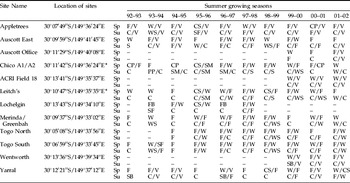
A grid of 7–11 pairs of AgrisenseTM canister pheromone traps (one trap within each pair for each of H. armigera and H. punctigea) was maintained within about a 10 km radius of the Australian Cotton Research Institute (ACRI), Narrabri, in northern New South Wales. Table 1 lists the 12 trapping sites and their locations used for the study (note: the site at Lochelgin was replaced by ACRI Field 18 in 1999–2000 when the former site became too difficult to access in wet weather, and two new sites were established at Auscott Office and Wentworth at the same time). The traps within each pair were placed approximately 100 m apart. The traps were emptied weekly or more often, weather permitting. Lures were changed monthly and pesticide strips were changed bi-monthly. The traps were run continuously from July 1992 to June 2002. The traps were mounted on metal poles, approximately 1.5 m above the ground, and adjacent to agricultural fields. The pheromone traps only caught male moths.
Locations of sites near ACRI, Narrabri, New South Wales used for pheromone (and also light trapping*) from 1992 to 2002. The spring (Sp) and summer (Su) crops grown in fields adjacent to each pheromone trapping site and surrounding each light trapping site, or other field uses, are also listed: C, cotton; CS, cotton stubble; S, sorghum; SB, soy bean; SF, sunflower; CP, chickpea; PP, pigeon pea; FB, faba bean; SM, seed mix; W, wheat; WS, wheat stubble; V, verge; F, fallow. Dashes indicate not sampled.

(Note: In 1990–91, five summer crops were also grown in Chico A1/A2 (chickpea, cotton, maize, sorghum and sunflower), and light traps were set within each. No light traps were set in Leitch's during this time. In 1991–92, the summer crops in Chico A1/A2 were sorghum and cotton, and in Leitch's the summer crop was cotton. Light traps were set in both fields in this year. Where two crops or fallow are listed in the table above, e.g. C/F, this indicates different land use on the two sides of the pheromone traps.)
Table 1 indicates the spring & summer crops that were grown in the fields nearest the pheromone traps each year. These included cotton (Gossypium hirsutum L. – conventional and transgenic), chickpea (Cicer arietinum L.), pigeon pea (Cajanus cajan (L.)), soy bean (Glycine max Merr.), sorghum (Sorghum bicolor (L.)), sunflower (Helianthus annuus L.), wheat (Triticum aestivum L.), faba bean (Vicia faba L.) and an experimental ‘seed mix’ (a mixture of conventional cotton, sorghum, maize (Zea mays L.), sunflower, pigeon pea, soybean, mungbean (Vigna radiata L.), niger (Guizotia abyssinica Cass.) and lablab (Dolichos lablab L.)). The fields were most commonly in fallow or wheat in spring. Cotton was the most common crop in summer. In some instances, the trapping sites were bordered by land that was not used for cropping (called ‘verge’ in table 1). This land was variable in nature and included, for example, patches of native vegetation and weedy roadside vegetation.
CSIRO-designed cone light traps, each containing a horizontal 8 W black light fluoro globe, were also run within two fields at ACRI (Leitch's and Chico block), from September 1990 to June 2002 (but not continuously: traps were sometimes not set during winter months, when moths were scarce). These traps caught both male and female moths. Between 1–5 light traps were run each season (usually 2 or 3). The light traps were emptied at weekly intervals (or more frequently), and the moths were then sexed and identified to species. Spermatophore counts (Coombs et al., Reference Coombs, Del Socorro, Fitt and Gregg1993) were made for up to ten females (selected at random, if more than ten were available) from each catch (by dissecting the copulatory bursa in each female) to determine mated status. The same females were classified as being either gravid or non-gravid, based on the presence or absence of chorionated eggs.
It should be noted that the light traps used during our studies were of a different design (and smaller) than those used earlier at ACRI during the 1970s and 1980s by Oertel et al. (Reference Oertel, Zalucki, Maelzer, Fitt and Sutherst1999) and other authors referred to often below (Maelzer et al., Reference Maelzer, Zalucki and Laughlin1996; Maelzer & Zalucki, Reference Maelzer and Zalucki1999).
Relationships with rainfall
Rainfall was recorded at ACRI (Myall Vale), Narrabri. It varied from 282–848 mm per year (calculated from July 1 to June 30 – see below for reason) during the study. The long-term average annual rainfall at ACRI is currently 649 mm.
Oertel et al. (Reference Oertel, Zalucki, Maelzer, Fitt and Sutherst1999) obtained monthly rainfall data from 34 recording stations within various meteorological districts (as designated by the Australian Government's Bureau of Meteorology) in central Australia. These stations were in Western Australia (Districts 12 and 13), Northern Territory (15), South Australia (16, 17), Queensland (36, 37, 38, 44, 45) and New South Wales (46, 48). Oertel et al. (Reference Oertel, Zalucki, Maelzer, Fitt and Sutherst1999) sought correlations between rainfall data from these sites, in particular records for autumn and winter months, and light trap catches of the subsequent 1st (spring) generations of H. punctigera at ACRI, Narrabri, during the 1970s (four years) and 1980s (six years). We repeated the Oertel et al. (Reference Oertel, Zalucki, Maelzer, Fitt and Sutherst1999) study, but for both Helicoverpa spp., using catches in both pheromone (1992–2002) and light traps (1991–2002) as described above. However, three of the stations used by Oertel et al. (Reference Oertel, Zalucki, Maelzer, Fitt and Sutherst1999) (one in each of districts 15, 16 and 45) were no longer operational in the 1991–2002 period. We replaced these stations with 12 ‘new’ stations, making 36 stations in our study (fig. 1). We also ignored districts 12 and 13, noted by Oertel et al. (Reference Oertel, Zalucki, Maelzer, Fitt and Sutherst1999) to be irrelevant to moth populations in the Narrabri region. Instead, we included an additional district (29) in western Queensland. Overall, we had 24 stations in common with Oertel et al. (Reference Oertel, Zalucki, Maelzer, Fitt and Sutherst1999). All stations were north of 30°S latitude, which avoids regions regarded as too cold to allow winter breeding of Helicoverpa (Oertel et al., Reference Oertel, Zalucki, Maelzer, Fitt and Sutherst1999).
Locations (×) of meteorological stations used to correlate rainfall with light and pheromone trap catches near Narrabri. Meteorological districts are numbered and enclosed by solid lines. Lines of latitude are also indicated.

Data analysis
Statistix® 7 (Analytical Software, 2000) was used for data analyses (Pearson r correlations between rainfalls and trap catches, Bonferroni correction test for large numbers of correlation coefficients and Chi-squared tests involving tests on the incidence of maturity and mating). The method of Haccou & Meelis (Reference Haccou and Meelis1992) was used to complete a less stringent Bonferroni correction to test the significance of many correlation coefficients.
Results
Trap catch patterns
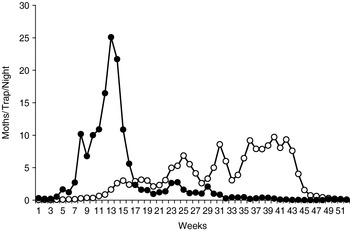
Figure 2 illustrates the long-term average catches of male H. armigera and H. punctigera in pheromone traps throughout the study period (1992–2002). Data are arranged in weeks from 1 July to 30 June, in order to best depict the seasonal patterns of the moths, to be consistent with previous analyses of seasonal dynamics and to enable simple comparisons with the summer growing season of cotton (approximately November to April, i.e. weeks 18–43). There was a clear peak in the abundance of H. punctigera in the traps in early spring (weeks 7–16) and at least one subsequent minor peak, in weeks 23–24. An opposite pattern occurred in H. armigera (greatest abundance in weeks 23–45 during the summer and early autumn), with several subsidiary peaks in abundance.
Long-term average catches of H. armigera and H. punctigera male moths in pheromone traps in the vicinity of ACRI, Narrabri, New South Wales from 1992–93 to 2001–02. Weeks are numbered from July 1. Thus, weeks 1–4 are in July, week 26 is late in December and weeks 48–52 are in June (–○–, H. armigera; –•–, H. punctigera).

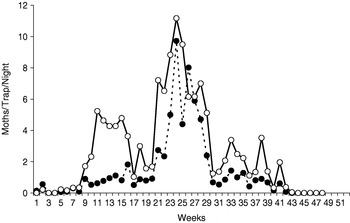
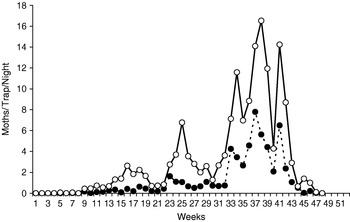
Figures 3 and 4 illustrate long-term average catches of both female and male H. armigera and H. punctigera in light traps from 1992–2002 (the data for 1990–92 were not included here to enable direct comparisons of light and pheromone data over the same sampling period; the 1990–92 data, however, were similar in pattern to that depicted in figs 3 and 4). Notably, males predominated in the catches of both species (2.73× for H. armigera and 1.96× for H. punctigera), despite the sexes being equally common amongst moths reared from eggs and larvae collected from a wide variety of plant species (C. Tann & G. Baker, unpublished data). Curiously, only male H. punctigera proved particularly abundant in the first peak in abundance (approx. weeks 8–20, i.e. spring), a period traditionally attributed to H. punctigera invading from elsewhere (e.g. Maelzer et al., Reference Maelzer, Zalucki and Laughlin1996; Oertel et al., Reference Oertel, Zalucki, Maelzer, Fitt and Sutherst1999).
Long-term average catches of H. punctigera female and male moths in light traps at ACRI, Narrabri, New South Wales from 1992–93 to 2001–02 (–•–, female; –○–, male).

Long-term average catches of H. armigera female and male moths in light traps at ACRI, Narrabri, New South Wales from 1992–93 to 2001–02 (–•–, female; –○–, male).

Maelzer & Zalucki (Reference Maelzer and Zalucki1999) separated the 1st, 2nd and 3rd generations of H. armigera and H. punctigera caught in light traps at Narrabri as being those moths caught prior to week 20, between weeks 20 and 33 and those caught between weeks 33 and 44, respectively. Similar generations were evident in this study (figs 3 and 4), but the distinction between the 2nd and 3rd generations of both species was best described in our data as being at approximately week 30.
The long-term averaged data from pheromone and light trapping are compared directly in figs 5 and 6 for male H. armigera and H. punctigera. Somewhat similar patterns appear for H. armigera, but gross differences are apparent for H. punctigera. For the latter species, the initial generation (weeks 8–20) was most abundant in pheromone traps, but the 2nd generation (weeks 21–30) was predominant in light traps. Very few males were caught in pheromone traps during the 3rd generation. Reasons for these distinct differences in trapping success of the early generations of H. punctigera are not understood. The pheromone traps that were run in close proximity to the light traps at ACRI (i.e. at Chico and Leitch's blocks) yielded overall catches throughout the 1992–2002 period similar to those amongst the rest of the pheromone traps further away from ACRI (data not shown here). The differences in the data were, therefore, not a result of varying regions being trapped by the different methods.
Long-term average catches of H. punctigera male moths in pheromone and light traps in the vicinity of ACRI, Narrabri, New South Wales from 1992–93 to 2001–02 (–•–, pheromone; –○–, light).

Long-term average catches of H. armigera male moths in pheromone and light traps in the vicinity of ACRI, Narrabri, New South Wales from 1992–93 to 2001–02 (–•–, pheromone; –○–, light).

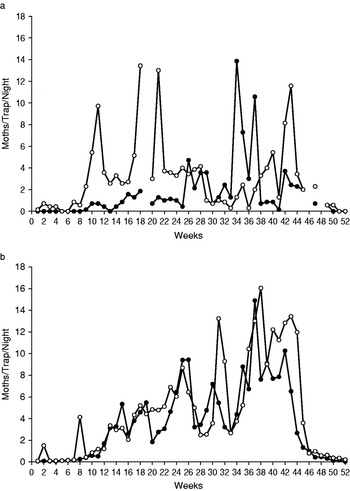
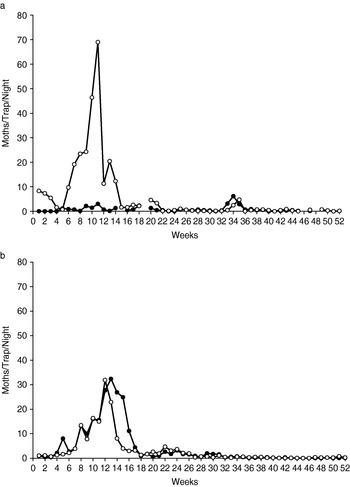
Similar overall patterns (averaged across all years) were observed in the pheromone trap catches at all individual sites (data not shown). In particular, the data sets for Chico A1/A2 and Leitch's (where light traps were also run) yielded the same overall patterns as obtained for all pheromone traps combined. However, within particular years, marked differences in catch were obtained between sites. Figures 7 and 8 provide examples of this, wherein the abundance of H. armigera and H. punctigera were very different at two sites quite close together (Appletrees and Togo South) during the 1994–95 season, yet over the whole monitoring period (1992–2002), patterns were very similar. There was no obvious spring catch of H. punctigera at Appletrees in 1994–95, and the patterns in catch of H. armigera were erratic at both sites that year. Both trapping sites were adjacent to fallow or verge in spring 1994. Fallow was continued at Togo South throughout the following summer, but the traps at Appletrees abutted cotton then.
Catches of H. armigera male moths in pheromone traps at Appletrees and Togo South, near Narrabri, New South Wales during (a) 1994–95 and (b) 1992–2002 (data are averages across years in the latter case). Note there were no records for some weeks in 1994–95, when traps could not be accessed (–•–, Appletrees; –○–, Togo South).

Catches of H. punctigera male moths in pheromone traps at Appletrees and Togo South, near Narrabri, New South Wales during (a) 1994–95 and (b) 1992–2002 (data are averages across years in the latter case). Note there were no records for some weeks in 1994–95, when traps could not be accessed (–•–, Appletrees; –○–, Togo South).

Relationships with rainfall
As Maelzer et al. (Reference Maelzer, Zalucki and Laughlin1996) and Maelzer & Zalucki (Reference Maelzer and Zalucki1999) did before us using light trap data from ACRI, we tried to relate the abundance of the moths we caught in light traps to the local weather, in particular rainfall, before and during each cotton growing season. We calculated the average number of moths per trap per night for three key periods (weeks 8–20, 21–30 and 31–44; which corresponded approximately to, likely, 1st, 2nd and 3rd generations) within each of the 11 seasons we fully monitored, i.e. during 1991–2002. Rainfall data were grouped into autumn (March–May), winter (June–August), spring (September–November) and summer (December–February) totals. No significant correlations (Pearson r, P>0.05) were obtained between the abundance of moths in light trap catches in any of the three generations and the rainfalls in the autumn, winter or spring preceding the summer growing seasons, nor during the summer itself, either for total moths or where the sexes were treated separately. However, the numbers of 1st generation H. armigera and H. punctigera were positively correlated (r=0.888, P<0.001), as were the 1st and 2nd generations of H. armigera (r=0.674, P<0.05), and the 1st and 3rd generations of H. punctigera (r=0.647, P<0.05). When the sexes were treated separately, the numbers of 1st generation H. armigera and H. punctigera were positively correlated for males (r=0.891, P<0.001) and females (r=0.692, P<0.05), as were the 1st and 2nd generations of male H. armigera (r=0.692, P<0.05), and the 2nd and 3rd generation females of both H. armigera (r=0.708, P<0.05) and H. punctigera (r=0.646, P<0.05). On the other hand, when similar analyses were done using the pheromone trap catches (1992–2002, males only of course), the abundance of the 2nd generation of H. armigera was positively correlated with rainfall during the preceding spring (r=0.793, P<0.01) and the concurrent summer (r=0.680, P<0.05). The numbers in the 3rd generation of H. punctigera were negatively correlated with preceding spring rainfall (r=−0.650, P<0.05). No significant correlations were observed between the abundance of the 1st generation of either species and local rainfall, nor between the abundance of the various generations of the moths, using the pheromone trap data.
Like Oertel et al. (Reference Oertel, Zalucki, Maelzer, Fitt and Sutherst1999), we also tried to relate the abundance of 1st generation Helicoverpa moths in traps at ACRI (and nearby in the case of the pheromone traps) to rainfall during the preceding autumn and winter in central Australian regions. We used the average number of moths per trap per night for weeks 8–20 (i.e. the 1st generation). Rainfall data for individual months (April–July) were averaged for each meteorological district (fig. 1). These averaged data and totals of such averages over the four-month period were analysed for correlations (Pearson r, P<0.05) with trap catches for the 1st generations of each species for each year. We also summed the average monthly rainfalls for all months across all districts and related them to moth catches. We did the same for May only and June only rainfalls across all districts (because Oertel et al., Reference Oertel, Zalucki, Maelzer, Fitt and Sutherst1999 found May and June to be the most influential months). Significant correlations were rare. No significant correlations were found for either species using the light trap data collected from 1991–2002 (sexes were not separated for the analyses). With the pheromone trap data (1992–2002), the following significant correlations were obtained between trap catches of 1st generation moths and preceding inland rainfalls: for H. armigera, district 29 (Qld) (June, r=0.796, P<0.01), district 36 (Qld) (June, r=0.795, P<0.01), district 37 (Qld) (June, r=0.788, P<0.01), district 44 (Qld) (June, r=0.668, P<0.05; total for all four months, r=0.632, P<0.05), district 45 (Qld) (total for all four months, r=0.673, P<0.05), all districts combined (total for all four months, r=0.646, P<0.05); and for H. punctigera, district 17 (S.A.) (May, r=0.832, P<0.01), district 36 (Qld) (July, r=0.670, P<0.05), district 46 (N.S.W.) (May, r=0.858, P<0.01). The other 51 and 55 possible correlations involving rainfall and pheromone trap records for H. armigera and H. punctigera, respectively, were not significant. It seems reasonable to conclude that at least some of the significant correlations we obtained could easily have occurred by chance. Indeed, when a Bonferroni correction was made to P, to take into account the large numbers of potential correlations and chance significance, none of the correlations listed above were sufficiently strong to remain acceptable (P needed to be <0.001). Similarly, a modified Bonferroni test, which is less stringent (Haccou & Meelis, Reference Haccou and Meelis1992), failed to yield any significant correlations. It is, however, worthy of note that all the significant correlations, obtained before Bonferroni corrections, were positive (10/10).
Maturity and mating
Totals of 2640 female H. armigera moths and 4454 female H. punctigera moths, caught in light traps set in cotton crops, were dissected for evidence of reproductive maturity and spermatophores from 1990–2002. The reproductive maturity (percent gravid) of female H. punctigera caught in light traps was consistently higher than that of H. armigera (fig. 9) (Chi-squared with 1 df=179.0, P<0.001, for total catches across all years). There was a clear seasonal peak in the reproductive maturity of H. armigera (December–February), but this was less evident in H. punctigera. The average number of spermatophores per female were 0.74 and 1.03 for H. armigera and H. punctigera, respectively. Overall, 56% of female H. armigera had not mated, 24% had mated once, and 20% had mated more than once when they were caught (fig. 10). Put differently, 45% of mated H. armigera had mated more than once when trapped. In contrast, 35% of female H. punctigera had not mated, 39% had mated once, 26% had mated more than once, and 40% of mated moths had mated more than once. Analysing the frequencies for all spermatophore scores (0–6 per female) for the two species gave Chi-squared with 6 df=320.6, P<0.001. This suggests that H. punctigera was more likely to have mated than H. armigera at the time they were trapped. On the other hand, by analysing only the frequencies of ‘positive’ spermatophore counts (1–6 per female), we obtained Chi-squared with 5 df=14.7, P<0.05. This suggests that mated H. armigera females had mated slightly more often than the mated H. punctigera females.
Reproductive maturity of H. armigera and H. punctigera female moths caught in light traps set within cotton crops at ACRI, Narrabri, New South Wales from 1990–91 to 2001–02. The number of observations in each month (n), varied between 193–1058 for H. armigera and 157–1664 for H. punctigera. Data for May–October and April–September are based on summations of relatively small catches in months between those times (total n=122 for H. armigera and total n=68 for H. punctigera) (–○–, H. armigera; –•–, H. punctigera).

Average frequency of spermatophores in dissected H. armigera and H. punctigera female moths caught in light traps set within cotton crops at ACRI, Narrabri, New South Wales over the 11 year period from 1990–91 to 2001–02 (–○–, H. armigera; –•–, H. punctigera).

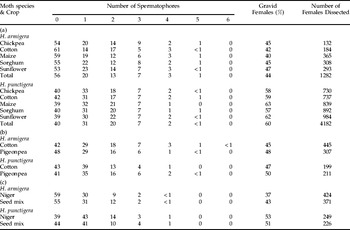
During the 1990–91 spring-summer growing season, light traps were set within five different crop types (cotton, chick pea, sorghum, maize and sunflower) at ACRI, compared with the more restricted numbers of crops in subsequent years (table 1). There were no differences between the reproductive maturity nor the numbers of spermatophores within female H. armigera moths across these different crop types (table 2a) (Chi-squared with 4 df for reproductive maturity=4.16, P>0.05; Chi-squared with 20 df for numbers of spermatophores=19.55, P>0.05). There was also no difference between the reproductive maturity of female H. punctigera moths across the different crop types (table 2a) (Chi-squared with 4 df for reproductive maturity=8.99, P>0.05), but there was for numbers of spermatophores (Chi-squared with 20 df=36.98, P<0.05). The largest contributions to this latter significance were the unexpectedly high number (12) of female H. punctigera moths caught within the sorghum crop that contained five spermatophores (this contributed a cell Chi-squared=9.3, although only representing 1.3% of the sorghum catch) and the lack of any females with five spermatophores in the maize catch (cell Chi-squared=4.8). Overall (all crops combined), H. punctigera was again consistently more (reproductively) mature than H. armigera (Chi-squared with 1 df=105.8, P<0.001) and more often mated (i.e. at least once, using spermatophore counts of 0–5 per female) (Chi-squared with 5 df=136.6, P<0.001). However, amongst the mated females, there was again a tendency for H. armigera females to have mated more often than the H. punctigera females (Chi-squared with 4 df=31.0, P<0.001).
Frequencies (%) of spermatophores in dissected female H. armigera and H. punctigera moths caught in light traps set amongst various crops at ACRI, Narrabri, New South Wales during (a) 1990–91, (b) 1993–4 and (c) 1995–96.

Dissections of female moths from light traps were sufficient in 1993–94 (cotton and pigeon pea crops) and 1995–96 (niger and seedmix crops) to enable similar analyses of reproductive maturity and mating according to crop type (table 2b, c). There were no intra-specific differences in the maturity or mating of the moths collected in cotton and pigeon pea crops in the 1993–94 season (Chi-squared with 1 df for maturity=0.5, P>0.05 and 0.5, P>0.05 for H. armigera and H. punctigera, respectively; Chi-squared with 5 df for spermatophore counts (0–5 per female)=7.1, P>0.05 and 3.4, P>0.05 for H. armigera and H. punctigera, respectively) nor niger and ‘seed mix’ crops in the 1995–96 season (Chi-squared with 1 df for maturity=2.3, P>0.05 and 0.1, P>0.05 for H. armigera and H. punctigera, respectively; Chi-squared with 4 df for spermatophore counts (0–4 per female)=3.3, P>0.05 and 2.5, P>0.05 for H. armigera and H. punctigera, respectively. Overall (both crops combined in each season), H. punctigera yet again showed a higher proportion of reproductively mature females than H. armigera in 1995–96 (Chi-squared with 1 df=18.7, P<0.001), but this was not the case in 1993–94 (Chi-squared with 1 df=0.5, P>0.05). Also, no inter-specific differences could be demonstrated between spermatophore frequencies in 1993–94 (when data for both crops were combined), either using spermatophore counts of 0–5 per female or 1–5 per female (Chi-squared with 5 df=8.7, P>0.05 and Chi-squared with 4 df=7.8, P>0.05). However, in 1995–96, an inter-specific difference in spermatophore frequencies was obtained when counts of 0–4 spermatophores per female were compared (Chi-squared with 4 df=30.5, P<0.001); whilst when counts of 1–4 per female were used, no difference resulted (Chi-squared with 3 df=2.5, P>0.05). Collectively, these data suggest that female H. punctigera females were more likely to have mated than female H. armigera in 1995–96, but not in 1993–94.
Discussion
The male moths collected in pheromone traps near ACRI, Narrabri during 1992–2002 were most commonly H. punctigera in late winter-spring (August–October; weeks 7–16) and H. armigera in summer-autumn (December–May; weeks 23–45). In contrast, H. puntigera (both male and female moths) predominated in light traps until mid-summer (late January; about week 30) after which H. armigera was most common. That is, light traps indicated that H. punctigera predominated later into the summer growing season and longer than pheromone traps suggested. Concurrent studies (C. Tann & G. Baker, unpublished data), wherein egg, larval and pupal collections were made in the vicinity of Narrabri and reared through to adult moths, have suggested a switch to a predominance of H. armigera occurs in field populations in February (about weeks 32–35), supporting the greater validity of light traps as indicators of current moth community structure. In addition, Forrester et al. (Reference Forrester, Cahill, Bird and Layland1993) also presented data on the relative proportions of H. armigera and H. punctigera that they reared from eggs collected from cotton in northern New South Wales in the 1980s. They found a general switch from a predominance of H. punctigera to that of H. armigera in late February (i.e. about week 34).
Other authors have also commented on discrepancies between light and pheromone trap catches of H. armigera and H. punctigera. In particular, Fitt et al. (Reference Fitt, Forrester and Cahill1984) reported that catches in light traps in northern New South Wales during the early 1980s matched the species composition of Helicoverpa amongst local egg lays better than did pheromone trap catches. In general, they found more H. armigera and less H. punctigera in pheromone traps than might be expected based on egg lays. Fitt et al. (Reference Fitt, Forrester and Cahill1984) suggested that pheromone traps may thus be unreliable indicators of the relative abundance of H. armigera and H. punctigera. They gave several possible explanations for such deficiencies in pheromone trap catches, including (i) poorer performance of the synthetic pheromone used for H. punctigera compared with that for H. armigera (in both the lure's content per se and its sensitivity to environmental factors), (ii) possibly a less suitable trap design being used relative to H. punctigera's behaviour, and (iii) differential reproductive status of females within the trap vicinity (e.g. more H. punctigera females already mated and not attractive to males, thus ovipositing more than the number of males in pheromone traps might suggest). In relation to Fitt et al.'s (Reference Fitt, Forrester and Cahill1984) first explanation, the H. punctigera lure contains both aldehyde and acetate components, whilst the H. armigera lure contains only aldehydes. Given that aldehydes and acetates volatilise at different rates, Wilson (Reference Wilson1984) suggested the relative efficiencies of these lures might be influenced by such differences. In relation to Fitt et al.'s (Reference Fitt, Forrester and Cahill1984) third explanation, it is of interest that we found that H. punctigera females did seem to be more often mated in our study compared with H. armigera females.
Fitt et al. (Reference Fitt, Zalucki and Twine1989) found little spatial consistency in pheromone trap catches of H. armigera and H. punctigera in their 1982–1985 study (see above) in northern New South Wales. They noted strong patchiness in the trap catches for the two species and suggested that regional patterns of moth abundance cannot be easily predicted from traps at ‘one or two sites only’. We concur with this finding. Our data also showed marked differences in catch could occur at sites in close proximity within individual years.
In addition, Fitt et al. (Reference Fitt, Zalucki and Twine1989) showed a predominant spring (late September–October) peak in catches of both H. armigera and H. punctigera, whilst Wilson (Reference Wilson1983) collected moths in light traps near Narrabri from 1973 to 1981 and found that peaks in catch occurred frequently for both species in November–December, and occasionally later in the season for H. armigera. Fitt & Daly (Reference Fitt and Daly1990) set a grid of pheromone traps for male H. armigera and H. punctigera throughout the Namoi Valley in northern New South Wales for four years (1985–89). They demonstrated peaks in catches of both species in weeks 10–15 (i.e. in early spring, September–October). A smaller peak was obvious for H. punctigera in one year between weeks 20–25, but thereafter such moths were rarely caught. A second peak, usually less than the first, was also found for H. armigera between weeks 20–25. This species was commonly caught in the traps until about week 40. Thus, the data obtained by these authors for H. punctigera resembled what we found, but their data for H. armigera were somewhat the reverse of our results, i.e. generally higher numbers in the first peak, compared with later in the season. On the other hand, Duffield & Steer (Reference Duffield and Steer2006) set pheromone traps for H. armigera and H. punctigera in southern New South Wales for three seasons (1997–2000). The patterns they observed in their catches were similar to those that we found, with early spring peaks in the abundance of H. punctigera and late summer peaks in abundance for H. armigera, in two out of the three years for both species. Earlier, Persson (Reference Persson1976) likewise observed a late summer bias in the abundance of H. armigera, using a light trap for 18 months in southern Queensland, but a spring peak only for H. punctigera. Maelzer & Zalucki (Reference Maelzer and Zalucki1999) analysed light trap data collected at ACRI, Narrabri in the 1970s and 1980s and found that both H. armigera and H. punctigera were more often caught in early to mid-summer (2nd generation) than at other times. Wu et al. (Reference Wu, Guo and Gao2002) set light traps for H. armigera from spring to autumn in central China for two years and reported a distinct late summer bias in their catches.
It is difficult to find an explanation for the varied results in these studies, including our own, especially for H. armigera. Perhaps the conclusion has to be that the seasonal patterns in trap catches are highly variable and studies of just a few years duration can lead to very different findings. The notable exception to this conclusion is the Maelzer & Zalucki (Reference Maelzer and Zalucki1999) long-term study of data collected during the 1970s and 1980s, wherein H. armigera mostly peaked in early to mid-summer, compared with our long-term study from the 1990s to the early 2000s which found a definite bias in the abundance of H. armigera in late summer. Possibly, there have been changes in the dynamics of H. armigera over the last three decades?
Maelzer et al. (Reference Maelzer, Zalucki and Laughlin1996) reported an initial seasonal peak in the light trap catch of H. punctigera prior to about week 20 (i.e. before mid-November) at ACRI near Narrabri (during the 1970s and 1980s) and regarded this to be a mixture of (mostly) migrant moths arriving from inland areas (from approximately mid-September onwards) and, to a very small degree, moths that emerged locally (from approximately October onwards). Maelzer et al. (Reference Maelzer, Zalucki and Laughlin1996) did not distinguish male and female moths in their catches. We found a similar peak in male moths in both light and pheromone traps (but beginning slightly earlier – at the start of September). However, there was little evidence of such a peak in female moths in the light traps. Rather, there seemed to be a more gradual increase in female catch from early September through to November. Reasons for this difference in the temporal patterns of the sexes of H. punctigera are not clear. In contrast, no obvious differences in the seasonal patterns of the sexes of H. armigera were observed, although males were caught more often overall than females. The apparent ‘lack’ of female H. punctigera early in the season begs the question: did the particularly high catch of males in pheromone traps at that time reflect, at least in part, low competition from calling female moths (as per the suggestion by Kvedaras (Reference Kvedaras2003) for H. armigera – see Introduction above)? Alternatively, perhaps there was a difference in mobility between the sexes, in particular, in relation to the upward-facing light traps that we used. But why the seasonal difference in sex ratios in the catch of H. punctigera?
Local weather patterns and the abundance of early generations of Helicoverpa spp. caught in traps might be used to predict the likelihood of pest problems later in the cotton growing season (Maelzer et al., Reference Maelzer, Zalucki and Laughlin1996; Maelzer & Zalucki, Reference Maelzer and Zalucki1999, Reference Maelzer and Zalucki2000). Maelzer et al. (Reference Maelzer, Zalucki and Laughlin1996) reported significant positive relationships between the numbers of H. punctigera and H. armigera caught during the 1st and 2nd generations in light traps each ‘season’ (i.e. prior to about mid-November and between mid-November and mid-January) at Narrabri. In addition, they found positive correlations between local rainfall during winter and the subsequent size of the 2nd generations in the catches of H. punctigera and H. armigera (and the 3rd generation of the latter), but negative relationships with spring rainfall. Maelzer et al. (Reference Maelzer, Zalucki and Laughlin1996) and Maelzer & Zalucki (Reference Maelzer and Zalucki1999) argued that winter rainfall would probably have enhanced host plant abundance for the 1st generation larvae of these moths, with flow-on effects thus inferred for the abundance of subsequent generations. They also suggested the negative influence they observed for spring rainfall might be due to dislodgement of eggs and larvae from host plants. In somewhat contrast, Fitt et al. (Reference Fitt, Gregg, Zalucki and Twine1990) reported that low rainfall in spring could reduce the abundance of Helicoverpa by withering host plants.
The results of our study, which was run over the same number of seasons (n=11) and near Narrabri, as was the earlier work of Maelzer et al. (Reference Maelzer, Zalucki and Laughlin1996) and Maelzer & Zalucki (Reference Maelzer and Zalucki1999), failed to show any (local) climatic relationships with light trap catches, but did demonstrate some linkages using pheromone traps. However, these relationships were not always in agreement with the conclusions of the previous authors. We too found a negative relationship between spring rainfall and subsequent abundance of H. punctigera, but curiously this was only apparent for the 3rd generation, not the 2nd generation which followed spring more closely. In addition, the abundance of the 2nd generation of H. armigera was positively correlated with both spring and summer rainfall, which does not support the conclusion that heavy rainfall could dislodge eggs and larvae from plants (see above). Our light trap data did, however, support the findings of Maelzer et al. (Reference Maelzer, Zalucki and Laughlin1996) and Maelzer & Zalucki (Reference Maelzer and Zalucki1999) that the size of late generations of Helicoverpa spp. can be positively correlated with that of early generations. Further, we showed that the numbers of 1st generation H. armigera and H. punctigera were strongly correlated, suggesting perhaps that both species might be responding to similar environmental cues. Whilst there is limited consistency in all these findings, such perhaps is not too surprising, given that very heavy pesticide use at the times of the studies (Fitt, Reference Fitt, Romeis, Shelton and Kennedy2008) must have influenced populations substantially, irrespective of the effects of other environmental drivers on their abundance.
Like Gregg et al. (Reference Gregg, Fitt, Zalucki, Murray, Drake and Gatehouse1995) before them, Oertel et al. (Reference Oertel, Zalucki, Maelzer, Fitt and Sutherst1999) found that the abundance of H. punctigera in the 1st (spring) generation in light traps in eastern Australia was highly variable across years, and sought explanations further afield in central Australia rather than locally. Oertel et al. (Reference Oertel, Zalucki, Maelzer, Fitt and Sutherst1999) reported significant correlations between such abundance and the amount of rainfall in central Australia in the preceding May and June. In particular, they reported significant relationships for meteorological districts 36 and 45 in western Queensland. Oertel et al. (Reference Oertel, Zalucki, Maelzer, Fitt and Sutherst1999) considered the growth responses of suitable host plants to increased rainfall in these inland regions to be the important drivers for this relationship. Whilst we found a few significant correlations between inland autumn and winter rainfalls and subsequent abundance of Helicoverpa moths in traps in spring at the same site near Narrabri, such correlations were rare and could well have occurred by chance. Curiously, our light traps failed to show any significant correlations between autumn and winter rainfalls in central Australia and 1st generation moth abundance. What significant correlations we did obtain were based on pheromone trap catches, and were more common for H. armigera than H. punctigera, which is counter to what might have been expected based on our previous understanding of the relative seasonal movements of the two species (see Introduction above). Oertel et al. (Reference Oertel, Zalucki, Maelzer, Fitt and Sutherst1999) did comment that the relationships they observed were weak and that additional factors such as temperature, evaporation, and prevailing wind systems may be required to provide accurate forecasts of potential infestations in eastern cropping regions.
Possible reasons for the reduced catch of H. punctigera in late summer, whilst the catch of H. armigera increases (see comments above referring to exceptions to this), have been speculated upon (Maelzer et al., Reference Maelzer, Zalucki and Laughlin1996) and include a lack of attractive plant hosts, increased mortality and emigration, but none of these explanations is particularly persuasive in the absence of convincing data. Pesticide resistance in H. armigera, but not in H. punctigera (Forrester et al., Reference Forrester, Cahill, Bird and Layland1993; Fitt, Reference Fitt1994; Zalucki et al., Reference Zalucki, Adamson and Furlong2009), may contribute at least part of the explanation.
Coombs et al. (Reference Coombs, Del Socorro, Fitt and Gregg1993) found that the majority of female H. punctigera and H. armigera moths caught in tower-mounted light traps on mountain tops in northern New South Wales were reproductively immature and unmated (approximately 89% for both species). They argued that these moths were long-distance migrants undertaking pre-reproductive dispersal. Such moths contrasted markedly with those collected in the light traps at ACRI, where up to 54–62% were reproductively mature and 44–65% had mated (H. armigera and H. punctigera, respectively within each range) (figs 9 and 10). In addition, the vast majority of the mated females caught by Coombs et al. (Reference Coombs, Del Socorro, Fitt and Gregg1993) carried only one spermatophore (79% for H. armigera and 97% for H. punctigera), with a maximum of three spermatophores per female for H. armigera and two for H. punctigera. This contrasts with the current study where up to six spermatophores were found per female in both species, and 40–45% of mated females had mated more than once. It is reasonable to assume that mating frequency increases with female age (Raulston et al., Reference Raulston, Snow, Graham and Lingren1975; Coombs et al., Reference Coombs, Del Socorro, Fitt and Gregg1993) and Armes & Cooter (Reference Armes and Cooter1991) have demonstrated that flight activity of H. armigera females generally decreases after mating. It, thus, seems likely that the majority of the female moths that we trapped at Narrabri were not long-distance migrants but rather reasonably local in their movements. Su et al. (Reference Su, Wang and Ge2006) captured female H. armigera moths in China in waterbasin traps, with and without synthetic female sex pheromone added. The majority of these females (approximately 88 and 87%, respectively) were mated. The female moths carried on average 1.5 and 0.9 spermatophores, respectively. These data suggest even more prolific sexual activity than that recorded in the present study.
Overall, our results highlight the extreme variability in trap catches of H. armigera and H. punctigera and call into question whether the magnitude of catches in either pheromone or light traps can be used in a quantitative way to make useful predictions of future Helicoverpa abundance. Clearly, there are many factors influencing the likelihood that moths respond to cues provided by these traps. It would also be particularly useful to better understand the relative abundances (and timings) of immigrant and locally emerging moths in the cropping regions in spring, in order to partition their contributions to 1st generation populations.
Acknowledgements
The research was generously supported by the Cotton Research and Development Corporation. Several CSIRO staff have contributed greatly to the collection of data reported here. We especially thank Donna Jones and Tracey Parker for their support. We also thank Peter Gregg for his helpful comments on a draft manuscript.