Suicide attempts, or self-injurious behavior with some intent to die (Nock, Reference Nock2010), are a leading cause of death in adolescents (Kann et al., Reference Kann, McManus, Harris, Shanklin, Flint, Queen and Lim2018). According to Centers for Disease Control and Prevention Youth Risk Behavior Surveillance (CDC YRBS), 6769 youth aged 10–24 died by suicide in 2017, with even greater numbers reporting non-fatal attempts (e.g. 7.4% of high school youth in a 12-month assessment period; Kann et al., Reference Kann, McManus, Harris, Shanklin, Flint, Queen and Lim2018). Suicidal behavior is a particularly alarming public health concern, as suicide is one of the only leading causes of death to increase in prevalence over past decades, while other leading causes of death have decreased (e.g. motor vehicle fatalities; Derrig, Segui-Gomez, Abtahi, & Liu, Reference Derrig, Segui-Gomez, Abtahi and Liu2002).
Clinical assessments (e.g. suicide risk interviews and self-report screening) are primary methods for understanding suicidal behavior, and studying these methodologies is one way to improve suicide risk detection. Assessing suicide attempts is a cornerstone of all suicide-focused measures; however, the language used across measures varies, with some measures asking directly phrased questions about suicide attempts (i.e. use the word ‘suicide’) and others using indirectly phrased questions, such as asking if individuals have engaged in self-harm behavior as a way to end their life, without the term ‘suicide’. Research has not yet examined whether adolescents respond differently when suicide attempt questions are phrased directly or indirectly. Further, research has not yet examined whether adolescents of varying sociodemographic backgrounds endorse suicide attempt questions differently when phrased directly and indirectly.
This research gap remains troubling, as multiple converging research areas (i.e. on culture, mental health language, and suicide communication) indicate individuals from varying sociodemographic backgrounds may communicate differently about mental health concerns (Loveys, Torrez, Fine, Moriarty, & Coppersmith, Reference Loveys, Torrez, Fine, Moriarty and Coppersmith2018) and suicide specifically (Leenaars et al., Reference Leenaars, Sayin, Candansayar, Leenaars, Akar and Demirel2010; Batterham, Calear, & Christensen, Reference Batterham, Calear and Christensen2013). Broadly, research on culture, communication, and mental health literacy indicates communication differences exist for individuals of different cultures and ethnicities. For example, the cultural theory has long differentiated between high- and low-context culture communication, such that low-context culture communication (e.g. American culture) emphasizes direct and explicit verbalizations, whereas high-context culture communication (e.g. Hispanic, Chinese, and Native American cultures) heavily depends on context and situation, and involves indirect language and subtle non-verbal cues (Hall, Reference Hall1976, Reference Hall, Samovar and Porter2000; Brice, Reference Brice1993, Reference Brice2000; Plawecki, Sanchez, & Plawecki, Reference Plawecki, Sanchez and Plawecki1994). These communication differences have been evidenced in mental health research (e.g. De Choudhury, Sharma, Logar, Eekhout, & Nielsen, Reference De Choudhury, Sharma, Logar, Eekhout and Nielsen2017), and integrated into treatment manuals for working with diverse clients. For example, the cultural sensitivity in mental health text recommends indirect communication and use of metaphors and proverbs with Latinx individuals in therapy (Jiménez, Alegría, Camino-Gaztambide, & Zayas, Reference Jiménez, Alegría, Camino-Gaztambide, Zayas and Parekh2014, pp. 79–81). Overall, prior work indicates notable cultural differences in communication, which may transcend communication about mental health symptoms and suicide specifically.
Preliminary studies on adult suicide communication and bereavement indicate suicide language is embedded in cultural and societal norms. For example, Owen et al. (Reference Owen, Belam, Lambert, Donovan, Rapport and Owens2012) found ‘suicide communication events’ for adults bereaved by suicide in the United Kingdom often involve indirect language and euphemisms intended to ‘save face’, a finding contextualized by cultural norms, and that some individuals may wish to use indirect language to reduce distress. A study by Wasserman et al. (Reference Wasserman, Thanh, Minh, Goldstein, Nordenskiöld and Wasserman2008, pp. 49–50) indicated that greater numbers of rural Vietnamese young adults reported indirect communication about ‘wish to disappear from life’, relative to direct verbal suicidal communication. Lastly, echoing research on broad cultural differences in language, a cross-cultural thematic comparison of suicide notes from Turkey and USA found that notes from Turkey had more indirect and ‘veiled communications’ about suicide than notes from USA (Leenaars et al., Reference Leenaars, Sayin, Candansayar, Leenaars, Akar and Demirel2010). Although preliminary, adult research shows cross-cultural differences exist in how directly adults speak about suicide.
Despite this tentative adult research, to our knowledge, no studies have investigated whether demographic characteristics (sex, age, ethnicity/race, parental education, and public assistance usage) and mental health service histories impact the endorsement of directly and indirectly phrased questions about suicide attempts in an adolescent sample. Addressing this empirical gap is critical to a better understanding of sociodemographic factors impacting suicide risk assessment and how adolescents respond to differently phrased questions. Beyond this, evidenced demographic differences in item endorsement may indicate using a combination of directly and indirectly phrased questions in suicide risk assessments, to provide youth with linguistic options they may be more likely to understand or identify with. Lastly, findings may be used to inform culturally sensitive treatments, and the language therapists use these when working with teens of varying backgrounds. To this end, the primary aims of this study are to investigate whether a geographically diverse sample of adolescents endorse directly and indirectly phrased suicide attempt questions differently and to examine whether sociodemographic and mental health service factors impact endorsement differences of such questions.
Methods
Participants
Participants were drawn from an existing, National Institute of Mental Health (NIMH)-funded multi-site study, the Emergency Department Screening for Teens at Risk for Suicide (ED-STARS). As part of the principal study, a youth cohort aged 12–17 years were recruited upon presentation to 13 pediatric emergency departments (EDs) participating in the Pediatric Emergency Care Applied Research Network (PECARN) (June 2015–July 2016) and an Indian Health Services Emergency Department (November 2015–April 2017) in the United States. In total, 6641 participants were enrolled in ED-STARS. For the current study, a sample of N = 5909 participants with complete suicide attempt variables and demographic characteristics were included.
Procedures
Institutional Review Board approval was obtained for the principal study and procedures. At the 13 PECARN sites, recruitment took place during shifts that were randomly selected for each site from among the time periods when research staff were on site. At the IHS site, study staff conducted a daily review of ED admission and approached the families of adolescents who had obtained ED services for possible participation following their discharge. Research staff included trained PECARN research coordinators who completed training on study and consent procedures. Parental/legal guardian consent and adolescent assent were obtained by research coordinators prior to protocol completion. Inclusion criteria for the ED-STARS study were: (a) adolescent aged 12–17 years, (b) adolescent was English speaking, and (c) adolescent was medically stable. Adolescents were excluded if they were medically unstable, exhibited severe cognitive impairment, or were wards of the state.
The assessment battery included a self-report survey completed on computer tablets by adolescents and their parents/legal guardians following consent and assent. The survey captured both self- and parent-reported demographic information, as well as clinical functioning and suicide risk factors. Participants received financial reimbursement. Further details about ED-STARS protocol are described in King et al. (Reference King, Grupp-Phelan, Brent, Dean, Webb, Bridge and Rea2019).
Measures
Suicide attempt outcome variables
The Columbia Suicide Severity Rating Scale (C-SSRS) is a widely accepted measure of suicidal ideation and behavior with validated psychometric properties (Posner et al., Reference Posner, Brent, Lucas, Gould, Stanley, Brown and Mann2008; Gipson, Agarwala, Opperman, Horwitz, & King, Reference Gipson, Agarwala, Opperman, Horwitz and King2015). The C-SSRS has been used to assess adolescent suicidal ideation and behavior, with youth presenting to pediatric EDs (e.g. King et al., Reference King, Brent, Grupp-Phelan, Shenoi, Page and Mahabee-Gittens2020) and psychiatric hospitals (e.g. Hill, Hatkevich, Kazimi, and Sharp, Reference Hill, Hatkevich, Kazimi and Sharp2017). Primary outcome variables assessing lifetime suicide attempt were two items from an adapted version of the C-SSRS for use in emergency care settings in the current study. One item asks: ‘Have you ever in your life made a suicide attempt?’; the other explains the definition of a suicide attempt: ‘Have you ever in your life tried to harm yourself because you were at least partly trying to end your life?’ We refer to these, respectively, as the directly and indirectly phrased language items. Response options for both language items were dichotomous (yes/no). The reading ability and specifically Flesch–Kincaid grade level was tabulated using an online tool for both the directly and indirectly phrased questions, and the direct item has an average reading level of 6.01 (US sixth-grade reading level) and the indirect item has a level of 5.36 (US fifth-grade reading level).
Demographic and mental health service usage characteristics
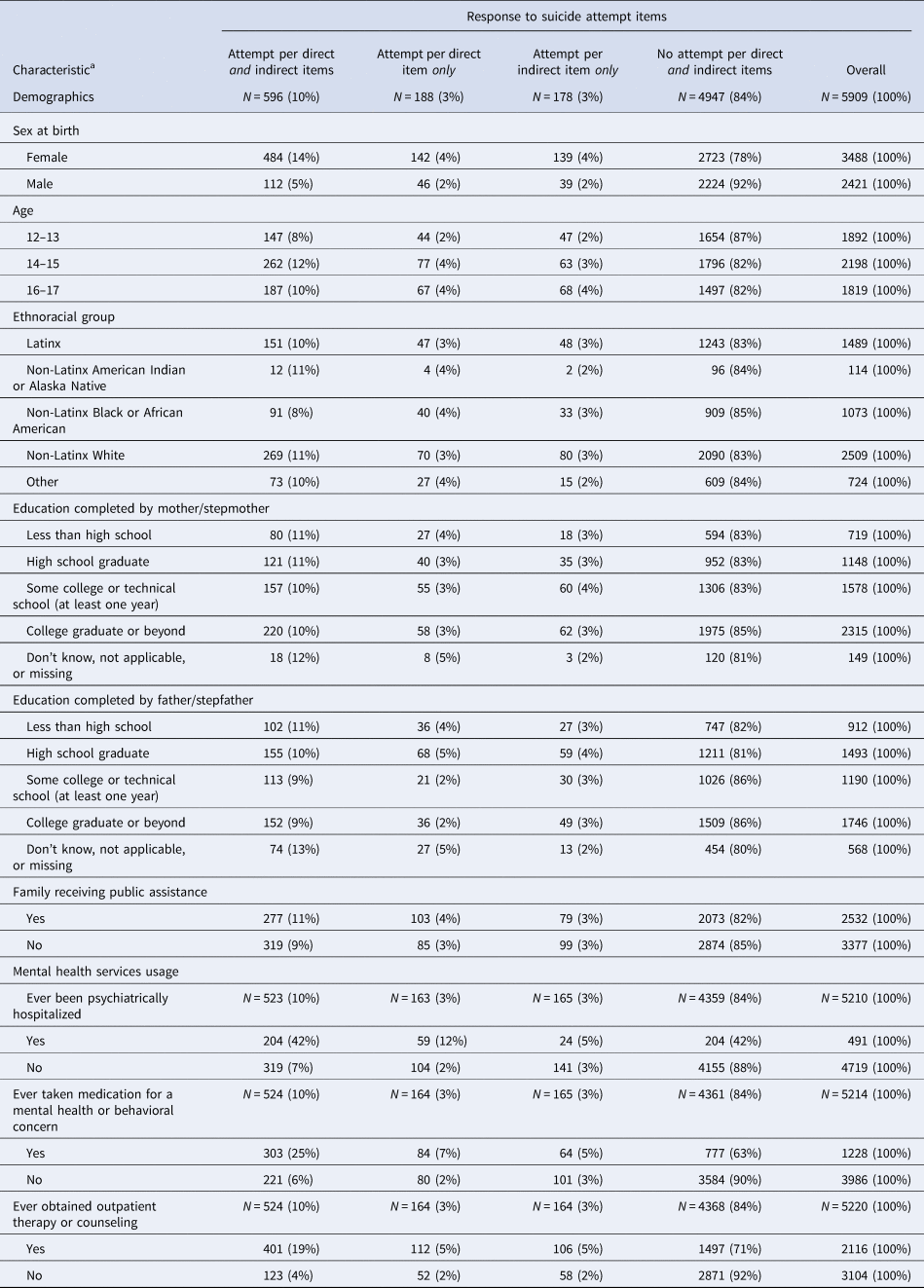
Adolescents and parents/guardians each had their own set of assessments to collect information about the adolescents. Some demographic information was requested on both adolescent and parent/guardian assessments; other demographic information and mental health service history were only requested on one assessment set. Demographic variables included in analyses were age, sex at birth, ethnicity/race, mother's education, father's education, and current public assistance; mental health service history variables included three-lifetime service usage variables: psychiatric hospitalization, medication taken for mental health/behavioral concern, and outpatient therapy/counseling. The response options were combined in some instances to facilitate summary and analysis, and the categories used for each item are depicted in Table 1. Sex at birth was per parent report, but youth report was used if the parent report was missing. Ethnicity/race are per parent and youth report, and represent a union of all options identified by a parent or youth report if discrepancies existed. We considered three-lifetime mental health service history variables per parent report: psychiatric hospitalization, medication taken for mental health/behavioral concern, and outpatient therapy/counseling. Response choices for mental health service use were dichotomous (yes/no).
Baseline patient characteristics by direct/indirect suicidal endorsement

a The demographic variables (first six) are among N = 5909 patients with no missing values for the two outcomes and no missing values for any of the six demographics variables. The mental health services usage variables (last three) are among patients with no missing values for the two outcomes, no missing values for any of the six demographic variables, and no missing values for the indicated variable. Because different items have different missing rates, each of these three variables has a unique sample size.
Data analytic strategy
Missing data frequency was calculated for each study variable. All subsequent analyses were performed on participants with data for both suicide attempt variables and for demographic variables, resulting in a sample of N = 5909, which was used for all analyses that did not depend on the mental health service usage variables. Analyses that incorporated mental health service use variables were conducted on the subset of 5909 participants who were not missing the relevant variable(s). Of note, and to maximize the number of participants eligible for inclusion, for parental education variables (mother's education and father's education), any non-response was grouped with the ‘don't know’ and ‘not applicable’ categories for parent's education.
In order to examine responses to the C-SSRS directly and indirectly phrased suicide attempt items, a 2 × 2 table was created to summarize the four observed patterns of item response endorsement in the two primary suicide attempt outcomes: those endorsing no past attempt on both items, those endorsing only the direct language past attempt item, those endorsing only the indirect language past attempt item, those endorsing both past attempt items. Baseline demographic and mental health service usage were calculated for the overall sample and by response profile.
To examine predictors of discordant responses to the C-SSRS directly and indirectly phrased suicide attempt items, each discordant response was considered in turn. First, logistic regression was used to assess the unadjusted associations of each demographic and mental health usage variable with whether the individual endorsed only the direct item or not (combining those who endorsed both, only indirect, or as ‘not endorsing only the direct item’). Then, logistic regression was conducted to assess unadjusted associations of demographic and mental health usage variables with whether the individual endorsed only the indirect item. If the assumptions for logistic regression were not reasonably met, exact logistic regression was considered to obtain odds ratios (ORs) and confidence intervals (CIs).
Two multivariable logistic regression models were created, with a separate model for each possible response discordance. The models were limited to consider only demographic variables that had significant unadjusted associations with the discordance. The Akaike information criterion (AIC) was used to determine final models. As a secondary set of multivariable logistic regression models, the data were further restricted to exclude individuals with any missing values for the mental health usage variables. Two multivariable models (one for each discordance) were then determined using AIC on this expanded set of predictors. Had multivariable models needed to use exact logistic regression, AIC would not have been a viable model selection criterion and thus stepwise selection with α = 0.10 would have been used to determine the multivariable models. Only the final multivariable models were depicted rather than all candidate models.
Exploratory post hoc analyses were conducted to elucidate sex at birth findings from univariable and multivariable analyses.
Results
Missing data
Among 6641 enrolled subjects, the number and percentage of missing values for each variable were generally modest but exhibited substantial variability, such as ranging from 0.8% missing for sex at birth (N = 55) to 17.6% missing for psychiatric hospitalization (N = 1168, see Table 1 for further details). Casewise deletion was conducted and resulted in a sample of N = 5909 (89.0% of the initial sample).
Response patterns to the direct and indirect language suicide attempt items
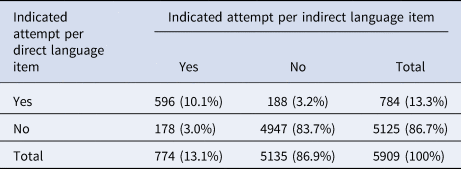
Table 2 depicts the four observed patterns of item response endorsement in the two primary suicide attempt outcomes. Findings indicate that a majority of the sample (83.7%) reported no lifetime attempt on both items, followed by endorsing attempts on both items (10.1%), and 6.2% of the sample had a discordant pair (i.e. endorsed either the direct or indirect items, but not both).
Response to baseline suicide attempt items (among N = 5909 responding to both items and with no missing demographics)

Sample characteristics
Demographic and lifetime mental health service use characteristics for the overall sample and by response profile are depicted in Table 1. Overall, the sample was largely female per sex at birth; regarding race and ethnicity, 1489 identified as Latinx, 2509 as non-Latinx White, 1073 as non-Latinx Black or African American, 114 as non-Latinx American Indian or Alaska Native, and 724 identified as others. Considerable spread existed in youth's parental education completed. In total, 42.8% of the sample reported public assistance. For lifetime mental health service usage, 9.4% of respondents reported prior psychiatric hospitalization, 23.6% reported taking a psychiatric medication, and 40.5% reported outpatient therapy/counseling history.
Demographic and mental health usage variables and suicide item responding
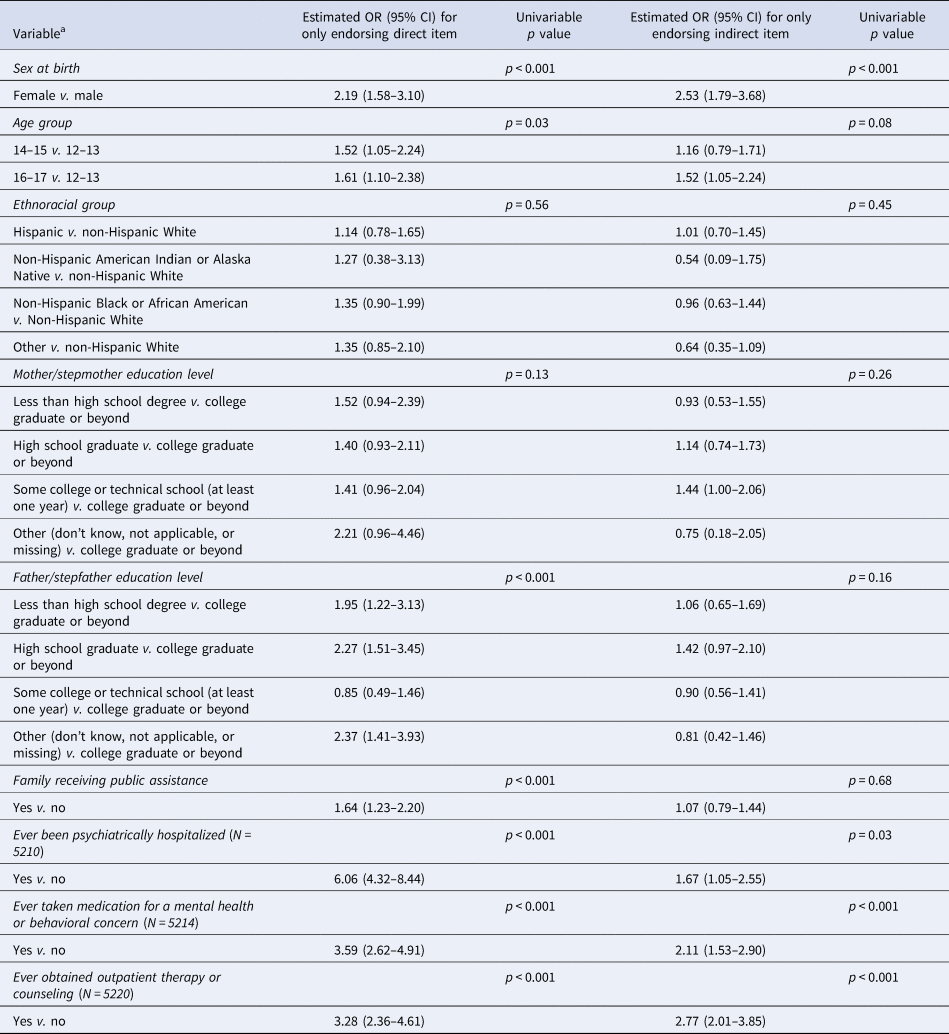
Table 3 depicts unadjusted associations between potential predictors and each pattern of discordant responses to directly and indirectly phrased attempt items. Most variables were predictive of only endorsing the direct item, while fewer were predictive of only endorsing the indirect item.
Univariable associations with indicators of endorsing only the directly and indirectly worded items

a The demographic variables (first six) are among N = 5909 patients with no missing values for the two outcomes and no missing values for any of the six demographics variables. The mental health services usage variables (last three) are among patients with no missing values for the two outcomes, no missing values for any of the six demographic variables, and no missing values for the indicated variable. Because different items have different missingness rates, each of these three variables has a unique sample size.
Multivariable models of predictors of discrepant item endorsement
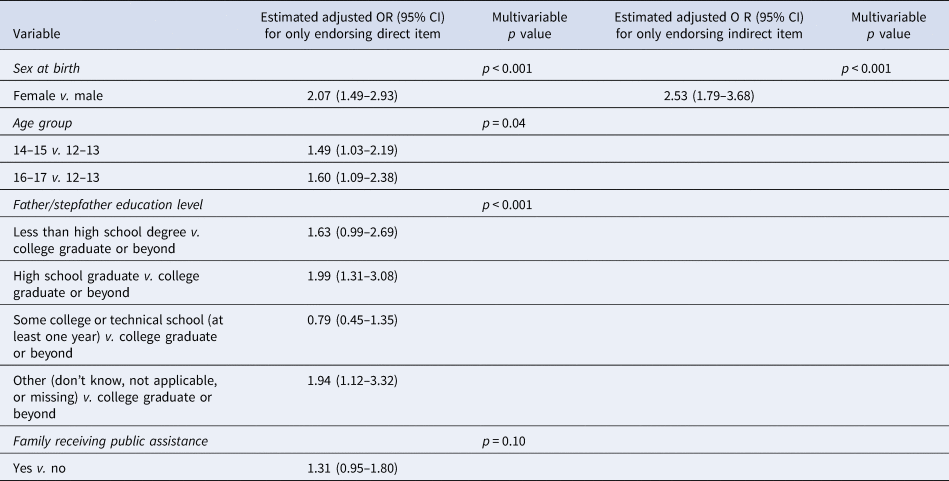
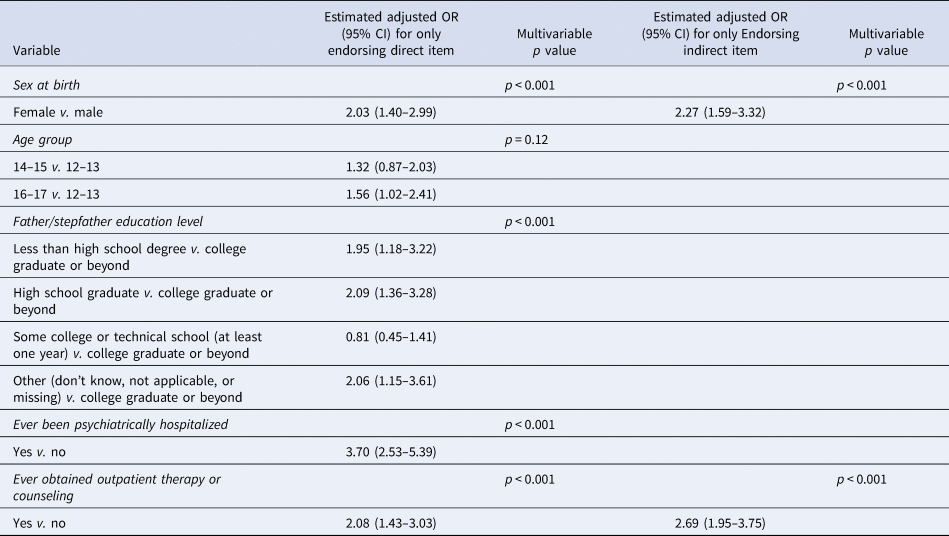
Table 4 shows the multivariable models with the lowest AIC when restricted to demographic variables that were significant in univariable models (see Table 3). The multivariable model for only endorsing the indirect item is redundant because only one demographic variable, sex at birth, demonstrated significant univariable predictive ability. All four demographic variables considered in the model for only endorsing the direct item were retained by the model with the lowest AIC. However, while sex, age, and father/stepfather education maintained significance, the adjusted OR for current public assistance was no longer significant.
Multivariable (Demographics Only) logistic regression models for indicators of endorsing only the directly, indirectly worded items (N = 5909)

As a secondary set of multivariable logistic regression models, data were further restricted to exclude individuals with any missing values for mental health usage indicators, resulting in a sample of N = 5189. Two multivariable models (one for each possible discordance) were then determined using AIC on this expanded set of predictors (i.e. including mental health service variables); these models are depicted in Table 5. Notably, although all service usage variables were significant in univariable models, at most two were retained in the multivariable models with the lowest AICs. Sex at birth and father/stepfather education level remained significant predictors of endorsing only the direct item when including mental health service variables. Specifically, female individuals were twice as likely as male individuals to endorse the direct item only [OR 2.03, 95% CI (1.40–2.99)], and youth whose fathers/stepfathers had less than a high school education [OR 1.95, 95% CI (1.18–3.22)], completed high school [OR 2.09, 95% CI (1.36–3.28)], or education was unknown, not applicable or unanswered [OR 2.06, 95% CI (1.15–3.61)], were twice as likely to endorse the direct attempt item only, relative to youth whose fathers were college graduates or beyond. Alternatively, youth with lifetime mental health service usage – specifically prior psychiatric hospitalization and therapy/counseling history – were more likely to endorse only the direct attempt item v. those not reporting this mental health service history. The multivariable model for endorsing only the indirect suicide attempt item retained two predictors when allowing mental health use variables: sex at birth and therapy/counseling history. Female individuals were twice as likely to endorse only the indirect attempt item [OR 2.27, 95% CI (1.59–3.32)] and youth were more likely to endorse only the indirect item if they had a therapy/counseling history.
Multivariable (Demographics and Mental Health Services Usage) logistic regression models for indicators of endorsing only the directly, indirectly worded items (N = 5189)

Post hoc analyses
Due to findings indicating sex at birth significantly predicted endorsement of both the direct and indirect suicide attempt items, additional post hoc analyses were conducted. First, exploratory post hoc analyses were conducted to assess potential interaction effects between sex and one of two mental health usage variables (prior psychiatric hospitalization or therapy/counseling history). Results are depicted in online Supplementary Table S6. For modeling the response of direct item endorsement only, there was a significant interaction effect [OR 0.38, 95% CI (0.17–0.83), p = 0.02] for female individuals with a prior psychiatric hospitalization. Among youth without prior hospitalization, female individuals were nearly three times as likely as male individuals to endorse the direct item only (OR 2.96). However, among youth with prior hospitalization, female individuals had nearly the same odds as male individuals to endorse the direct item only [OR 1.12, 95% CI (0.62–2.11)]. In the other models, there was no significant interaction.
An additional exploratory analysis was conducted to further explore the paradoxical finding that female individuals were both more likely to endorse only the direct item and more likely to endorse only the indirect item. The response profiles by sex shown in Table 1 (N = 5909) suggest that among those endorsing at least one item (N = 962), there may not be significant differences between female individuals and male individuals. To formally assess this data-driven conjecture, Fisher's exact test was applied to the 2 × 3 table in online Supplementary Table S7, which excludes individuals answering no to both items. The Fisher's exact test p value is 0.20, suggesting it is plausible that the previous significant sex findings are driven by the increased likelihood for female individuals of having endorsed at least one item. Conditional on reporting an attempt, there may be no difference between sexes as to how each of the two questions (i.e. direct, indirect suicide attempt items) were answered.
Discussion
The current study examined whether a geographically diverse sample of ED-recruited adolescents responded differently to directly and indirectly phrased questions about suicide attempts and investigated demographic and mental health service usage characteristics that predicted differential responding to suicide attempt items. Overall, 94% of youth responded consistently to both the directly and indirectly phrased suicide attempt questions of the C-SSRS, although a notable portion of the sample, 366 youth in total, endorsed only the directly or indirectly phrased questions, but not both.
Importantly, multiple sociodemographic and mental health service usage variables predicted discordant responding to suicide attempt items when variables were included concurrently. Specifically, female sex at birth, father/stepfather education level at or below high school education, and history of psychiatric hospitalization and outpatient therapy predicted endorsement of the direct suicide attempt item only. Interestingly, female biological sex and prior outpatient history were also the only significant predictors of solely endorsing the indirectly phrased suicide attempt item. To explore female sex at birth significantly predicting both types of discordant endorsement, post hoc analyses were employed and indicated paradoxical female endorsement of both items in isolation may be more an artifact of female individuals being more likely to endorse an attempt altogether, than attributable to potential nuances of female sex in combination with other demographic factors. This finding should be considered alongside the broader makeup of the sample, which is predominantly female, and work showing that female individuals make up a greater portion of emergency care visits for suicide attempts and self-inflicted injuries (Doshi, Boudreaux, Wang, Pelletier, & Camargo, Reference Doshi, Boudreaux, Wang, Pelletier and Camargo2005). Cumulatively, findings indicate a subsample of adolescents do respond discordantly to differently phrased suicide attempt questions, and discordant responding may be related to sociodemographics and mental health service factors.
The majority of this large pediatric sample responded identically to both questions about suicide attempt history, which is notable for multiple reasons. A high degree of uniformity in adolescents' responses to directly and indirectly phrased questions may imply that adolescents perceive these questions as asking about the same past behavior. High degree of consistency in item-level responding also suggests a lack of specific measurement errors that indicate individuals are interpreting particular items differently than other items intended to get at the same construct (MacDonald & Trafimow, Reference MacDonald and Trafimow2013). To this end, findings appear to support the within-participant response consistency for suicide attempt questions for the majority of the sample. Further, item-level responding indicates 13% of youth report a lifetime suicide attempt history. This prevalence rate is higher than past-year suicide attempt prevalence rates available through the CDC YRBS 2017 data (i.e. indicating 7.4% with past-year attempt; Kann et al., Reference Kann, McManus, Harris, Shanklin, Flint, Queen and Lim2018), which makes sense as YRBS data only captures past 12-month attempt rates in high school students, relative to lifetime history captured by the current assessment and in potentially high-risk youth presenting to emergency care settings. The elevated nature of the lifetime prevalence rate falls in line with literature indicating ED-recruited samples, including the current sample, have greater proportions of youth with elevated suicide risk (King, O'Mara, Hayward, & Cunningham, Reference King, O'Mara, Hayward and Cunningham2009).
Notwithstanding most youth responding consistently to both suicide attempt questions on the adapted C-SSRS, there was a considerable subsample where youth responded differently to each item. One preliminary finding was that adolescents whose fathers/stepfathers obtained less than, or the equivalent of, a high school education were more likely to endorse only the direct item, relative to youth whose fathers/stepfathers had obtained a college degree or beyond. Critically, this finding retained significance in all models, whether or not significant mental health service variables were included. Multiple factors may relate to this discordant responding, including child academic attainment, reading/verbal comprehension, and/or linguistic preferences for explicit verbal communication. One highly tentative explanation is that some youth whose fathers/stepfathers have obtained less than high school education may experience academic, and specifically reading/verbal comprehension difficulties, impacting their understanding of the indirect question as capturing the same construct as the direct question. Research (e.g.Eccles, Reference Eccles2005; Myrberg & Rosén, Reference Myrberg and Rosén2008; Dubow, Boxer, & Huesmann, Reference Dubow, Boxer and Huesmann2009) shows that child academic attainment and reading development is predicted by, and complexly related to, parent education attainment and family socioeconomic functioning. For example, Davis-Kean (Reference Davis-Kean2005) identified that parents' education attainment significantly predicted child academic attainment and did so indirectly through how much the child reads and warmth in parent–child interactions for African American families (pp 298–301). Subsequently, child academic functioning and reading/verbal comprehension development are impacted by a host of socioeconomic and parental education factors, and child academic attainment and verbal comprehension may have in part impacted youth's comprehension of indirectly phrased suicide attempt questions in the present study. This explanation is tentative and in need of further exploration, as the current protocol did not assess child academic functioning, verbal comprehension, or reading achievement.
In contrast to father's education, many sociodemographic factors (e.g. age, public assistance, ethnoracial identity, public assistance usage) failed to predict discordant responses to suicide attempt items, or became non-significant when included with other demographic and mental health service variables. Perhaps it is not that these demographics are unimportant for youth responding to suicide attempt questions, but rather that these characteristics are related to, and potentially subsumed by, other important demographic characteristics accounted for in the models (e.g. father's education). For example, family education, income, and public assistance are inherently related, with dropping out from high school associated with greater welfare usage (Coelli, Green, & Warburton, Reference Coelli, Green and Warburton2007), and public assistance eligibility determined by state-level poverty thresholds for family income (e.g. Temporary assistance for needy families; Falk, Reference Falk2014). It follows that fathers and stepfathers' education may have at least partially accounted for other related sociodemographic factors in models examining responses to suicide attempt questions.
Similar to sex findings, prior mental health usage variables significantly predicting sole endorsement of both the direct and indirect items appears paradoxical. Prior outpatient therapy/counseling experience predicting sole endorsement of the indirectly phrased attempt item is clinically intuitive and aligned with research on suicidal clients' under-reporting on risk assessments. Youth who have previously obtained mental health services may be cognizant of the reason therapists ask questions about suicide (i.e. to assess current suicide risk, determine the need for hospitalization), and may fear that endorsing direct suicide attempt questions may lead to psychiatric hospitalization or triage to emergency care. Research has recognized the ‘guarded suicidal patient’ (e.g. Simon, Reference Simon2008) and that some suicidal patients deny suicidal ideation in fear of the potential outcome (e.g. clinician over-reaction; Richards et al., Reference Richards, Whiteside, Ludman, Pabiniak, Kirlin, Hidalgo and Simon2018). Future studies should explore if teens who have prior mental health experience may have interpreted the direct suicide attempt question as screening for psychiatric hospitalization, and to this end non-endorsed the direct item while endorsing an indirectly-phrased question.
Despite these important findings, several limitations exist in the current study. First, teens who provided discordant responses (i.e. endorsed ‘yes’ to either the direct or indirect item, but ‘no’ to the other) were not asked to provide reasons for discordant responding (e.g. if due to linguistic preferences, difficulty comprehending the questions). To this end, the current study cannot fully speak to factors accounting for discordant responding to differently phrased attempt questions. Second, the current study did not assess child reading achievement through the use of a standardized assessment and subsequently cannot speak to the reading achievement and verbal comprehension of study participants, and if this factor is related to paternal education findings. Third, due to the brief nature of the study battery for implementation in emergency settings, the present study did not obtain information on specific sociodemographics (e.g. absolute family income and rural–urban area classification), which may be relevant to study findings. Fourth, the suicide attempt questions included in the present study were dichotomous (yes/no about prior attempt history), and the study is therefore limited by not fully capturing the suicide intent or lethality of prior attempts. Fifth, due to non-significant associations in univariate analyses, ethnoracial identity was not included in subsequent analyses; this precluded the further study of ethnoracial identity and specific language endorsement discrepancies that may be evident, but underpowered in smaller, but important subsamples (e.g. in non-Hispanic American Indian or Alaska Native youth). Lastly, the study used a large sample of emergency-recruited adolescents in the USA, and findings may therefore not generalize to adolescents in other countries.
Notwithstanding these limitations, the current study has notable strengths and clinical implications. The current study was the first to examine how a geographically diverse sample of emergency-recruited adolescents responded discordantly to suicide attempt questions that were phrased differently. Findings importantly revealed the majority of the youth responded consistently to both suicide attempt questions in a large US adolescent sample. Results also identified a subsample of youth who responded discordantly to these items, and potential demographic characteristics, like paternal education, that may partially account for why youth only endorse directly phrased questions about attempt history. For clinical implications, further research is first needed to investigate paternal education (specifically, less than/equivalent of high school education) significantly predicting responding to only the directly phrased item, and potential hypotheses [e.g. a subset of youth whose fathers have less than high school education, may themselves prefer explicit language about suicide, or have difficulty comprehending the indirectly phrased question (e.g. for the reason it contains a conditional clause, ‘at least partly trying to end your life’)]. Qualitative research and lexical analyses may be especially complementary to exploring these findings and hypotheses.
If further research replicates these findings, that youth whose fathers and/or stepfathers have obtained less than a high school education report difficulty understanding, or do not linguistically prefer, the indirect question, one clinical implication is that emergency medicine psychiatrists, psychologists, and other clinicians assessing suicide risk may need to further utilize directly phrased questions about ideation, attempt, and suicide-specific histories, in addition to indirectly phrased questions. Many commonly used suicide risk assessments (including the C-SSRS and Ask Suicide-Screening Questions; Horowitz et al., Reference Horowitz, Bridge, Teach, Ballard, Klima, Rosenstein and Joshi2012) in pediatric emergency care settings include direct questions about recent suicidal ideation, wish to be dead, and attempt history. If current findings replicate, use of both directly and indirectly phrased questions appears to be indicated for assessing adolescent suicide risk. Future research validating our findings on parental education, and child reading achievement as a contributing factor, may also point to a need to more closely examine the reading level of commonly utilized suicide risk assessments and interview questions, and identify potential modifications to questions for individuals who read at an elementary or middle school-level. Lastly, one important future direction for future research is to not only explore the ‘what’ of suicide attempt questions (i.e. language used), but the ‘when’, or optimal timing in which asking questions is likely to elicit an accurate response from teens. Future research would benefit from studying response to differently phrased suicide attempt questions, and the potential timing of when questions are posed in research or clinical settings.
Supplementary material
The supplementary material for this article can be found at https://doi.org/10.1017/S0033291720004213.
Acknowledgements
This manuscript was submitted on behalf of the PECARN.
Financial support
This study was supported by a grant from the NIMH, ‘Emergency Department Screen for Teens at Risk for Suicide’ (ED-STARS, U01 MH104311). It was also supported in part by the Health Resources and Services Administration (HRSA), Maternal and Child Health Bureau (MCHB), Emergency Medical Services for Children (EMSC) Network Development Demonstration Program under cooperative agreements U03MC00008, U03MC00001, U03MC00003, U03MC00006, U03MC00007, U03MC22684, U03MC28845, H3MC26201, and U03MC22685. The information or content and conclusions in this manuscript are those of the authors and should not be construed as the official position or policy of, nor should any endorsements be inferred by NIMH, HRSA, HHS or the US Government.
Conflicts of interest
Dr King receives research support from NIMH, NICHD, the CDC, and AFSP; and royalties from Guilford Press. Dr Brent receives research support from NIMH, AFSP, the Once Upon a Time Foundation, and the Beckwith Foundation, receives royalties from the Guilford Press, the electronic self-rated version of the C-SSRS, the eRT Inc., and from performing duties as an UptoDate Psychiatry Section Editor, receives consulting fees from Healthwise, and receives Honoraria from the Klingenstein Third Generation Foundation for scientific board membership and grant review. Drs Grupp-Phelan, Casper, Barney, Hatkevich, Cwik, and Melzer-Lange have no conflicts to disclose.