INTRODUCTION
The Caribbean Sea supports a diverse cetacean fauna comprising at least thirty species (UNEP, 2008). However, distribution data on most of these species are scarce. Even for the more extensively studied cetacean species, data on the biology of those species in the Caribbean Sea are deficient (UNEP, 2008). This limited knowledge is largely due to the paucity of systematic surveys in the Caribbean (Romero et al., Reference Romero, Agudo, Green and Sciara2001).
The islands of Aruba, Curaçao and Bonaire are situated to the north of Venezuela and represent the western part of the Leeward Antilles. In 1986, Aruba was granted independence, whereas Curaçao and Bonaire remained part of the Netherlands Antilles. Both Aruba and the Netherlands Antilles represent separate constituent countries within the Kingdom of the Netherlands. For ease of reference, this paper uses the non-political term ‘ABC Islands’ for Aruba, Curaçao and Bonaire.
Debrot and colleagues listed 13 cetacean species as having been recorded for the ABC Islands (Debrot, Reference Debrot1998; Debrot et al., Reference Debrot, De Meyer and Dezentjé1998). However, it is likely that several other species are present in the waters of the ABC Islands but have remained undetected. For instance, at least 24 species have been recorded from nearby Venezuela (Romero et al., Reference Romero, Agudo, Green and Sciara2001; Bolaños & Villarroel-Marin, Reference Bolaños and Villarroel-Marin2003; Bermúdez-Villapol et al., Reference Bermúdez-Villapol, Sayegh and León2008a, Reference Bermúdez-Villapol, Sayegh, Rangel, Rosso and Verab). Even though there are more than 70 records of cetaceans in the ABC Islands, most records are based on opportunistic sightings and not on systematic surveys for cetaceans (Debrot et al., Reference Debrot, De Meyer and Dezentjé1998).
Knowledge of the cetacean community of Aruba is particularly poor. Debrot et al. (Reference Debrot, De Meyer and Dezentjé1998) reported three species for Aruba, all of which were only known from single strandings: short-finned pilot whale (Globicephala macrorhynchus), Cuvier's beaked whale (Ziphius cavirostris), and dwarf sperm whale (Kogia sima). Barros & Debrot (Reference Barros and Debrot2006) reported three additional species for Aruba: Gervais' beaked whale (Mesoplodon europaeus; stranding of a female and calf), Atlantic spotted dolphin (Stenella frontalis; ‘various’ sightings) and rough-toothed dolphin (Steno bredanensis; sighting) but did not include any documentation for these records. Although Barros & Debrot (Reference Barros and Debrot2006) mention photographs on file for Stenella frontalis and a photograph of Steno bredanensis in a newspaper, no details were provided about the name of the newspaper or the date(s) of publication. Furthermore, no data have been made available about which diagnostic features have been observed that support the identification of these records. Therefore, the specific identity of these records is difficult to verify and no permanent scientific record of these sightings exists. Barros & Debrot (Reference Barros and Debrot2006) also reported a record of Risso's dolphin (Grampus griseus) and a further record of Ziphius cavirostris but expressed doubt about the identity of these records.
While undertaking the first dedicated cetacean surveys in Aruba in April 2010, photographic evidence for the occurrence of Pseudorca crassidens, Stenella frontalis and S. longirostris was obtained in Aruban waters.
False killer whale (Pseudorca crassidens)
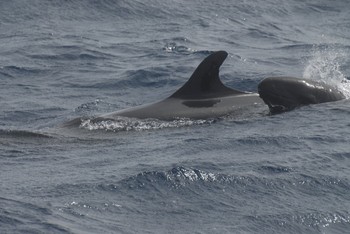
On 29 April 2010, a group of approximately 12 false killer whales was observed and photographed (Figure 1). The group was located about 1.3 km off the south-western coast (leeward side) of Aruba (12°29.110′N 70°01.221′W) (0.5 km off the reef island) at a water depth of 65 m, and was followed for 40 minutes during which the whales travelled 8.2 km. The animals were identified as Pseudorca crassidens based on their overall black colour, lack of ‘white lips’, long head with a rounded beak, and large dorsal fin with a rounded tip (Stacy et al., Reference Stacy, Leatherwood and Baird1994; Carwardine, Reference Carwardine1995). The group included at least two calves (animal less than 2/3 of adult length), both of which were accompanied by an adult.
False killer whales (Pseudorca crassidens) north-west of Aruba, 29 April 2010.

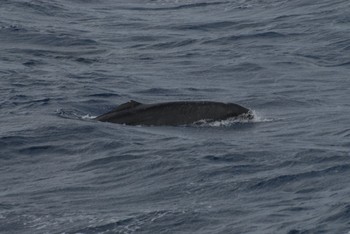
The whales occasionally approached the boat for bow-riding. Porpoising was observed in at least two different animals. Upon arrival on the north-western coastline of Aruba the whales started foraging in waters of 58–182 m depth. The whales were accompanied by three magnificent frigate birds (Fregata magnificens) the entire observed hunting time (approximately 41 minutes and 7 km). During the observation of the hunting, one lobtail and one leap clear of the water was observed. One whale was observed carrying a fish in its mouth. One individual had a truncated dorsal fin (Figure 2) and one individual had skin lesions on the dorsal side of its body.
False killer whale (Pseudorca crassidens) with severely damaged dorsal fin, south-west of Aruba, 29 April 2010.

Atlantic spotted dolphin (Stenella frontalis)
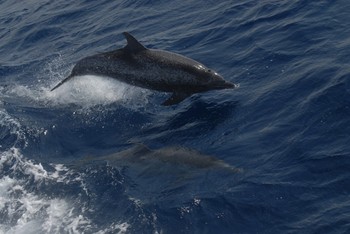
On 22 April 2010, a group of approximately eight Atlantic spotted dolphins was sighted and photographed (Figure 3). The location of the sighting was 2.7 km (2.2 km off the reef island) off the south-western coast of Aruba (12°28.101′N 70°01.359′W) at a water depth of 180 m. The animals were identified as Stenella frontalis based on the presence of: (i) a spinal blaze that sweeps up and backwards; and (ii) dorsal spotting (Perrin, Reference Perrin2002). Other differences observed that distinguish S. frontalis from the similar looking S. attenuata are: (iii) a colour pattern that consists of three parts, with a dark cape, lighter grey lateral side and white ventral side; (iv) the tail stock is not divided into upper dark and lower light halves; and (v) the absence of white lips and a marked white tip of the snout (Mignucci-Giannoni et al., Reference Mignucci-Giannoni, Swartz, Martínez, Burks and Watkins2003).
Atlantic spotted dolphins (Stenella frontalis) bow-riding, south-west of Aruba, 22 April 2010.

No wounds were observed. At least one calf (animal less than 2/3 of adult length) accompanied by an adult was seen. The individuals approached the boat at high speed for bow-riding on several occasions, but were lost after a few minutes. On most occasions two to three individuals approached the boat. The highest number approaching the boat was estimated to be eight individuals. The water depth of the entire area where they were observed ranged from 155 to 190 m deep.
Spinner dolphin (Stenella longirostris)
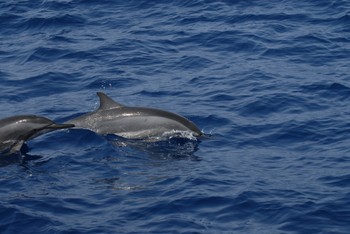
On 15 April 2010, a group of at least 70 spinner dolphins was observed and photographed (Figure 4) and further documented by two sound recordings. The group was located about 8.4 km off the south-eastern coast of Aruba (12°24.866′N 69°47.346′W) at a water depth of 600 m. The animals were identified as Stenella longirostris rather than the closely similar Clymene dolphin (S. clymene) based on their long, narrow beak, a triangular or sub-triangular dorsal fin which is slightly falcate and no ‘moustache’ mark was observed on the dorsal part of the rostrum (Carwardine, Reference Carwardine1995; Perrin, Reference Perrin1998). No wounds were observed on the animals.
Spinner dolphins (Stenella longirostris), south-east of Aruba, 15 April 2010.

The individuals approached the boat at high speed from the north and began bow-riding. Leaping was observed regularly. Several breaches were also observed. Six individuals remained with the boat, swimming underneath and around the boat for approximately 20 min. The animals were vocalizing continuously.
DISCUSSION
These are the first definitive records of Pseudorca crassidens and Stenella frontalis for the ABC Islands and the first record of Stenella longirostris for Aruba (cf. Debrot & Barros, Reference Debrot and Barros1994; Debrot, Reference Debrot1998; Debrot et al., Reference Debrot, De Meyer and Dezentjé1998).
The distribution of P. crassidens in the Caribbean is poorly known (Ward et al., Reference Ward, Moscrop and Carlson2001). In the southern part of the Caribbean, it has been reported in Colombia (Alberico et al., Reference Alberico, Cadena, Hernández-Camacho and Muñoz-Saba2000) and Venezuela (Bolaños & Boher, Reference Bolaños and Boher1996; Romero et al., Reference Romero, Agudo, Green and Sciara2001). In the Venezuelan part of the Leeward Antilles, P. crassidens has been sighted in Las Aves and Los Roques Islands (Romero et al., Reference Romero, Agudo, Green and Sciara2001). The false killer whales reported here were observed feeding in an area popular for big game fishing. False killer whales are known to feed on big game fish in Hawaii (Baird, Reference Baird2009). The severely damaged dorsal fin of a false killer whale is most likely the result of long-line fisheries. Baird & Gorgone (Reference Baird and Gorgone2005) also described a false killer whale with a missing dorsal fin and suggested that this is the result of interaction with long-line fisheries. More data on the occurrence of this species in the southern part of the Caribbean and its interactions with fisheries are necessary to assess its local conservation status.
The two ‘spotted’ dolphins S. frontalis and S. attenuata are closely related sister-taxa (Kingston et al., Reference Kingston, Adams and Rosel2009). The two species are difficult to separate in the field for the untrained observer and identification is ideally documented by photographic evidence (Mignucci-Giannoni et al., Reference Mignucci-Giannoni, Swartz, Martínez, Burks and Watkins2003). Until now, all well-documented records of ‘spotted dolphins’ in the ABC Islands referred to S. attenuata (LeDuc et al., Reference LeDuc, Perrin, Debrot, Barros and van Bree1997; Debrot et al., Reference Debrot, De Meyer and Dezentjé1998). In Venezuela, on the other hand, S. frontalis is widespread in both inshore and offshore waters whereas only one sighting of S. attenuata has been reported (Romero et al., Reference Romero, Agudo, Green and Sciara2001). In Colombia S. attenuata is known from very few records (Jefferson & Lynn, Reference Jefferson and Lynn1994; Pardo & Palacios, Reference Pardo and Palacios2006) whereas S. frontalis is more common (Vidal, Reference Vidal1990; Pardo & Palacios, Reference Pardo and Palacios2006). More field work is necessary to determine the relative abundance of these two species in the ABC Islands.
The distribution and habitat preferences of S. frontalis and S. attenuata in the Caribbean are poorly known (Mignucci-Giannoni et al., Reference Mignucci-Giannoni, Swartz, Martínez, Burks and Watkins2003). It has been suggested that S. attenuata occurs parapatrically with S. frontalis or replaces the latter near coastal areas and islands in the West Indies and the Lesser Antilles (Leatherwood et al., Reference Leatherwood, Caldwell and Winn1976). However, there are indications that the two species are sympatric in at least some parts of the Caribbean (Mignucci-Giannoni et al., Reference Mignucci-Giannoni, Swartz, Martínez, Burks and Watkins2003). Accurate recording of sightings for both species will help to clarify to what extent both species are sympatric and what ecological differences exist.
Spinner dolphins have been reported from the Caribbean coast of Colombia (Alberico et al., Reference Alberico, Cadena, Hernández-Camacho and Muñoz-Saba2000) and they are fairly common in eastern and central waters of Venezuela including the Venezuelan archipelago (Romero et al., Reference Romero, Agudo, Green and Sciara2001). Spinner dolphins are fairly common in Curaçao and Bonaire, where the species represents 30% of all opportunistic sightings of cetaceans (Debrot et al., Reference Debrot, De Meyer and Dezentjé1998). They are sighted throughout the year with an increase in sightings in late spring and summer (Debrot et al., Reference Debrot, De Meyer and Dezentjé1998). Therefore, its presence in Aruban waters was to be expected.
In all three newly reported species, the occurrence in Aruba was not surprising. These species have been overlooked due to a lack of research effort and a reliable reporting system, until now. Gero & Whitehead (Reference Gero and Whitehead2006) noted that it is important that all research activity in the Caribbean report their opportunistic sightings of small cetaceans so that a better overall picture can be produced through a synthesis of sparse data sets. Furthermore, it is important that new and significant sightings are properly documented in the scientific literature. Photographic (or video) documentation of rare sightings is important because it allows independent assessment of the accuracy of identifications and thus helps to avoid error or confusion about the ranges of the species involved (Fertl et al., Reference Fertl, Jefferson, Moreno, Zerbini and Mullin2003; Jefferson et al., Reference Jefferson, Fertl, Bolaños-Jimenez and Zerbini2009). The species reported here are often confused with other species and this has led to misidentification of past records. For instance, the first reports of false killer whale (Agudo & Ponson, Reference Agudo and Ponson1996) and striped dolphin Stenella coeruleoalba (Debrot & Barros, Reference Debrot and Barros1994) in the ABC Islands were subsequently re-identified as short-finned pilot whale and pantropical spotted dolphin, respectively, largely based on re-examination of photographic material (LeDuc et al., Reference LeDuc, Perrin, Debrot, Barros and van Bree1997; Debrot et al., Reference Debrot, De Meyer and Dezentjé1998).
Another benefit of photographic documentation of cetacean sightings is that it helps to catalogue individuals with noticeable injuries on their bodies, including cut-like wounds, skin ulceration and mutilation, which in turn may help to quantify the risk of injury due to human activity (Azevedo et al., Reference Azevedo, Lailson-Brito, Dorneles, Van Sluys, Cunha and Fragoso2009). Aruba is the second-most densely populated island in the Caribbean after Barbados, and fishing boats and other boat traffic is ubiquitous in coastal Aruban waters. Photo-documentation of marine mammals in Aruban waters may therefore be an important tool in identifying and quantifying threats and may help to inform future conservation management.
More detailed studies are necessary to establish the status of these and other cetaceans in Aruban waters. The discovery of two new species for the ABC Islands and a further new species for Aruba in a short period of time is not only remarkable, but implies that more species could be present but remain undetected due to a lack of research activity.
ACKNOWLEDGEMENTS
I am grateful to Angiolina Henriquez of the Aruba Marine Mammal Foundation for help with logistics and to Ida Does for her hospitality. I thank R.W. Baird and T.A. Jefferson for confirming the identity of some of the records and R.W. Baird, T.A. Jefferson, E.C.M. Parsons and G. Sangster, for their constructive comments on the manuscript. Fieldwork was supported by the Prins Bernhard Culture Fund, George Mason University, the Society for Marine Mammalogy, the Lerner-Gray Fund for Marine Research of the American Museum of Natural History, the Cetacean Society International, and the Humane Society International.