

Introduction
The global financial crisis and austerity policies implemented in the wake of the Eurozone sovereign debt crisis deeply shook the framework in which states, capital, and labor operate. Research abounds on the constraints felt and actions taken by national governmentsFootnote 1 and on the strategies pursued by trade unions.Footnote 2 Yet, little or no attention has been paid to the preferences and actions of the main national business associations, i.e., the employer confederations (ECs).
This paper aims to cross this bridge through the analysis of the role played by ECs in the institutional and political spheres of a peripheral Southern European country that was particularly struck by the Eurozone crisis. As numerous studies have shown, business groups enjoy considerable power given their structural sources and the dependence of society (and the state) on investments by private firms.Footnote 3 Moreover, they are also considered effective actors given their capacity to lobby and attain their strategic goals.Footnote 4 Finally, like trade unions, ECs are key actors in the network of relations established between the government and social partners, especially within “Mediterranean economies,” a hybrid and less stable model of socio-economic governance situated halfway between coordinated and liberal market economies.Footnote 5
Throughout the European periphery, far-reaching changes were implemented in labor market regulations, bargaining systems, public sector employment and welfare states.Footnote 6 To the extent that a prevalence in the system of interest intermediation seems to have emerged in favor of business organizations vis-à-vis trade unions and other civic organizations,Footnote 7 this period can be seen as a window of opportunity for employers to advance their agenda. Notwithstanding, important challenges might have also been faced, if one accounts for the existing research that highlights the eroded influence of the social partners in these adjustments,Footnote 8 as well as the acute economic downturn that occurred.
Portugal is a crucial case when studying the political alignments between ECs and governing parties.Footnote 9 Two main arguments can be made for the relevance of this case study. Within the realm of employer preferences, there is a recurrent heterogeneity that has been argued to have increased with the internationalization of the national economies.Footnote 10 Periods of economic hardship and ideological divisions can also deepen such heterogeneity,Footnote 11 which is frequently managed through internal and/or informal dynamics.Footnote 12 Portugal has four ECs with a seat at its tripartite body of concertation and thus presents a fragmentation at the peak-level of business representation that provides the necessary organizational autonomy for diverging interests to be publicly voiced, whereas in cases of greater organizational unity such differences might be more commonly addressed behind closed doors (e.g., Spain).
Secondly, Portugal falls into the hybrid category of the “mixed market economies,” which have been characterized, among other features, by the “politicization of interest associations.”Footnote 13 The way employers have interacted with political actors has indeed been studied in some of these countries,Footnote 14 but such has not been the case for Portugal. In addition, the period under analysis offers a variety of scenarios that may enable the observation of interesting patterns: there were two governments (elected in 2009 and 2011) of different political colors (center-left and center-right, respectively) under similar external constraints and a government solution never experienced before, with the Socialist Party (PS) ascending to power in 2015 with the parliamentary support of the parties on its left (Left Bloc (BE); Portuguese Communist Party (PCP); the Greens (PEV)).
What have been the preferences and main grievances expressed by the Portuguese employers during the crisis? Can we identify specific partisan alignments during this period? What are the main factors that have shaped the position of ECs vis-à-vis the government since the onset of the Great Recession? These are the main questions that guide our study, in an attempt to qualify conventional wisdom while providing the first in-depth analysis that is endogenous to a frequently neglected agent. By examining the Portuguese case it is possible to analyze how a changing political environment and the incidence of the Great Recession have challenged business interest groups in a mixed market economy, how they have responded and adapted to this situation, as well as the strategies and goals they have pursued. The paper advances empirical evidence on the adaptive nature of business preferences and suggests that, beyond the “usual suspects”—i.e., internal organizational dynamics and external competitive constraints—we need to consider both the historical legacies and the central role played by the state in the economy in order to fully understand the interests of ECs and their political alignments.
The paper starts with a review of the literature on the political role and preferences of organized business and on the relationship between business associations and political actors during the Great Recession. We then explain the research design and we contextualize the Portuguese case. The following section presents the empirical analysis through a longitudinal and qualitative approach. The conclusion summarizes the main findings and their implications for the system of interest intermediation and political representation.
The political role of business organizations and the impact of the crisis
Conventional approaches on business associations have mainly focused on their lobbying strategy, the process of Europeanization, and, more generally, their role as actors of intermediation in national political systems.Footnote 15 There are also a number of studies that have examined the relations between business groups and political parties in terms of organizational proximity (or strength) and its evolution over time.Footnote 16 Yet very little is known about the position of business groups on the main contested issues of the political agenda—especially regarding market reforms—and how they establish their network of political alliances. As McMenamim and Schoenman have argued, “the political party remains a relatively understudied actor in government-business relations. Indeed, there is very little systematic literature on the relationship between two key organizations of capitalism and representative democracy.”Footnote 17
The literature on the varieties of capitalism has analyzed the preferences of business groups and how they relate to governments. Inspired by the Schmitter and Streeck's seminal contributions,Footnote 18 this strand of research has focused on two main factors that may explain the alignment between business and governing actors. On the one hand, these organizations are expected to channel and defend the fragmented and specialized interests of their affiliates (firms and/or territorial and sectoral associations); on the other, they need to ensure unity and cohesion in order to face the opposition of trade unions and the state. Schmitter and Streeck refer to the logic of membership versus the logic of influence to highlight two distinct—and potentially contradictory—forces that may drive the formation of business preferences and their relationship to the government. Lanzalaco has argued that the main challenge for business organizations stems from the logic of membership, as there are always huge divergences among affiliates and heterogeneous interests, thus fostering intraclass conflicts.Footnote 19 While conventional wisdom suggests that employer associations do not aim to define their interests and their identity,Footnote 20 this type of group sometimes has a collective action problem that makes it more difficult to define a coherent platform and to establish clear political alignments. Indeed, a study on the Italian case found that the shifting attitude of the main employers’ confederation (Confindustria) was crucially determined by organizational constraints and external (institutional) factors.Footnote 21 In addition, the governing capacity of business associations can also be undermined by the relatively stronger power of their own members, i.e., large firms, leading them to redefine their political strategy and their main objectives.Footnote 22 Evidence from several European countries seems to confirm the importance of internal (organizational) challenges and the constraints imposed by the globalization (and Europeanization) in shaping the discourse of business organizations.Footnote 23
The economic and political crisis has had a crucial impact on the politics and strategies of business associations. First, national governments have been increasingly empowered, especially in Southern European countries where executives were heavily constrained by international institutions. Even though some institutional bodies—e.g., parliaments or constitutional courts—may have enhanced their capacity for ensuring horizontal accountability, the information asymmetry between the government and other political actors has been steadily increased by austerity policies. It has been noted that when the role of parliaments is weak in the policy-making process, interest groups tend to neglect establishing links with political parties, privileging civil society mobilization or direct lobbying, namely by targeting institutional actors such as government actors or the bureaucracy.Footnote 24 On the other hand, recent research has found that social partners had been marginalized during the crisis,Footnote 25 thus reducing their capacity to voice their own interests and influence policy reforms through institutionalized mechanisms.
The second aspect concerns the growing polarization and instability of party systems, especially in Southern Europe. A more fragmented and unstable party system is likely to foster coordination among interest groups so that the interests they represent become more united. This political configuration is also more likely to lead business groups to rediscover ties with political parties (or vice versa), forging or strengthening political alignments. Traditionally, multi-party systems allow for greater policy coalitions around specific topics, while stronger party competition stimulates party domination or penetration in business associations. On the other hand, two-party systems and alternation in government are prone to foster neutral stances between parties and business groups.Footnote 26 In Anglo-Saxon countries, for example, right-wing parties and business associations are relatively close, although this proximity is always limited given the catch-all character of parties and the alternation of the party in office.Footnote 27
Based on these arguments, it is plausible to expect that the Great Recession will shape the relationship between business organizations and the main governing parties. Indeed, existing studies suggest that economic and political crises have an important impact on the strategy of organized interests, thus reshaping their alignments.Footnote 28 Research on the United States—in addition to the usual focus on the financial contributions to political campaignsFootnote 29—also suggests that electoral cycles have coincided with major shifts in the linkage between business groups and the main political forces.Footnote 30 Evidence from Southern Europe also confirms that elections and major shifts in party system dynamics are likely to favor the strategic redefinition of business goals. For example, the disappearance of the main parties of the First Italian Republic represented a “critical juncture” that reshaped both the connections between interest groups and parties, as well as the whole system of interest intermediation and the model of democracy.Footnote 31 These changes have led to the growing autonomy of business groups in Italy and, at the same time, an attempt to exert a favorable influence in the institutional arena in order to gain direct access to decision makers.
Despite these important findings, empirical research on the relations between ECs and government actors in Southern Europe shows inconclusive results. A study on the Spanish case found that support for austerity (and the Eurozone membership) among managers and owners was quite consensual and homogeneous, irrespective of the interests they represented.Footnote 32 Nevertheless, an in-depth analysis of the policies supported by business groups during the crisis provides a more nuanced and complex picture. Focusing on the cases of Italy, Portugal, and Spain, Bulfone and Afonso found that employer organizations have actually opposed governments’ reforms to decentralize collective bargaining.Footnote 33 In fact, austerity entails a variety of reforms that are not solely related to the system of industrial relations. While business associations are more prone to support welfare system reforms and the increasing flexibility of the job market, they may also defend more investments in public infrastructures and less taxation, which is difficult to combine with the deficit cuts recommended during the crisis by the troika or European institutions. On the other hand, there may also be contrasting interests within business organizations. As the Italian case during Monti's cabinet shows, small and medium enterprises (SMEs) were fiercely opposed to austerity reforms—especially those in favor of the liberalization of the self-employed sectors—whereas bigger corporations displayed more positive support.Footnote 34 The Italian case also shows that political context plays a key role in shaping the political alignment of the business sector, as the global crisis has accelerated the marginalization of political parties in the policy-making process, leading employer associations to influence the policy agenda directly and to establish new and ad hoc alliances.Footnote 35 In addition, the rationalization of the state apparatus may also imply policies not in tune with business interests. It is therefore necessary to take a more detailed look at the positions adopted by business associations during the economic crisis and their political alignments with mainstream parties.
Evidence from Southern Europe also indicates that business groups have tried to enhance their legitimacy by defending institutional cooperation.Footnote 36 However, the extent to which these findings can be generalized must be questioned. On the one hand, the crisis does not seem to have reduced the representative potential of business confederations.Footnote 37 On the other, business organizations took advantage of neoliberal reforms and austerity measures implemented during the crisis, by reinforcing, for example, the decentralization of wage bargaining. Although these policies have shifted the balance of power between employees and employers toward the latter at the expense of the former,Footnote 38 this situation may also raise internal tensions, since SMEs are more prone to defend collective agreements stipulated at the supra-company level (at the territorial or sectoral level) than large companies, which strongly support decentralization.
All in all, while political or economic crises may have important effects, it is unknown how these shocks affect the relations between employers’ organizations and the main governing parties. Given that the Eurozone crisis has led to radical labor market reforms, the weakening of social pacts, and a drift from “bargaining to imposition” with regard to socio-economic governance,Footnote 39 our hunch is that these conditions are likely to favor the agenda put forth by business associations, thus fostering a convergence between entrepreneurs and incumbent governments. In general, employer organizations have been in favor of the European Monetary Union (EMU) because it increases the importance of market forces and the legitimacy for restructuring expensive welfare states. This means that there should be a convergence between business organizations and those forces supporting austerity policies—mainly right-wing parties, although very often also moderate (left-of-center) parties—implemented during the sovereign debt crisis, at least in the short term.
The political alignments of business groups: the case of Southern Europe
Despite the general lack of studies on the political alignments of business organizations, some works have dealt with the preferences of business and business's role as a political actor. Morlino's seminal research on Southern Europe found that autonomy—defined as the parties’ lack of intervention in interest groups’ affairs and vice versaFootnote 40—was the prevalent modality of interaction between employers’ associations and the government. Moreover, these countries share the feature of politicizing the relationship between business associations and political parties. Finally, it has been noted that sectoral fragmentation mirrored party system cleavages.Footnote 41
Despite these similarities, political alignments have varied. In Greece, for example, the delegitimization of business actors led to open conflicts between this sector and the government.Footnote 42 However, collaboration steadily increased and employers’ associations consolidated their autonomy by bargaining directly with trade unions. Although the demands of the main business confederations converged to a great extent with New Democracy's (ND) policy orientations, the relationship between the government and business groups was characterized by a pragmatic approach. Indeed, the main federation of industrialists (Hellenic Federation of Enterprises, SEV) has switched its support to different governing parties over the last decades.Footnote 43 Proximity also emerged between the main business confederation, Confederación Española de Organizaciones Empresariales (CEOE), and the right-wing Popular Party (PP) in the Spanish case.Footnote 44 According to Verge, close relations can also be identified through the financial donations channeled by CEOE to foundations linked to the conservatives at the national or regional level (e.g., FUNDESCAM in Madrid).Footnote 45 Finally, the PP has also recruited candidates from CEOE members and vice versa. Overall, the evidence suggests a relatively strong alignment between business associations and the main right-wing party.
Data and methods
The first step in our study of the role of business associations in Portugal during the crisis was to select the most relevant actors. We chose to focus on the main confederations recognized at the institutional level, namely the Portuguese Farmers’ Confederation (CAP), the Portuguese Commerce and Services Confederation (CCP), the Confederation of Portuguese Industry (CIP), and the Confederation of Portuguese Tourism (CTP).
Our study covers the period from 2008 to 2016 and is based on a qualitative analysis in the form of “thick narrative.” This method stresses the importance of context and historical legacies, seeking to elucidate the complex developments of events without attempting to generalize.Footnote 46 The empirical analysis will focus on the most relevant moments of this period, including national elections, social concertation agreements, periods of greater political uncertainty, and discussions of the annual state budgets (SB). It relies on the information collected through documents produced by the four employer confederations—press releases, official statements, official journals, and newsletters—which could be found on the ECs websites and on national Portuguese archives that gather periodical publications. Press sources, also available either online or in public archives, were consulted in order to complement the data collected. Finally, interviews were conducted with representatives of the four confederations (including three presidents).Footnote 47
The Portuguese case: background and context
Employer confederations in Portugal
As the exclusive business representatives at the Permanent Commission of Social Concertation (CPCS), CIP, CCP, CAP, and CTP are clearly prominent institutions at the peak-level organization of business interests. The CPCS is the chief body for tripartite dialogue between representatives of workers, employers, and government and has been in place since 1984.
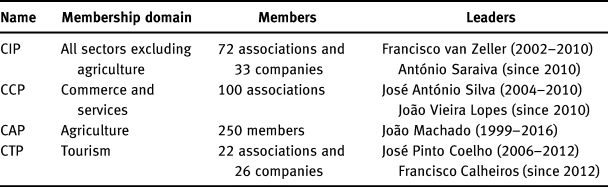
CIP is the largest of these confederations and the bulk of its membership stems from the manufacturing sector, although it has gradually become more cross-sectoral by extending its domain to the service sector.Footnote 48 It was founded in 1974 with the explicit purpose of defending the interests of the private industrial sectors in the midst of the revolutionary turmoil. On top of the stronger presence of large firms in the manufacturing sector, CIP also counts with the direct membership and contributions of the larger Portuguese companies. António Saraiva has been its president since January 2010 and has a background that is quite distinct from the previous four presidents of this organization. He was a trade unionist in the General Workers’ Union (UGT) (the socialist-leaning trade union confederation) back in the 1970s, and was a candidate for PS in the national parliament elections of 1987.
The turbulence of the democratic transition also marked the emergence of CAP, which was founded in 1975, in the context of a militant conservatism against the more radical left-wing dynamics underlying the occupation of a number of farmlands. It has since been the main representative of employers in the agricultural sector. João Machado was its president between 1999 and 2016, succeeding to a twenty-four-years long secretary general who was actually elected as MP for the PSD/CDS-PPFootnote 49 coalition in 1979. Likewise, another historic leader of this organization was elected MP and MEP on different occasions, both on CDS-PP's lists.
The CCP is the other cross-sectoral confederation. Formed in 1976 with an entirely commerce focus, it formally adapted its structure in 1995 to include the service sector. The CCP and CIP's dispute over the representation of the service sector could have been a source of competitive pressure, but this has been moderated thanks to informal arrangements between the two and the possibility for companies to have multiple affiliations, with CCP's representative stance leaning more towards the interests of SMEs.Footnote 50
Finally, the CTP is the most recent confederation. Formed in 1995 and entering the CPCS in 2003, its members are all from the tourism sector, which until then had usually been integrated in CIP. Table 1 provides a brief characterization of the ECs under analysis.
Employer confederations in Portugal: basic data (2016)

Source: Membership figures were collected in the ECs websites (CIP; CTP) and through interviews (CCP; CAP).
In truth, this fragmented picture could be complemented with several other employer confederations and business forums, which have been created throughout the years. However, organizations that are members of the CPCS can veto the inclusion of other confederations in this tripartite institution. Such a prerogative lowers the benefits associated with eventual exit options for firms and associations that might consider to leave the main confederations.Footnote 51
Based on information provided to the national authorities, by 2016, only 17.1 percent of Portuguese employers were affiliated in an employer association.Footnote 52 This low membership density has a natural impact over the financial resources of the main ECs: according to our interviews, CAP, CCP, and CTP are rather dependent on public funding, namely through their role as intermediate bodies in which the state delegates some functions with regard to the management of European funds.Footnote 53 It is also worth mentioning that the overwhelming majority of enterprises have a small, medium, or micro size.Footnote 54
The interaction between business associations and mainstream parties was characterized as conflictual during the Portuguese democratic transition.Footnote 55 However, after the emergence of Social Democratic Party (PSD) majorities, the main confederations adopted a collaborative strategy and substantial neutrality.Footnote 56 Political parties were important gate-keepers due to the importance of the public sector and the use of state resources for consolidating their electoral support and policy-making control. Although the amount of financial support was relatively small, research on party funding showed that business firms sponsored all governing parties, particularly right-wing forces.Footnote 57 A recent study examining party-group relations in Portugal during the crisis argues that “some of the measures carried out by the government were in line with the interests of the business organizations.”Footnote 58 Like other case studies on the subject,Footnote 59 these works deal only marginally with business groups, and they do not consider in detail how business groups have interacted with party governments, the positions taken vis-à-vis austerity policies and their institutional role in general.
Portugal is an interesting (and understudied) case for examining the preferences of business organizations and their relations with the government. Despite sharing several institutional and socio-economic features with other “mixed-market economies,” namely a wide state involvement in the economy and similar models of industrial relations (“middle” or “soft pluralism”),Footnote 60 the business sector displays a significant level of fragmentation. Portugal can typify the case of government-business relations in the context of a relatively fragmented system of intermediation and a state-influenced market economy.
Crisis in Portugal: brief political context
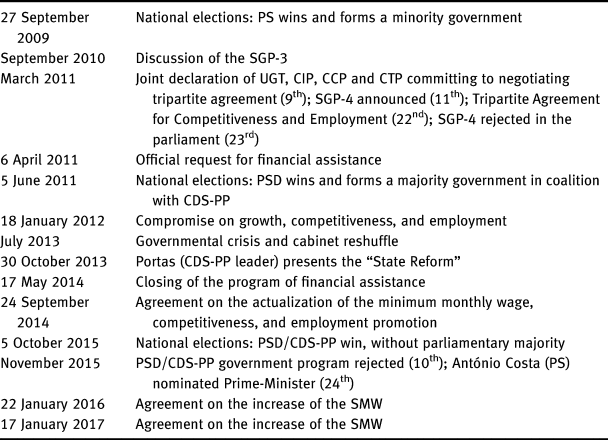
At the onset of the period under analysis, the PS was in government with a single-party majority and José Sócrates as prime minister (PM), being re-elected without a majority at the national elections of September 2009. The minority government of Sócrates continued to take advantage of the European flexibility on the use of fiscal stimuli to curb the effects of the financial crisis but, as pressure mounted from the financial markets and European institutions, its policy response was quickly reversed. Fiscal consolidation became a priority and successive austerity packages, known as the Stability and Growth Pact (SGP), were implemented.
By March 2011, these pressures were growing to unsustainable levels and the social partners signed a declaration stressing their willingness to achieve a tripartite agreement in the near future that could meet the European demands to boost the competitiveness of the Portuguese economy. Just two days after this declaration, Sócrates announced the fourth SGP (worked out directly with the European authorities, without giving the social partners any prior information) and threatened to resign if the respective measures were not approved by the Parliament.
Prior to the voting on the fourth SGP, a Tripartite Agreement for Competitiveness and Employment between employers, UGT, and the government was signed.Footnote 61 Nonetheless, the SGP-4 was rejected in Parliament and the PM resigned; a few days later, Portugal made its official request for financial assistance and a memorandum of understanding (MoU) was signed between the troika and PS, PSD, and CDS-PP. Following the June elections, a PSD/CDS-PP majority coalition was formed with the leader of PSD, Pedro Passos Coelho, as PM.
Various austerity measures were enacted in the years that followed. In the social concertation sphere, another tripartite agreement was signed in January 2012 that further deregulated labor market legislation.Footnote 62 The “adjustment program” launched the country into a deep recession, with a huge increase in unemployment (especially among the young) and a devastating impact on some sectors of the economy (namely construction, the property market, and the financial sector).Footnote 63 Since the beginning of 2010 there have been opposing trends in exports and imports, with the former showing a steady growth, leading to a reduction in the external deficit.
In summer 2013, the government faced its greatest crisis following the resignation of the finance minister Vítor Gaspar (and subsequent choice over its replacement), which prompted Paulo Portas—leader of CDS-PP and foreign affairs minister—to also tender his resignation. This crisis was overcome through a cabinet reshuffle negotiated between Passos Coelho and Portas.
Although the pre-electoral coalition between PSD and CDS-PP actually obtained the most votes in the national elections of October 2015, their government's program was rejected by the remaining parties in Parliament.Footnote 64 As a result, António Costa, leader of PS, became PM of a minority government that relied on formal agreements signed between PS and each of the parties on the Left, which decided to support the minority socialist government (see table 2 for a chronological presentation of the main events).
Main events – chronological presentation (2009–17)

The preferences and alignments of Portuguese employers
The road to the MoU: 2008–June 2011
Counter-cyclical policies were adopted in Portugal in the context of a potential global recession. The employers did not raise substantial criticisms to this approach in the public arena, even though demands for lower taxes and public expenses were often heard, as well as for the need to create credit lines for companies and maintain public investment.
However, the grievances of CAP were more salient. In addition to several confrontations with the Minister for Agriculture (which, through the partial revoking of functions delegated by the state on CAP, affected its funding and caused the dismissal of a third of its staff),Footnote 65 the confederation blamed the government for the insufficient entry of EU funds into the agriculture sector, which required national co-funding through the annual State Budgets. This led to the active mobilization of farmers prior to the 2009 electoral campaign, with several protests held throughout the country calling for a vote against PS. Following the elections, Francisco Van Zeller (then president of CIP) would also stress his opposition to any meaningful convergence between PS and BE; months before the election, he had expressed his preference for a coalition government over a renewed PS absolute majority.Footnote 66
The subsequent PS minority government quickly had to reverse its policy and implement successive austerity packages, which had the overall acquiescence of employers. While displeased with the lack of a more structural cutback on public expenses (i.e., a “reform of the State”), they jointly called for the political parties to “place the national interest above political-partisan logics and confrontation” when the approval of the SGP-3 was at stake.Footnote 67 However, by March 2011 the socialist government was still under acute pressure, both from abroad and within—and it reached for the support of the social partners in two subsequent moments.
First, a declaration of compromise over the obtainment of a tripartite agreement in the near future towards the improvement of the country's competitiveness, signed by the social partners and the government before a decisive Euro summit, was aimed at strengthening the bargaining power of Sócrates in Brussels. Later on, the actual tripartite agreement was signed on the eve of the parliamentary voting on the SGP-4, thus boosting the government's legitimacy when the PM was still threatening to resign if the austerity package was not approved. On the employers’ side, only CAP refused to sign both documents. It was also the only confederation that welcomed early elections, while its counterparts argued for a partisan consensus that could avoid the latter.Footnote 68
Most of the ECs, thus, seemed to have seek some degree of stability during this critical juncture for the country's economic and political future. Nonetheless, and despite the eventual instrumentalization of social concertation operated by the government, the employers guaranteed through this 2011 tripartite agreement a major structural victory, since the liberalizing provisions of this document became the backbone of the MoU with regard to the labor market sphere—a fact that was praised by the employers themselves.
Concurrently, it should be noted that some of the confederations did not refrain from holding the government accountable for the country's situation. For instance, CAP severely criticized the SGP-3, as the government had already implemented austerity measures with no meaningful results when compared to other countries.Footnote 69 Also, CIP discarded any alternative narratives highlighting speculative attacks and argued the financial rescue of Portugal in May 2011 to be legitimized by the lack of reforms over the previous decade.Footnote 70
Great expectations, growing disillusionment: June 2011–October 2015
“The end has come to a certain type of governance and to a certain understanding of the relationship between the State and the Society. The crisis we are facing has shown the exhaustion of the old ways and has brought echoes of a call for change. In this solemn moment the Government affirms it will answer this call.”Footnote 71
Between the commitments established in the MoU and the electoral platform on which Passos Coelho had been elected PM, Portugal seemed to be on the verge of entering a path that broadly met the crucial demands of its employer confederations: under the imperative of economic competitiveness, the two main pillars of this adjustment were the consolidation of both the public accounts and trade deficit and the flexibilization of the labor market. Nonetheless, and from the employers’ standpoint, the fiscal consolidation should also entail the redefinition of the state's role in the economy as the key precondition. Only then—and through the corresponding reduction of public spending—could the private initiative and the economy as a whole prosper under a lower tax burden.
The reality, however, never fully met the expectations—and “even though, ideologically, less tension was foreseeable, there was a great amount of it.”Footnote 72 Each announcement of new austerity measures, especially in the context of the successive SBs, was met with criticisms from most ECs. The fiscal consolidation that was in fact pursued relied overwhelmingly on tax increases, while the public expenses were lowered primarily due to “across-the-board” cuts on public sector wages and pensions rather than a structural reform of the state. Concurrently, there were growing concerns about the economic results of this policy as a vicious cycle appeared to be crystalizing, with an economic recession and continuous budgetary slippages requiring further contractionary measures. By the end of June 2013, the disparity between the employers’ expectations, the government's policies and the respective social and economic outcomes reached a critical point, culminating in the four ECs holding a joint press conference to voice their commitment to “A New Direction for Portugal.” In their own words, it is
“now widely consensual throughout the Portuguese society and even recognized by some international organizations, that the austerity plan for Portugal was a short-term answer, applied as if it was the only one possible; but today, given its results, nobody can be so irresponsible as to reaffirm it or, even worse, continue it. (…) It is thus urgent to reconcile the public deficit reduction with the stimulation of investment, growth and employment. The first step towards a correction is to recognize that one has erred, but the Government has yet to show any signs of taking this direction. (…) Hence, [we] propose that the general guidelines that are the backbone of the ‘Agreement for growth, competitiveness and employment’ subscribed in January 2012 are implemented.”Footnote 73
The tripartite agreement of January 2012 the ECs refer to was composed of two main pillars. On the one hand, there were several changes in the labor market institutions, which were swiftly enacted by the government in what was arguably the most structural reform of its mandate, further reinforcing employer unilateralism.Footnote 74 The second axis of this document revolved around a set of vaguer measures mostly aimed at supporting companies, addressing some of the concerns expressed by the employers. Particularly frequent were their grievances regarding the companies’ access to funding and the “contextual costs”: the latter were usually associated with energy costs, the inefficiency of the judicial system in dealing with economic disputes, and costs related with bureaucracy and local-level taxation. Nonetheless, the implementation of this second dimension of the agreement was clearly lagging behind by June 2013, when the ECs held the previously mentioned joint press conference.
The “new direction” called for at the time, however, could not be pursued by any other government. A week after (though not because of) this press conference, the finance minister resigned and a governmental crisis burst, with the ECs rejecting the option of early elections. The exception was CCP, indifferent to the political outcome as long as there was a change in the overall economic policies.Footnote 75
Nevertheless, employers’ grievances over the lack of a reform of the state that could enable a reduction in the tax burden, deemed essential for economic recovery, echoed throughout the rest of this government's mandate. Interestingly enough, policy proposals were rarely publicly specified in these calls for a “reform of the State.” Apart from occasionally arguing for some privatizations or the extinction/merger of public entities, the common approach of employer representatives was to call for a “redefinition of the role of the State in the economy” without actually indicating concrete ways to achieve it. In the attempt to gain political support and legitimacy, the vice prime minister Paulo Portas proposed, in October 2013, some general guidelines for the “State reform,” but the document was soon criticized by ECs because of its vagueness. CIP and CCP were the main interlocutors of the government, but the prime minister linked the implementation of these measures to the economic performance, which led to postponing this reform sine die.
It should be noted that macroeconomic reforms related to the “State reform” were mostly present in the views expressed by CIP and CCP, while CTP and CAP were more prone to focus on their respective sectors, with the latter being particularly appreciative of the government's willingness to guarantee funds in the consecutive SBs to allow for the entry of EU funding. Even more relevant disparities emerge when considering the nuances of each confederation's framing of the triad “external impositions–government's options–socio-economic results.” In fact, all the employer confederations claimed, at some point, that it was necessary either to revise the fiscal consolidation goals or renegotiate the debt repayment conditions. But CCP, which stands out in the way it emphasized the detrimental effects felt by the domestic market as a result of the actual implementation of the policies of economic and fiscal adjustment, was also the fiercest critic of the latter, holding both the troika and the government accountable. The Portuguese executive,
“by omitting any disagreement towards the known positions of the troika (…) loses any legitimacy to distance itself from the solutions adopted or to invoke, untimely, the troika's intransigence (…) In this context, the discourse of ‘complying with the agreement to get rid of the troika’ no longer makes sense. It tends to hide the fact that under no circumstance we will get rid of the troika in their quality of creditors, which they will continue to be; and it further omits that it is about organizations of which Portugal is a member of full right and, especially where it concerns the European Commission and the European Central Bank, from these Portugal should expect an effective contribution to overcoming a crisis which, to a great extent, results from the model in which the euro was created and from the way the European Union has been acting.”Footnote 76
CAP, in its turn and after praising the first SB presented by the PSD/CDS-PP government for its “courage” in correcting structural deficits of the Portuguese economy, despite its “harsh” nature, stressed that Portugal's success depended on international (and especially European) developments.Footnote 77 Furthermore, it often presented its views in terms that placed the government as strictly subordinated to the troika's will, thus implying a shift of accountability from the former to the latter.
The positioning of CIP was, on the other hand, somehow ambiguous: it frequently underscored the need for the government to fulfill its international commitments but increasingly acknowledged the inevitability of renegotiating the conditions agreed upon. Particularly interesting in this regard was a document known as “Manifesto of the 70,” stressing the need for a restructuring of the Portuguese debt and hence bringing this topic to the fore of the political debate. It was signed by seventy individuals in March 2014— including Vieira Lopes from CCP and António Saraiva from CIP. Saraiva would, however, be vehemently condemned by the previous presidents and founding members of CIP, who wrote a public letter blaming him for “signing a Manifesto which does not defend, but rather hurts, the permanent interests of Portugal” and therefore “hurts the Historic Patrimony that he should respect, and whose motto is, as it always was, the intransigent defense of the Private Initiative.”Footnote 78 Notwithstanding, with the closing in of troika's departure, Saraiva claimed the need for continued efforts in adjusting the country's economy over the coming years.
Entering unchartered waters: October 2015–16
Facing a potential ascension to power of PS with the unprecedented support of the three other parties from the Left, the employers diverge in their response. António Saraiva had previously claimed that the best electoral program would result from a mixture between the proposals of PS and PSD/CDS-PP, and therefore now argued for greater stability around a parliamentary convergence among these parties. But inner tensions were again felt, as some member associations of CIP and other organizations led by CIP's previous leaders showed a much stronger opposition to this government solution.
CAP actually called for new elections to be held as soon as possible. Until then, a government of presidential initiative should be formed and, if necessary, be kept as a caretaker government. This latter solution was explicitly discarded by CCP, whose main concern was the potential shift of labor-related measures away from the social concertation institutions—a fear that pervaded all the confederations’ stances.
Indeed, the dependence of the PS government on the parliamentary support of the Left shifted the locus of power from a majoritarian executive to the realm of parliamentary decisions, where the de facto veto players hold core values intrinsically detrimental to most employers’ interests. Hence, the confederations clearly gave priority to attaching any decisions over the labor sphere to social concertation, which can be seen in their positioning vis-à-vis the government's intention to increase the statutory minimum wage (SMW) in every year of its mandate.
By the end of 2015, the employers refused to accept any tripartite agreement that included a SMW increase unless General Confederation of the Portuguese Workers (CGTP, the communist-leaning trade union confederation, which had fiercely opposed all previous agreements) would also sign the document, which can be seen as an attempt to tie CGTP to the content of an eventual agreement and thus curb its legitimacy for stronger demands in the future. Given the CGTP refusal and the unprecedented nature of this demand, the government unilaterally increased the SMW. The employers would then return to the negotiations and reach an agreement that guaranteed them fiscally compensatory measures. A year later, these same measures would be secured in a new agreement, this time complemented with a tripartite commitment to have future discussions at the CPCS over “the labor framework” towards an eventual agreement regarding those matters.
In fact, during the previous government's mandate, employers had downplayed the importance of labor-related costs and legislation, arguing that companies were more affected by the contextual costs and the lack of financing. But facing new circumstances —though not dropping these latter two virtually ever-present grievances—the ECs promptly put new demands regarding labor market legislation on the agenda.
Regarding the overall economic policy, the PS government marked, somehow, a shift, by prioritizing the restoring of the household incomes without disregarding the European commitments for fiscal consolidation. The four confederations disagreed: in a joint statement, they expressed their criticism towards the 2016 SB for not favoring private investment, criticizing the non-decrease of the tax burden, especially on consumption and business, while stressing the need to resume strategic public investment despite demanding a greater contribution of the decrease in public expenses for the fiscal consolidation.Footnote 79 The usual element that would have solved this apparent contradiction—the reform of the State—was however less present in the employers’ demands over this period.
Discussion
Overall, there was a clear convergence between the interests of the main Portuguese employer confederations and the political agenda put forward under the umbrella of austerity politics, namely on its core principles of fiscal consolidation and labor deregulation. Notwithstanding, such convergence dwindled as, on the one hand, the fiscal efforts growingly relied on the soaring of the tax burden at the expense of a structural reduction of state expenses and as, on the other hand, the negative economic effects of such policies became increasingly evident.
Employers were also generally in tune regarding their overall policy preferences and in adapting the latter to the economic and political environment. Effective and structural reforms of the state are necessary, taxes should be lowered and labor legislation should be flexible. But the easing of economic conditions allowed for the resurgence of calls for greater public investment, while the “reform of the State” was more emphatically defended towards governments that were either more externally constrained or potentially more receptive. In a similar way, the importance of labor market legislation was played down while major victories were being achieved, later becoming rather salient when the context became less favorable. However, severe concerns regarding the companies’ access to financing and the contextual costs pervade the entire period under analysis.
Yet there were relevant differences in the main focuses and demands of the Portuguese ECs. The policy preferences of CTP and CAP were clearly more sector-oriented, with the farmers always seeing the co-financing for the entry of EU funds as a crucial issue. The cross-sectoral CIP and CCP had a larger scope of intervention, where one can find significant divergences. The CCP was especially prone to focus on the impacts of the internal devaluation suffered by the Portuguese economy, particularly when compared to the clearly more export-oriented CIP. Concurrently, CCP has been by far the loudest critic among business organizations with regard to the EU response to the economic crisis. CIP, however, has shown some ambiguity with regard to the external constraints affecting the country, but its emphasis on the need to continue the country's economic adjustment despite the troika's departure, on top of its refusal of the “speculative attacks on the euro” narratives, hints at a greater convergence with the neoliberal prescriptions stemming from European interlocutors. In our view, these disparities result from the considerable weight that non-tradable sectors and SMEs have within CCP, against the greater proportion of larger firms (inherently more capable of absorbing the economic shocks under market dynamics) among CIP's associates.
Employers have also shared an overwhelming caution with regard to voicing partisan preferences. But the above analysis allows for a more nuanced view, with CAP standing out as the only EC that used a mobilization strategy with electoral purposes in this period. Furthermore, its positioning in the main critical junctures that were analyzed was usually closer to the solutions that would favor the right-wing parties PSD and CDS-PP (see appendix A1 for a summary of the four ECs’ positions). Concomitantly, there was a clear disparity in its critics to the socialist efforts in face of external pressures when compared to its blaming of the troika during the PSD/CDS-PP government. But it should be noted that this inclination has not prevented the maintenance of institutionally cooperative relations: in the 2015 elections, CAP contributed to the electoral platform of PS on agriculture-related issues.Footnote 80
CIP appears to have a more consensual approach to party politics. This can be seen either as a means to what has been described as the “disengagement of politics (…) from the economy,”Footnote 81 or as a way to deal with the inner tensions of the largest Portuguese EC, which were more publicly evident in the controversy around the “Manifesto of the 70” and in the aftermath of the 2015 elections. The default attitude of CCP with regard to the most relevant political crossroads, however, has been one of distance from any partisan alignment. Whenever there is a relevant statement as elections approach or at a time of greater political uncertainty, it has been a policy-based one.
Lastly, the CTP is clearly an organization whose intervention is largely sector-focused, shying away from any consequential positions in most periods of greater political relevance. This pattern may be explained by the limited scope of the sector that it represents, as well as its recent origin, which arguably results in a CTP that lacks the historical contingencies and potential ideological inheritances of its counterparts that were created in the 1974–76 period.
With regard to the political role of business organizations, ECs have certainly benefited from labor market reforms that aimed to lower labor costs and to achieve internal devaluation. However, they were unable to play a key role in setting the agenda of government actors or to influence important reforms, while their impact in terms of voting behavior or government formation was virtually irrelevant.
Conclusion
This study provides a first in-depth analysis of the role played by ECs in one of the countries that was hardest hit by the Eurozone crisis, contributing to the literature on the political role of employers’ organizations and, more generally, the politics of organized interests. Evidence has been presented on the common and divergent interests pursued by employers and on the strategic adaptation of their preferences to the political and economic environment.
Disparities were found between confederations based on the type of membership represented, inclusively leading to varying positions with regard to the impositions stemming from Brussels. But the Portuguese employers shared a liberalizing rhetoric, which frequently coexisted with attempts to secure state-compensating mechanisms, in line with the “mixed market economies” trend. During a period in which a more profound withdrawal of the state from the economy could have been pursued, the Portuguese ECs saw the national government as an interlocutor for addressing their members’ fragilities in face of market dynamics, such as in the credit and energy markets.
This reliance on the state in order to address some of their membership's concerns, combined with the financial dependence of these ECs (apart from CIP) on functions that are delegated by the state, creates strong incentives for a pragmatic approach to party politics, at least within the governmental arena. The predominance of neutral partisan positions and the maintenance of institutionally cooperative relations avoid antagonizing any of the main governing parties in one of the most resilient European party systems. This approach has remained substantially stable even in a highly fluctuating environment from both a political and economic point of view.
Yet, historical imprints still influence the divide in the political alignments across the Portuguese business landscape (e.g., CAP, CIP's inner tensions). The original fragmentation, crystallized by decades of organizational autonomy between the main peak-level actors, still hinders a more robust right-wing party-group linkage, which is present in the more business-unified Spanish case, where a univocal “capital coalition” is more likely under an umbrella confederation.
No single-factor can therefore explain the variety of preferences and the political alignments of employers. Rather, this study shows that we need to rely on various factors beyond the “usual suspects”—i.e., organizational constraints and external competition—and thus account for historical and institutional legacies, alongside the business’ reliance on the state. It is also worth mentioning that the small size of the Portuguese business sector and the lack of “exit options” have contributed to the stability of the political alignments over the crisis period.
The extent to which these findings can be a generalizable argument is naturally dependent on further studies dealing with different national realities. On the same note, the Portuguese case allows us to observe some patterns that would be interesting to test across borders, for example, by examining farmers’ predisposition for mass mobilization and their strong focus on European funds. Another interesting avenue for future research is the conditions that inhibit cross-class coalitions, especially with regard to European integration (see, for instance, the refusal of employers from the trade and service sectors of contractionary policies that affect the domestic demand, thus opposing more pro-European and pro-globalization forces).
A final word goes to the implication of our objects of analysis for a better understanding of interest group politics. First, future studies should focus on the direct and informal channels at the disposal of individual firms for accessing policy-making, thus by-passing the circuits of political representation in which ECs interact. In addition, given the fragmentation of Portuguese peak-level employer organization, it would be interesting to examine, in more detail, the internal decision-making processes and how they define their positions and agenda. As this study has shown, the political role of business groups is a complex and multi-dimensional phenomenon that requires the examination of the interplay between the political and institutional environment, on the one hand, and leadership strategic action and internal dynamics, on the other.
Appendix A1. Positions of CIP, CCP, CAP, CTP (2009–15)

Appendix 2