


Introduction
Cognitive-behavioral models of obsessive-compulsive disorder (OCD) assert that obsessional thoughts are more likely to develop and persist when they are appraised negatively (e.g. Rachman, Reference Rachman1997, Reference Rachman1998; Salkovskis, Reference Salkovskis1985, Reference Salkovskis, Swinson, Antony, Rachman and Richter1998, Reference Salkovskis1999). Such negative appraisals include viewing the thought signifying harm or danger that the individual is honor bound to prevent, as actually causing the event to occur, as being a sign of immorality, or as mental events that can and should be controlled. Negative appraisals result in distress, which in turn is ameliorated by thought avoidance (i.e. suppression) and/or trying to undo or defend against the thought coming true in some way (i.e. neutralizing or performing some kind of compulsive act). Thought suppression is said to be problematic because it may a) lead to an increase in thought frequency, as argued by Wegner (e.g. Wegner, Schneider, Carter and White, Reference Wegner, Schneider, Carter and White1987) and b) terminate exposure to the thought, preventing the negative response to the thought from extinguishing (Rachman, Reference Rachman1997, Reference Rachman1998; Salkovskis, Reference Salkovskis1999). That is, the elimination of anxiety in response to a stimulus (e.g. germs if one has contamination obsessions) will not occur in the absence of exposure to the stimulus and thoughts about the stimulus. As the thought persists, negative appraisals escalate along with suppression efforts and neutralizing/compulsions. Mood state subsequently deteriorates, making negative appraisals of the thought more accessible and salient. Thus, a key mechanism by which obsessional thoughts develop and persist is through the relationship between negative thought appraisal and subsequent ameliorative efforts, such as thought suppression.
A number of studies have examined these central tenets of cognitive-behavioral models of OCD. For example, Smári and Hólmsteinsson (Reference Smári and Hólmsteinsson2001) administered self-report measures of appraisal (responsibility and TAF), OC symptoms, and thought suppression to a nonclinical sample. Path analysis revealed that negative appraisal predicted suppression, which in turn predicted OC symptoms. Rassin, Muris, Schmidt and Merckelbach (Reference Rassin, Muris, Schmidt and Merckelbach2000) investigated the relations among appraisals of obsessional thoughts, thought suppression, and obsessive-compulsive symptoms in a nonclinical sample. Structural equation modeling suggested that thought-action fusion (TAF) appraisals contributed to OC symptoms indirectly through the effects of thought suppression.
Rassin (Reference Rassin2001) conducted an experiment to complement this correlational research. He examined the relationship between suppression and appraisals of a thought akin to obsessional concerns – that of a loved one being in a car accident. In contrast to the findings reported above, participants assigned to the suppression condition (relative to those instructed to think anything) a) spent less time thinking about the intrusive thought, b) had fewer thought occurrences, c) perceived the act of writing the thought to be less morally wrong, and d) experienced less responsibility and guilt over the prospect of the accident actually happening. Rassin concluded that thought suppression might reduce the discomfort that TAF intrusions cause. Purdon (Reference Purdon2004) argued that suppression may indeed be useful in the short-term but is less useful in the long-term due to its influence on negative appraisals. Furthermore, suppression may be more effective when the source of the thought is known (i.e. evoked by the researcher) than unknown (i.e. appears spontaneously in the mind).
In a further study, Purdon (Reference Purdon2001) investigated the impact of suppression on TAF, responsibility, and control appraisals, and examined the impact of those appraisals in turn on mood and the aversiveness of the thought. A nonclinical sample of participants was instructed either to suppress or not to suppress their most upsetting obsessional thought. In a second interval, all participants were instructed not to suppress the thought. Appraisal of the thought during the first interval was assessed, along with anxiety over thought occurrences and mood state. In contrast to the Wegner experiments (e.g. Wegner et al., Reference Wegner, Schneider, Carter and White1987), thought suppression was not associated with an increase in thought intrusions. However, TAF and control appraisals during the first interval predicted more negative mood state and greater anxiety over thought occurrences, regardless of experimental group. Furthermore, suppression effort in the initial “do not suppress” interval was predicted by greater perceived need to control thoughts. Purdon, Rowa and Antony (Reference Purdon, Rowa and Antony2005) replicated these findings in a clinical sample of individuals with primary OCD. They concluded that negative thought appraisal is associated with escalating efforts at thought control. Failures in thought control, no matter how few, in turn lead to negative emotional responses to the thoughts and negative mood states. Thus, appraisal may have its impact on obsessive-compulsive symptoms because it leads to suppression efforts and inevitable failures in thought control, which may in turn lead to increasingly extreme measures to manage the thought, such as neutralizing and compulsive acts.
This body of work is small, even though cognitive models of OCD ascribe central importance to the relations among appraisal, suppression, and OC symptoms. Furthermore, researchers have not addressed four aspects of these models. First, although the model asserts that appraisals of responsibility, TAF, and control are vulnerability factors, the relationship of general personality traits and appraisal has not been assessed. It is possible that this form of appraisal is the simple result of a general factor, such as neuroticism or negative mood, especially given that the latter is characteristic of anxiety and depression (e.g. Clark and Watson, Reference Clark and Watson1991; Clark, Watson and Mineka, Reference Clark, Watson and Mineka1994). Second, although the use of suppression by people with OCD has been studied, researchers have not examined OC symptoms as a predictor of features of cognitive models (e.g. thought appraisal, thought suppression), even though these factors are viewed as important to both the development and persistence of OC symptoms. Third, although researchers have examined the effects of thought suppression, few have examined the predictors of suppression effort. Further, those that have (e.g. Purdon, Reference Purdon2001) have done so by imposing suppression in an experimental paradigm rather than examining naturally occurring suppression effort. Purdon (Reference Purdon2004) has argued that there are substantial problems with examining imposed suppression, in that participants in the control condition will be naturally motivated to suppress. Furthermore, findings from study of natural active resistance may have greater ecological validity. Fourth, most studies to date have examined only the immediate impact of suppression on outcomes.
A final consideration in the present study was the operationalization of thought suppression. In several of the studies cited above (e.g. Rassin et al.; Smári and Hólmsteinsson, Reference Smári and Hólmsteinsson2001) suppression was assessed using the White Bear Suppression Inventory (WBSI; Wegner and Zanakos, Reference Wegner and Zanakos1994), which is a retrospective self-report measure of tendency to use suppression. The WBSI is problematic because of potential memory biases associated with long-term retrospection and because it may confound tendency to experience with tendency to suppress unwanted thoughts (see Borton, Markowitz and Dieterich, Reference Borton, Markowitz and Dieterich2005; Markowitz and Borton, Reference Markowitz and Borton2002; Purdon, Reference Purdon2004). Indeed, factor analyses of the WBSI in three samples with approximately 1200 participants found that the majority of the items assess the tendency to experience intrusive thoughts, whereas only a minority assess the tendency to suppress them (Blumberg, Reference Blumberg2000; Hoping and Jong-Meyer, Reference Hoping and Jong-Meyer2003). Further, the thought intrusion frequency items, not the thought suppression items, relate (positively) to OC symptoms and other indices of psychopathology (Hoping and Jong-Meyer, Reference Hoping and Jong-Meyer2003), suggesting that the WBSI is assessing more the presence of symptoms than the use of suppression. In the present study nonclinical participants completed measures of OC symptoms, neuroticism, and appraisals of responsibility, control, and TAF. Participants' most distressing obsessional thought was primed and they monitored its occurrence. Ratings of mood state and distress over the thought were taken before and ratings of suppression effort were taken after this interval. Finally, participants were contacted via telephone four hours after they had left the lab and reported on the frequency of and distress caused by their obsessional thought.
We examined two hypotheses. First, it was expected that, controlling for neuroticism and initial negative mood, individuals high in OC symptoms should have high appraisals of control, responsibility, and importance. These appraisals should lead to high distress over the thought, which in turn should trigger high efforts to suppress the thought. Second, it was expected that greater use of thought suppression would be correlated with greater negative mood after suppression, more frequent intrusions, and greater distress caused by intrusions outside the laboratory.
Method
Participants
One-hundred-and-fifty nonclinical individuals (83 women, 67 men) enrolled in a variety of large classes at the University of Waterloo (Ontario, Canada) participated in exchange for $6 Cdn. Participants ranged in age from 17 to 38 (M = 20.5, SD = 2.6) years.
Materials
Padua Inventory-Washington State University Revision (PI-WSUR; Burns, Keortge, Formea and Sternberger, Reference Burns, Keortge, Formea and Sternberger1996)
The PI-WSUR measures obsessive-compulsive symptoms. It has good internal consistency and good convergent and divergent validity. The measure contains 39 items rated on a 5-point scale ranging from 0 to 4. There are five subscales: (a) contamination obsessions and washing compulsions; (b) dressing/grooming compulsions; (c) checking compulsions; (d) intrusive thoughts of harm to self/others; and (e) intrusive impulses to harm self/others.
International Personality Item Pool-Neuroticism Subscale (IPIP-NS; Goldberg, Reference Goldberg, Mervielde, Deary, De Fruyt and Ostendorf1999; International Personality Item Pool, 2001)
The IPIP is a collection of nearly 2000 items assessing 280 personality traits. The neuroticism subscale contains 10 items (e.g. “Get stressed out easily”; “Am easily disturbed”) rated on a 5-point scale ranging from “Very inaccurate” to “Very accurate”. In the present study, the scale demonstrated good reliability (α = .86). The measure was entered as a covariate to demonstrate the specificity of the findings to obsessive-compulsiveness.
Positive and Negative Affect Schedule (PANAS; Watson, Clark and Tellegen, Reference Watson, Clark and Tellegen1988)
The PANAS is a well-validated, frequently used measure of mood. The scale assessing positive (e.g. “enthusiastic”) and negative (“afraid”) affect contains 10 words each. Each word is rated for the extent to which it describes the individual's affective state on a 5-point scale ranging from 1 (“very slightly or not at all”) to 5 (“extremely”). The two subscales have good reliability, convergent validity, and discriminant validity (Watson et al.).
Interpretation of Intrusions Inventory (III; Obsessive Compulsive Cognitions Working Group; OCCWG, 2001)
The III is a 31-item measure of appraisals of intrusive thoughts. The measure consists of three types of appraisals theoretically relevant to OCD: control (e.g. “Having this thought means I'm out of control”), responsibility (e.g. “If I ignore this thought, I could be responsible for serious harm”), and importance (e.g. “Because I have this thought, it must be important”) appraisals. Participants rate the frequency with which they experience and degree of distress caused by thoughts of this type on 6-point Likert scales. Appraisal items are rated on 11-point scales ranging from 0 to 100. The inventory has good reliability and convergent validity and distinguishes patients with OCD from both nonclinical controls and patients with other anxiety disorders. The instructions were modified very slightly such that rather than responding to the items in relation to their obsessional thoughts in general, participants were instructed to respond to the items in relation to their most upsetting obsessional thought in particular. Also, because the three are very highly correlated (rs > .84; OCCWG), we combined the three subscales for all analyses to represent one variable measuring general thought appraisals theoretically relevant to OCD.
Classification of intrusive thoughts
Because of concerns that some thoughts identified on the III might not be obsessional in nature but might be more representative of worries or other unwanted thoughts, we classified the thoughts as obsessions or worries, using criteria for OCD and GAD delineated in the Diagnostic and Statistical Manual of Mental Disorders-IV-TR (APA, 2000). Thoughts were considered obsessional if they were (a) not simply concerns about daily life events, (b) implausible (e.g. concerns about someone dying when there is no rational reason for this concern), (c) ego-dystonic (or inconsistent with the individual's self-concept and moral values), (d) unwanted and unacceptable (there is nothing pleasant about the thoughts), and (e) spontaneous (not actively generated). In contrast, thoughts that were concerns about daily events and were plausible, ego-syntonic, and actively generated were considered worries (e.g. “People in my family leaving me, I'm alone.”; “I'm concerned about being seen as a loser.”). Coding was completed by the authors who were blind to participants' responses on any other measure at the time of coding. The coders went through each thought together and determined by consensus whether or not the thought classified as an obsession. If in doubt, we excluded the data. Twenty-four thoughts fell into the worry classification and 20 thoughts did not fit either category and were classified as “other” (e.g. “I wonder about why people kill others or do terrible things”).
Only participants reporting obsessional intrusions were included in further analyses. This reduced the sample examined from 150 to 102 for the analyses in the laboratory and from 112 to 77 for those successfully contacted 4 hours after leaving the lab. Data from 11 further participants were excluded from all analyses (one due to a mechanical failure, one due to experiencing difficulty understanding questions in English, four for not completing most of the questionnaires, one for participating in this study twice, and four for being multivariate outliers based on the recommendation of removing cases with standardized DFBETAS of at least 1; Neter, Wasserman and Kitner, 1989, as cited in Pedhazur, Reference Pedhazur1997). Note that the statistical significance of none of the hypothesized effects changed meaningfully with an alpha level set to .05 when we analyzed the full sample of 150.
Content of intrusive thoughts
The thoughts that were considered obsessions were then classified based on content into categories provided by the Yale Brown Obsessive-Compulsive Symptom Checklist (Goodman et al., Reference Goodman, Price, Rasmussen, Mazure, Fleishmann, Hill, Heninger and Charney1989). Aggressive intrusive thoughts were the most common (66% – e.g. “The thought of making myself fall down a flight of stairs to inflict pain on myself”), followed by sexual (19% – “An unwanted sexual urge/image of my ex-boyfriend”), miscellaneous (7% – e.g. “The idea that my youngest sister could grow up one day to be a drug addict”), religious (4% – e.g. “Thinking of an action that is against my moral beliefs”) and contamination (3% – e.g. “The urge to excessively use toilet paper around the toilet seat in the bathroom of public places because of fear of contamination”) obsessions. There were no hoarding/saving or symmetry/exactness obsessions.
Content of thought recordings
The content of the thoughts participants recorded during the period (described below) in which they wrote down whatever came to mind was analyzed. The content was rated according to criteria reported by Roemer and Borkevec (Reference Roemer and Borkovec1994) for its relation to the target intrusive thought participants had identified earlier. Specifically, each statement was considered directly related, indirectly related, or unrelated to the target thought. (See Roemer and Borkovec for more detailed descriptions of each classification.) Three individuals blind to each other's ratings and to participants' scores on all measures rated all statements for 20 participants. Directly, indirectly, and unrelated statements were coded as a “2”, a “1”, and a “0” respectively. This variable was labeled “proportion” because it represents the proportion (on a 3-point scale) of thoughts during the thought-recording period that were related to the target thought. Because the three raters' scores on the 20 participants were highly correlated (all rs > .88, all ps < .001) and because the intra-class correlation coefficient was very high (α = .97), only one rater was retained for the remaining participants. His were the only ratings used for the initial 20 participants as well.
Procedure
Participants read a description of the study and provided informed consent. They were then given a 3-minute practice thought-recording period in which they were instructed to “write whatever thoughts come to mind without worrying about writing complete sentences or about grammar”. Participants then completed the PI-WSUR and identified their most distressing obsessional thought on the III. Participants completed the III in response to this one obsessional thought. Note that the III includes one item assessing distress over the thought. This item served as the time 1 distress rating in later analyses.
Participants' most distressing obsessional thought was then primed by having them write about it for 2 minutes. They were encouraged to “think about past instances when the thought has come to mind or about how it feels when the thought comes to mind”. The PANAS was then administered (time 1), and participants were instructed to think freely about anything they wanted to for a 6-minute period. Ratings of suppression effort during this interval were taken using three Likert scales ranging from 0–100, and involved ratings of how hard the participant tried to suppress the thought (0 = “Did not try at all” – 100 “Tried very hard”), how much they wanted to avoid thinking about the thought (0 = Not at all-100 = “Very much”), and how hard they tried to think only about thoughts other than the target thought (0 = “Did not try at all” – “Tried very hard”). These items are based on those used by Purdon (Reference Purdon2001; Purdon and Clark, Reference Purdon and Clark2001; Purdon et al., Reference Purdon, Rowa and Antony2005). The items were summed to create an aggregate score of “suppression.”
The PANAS was then re-administered (time 2). This task marked the end of participation inside the laboratory. Participants were contacted via telephone 4 hours later and asked to report, using 0 (“Not at all”) to 10 (“Extremely”) Likert scales completed by the researcher, on how often the unwanted thought has come to mind (to assess frequency), how much the unwanted thought has been bothering them, and how anxious they felt when the thought has come to mind (the latter two being aggregated as a measure of distress). Finally, participants were debriefed and thanked.
Results
Approach to testing for mediation
The main hypotheses driving the prediction of thought suppression were mediational. Several variables that would mediate the OC symptoms/thought suppression relation were proposed. To examine these mediational hypotheses, we followed MacKinnon and colleagues' (MacKinnon, Lockwood, Hoffman, West and Sheets, Reference MacKinnon, Lockwood, Hoffman, West and Sheets2002) recommendation to test the significance of the paths comprising the hypothesized mediated effects. For example, if variable x is a significant cause of variable y, which, in turn, is a significant cause of variable z, then the results are consistent with the hypothesis that y mediates the relation between x and z (D. P. MacKinnon, personal communication, 30 August, 2002; MacKinnon et al.). We chose this approach rather than Baron and Kenny's (Reference Baron and Kenny1986) because the latter approach possesses low statistical power and high type II error rates (for a discussion and a large simulation study, see MacKinnon et al.). Instead, a better balance of type I error rates and statistical power is achieved by testing the statistical significance of the effects comprising the hypothesized mediated path.
Predictors of thought suppression
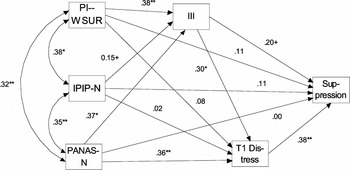
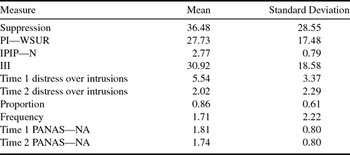
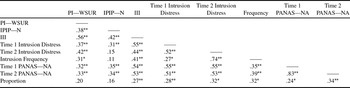
The first analysis tested the hypothesis that, controlling for IPIP—N and time 1 PANAS—NA, PI—WSUR scores would predict III scores. III scores, in turn, should predict time 1 distress over intrusions. The latter should then predict thought suppression effort. As predicted, all components of this model were supported. (See Figure 1; see also Tables 1 and 2 for means and standard deviations of and correlations between all measures.) That is, independent of time 1 negative mood and neuroticism, high OC symptoms predicted more maladaptive thought appraisals, which led to higher distress over intrusions. Higher distress, in turn, was associated with greater suppression efforts.
Predicting thought suppression effort
Note: that PI—WSUR = Padua Inventory—Washington State University Revision; IPIP—N = International Personality Item Pool—Neuroticism subscale; PANAS—N = Positive and Negative Affect Schedule—Negative Mood; III = Interpretation of Intrusions Inventory; T1 Distress = Distress over Thought Intrusions at Time 1; Suppression = Naturally Occurring Thought Suppression Effort. + = p < .10, * = p < .05, ** = p < .01 (two-tailed).

Means and standard deviations on dependent measures

Note: Suppression = Naturally occurring Thought Suppression; PI—WSUR = Padua Inventory—Washington State University Revision; IPIP-N = International Personality Item Pool: Neuroticism subscale; III = Interpretation of Intrusions Inventory; Time 1 Intrusion Distress = Distress over intrusions inside the laboratory; Time 2 Intrusion Distress = Distress over thought intrusions outside the laboratory; Proportion = Proportion ratings; Frequency = self-reported intrusion frequency outside the laboratory; and PANAS—NA = Positive and Negative Affect Scales—Negative Affect.
Correlations among dependent measures

Note: PI—WSUR = Padua Inventory—Washington State University Revision; IPIP-N = International Personality Item Pool: Neuroticism subscale; III = Interpretation of Intrusions Inventory; Time 1 Intrusion Distress = Distress over intrusions inside the laboratory; Proportion = Proportion ratings; Frequency = self-reported intrusion frequency outside the laboratory; PANAS-N = Positive and Negative Affect Scale—Negative Affect.
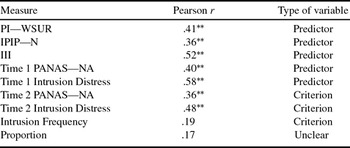
Correlations with thought suppression are presented in Table 3.
*p < .05, ** p < .01 (two-tailed).
Potential consequences of thought suppression
The next analyses examined whether high thought suppression effort led to negative mood inside the laboratory and more frequent and more distressing thought intrusions outside the laboratory. As predicted, thought suppression effort was a strong bivariate predictor of time 2 negative mood (T2 PANAS—NA) and time 2 distress over intrusions. Contrary to expectations, however, thought suppression effort was unrelated to intrusion frequency (see Table 3). Thus, individuals who attempted to suppress their intrusive thoughts experienced more negative mood inside and more distress over thought intrusions outside the laboratory. They did not, however, experience more frequent thought intrusions outside the laboratory.
Correlational predictors and potential consequences of thought suppression effort

Note: Suppression = Naturally occurring Thought Suppression; PI—WSUR = Padua Inventory—Washington State University Revision; IPIP-N = International Personality Item Pool: Neuroticism subscale; III = Interpretation of Intrusions Inventory; Time 1 Intrusion Distress = Distress over intrusions inside the laboratory; Proportion = Proportion ratings; Frequency = self-reported intrusion frequency outside the laboratory; PANAS-N = Positive and Negative Affect Scale—Negative Affect.
* = p < .05, ** = p < .01 (two-tailed).
Variables assessed before suppression effort are labeled “Predictor”; those assessed after are labeled “Criterion” and are viewed as potential consequences of suppression; Proportion and suppression effort were measured at the same stage of participation and thus proportion is labeled “Unclear”.
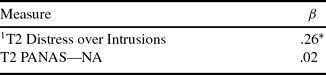
Next we tested whether thought suppression significantly predicted time 2 distress over intrusions and time 2 negative mood (T2 PANAS—NA) when time 1 negative mood (T1 PANAS—NA), neuroticism (IPIP—N), and pre-suppression distress over intrusions were held constant. We also controlled for time 1 distress over intrusions (assessed before thought suppression) when predicting time 2 distress over intrusions. As expected, thought suppression effort was a unique predictor of time 2 distress over thought intrusions. Thus, independent of baseline negative mood and neuroticism, individuals who suppressed their intrusive thoughts experienced more distress outside the laboratory when those thoughts entered their minds (see Table 4.) Contrary to expectations, high suppression effort did not uniquely predict time 2 negative mood. Instead, time 1 negative mood explained nearly all the variance in time 2 negative mood (β = 81, p < .001).
Effects of thought suppression controlling for mood and neuroticism

Note: T2 Distress over Intrusions = distress over thought intrusions outside the laboratory; Frequency of Intrusions = the frequency of thought intrusions outside the laboratory; T2 PANAS—NA = Time 2 Positive and Negative Affect Schedule; mood and neuroticism were controlled for in all analyses with scores on Time 1 Positive and Negative Affect Schedule and the International Personality Item Pool—Neuroticism subscale (respectively).
* = p < .05 (two-tailed).
1This analysis also controlled for T1 Distress over Intrusions (measured before thought suppression effort).
Relations between thought recordings and dependent measures
For exploratory purposes, we examined the relations between participants' thought recordings during the thought-monitoring tasks and all other variables. We expected a positive association between the proportion of thoughts directly related to the target thought during the thought-recording task and indicators of maladjustment (e.g. high OC scores, maladaptive interpretations of intrusions). As expected, proportion ratings correlated positively with III scores, time 1 and time 2 PANAS—NA scores, distress over intrusions both before and 4 hours after the thought-recording task, and the frequency of thought intrusions 4 hours after the task (see Table 2). Thus, individuals whose thoughts during the 6-minute period were more closely related to their target thought had more maladaptive interpretations of their thought intrusions, more negative affect, higher distress over thought intrusions, and more frequent thought intrusions. Contrary to predictions, however, proportion ratings were unrelated to all other variables in the study.
Discussion
The results of this study support several of the assertions of cognitive-behavioral models of OCD (e.g. Rachman, Reference Rachman1997, Reference Rachman1998; Salkovskis, Reference Salkovskis1985, Reference Salkovskis, Swinson, Antony, Rachman and Richter1998, Reference Salkovskis1999). First, the results fully supported the proposed mediators of the OC symptoms/thought suppression relation. That is, individuals with high levels of OC symptoms did have more maladaptive appraisals of intrusive thoughts. These high appraisals were associated with greater distress over thought intrusions, which in turn was associated with greater thought suppression effort. Crucially, none of these relations could be attributed to baseline negative mood or neuroticism. Second, high thought suppression significantly predicted subsequent negative mood and distress caused by thought intrusions outside the laboratory. Third, high thought suppression effort uniquely predicted this latter variable. Further, because this analysis controlled for pre-suppression distress over thought intrusions, it appears that suppression was associated with an increase in individuals' distress over intrusions beyond their typical levels of distress over intrusions. The only findings inconsistent with cognitive models were that suppression did not predict the frequency of intrusions outside the laboratory and did not uniquely predict negative mood. Nor did proportion of time thinking about the obsession in the in-lab predict any of the variables hypothesized.
The results mostly support Purdon and colleagues' (Purdon, Reference Purdon1999, 2001; Purdon et al., Reference Purdon, Rowa and Antony2005) argument for a close connection between thought intrusions and thought appraisals. They argued that failures in thought control may lead to more negative thought appraisal because the thought is interpreted as evermore meaningful. Consistent with this view, higher initial distress over intrusions did predict greater thought suppression efforts in the present study. Also, in the Purdon studies, appraisal of thought recurrences as signifying the presence of undesirable personality characteristics (e.g. “The more I had the thought, the more concerned I became that I may secretly want it to come true.”) predicted more negative mood beyond time 1 mood and appraisal (assessed by the III). It may be the case that as the individual's concerns grow and the meaning of the thought is elaborated and extended, there are more internal cues for the thought, which may make the thought more difficult to suppress. Furthermore, as the thought becomes more distressing, it may also be harder to manage, because thoughts consistent with mood state are more difficult to manage than thoughts inconsistent with mood state (e.g. Wenzlaff, Wegner and Klein, Reference Wenzlaff, Wegner and Stanley1991). Once the thought becomes unmanageable by suppression, other strategies may be employed to manage it, such as neutralization and compulsive acts.
Although many aspects of cognitive models were supported, there was no unique relationship between thought suppression effort and subsequent thought frequency. This latter finding is consistent with a number of studies that have found no paradoxical effect of suppression on frequency of obsessional thoughts (e.g. Janeck and Calamari, Reference Janeck and Calamari1999; Purdon and Clark, Reference Purdon and Clark2001; Purdon, Reference Purdon2001; Purdon et al., Reference Purdon, Rowa and Antony2005; but see Abramowitz, Tolin and Street, Reference Abramowitz, Tolin and Street2001). Differences in methodology between the studies that have found paradoxical effects and the present study deserve mention. In the former studies, thought frequency was assessed by “event marking”, such that participants would press a key or make a check mark whenever the thought occurs. In the current study, thought frequency was assessed by participant self-reported frequency of intrusions outside the laboratory, which of course is influenced by self-report and memory biases. A difficulty with all thought frequency measures is that they may confound frequency with duration, as now noted in a number of sources (Borton et al., Reference Borton, Markowitz and Dieterich2005; Markowitz and Borton, Reference Markowitz and Borton2002; Purdon, Reference Purdon2001, Reference Purdon2004; Purdon et al., Reference Purdon, Rowa and Antony2005). Thus, a participant who experiences only one thought occurrence that lasts a long time will appear to have good thought control, whereas another who has several thought occurrences that are readily dismissed will appear to have poor thought control. Thus, it may be more informative to inquire about thought dismissability as opposed to frequency in future research. Finally, in the present study, participants were not given instructions to suppress. Instead, the impact of their naturally occurring suppression effort was assessed. Perhaps the effects of suppression are greater when the performance demand is higher (i.e. when there is an experimental requirement to suppress).
Also, the significant relation between thought suppression and negative mood was eliminated once initial negative mood was entered as a covariate. This finding contradicts a number of studies that have found a relation between suppression and mood. However, Time 1 mood was assessed immediately after participants had written about their intrusive thoughts for 2 minutes, which may have resulted in a reduction in mood state such that any further influences on mood state were negligible. Indeed, the mean negative mood scores reported at time 1 was higher overall than that reported by Watson et al. (Reference Watson, Clark and Tellegen1988) in their PANAS validation study. It was also unfortunate that data from so many participants had to be discarded because the thought recorded was clearly not obsessional. This finding suggests that the III may not be a good measure for eliciting obsessional thoughts in nonclinical samples.
It would be interesting for future investigations to examine the degree and impact of thought suppression effort across different types of intrusive thoughts. Certain obsessions, particularly those that are highly ego-dystonic (e.g. harm/aggression, blasphemous, sexual obsessions), might give rise to stronger suppression efforts than would less ego-dystonic obsessions (e.g. contamination, symmetry/exactness). Thus, for the former (relative to the latter) type, suppression may have more deleterious effects. The relative infrequency of intrusive thoughts other than aggressive and miscellaneous obsessions in the present study prevented us from testing this hypothesis. However, in future studies, researchers could try to elicit different types of intrusive thoughts from participants and then use a design similar to that of the present study to assess effects across different types of intrusive thoughts.
What is most striking about the present findings is that many of the predictions remained significant after controlling for neuroticism and baseline negative mood. Thus, appraisal, distress over thought intrusions, and suppression are not simply manifestations of neuroticism or negative mood; nor is their impact on distress over intrusions due to neuroticism or negative mood. These findings support the assertion of cognitive-behavioral models of OCD of unique links among thought suppression, thought appraisal, and subsequent behavior. Finally, these data highlight the complexities of examining variables in the OC cycle in a meaningful way. Specifically, the relations among thought suppression, thought frequency, thought appraisal, and mood may change depending upon when in the cycle they are assessed.
Limitations
The study made use of a nonclinical sample rather than patients with OCD, so the findings must be extrapolated to OCD with caution. However, cognitive-behavioral theories of OCD start with the hypothesis that obsessional problems originate from normal intrusive cognitions (e.g. Salkovskis, Reference Salkovskis, Swinson, Antony, Rachman and Richter1998). Studies using nonclinical samples thus may help researchers to understand the escalation and persistence of OC problems. Second, the study was correlational and thus cannot provide firm causal conclusions. Nevertheless, by controlling for general factors while examining natural active suppression efforts, we helped to rule out the third variable threat common to correlational research. Also, by assessing each variable in a temporal sequence consistent with hypotheses, we argue we have reduced causal direction ambiguities.
In sum, this study provides support for cognitive-behavioral models of OCD. Its novel contributions include an investigation of (a) predictors of thought suppression; (b) naturally occurring, as opposed to imposed, thought suppression; and (c) a more complex relationship between key factors than has been examined in the past, as multiple predictors and consequences of suppression were assessed. The present findings thus add to a growing body of literature indicating critical, unique connections among several processes cognitive-behavioral models implicate in OCD.



Comments
No Comments have been published for this article.