Introduction
Annual sowthistle and prickly lettuce are wind-dispersed annual weeds of the Asteraceae family with wide geographic distribution. These species are often found growing in association with each other and readily colonize open habitats such as roadsides, cropland, and other disturbed areas (Hutchinson et al. Reference Hutchinson, Colosi and Lewin1984; Weaver and Downs Reference Weaver and Downs2003). They have become more common in annual cropping systems in Australia since the widespread adoption of reduced tillage systems because the seeds remain close to the soil surface (Weaver and Downs Reference Weaver and Downs2003; Widderick et al. Reference Widderick, Sindel and Walker1999), which favors germination of both species (Chadha et al. Reference Chadha, Florentine, Chauhan, Long, Jayasundera, Javaid and Turville2019; Chauhan et al. Reference Chauhan, Gill and Preston2006). These weed species can affect yield in subsequent crops by depleting soil moisture in summer fallows (Widderick et al. Reference Widderick, Walker, Sindel and Bell2010), and a recent study has demonstrated yield loss in wheat due to competition at high densities of annual sowthistle (Manalil et al. Reference Manalil, Ali and Chauhan2020). Both species reduce grain quality by increasing moisture levels and staining grain with their milky sap (Widderick Reference Widderick and Preston2019), with prickly lettuce having the potential to cause problems to mechanical equipment at harvest due to this milky sap (Amor Reference Amor1986). Finally, annual sowthistle is an alternate host for crop pests and disease vectors between seasons (Hutchinson et al. Reference Hutchinson, Colosi and Lewin1984). Across all crops, annual sowthistle is estimated to cause annual revenue losses of A$4.2 million in grain production regions of northern Australia and annual sowthistle and prickly lettuce together are responsible for an additional A$1.5 million annually in revenue loss in grain production regions of southern Australia (Llewellyn et al. Reference Llewellyn, Ronning, Clarke, Walker and Ouzman2016).
Broadleaf weeds such as prickly lettuce and annual sowthistle are especially hard to control among pulse crops due to a lack of selective POST herbicide options and poor crop competition, with lentils being one of the least competitive pulse crops (McDonald et al. Reference McDonald, Hollaway and McMurray2007). Control of these weeds has become an issue for many growers in the lentil-production regions of southern Australia. Due to the difficulty of in-crop control, recommendations often focus on controlling these weeds prior to sowing or crop emergence (GRDC GrowNotes™ 2018). Seed production of annual sowthistle and prickly lettuce is sensitive to competition, with production estimates under little or no competition being greater than 10,000 seeds per plant (Amor Reference Amor1986; Hutchinson et al. Reference Hutchinson, Colosi and Lewin1984). Therefore, the weed seedbank within a field can increase considerably following a season in which a weakly competitive pulse crop has been grown. However, seedbank persistence in both species is short under field conditions, with little or no innate dormancy (Chadha et al. Reference Chadha, Florentine, Chauhan, Long, Jayasundera, Javaid and Turville2019; Chauhan et al. Reference Chauhan, Gill and Preston2006). Provided cues of light and moisture, germination rates of greater than 80% have been reported in both species, whereas factors such as seed burial or drought conditions can increase the proportion of seed that persists in the seed bank beyond a season (Chadha et al. Reference Chadha, Florentine, Chauhan, Long, Jayasundera, Javaid and Turville2019; Chauhan et al. Reference Chauhan, Gill and Preston2006).
The first herbicide-tolerant lentil varieties to be introduced in Australia have tolerance to the imidazolinone chemical family of the acetolactate synthase (ALS)-inhibiting herbicides (Weed Science Society of America [WSSA] Group 2). These varieties allow the use of imidazolinones for broadleaf weed control and provide some tolerance to sulfonylurea herbicide residues in the soil (Bruce et al. Reference Bruce, Roberts, Gutsche and Day2019; Pulse Breeding Australia 2011; Rodda et al. Reference Rodda, Rosewarne and Sounness2016). Consequently, these varieties have become very popular since their introduction, and they are now widely grown. However, ALS-inhibiting herbicides are considered high risk for the evolution of herbicide resistance. A single nuclear gene with a semidominant inheritance pattern frequently confers resistance via a large number of point mutations that have little or no fitness penalty (Tranel and Wright Reference Tranel and Wright2002). The increased use of imidazolinone herbicides is likely to select for resistance in these weeds and presents a significant risk to the sustainability of these production systems.
Annual sowthistle and prickly lettuce are similar in their spectrum of resistance to herbicides, with cases reported to the ALS inhibitors 2,4-D (WSSA Group 4, synthetic auxins), and glyphosate (WSSA Group 9, enolpyruvyl shikimate phosphate synthase inhibitors) in both species (Heap Reference Heap2020). Cases of synthetic auxin and glyphosate resistance in Australia are still relatively recent and limited in number, but ALS inhibitor resistance is widespread in both species. ALS inhibitor-resistant annual sowthistle was first identified in Australia in 1991 (Boutsalis and Powles Reference Boutsalis and Powles1995). The first case of resistance in prickly lettuce was identified in the United States in 1987 (Mallory-Smith et al. Reference Mallory-Smith, Thill and Dial1990), and discovery of resistant populations in Australia occurred in 1994 (Heap Reference Heap2020). According to data from resistance monitoring surveys in southern Australia, the frequency of resistance to the sulfonylurea herbicides in annual sowthistle is estimated at 78%, and at 68% to the imidazolinone herbicides across the region (Merriam et al. Reference Merriam, Boutsalis, Malone, Gill and Preston2018). Earlier surveys of prickly lettuce conducted in lentil-production areas of South Australia in 1999 and 2004 reported the frequency of sulfonylurea resistance at 66% and 82%, respectively (Lu et al. Reference Lu, Baker and Preston2007).
Using a diverse crop rotation can help in managing weeds by providing control opportunities and varying selection pressures applied to the weed community (Derksen et al. Reference Derksen, Anderson, Blackshaw and Maxwell2002) while also providing a yield benefit (Angus et al. Reference Angus, Kirkegaard, Hunt, Ryan, Ohlander and Peoples2015; Hunt et al. Reference Hunt, Hill and Liebman2019; Zhao et al. Reference Zhao, Yang, Zhang, Jeong, Zeng and Zang2020). Pulse crops are commonly grown as a break-crop in a rotation focused on cereals, and many studies have evaluated their benefits for management of weeds and other agronomic issues in the cereal phase (Legere and Stevenson Reference Legere and Stevenson2002; Moyer et al. Reference Moyer, Blackshaw, Doram, Huang and Entz2005; Seymour et al. Reference Seymour, Kirkegaard, Peoples, White and French2012). In particular, inclusion of break crops in cereal-based rotations can help to alleviate management issues involving intractable grass weeds (Colbach et al. Reference Colbach, Schneider, Ballot and Vivier2010; Seymour et al. Reference Seymour, Kirkegaard, Peoples, White and French2012). However, rotations with a high frequency of broadleaf crops can result in similar issues around management of difficult-to-control broadleaf weeds (Koocheki et al. Reference Koocheki, Nassiri, Alimoradi and Ghorbani2009; Stevenson and Johnston Reference Stevenson and Johnston1999), and fewer studies have focused on the reciprocal benefit provided by a cereal phase to weed management issues in the break crop phase (Hegewald et al. Reference Hegewald, Wensch-Dorendorf, Sieling and Christen2018; Miller et al. Reference Miller, Gan, McConkey and McDonald2003).
Given the lack of effective herbicide options available for broadleaf weed control among lentil crops, exploiting management opportunities provided by a prior cereal phase is appealing, but seed mobility of annual sowthistle and prickly lettuce is a complicating factor. This study aims to determine whether specific management practices applied to a prior cereal crop can have a legacy effect on the density of these broadleaf weeds in the following crop, despite seed mobility.
Materials and Methods
Experimental Design and Sampling
Two trial sites approximately 100 km apart were established in 2018 in lentil-production areas of South Australia: one near Kulpara (KYP) on the Yorke Peninsula and one near Roseworthy (RS2) in the Mid-North cropping region (Table 1). The soil type at KYP is a calcareous gradational clay loam, while the soil at RS2 is loam over poorly structured red clay (Government of South Australia Department for Environment and Water 2016) and both are in landscapes dominated by annual winter crop production systems that incorporate a mix of oilseed, pulse, and cereal crops. Both sites have a Mediterranean climate characterized by cool, wet winters and hot, dry summers. Lentils had been grown in both selected sites the previous year and the trial was run for 2 yr over the 2018 and 2019 seasons. The sites received below average growing season rainfall in both years of the trial (Table 1).
Geographic location of the trial sites, growing season rainfall during the trial years and long-term average, dates of treatment application in 2018 and crop rotation in the trial years and the year prior.a

a Abbreviations: AWS, Automatic Weather Station; KYP, Kulpara trial site; RS2, Roseworthy trial site.
b In temperate Australia, growing season rainfall is that received between April and October. Rainfall data are from the nearest available weather station: Port Clinton (Yararoo) for KYP and Roseworthy AWS for RS2 (Australian Government Bureau of Meteorology, 2019). Averages are based on years 1919–2019.
Prior to seeding wheat in 2018, 648 g ai ha−1 of glyphosate (Roundup PowerMAX®, Nufarm Pty Ltd, Australia) and 100 g ai ha−1 of pyroxasulfone (Sakura® 850 WG, Bayer Crop Science Pty Ltd, Australia) were applied to both trial areas to control existing weeds and to provide residual control of grass weeds. Treatments were applied during the 2018 season in a split-plot design with four replicates incorporating, in factorial arrangement, two levels of crop competition applied to the whole plots and three POST herbicide treatments (including a control) applied to the subplots. Experimental designs for each site were generated using the agricolae package in R (de Mendiburu Reference de Mendiburu2020). Crop competition treatments were applied using two seeding rates (60 and 90 kg ha−1) of wheat [cv. Chief] with a knife-point seeder on 25-cm row spacings, and monoammonium phosphate fertilizer was applied at 80 kg ha−1 (10 kg ha−1 N and 21.9 kg ha−1 P) at the time of seeding. Plot width was set at the width of the seeder available at KYP and RS2 at 16 m and 10 m, respectively, and lengths were set to establish plots of equal area at each site (160 m2).
Herbicide treatments included a conventional choice, including an ALS inhibitor and a synthetic auxin; and a proactive choice that included a photosystem II inhibitor (WSSA Group 6), a phytoene desaturase inhibitor (WSSA Group 12) and a synthetic auxin (Table 2). Herbicide treatments were applied approximately 10 wk after sowing using a quad-bike boom sprayer equipped with flat-fan nozzles (TeeJet 110015, TeeJet Technologies Australia) spaced 50 cm apart and operating at 10 km h−1 and 200 kPa for an output of 57.6 L ha−1. GPS coordinates and detailed measurements were taken at each site at the end of 2018 before harvest in order to be able to superimpose the trial in the same area in 2019, and this was verified using satellite imagery where available. The 2019 crop at RS2 was lentils (‘Hurricane’), with barley (‘Spartacus’) sown at KYP, and uniform management was applied across each trial site.
Herbicides applied in 2018 in the field trials at KYP and RS2, and in herbicide resistance screening of trial site populations of annual sowthistle and prickly lettuce. Active ingredients, trade names, rates and manufacturers are presented.a

a Abbreviations: KYP, Kulpara trial site; RSW, Roseworthy trial site.
Crop establishment counts were taken 5 wk after sowing at both sites in 2018. Counts of prickly lettuce and annual sowthistle were completed prior to herbicide treatment application, approximately 10 wk after sowing, to establish initial weed densities. Post-treatment weed counts were completed at both sites approximately 7 wk after herbicide application in 2018. Sowthistle capitula counts were taken at KYP prior to harvest in November 2018 to estimate seed production. Mature weed plants in each plot were identified, and the number of capitula were recorded to generate an estimate of the average number of capitula per plant in each plot: if fewer than five plants were found in a plot, the number of capitula on each was recorded, and if more than five plants were identified, five were randomly selected from the plot for capitula counts. These numbers were multiplied by the number of plants per plot from the earlier post-treatment weed counts and an estimated average of 170 seeds per capitula based on the literature (Mobli et al. Reference Mobli, Yadav and Chauhan2020; Ollivier et al. Reference Ollivier, Kazakou, Corbin, Sartori, Gooden, Lesieur, Thomann, Martin and Tixier2020). Due to low weed densities in 2018 at RS2, an extra weed density assessment was completed before presowing herbicide treatments in 2019. Legacy effect was assessed by counts taken at both sites following 2019 crop emergence but prior to POST herbicide treatments. Weed density assessments in 2018 were conducted by counting weeds present in the entire plot due to low numbers, and in 2019 counts were carried out using 0.25-m2 quadrats.
Herbicide Resistance Screening
Mature seed samples of annual sowthistle and prickly lettuce were collected from the trial sites at KYP and RS2 for herbicide resistance screening. Fields were surveyed as described by Boutsalis et al. (Reference Boutsalis, Gill and Preston2012), with mature seed of each species pooled to make a representative sample of the population, air-dried in paper bags and stored at ambient temperature until screening. Annual sowthistle samples were collected in late 2018 and prickly lettuce was sampled in early 2019.
Herbicide resistance screening was completed at the Waite Campus of the University of Adelaide in Urrbrae, SA (34.97°S, 138.64°E) as described by Merriam et al. (Reference Merriam, Boutsalis, Malone, Gill and Preston2018) with two experimental runs in spring 2020. Seeds from each study site population and a standard susceptible control population of each species were sown on the soil surface in punnet pots (Masrac Plastics, Adelaide, Australia) containing a coco-peat potting mix (Boutsalis et al. Reference Boutsalis, Gill and Preston2012) and transplanted at the one-leaf growth stage into 0.2-L punnet pots at one plant per pot. A total of 10 seedlings per population were screened with each herbicide, and a nontreated control for each population was also included. Seedlings were grown outdoors with watering as required. Herbicide application occurred at the four- to five-leaf stage using a laboratory moving boom cabinet sprayer equipped with TeeJet flat-fan nozzles (110015) calibrated to an output of 118 L ha−1 at 300 kPa and 1 m s−1. Herbicide screening rates (Table 2) were within the label-recommended field rate range in Australia for each herbicide. Survival was assessed 4 wk after herbicide application as the percentage of living plants remaining in each treatment. Mortality was classified as dead leaf tissue with no further production of new growth.
Data Analysis
All statistical analyses were performed using R Statistics Package (R Core Team 2018). Herbicide resistance screening data were analyzed using a two-proportion Z-test (P = 0.05) to compare each study site population with the relevant standard susceptible population of each species. Data were pooled between experimental runs because there was no significant difference between the runs. A factorial ANOVA of weed density assessments indicated that results differed between the trial sites, so data were analyzed separately for each site. Crop density and herbicide treatments were tested with a two-way ANOVA using ASReml statistical software (Gilmour et al. Reference Gilmour, Gogel, Cullis and Thompson2009), which indicated that only herbicide treatments effects were significant. One-way ANOVA was then applied to compare herbicide treatments, and Tukey’s multiple comparison test was then used to compare the treatment means at a significance level of P = 0.05.
Results and Discussion
Herbicide Resistance Screening
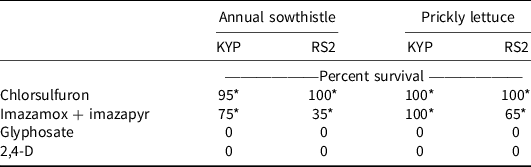
Seeds collected from plants growing at each site prior to the experiment starting were assessed for resistance to sulfonylurea, imidazolinone and auxin herbicides as well as glyphosate. The populations of both weed species sampled from each site were resistant to the sulfonylurea and imidazolinone herbicides, but susceptible to 2,4-D and glyphosate (Table 3). Sulfonylurea resistance was especially high, with all populations exhibiting at least 95% survival. This was expected to affect the performance of the conventional herbicide treatment, which includes a sulfonylurea component. The standard susceptible population included in screening was fully controlled (0% survival) by all screening herbicides and the nontreated control sample of each population had 100% survival.
Percent survival of annual sowthistle and prickly lettuce populations from the trial sites to herbicides used in resistance screening.a,b

a Trial site populations were sampled in summer 2018–2019 and screened in spring 2020. Data from each experimental run were pooled. Values followed by an asterisk (*) are greater than survival in the standard susceptible for each species (at P = 0.05), which in all cases was completely controlled.
b Abbreviations: KYP, Kulpara trial site; RS2, Roseworthy trial site.
Crop Establishment and Density Effects
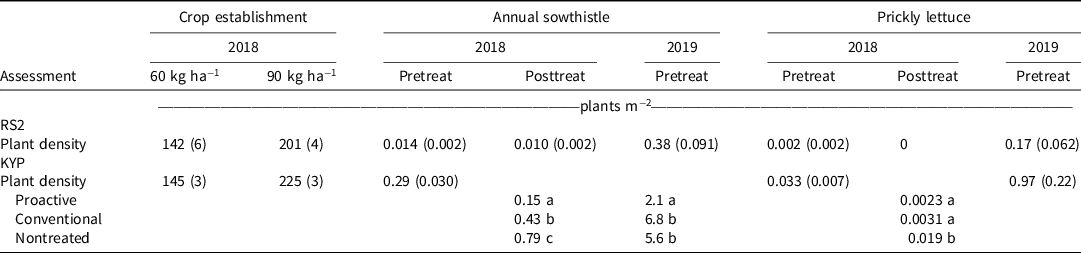
Wheat establishment was more variable at RS2 compared with that at KYP, but both sites had different (P < 0.05) crop plant density for the two sowing rate treatments applied (Table 4). Sowing guides for southern Australia often recommend densities of 100 to 150 plants m−2 for rainfed wheat production, and the Yield Prophet database, which collates input and yield data from across Australia, reports a mean sowing density of 145 (± 26 SD) plants m−2 in the southern grain production region (Hochman and Horan Reference Hochman and Horan2018). Therefore, the lower seeding density used in this trial represents a typical plant density, whereas the higher sowing rate is an above-average plant density.
Crop establishment, annual sowthistle, and prickly lettuce density at RS2 and KYP during the trial period.a,b

a Abbreviations: KYP, Kulpara trial site; RS2, Roseworthy trial site.
b Crop establishment is shown for the low (60 kg ha−1) and high (90 kg ha−1) seeding rates. Pretreat refers to counts taken following crop emergence but prior to POST herbicide application. Posttreat counts were taken following POST herbicide application. Where no significant treatment difference exists, counts have been averaged across the whole site area, and values are expressed as mean plant density with standard error in parentheses. Means within a column followed by the same letter are not significantly different at P = 0.05.
There was no effect (P > 0.05) of crop density treatments on the assessed metrics of weed density or seed production at either site in 2018 or 2019. The benefits of increased crop density for weed control are well established and are effected through a reduction in weed biomass and fecundity rather than weed density (Bajwa et al. Reference Bajwa, Walsh and Chauhan2017; Lemerle et al. Reference Lemerle, Cousens, Gill, Peltzer, Moerkerk, Murphy, Collins and Cullis2004; McDonald et al. Reference McDonald, Hollaway and McMurray2007; van der Meulen and Chauhan Reference van der Meulen and Chauhan2017). Therefore, crop competition may not have affected weed density in 2018 but could become apparent in the following year by reducing biomass and reproductive success of the 2018 weed population. Since destructive weed biomass measurements in 2018 would have affected 2019 results, fecundity was estimated through seed production estimates at KYP at the end of 2018 (Supplementary Table 1), but no effect of crop density was found. The experimental densities represent only a typical and an above-average plant density, and wheat is a relatively competitive crop, particularly against broadleaf weeds (Mobli et al. Reference Mobli, Yadav and Chauhan2020; Walsh Reference Walsh2019). Lower crop density or a less competitive crop could result in greater seed production.
Initial Weed Density and Herbicide Treatment Effects
Initial weed densities at each site were assessed after crop emergence and prior to herbicide treatment in 2018 (Table 4). Densities of both weeds were variable across the two experimental sites, but KYP had much higher densities of both species than RS2. Density of annual sowthistle was higher than prickly lettuce at both sites.
Trial Site RS2
There was no effect (P > 0.05) of herbicide treatment on weed density at RS2, possibly due to the low initial weed density and high variability across the site, so results are presented as averages across the site at each assessment (Table 4). Following herbicide treatment in 2018 (Posttreat), annual sowthistle density decreased compared with initial density assessments and prickly lettuce was not detected in the trial area. An extra weed density assessment was conducted at RS2 before sowing in 2019, when densities were at their highest, but there was still no treatment difference in weed populations (Supplementary Table 2). In the counts taken following crop emergence, but prior to POST herbicide application in 2019 (Pretreat), densities were lower than counts taken prior to sowing, but there was no difference between treatments.
Despite the low density of annual sowthistle and absence of prickly lettuce in the RS2 trial area following herbicide treatment in 2018, both weeds were present prior to sowing in 2019 (Supplementary Table 2) and after crop emergence (2019 Pretreat; Table 4). Possible reasons for this include prolific seed production by survivors in the study area (such as in nontreated plots), colonization from outside the study area, and contributions from the soil seedbank. The presence of prickly lettuce in 2019, despite being completely absent from the trial area following herbicide treatment in 2018, suggests that colonization and seedbank recruitment (of seed produced in 2017 prior to the trial) are important factors at this site. There were patches of prickly lettuce present along the edge of the RS2 site and around a large tree within the crop that could be the source of this colonization, in addition to seed dispersed from farther afield in the landscape. Seedbank recruitment is unlikely to be the major contributor since both species have little dormancy and most seed will germinate within the first year provided the necessary cues. Chauhan et al. (Reference Chauhan, Gill and Preston2006) reported >90% germination in annual sowthistle, and Chadha et al. (Reference Chadha, Florentine, Chauhan, Long, Jayasundera, Javaid and Turville2019) reported >85% germination in prickly lettuce following exposure of seed to light and moisture, with germination and emergence declining with increasing osmotic potential and depth of seed burial. However, the lack of substantial rainfall events in 2018 and seed burial at seeding could have resulted in some persistence of viable seed produced in 2017 to the 2019 season.
Trial Site KYP
Sowthistle density in 2018 and 2019 at KYP was affected by the 2018 herbicide treatments (Table 4). At the 2018 Posttreat assessment the proactive treatment resulted in the lowest sowthistle density, with an 81% reduction in plant numbers compared to the nontreated control. The conventional treatment resulted in a 46% reduction in sowthistle plant densities. Annual sowthistle seed production estimates followed the same pattern, with the lowest seed production in the proactive treatment and the highest seed production in the nontreated plots (Supplementary Table 1). At the 2019 Pretreat assessment, the proactive treatment still had the lowest density of sowthistle plants (63% control), but there was no longer a statistically significant difference between the conventional treatment and nontreated plots. This difference from 2018 to 2019 may be because the population of annual sowthistle at KYP is resistant to sulfonylurea herbicides, with 100% survival at the field rate (Table 3). The residual component of the conventional herbicide treatment relies on a sulfonylurea herbicide, metsulfuron methyl, so this treatment would have provided no residual control after the initial immediate effects of the MCPA component. It could also be due to seed produced in the nontreated plots dispersing to other areas of the trial, which is an innate characteristic of these weed species.
Prickly lettuce density at KYP at the 2018 Posttreat assessment was higher in the nontreated plots, but there was no difference between the conventional and proactive herbicide treatments (Table 4), both achieving about 86% control with respect to the nontreated. Under both herbicide treatments, weed density was similar to the initial density across the site, whereas density in the nontreated plots increased. This suggests that new germinations may have occurred following the application of herbicide treatments. There was no effect (P > 0.05) of herbicide treatment at the 2019 Pretreat assessment and therefore no legacy effect observed for prickly lettuce.
Increase in Weed Density from 2018 to 2019
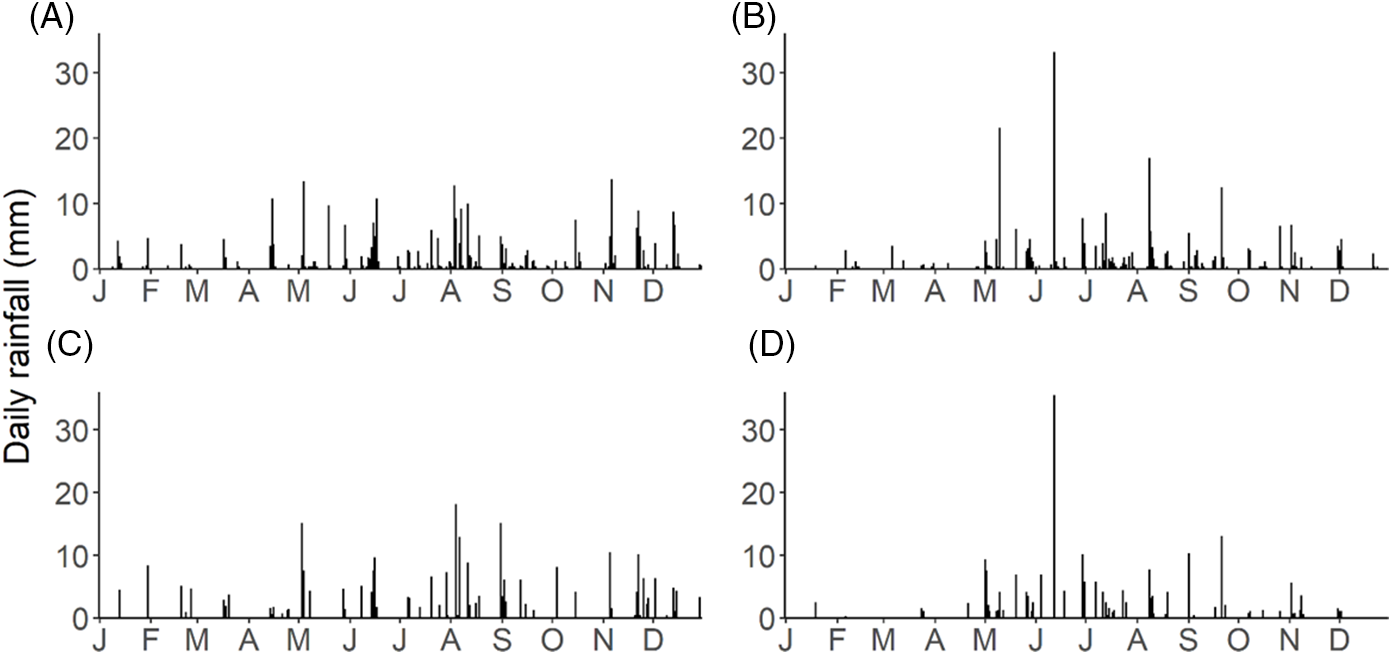
Weed densities at 2019 Pretreat assessments were higher for both species at both sites compared with the initial densities recorded in 2018 (Table 4). In both years, these assessments were completed at similar stages—following crop emergence but prior to POST herbicide application—so they represent an overall increase in density from 2018 to 2019. At RS2, this could be influenced by the crop selection in each year—the 2018 crop (wheat) was much more competitive than the 2019 crop (lentils; Bajwa et al. Reference Bajwa, Walsh and Chauhan2017). However, at KYP, the 2019 crop (barley) was more competitive than the 2018 crop (wheat), but density still increased. The more likely factor is the difference in rainfall between the two growing seasons. Growing season rainfall did not differ greatly between the two years at either site (Table 1), but there was a lack of substantial rainfall events in 2018 (Figure 1). The only daily rainfall totals greater than 20 mm during the entire trial period were in 2019 on May 10th (RS2), and June 12th (both sites; Australian Government Bureau of Meteorology 2019). These rainfall events occurred several weeks before the 2019 Presow assessment at RS2 and the 2019 Pretreat assessment at both sites. Germination in both weed species is highly moisture dependent and large rainfall events stimulate flushes of germination (Chadha et al. Reference Chadha, Florentine, Chauhan, Long, Jayasundera, Javaid and Turville2019; Widderick et al. 2010), which could be responsible for the elevated numbers observed in Reference Widderick and Preston2019 assessments.
Daily rainfall totals at Roseworthy (RS2) in 2018 (A) and 2019 (B), and at Kulpara (KYP) in 2018 (C) and 2019 (D) (Australian Government Bureau of Meteorology 2019).

Implications for Management
The results of this trial suggest that legacy effects on weed density of herbicide treatment from one year to the next may be density dependent for annual sowthistle and prickly lettuce, with high initial densities in the first year increasing the chances of treatment differences in the following year. Significant treatment differences in the first year were observed only in the two situations with the highest initial weed density, sowthistle and prickly lettuce at KYP. Only sowthistle at KYP, with the highest initial density, had a legacy effect in the second year. Since the prices of herbicide treatments used in this study differed greatly with the proactive treatment costing roughly five times more than the conventional treatment, the initial density and resistance status of target weeds should be considered when employing this tactic. High densities of annual sowthistle or prickly lettuce may justify the extra expense, especially if ALS inhibitor resistance is present. In any case, earlier studies have shown that the incidence of annual sowthistle and prickly lettuce resistance to the ALS inhibitors is extremely widespread in southern Australia (Lu et al. Reference Lu, Baker and Preston2007; Merriam et al. Reference Merriam, Boutsalis, Malone, Gill and Preston2018), so this mode of action should not be relied on.
The data demonstrated the ability of these weed species to increase in abundance even after effective control the year prior. This increase could come from prolific seed production of surviving plants, colonization from outside the area, or contributions from the soil seed bank. Individuals of these species have the potential for prolific seed production, particularly when growing in uncropped areas where they may face less intense competition (Amor Reference Amor1986; Hutchinson et al. Reference Hutchinson, Colosi and Lewin1984). These individuals have the potential to contribute substantially to weed numbers in an adjacent field. Although colonization from outside areas or dispersal between plots was not quantified in this study due to the practical difficulty of experimentally tracking dispersal in small seeded, wind-dispersed species (Bullock et al. Reference Bullock, Shea and Skarpaas2006), these factors would certainly occur in the field. Both annual sowthistle and prickly lettuce have relatively short seedbank persistence but have the ability to persist beyond one growing season in the absence of suitable growing conditions (Chadha et al. Reference Chadha, Florentine, Chauhan, Long, Jayasundera, Javaid and Turville2019; Hutchinson et al. Reference Hutchinson, Colosi and Lewin1984; Weaver and Downs Reference Weaver and Downs2003; Widderick et al. Reference Widderick, Walker, Sindel and Bell2010). Furthermore, both annual sowthistle and prickly lettuce germinate in a range of temperatures so germination can occur at any time of year in Australia provided sufficient moisture is available. Crop monitoring, particularly in the weeks following substantial rainfall events, can help to identify and control these flushes of germination.
The inconsistency of management benefits carrying over to the following year indicate that the strategy of targeting broadleaf weeds in a prior cereal crop is insufficient on its own when dealing with highly fecund, wind-dispersed weeds, although it can be a useful tool in some situations. Even if high levels of control are achieved in the cereal phase, these species could colonize from the soil seedbank, adjacent fields, fence lines and roadsides, or other uncropped areas. Reducing seed set, especially for individuals growing under reduced competition, should be a priority since both species produce large quantities of mobile seed.
Acknowledgments
This research is supported by an Australian Government Research Training Program Scholarship and a Grains Research and Development Corporation (GRDC) Grains Research Scholarship (project UOA1801-003RSX). Technical assistance was provided by David Brunton, Ben Fleet, and Jerome Martin from the University of Adelaide Weed Science Research group. We thank the grower and farm manager at each site for accommodating the trials on their property. No conflicts of interest are declared.
Supplementary material
To view supplementary material for this article, please visit https://doi.org/10.1017/wet.2020.134