Introduction
Population ageing is occurring at a rapid pace in many Asian countries as fertility rates decline and life expectancy increases (United Nations, Population Division, Department of Economic and Social Affairs 2010). As a result, an increasing number of older adults will require assistance in the form of income support, health care, and personal or ‘everyday’ care (Wolf and Ballal Reference Wolf and Ballal2006). Given that most Asian countries have relied historically on family-based support for older adults, the growing number of older adults undoubtedly places additional stress on family systems.
At the same time, social, economic and institutional changes, which are often referred to as ‘modernisation’, are occurring rapidly throughout Asia. One way these changes affect individuals is by giving them increased opportunities to participate in new activities, such as schooling, employment outside of the family and travel. A potential consequence of these new opportunities is weakening family support for older adults. According to the ‘ageing and modernisation’ theory, the status and support of older people declines as societies ‘modernise’ (Cowgill Reference Cowgill and Gubrium1974, Reference Cowgill1986; Cowgill and Holmes Reference Cowgill and Holmes1972). The theory emphasises the role of weakening norms of family and filial obligations in eroding old age support. Custom no longer compels young people to provide for their older parents or relatives, so their support is increasingly dependent on personal sentiments, such as sympathy or affection (Aboderin Reference Aboderin2004). This theory has motivated much of the debate and research on the declining status and support of older people (e.g. Cheung and Kwan Reference Cheung and Kwan2009; Frankenberg, Lillard and Willis Reference Frankenberg, Lillard and Willis2002; Lee, Parish and Willis Reference Lee, Parish and Willis1994; Martin Reference Martin1990a, Reference Martin1990b; Mason Reference Mason1992).
Previous empirical research on this topic has two main limitations. First, most of the studies focus on how children's experiences with non-family activities influence their support of parents and other relatives (e.g. Brauner-Otto Reference Brauner-Otto2009; Knodel and Saengtienchai Reference Knodel and Saengtienchai1996; Pienta, Barber and Axinn Reference Pienta, Barber and Axinn2001; Piotrowski Reference Piotrowski2008). We know relatively little about how one's own experiences with non-family organisations, such as schools and employers, influence receipt of care for oneself later in life. Second, previous research has focused on how changing social and economic institutions have influenced other types of care, including co-residence (Cameron Reference Cameron2000; Frankenberg, Chan and Ofstedal Reference Frankenberg, Chan and Ofstedal2002; Knodel, Saengtienchai and Sittitrai Reference Knodel, Saengtienchai and Sittitrai1995; Zhang Reference Zhang2004) and income transfers (Brauner-Otto Reference Brauner-Otto2009; Frankbenberg, Lillard and Willis Reference Frankenberg, Lillard and Willis2002; Lee, Parish and Willis Reference Lee, Parish and Willis1994; Lillard and Willis Reference Lillard and Willis1997). In contrast, relatively few studies have examined the receipt of personal care, such as help with bathing, dressing, and feeding or household tasks.
Our study seeks to understand the extent to which individuals' experiences with non-family institutions influence the personal care they receive from their children and other family members in older adulthood. We have three main objectives. First, we construct a guiding theoretical framework pulling together theories typically applied to care-giving with those of social change. Second, we examine how older adults' previous non-family experiences influence their later receipt of personal care. Third, we examine how non-family experiences moderate the influence of poor health on the receipt of care in older adulthood. Our study relies on data from the Chitwan Valley in rural, south-central Nepal, an area which has recently experienced dramatic social, economic and institutional changes. Consequently, this setting provides a unique opportunity to examine the relationship between a shift toward non-family organisation and care in older adulthood.
Theoretical background
Substantial bodies of literature exist on both the link between the expansion of opportunities for non-family experiences and family relations (e.g. Axinn and Yabiku Reference Axinn and Yabiku2001; Hoelter, Axinn and Ghimire Reference Hoelter, Axinn and Ghimire2004; Yabiku Reference Yabiku2005) and on care-giving in the context of rapid social and economic change (e.g. Frankenberg, Chan and Ofstedal Reference Frankenberg, Chan and Ofstedal2002; Lee, Parish and Willis Reference Lee, Parish and Willis1994; Zhang Reference Zhang2004). However, little research has brought these two topics together. In this paper we develop a framework for understanding this link between non-family experiences and receipt of care in later adulthood.
Our framework draws on two groups of commonly used theories that attempt to explain patterns of care-giving and receiving: theories of altruism or mutual aid, and theories of reciprocal exchange. Under the altruistic or mutual aid model, family members may care for one another because they care about each other's wellbeing, with illness and disability as the primary determinants of receiving care (Hogan, Eggebeen and Clogg Reference Hogan, Eggebeen and Clogg1993; Lee, Parish and Willis Reference Lee, Parish and Willis1994; McGarry and Schoeni Reference McGarry and Schoeni1997). Under the reciprocal exchange model of care-giving, family members may offer assistance in response to gifts received or expected future gifts (Goldscheider, Thornton and Yang Reference Goldscheider, Thornton and Yang2001). Proponents of this theory cite three common examples: adult children assisting their parents to repay them for the assistance they received in childhood, adult children assisting their parents and expecting their parents to repay them through inheritance, and parents assisting their children to ensure that their children will in turn care for them (the parents) in their old age (Becker et al. Reference Becker, Beyene, Newsom and Mayen2003; Henretta et al. Reference Henretta, Hill, Li, Sodo and Wolf1997; Silverstein, Parrott and Bengtson Reference Silverstein, Parrott and Bengtson1995).
Taking into account these two perspectives on care-giving and receiving, we identify three specific mechanisms, described further below, that may operate to produce a relationship between non-family experiences and care receipt in older adulthood: increased individualism, decreased availability of care-givers and increased wealth. Of course, both younger and older people may be affected by the expansion of opportunities for non-family experiences. Younger people's non-family experiences may influence their motivation and ability to give care, just as older adults' past non-family experiences may influence whether they receive care. The present study and, thus, the mechanisms we describe here are focused on the link between one's own non-family experiences and care receipt.
Individualism
Non-family experiences may be linked to a lower likelihood of receiving care through increased individualism. The modes of social organisation framework suggests that those who have had significant experiences outside the family are more likely to hold individualistic attitudes (Thornton and Fricke Reference Thornton and Fricke1987; Thornton and Lin Reference Thornton and Lin1994). A key premise of this framework is that as more non-family institutions, such as schools, appear in communities, there is a fundamental shift in the social organisation of daily life that draws individuals out of social networks dominated by family members and, via participation with these institutions, into new, non-family social networks. With this shift, individuals' own ideas about certain behaviours and their perceptions of others' ideas about those behaviours begin to change. More specifically, participants in non-family institutions become increasingly individualistic and emotionally nucleated, meaning that they become more concerned with their own welfare and the welfare of their children and less concerned with extended families and familial networks (Caldwell Reference Caldwell1982; Lesthaeghe and Surkyn Reference Lesthaeghe and Surkyn1988). This is due to the increased time spent away from the family, increased interactions with people who hold different, specifically non-family-oriented values, and because of the new ideas they are exposed to in these non-family locations (Thornton and Fricke Reference Thornton and Fricke1987; Thornton and Lin Reference Thornton and Lin1994).
Given that those who have had non-family experiences are likely to hold more individualistic attitudes, the increased individualism may translate into a lower likelihood of care receipt in two main ways. First, individuals who are more individualistic may be less likely to ask their family members for assistance with their personal care needs. They may be less likely to recognise their dependencies or less willing to request and accept offers of assistance. Second, parents who have had non-family experiences may socialise their children to hold more individualistic attitudes and, as a result, their children may feel less committed to caring for their parents.
Availability of care providers
Participation in non-family experiences also may be linked to a lower likelihood of receiving care through a decreased availability of care-givers. An older adult's receipt of care depends on the proximity and availability of potential care-givers, typically children or other family members. Previous research has found a positive association between women and men's non-family experiences and fertility decline (Axinn and Barber Reference Axinn and Barber2001; Axinn and Yabiku Reference Axinn and Yabiku2001; Barber and Axinn Reference Barber and Axinn2004; Caldwell Reference Caldwell1982). In addition, older adults who have had non-family experiences are more likely to encourage and help their children to pursue non-family experiences as well, so their children are more likely to be away from home pursuing school, work or travel and, thus, unavailable to provide care.
Wealth
Non-family experiences also may be linked with a higher likelihood of receiving care through increased wealth. Individuals who have had non-family experiences tend to have more wealth than those who have not had these experiences. In turn, older adults' wealth may influence their likelihood of receiving care in two main ways. First, wealthier parents have more resources to invest in children, such as purchasing school books or supporting children's travel to and living in cities. Based on the reciprocal exchange model described above, this greater investment in children would result in a higher likelihood of these parents receiving care from their children because of the higher debt that children must repay to their parents. Second, children who hope to inherit wealth from their parents may have a greater incentive to provide care for them. As a result, parents who have had non-family experiences may be more likely to receive care from children hoping to inherit the wealth these experiences have helped them accumulate. It is also worth noting that although wealth can also be used to hire care providers, in this setting (described below) the formal-care sector is nearly non-existent and less than 5 per cent of the respondents receiving care identified the provider as a non-relative.
Although conceptually distinct, the mechanisms described above may be interrelated in complex ways. Each mechanism may shape and be shaped by the others. For example, individualistic attitudes may be related to the accumulation of wealth. The relationship between non-family experiences and older adults' receipt of care likely operates through multiple mechanisms simultaneously. This paper does not explicitly test whether only one of these mechanisms is at work. Instead, it describes them as the pathways through which non-family experiences are related to receiving care.
Non-family experiences as moderator
Non-family experiences may have a direct effect on the receipt of care through the mechanisms described above, or they may moderate the relationship between health status and care receipt in older adulthood. In other words, while health problems create the need for care, the effect of health status on actually receiving care may vary according to the older adult's non-family experiences.
Whether non-family experiences exert a positive or negative moderating effect on the relationship between health and care will depend on which mechanism is at work. For example, consider the scenario in which increased education influences care receipt by increasing individualism. If adults who have had more education raise more individualistic children, those children may be less likely to provide care for a specific health need than children who are more family-centred. In this case, we expect the effect of an older adult's health status on the likelihood that he/she receives care to depend on the amount of education he/she had. Older adults in poor health who had more education will be less likely to receive care than those in poor health with less education. Alternatively, consider the scenario in which increased education influences care receipt by increasing wealth. In this situation, adults who had more education are wealthier. If their children are motivated by this increased wealth to provide care, then the older adult with more education will be more likely to receive care in a specific health context than an adult who had less education.
Of course, the results we present here should be interpreted with caution regarding the nature of the true causal effects that our estimates are designed to reflect. The individuals in our sample were not randomly assigned to participate in non-family activities, and some other factor may explain both the participation in non-family activities and receipt of personal care. Access to non-family organisations and demographic characteristics are examples. Theory and previous research provides evidence that access to non-family organisations such as schools, employers, mass transportation, markets and health services is related to the likelihood of participating in non-family activities as well as attitudes about care for older adults and the likelihood of intergenerational transfers (Beutel and Axinn Reference Beutel and Axinn2002; Pienta, Barber and Axinn Reference Pienta, Barber and Axinn2001). Consequently, it is important for us to investigate how proximity to non-family organisations and services impacts our models.
Additionally, we take great care to control for potentially endogenous background characteristics, including gender, age cohort and ethnicity. Gender inequalities have long been a dynamic of Nepalese society (Acharya and Bennett Reference Acharya and Bennett1981; Bennett Reference Bennett1983; Beutel and Axinn Reference Beutel and Axinn2002; Morgan and Niraula Reference Morgan and Niraula1995). While the position of women in Nepal has improved greatly in recent decades, the older women included in our analysis would have been relatively constrained from participating in education, employment and other activities outside the family. In addition, past research has demonstrated that levels of support received in older adulthood often vary by gender (Knodel and Ofstedal Reference Knodel and Ofstedal2003; Oftstedal, Reidy and Knodel Reference Ofstedal, Reidy and Knodel2004; Yount and Agree 2005). With regard to age, as non-family organisations increased over time, younger age cohorts would have had more opportunities for non-family involvement throughout their lifecourse. We also control for ethnicity, which is complex, multifaceted and interrelated with religion in Nepal. Although a full description of the ethnic groups in this setting is beyond the scope of this article (for detailed descriptions, see Acharya and Bennett Reference Acharya and Bennett1981; Bista Reference Bista1972; Fricke Reference Fricke1994; Gurung Reference Gurung1980), it is important to recognise that opportunities to participate in non-family activities may vary by ethnicity.
Setting
The setting for our study is the Chitwan Valley, an area that has recently undergone a period of rapid social change. Until the 1950s, this valley was covered with virgin jungle and only sparingly inhabited by indigenous ethnic groups (Guneratne Reference Guneratne1994). In the 1950s, the government began clearing parts of the jungle, implemented malaria eradication efforts, and instituted a resettlement plan leading to the migration to the region of many different ethnic groups, including both Buddhists and Hindus. By the late 1970s, roughly two-thirds of this valley was cultivated and a small town, Narayanghat, was forming in one corner. However, the vast majority of residents were employed in agriculture and continued to use traditional methods of production.
In 1979, the first all-weather road was completed linking Narayanghat to India and eastern Nepalese cities. Following that, two other roads were built – one to the west and one north to the capital city, Kathmandu. Because of Narayanghat's central location, it quickly became the transportation hub for the entire country. This led to the rapid expansion of schools, health services, wage labour, markets and mass transportation (Axinn and Yabiku Reference Axinn and Barber2001; Pokharel and Shivakoti Reference Pokharel and Shivakoti1986).
The introduction of new schools and other institutions changed how family life in the Chitwan Valley was organised. More activities, such as education, living and work, took place outside the family, whereas almost all activities previously occurred within the confines of one's natal home until marriage, and then within the confines of the marital home. For instance, as schools became more common, education became a non-family activity (Beutel and Axinn Reference Beutel and Axinn2002). As people interacted more with non-family organisations, other activities of daily living began to move outside the family. For example, individuals were more likely to reside away from their natal homes and travel to other areas for work or recreation. That is, the spread of non-family organisations and community services led to a change for individuals in both the number and types of their non-family experiences.
In this setting, family ties and support have generally been very strong, especially towards the husband's family. State-based programmes to meet the financial needs of older adults and the health-care system are minimal and market means of providing personal care (e.g. nursing homes, home-care nursing services) are nearly non-existent (Chalise and Brightman Reference Chalise and Brightman2006), so older adults must rely on family members for all forms of support. Historically, for most ethnic groups living in the Chitwan Valley, a married son and daughter-in-law would live with the son's parents. Previous research in this setting has found that the vast majority of adults continue to feel that adult children should care for their elderly parents (Pienta, Barber and Axinn Reference Pienta, Barber and Axinn2001), although familial ties remain stronger to the husband's family than to the wife's. Brauner-Otto (Reference Brauner-Otto2009) found that adult children were more likely to provide support to the husband's parents than the wife's.
Although research has found that familial ties are still strong in Nepal, those ties do appear to be weakening. Empirical research has found that most adult children still say they should support their elderly parents, but individuals who had more education or who had travelled to Kathmandu or outside Nepal were less likely to believe that a married child should care for his or her ageing parents (Pienta, Barber and Axinn Reference Pienta, Barber and Axinn2001). In addition, the pattern of co-residence is no longer universally followed; by 1996, less than one-third of married couples were living with the husband's parents and fewer than 3 per cent were living with the wife's parents (Brauner-Otto Reference Brauner-Otto2009). Past research has found that adult children are less likely to live with their parents if they have worked outside the family or if either of their parents has travelled outside Nepal (Pienta, Barber and Axinn Reference Pienta, Barber and Axinn2000). Also, couples who lived closer to schools were less likely to have offered support to the wife's parents than couples who lived farther from schools (Brauner-Otto Reference Brauner-Otto2009). This paper builds on this research by investigating the relationship between experiences with these non-family organisations and receipt of personal care.
Hypotheses
To summarise, the Chitwan Valley has experienced a significant increase in non-family activities, such as schooling, non-family living and travel. Participating in these activities may alter the care one receives later in older adulthood by fostering individualistic attitudes, increasing wealth and reducing available care-givers. Unique data from the Chitwan Valley Family Study (CVFS) enable us to test two hypotheses about the effects of non-family activities on receipt of care in older adulthood:
• Hypothesis 1: Non-family experiences will be associated with receipt of care in older adulthood.
• Hypothesis 2: Non-family experiences will moderate the relationship between health and receipt of care in older adulthood.
Method
Data
The study uses data from the CVFS conducted in rural Nepal. This study combines survey and ethnographic methods to obtain detailed measures of individual life histories and community context. In 1996, the CVFS collected information from residents of a systematic sample of 171 neighbourhoods in Western Chitwan Valley; it interviewed every resident between the ages of 15 and 59 in the 171 sampled neighbourhoods, and their spouses. Because of large age differentials between spouses, the age distribution of the final sample ranged from 13 to 80 years old. The overall response rate of 97 per cent yielded 5,271 completed interviews. All interviews were conducted in the most common language in Nepal, Nepali (questions presented below are translated). In 1996 only, Life History Calendar techniques were used to collect information essential to the present study regarding residents' education, labour force participation, living arrangements, travel and family formation behaviours throughout the lifecourse (Axinn, Pearce and Ghimire Reference Axinn, Pearce and Ghimire1999).
In 2007, the CVFS collected detailed information about the health and care receipt for all residents aged 45 and older in 151 of the sample neighbourhoods.Footnote 1 This age is lower than what is often used in studies of care-giving for older adults. However, work in the Chitwan Valley is generally very physically demanding and most people in their forties have been participating in hard physical labour for over 30 years. As a result, in this setting, many individuals are already experiencing many of the physical and mental signs of ageing by the age of 45. For example, in our study, over half of the adults between ages 45 and 54 years reported difficulty stooping, kneeling or crouching, and nearly half (46 per cent) of respondents in this age group reported difficulty walking continuously for an hour. Additionally, medical resources in Nepal are much more limited than in Western countries, which means that minor ailments are more likely to become physical impairments that require assistance from others.
This 2007 survey of older adult respondents was conducted at the household level. If the older adult was present at the time of the interview, the interviewer asked the questions directly of him or her. In situations where the target person was not present at the time of the interview, other household members served as proxy reporters. Information was gathered for 99 per cent of eligible individuals, yielding 2,155 completed interviews. We are forced to exclude 490 respondents from our analysis sample who were not eligible to be interviewed in 1996 and therefore have missing data on our key independent and control variables. (We ran separate models with measures of socio-demographic characteristics and wealth predicting receipt of care using two separate samples – one sample including all individuals interviewed in 2007 and a second sample including only those interviewed in 1996 and 2007 – and found no substantive differences between the results using the two different samples). In addition, we drop eight respondents who reported an ‘other’ ethnicity group and three respondents with missing data on key control variables. Our final analytic sample includes 1,654 older adults.
Measures of receipt of care
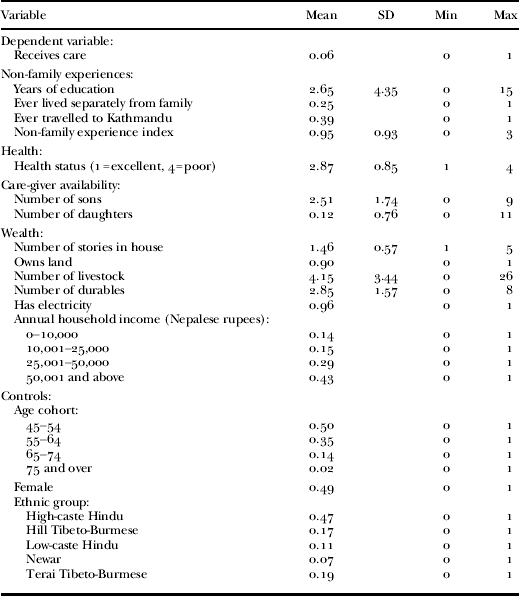
In the 2007 survey, respondents were asked, ‘Now I would like to talk about care received from other people. There are situations in which people receive care or assistance, perhaps because of difficulties with the activities just discussed, or because of a long-term physical or mental illness or a disability. During the past two weeks, have you (has she/he) received any such care or assistance?’ This question followed a series of questions about their difficulty with activities of daily living, such as eating, bathing and getting out of bed. We create a measure equal to 1 if the older adult reported receiving assistance and 0 if not. Descriptive statistics for this, and all measures used in the analyses, can be found in Table 1. Approximately 6 per cent of all individuals reported receiving care or assistance in the last two weeks.Footnote 2
Descriptive statistics for variables used in analyses (N = 1,654)

Notes: SD: standard deviation. Min: minimum. Max: maximum.
Measures of non-family experiences
We use information gathered in the Life History Calendars in 1996 to create four measures of the individual's non-family experiences. First, we created a count measure of the number of years of formal education the respondent had attained. Approximately 3 per cent of respondents reported more than 15 years of education, which is roughly equivalent to graduating from college. We recoded the measure of education, capping the outliers at 15 years. The mean number of years of education for this capped measure was just under three.
We also created two dichotomous measures for whether the individual had ever lived away from home (alone, in dormitories, with unrelated individuals and other non-family possibilities) or had ever travelled to Kathmandu, the capital city of Nepal. Both of these experiences represent substantial separation from the family. A quarter of respondents had lived away from their families at some point in time and 39 per cent had travelled to Kathmandu.
Finally, we created an index counting the number of these non-family experiences for each respondent. For education we coded a dichotomous variable equal to 1 if the respondent reported more than the mean years of education and 0 otherwise. We then summed this measure with the two dichotomous measures of non-family living and travelling. The mean number of experiences was just under 1.
Measures of health status
Given the theoretical argument for altruistic giving, it is important to control for the health of the individual, because individuals in worse health are more likely to receive care. Our measure of health is based on responses to the question, ‘Overall, would you say that your (her/his) health is excellent, good, fair, or poor?’ Responses ranged from 1 to 4 where 1 = excellent and 4 = poor. Overall, respondents generally had low assessments of their health; the mean for all the older adults was 2.87.
Measures of care-giver availability
We control for the number of care-givers available by including measures of the number of sons and daughters the individual gave birth to or fathered. We distinguish between the sons and daughters because gender plays an important role in social norms dictating care-giving in Nepal. A son typically lives with his parents, bringing his wife into the household, whereas a daughter moves to her husband's home. Consequently, a couple who has a son likely would have at least two care-givers available in their household in their old age, whereas a couple with only daughters may be more likely to live alone. Another advantage of living with a son and daughter-in-law in older adulthood is that providing assistance often requires intimate physical contact, and according to local customs, the care-giver should be the same gender as the recipient of the care.
Measures of wealth
We include six measures of wealth in these analyses. In the Chitwan Valley, household goods and landownership are a typically more meaningful measure of wealth or of need of support than cash income, and these wealth measures reflect this fact. The first measure is a count of the number of stories in the house that the family is living in. The second measure is a dichotomous measure equal to 1 if the household owns the land their house is on and 0 otherwise. The third and fourth measures are counts of the number of large livestock and consumer durables the family owns, respectively. The livestock measure includes bulls, cows, buffaloes, sheep, goats and pigs. The consumer durables measure includes radios, televisions, bicycles, motorcycles, carts, tractors, irrigation pumpsets, gobar gas plants, and farm tools such as threshers, chaff cutters, sprayers and corn shellers. The fifth measure is a dichotomous measure equal to 1 if the household has electricity and 0 otherwise. We also include a categorical measure of the family's household cash income in the previous year measured in Nepalese rupees.
Controls
In order to properly specify the models, we control for various characteristics of the respondents that may influence both their non-family experiences and likelihood of receiving care. Age is measured using dichotomous variables for four birth cohorts: ages 45–54, ages 55–64, ages 65–74, and ages 75 and over. The group ages 45–54 is the reference group in all analyses. Gender is a dichotomous measure equal to 1 if the respondent is female and 0 otherwise. We use dichotomous variables to control for five classifications of ethnicity: high-caste Hindu, hill Tibeto-Burmese, low-caste Hindu, Newar and terai Tibeto-Burmese. High-caste Hindu is the reference group in all analyses.
To control for proximity to non-family organisations we follow previous research and create five dichotomous measures equal to 1 if the respondent reported a school, employer, bus stop, market or health service within an hour's walk when he/she was 12 years old (Axinn and Yabiku Reference Axinn and Yabiku2001; Brauner-Otto, Axinn and Ghimire Reference Brauner-Otto, Axinn and Ghimire2007). We then sum these five variables creating an index denoting the number of non-family organisations nearby. The index ranges from 0 to 5 with fewer than half of respondents having lived within an hour's walk of at least two organisations. Respondents were asked this information in the individual interviews in 1996. Unfortunately, it is possible that the non-family experiences we are investigating actually occurred before age 12, particularly in the case of education. If this were true, the measure of proximity to non-family organisations could not be explaining the effect of experience on receipt of care. Rather, the presence of non-family organisations could actually be a result of the experiences. Therefore, we present the results of models that exclude this control, but discuss its effects below.
Analytic strategy
We use multivariate logistic regression techniques to examine the relationship between non-family experiences and receipt of care. All analyses include controls for the respondents' age, gender, ethnicity, health status, wealth and the availability of care-givers. We run the models using the xtlogit command in Stata, which adjusts for the fact that individuals were clustered in the sample neighbourhoods.
Our analysis has two main sections. In the first section, we examine the main effects of health and non-family experiences on receipt of care. Next, we consider the extent to which non-family experiences moderate the relationship between health and receipt of care. To accomplish this part of the analysis, we test models that include a set of interactions between health status and each measure of non-family experiences – years of education, non-family living, travel to the capital city and the non-family experience index.
Results
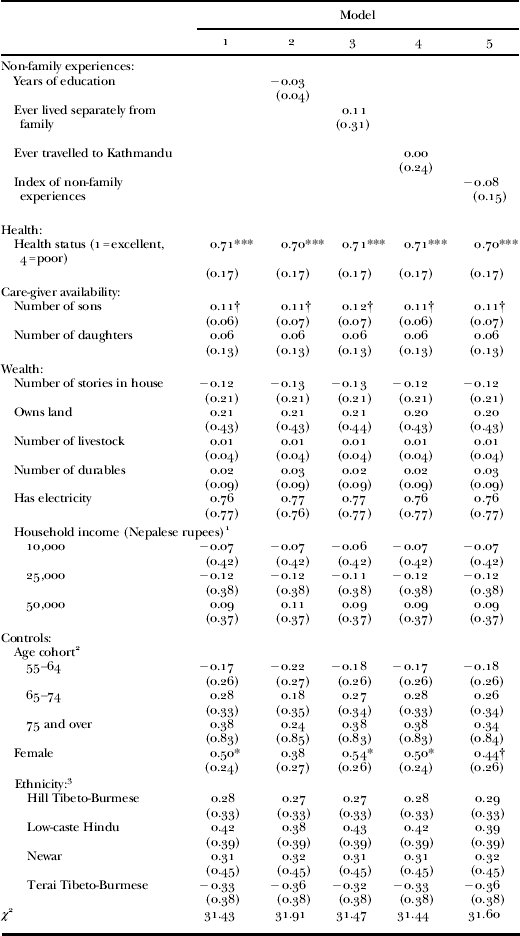
Table 2 presents results (estimated coefficients with standard errors) from a set of equations in which receipt of care is regressed on measures of older adults' health and non-family experiences. Model 1 includes the measures for health status, the availability of care-givers, wealth and the control variables – age cohort, gender and ethnicity. As expected, we see that health status, gender and number of sons have an important influence on the likelihood of receiving care. The unstandardised coefficient of 0.71 for health status means that for every one unit decline in health, the log odds of receiving care increases by 0.71. Family members appear to be responsive to older adults' need for assistance due to functional limitations or illness. Supplementary analyses show similar effects of health status on receipt of care when more specific measures of functional limitations are used, such as difficulty getting out of bed, eating or bathing (results not shown). This finding supports the theory that care is given at least partially for altruistic reasons.
Unstandardised coefficients from regression of non-family experiences on receiving care (N = 1,654)
Notes: Standard errors are given in parentheses. 1. Excluded group is 0–10,000. 2. Excluded group is ages 45–54. 3. Excluded group is high-caste Hindu.
Significance levels: † p<0.10, * p < 0.05, ** p < 0.01, *** p < 0.001.
Older adults with more sons were also more likely to receive care, which is a finding we expected due to the historical patterns of co-residence described above. The finding that women were more likely to receive care than men echoes the findings of other studies on personal care-giving in Asia (e.g. Zimmer and Kwong Reference Zimmer and Kwong2003). Finally, wealth is not significantly related to the likelihood of receiving care.
In Models 2–5 we add in our measures of non-family experiences. Years of education (Model 2), living separately from family (Model 3), travelling to Kathmandu (Model 4) and the number of non-family experiences (Model 5) are not significantly related to the receipt of care. Thus, the findings do not support our first hypothesis that older adults' non-family experiences are related to receipt of care. The index of proximity to non-family organisations in childhood was not statistically significant, nor did it substantively alter the effect of non-family experiences (results not shown).
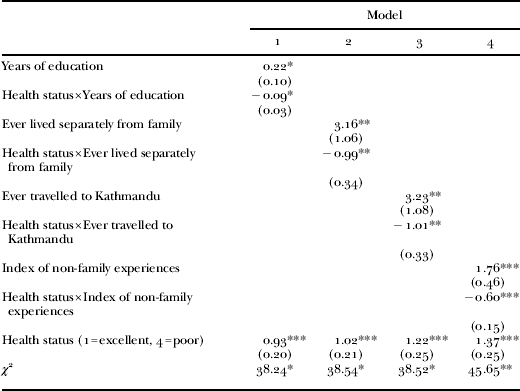
Having considered the main effects of health and non-family experiences in Table 2, we now investigate the moderating influences of non-family experiences on the relationship between health and receipt of care. The models in Table 3 test our second hypothesis, which is that older adults' non-family experiences will condition the association between health and non-family experiences. The equations used to estimate the models shown in Table 3 add terms capturing the interaction of non-family experiences and health to the equations in Table 2. All models include the controls shown in Table 2, and again proximity to non-family organisations was not statistically significant, nor did including it change the effect estimates for the other variables.
Unstandardised coefficients from regression of non-family experiences on receiving care and interactions of health status and non-family experiences (N = 1,654)
Notes: All models include controls for age cohort, gender, ethnic group, wealth and care-giver availability. Standard errors are given in parentheses.
Significance levels: * p < 0.05, ** p < 0.01, *** p < 0.001.
We continue to see a strong positive association between health and receipt of care. More importantly, we find evidence supporting our hypothesis that non-family experiences moderate the influence of health on receipt of care. Model 1 in Table 3 shows that the effect of health on receipt of care depends on years of education. The significant and negative interaction between years of education and health indicates that the positive relationship between worse health and receipt of care is weaker at higher levels of education (and that the positive effect of education on care receipt is weaker for those in worse health). Among those with more years of education, the slope representing the health–receipt of care relationship flattens.
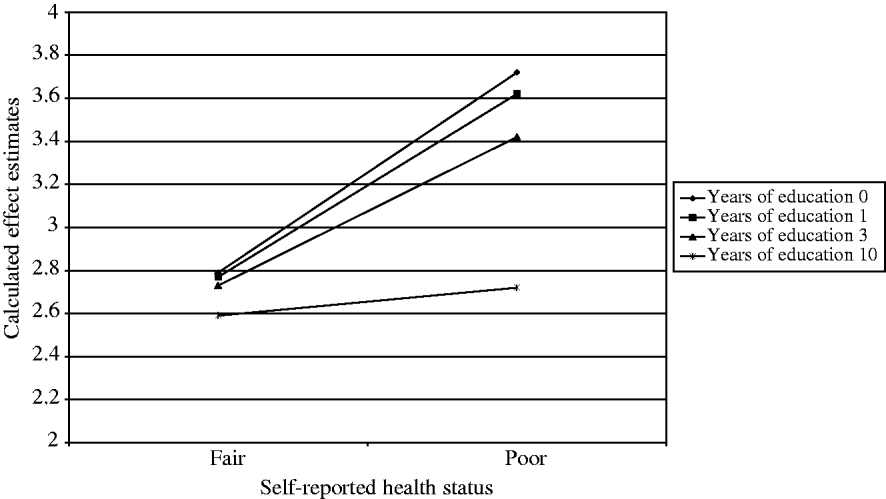
Figure 1 illustrates this pattern by graphing the effect of health status on the likelihood of receiving care, conditional on years of education. Each line shows the relationship between health status and the likelihood of receiving care for people with different levels of education. To illustrate the interaction we show the relationship for people with no education, one year of education, three years of education (the mean number of years for people in our sample) and ten years of education (the completion of high school in Nepal). Among the older adults in poor health, those who have had more education are less likely to receive care than their counterparts who have had less education, and the gap in care is even wider for those in poor health as opposed to fair health. More educated people are less likely to get needed care. That is, the positive effect of health status on care receipt is less for people with more education.
Interaction between years of education and health status: effect on receiving care.
Model 2 in Table 3 shows how the effect of health varies between those who have lived separately from family and those who have not. Again, the significant and negative interaction term between non-family living and health indicates that the effect of health on receipt of care is weaker among those who have experienced non-family living. Similarly, in Model 3, we see that the effect of health is weaker among those who have travelled to Kathmandu, the capital city. Model 4 includes the interaction between number of non-family experiences and health and also reveals a negative interaction between number of non-family experiences and health status. Taken together, the results indicate that older adults in poor health are more likely to receive care, but the link between health and receipt of care is weaker among those who have had more non-family experiences.
Overall, these findings support our hypothesis that non-family experiences moderate the relationship between health and receipt of care. They suggest that the influence of health on receipt of care is smaller among older adults who have had non-family experiences. In other words, older adults in poor health are more likely to receive care than older adults in good health, regardless of their non-family experiences. However, among the older adults in poor health, those who have had non-family experiences are less likely to receive care than their counterparts who have not had non-family experiences. Our models in Table 2 do not show an effect of non-family experiences, because the effect is hidden when we look across health status groups. By including interaction terms we are able to look at the effect of non-family experiences on receipt of care within health status groups, and as a result see this potentially detrimental effect of non-family experiences on the likelihood of receiving care among older adults.
According to our theoretical framework, the negative interaction term between health and non-family experiences can be interpreted in two non-mutually exclusive ways. First, the negative interaction term may indicate that family members are less responsive to the health needs of older adults who have had non-family experiences. Second, older adults who have had non-family experiences may be less willing to request or receive assistance with health problems.
Discussion
The rapid and dramatic demographic, social and economic changes that have swept through Nepal and many other countries over the past 50 years have raised concern regarding the wellbeing of older adults. In particular, the academic and policy worlds fear that these changes will result in an abandonment of older family members. There has been much discussion over whether historical systems of care, living arrangements and familial responsibilities that once centred around or within the family network are changing to look more like Western, individualistic systems and whether older adults are suffering as a result. By exploring care for older adults in a setting currently experiencing such dramatic social and economic change, we learn new information about the relationship between social context and care-giving and receipt.
This paper contributes to this discussion in two ways. First, we focus on personal care, which is an area that has received far less attention than co-residence or monetary support for parents, despite its essential connection to health and wellbeing. In a setting like Nepal, where the health-care system is minimal and nursing homes are non-existent, family care is the only care option when one becomes ill or disabled. Second, we examine the effect of the older adult's own experiences on whether he or she receives care. It is not surprising that most studies have focused on the effects of children's experiences on their care provision – younger people have gone to school, lived away from their families and travelled more often than the older generations. However, as the first generations that have had non-family experiences reach older adulthood, investigating how these experiences influence receipt of care later in life expands our understanding of how social change influences family care dynamics.
In order to investigate how the new experiences made possible by dramatic social change may affect the care older adults receive, we develop a framework that combines theories of social change, specifically the modes of social organisation framework, with theories of care-giving. Our empirical analysis provides evidence that social change is influencing the care situation for older adults in Nepal. When we look at older adults in poor health we find that those with more non-family experiences – more schooling, living away from their families and travelling to the capital city – are less likely to have received care in the previous two weeks than those with fewer experiences. Given that the social changes currently occurring in Nepal and similar settings typically result in dramatic increases in education, travel, living and work opportunities, it is probable that older and sick adults will increasingly find themselves lacking necessary personal care.
Our analysis also yields important conclusions regarding the specific motivation behind care-giving and receiving in Nepal. In particular, these findings support the altruistic model of giving. Older adults who were in need of care, those who had lower self-reported health, were more likely to receive it. Similarly, those who had more care-givers available, that is had given birth to more sons, were also more likely to receive care. However, we do not find evidence that the increased prevalence of non-family experiences (i.e. social change) influences care receipt through care-giver availability. Even though number of sons born was positively associated with care receipt, the inclusion of this variable in our models does not influence the effect estimates of non-family experiences on care receipt (results not shown). So, while non-family experiences influence the likelihood of receiving care, they do not appear to do so by influencing care-giver availability.
We also do not find evidence in support of the reciprocal exchange model for care-giving. Recall that those who had received more education were not more likely to receive care, nor was wealth related to the likelihood of receiving care. This is in contrast to previous research in this setting which found that those with more education were less likely to have provided support to their parents (Brauner-Otto Reference Brauner-Otto2009). One reason for these conflicting findings may be that the work presented here is from the care recipient's perspective, whereas other research has been from the care provider's perspective. Also, the type of care provided is different – here we look at physical care whereas previous research looked at material support or attitudes about support.
Altogether, our results suggest that non-family experiences influence care for older adults through attitudinal or ideational changes. Based on our theoretical framework, this is evidence that the social changes occurring are encouraging individualism and further distancing people from their families. Future research should focus more specifically on the role of changing attitudes as a mechanism through which social change influences old-age support. The research would be particularly informative if it incorporates both the attitudes of the older adults as well as their children, and, of course, longitudinal data on attitudes would also be crucial.
In conclusion, this research provides an important glimpse into the complex way social change is influencing the wellbeing of older adults. Although there still appears to be fairly strong levels of familial ties, the actual receipt of personal care is negatively influenced by the experiences individuals have in these new non-family social contexts. As these experiences become increasingly common, we can expect to see a decline in family care for older adults.
Acknowledgements
This research was supported in part by an NIA training grant to the Population Studies Center at the University of Michigan (T32 AG000221). The authors are grateful to Zachary Zimmer for his comments on an earlier draft.