Bovine tuberculosis (bTB) is a zoonotic infectious disease caused by Mycobacterium bovis, a bacteria belonging to the Mycobacterium tuberculosis complex. Disease development is influenced by host genetic background (Papaianni et al. Reference Papaianni, Cosenza, Borriello, Galiero, Grasso, Della Ventura, Iannaccone and Capparelli2017) and by a proper immune response. bTB significantly affects animal health, influencing herd economic sustainability due to a reduction in productivity in severely affected animals. Thus, control and eradication of disease is principally based on removal and slaughter of infected animals following early diagnosis of disease (Vordermeier et al. Reference Vordermeier, Jones, Buddle, Hewinson and Villarreal-Ramos2016). Diagnosis is based on skin test where the intradermal injection of crude preparation from bacteria gives a delayed-type hypersensitivity reaction in positive animals. This technique is often associated with quantification of interferon gamma in ex-vivo stimulated cells of tested animals. However, these methods are influenced by several confounding factors (Pai et al. Reference Pai, Riley and Colford2004) and new potential biomarkers are required. microRNAs (miRs) are small non-coding RNA that influence gene expression by controlling mRNA degradation (Bartel, Reference Bartel2004). Differential expression of miRs has often been associated with non-infectious (Jeffrey, Reference Jeffrey2008) and infectious diseases including bTB (Vegh et al. Reference Vegh, Magee, Nalpas, Bryan, McCabe, Browne, Conlon, Gordon, Bradley, MacHugh and Lynn2013). Moreover, recent studies have shown that extracellular miRs are stably recovered from body fluid including milk (Weber et al. Reference Weber, Baxter, Zhang, Huang, Huang, Lee, Galas and Wang2010) where they have been associated with various biological processes, including immune response (Kosaka et al. Reference Kosaka, Izumi, Sekine and Ochiya2010). Based on these studies, we have measured the expression of four miRs named bta-miR-146a, bta-miR-29c, bta-miR-155 and bta-miR99b from milk of active bTB infected cows and compared them with non-infected controls. We were particularly focused on these miRs because they were differentially regulated upon M. bovis infection (Vegh et al. Reference Vegh, Magee, Nalpas, Bryan, McCabe, Browne, Conlon, Gordon, Bradley, MacHugh and Lynn2013). Finally, we have evaluated the potential use of miR-146a as a prognostic biomarker for diagnosis of bovine tuberculosis.
Materials and methods
Samples collection
Animals included in the study were from 3 different herds declared infected with bTB and were enrolled already in our previous study (Capparelli et al. Reference Capparelli, De Chiara, Nocerino, Medaglia, Di Costanzo, Ramunno, Capuano, Casalinuovo, Di Matteo and Iannelli2013). As described, they were grouped in cases and controls according to reactivity to resuscitation factor B (Capparelli et al. Reference Capparelli, De Chiara, Nocerino, Medaglia, Di Costanzo, Ramunno, Capuano, Casalinuovo, Di Matteo and Iannelli2013). Milk samples were stored at 4 °C and immediately processed upon arrival at the laboratory by centrifugation at 3000 g for 15 min at room temperature. The supernatant was recovered and further centrifuged at 15 000 g for 15 min at 4 °C. The milk whey was recovered and stored at −80 °C for RNA extraction.
RNA extraction
Before proceeding with RNA extraction from milk whey, 5 fmol of exogenous cel-miR-39 were spiked-in. RNA was isolated using Trizol LS (Thermofisher) following manufacturer's instruction and quantified using NanoDrop. Only samples with both 260/280 and 260/230 ratios >1·8 were used for further investigation.
Real-time reverse transcriptase quantitative PCR
One microgram of total RNA was reverse transcribed using TaqMan™ MicroRNA Reverse Transcription Kit (Thermo FisherScientific) according to the manufacturer's protocol. Quantitative PCR was performed using a TaqMan Fast Advanced Master Mix kit and a StepOne Plus Real-Time PCR system (Thermo Fisher Scientific). The TaqMan MicroRNA Assays used in this study and their Taqman assay IDs are as follows: bta-miR-146a (ID: 005896), bta-miR-29c (ID: 000587), bta-miR-155 (ID: 002623) and bta-miR99b (ID: 000436). Thermal cycling was conducted according to the manufacturer's recommended program and using cel-miR-39 as internal control for relative quantification.
Statistical analysis
All of the milk samples were taken from Holstein-Friesian cows. To reduce potential confounders, all subjects were lactating cows between 40 and 90 month of age and a screening for mastitis was performed immediately in the field using a California mastitis test with a commercial tester in order to exclude mastitis co-infection. To eliminate quarter bias, quarter samples were mixed. Data analysis and Receiver operating characteristic (ROC) curves were established using GraphPad Prism 6 (GraphPad Software Inc., San Diego, CA). Data were analysed using a parametric unpaired t test, and P < 0·05 was considered statistically significant.
Results and discussion
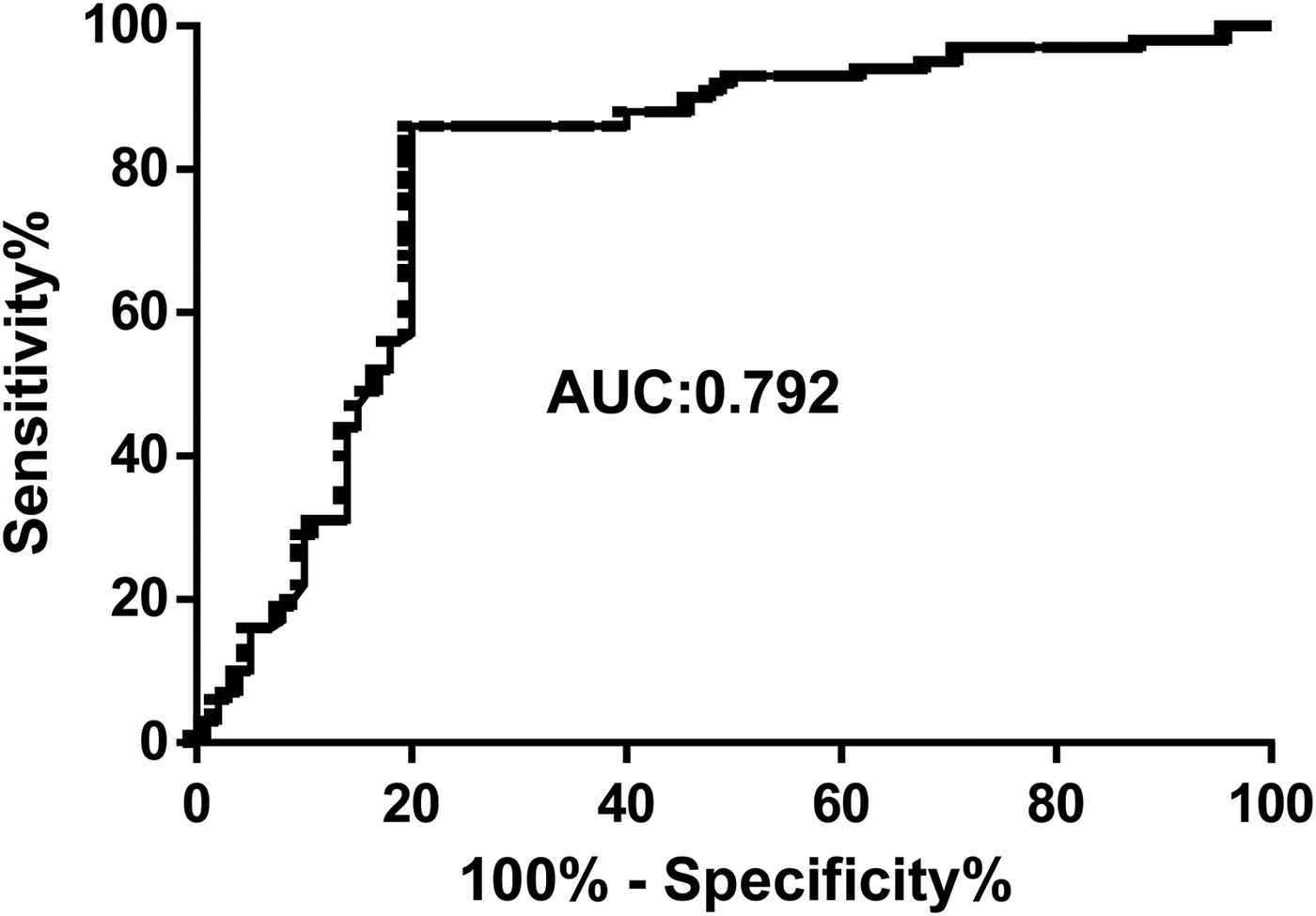
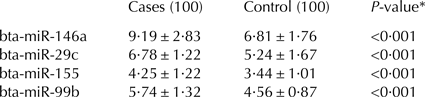
We compared miRs expression in 200 milk samples of Holstein-Friesian cows. Samples were previously grouped in cases (100 animals actively infected) and controls (100 animals negative) according to our previous study (Capparelli et al. Reference Capparelli, De Chiara, Nocerino, Medaglia, Di Costanzo, Ramunno, Capuano, Casalinuovo, Di Matteo and Iannelli2013). In detail, bta-miR-146a, bta-miR-29, bta-miR-155, bta-miR99b were chosen on the basis of a previous study where it was shown that they were differentially regulated in bovine milk during infection with M. bovis (Vegh et al. Reference Vegh, Magee, Nalpas, Bryan, McCabe, Browne, Conlon, Gordon, Bradley, MacHugh and Lynn2013). Using a qRT-PCR, we analysed the expression of the above miRs and all of them were significantly up-regulated in cases vs. controls (Table 1). Among them miR-146a is been extensively studied as a negative regulator of the inflammatory response (Taganov et al. Reference Taganov, Boldin, Chang and Baltimore2006) and it was also identified as a biomarker in plasma samples of sepsis and septic shock human samples (Wang et al. Reference Wang, Wang, Chen, Zeng, Wang, Zheng and Yu2013). In our data, miR-146a showed the highest difference between cases and controls and the expression data were subjected to ROC analysis to determine if miR-146a could serve as a sensitive and specific prognostic marker identifying animals with active bTB. This analysis showed that miR-146a could discriminate significantly between cases and controls animals (area under the curve: 0·795 [95% CI: 0·7290 to 0·8614, P < 0·001]) (Fig. 1). In order to determine a test cut-off value for miR-146a expression that would differentiate cases and controls, a value for the miR-146a expression higher than 8 was selected as this gave a test specificity of 80·0% (i.e. 20/100 detection of false positive miR-146s responses in control animals). Using this cut-off, miR-146a positive responses were identified in 16/100 controls, giving a test sensitivity of 86·0%. The prognostic accuracy of miR-146a to distinguish cases from controls was also highlighted by calculating the odds ratio after applying the cut-off value described above. Thus, the diagnostic odds ratio was established as being 24, indicating that for an animal showing significant induction of miR-146a in milk the probability of it developing tuberculosis is 24-fold higher than not having it.
miR-146a as a biomarker of active tuberculosis in milk. Receiver operating characteristic (ROC) analysis to assess efficacy of miR-146a as a biomarker of tuberculosis. AUC, area under the curve.

Relative microRNAs expression in milk from both active TB (cases) and control (negative) cows

Expression value are indicated as mean ± sd (standard deviation).
* Student's t-test.
Conclusion
This is the first study to demonstrate that miRs, namely bta-miR-146a, bta-miR-29, bta-miR-155 and bta-miR99b, are differentially regulated in milk from tuberculosis affected dairy cows. This result shows the potential of miRNA in milk for use as a biomarker for bovine tuberculosis. In particular, we have shown that miR-146a can be used as a potential biomarker candidate for active tuberculosis infection in cows with 80·0% and 86·0% specificity and sensitivity, respectively.
Dr Marco Iannaccone was supported by research funding from ‘Fondazione con il Sud’ (Project no.2011-PDR-18, ‘Biosensori piezoelettrici a risposta in tempo reale per applicazioni ambientali e agro-alimentari’).