


Introduction
Although exposure therapy is the most effective treatment for reducing spider fear (Wolitzky-Taylor et al., Reference Wolitzky-Taylor, Horowitz, Powers and Telch2008), some individuals do not respond to it and others experience a return of fear after treatment ceases (Mystkowski et al., Reference Mystkowski, Craske and Echiverri2002). According to Rescorla and Wagner (Reference Rescorla, Wagner, Black and Prokasy1972), learning during extinction (the mechanism underlying exposure therapy) is regulated by the discrepancy between the predicted outcome and the actual outcome, with greater discrepancies producing stronger extinction. As most individuals who fear spiders believe that uncontrollable contact with spiders will cause them to panic and then to go crazy or die (Arntz et al., Reference Arntz, Lavy, Van den Berg and Van Rijsoort1993), exposure tasks should then show them that uncontrollable contact does not lead them to go crazy or die and that they can tolerate their anxiety.
This study was a preliminary test of the benefit of adding a more challenging step to the standard fear hierarchy (‘Step 15 – Let the spider walk freely over the body’). We hypothesized that at post-treatment, participants who completed Step 15 would report (1) greater reductions in the probability of harm, (2) more fear reduction, and (3) greater ability to tolerate their reactions to the spider than those who did not make it to Step 15. After a context change, we expected that participants who completed Step 15 would be less likely to experience a return of fear than those who had completed fewer steps. We expected that this would translate into Step 15 participants having the greatest reductions in fear experienced during the follow-up behavioural approach test (BAT).
Method
Design
This experiment utilized a 2 (treatment context) × 2 (step completion) × 3 (time) design. Participants were randomly assigned to one of two treatment context groups (Same-Context or Different-Context). Those in the Same-Context group completed assessments and treatment in a living room. Those assigned to the Different-Context group completed assessments in a living room, but treatment in a therapist's office. Participants were categorized into one of two step completion groups (Step 14 or lower; Step 15) based upon which step of the fear hierarchy they completed by the end of treatment. These groups were then compared across time: immediately prior to Session 1 (baseline; Time 1); immediately after Session 2 (post-treatment; Time 2); and 25 min after the end of Session 2 (follow-up; Time 3).
Participants
Fifty-five students who reported a severe fear of spiders on the Fear of Spiders Questionnaire (required score = 47; actual scores ranged from 54 to 108; Szymanski and O'Donohue, Reference Szymanski and O'Donohue1995) and who also denied any heart, respiratory, or neurological problems completed Time 1, with 51 (46 women) completing the entire study. The final sample ranged in age from 17 to 47 years (median = 18, inter-quartile range = 3).
Materials
Physiological activity
Electrodermal activity (EDA), an objective assessment of spider fear, was measured continuously during the BATs using a Biopac MP150 system.
Fear of Spiders Questionnaire (FSQ)
The FSQ consists of 18 statements tapping cognitive, behavioural, and physiological domains of spider fear (Szymanski and O'Donohue, Reference Szymanski and O'Donohue1995).
Fear expectancies
Participants described their worst-case spider scenario (e.g. if a spider crawls freely on me, then it will go inside my body and I will get hurt) and then rated the probability of the expected outcome occurring (0 = not at all, 100 = extremely likely), how much fear they would experience during this situation (0 = no fear, 100 = extreme fear), and how much they believed they could tolerate it (0 = not at all, 100 = completely).
Fear ratings
The 0–100 point scale identified above was also used to measure fear levels during the BAT.
Procedure
During visit 1, participants completed the Time 1 BAT, followed by a brief break. Next, participants spent 1 h engaging in the fear hierarchy in their randomly assigned room (Same-Context or Different-Context). During visit 2 (1 week later), participants completed their second, 1 h session of exposure to the spider in their assigned room (Time 2). Afterwards, participants had a 25 min break in the waiting room before returning to the living room to complete the Time 3 BAT.
Behavioural approach task (BAT)
The BAT utilized a live female Australian golden orb weaver spider (Nephila clavipes) housed in a 30 cm × 30 cm × 30 cm clear glass container with a sliding lid. The BAT was modified from the standard 14-step procedure (Mystkowski et al., Reference Mystkowski, Craske and Echiverri2002) to include: ‘Step 15 – Let the spider walk freely over the body’. When participants stopped the Time 1 BAT, they paused for 10 s and then reported on their fear and fear expectancies ratings (Time 1 BAT). During the Time 3 BAT, participants stopped at the Time 1 BAT final distance to report on their fear and fear expectancies.
In vivo exposure
Exposure sessions followed the BAT step sequence, and treatment began with the final step reached during the Time 1 BAT. During each step, the experimenter guided participants to focus on their reactions towards the spider and discussed the likelihood that their worst-case scenario would happen and how much they could tolerate their reactions to it. Participants remained on a step until they indicated that they were unable to learn anything more about their worst-case scenario beliefs. If participants declined to move to the next step, they repeated the current step until they completed 60 min of exposure. At the end of each session, participants reported on their fear expectancies.
Scoring and atatistical analysis
The peak (maximum) EDA reading from the last 10 s of each baseline and its corresponding BAT were used. To reduce variance resulting in large individual differences, the level of maximum EDA (BATmax) experienced during the Time 1 and Time 3 BATs was calculated as the difference between the maximum log EDA during the baseline and the maximum log EDA during its corresponding BAT [e.g. log10 (max Time 1 BAT EDA +1) – log10 (max baseline Time 1 +1).
To select covariates, we assessed for potential differences in age and FSQ score between the hierarchy step groups and the context groups at Time 1 using independent samples t-tests and, if assumptions were violated, Mann-Whitney U-tests. We conducted a Fischer's exact test to examine differences in gender proportions between groups.
As participants’ ratings for fear variables were not normally distributed, we used generalized linear mixed models to examine changes in participants’ fear expectancies from Time 1 to Time 2, and from Time 2 to Time 3. Generalized linear mixed models also examined changes in fear ratings and EDAmax readings from the Time 1 to the Time 3 BAT. Gamma distributions were specified for all worst-case scenario fear expectancy ratings, BAT fear ratings, and EDAmax recordings. Fear ratings and EDAmax scores were transformed to eliminate negative values and values of zero.
Results
Preliminary analyses
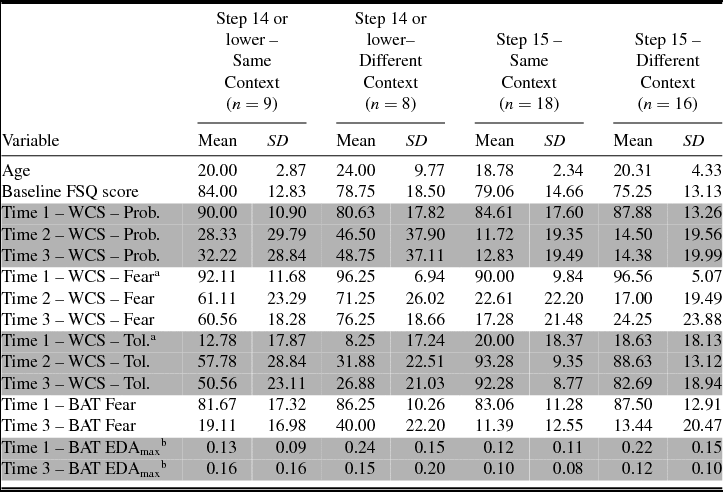
Only age differed at baseline. The Step 14 or lower group was older (z = –2.51, p = 0.01) and thus only age was included as a covariate in the remaining analyses. Descriptive statistics are given in Table 1.
Descriptive statistics by group

FSQ, Fear of Spiders Questionnaire; WCS, worst-case scenario; Prob., probability; Tol., tolerance; BAT, behavioural approach test; Step, final step from the Time 1 BAT; Fear, fear rating at participant's final step from the Time 1 BAT; EDAmax, peak electrodermal activity taken from the last 10 s of the BAT minus the peak electrodermal activity taken from the last 10 s of baseline. aOne participant was missing fear and tolerance ratings at Time 1; bone participant was missing EDA data at Time 1, two participants were missing EDA data at Time 3, and one participant was missing EDA data at both Time 1 and Time 3.
Worst case scenario ratings: change from Time 1 to Time 2
For probability ratings, only the effect of time was statistically significant (p = .007). The effect size of time for the Step 15 group was twice as large as the effect size for the Step 14 or lower group (d = –.96 vs d = –2.08). For fear ratings, the interaction between time and step completion was statistically significant (p = .009). The Step 14 or lower group evidenced a medium effect size difference between Time 1 and Time 2 (d = –.57), while the Step 15 group evidenced a large effect size difference between these time points (d = –2.50). For tolerance ratings, the fixed effect for time was statistically significant. Both groups evidenced a large effect size increase in tolerance ratings between Time 1 and Time 2 (Step 14 or lower group: d = 1.88; Step 15 group: d = 1.88).
Worst case scenario ratings: change from Time 2 to Time 3
When looking for evidence of renewal, none of the coefficients were statistically significant in predicting probability ratings; however, evidence of renewal was found when examining fear and tolerance ratings. A statistically significant effect size difference for fear ratings occurred between the two Step groups (p = .006). The Step 14 or lower group evidenced minimal change between Time 2 and Time 3 (d = .02 to .09), while individuals who completed Step 15 in the Same-Context (d = –.29) evidenced a small decrease in fear and those in the Different-Context (d = .25) evidenced a small increase in fear. For tolerance ratings, statistically significant effects occurred for step completion, context, and the interaction between step completion and context. Although the three-way interaction was not statistically significant, examination of effect sizes revealed that the Same-Context and Different-Context groups who completed Step 15 evidenced minimal change in their tolerance ratings between Time 2 and Time 3 (d = –.02 and –.19, respectively), as did those who completed Step 14 or lower in the Same-Context (d = –.12), but, those that completed Step 14 or lower in the Different-Context evidenced a small effect size reduction in tolerance ratings over time (d = –.40).
BAT: change from Time 1 to Time 3
For self-reported fear, the effect of time was statistically significant. Both groups largely improved over time with the effect size being somewhat larger (but not statistically significantly different) for the Step 15 group than the Step 14 or lower group (d = –2.38 vs d = –1.37, respectively). With regard to EDAmax, there were no statistically significant effects.
Discussion
We found partial support for our hypothesis that a more challenging exposure would lead to better treatment outcomes. Although both groups evidenced extremely large reductions in their self-reported fear (d = –1.37 to –2.38), those who completed the more intensive exposure step (Step 15) fared better in some respects. Immediately following treatment, individuals who completed Step 15 reported that their worst-case scenarios were less likely to occur, and after a context change, they did not lose their ability to tolerate their worst-case scenarios unlike individuals who completed Step 14 or lower. Yet contradictory to our predictions, Step 15 Different-Context participants experienced a renewal of fear after treatment, and thus lost some of the benefit they received during treatment with regard to greater fear reductions. Thus, the main benefit from completing more difficult exposures may be in reducing harm beliefs and in improving one's ability to tolerate aversive experiences.
Öst et al. (Reference Öst, Salkovskis and Hellstrom1991) recommended almost 30 years ago that individuals engage in behavioural experiments that require them to give up control. Studies that have not followed this advice have shown fear to return after treatment (e.g. Mystkowski et al., Reference Mystkowski, Craske and Echiverri2002). The current study provides preliminary evidence that Öst and colleagues’ (Reference Öst, Salkovskis and Hellstrom1991) recommendations should be followed. By doing so, clients may reduce their harm beliefs and increase their ability to tolerate distress to a greater degree. These findings need replication in a larger sample of individuals diagnosed with spider phobia that are randomized to a hierarchy step group using a yoked design to control for treatment durationFootnote 1.
Acknowledgements
This study used the Simulation Hub at Macquarie University to test for return of fear. The Simulation Hub contained a ‘real’ living room and therapist's office.
Ethical statement: All authors have abided by the Ethical Principles of Psychologists and Code of Conduct as set out by the APA: http://www.apa.org/ethics/code/. Macquarie University's Human Research Ethics Committee approved this study (5201500091).
Conflicts of interest: Melissa M. Norberg, Amie Newins, Yan Jiang, Jianqiu Xu, Eduard Forcadell, Cristina Alberich and Brett Deacon have no conflicts of interest with respect to this publication.
Financial support: This research received no specific grant from any funding agency, commercial, or not-for-profit sectors.
Supplementary material
To view supplementary material for this article, please visit https://doi.org/10.1017/S1352465818000437




Comments
No Comments have been published for this article.