


This article contributes to the literature on the causes and persistence of corruption. The theoretical understanding of corruption has for a long time been characterized by a modeling of this phenomenon as a situation in which those in power can extract rents from citizens by abusing their power. Indeed, a very widely cited definition of corruption is provided by the World Bank as “the abuse of public power for private gain.” If this were all there was to say about this phenomenon, then the problem of eliminating corruption is reduced to a principal-agent model in which the citizens, as principals, aim to control the behavior of officials. Persson, Rothstein and Teorell (Reference Persson, Rothstein and Teorell2012) make an important contribution, pointing out the shortcomings of this understanding of corrupt systems. The following paragraphs, on the current theoretical literature on corruption draw on some of their arguments. A large literature in economics and political science has sought to model the problem of corruption as a situation in which the principals, either all citizens as a group (Adsera, Boix and Payne Reference Adsera, Boix and Payne2003; Besley Reference Besley2007; Myerson Reference Myerson1993), or a non-corrupt central government (Becker and Stigler Reference Becker and Stigler1974; Van Rijckeghem and Weder Reference Van Rijckeghem and Weder2001; Banerjee Reference Banerjee1997; Banerjee, Mullainathan and Hanna Reference Banerjee, Mullainathan and Hanna2012), seek to control the behavior of bureaucrats or politicians.Footnote 1 In this framework, the elimination of corruption presupposes institutional changes that make the principals better able to incentivize good behavior from the agents: more effective monitoring, harsher punishments for bad behavior and better pay for doing the job right (Klitgaard Reference Klitgaard1988; Galtung Reference Galtung1998; Langseth, Stapenhurst and Pope Reference Langseth, Stapenhurst and Pope1997; Lawson Reference Lawson2009).
There are a few serious problems with this view of corruption, however, on both the theoretical and empirical fronts. In terms of the model's ability to explain empirical facts, the most obvious problem is that in many societies, citizens choose to vote for corrupt politicians, which seems counter to the most basic aspects of the principal-agent model (Chang, Golden and Hill Reference Chang, Golden and Hill2007; Kurer Reference Kurer2001; Peters and Welch Reference Peters and Welch1980). Connected to this, there are many notable instances of countries in which the electorate's control of politicians seems to be quite developed, in the sense that governments are often removed from power through democratic voting, but this does not lead to better control of corrupt behavior, as would be suggested by the principal-agent model. (The most obvious example would be many Eastern European countries after 1989, as analyzed in Miller, Grødeland and Koshechkina Reference Miller, Grødeland and Koshechkina2001; Miller Reference Miller2006; Karklins Reference Karklins2005).
Another problem is that policy interventions designed to strengthen the control of the agents on principals have often had dubious effectiveness (Fjeldstad and Isaksen Reference Fjeldstad and Isaksen2008; Anechiarico Reference Anechiarico1996; Johnston Reference Johnston2005; Meagher Reference Meagher2005; Doig and Riley Reference Doig and Riley1998; Riley Reference Riley1998; Szeftel Reference Szeftel1998; Montinola and Jackman Reference Montinola and Jackman2002; Sung Reference Sung2004). This suggests that the basic principal-agent model needs to be altered to allow for the possibility that corruption is a situation in which some of the principals themselves find little reason to take actions to limit the corrupt behavior of the agents. Persson, Rothstein, and Teorell (Reference Persson, Rothstein and Teorell2012) is one of the first efforts toward understanding such a situation. These authors concentrate on the collective action problem faced by citizens who seek to impose good behavior on officials in order to show that corruption can be understood as an equilibrium in which every citizen has an incentive to continue to participate in corruption as long as other citizens participate as well. In a similar vein, Della Porta and Vannucci (Reference Della Porta and Vannucci2012) move beyond the principal-agent model of corruption to analyze the rich institutional structure that characterizes corrupt exchanges.
While the argument in Persson, Rothstein and Teorell is convincing, this article argues that there are even more fundamental reasons why (some) citizens might desire the continuation of the corrupt system. There are at least two theoretical problems with the principal-agent model as it is often employed in analyses of corruption. One is that corrupt interactions can also benefit individual citizens, so there is no reason to always model them as situations in which the interests of government officials and citizens are completely opposed. It is true that corruption can take the form of extortion (for example a police officer stopping a driver for no reason and demanding a bribe in exchange for letting them drive on), but corrupt interactions are very often mutually desired, as an object of value for the citizen is traded. Situations in which business or building permits are sold for bribes, government procurement contracts are granted to the highest bribe-payer or criminals are left unpunished in exchange for bribes are best characterized not as extortion, but as transactions in which citizens can choose to participate if they feel there is a gain from doing so. It is not immediately obvious that the citizens participating in such exchanges would like to enact a policy that makes it impossible for the transactions to take place. While the notable contributions of Shleifer and Vishny (Reference Shleifer and Vishny1993) and Olken and Barron (Reference Olken and Barron2009) indeed model corrupt interactions as markets in which both sellers and buyers can gain surplus, their articles concentrate on the efficiency of such transactions, not on the more general question of how they relate to the persistence of corruption in society.
A second reason why the principal-agent view of corruption is incomplete has to do with heterogeneity among citizens in terms of their utility or disutility from corruption. Once we allow that citizens may stand to gain from individual corrupt transactions, it is natural to ask whether some of them will not be net winners from the corrupt system. If this is the case, then these net winners have no incentive to seek the elimination of corruption as in the typical principal-agent setting, which could help explain the persistence of corruption.
A second, connected contribution made by this article is in proposing a new mechanism through which corruption leads to inefficiency in terms of lost output. There is an empirical literature that seeks to establish whether corruption ‘greases the wheels’ or acts as ‘sand’ in terms of economic efficiency (Aidt Reference Aidt2009). The cross-country results tend to favor the inefficient ‘sand’ version of the story, allowing for the difficulty of establishing causality in cross-country regressions. The mechanisms through which corruption leads to less output, however, are still an open question in the literature (Mauro Reference Mauro1996; Tanzi and Davoodi Reference Tanzi and Davoodi2002). This article will argue that an important mechanism through which corruption produces its negative effects is the severe misallocation of resources that emerges from the interaction between citizens and officials, as the nature of corrupt interactions often ensures that only a limited subset of the population can gain access to productive assets.
The article's theoretical framework uses the definition of corruption provided by Shleifer and Vishny (Reference Shleifer and Vishny1993): “the sale of government property for private gain.” The assets being sold could be a policy decision, a permit to allow a certain action on the part of the citizen or simply the government's ability to impose heavy costs on its citizens due to its overwhelming power advantage in relations with them. More explicitly, the market transactions that constitute corruption in the model can help explain several classic instances of corrupt behavior, as described in the following.
Government contracts: For its daily activities, the government needs to buy goods and services from firms. A classic instance of corruption is when such a transaction takes place at a price above the competitive level (or if the quality of the product means the price is too high). In this case, there are rents to be shared by the buyer (the government) and the seller (the firm). The firm might pay a bribe to the government officials responsible for the contract, and in exchange get these super-competitive profits. In this case, the ‘permit’ being transacted is a permit to participate in the sale of these goods at super-competitive prices, and the price paid for the permit is the bribe paid to officials.
Business/building permits: This case is quite straightforward. The product being transacted is a permit to start a business or build something. It is not necessarily the case that such a permit would be allocated in the non-corrupt, socially optimal case, as permits are issued in order to limit activities that might be undesirable because of pollution, public health or other reasons. In this case the product being sold is a permit to build regardless of whether the law allows, and the price paid is the bribe.
Patronage: This is a situation in which the federal, state or local government provides jobs for individuals who then perform political services for the government. In this case the product being sold is the job's salary, and the price paid is the political service (donation, legislative support, or simply time and labor) being performed by the client for the patron.
Import tariffs, quotas and other protection: The product being sold from the central government/legislature/governing party to a firm or group of firms is the ability to get a super-competitive price for its goods on the domestic market because of protection from foreign competition. The payment might take the form of campaign donations or outright bribes.
Favorable judicial decisions if a crime has been committed: The product being sold by a judge, prosecutor or the police to a guilty party is “years out of jail,” and the price paid would generally be a bribe.
Secret party funding and buying off legislative decisions: The product being sold by a party in this case is the surplus/profit to be gained by the buyer from the favorable legislative decisions, and the price paid can be a bribe or favorable media exposure, jobs for family members of party leaders, etc.
As is apparent from this list, a market model for corrupt interactions can cover most of what has traditionally been included in the definition of this phenomenon. In each case, a government entity—whether a village mayor or traffic police officer, or the president or prime minister—sells a good to an individual or firm, who pays for it either directly (through a bribe) or through political donations, media support, time and labor, or in some other way. The market model, however, only includes as a limit situations in which corruption is simple extortion (robbery) of citizens: in this case, the market is one in which the consumption of the buyer is forced. An example would be a police officer requiring a bribe simply to leave a citizen alone. These cases will be included in the analysis, but their possible existence will only reduce the magnitude of the results in the article, rather than invalidate them.
The main results of the model suggest that in all such transactions, there are significant gains for both the government officials participating and the citizens who are their counterparties. Of course, however, some citizens will be net winners from the corrupt system, as compared to a non-corrupt baseline, and some will be net losers. The coalition of winners from corruption and government workers might be large enough to serve as a significant barrier to anti-corruption reforms. The main determinants of whether a citizen is a winner or loser from corruption are (1) whether the citizen is part of a group that, for whatever reason, finds it easier to engage in such transactions with government officials and (2) the degree to which the citizen is interested in acquiring the sorts of goods that are sold in corrupt markets. The results also show that characteristics of these corrupt markets mean that transactions made in them tend to lower overall social welfare through the severe misallocation of resources. The next section will informally present the model. Then the formal model of corrupt interactions will be developed, and its distributive effects analyzed, followed by the conclusions.
INFORMAL PRESENTATION OF THE MODEL
The model is based on a number of primitives that differentiate it from principal-agent models of corruption. Just as in Shleifer and Vishny (Reference Shleifer and Vishny1993) and Olken (2009), corrupt interactions are modeled as markets in which citizens pay a government official to buy goods that are valuable for them individually.Footnote 2 However, the model goes beyond this to explicitly consider how the special features of corrupt market transactions determine who gains and who loses from them. The interaction between citizens and the government officials in the model takes place in order to exchange a generic government good G, which corresponds to the examples presented in the introduction. In a non-corrupt system, G is allocated based on social utility. So if the social utility of allocating G to anyone is computed to be negative, it would not be allocated at all. In a corrupt system, G is allocated in order to maximize the government official's income, rather than according to social utility. In practice this means the good is allocated through a market mechanism: this is Shleifer and Vishny's classic definition of corruption as the sale of government assets. The market allocation of G will differ from the allocation based on social utility in the non-corrupt case in many ways, but one immediate implication is that goods that should not be available at all in the non-corrupt case are available for purchase in the corrupt case. The only case in which a market for G would also exist in a non-corrupt system is if it is the socially optimal way to distribute G: for example government auctions for telecommunications bandwidth. Even in this case, there will be significant differences between the market for G in the non-corrupt and corrupt systems.
Beyond the fact that it often should not exist, the market for G under the corrupt regime is very special. Two characteristics separate it from regular markets in two primary ways; the difference between them might be so great as to make it inappropriate to call the corrupt interaction a “market.” The first difference is the lack of an outside enforcer of corrupt contracts. Simply put, promises made under corrupt conditions are not at all credible, as no higher authority would intervene to enforce them, since they are illegal (as also argued in Della Porta and Vannucci Reference Della Porta and Vannucci2012). This would seem to suggest that corrupt interactions should be limited to spot transactions. However, there are few (if any) true spot transactions in the world: what is normally called a spot transaction is still an exchange of money now for goods that will have to reveal their true usefulness over time, even if that time is very short and very near. If the goods are proved ex post to lack the promised qualities, the seller will be sanctioned by the non-corrupt government, which would not be the case if that transaction were a corrupt one. This leads to modeling the corrupt interaction as a dynamic game: first the customer pays the bribe, then the government delivers, or not, the promised good. If there is the slightest cost to delivering the good, the government's unique equilibrium behavior should be to not deliver it, and corrupt transactions and their associated bribing would therefore never happen.
Cooperative equilibria in which corrupt transactions do happen should therefore emerge only under some form of repeated interaction. Some corrupt interactions are appropriately modeled as infinitely repeated games between one citizen and one government official, and this case is discussed in the article. However, many relevant types of interactions between the official and citizens are those in which they interact once (or over a finite or short time horizon). Favorable judicial decisions, business and building permits, and government contracts and their associated rents are all examples of ‘one-shot’ interactions, in which the government's commitment power compared to that of a potential customer is normally non-existent. Whenever such an interaction has a natural ending (for example, the end of a trial or the end of a government contract)—or when its continuation to infinity is under strong doubt due to its illegal, hidden and risky nature—the one-shot model is more realistic than the infinite-horizon model.
Therefore, this article argues that the most relevant model of interaction between citizens and the government is one in which customers are randomly drawn from a continuum of citizens and matched with the government for such a one-on-one, one-shot transaction. The government is a long-run player, and the customers are short-run players (Fudenberg and Tirole Reference Fudenberg and Tirole1991). The natural way to obtain a cooperative equilibrium in such cases is to rely on community enforcement: new players who are drawn to be matched with the government condition their behavior on the previous behavior of the government and citizens. If deviations from the cooperative equilibrium by either citizens or the government occur, play switches to a punishment equilibrium, in which players revert to the one-shot non-cooperative outcome. These kinds of “trigger” community-enforcement strategies can generate cooperative equilibria in much the same way they generate cooperative equilibria in regular repeated games.
The main question in this article is what are the distributive effects in society of such cooperative equilibria compared to a baseline in which the government good is distributed according to social utility. To determine the properties of cooperative equilibria, the second feature of corrupt transactions must be taken into account: the fact that corrupt transactions are not usually public. Since their outcomes will not normally be observed by all agents, the information structure of games that model such transactions must be constructed carefully. Having access to knowledge about previous interactions is a valuable asset in this case, and those citizens who (for whatever reason) know what the government and other fellow citizens have done in the past, or to whom such information can be revealed without danger, will be the only ones who can participate in a cooperative equilibrium.
A group of ‘insiders’ that has access to information on previous matches between the government and citizens will therefore be the only one that can participate in such corrupt transactions. In practice, the insiders are family or friends, or are otherwise connected to the official, which explains why corruption most often goes hand in hand with cliquish behavior based on connections rather than an open process by which the highest bidder among all possible customers engages in the corrupt transaction. One immediate implication of this characteristic is that corrupt transactions will often be very inefficient: the only ones who engage in them are those who are closely connected to the official (and there is no reason to believe they are also the ones with the highest valuation of the corrupt good) rather than the most efficient agents in the entire population, even if the most efficient agents would be able to pay much higher bribes. An extension of the model allows more than one citizen to be matched with the government at any given time. In this case, it will be argued that an equilibrium in which the government selects the insider citizen who has the highest valuation of the good and the highest willingness to pay for it has special attractive properties; this forms the basis of the analysis.
Repeated interactions between citizens and government officials can also lead to corrupt equilibria, with the role of community enforcement being taken by repeated play with the same player(s). In this case, the crucial parameter that determines whether corrupt interactions can be sustained is the frequency of interactions between any citizen and a public official, as reflected in the discount rate. Again, the prediction is that citizens who interact frequently with the official, for whatever reason, should be favored by the corrupt regime.
Interactions in which the citizens are simply robbed under the threat of harm are a limit case, and they never benefit citizens. Matches with a government official in this case are unlucky for the citizens. In the model, the existence of such transactions uniformly lowers every citizen's utility from the corrupt system and tones down the redistributive effects of corruption.
The private usefulness of the G good can itself be seen as endogenous. For example, the utility of a get-out-of-jail card depends on whether the citizen has committed the crime with which it is associated. The knowledge that such products are available for purchase will make citizens determined to maximize the usefulness of holding them. A large part of the utility of holding the G good might come in the form of an externality: the usefulness of the freedom card is maximized if the crime associated with it has been committed. The usefulness of a ticket to participate in government contracting is maximized if the ticketholder can capture the highest amount of rents from other citizens. In equilibrium, agents who gain G will always maximize their private utility for the good (i.e., maximize the externality that the good allows), which means that those who are able to impose the highest externalities have an advantage over other players in winning G.
The distributive effects of the corrupt system compared to a non-corrupt system follow from the properties of the described equilibria. The comparison is mainly made in the case of the random matching interaction described above. Compared to a non-corrupt baseline, the corrupt system generally redistributes toward insiders, as they are the only ones who are able to engage in corrupt transactions (and toward those who frequently interact with officials in the case of repeated interaction). The corrupt system also generally redistributes toward citizens who have a high ability to impose externalities on others, for example criminals or persons who are especially skilled at capturing utility from others. This is because the ones with such a high ability to impose externalities will have a higher private utility for the G good, and therefore will be the ones who acquire it. The corrupt system also obviously redistributes toward the government official, who is free to use his or her ability to provide the G good to extract bribes. The effect of corruption on total utility in the society is generally negative: even if externalities and rents are counted as transfers, and therefore have no effect on total utility, selecting partners for corrupt transactions only from the insider group will have large negative effects on total utility for realistic models of private utility for G. As the most reasonable distribution of the parameter indicating private utility for G in society is skewed toward zero and has a very long tail, limiting the number of draws from the distribution to the insider group will leave out some very high-utility citizens. The properties of the social loss from corruption are explored through a simulation exercise, which shows that a small insider group and high variability in the private utility for G increase social losses.
A MODEL OF CORRUPT INTERACTIONS
The basic building block of the model is an allocation problem: a government good G needs to be allocated (or not) to citizens who each have a certain level of utility for the good. Under a corrupt (CORR) system, a citizen j desiring such a product can engage in an interaction with a government official who can provide G.
One Citizen per Period
The simplest type of interaction between citizens and the government is a two-player game that takes place at time t: a citizen j and a government official g are matched for an interaction. The citizen has an endowment w and can spend it on two goods: a private good P (which has a price normalized to 1 per unit, and provides utility normalized to 1 per unit) or a government good G. In the following, only one market for G goods is considered at a time, so the subscript g on each G good is omitted.
The utility function of the citizen for the private and government good is linear and additive: the endowment is transformed into utility at rate 1 for the private good, so w enters into the utility function without a coefficient before it. The government good enters the utility function at rate αj, and it is constrained by assumption to be binary: Gj ∈ {0,1}. For the problem to be at all interesting, αj has to be greater than 1, so that the government good is desirable for the citizen. Any Rj ‘rent’ (bribe, tax) payments to the government are subtracted from the utility function, as they reduce the private good consumption of the citizen. The utility function is therefore:
 $${{U}_j}\, = \,w\, + \,{{\alpha }_j}{{G}_j}\,{\rm{ - }}\,{{R}_j}.$$
The government official's utility is also linear in money (which in the corrupt system comes in the form of a ‘rent’ or bribe, hence the R notation):
 $${{U}_g}\, = \,{{R}_g}.$$
One-shot interaction
The ‘match’ of the two players takes the form of a two-stage game: in the first stage, the citizen hands out a payment of size Rj to the official. Assume no credit constraints for the citizen, so Rj can be as large as needed to secure G. In the second stage, the official keeps this payment and can choose to provide G to the citizen. The provision of the good to player j is denoted by Gj = 1, and the non-provision by Gj = 0. Providing the good carries a cost c ∈ (0, ∞), so cg = c denotes the event “official g incurs cost c.” This cost encapsulates the private cost for the government official: the official's personal effort to produce g, the risk involved in providing an illegal good or simply the opportunity cost of giving up a good that is generally desirable (this would happen if the G good was rival). It does not include the costs of producing the good that are borne by the public budget, as these should not affect the official's utility in any way. Therefore, c might well be very small.
The unique subgame perfect equilibrium outcome of the one-shot game is easy to see: in the second stage, the government official j maximizes the expression Rj − cg, and because the non-provision of Gj makes cg = 0, the good Gj will not be provided. Backing off one stage, in the first stage, the citizen maximizes the expression w + αjGj − Rj, and because  $$$G_{j}^{\ast} \, = \,{\rm{0}}$$$
, the rent will not be paid,
 $$$R_{j}^{\ast} \, = \,{\rm{0}}$$$
and the citizen will derive utility Uj = w, all from private consumption.
Multiple interactions, different citizens
The commitment problem looks different however, if multiple, repeated interactions are considered. Repeated games will have multiple equilibria, as suggested by the various folk theorem results (for example, Friedman Reference Friedman1971). The folk theorem for repeated games in which the stage game is a dynamic game is given in Wen (Reference Wen2002). The result in Wen (Reference Wen2002) is similar to the one in the folk theorems for repeated simultaneous games, with the exception of the replacement of the minmax value for repeated simultaneous games with a more general notion of “effective minmax.” The effective minmax is, roughly speaking, the lowest utility that can be imposed on a player in one period without other players also minmaxing themselves. In the present case, this value is easy to determine as w for citizens and zero for the government. Each citizen can choose to not make any rent payments and consume only private goods, thus receiving a utility of w. The government can choose to not provide any G and therefore not incur any costs, and get zero utility. The feasibility condition in the folk theorem is that the sum of payoffs cannot be greater than the maximum amount of utility available in the game each period, which in this case is  $$$w\, + \,\alpha _{{t,j}}^{{MAX}} \,{\rm{ - }}\,c$$$
. Here
 $$$\alpha _{{t,j}}^{{MAX}} $$$
is the highest value of α at time t. Therefore the folk theorem of Wen (Reference Wen2002) states that any payoff vector that generates utilities per period higher than zero for the government, and higher than w for citizens, but that sums up to less than
 $$$w\, + \,\alpha _{j}^{{MAX}} \,{\rm{ - }}\,c$$$
in each period can be sustained in a subgame-perfect equilibrium for a high enough discount rate.
Among these multiple equilibria, this analysis concentrates on those that, loosely speaking, are cooperative in the sense of having some notion of Pareto optimality associated with them. More formally, the analysis will assume that players only consider equilibria Γ*, which has the following properties:
(1) Γ* is Pareto efficient in expectation.
This means that Γ* is not weakly Pareto dominated in expectation.  $$$EV_{{EQ}}^{k} $$$
denotes the expected payoff of player k in equilibrium EQ. An equilibrium
 $$${{\rGamma }^{ \ast '}} $$$
will not be considered if there exists another Γ* such that
 $$$EV_{{{{\rGamma }^{ \,\ast '}} }}^{k} \leq EV_{{{{\rGamma \,}^ \ast } }}^{k} \,\forall k \in {\rm{\{ }}N,g{\rm{\} }}$$$
, with strict inequality at least once, in which N is a continuum from which the citizens are selected.
A separate requirement from the cooperative one would be that the community enforcement process only selects equilibria in which the citizens are not overpaying for the good, that is, the rent level is not higher than what is absolutely necessary for the government to provide the good to whatever citizen it provides to in equilibrium. This requirement helps remove multiple equilibria in which all that is different is the size of the rent (which is just a transfer from citizens to the government), and thus allows the analysis to concentrate on other dimensions of redistribution. Formally:
(2) Γ* is such that  $$$V_{{t,{{\rGamma \,}^ \ast } }}^{g} \, = \,V_{{t,OSD}}^{g}, \forall t.$$$
This requires that the government's participation (incentive compatibility) condition in the equilibrium always holds with equality: the utility of the government under the equilibrium has to be equal to the utility of the government under the best one-stage deviation from the given equilibrium at every moment.
Consider a game in which the basic two-stage game presented above is repeated numerous times between the official and a different potential customer each period. In such an infinitely repeated game, all players discount the future with rate  $$$\delta \, \in \,{\rm{(0}},{\rm{1)}}$$$
. In this section, consider the simplest matching structure between the official and possible ‘customers’: each period, the official is matched to play the game described above with a single customer. The customers are drawn from a continuum of size N, so each customer will only be drawn once. The crucial parameters that influence what sorts of equilibria can arise in this random matching game are the players’ information sets: the information set Λt,j of player j at time t is determined by which of the interactions that have taken place until time t − 1 are known to j, in terms of their actions/outcomes. A player who knows about (some of) the actions taken until time t − 1 at time t can condition his or her actions based on this knowledge. This leads to splitting the citizens into two groups: I for insiders, whose information sets include at least the last meetings between the government official and a member of I (the more realistic situation in which they include all previous interactions between insiders and the official is identical in terms of equilibrium outcomes), and O for outsiders, whose information sets include only their own participation in the game.
Given the set of histories Ht up to time t, the information set of player j at time t is Λt,j. Denote by At.i the set of available actions for player j at time t, by at,j ∈ At,j the action chosen by player j at time t, and by a (t − 1)I ,j or a (t − 1)O ,j the action of j in the previous time period in which an I player has been matched, and the corresponding notion for O players, respectively. If the history h is such that h ∈ Λt ,j, then player j does not know whether they are at history h or some other  $$$h^{\prime}\, \in \,{{\rLambda }_{t,j}}$$$
. The information sets of the two kinds of players, assumed to be common knowledge, therefore are:
 $$no{ \qquad\qquad\qquad\quad{{\rLambda }_{t,i}}\, = \, {\rm{\{ }}{{h}_t}|{{a}_{{\rm{(}}t\,{\rm{ - }}\,{\rm{1)}}I,i}} \in {{h}_t},{{A}_{\tau, o}} \in {{h}_t},{{a}_{{\rm{(}}t\,{\rm{ - }}\,{\rm{1)}}I,g}} \in {{h}_t},{{A}_{\:{\rm{(}}\tau \:{\rm{)}}O,g}} \in {{h}_t}, \cr \qquad\forall \,\tau \in \overline{{0,t}}, \:\:\forall i \in I,\:\:\forall \,o \in O{\rm{\} }} $$
 $${{\rLambda }_{t,o}}\, = \,{\rm{\{ }}{{h}_t}\,|\,{{A}_{\tau, i}} \in {{h}_t},\,{{A}_{\tau, o}} \in {{h}_t},{{A}_{\tau, g}} \in {{h}_t},\,\forall \,\tau \in \overline{{0,t}}, \,\forall i \in I,\forall o \in O{\rm{\} }}{\rm{.}}$$
The matching process is given by random draws from the mass of citizens, and the distribution of α parameters in the mass of citizens is given by a continuous random variable with cumulative distribution function F:
 $$\alpha \, \sim \,{{F}_\alpha }{\rm{(}}\alpha {\rm{)}}{\rm{.}}$$
The repeated nature of the game opens up the possibility of cooperation sustained by community enforcement.Footnote 3 In the following, an equilibrium that fulfills Condition 1 will be derived, and shown to be the only one that satisfies it while also satisfying Condition 2. The basic intuition of community enforcement of ‘cooperative’ equilibria is that the players who are matched after a certain interaction has taken place use punishment strategies against players who have deviated from the prescribed equilibrium behavior in that interaction. The matching of I or O players is stochastic, with the simple law that the probability of an i match in every stage is p and the probability of an o match is 1 − p. The parameter p is a measure of the extent of secrecy that exists in society with respect to corrupt transactions: a higher p means less secrecy, as more people are in the group of insiders. In the extreme case in which p = 1, everyone has full information about corruption, meaning that there are no constraints on revealing corrupt transactions.
Denote by Mt ,i the event “an insider player has been matched with the government official at stage t,” and by Mt ,o the event that “an outsider player has been matched with the government official at stage t.” Also denote by i′ all I players that are not i. Given this set-up, the following statement can be shown to be true (proof in online Appendix 1):
Proposition 1: Assume  $$${{\alpha }_i}\,\geq \,\frac{{c{\rm{(}}1\, - \,\delta \,{\rm{(1}}\, - \,p{\rm{))}}}}{{\delta p}}$$$
, ∀i. The following strategies generate a cooperative subgame perfect equilibrium of the repeated game, in periods when the government official is matched with players from I:
∀τ < t:
 $${{\sigma }_{t,i}}\, = \,\left\{ {\matrix{ {{{R}_{t,i}}\, = \,} \hfill &#x0026; {c\frac{{{\rm{1}}\,{\rm{ - }}\,\delta {\rm{(1}}\,{\rm{ - }}\,p{\rm{)}}}}{{\delta p}}\:\;if\;\:\left( {{{R}_{{\rm{(}}t\,{\rm{ - }}\,{\rm{1)}}I,i'}}\,\geq \,c\frac{{{\rm{1}}\,{\rm{ - }}\,\delta {\rm{(1}}\,{\rm{ - }}\,p)}}{{\delta p}}\:\;and\;\:{{G}_{{\rm{(}}t\,{\rm{ - }}\,{\rm{1)}}I,i'}}\, = \,{\rm{1}}} \right)} \hfill \cr {{{R}_{t,i}}\, = \,} \hfill &#x0026; {\; \; \; \; {\rm{0}}\:\;if\;\:\left( {{{R}_{{\rm{(}}t\,{\rm{ - }}\,{\rm{1)}}I,i'}}\, \lt \,c\frac{{{\rm{1}}\,{\rm{ - }}\,\delta {\rm{(1}}\,{\rm{ - }}\,p{\rm{)}}}}{{\delta p}}\:\;or\;\:{{G}_{{\rm{(}}t\,{\rm{ - }}\,{\rm{1)}}I,i'}}\, \ne \,G} \right)} \hfill \\\end} \right$$
∀τ < t:
 $${{\sigma }_{t,g}}\, = \,\left\{ {\matrix{ {{{G}_{t,i}}} \hfill { = \,{\rm{1}}\:\;if\;\:\left( {{{M}_{t,i}}\:\;and\;\:\left( {{{R}_{{\rm{(}}t\,{\rm{ - }}\,{\rm{1)}}I,i'}}\,\geq \,c\frac{{{\rm{1}}\,{\rm{ - }}\,\delta {\rm{(1}}\,{\rm{ - }}\,p{\rm{)}}}}{{\delta p}}\:\;and\;\:{{R}_{t,i}}\,\geq \,c\frac{{{\rm{1}}\,{\rm{ - }}\,\delta {\rm{(1}}\,{\rm{ - }}\,p{\rm{)}}}}{{\delta p}}\:\;and\;\:{{G}_{{\rm{(}}t\,{\rm{ - }}\,{\rm{1)}}I,i'}}\, = \,{\rm{1}}} \right)} \right)} \hfill \cr {{{G}_{t,i}}} {\, = \,0\:\:\:\;if\;\:\left( {{{M}_{t,i}}\:\;and\;\:\left( {{{R}_{{\rm{(}}t\,{\rm{ - }}\,{\rm{1)}}I,i'}}\, \lt \,c\frac{{{\rm{1}}\,{\rm{ - }}\,\delta {\rm{(1}}\,{\rm{ - }}\,p{\rm{)}}}}{{\delta p}}\:\;or\;\:{{R}_{t,i}}\, \lt \,c\frac{{{\rm{1}}\,{\rm{ - }}\,\delta {\rm{(1}}\,{\rm{ - }}\,p{\rm{)}}}}{{\delta p}}\:\;or\;\:{{G}_{{\rm{(}}t\,{\rm{ - }}\,{\rm{1)}}I,i'}}\, \ne \,{\rm{1}}} \right)} \right)} \hfill \cr {{{G}_{t,o}}} {\, = \,0\:\:\:\;if\;\:{{M}_{t,o}}}. \hfill \\\end} \right$$
 $$\forall \,\tau \, \lt \,t\,{{\sigma }_{t,o}}\, = \,\left( {{{R}_{t,o}}\, = \,0} \right).$$
This condition  $$${{\alpha }_i}\,\geq \,\frac{{c{\rm{(1}}\,{\rm{ - }}\,\delta {\rm{(1}}\,{\rm{ - }}\,p{\rm{))}}}}{{\delta p}}$$$
states that the government good is worth enough that sacrificing some income to secure it is worth it for player i. If this condition holds for any αi, the cooperative equilibrium always exists and features the provision of G in every matching with an insider player, the payment of a bribe Ri, and the provision of no G (and the payment of no bribes) when interacting with outsiders. The assumption of no credit constraints means that αi (and therefore the rent paid) can be greater than w if needed (or alternatively, that αi ≤ w, ∀i). Note that an equivalent equilibrium is generated if insider players observe all previous matches with other insider players: similar to the equilibrium presented above, they would condition the start of the punishment phase on observing one defection from cooperative behavior.
The equilibrium derived above is Pareto optimal, as the maximal level of utility is generated at each stage. The utilities in each period are w + αj − Rj for the citizen and Rj − c for the government, so total utility is w + αj − c, which is the maximal amount of utility available in the game, as long as c < αj. Among the allocations that are Pareto optimal, the one generated by the equilibrium is the only one that is also subgame perfect: the citizens would not give up more income at each stage for the government, as this would not be subgame perfect for them, and the government would similarly not give up any of its utility, as this would violate subgame perfection.
Multiple Citizens per Period
The model above omits an important feature of real-life corrupt transactions: the fact that the G good might be rival at any given time t, that is, that more than one person would derive utility from getting it from the official. This situation will generate multiple equilibria, so the question that arises is how to select among the multiple possible equilibria. Applying Condition 1 will restrict the possible equilibria to a class of equilibria that shares most of the properties of the one for single matches, and further requirements will suggest a natural candidate for a focal point among this class of equilibria.
Consider a modified version of the selection process for customers for G at time t: now instead of drawing one citizen, insider or outsider, from the distribution Fα (α), draw ni insiders, and no outsiders from Fα (α). The parameters ni and no are themselves random:
 $$no{ \qquad\qquad\qquad\qquad\qquad\qquad \ \qquad\qquad&#x0026; {{n}_i}\, \sim \,{{F}_{{{N}_i}}}{\rm{(}}{{n}_i}{\rm{)}} \cr &#x0026; {{n}_o}\, \sim \,{{F}_{{{N}_o}}}{\rm{(}}{{n}_o}{\rm{)}} $$
The random variable Fn is generic, but it is useful to impose the limitation that ni > 0 or no > 0 for simplicity of computation. That is, stages in which no customer is matched are ignored, and there is at least one potential customer in each stage. Also maintained is the assumption that the customers are drawn from a continuum. So the government now faces a ‘demand function’ in each period made up of ni + no potential customers, ranked by α (their valuation of the government good) and can distribute G to only one of them. It is useful to denote by  $$$\alpha _{{t,i}}^{{{\rm{(}}r{\rm{)}}}} $$$
, r = 1, 2, … the ranking of the α parameters of the insiders drawn at time t, with
 $$$\alpha _{{t,i}}^{{{\rm{(1)}}}} $$$
being the highest, and so on. It is also useful to denote by q the probability that the draws from the two distributions generate a match with at least one inside player: q = Pr(ni > 0). Further, denote by Ct,j the event “player j has been chosen by the government as partner at stage t,” and by
 $$${{{\rm M}}_t}$$$
the set of all citizens that have been matched at time t. Also denote by Mt ,i the event “at least one insider player has been matched at time t” (which has probability q) and by Mt,o the event “only outsider players have been matched at time t” (probability 1 – q).
Condition 1 eliminates all equilibria in which G is not allocated to someone who is part of the demand at each time t. Therefore, only consider equilibria in which someone is always the recipient of the good, from among those who have been matched at time t. The surviving equilibria are all similar to the one in the ‘multiple citizens per period’ section, in that the government selects an insider citizen from among those forming the demand and offers G in exchange for a rent; deviations from that behavior lead to a trigger punishment strategy for all players. One equilibrium, however, has a number of attractive properties that suggest it is the most natural focal point: an equilibrium in which the government asks for bids from the insider citizens who have been matched each period, and selects the one with the highest ability to pay the rent. This equilibrium has four attractive properties. First, it is the most attractive for the government among those that satisfy all the other conditions, as it generates the largest bribe. In as much as the government's announced strategy can be a focal point, this will be the outcome of the game. Second, it is strictly better in expectation than the non-cooperative equilibrium, for every citizen, as every citizen has a positive probability of being selected as a partner, as everyone has a positive probability of ending up in a single match with the government (though it is not the only equilibrium that has this property). Third, it maximizes total welfare in the group made up of g and I, as the citizen who wins the good is the one with the highest valuation of it. Fourth, it satisfies Condition 2, which requires that citizens do not overpay for G. The formal description of this equilibrium follows here, and the proof is provided in online Appendix 1:
Proposition 2: Assume  $$$\alpha _{{t,i}}^{{(2)}} \geq \frac{{c(1\,{\rm{ - }}\,\delta (1\,{\rm{ - }}\,q))}}{{\delta q}}\:\:\:\forall t,\forall i$$$
. The following strategies generate a cooperative subgame perfect equilibrium whenever the government official is matched with players from I:
∀τ < t:
 $${{\sigma }_{t,i}}\, = \,\left\{ {\matrix{ {{{R}_{t,i}}\, = \,} {\frac{{c{\rm{(1}}\,{\rm{ - }}\,\delta \,{\rm{(1}}\,{\rm{ - }}\,q{\rm{))}}}}{{\delta q}}\:\;if\;\:\left( {{{R}_{{\rm{(}}t\,{\rm{ - }}\,{\rm{1)}}I,i'}}\,\geq \,\frac{{c{\rm{(1}}\,{\rm{ - }}\,\delta \,{\rm{(1}}\,{\rm{ - }}\,q{\rm{))}}}}{{\delta q}}\:\;and\;\:{{G}_{{\rm{(}}t\,{\rm{ - }}\,{\rm{1)}}I,i'}}\, = \,G\:\;and\;\:{{C}_{t,i}}\:\;and\;\:{{n}_{t,i}}\, = \,{\rm{1}}} \right)} \hfill \cr {{{R}_{t,i}}\, = \,} {\; \; \alpha _{{t,i}}^{{{\rm{(2)}}}} \:\;if\;\:\left( {{{R}_{{\rm{(}}t\,{\rm{ - }}\,{\rm{1)}}I,i'}}\,\geq \,\frac{{c{\rm{(1}}\,{\rm{ - }}\,\delta \,{\rm{(1}}\,{\rm{ - }}\,q{\rm{))}}}}{{\delta q}}\:\;and\;\:{{G}_{{\rm{(}}t\,{\rm{ - }}\,{\rm{1)}}I,i'}}\, = \,G\:\;and\;\:{{C}_{t,i}}\:\;and\;\:{{n}_{t,i}}\, \gt \,{\rm{1}}} \right)} \hfill \cr {{{R}_{t,i}}\, = \,} {\; \; \; \; {\rm{0}}\:\;if\;\:\left( {{{R}_{{\rm{(}}t\,{\rm{ - }}\,{\rm{1)}}I,i'}}\, \lt \,\frac{{c{\rm{(1}}\,{\rm{ - }}\,\delta \,{\rm{(1}}\,{\rm{ - }}\,q{\rm{))}}}}{{\delta q}}\:\;or\;\:{{G}_{{\rm{(}}t\,{\rm{ - }}\,{\rm{1)}}I,i'}}\, \ne \,G\:\;or\;\:\neg {{C}_{t,i}}} \right)} \hfill } \right$$
∀τ < t
 $${{\sigma }_{t,g}}\, = \,\left\{ {\matrix {{j\:\;s.t.\;\:{{C}_{t,j}}} {\, = \,\arg \,{{{\mathop {\max }\limits_j }}^V} _{{\!\!\!\!\!\!\!\!\!\!COOP}}^{g} {\rm{(}}{{C}_{t,j}}{\rm{)}},\:\;s.t. \ \ j \in {{{\rm M}}_t}} \hfill \cr {{{G}_{t,i}}} {\, = \,G\:\;if\;\:\left( {{{n}_{t,i}}\, \gt \,0\:\;and\;\:{{R}_{{\rm{(}}t\,{\rm{ - }}\,{\rm{1)}}I,i'}}\,\geq \,\frac{{c{\rm{(1}}\,{\rm{ - }}\,\delta \,{\rm{(1}}\,{\rm{ - }}\,q{\rm{))}}}}{{\delta q}}\:\;and\;\:{{R}_{t,i}}\,\geq \,\frac{{c{\rm{(1}}\,{\rm{ - }}\,\delta \,{\rm{(1}}\,{\rm{ - }}\,q{\rm{))}}}}{{\delta q}}\:\;and\;\:{{G}_{{\rm{(}}t\,{\rm{ - }}\,{\rm{1)}}I,i'}}\, = \,G} \right)} \hfill \cr {{{G}_{t,i}}} {\, = \,{\rm{0}}\:\:\:\;if\;\:\left( {{{n}_{t,i}}\, \gt \,0\:\;and\;\:\left( {{{R}_{{\rm{(}}t\,{\rm{ - }}\,{\rm{1)}}I,i}}\, \lt \,\frac{{c{\rm{(1}}\,{\rm{ - }}\,\delta \,{\rm{(1}}\,{\rm{ - }}\,q{\rm{))}}}}{{\delta q}}\:\;or\;\: {{R}_{t,i}}\, \lt \,\frac{{c{\rm{(1}}\,{\rm{ - }}\,\delta \,{\rm{(}}1\,{\rm{ - }}\,q{\rm{))}}}}{{\delta q}}\:\;or\;\:{{G}_{{\rm{(}}t\,{\rm{ - }}\,{\rm{1)}}I,i'}}\, \ne \,G} \right)} \right)} \hfill \cr {{{G}_{t,o}}} {\, = \,{\rm{0}}} \hfill } \right $$
 $$\forall \,\tau \, \lt \,t\:\:\:{{\sigma }_{t,o}}\, = \,\left( {{{R}_{t,o}}\, = \,0} \right)$$
The player with the highest valuation of G at time t wins the contest for G by paying (slightly more than) the maximum that the second player is willing to pay. The assumption that this rent payment is enough to keep the government in the cooperative equilibrium is similar to the one above:  $$${{\alpha }^{{\rm{(2)}}}} \,\geq \,\frac{{c{\rm{(1}}\,{\rm{ - }}\,\delta {\rm{(1}}\,{\rm{ - }}\,q{\rm{))}}}}{{\delta q}}$$$
. The major difference between this equilibrium and the one described in the previous case is that the distribution of gains between the government and citizens is different in the case of multiple matches. The presence of competition between bribe payers leads to the government capturing most of the rents from such interactions.
Spot Transactions
One type of interaction not covered by the model above is that of a spot transaction, in which there are no commitment problems on the part of the government. As has been argued, these kinds of transactions are not likely to be characteristic of corrupt interactions in most cases, but they are included here for completeness. In the spot transaction case, the insider-outsider effect disappears, and the government awards the good to the citizen who pays the highest price in each stage. That is, the government official's problem is to maximize Rj − c subject to the fact that Rj will be received only if c is also paid. This leads the government official to select the j player who can pay the highest Rj. That citizen will maximize their own utility w + αjGj − Rj knowing that Gj = 1 only if the payment Rj is the maximal offer received by the government official. This leads the citizen with the highest valuation of the good to pay a bribe worth  $$$R_{j}^{\ast} \, = \,\alpha _{j}^{{{\rm{(2)}}}} $$$
if more than one player has been matched, and
 $$$R_{j}^{\ast} \, = \,c$$$
if they are the only match. Therefore, the insider or outsider who has the highest α gets the G good, and pays a rent worth the maximal rent that the player with the second-highest α is willing to pay. So the spot transaction case retains the result that the citizen with the highest private utility wins the good, but does not retain the distinction between insiders and outsiders. However, these kinds of transactions are likely to be rare (or altogether non-existent) in practice.
Repeated Interaction
The case of repeated interactions between the official and either one citizen or multiple citizens leads to the possibility of achieving cooperative (corrupt) outcomes just like in the community-enforcement case. Because the community-enforcement and repeated-interaction models are largely analogous, the presentation in this section is abbreviated. The factor that determines whether a given citizen will be able to participate in such corrupt interactions is in this case the frequency of interactions with the corrupt official, corresponding to the discount rate. In the case of a single player being repeatedly matched with a corrupt official (for example, repeated government contracts being awarded by the same official to potentially the same businessperson), the two players can achieve a cooperative equilibrium in which the optimal outcome is achieved, just like in the community-enforcement case, if the discount rate is high enough. Therefore in this case, the likelihood that each citizen will be matched with the official in the future, for any kind of future interaction, determines whether such equilibria can exist. The equilibrium derivation for the case of one citizen being matched with one government official for repeated interactions will be analogous to the one in the ‘one citizen per period’ section; the condition for equilibrium existence between an official and citizen i is  $$${{\delta }_i}\,\geq \,\frac{c}{{{{\alpha }_i}}}$$$
, where δi is the discount rate faced by both government official and citizen i in their repeated interaction. (This is just the condition for equilibrium existence from the ‘one citizen per period’ section,
 $$${{\alpha }_i}\,\geq \,\frac{{c{\rm{(1}}\,{\rm{ - }}\,\delta {\rm{(1}}\,{\rm{ - }}\,p{\rm{))}}}}{{\delta p}}$$$
, where p = 1, because the next match is a player who knows the history of the game, and terms have been rearranged to express the condition as a function of the discount rate.) Therefore, citizens can now be split into two groups: those for whom the discount rate δi meets this condition, and those for whom it does not. The gains/losses for the two groups can be analyzed in a manner that is identical to the one for the two insider and outsider groups. Therefore the discussion in the next section, which refers to relative gains and losses from corruption, can be applied to the frequent-rare interaction distinction just as it can be applied to the insider-outsider distinction. Moreover, in practice, the group of insiders and the group of frequent interactors will probably have very significant overlap: those who have lots of information about the hidden behavior of official j are probably, to a large extent, the same as those who will potentially interact with official j frequently.
The conclusion is similar for cases in which more than one player desires the good in each stage. Consider a situation similar to the single-player one, where in each period t set of n players competes for a rival good. Assume that the n citizens are split between a group H of citizens (who are matched at each stage with the official) and a group L of citizens (who meet infrequently with the official). The H players will have a discount rate δH > 0, and the low-frequency players will have a low discount rate, approximated by zero for simplicity, δL = 0. The most efficient equilibrium for the government official is to select the H player with the highest valuation of the good, who can pay a price equal to the second-highest valuation, just like in the non-repeated version. Now all that has changed is that the punishment in case of defection will come from that same player rather than from other future matches.
The conclusion of the repeated interaction model is very similar to that of the single-interaction model: only citizens who meet government officials frequently can participate in corrupt exchanges, and therefore any gains to be had from corruption can only be shared among them. The results of the distributive effects of corruption over groups to be presented in the rest of the article can be understood as applying equally to the insider-outsider distinction and the frequent-infrequent interaction distinction, especially since in practice the two sets of categories overlap significantly.
Extortion/Forced Consumption
The case of meetings between citizens and government officials in which nothing valuable to the citizen is transferred to them is not covered by the previous cases. In this case, the interaction between the official and the citizen is characterized by the possibility that the official will impose a cost k on the citizen unless a payment R, R ≤ k, is made by the citizen, corresponding to extortion. For such transactions to happen, the official must be able to commit to leaving the citizen alone once the payment has been made. Assuming that this happens, therefore assuming a spot transaction, the equilibrium outcome is that in each unlucky match, the citizen will have to pay R = k as a rent to the official. Keeping the assumption of random matching, and denoting by pe the probability of being matched with an official who extorts the citizen in each period, all citizens will incur a cost pek per period in the corrupt regime (extortion is assumed to not take place in the non-corrupt regime). The higher pe is, the less attractive corruption is for any citizen. However, in societies in which such practices are rare, the other distributive effects of corruption would take precedence in citizens’ calculations.
Equilibrium Determination of α
Thus far, the α indicating how useful the government good is for each of the citizens has been kept exogenous. But there are many cases in which agents react to knowing that G is for sale by modifying their behavior in ways that maximize the usefulness of this fact. An obvious example is a “get out of jail” card. The knowledge that this product can be bought on the open market will make an agent commit the crime that is associated with the card, knowing that he or she can avoid the negative consequences of jail by buying the card. Assuming the equilibrium presented in the ‘multiple citizens per period’ section, if more than one customer is matched with the government, the one with the highest ability to maximize α will have an advantage over the others.
To analyze the nature of this maximization, and the effects it creates for utility distribution, consider the maximization problem if G is not for sale. Time subscripts are not included, as they would be redundant here. In this non-corrupt case, in each match between citizens and an official, G is distributed according to social utility. The major reason why utilitarian social and private utility would differ is the existence of externalities: citizen j maximizing his or her utility might induce an externality e on other citizens. So the identity that connects social and private utilities is assumed to be:
 $${{\alpha }_j}\, = \,\alpha _{j}^{B} \, + \,{{e}_j}.$$
The parameters  $$$\alpha _{j}^{B} $$$
and ej arise in equilibrium, once player j knows that he or she will be the one to receive G. The externality ej is assumed to always be positive for the citizen whose utility function it enters directly, and negative for all other citizens (it is a negative externality). The parameter α B indicates the ‘baseline’ utility of distributing good G for citizen j—that is, j's private utility net of any externalities. For many of the goods that are subject to corrupt transactions, this baseline utility is zero: there is no benefit to having a get-out-of-jail card, or a pass to extract rents from citizens, that is not also a cost for someone else. In these cases, all of the gains for j are captured by the externality term.
Whether citizen j is the one receiving the good is determined by the nature of the regime: non-corrupt or corrupt. In the non-corrupt system, the good is distributed to the citizen with the highest baseline utility for it, as long as he or she does not impose externalities. That is, the j* who gets the good G is determined by:
 $$\forall j \, \, s.t. \, \, \, {\rm{(}}{{e}_j}\, = \,0 \, \;and\; \, \alpha _{j}^{B} \, \gt \,0{\rm{)}} \, \, \, \, {{j}^ \ast } \, = \,\arg \,\mathop {\max }\limits_j \alpha _{j}^{B} .$$
Implicit in this definition is that if the baseline utility of anyone receiving the good is not strictly positive, then the good is not distributed at all,  $$${{j}^ \ast } \, = \,\varnothing $$$
. This simple social welfare function combines the two basic principles of utilitarian individual utility maximization and Pareto optimality. The citizen's problem is therefore to set the optimal level of (potential)
 $$$\alpha _{j}^{B} $$$
and ej, knowing that they could be selected by the government for the allocation of G based on the results of this optimization. The maximization problem of the citizen in the non-corrupt system is:
 $$no{\qquad\qquad\qquad\qquad\qquad\qquad\qquad \ \ \qquad &#x0026; \mathop {\max }\limits_{{{\alpha }_j},{{e}_j}} \alpha _{j}^{B} \, + \,{{e}_j} \cr &#x0026; \, s.t. \, \, \, \, e\, = \,{\rm{0}}, $$
which yields the obvious solution (max α B)j, ej = 0, where (max α B)j stands for the highest α B that citizen j can achieve. The externality ej is already set to 0 in the maximization problem, since it is a given that any other level of ej will not maximize the citizen's utility, as he or she will not receive G.
In the corrupt system, G is always distributed to the citizen with the highest αj, that is, the one with the highest private utility for the good. The citizen who gets the good is therefore:
 $${{i}^ \ast } \, = \,\arg \,\mathop {\max }\limits_i \alpha _{i}^{B} \, + \,{{e}_i}.$$
So the players who manage to make ei higher have an advantage over those who do not. Also, if  $$$\alpha _{i}^{B} $$$
is zero—that is, there is no private utility for the good that is not also an externality—all that matters is the citizen's ability to impose externalities: the citizens who are most skilled at this get the government good.
Distributive Effects
This section formally discusses what should intuitively emerge from the sections above: the presence of corruption, when compared to the non-corrupt system in which goods are not allocated based on willingness to pay and private utility, distributes income toward insiders (those with high capability to impose externalities) and toward the government, while reducing total output. The analysis first concentrates on the cases in the ‘one citizen per period’ and ‘multiple citizens per period’ sections above (single matches and multiple matches in one stage), as the spot transaction and repeated game situations are very relevant (the former) or make predictions that are analogous to the ones for non-repeated interaction (the latter). The equilibrium assumed for the case of multiple matches is the one described in the ‘multiple citizens per period’ section.
Denote by  $$${{\rDelta }_j}{\rm{(}} \cdot {\rm{)}}\,{\rm{ = }}\,U_{j}^{{CORR}} {\rm{(}} \cdot {\rm{)}}\,{\rm{ - }}\,U_{j}^{{REF}} {\rm{(}} \cdot {\rm{)}}$$$
the net gain from corruption when compared to reform (REF). The relevant gains and losses are: Δi (αi, ei), the gain for insiders given fixed α and e; Δo (αo, eo), the gain for outsiders; Δj (e), the gain as a function of an agent's e; Δg, the gain for the government; and
 $$$\rDelta \left( {\mathop{\sum}\nolimits_{I,O,g} U} \right)$$$
, the total gain in utility for the society. It is useful to denote by
 $$$\bar{e}$$$
the per capita level of the externality for players who are not the ones imposing it. This term will enter their utilities with a negative sign.
The change in utility for outsiders of the corrupt system is given by:
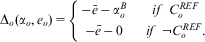 $${{\rDelta }_o}{\rm{(}}{{\alpha }_o},{{e}_o}{\rm{)}}\, = \,\left\{ {\matrix{ {{\rm{ - }}\bar{e}\,{\rm{ - }}\,\alpha _{o}^{B} } &#x0026; { \, \;if\; \, C_{o}^{{REF}} } \cr {{\rm{ - }}\bar{e}\,{\rm{ - }}\,0} &#x0026; { \, \;if\; \, \neg C_{o}^{{REF}} }. \right$$
In the corrupt system, outsider players are never chosen to receive G, but have to suffer the expected value of the externality imposed by the winner. In the reformed system, the outsiders can either be allocated the G (which gives them the baseline utility  $$$\alpha _{o}^{B} $$$
) or not win it, while not having an externality imposed on them, and get 0. So whatever the case, outsider players lose from the corrupt system.
Denote by RMIN either  $$$\frac{{c{\rm{(1}}\,{\rm{ - }}\,\delta \,{\rm{(1}}\,{\rm{ - }}\,p{\rm{))}}}}{{\delta p}}$$$
or
 $$$\frac{{c{\rm{(1}}\,{\rm{ - }}\,\delta \,{\rm{(1}}\,{\rm{ - }}\,q{\rm{))}}}}{{\delta q}}$$$
, depending on whether the analysis is performed on the model with single matches or on the model with multiple matches. RMIN is the minimal payment made to the government at each stage when matched alone. The change in utility for insider players is given by:
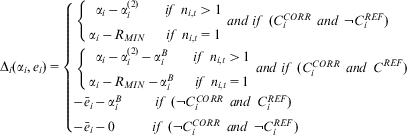 $${{\rDelta }_i}{\rm{(}}{{\alpha }_i},{{e}_i}{\rm{)}}\, = \,\left\{ {\matrix{ {\left\{ {\matrix{ {{{\alpha }_i}\,{\rm{ - }}\,\alpha _{i}^{{(2)}} } &#x0026; { \, \;if\; \, {{n}_{i,t}}\, \gt \,1} \cr {{{\alpha }_i}\,{\rm{ - }}\,{{R}_{MIN}}} &#x0026; { \, \;if\; \, {{n}_{i,t}}\, = \,1} \\\end} \right} \hfill &#x0026; {\;and\;if\; \, {\rm{(}}C_{i}^{{CORR}} \, \;and\; \, \neg C_{i}^{{REF}} {\rm{)}} \right} \right \hfill }\hfill\cr \left \{ {\matrix{ {{{\alpha }_i}\,{\rm{ - }}\,\alpha _{i}^{{(2)}} \,{\rm{ - }}\,\alpha _{i}^{B} } &#x0026; { \, \;if\; \, {{n}_{i,t}}\, \gt \,1} \hfill\cr {{{\alpha }_i}\,{\rm{ - }}\,{{R}_{MIN}}\,{\rm{ - }}\,\alpha _{i}^{B} } &#x0026; { \, \;if\; \, {{n}_{i,t}}\, = \,1} \\\end} \right} \hfill &#x0026; \;and\;if\; \, {\rm{(}}C_{i}^{{CORR}} \, \;and\; \, {{C}^{REF}} {\rm{)}} \right \right \hfill \cr \left \hskip -7pc \matrix{ {{\rm{ - }}{{{\bar{e}}}_i}\,{\rm{ - }}\,\alpha _{i}^{B} } \hfill \qquad{if\; \, {\rm{(}}\neg C_{i}^{{CORR}} \, \;and\; \, C_{i}^{{REF}} {\rm{)}}} \hfill \cr {{\rm{ - }}{{{\bar{e}}}_i}\,{\rm{ - }}\,0} \hfill \ \, \qquad {\;if\; \, {\rm{(}}\neg C_{i}^{{CORR}} \, \;and\; \, \neg C_{i}^{{REF}} {\rm{)}}} \hfill \\\end} \hfill \right$$
The cases in which ni,t > 1 are obviously only relevant if allowing multiple matches. Insider players gain from the corrupt system if they are chosen as recipients of G in this system but not in the reformed system (first case). If they are chosen in both systems, the effect is ambiguous. On the one hand, they have to pay the bribe  $$$\alpha _{i}^{{{\rm{(2)}}}} $$$
or RMIN for getting the good in the corrupt system, and no bribe in the reformed system. On the other hand, the utility from the good in the corrupt system, αi, can be greater than the utility in the reformed system,
 $$$\alpha _{i}^{B} $$$
, because the former might include the externality ei. So the insider player gains from the corrupt system in this subcase if:
 $$\left\{ {\matrix{ {{{\alpha }_i}\,{\rm{ - }}\,\alpha _{i}^{{{\rm{(2)}}}} \,{\rm{ - }}\,\alpha _{i}^{B} \, \gt \,{\rm{0}}\, \Leftrightarrow \,{{e}_i}\, \gt \,\alpha _{i}^{{(2)}} } &#x0026; { \, \;if\; \, {{n}_{i,t}}\,{\rm{ \gt }}\,{\rm{1}}} \cr {{{\alpha }_i}\,{\rm{ - }}\,{{R}_{MIN}}\,{\rm{ - }}\,\alpha _{i}^{B} \, \gt \,{\rm{0}}\, \Leftrightarrow \,{{e}_i}\, \gt \,{{R}_{MIN}}} &#x0026; { \, \;if\; \, {{n}_{i,t}}\,{\rm{ = }}\,{\rm{1}}.} \\\end} \right$$
That is, an insider player who is very skilled at imposing externalities can benefit from the corrupt system, even if he or she would have been awarded G in the bribe-free reformed system, if the externality he or she can impose on other players is higher than the effective value of the bribe.
The third subcase—when the insider player is not awarded G in the corrupt system, but would be awarded G in the reformed system—can arise when the insider player has a high baseline utility for the good, but less of an ability to impose externalities than other I players. In this case, this player loses from the corrupt system. If the insider player would not be awarded G in either the reformed or the corrupt system, he or she loses from the corrupt system because of the externality that is imposed in such a system.
The conclusion of the first two analyses of changes in utilities is that outsider players always lose from the corrupt system, while insider players can often gain from it. In any given stage, the insider player who wins G under corruption either clearly gains from the corrupt system (if they would not have received G in the reformed system) or gains conditional on having a large ei (or low RMIN or low  $$$\alpha _{i}^{{{\rm{(2)}}}} $$$
). As different I players will be drawn in different stages, all of them have a chance to benefit from corruption at some point. Also notable would be a realistic case in which the externalities
 $$$\bar{e}$$$
are imposed on a large mass of citizens that is either outside the I group, or outside the I and O group altogether. In this case, the
 $$$\bar{e}$$$
terms would be very small for an individual I player, so over time their negative effect in stages where that I player is not chosen to receive G would be small, while in the stages where he or she is chosen to receive G the gains would be large. In the case of an equilibrium in which the citizen who gets G pays something else than α (2) (in the multiple-matches case), the intuition of the results is not changed: insider players can often benefit from corruption, while outsider players never benefit.
The effect of corruption given ej is that those with a high capacity to impose externalities have to gain from corruption if they are also insiders, as they are both more likely to win G and to benefit from it once they have gained it. (In the case of multiple matches, this assumes the equilibrium presented in the ‘multiple citizens per period’ section). The change in utility from corruption is given in the following expression, in which the underset notation indicates whether e has a positive (+), negative (−) or neutral (0) effect on the given quantity:
 $${{\rDelta }_i}{\rm{(}}e{\rm{)}}\,{\rm{ = }}\,{\mathop{{E{\rm{[}}C_{i}^{{CORR}} |{{e}_i}{\rm{]}}}}\limits_{{{\rm{( + }}/0{\rm{)}}}}} {\mathop{{{{U}^{CORR}} {\rm{(}}{{e}_i}{\rm{)}}}}\limits_{{{\rm{( + )}}}}} \,{\rm{ - }}\,{\mathop{{E{\rm{[}}C_{i}^{{REF}} {\rm{]}}}}\limits_{{{\rm{(0)}}}}} {\mathop{{{{U}^{REF}} {\rm{(}}e{\rm{)}}\,}}\limits_{{{\rm{(0)}}}}} {\rm{ - }}\,{\mathop{{E{\rm{[}}\neg C_{i}^{{CORR}} |{{e}_i}{\rm{]}}}}\limits_{{{\rm{( - /0)}}}}} {\mathop{{{\rm{(}}{{{\bar{e}}}_i}{\rm{)}}}}\limits_{{{\rm{(0)}}}}} .$$
This quantity is affected by ei in the following way. The second term is not affected by e at all. In the first term, the expectation of winning G is increased by e (when competing against other I players), as well as the utility of winning it (always). In the third term, the loss from externalities from others is not affected by I's own ei, but the probability of not being chosen is negatively affected by ei. So overall, ei has a positive effect on an insider player's utility from corruption; that is, the corrupt system favors those with a greater ability to generate externalities. For an outsider player, eo has no effect on their gain or loss from corruption, as they either do not get the good (in a corrupt system), or get it in an environment in which eo does not matter (in a reformed system). If the rule for choosing partners in the case of multiple matches is different, then, while U (CORR) (ei) is still positively affected by e, it may be that  $$$E{\rm{[}}C_{i}^{{CORR}} |{{e}_i}{\rm{]}}$$$
has no natural connection with ei if the rule for choosing partners is not based on choosing the one with the highest α.
For the government, the effect of corruption is either neutral or positive in each period:
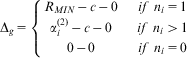 $${{\rDelta }_g}\, = \,\left\{ {\matrix{ {{{R}_{MIN}}\,{\rm{ - }}\,c\,{\rm{ - }}\,{\rm{0}}} &#x0026; { \, \;if\; \, {{n}_i}\, = \,{\rm{1}}} \cr {\alpha _{i}^{{{\rm{(2)}}}} \,{\rm{ - }}\,c\,{\rm{ - }}\,{\rm{0}}} &#x0026; { \, \;if\; \, {{n}_i}\, \gt \,{\rm{1}}} \cr {{\rm{0}}\,{\rm{ - }}\,{\rm{0}}} &#x0026; { \, \;if\; \, {{n}_i}\, = \,{\rm{0}}} \\\end} \right$$
In the first two cases, the effect is positive, as RMIN > c from its formula, and  $$$\alpha _{i}^{{{\rm{(2)}}}} \,\geq \,{{R}_{MIN}}\, \Leftrightarrow \,\alpha _{i}^{{{\rm{(2)}}}} \,\geq \,c$$$
by assumption. So the overall effect of the corrupt system on the government is positive, even if the rent that emerges in the case of multiple matches is not
 $$$\alpha _{i}^{{{\rm{(2)}}}} $$$
, as the rent paid always has to be large enough to cover the cost c for the government.
To compute the overall effect on total utility of the three kinds of agents, first note that externalities and rent payments can be eliminated from the calculation, as they are just transfers from one group to another. Also notable is the fact that in a corrupt system, many transactions do not happen at all: if the only match is one or more outsider players, G is not allocated at all, and it does not generate utility for anyone even if it would have positive social utility if it were allocated. Another reason that corruption reduces total utility is that even when G is allocated in a corrupt system, it is less likely to be allocated to the individual with the highest baseline utility for it. In a corrupt system, in each stage, a citizen with baseline utility  $$$\alpha _{i}^{{B \ast }} $$$
gets the good. In a reformed system, in each stage a citizen with baseline utility
 $$$\alpha _{j}^{{B \ast }} $$$
gets the good. There are two reasons why
 $$$\alpha _{i}^{{B \ast }} $$$
might be lower than
 $$$\alpha _{j}^{{B \ast }} $$$
, and no case in which it is higher. First, as j can be either i or o, the pool from which the highest-α Bj player is drawn is larger than the pool from which the highest-α i player is drawn. Second, as distribution in the corrupt system is based on αi, not
 $$$\alpha _{i}^{B} $$$
, in general, the insider player with the highest
 $$$\alpha _{i}^{B} $$$
will not be chosen. That is, there are social losses under corruption because the government goods are awarded only to insider players and are awarded based on private utility, not social utility:
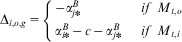 $${{\rDelta }_{i,o,g}}\, = \,\left\{ {\matrix{ {{\rm{ - }}\alpha _{{j \ast }}^{B} } \hfill &#x0026; { \, \;if\; \, {{M}_{t,o}}} \hfill \cr {\alpha _{{i \ast }}^{B} \,{\rm{ - }}\,c\,{\rm{ - }}\,\alpha _{{j \ast }}^{B} } \hfill &#x0026; { \, \;if\; \, {{M}_{t,i}}} \hfill \\\end} \right$$
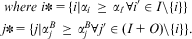 $${ &#x0026; \, where \ i \ast \, = \,{\rm{\{ }}i|{{\alpha }_i}\,\geq \,{{\alpha }_{i'}}\forall i' \in I\backslash {\rm{\{ }}i{\rm{\} \} }} \cr &#x0026; j \ast \, = \,{\rm{\{ }}j|\alpha _{j}^{B} \,\geq \,\alpha _{j}^{B} \forall j' \in {\rm{(}}I\, + \,O{\rm{)}}\backslash {\rm{\{ }}i{\rm{\} \} }}{\rm{.}} \cr}$$
In periods when only an outsider player is matched, the net social effect is negative or zero: no transaction takes place under corruption, whereas G would be allocated to the citizen with the highest baseline valuation in a non-corrupt system. If some insider players have been matched, the net effect is given by the difference between the baseline utility of the citizen receiving the good in a corrupt system (minus the cost of providing the good) and the baseline utility of the person receiving the good in a non-corrupt system. For reasonable parameter values, this will be highly negative in the case of goods that have any social utility in the first place. The major component of the difference is  $$$\alpha _{{i \ast }}^{B} \,{\rm{ - }}\,\alpha _{{j \ast }}^{B} $$$
, and
 $$$\alpha _{{i \ast }}^{B} $$$
will generally be smaller than
 $$$\alpha _{{j \ast }}^{B} $$$
. If the winner of the good in the multiple matches case is not the one with the highest α, then the effect can only be more negative, as the utility of whoever gets the good can only be lower.
A corollary to Expression 22 is that the amount of secrecy regarding corruption (which is given by the size of the I group, parameterized as the probability p) affects total social welfare. Keeping everything else constant, societies in which secrecy is greater suffer a greater loss, as more agents are part of the outside group with which transactions cannot be made.
In the case of market structures that feature repeated interactions with the same player(s), the model predicts that the only ones who are able to engage in corrupt transactions are those with frequent/long-term meetings with the official, as reflected in their discount rates for these interactions. Denoting by H the group with discount rates higher than the threshold for sustaining cooperation presented in the ‘repeated interaction’ section, and by L the group of citizens that does not meet this threshold (considering first the case of one-on-one matches between government officials and citizens), the net per-period effect of the corrupt system for the L group is equal to the net effect for the outsider group O defined in the single-interaction case:  $$${{\rDelta }_l}{\rm{(}}{{\alpha }_l},{{e}_l}{\rm{)}}\,{\rm{ = }}\,{{\rDelta }_o}{\rm{(}}{{\alpha }_o},{{e}_o}{\rm{)}}$$$
. This is because, just as in the case of outsiders in the single-interaction model, these citizens cannot engage in corrupt transactions. For the H group, which can engage in corrupt transactions, again the per-period effect on utility is the same compared with the non-corrupt baseline as for the I group:
 $$${{\rDelta }_h}{\rm{(}}{{\alpha }_h},{{e}_h}{\rm{)}}\,{\rm{ = }}\,{{\rDelta }_i}{\rm{(}}{{\alpha }_i},{{e}_i}{\rm{)}}$$$
, replacing RMIN with
 $$$\frac{c}{\delta }$$$
, given that now, effectively, p = 1. The argument is similar for the rival goods, multiple-customers case: H citizens can potentially gain from corruption, whereas L players will lose by an argument analogous to the single-match case.
The possibility of interactions in which the government official simply extorts citizens, described in the ‘extortion/forced consumption’ section, qualifies the statements about redistributive effects above. In each unlucky match with a government official who extorts citizens, a simple transfer is worth k. As stated in the ‘extortion/forced consumption’ section, if citizens in any of the situations analyzed above have chance pe of being part of such an interaction, then any net effect of corruption would take the form  $$${{\rDelta }_{NET}}\, = \,{\rm{(1}}\,{\rm{ - }}\,{{p}_k}{\rm{)}}\rDelta \,{\rm{ - }}\,{{p}_k}k$$$
, where Δ stands for any of the differences presented in the previous paragraphs. The term −pkk uniformly reduces every citizen's utility from corruption, and therefore the higher pk is, the more muted the distinctions between citizens as a result of non-extortionary corrupt interactions are.
The magnitude of the net social effect under reasonable parameter values if there is some social utility associated with the good is worth exploring. The nature of the distribution F α primarily determines it, and a realistic model for α will lead to high social losses from corruption. F α is the distribution of baseline utilities for the G good in the population. G goods that generate any kind of social utility, such as permits to engage in regular economic activity, will generally require very specific complementarities between the good and the consumer in order for the good to provide the optimal utility. For example, there are very few agents in a given country (maybe even in the world) who are very competent at building roads, operating retail operations, providing military equipment, etc. That is, the distribution F α is likely to be severely skewed toward zero, and very long-tailed. The first source of inefficiency is that limiting draws from this distribution to only insider players is likely to miss the few high-α B players. Moreover, even after taking the draws only from the insider group, the one insider who gets chosen is not the one with the highest baseline utility, but the one with the highest value of the sum of baseline value and externality. Since imposing externalities is itself a skill, it can also be modeled as being distributed as a long-tailed distribution, which is either independent or positively correlated with the baseline α B distribution. A Monte Carlo simulation is useful for illustrating this logic. Take the case in which there are multiple matches of insider players and model the distribution of α B and e as log-Normal:
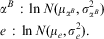 $$no{ \qquad \qquad \qquad \qquad \qquad \qquad \ \ \qquad &#x0026; {{\alpha }^B} \, : \,\ln N{\rm{(}}{{\mu }_{{{\alpha }^B} }},\sigma _{{{{\alpha }^B} }}^{2} {\rm{)}} \cr &#x0026; e\, : \,\ln N{\rm{(}}{{\mu }_e},\sigma _{e}^{2} {\rm{)}}{\rm{.}} $$
Set ni and no to be the expected value of their distributions, which are generic:
 $$no{ \qquad \qquad \qquad \qquad \qquad \qquad \ \ \qquad \qquad &#x0026; {{n}_i}\, \equiv \,E{{f}_{{{n}_i}}}\, \cr &#x0026; {{n}_o}\, \equiv \,E{{f}_{{{n}_o}}}. $$
Also set c = 5. For the simulation, take N = 100,000 repeated draws from the distribution above, at different values of the relevant parameters, and compute the expected value of the social loss  $$$E\left[ {\alpha _{{i \ast }}^{B} \,{\rm{ - }}\,c\,{\rm{ - }}\,\alpha _{{j \ast }}^{B} } \right]$$$
. Results are presented in Table 1. The social gain is always negative. A small I group relative to the O group, indicating greater secrecy, means a larger loss. The size of the externalities here does not matter, as they are not correlated with α B. High variation in the skill α B induces a larger loss, because getting the difference between the right agent for the job and the one chosen through the government's optimization problem will increase as the differences in skill in the population increase.
The Net Social Effect of Corruption: Simulations

DISCUSSION
There are a few non-obvious points that emerge from the models above. The first is that, while corruption is good for the government official, as she is able to maximize her income, the nature of corrupt transactions means that the official is not able to fully use her power and get the best deals from citizens. The primary reason is the inability to engage outsider players in the random matching models (or low-frequency players in repeated game models). This might be why real-life corrupt interactions, such as the awarding of a business permit, often seem to take the form of inefficient transactions between the government official and their proverbial ‘cousin,’ rather than the form of transactions with the most efficient agent, which in the case of the business permit would be the most efficient international corporation in that field. While the official would like to be able to extract a much higher bribe from the corporation, their lack of commitment power in that transaction means it will not take place.
An immediate corollary is that the value of corrupt transactions will often be unnaturally low. The fact that bribes paid to officials are often shown to be very low is emphasized in Buchanan (Reference Buchanan, Tollison and Tullock1980) as one of the major puzzles of empirical studies of corruption. One reason for this might be that the ‘demand’ for the corrupt good is artificially lowered by the official's inability to include in it all the potential customers from the outsider group.
The insider-outsider distinction suggests why corrupt societies are often best understood through the lens of cliques, connections, patronage and family relations rather than as extreme examples of free markets in which “everything is for sale.” Everything might be for sale, but the customers who are willing to engage in the transactions might very well be only a very small subset of society, thus greatly departing from the ideal of the free market. The most relevant distinction between corrupt and non-corrupt interactions is that corrupt markets are often markets that are not supposed to exist, not simply versions of legitimate markets in which the government official is free to optimize how she provides the good in order to maximize income.
Another interesting conclusion is that corruption also facilitates the existence of crime in general. If goods such as get-out-of-jail cards are available for sale in a corrupt (but not a non-corrupt) system, then the equilibrium response of citizens in the corrupt system will be to maximize the usefulness of this fact by committing the crime associated with the card.
The fact that corrupt interactions cannot be made public implicitly assumes that there is some cost to the government in making them public: either the cost of being sanctioned by a higher-level official or electoral costs. An interesting variation of the community-enforcement model removes this requirement, by making p = 1. This would mean that there is no reason for the transaction to be kept secret, as there is no higher-level official to punish, and/or electoral constraints are not binding. In this case, corruption would be more efficient, and the government would gain more, by making it possible for outsider players to engage in transactions. An example of such a situation might be oil-rich absolute monarchies in the contemporary world, in which transactions with the royal family are quite public, and seem to be engaged in by all agents who desire to be engaged in such transactions, including highly efficient international corporations. However, it also seems that these types of interactions should be called something other than corruption, as the phenomenon is quite different; ‘feudalism’ might be more appropriate in this case.
An interesting connection with the empirical literature on measuring corruption (Donchev and Ujhelyi Reference Donchev and Ujhelyi2013, Razafindrakoto and Roubaud Reference Razafindrakoto and Roubaud2010) can also be made. Donchev and Ujhelyi (Reference Donchev and Ujhelyi2013) point out that there is a disconnect between individual perceptions of corruption in countries around the world and objective measures of experienced corruption, and that perceptions are generally weak predictors of experienced corruption. The framework in this article can point to possible causes of this. On the one hand, experienced corruption might not be a reliable measure of how severe a country's corruption problem is: if only a small proportion of the population reports having been part of a corrupt transaction, that might simply reflect an environment in which few citizens are ‘insiders’ and can participate in such transactions, rather than a country in which corruption is not a significant problem. On the other hand, the degree to which citizens are willing to characterize corrupt exchanges with officials as corrupt might depend on whether they are part of the group that can participate in them; those who are unable to participate are more likely to report the existence of corruption in their country than those who are potential winners from the corrupt system. Therefore both measures of corruption (the number of citizens who participate in corrupt transactions, and general beliefs about the existence of corruption in society) can be imprecise indicators of the actual severity of corruption.
The most interesting conclusion of the analysis, though, is that the complex distributive effects of corruption mean that a large number of citizens are in favor of it. The usual view of corruption, as a transfer from citizens to the government, must be amended with the fact that this system also has important distributive effects among citizens. Citizens who are part of an official's connections, as well as those who are very skilled at imposing externalities, will benefit from corruption, and will vote to continue the system if given the opportunity. This might be why electoral mechanisms often seem unable to eliminate corruption even in the case of vigorous political competition.




