The prevalence of congenital heart disease (CHD) is 8–10 per 1000 births, and ventricular septal defects are the most common CHD. Ventricular septal defects treatment varies according to its hemodynamic effect: follow-up is sufficient for haemodynamically insignificant defects; however, haemodynamically important defects may be associated with pulmonary arterial hypertension, and if not closed, may result in pulmonary vascular disease. Reference Tretter, Benson, Crucean, Spicer, Anderson, Anderson, Krishna and Mussato1 Subclinical inflammation and oxidative stress are involved in the pathophysiology of pulmonary vascular disease. The strong link between inflammation and pulmonary vascular damage in pulmonary arterial hypertension is well documented. Furthermore, the coexistence of subclinical inflammation and oxidative stress plays a significant pathophysiological role in the development and progression of pulmonary vascular disease. Reference Yan, Chen and Talati2
The critical role of an inflammatory environment in the development of pulmonary arterial hypertension has been demonstrated in endothelial cells that mediate vascular damage. Reference Hiress, Tu and Ricard3 Troponin T and N-terminal pro-brain natriuretic peptide have been widely used as biomarkers of heart failure in clinical studies; however, a biomarker of inflammation in the pulmonary vascular bed before pulmonary arterial hypertension develops is needed. High-sensitivity C-reactive protein, an acute-phase reactant and sensitive marker of inflammation, tissue damage, and infection is frequently used as a biomarker of inflammation. The relationship between endothelial dysfunction and high-sensitivity C-reactive protein levels in cardiovascular injury is well known. Reference Fichtlscherer, Rosenberger, Walter, Breuer, Dimmeler and Zeiher4 Several studies have shown that elevated high-sensitivity C-reactive protein levels are associated with cardiovascular events in the healthy general population as well as in patients with coronary artery disease. Reference Ridker, Hennekens, Buring and Rifai5,Reference Lamblin, Mouquet and Hennache6
Factors such as acidosis, hypoxia, inflammation, and free radical damage reduce the capacity of the albumin N-terminal to bind metals, resulting in the formation of a metabolic protein variant known as ischemia-modified albumin, which can be measured in serum. The findings of various ischemia-reperfusion models of the myocardium and other organs support the hypothesis that ischemia-modified albumin is formed under conditions of high oxidative stress. Reference Roy, Quiles, Gaze, Collinson, Kaski and Baxter7–Reference Hacker, Hoyer and la Fouge‘re9 The ability to predict pulmonary vascular disease in patients with ventricular septal defects is crucial for the implementation of strategies to prevent or delay progression. Therefore, we investigated the hemodynamic impact of small ventricular septal defects on the pulmonary vascular bed before closure and the usefulness of serum ischemia-modified albumin level as a predictor of pulmonary involvement in patients with small ventricular septal defects.
Materials and methods
Study design and population
Our case-control study included 175 children: 100 patients diagnosed with small or haemodynamically insignificant ventricular septal defects in a pediatric cardiology clinic and followed up, and 75 age- and sex-matched healthy control participants. The inclusion criteria for the ventricular septal defect group included defect size (measured via echocardiography) less than one-third of the aortic root diameter, flow velocity through ventricular septal defect > 4 m/seconds, never received medical support for heart failure due to ventricular septal defect and no cardiac anomalies other than ventricular septal defect. The exclusion criteria included genetic syndromes, chronic diseases, drug use for any reason, and a family history of smoking. Oxygen saturation was above 95% in all patients. The study protocol was approved by the Sakarya University ethics committee. All patients provided informed consent, and written informed consent was obtained from all parents/caretakers of the children. Body mass index values were calculated as weight (kg) divided by height (m) squared. After a 10-minute rest period in the supine position, blood pressure was measured three times on both arms in the same place using a sphygmomanometer appropriate for the age and arm size of all participants. The average of the three measurements was recorded. All echocardiography studies were performed using a Philips IE33 ultrasound machine with a 3 MHz phase transducer (Philips Ultrasound, Bothell, WA, USA). Examinations were performed in the left lateral position with standard parasternal long-axis and apical four-chamber views. Two-dimensional, M-mode, colour-flow Doppler, pulsed Doppler, and continuous-wave Doppler echocardiography were performed in all patients. The mean pulmonary artery pressure was calculated from the peak pulmonary regurgitation Doppler signal. A pulmonary regurgitation signal was obtained in the parasternal short axis view. The peak pulmonary regurgitation velocity was measured using continuous-wave Doppler at a scan rate of 100 mm/second. The mean pulmonary artery pressure could be estimated approximately using the formula: mean Pulmonary Artery Pressure = 4(Pulmonary Regurgitation peak velocity) Reference Yan, Chen and Talati2 + Right Atrial Pressure. Reference Abbas, Fortuin and Schiller10
Measurement of ischemia-modified albumin and high-sensitivity C-reactive protein levels
Ischemia-modified albumin levels were determined using the calorimetric method based on the measurement of cobalt bound to albumin. In brief, 50 µl 0.1% cobalt chloride was slowly added to 200 μl serum in water and mixed. The mixture was incubated for a 10 minute period to allow the albumin to bind cobalt. Then 50 μl dithiothreitol was added as a coloring agent, and after 2 minutes, 1 ml 0.9% sodium chloride was added to stop the reaction. Color development with dithiothreitol was measured using a spectrophotometer (Shimadzu, model UV160U). Absorbance units (ABSUs) were measured at 470 nm against a cobalt blank without dithiothreitol. High-sensitivity C-reactive protein concentration was determined using the Siemens CardioPhase high-sensitivity C-reactive protein particle-enhanced immune nephelometric assay on the BN II analyser (Siemens Healthcare Diagnostics Products GmbH, Marburg, Germany).
Statistical analyses
Descriptive statistics were used to assess the demographic and clinical characteristics of the participants. The Kolmogorov–Smirnov test was used to determine normality of the numerical variables. Normally distributed variables are expressed as means ± standard deviations and non-normally distributed variables are expressed as medians (range). Categorical variables are expressed as numbers (n) and percentages (%). Student’s t-tests were used to compare normally distributed numerical variables, and the Mann–Whitney U test was used to compare non-normally distributed variables. Categorical variables were compared using the chi-square test. The Pearson’s correlation coefficient was used to assess relationships between normally distributed numerical variables, and the Spearman’s correlation coefficient was used to assess relationships between variables with a non-normal distribution. Linear regression analysis was used to assess the effect of continuous variables on ischemia-modified albumin levels. Receiver operating characteristic curve analyses were used to assess the sensitivity and specificity of ischemia-modified albumin and high-sensitivity C-reactive protein as predictors of pulmonary vascular involvement in patients with small ventricular septal defects.
Results
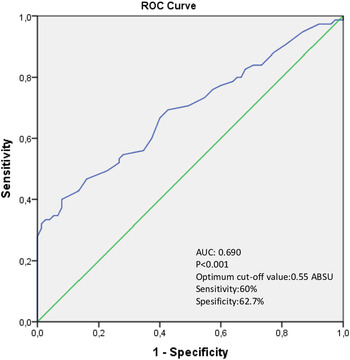
Our study included 100 children diagnosed with a small ventricular septal defect and 75 age- and sex-matched healthy controls. The age and sex ratios of participants were not significantly different between groups (p > 0.05). The mean ischemia-modified albumin level in the small ventricular septal defect group (0.62 ± 0.17 ABSU) was significantly higher than that in the control group (0.51 ± 0.09 ABSU; p < 0.001). Similarly, the mean high-sensitivity C-reactive protein value in the ventricular septal defect group group (3.72 ± 1.57) was significantly higher than that in the control group (2.45 ± 0.89; p < 0.001). No between-group differences were found in systolic blood pressure (84.41 ± 11.60 mmHg, 84.90 ± 11.0 mmHg; p = 0.791) or diastolic blood pressure (54.68 ± 7.20 mmHg, 54.81 ± 6.94 mmHg; p = 0.908). In our study, mean pulmonary artery pressures of all patients were < 20 mmHg. However, it was found significantly higher in the group with ventricular septal defect than in the control group (13.18 ± 2.28 mmHg, 10.3 ± 1.70 mmHg; p < 0.001). Demographic data, vital signs, echocardiographic data and inflammatory parameters of subjects are summarized in Table 1. The left ventricular internal diameter end-diastole, left ventricular internal diameter end-systole, main pulmonary artery, and the atrioventricular and ventriculoarterial valve annuli were significantly greater in the ventricular septal defect group than in the control group. The patients with ventricular septal defects were divided into two groups according to their left ventricular internal diameter end-diastole, left ventricular internal diameter end-systole, and main pulmonary artery z-score values (≥2 and <2). The ischemia-modified albumin and high-sensitivity C-reactive protein values in patients with left ventricular internal diameter end diastole and end sistole and main pulmonary artery z-scores ≥ 2 were significantly higher than patients whose z-scores were <2 (Table 2). We found a positive correlation between ischemia-modified albumin and high-sensitivity C-reactive protein levels in the group with ventricular septal defect. The results of correlation analysis are summarised in Table 3. Linear regression analyses indicated that ischemia-modified albumin was independently affected by high-sensitivity C-reactive protein, left ventricular internal diameter end diastole z-score, left ventricular internal diameter end sistole z-score, main pulmonary artery z-score in the group with ventricular septal defect (Table 4). Moreover, left ventricular internal diameter end-diastole, left ventricular internal diameter end-systole, and main pulmonary artery z-score values were positively correlated with high-sensitivity C-reactive protein, ischemia-modified albumin levels. Receiver operating characteristic curve analyses showed that the optimal cut-off value of ischemia-modified albumin for the prediction of pulmonary involvement was 0.55 absorbance units with a sensitivity of 60% and specificity of 62% (area under the curve = 0.690, p < 0.001) (Fig 1).
Demographic data, vital signs, BMI, echocardiographic data, IMA and hs-CRP values of study groups

Parameters were expressed as mean ± standard deviation, median (range) number.
BMI - body mass index; DBP - diastolic blood pressure; hs-CRP - high sensitivity C-reactive protein; IMA - ischemia modified albumin; LPA - Left pulmonary artery; LVIDd - left ventricular internal diameter end diastole; LVIDs - left ventricular internal diameter end sistole; mPA - main pulmonary artery; mPAP - mean pulmonary artery pressure; RPA - Right pulmonary artery; SBP- sistolic blood pressure.
Student’s t-test and Mann–Whitney U test and x2 square tests were performed and p value<0.05 was considered significant.
Relationship between LVIDd, LIVDs and main PA z-scores and inflammatory biomarkers

Parameters were expressed as mean ± standard deviation (SD), median (range) and number.
hs-CRP - high sensitivity C-reactive protein; IMA - ischemia modified albumin; LVIDd - left ventricular internal diameter end diastole; LVIDs - left ventricular internal diameter end sistole; mPA - main pulmonary artery.
Student’s t-test and Mann–Whitney U test were performed and p value<0.05 was considered significant.
Correlation analysis of IMA and hs-CRP with echocardiographic data in the group with VSD

hs-CRP - high sensitivity C-reactive protein; IMA-ischemia modified albumin; LVIDd - Left ventricular end-diastolic internal diameter; LVIDs - Left ventricular end-sistolic internal diameter; mPA - Main pulmonary artery; VSD - Ventricular septal defect.
Spearman’s correlation test was performed and p value < 0.05 was considered significant.
Multiple linear regression analysis results outlining the effect of independent variables on IMA levels in the group with VSD

hs-CRP - high sensitivity C-reactive protein; IMA -ischemia modified albumin; LVIDd - Left ventricular end-diastolic internal diameter; LVIDs - Left ventricular end-sistolic internal diameter; mPA - Main pulmonary artery; VSD - Ventricular septal defect.
Receiver operator characteristic curve analysis of the IMA optimal cut-off value in the group with ventricular septal defect. AUC, area under the curve.

Discussion
One of the most annoying aspects of congenital heart disease is the inability to explain its origin. Its etiology is largely unknown, genetic and environmental factors may contribute to the disease. Recently advances in human genetics have provided a clearer understanding of how certain malformations may occur. The microRNAs are small, non-coding RNA molecules and negatively regulate gene expression. Some microRNAs have been shown to be associated with congenital malformed hearts. For example, microRNA-1-1 and microRNA-181c are involved in the pathogenesis of ventricular septal defects. Reference Li, Cao and Ma11 The microRNA-1 causes a decrease in proliferating ventricular cardiomyocyte mass during cardiac development. Reference Zhao, Samal and Srivastava12 Similarly, microRNA-92 deficiency in mouse embryos has been shown to be associated with ventricular septal defect. Reference Catalucci, Latronico and Condorelli13 In the future, early detection of CHD is aimed by detecting microRNAs from maternal peripheral blood. The role of inflammatory mechanisms such as epigenetic changes in CHD has also been investigated. Although it is not proven that inflammation causes cardiovascular disease, inflammation is common for CHD. Lequier et al Reference Lequier, Nikaidoh and Leonard14 hypothesised that immune activation may be present in patients with CHD. In their study, they demonstrated endotoxemia causing significant interleukin-6 release in infants with CHD. Similarly, several studies in pediatric CHD patients have shown high inflammatory biomarkers such as C-reactive protein, interleukin-6, tumor necrosis factor- alpha. Sharma et al Reference Sharma, Bolger and Li15 in their study comparing patients with CHD and healthy controls showed that soluble tumor necrosis factor receptor-1 levels were associated with the degree of systemic ventricular impairment. In another study, it was hypothesized that fibrosis and inflammation in Fontan circulation might be demonstrated by serum galaectin-3 levels which is considered an inflammatory biomarker. Reference Opotowsky, Baraona and Owumi16 In a study with repaired aortic coarctation patients, atorvastatin was shown to suppress systemic inflammation and reduce the levels of interleukin-1b and soluble vascular cell adhesion molecule. We also thought that small ventricular septal defect flows might trigger inflammation, even though hemodynamically insignificant.
In our study, ischemia-modified albumin and high-sensitivity C-reactive protein levels were higher in patients with small small ventricular septal defects than in the healthy controls. Furthermore, ischemia-modified albumin and high-sensitivity C-reactive protein levels were positively correlated in the small ventricular septal defect group. Linear regression analyses also indicated that ischemia-modified albumin was independently affected by high-sensitivity C-reactive protein, left ventricular internal diameter end diastole z-score, left ventricular internal diameter end sistole z-score, main pulmonary artery z-score in the group with ventricular septal defect. Blood vessels are constantly exposed to biomechanical forces associated with blood pressure and blood flow. Physiological stresses activate antioxidant and vasoprotective pathways in the vascular wall. The ventricular septal defect increase volume and pressure load in the pulmonary vascular bed. Previous clinical studies of oxidative stress and antioxidant status in children with congenital heart disease have found that oxidative stress biomarkers and proinflammatory cytokines were significantly elevated in this population. Reference Pignatelli, Menichelli, Pastori and Violi17 Ischemia-modified albumin level is an indicator of oxidative stress, and high-sensitivity C-reactive protein is frequently used as a biomarker of inflammation. The left heart chamber, valve annulus, and the main pulmonary arter and its branches were larger in the ventricular septal defect group than in the control group. Long-term follow-up in patients with small ventricular septal defects indicates that the condition is not without complications. Reference Maagaard, Heiberg, Eckerström, Rex, Ringgaard and Hjortdal18 Congenital ventricular septal defects cause hyperperfusion of the pulmonary vascular bed, which may alter the pulmonary vascular endothelium resulting in increased vascular resistance and higher pulmonary artery pressure. This scenario was previously proposed by Möller et al Reference Moller, Brun and Fredriksen19 , who found that right ventricular systolic pressure during exercise was higher in adults with ventricular septal defect. In adults with a healthy, active lifestyle, exercise-induced right ventricular afterload may have an impact on right ventricular morphology over several years. However, small or surgically corrected ventricular septal defects have been shown to decrease peak exercise capacity. Furthermore, surgically closed or unrepaired small ventricular septal defects may alter right ventricular morphology and more pronounced trabeculation than observed in healthy controls. Reference Maagaard, Heiberg and Hjortdal20
In our study, patients with ventricular septal defect were divided into two groups according to their left ventricular z-scores (≥2 versus <2). The ischemia-modified albumin and high-sensitivity C-reactive protein values were higher in patients with left ventricular internal diameter end-diastole, left ventricular internal diameter end-sistole and main pulmonary arter z-scores ≥ 2 compared to patients whose z scores were <2. z-score values ≥2 may be attributed to the increased volume load caused by ventricular septal defects, and the higher high-sensitivity C-reactive protein and ischemia-modified albumin values indicate that the pulmonary bed is affected in these patients.
The role of oxidative stress in the development of cardiovascular disease is well established. Reference Rogowski, Shnizer, Wolff, Lewis and Amir21 Proteins are the most significant target of oxidative attack. Albumin, a major plasma protein, binds numerous cations and anions and as such, effectively inhibits oxidation reactions in plasma. The ischemia-modified albumin levels have been assessed in conditions of non-cardiac ischemia including peripheral vascular disease, skeletal muscle ischemia, and systemic sclerosis. Reference Jena, Nayak and Behera22–Reference Roy, Quiles, Gaze, Collinson, Kaski and Baxter24 Circulating ischemia-modified albumin levels are elevated in patients with myocardial ischemia, acute coronary syndrome, heart failure, and following percutaneous coronary intervention. Thus, ischemia-modified albumin levels may serve as a biomarker of cardiac injury. Reference Morrow, de Lemos, Sabatine and Antman25,Reference Sinha, Gaze, Tippins, Collinson and Kaski26 In our study, the optimum cut-off value for ischemia-modified albumin was 0.55 ABSU in patients with small ventricular septal defect who were thought to have pulmonary vascular involvement, the specificity was 62% and the sensitivity was 60%. Our study is the first to assess the usefulness of ischemia-modified albumin levels as a biomarker of cardiac injury and may serve as a guide for future research.
In conclusion, pulmonary vascular dysfunction is a significant complication in children with common CHD resulting in increased pulmonary blood flow and pressure, such as ventricular septal defects. Beginning immediately after birth, the pulmonary vasculature in these infants is subjected to pathological mechanical forces, which may result in early functional abnormalities of the vascular endothelium. Therefore, small, haemodynamically insignificant ventricular septal defects, which are thought to have a good prognosis, should be followed carefully throughout life. The ischemia-modified albumin may be a useful biomarker of the effects of small ventricular septal defects on the pulmonary bed.
Acknowledgements
We thank the Sakarya University Training and Research Hospital staff.
Financial support
This research received no specific grant from any funding agency, commercial or not for profit sectors.
Conflicts of interest
None.
Ethical standards
The authors assert that all procedures contributing to this work comply with the ethical standards of the relevant national guidelines on human experimentation in Turkey and with the Helsinki Declaration of 1975, as revised in 2008. Ethics committee approval was given for this study from the Faculty of Medicine of Sakarya (Ethics number:71522473/050.01.04/485).