Introduction
Sparganum is a plerocercoid larva of Spirometra erinacei, an intestinal tapeworm of cats and dogs. Human sparganosis is an accidental infection caused by ingesting cyclops infected with procercoids through drinking water, or by consuming frogs, snakes or rodents harbouring the plerocercoid (Kong et al., Reference Kong, Cho and Kang1994). Human sparganosis cases are observed most commonly in eastern Asia (i.e. China, Japan, Taiwan, Vietnam, Thailand and Korea) (Lee et al., Reference Lee, Bae, Kim, Deung and Ryang2002; Boonyasiri et al., Reference Boonyasiri, Suputtamongkol, Yamasaki, Sanpool, Maleewong and Intapan2014; Wei et al., Reference Wei, Zhang, Cui, Liu, Jiang and Wang2015). In Korea, more than 150 human sparganosis cases were reported from 1924 to 2006 (Kong et al., Reference Kong, Cho and Kang1994; Park et al., Reference Park, Chai, Cho, Paek, Guk, Shin and Chai2006).
The procercoid of S. erinacei invades non-specific sites such as the subcutaneous tissue or muscle in the chest, abdominal wall, eye and sometimes the central nervous system (CNS), resulting in neurological disease (Rahman et al., Reference Rahman, Lee and Bae2011). It is difficult to diagnose human sparganosis cases, due to the lack of specific symptoms or signs. To date, radiological and serological tests have been performed for confirmation of human sparganosis. Radiological tests using computed tomography (CT) or magnetic resonance (MR) imaging are useful for sparganosis diagnosis in subcutaneous tissue, but not in the CNS.
Serological tests by enzyme-linked immunosorbent assays (ELISAs) for total sparganum lysates could be used to diagnose human sparganosis. However, total sparganum lysates showed cross-reactivity with serum samples from individuals having other parasitic diseases, such as cysticercosis, paragonimiasis and clonorchiasis (Wei et al., Reference Wei, Zhang, Cui, Liu, Jiang and Wang2015). ELISAs using the excretory–secretory (ES) antigen rather than the crude antigen of Spirometra mansoni spargana were highly specific and sensitive for the diagnosis of sparganosis (Cui et al., Reference Cui, Li, Wang, Jiang and Lin2011). However, it is challenging to use ES antigen for serodiagnosis methods like ELISA because of the difficulty in obtaining sufficient ES antigen from sparganum. Therefore highly sensitive and specific sparganum antigens must be identified and catalogued to improve serodiagnosis. There have been several reports on sparganum antigenic proteins extracted by sodium dodecyl sulphate polyacrylamide gel electrophoresis (SDS-PAGE) and immunoblotting with sera from surgically confirmed sparganosis cases. The antigenic bands were observed by one-dimensional (1D)-PAGE, but were not identified (Choi et al., Reference Choi, Kang, Kong and Cho1988; Kim & Choi, Reference Kim and Choi1991).
Immunoproteomic approaches, involving two-dimensional electrophoresis (2DE) and mass spectrometry are powerful for screening specific and sensitive antigens in helminth parasites, including Clonorchis sinensis (Ju et al., Reference Ju, Joo, Lee, Cho, Cheun, Kim, Lee, Lee, Sohn, Kim, Kim, Park and Kim2009; Hu et al., Reference Hu, Cui, Xiao, Wang, Liu, Liu, Zhang and Wang2014), Trichinella spiralis (Rahman et al., Reference Rahman, Lee and Bae2011) and Echinostoma caproni (Dan et al., Reference Dan, Jing, Li, Li, Tong and Zhong2013). Recently, we generated and characterized the expressed sequence tag (EST) of S. erinacei spargana (Kim et al., Reference Kim, Yoo, Lee, Yang, Kim, Cho, Lee and Ju2014) and constructed a transcriptome database (Kim et al., Reference Kim, Kim, Yoo, Nam, Lee, Yang, Park, Lee, Lee, Cho, Lee, Park and Ju2012). In this study, we describe the seroprevalence of sparganosis in endemic areas in Korea and the identification of paramyosin as a candidate antigen through immunoproteomic approaches.
Materials and methods
Collection and examination of samples
This seropositivity study was undertaken from 2007 to 2014. The sera of 836 randomly selected inhabitants of Goseong-gun (n = 294), Cheorwon-gun (n = 312) and Ongjin-gun (n = 230) were collected. Ten sparganosis-positive serum samples were obtained from patients diagnosed by surgical removal of sparganum. Fourteen serum samples from healthy people who were not infected by helminths were used as controls. Ten serum samples each from patients with cysticercosis, paragonimiasis, clonorchiasis and fascioliasis were used in ELISA.
Spargana were collected from the muscles of the snake Rhabdophis tigrinus, which were naturally infected with spargana, and washed five times in saline to remove host tissue debris. The worms were homogenized using a mortar and pestle after snap freezing in liquid nitrogen, and dissolved in a sample buffer containing 7 m urea, 2 m thiourea, 4% CHAPS, 66 mm DTT and an EDTA-free protease inhibitor cocktail (Roche Applied Science, Manheim, Germany). The sample was incubated for 1 h and then centrifuged at 100,000 g for 30 min. The supernatant was collected and the protein concentration was measured by Bradford assay (Bradford, Reference Bradford1976).
ELISA and immunoblot analysis
Total lysate extracts were diluted in phosphate-buffered saline (PBS, pH 7.4) at a protein concentration of 5 μg/ml and coated in 96-well polystyrene plates overnight at 4°C. After washing, sera were diluted 1:100 in phosphate-buffered saline/0.05% Tween-20 (PBS/T, pH 7.4) and then incubated for 1 h at 37°C. After washing, peroxidase-conjugated anti-human IgG (whole molecule; Sigma Aldrich, St. Louis, Missouri, USA) was diluted 1:1000 in PBS/T and incubated for 1 h at 37°C with the sera. The mixture was subsequently reacted with ABTS (2,2′-azinobis [3-ethylbenzothiazoline-6-sulphonic acid]-diammonium salt) peroxidase substrate solution (KPL, Gaithersburg, Maryland, USA) at room temperature for 20 min. The samples were measured at 490 nm using an ELISA reader (Bio-Tex MQX200, BIO-TEX Instruments, Highland Park, Vermont, USA).
Seropositive sera against sparganum lysates, as determined by ELISA, were used to perform immunoblot analysis. To determine the presence of sparganum-specific IgG antibodies in sera, crude extract aliquots (20 μg) were separated on 12% acrylamide gels by SDS-PAGE. For immunoblotting, the proteins in the gels were electrotransferred on to a polyvinylidene difluoride (PVDF) membrane, using an electrotransfer apparatus. The blotted membranes were blocked with 5% skimmed milk for 1 h and then incubated overnight with ELISA-determined seropositive sera diluted 1:500 in PBS/T. The membranes were washed with PBS/T and incubated with peroxidase-conjugated anti-human IgG antibody (Sigma) diluted 1:1000 with PBS/T for 1 h. After washing, the blots were developed with 4-chloro-1-naphthol.
Two-dimensional electrophoresis and protein identification
The prepared sparganum total lysates were mixed with a rehydration buffer (6 m urea, 2 m thiourea, 4% CHAPS, 65 mm DTT, 0.5% IPG buffer, 0.002% bromophenol blue). The samples were incubated at 20°C, and then isoelectric focusing (IEF) was performed using IPG strips (Immobiline® DryStrip, pH 4–7 non-linear, 13 cm) in an IPGphor system (Amersham Bioscience, Uppsala, Sweden), utilizing the following voltage steps: 8 h at 100 V, 1 h at 500 V and 1000 V, 1 h at 5000 V and 8 h at 8000 V, for a total of 68 kVh. After IEF, the IPG strips were equilibrated with 10 mg/ml equilibration buffer (6 m urea, 2% SDS, 30% Tris–HCl, pH 8.8) for 15 min and subsequently incubated in the same buffer for another 15 min after replacing the DTT with 40 mg/ml iodoacetamide. After equilibration, the IPG strips were placed on to 12% SDS-PAGE gels and sealed with 0.5% agarose. Gels were run at 80 V for 15 min for the initial migration and then at 120 V for separation. Separated spots on 2DE gels were immunoblotted with seropositive pooled serum from ELISA. The spots were excised from the stained 2DE gels, subjected to an in-gel trypsin digestion and subsequently examined by liquid chromatography-coupled electrospray ionization-tandem mass spectrometry (LC-coupled ESI-MS/MS; ProteomeTech Inc., Seoul, Korea) analyses. All the data were analysed using the SpiroESTdb (Kim et al., Reference Kim, Kim, Yoo, Nam, Lee, Yang, Park, Lee, Lee, Cho, Lee, Park and Ju2012) and Mascot software (http://www.matrixscience.com) to identify peptide sequences that matched those in the National Center for Biotechnology Information (NCBI) non-redundant database.
Results
Seropositivity was evaluated in a total of 836 serum specimens from inhabitants in Cheorwon-gun, Goseong-gun and Ongjin-gun. Among all the samples tested, 4.2% were positive for anti-sparganum antibody. The sera from 5.8% and 5.1% of inhabitants in Cheorwon-gun (n = 312) and Goseong-gun (n = 294), respectively, exhibited highly positive reactivity to the sparganum antigen. Only 0.9% of serum specimens from Ongjin-gun (n = 230) exhibited seropositivity against sparganum. The specificity tests with sera from patients with cysticercosis, paragonimiasis, clonorchiasis or fascioliasis showed no cross-reactivity.
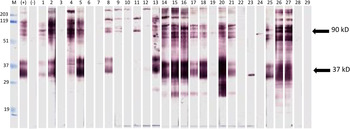
To ascertain antigenic proteins for sparganosis, we analysed crude sparganum extracts by immunoblotting with 29 of the positive serum samples obtained from the seroprevalence study. From the 29 positive serum samples, 23 showed antigenic bands on the immunoblot (fig. 1). Sixteen samples revealed strong antigenic bands at both 31–38 kDa and 51–119 kDa. Weak positive bands were observed at 23 or 204 kDa in some positive cases. All serum samples presenting antigenic bands commonly exhibited strong immunoreactive bands at both 37 and 90 kDa.
Immunoreactivity of sparganum crude extracts to ELISA-determined sparganosis-positive sera. Lanes: M, protein molecular weight markers; (+), sparganosis-positive serum; (−), normal serum; 1–13, sera from inhabitants of Cheorwon-gun; 14–27, sera from inhabitants of Goseong-gun; 28–29, sera from inhabitants of Ongjin-gun.

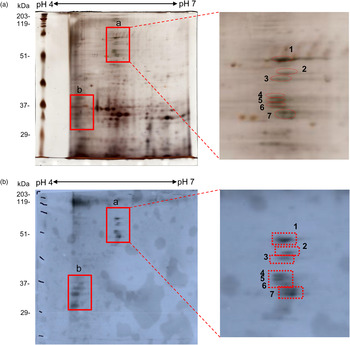
To identify strong antigenic proteins, the proteome of sparganum total lysates was separated by 2DE, transferred to membranes and primed with seropositive sera. Two-dimensional electrophoresis immunoblotting was conducted three times and the results (fig. 2) showed two antigenic regions – high molecular weight (51–119 kDa) and low molecular weight (31–38 kDa) – which were similar to the one-dimensional electrophoresis pattern. In the high molecular weight region, seven antigenic spots observed from positive sera were identified as paramyosin homologues of Echinococcus granulosus and Taenia solium by LC-coupled ESI-MS/MS. All spots had a common ‘RLEGDIGVMQGDLDEAVNAR’ sequence, and four spots had a ‘LTDLEALR’ sequence from Mascot results. Paramyosin retrieved from E. granulosus and T. solium was also aligned with expressed sequence tags (ESTs) of paramyosin in the sparganum EST database (Kim et al., Reference Kim, Kim, Yoo, Nam, Lee, Yang, Park, Lee, Lee, Cho, Lee, Park and Ju2012, Reference Kim, Yoo, Lee, Yang, Kim, Cho, Lee and Ju2014).
(a) Two-dimensional electrophoresis (2DE) map and (b) 2DE immunoblot of total sparganum lysates using sparganosis-positive pooled sera, showing regions of high (a) and low molecular weights (b). The panels on the right-hand side show enlargements of the high molecular weight regions.

Discussion
The seropositive rate (4.2%) of the studied population was higher than the previously reported average positive rate (1.9%) in other areas of Korea (Kong et al., Reference Kong, Cho and Kang1994). Sera from inhabitants of Cheorwon-gun (5.8%) and Goseong-gun (5.1%) in Gangwon-do had much higher positive rates than those from Ongjin-gun (0.9%) in northern Gyeonggi-do. The highest incidence of sparganosis was observed in areas in Gangwon-do, a mountainous region with many snakes compared to other areas of Korea (Lee et al., Reference Lee, Bae, Kim, Deung and Ryang2002). It is assumed that the habits of eating raw snakes and frogs and drinking contaminated stream water are prevalent in these areas. The seropositive rate of men (3.4%) was five times that of women (0.7%). Therefore, these results may be attributable to male eating habits and activities.
Of all the positive sera samples determined by ELISA, 23 showed positive results on immunoblotting. This discrepancy is likely due to the application of different techniques and methodologies, such as serum dilution and antigen concentration (Rodero et al., Reference Rodero, Chivato, Muro and Cuellar2005; Ang et al., Reference Ang, Notermans, Hommes, Simoons-Smit and Herremans2011). Immunoblot analysis of ELISA-positive sera revealed specific bands at 37 kDa in positive patients. This pattern was considered similar to that of previous reports reporting antigens for sparganum total lysates or ES proteins (Rahman et al., Reference Rahman, Lee and Bae2011; Dan et al., Reference Dan, Jing, Li, Li, Tong and Zhong2013; Hu et al., Reference Hu, Cui, Xiao, Wang, Liu, Liu, Zhang and Wang2014). Other bands at 51–119 kDa and 204 kDa were also noted. Moreover, protein bands at 37 and 90 kDa were specific for clinical sparganosis. In the present study, we profiled total antigenic protein from sparganum by 2DE and immunoblotting against sparganosis-positive sera. Sparganum sequences from LC-coupled ESI-MS/MS did not match any known peptides in the Mascot software, therefore, the sequences were BLASTed against the sparganum EST database (Kim et al., Reference Kim, Kim, Yoo, Nam, Lee, Yang, Park, Lee, Lee, Cho, Lee, Park and Ju2012, Reference Kim, Yoo, Lee, Yang, Kim, Cho, Lee and Ju2014). Consequently, paramyosin was identified as a candidate antigenic protein in sparganum.
Paramyosin is a fibrillar protein that is widely distributed among invertebrates but absent in vertebrates (Cohen et al., Reference Cohen, Szent-Gyorgyi and Kendrick-Jones1971). It is located predominantly in muscle as a component of the core of thick filaments (Epstein et al., Reference Epstein, Miller, Ortiz and Berliner1985). Notably, paramyosin has been found to be an immunogenic molecule during natural infections (Gobert & McManus, Reference Gobert and McManus2005) and has also been defined as a vaccine candidate antigen against infection with Schistosoma mansoni (Flanigan et al., Reference Flanigan, King, Lett, Nanduri and Mahmoud1989) and S. japonicum (Ramirez et al., Reference Ramirez, Kurtis, Wiest, Arias, Aliqui, Acosta, Peters and Olds1996; Yang et al., Reference Yang, Gobert and McManus1997).
In conclusion, we identified paramyosin as a putative antigen for serodiagnosis of sparganosis by immunoproteomic analyses. Moreover, our results constitute a significant source of information for the improvement of diagnostic tools for sparganosis, and contribute to identifying novel antigens against helminth parasites based on an immunoproteomic approach.
Financial support
This work was supported by an intramural research fund (2006-N54002-00) and an Endemic Diseases Control Program (NIH 4800-4847-311) from the National Institute of Health, Ministry of Health, and Welfare, Republic of Korea.
Conflict of interest
None.
Ethical standards
The study was approved by the ethics committee of the Korea National Institute of Health, KCDC (permit number 2007-03CON-04-P). All individuals' data were unlinked from the serum specimens.