




Introduction
“Considering that in the past two months there have been many expenses, it must be known that I have begun to note down everything; because previously, I did not record one-third of the expenses, and consequently my successors would not have known how to find out when, by whom, and in what manner many things were done; from now on, everything will be recorded, whether from industriousness or from something else.”Footnote 1
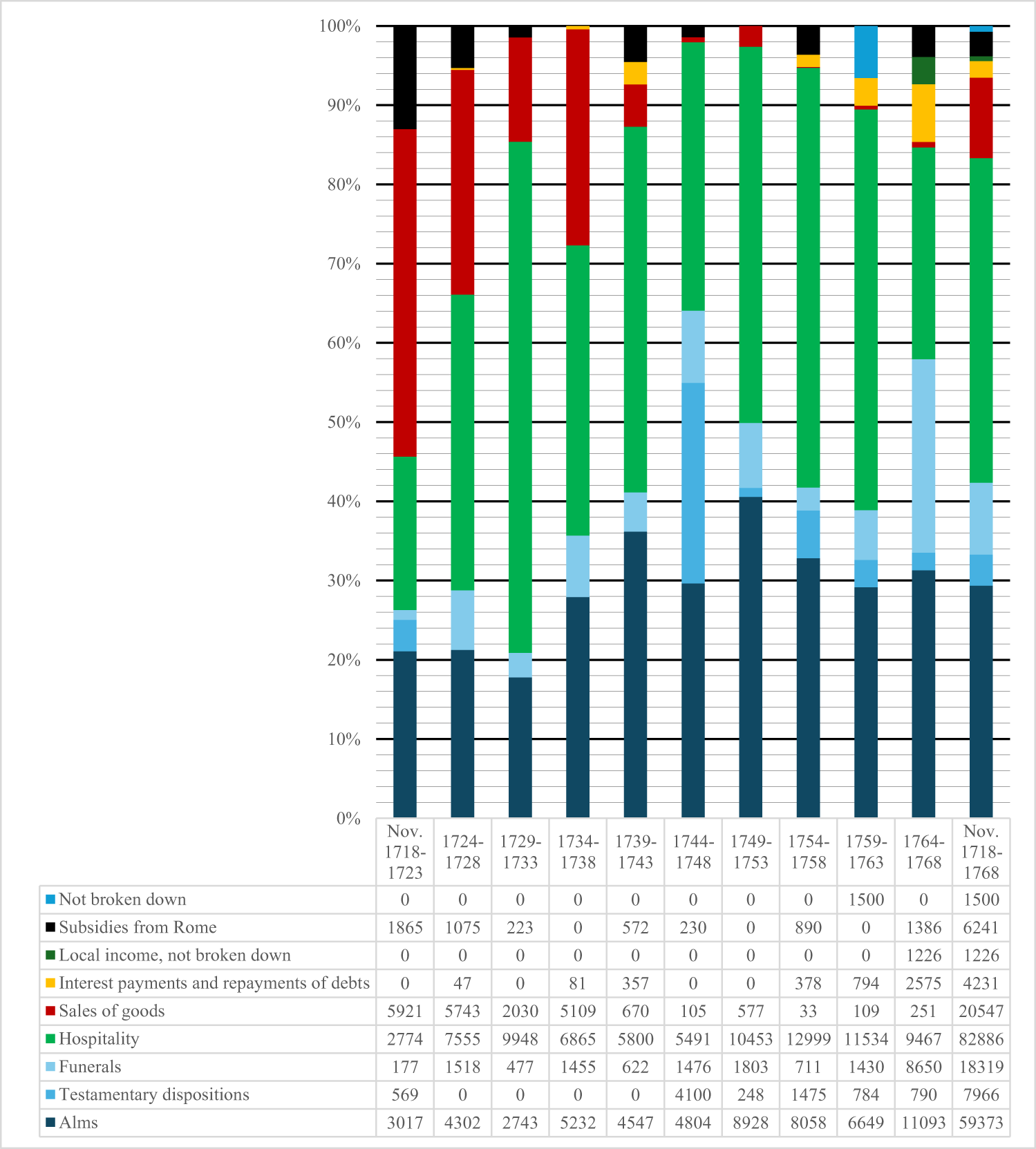
With these words, written at the end of 1718, Paolo Agostino di Santo Stefano, vicar of the Discalced Carmelites, and a co-signatory friar in Basra abandoned a bookkeeping practice that had made the accounts reflect less of the actual economy of the convent and more of what was sayable in the eyes of the accounting friar. Contrary to the announcement, however, the real change concerned the income rather than the expenses, which were detailed neither before nor after 1718. The changes are nevertheless impressive. Between November 1718 and 1723, the proportion of income “ex industria” (“from industriousness”) suddenly shot up from 0% to 41%. While income “ex industria” increased dramatically, subsidies from Rome fell from an average of 29% of the recorded income from 1674 to October 1718 to a mere 3% from November 1718 to 1768 (Figure 1).
Income of the Discalced Carmelites in Basra, November 1718 to 1768 (in abbāsī). Source: AGOCD, 483/f, Liber accepti et expensi Residentiae nostrae Bassorae, 1674–1727; AGOCD, 484/e, [Liber computum], 1728–1772.

Figure 1 Long description
Stacked bar graph with vertical axis labeled 0 percent to 100 percent. Horizontal axis shows time periods: Nov. 1718 dash 1723, 1724 dash 1728, 1729 dash 1733, 1734 dash 1738, 1739 dash 1743, 1744 dash 1748, 1749 dash 1753, 1754 dash 1758, 1759 dash 1763, 1764 dash 1768, Nov. 1718 dash 1768. Legend and table rows list: Not broken down; Subsidies from Rome; Local income, not broken down; Interest payments and repayments of debts; Sales of goods; Hospitality; Funerals; Testamentary dispositions; Alms. Table values by time period, in the same left to right order as the horizontal axis: Not broken down: 0, 0, 0, 0, 0, 0, 0, 0, 1500, 0, 1500. Subsidies from Rome: 1865, 1075, 223, 0, 572, 230, 0, 890, 0, 1386, 6241. Local income, not broken down: 0, 0, 0, 0, 0, 0, 0, 0, 0, 1226, 1226. Interest payments and repayments of debts: 0, 47, 0, 81, 357, 0, 0, 378, 794, 2575, 4231. Sales of goods: 5921, 5743, 2030, 5109, 670, 105, 577, 33, 109, 251, 20547. Hospitality: 2774, 7555, 9948, 6865, 5800, 5491, 10453, 12999, 11534, 9467, 82886. Funerals: 177, 1518, 477, 1455, 622, 1476, 1803, 711, 1430, 8650, 18319. Testamentary dispositions: 569, 0, 0, 0, 0, 4100, 248, 1475, 784, 790, 7966. Alms: 3017, 4302, 2743, 5232, 4547, 4804, 8928, 8058, 6649, 11093, 59373.
There is no evidence to suggest that the composition of the income of the Discalced Carmelites in Basra changed so radically in such a short time. Historians might be tempted to trust numbers more than texts and to overlook the narratives told by the numbers. For a long time, they have used the account books of ecclesiastical institutions mostly as sources for quantitative analysis, tending to take their contents at face value.Footnote 2 Research on the historicity of account-keeping practices centred on their efficiency as tools of financial administration, with the introduction of doubly-entry recording being considered an essential step towards economic “modernity.”Footnote 3 In contrast, more recently the account-keeping practices of ecclesiastical institutions and, in particular, late medieval mendicant orders have been studied in their own right. It has been emphasized that their accounting practice was “a technique of asceticism and governance” that instilled discipline and stewardship, linking the worldly accounts with the account that the faithful renders to God at the Last Judgment.Footnote 4 Yet the worldly activities that were necessary for missionaries to survive often inevitably contravened the moral economy of mendicant friars, i.e., their understanding of economic activities guided by the religious values and norms of their order.Footnote 5 This places account-keeping at the centre of the tensions between competing normative orders that characterised any missionary setting.Footnote 6
The present case study does not reduce accounting to its function as a tool of financial efficiency. Instead, it considers its performativity at the service of specific models of governance,Footnote 7 as well as its use as a medium of corporate self-narration and memory.Footnote 8 I assume that beside their function as tools of financial administration, accounting documents also focused “on the construction of identity,”Footnote 9 and I postulate that the variations in content and language in the Discalced Carmelites’ account books reflect the friars’ different responses to the collective moral dilemma they faced as members of a mendicant order in Basra. Until October 1718, the account-keeping practices constructed the fictitious image of a mendicant economy based on subsidies from Europe and on alms from the believers, complemented by limited additional revenue from hosting foreigners who were passing through. In 1718, the vicar changed to a practice that echoed his origins in Genoa and the missionaries’ integration into Basra’s merchant society, where the reliability of accountsFootnote 10 and the capacity to generate income through “industriousness”Footnote 11 were constitutive of a person’s respectability. Starting at the end of 1718, “industria” not only appeared in the account books as an important source of income but also as something that a friar might refer to proudly as a personal merit in the chronicle of his convent or in his personal memoirs, as I will demonstrate further on.
This also raises the question of personal profit-making. The Discalced Carmelites, a religious order resulting from the Carmelite reform initiated by Teresa of Ávila and John of the Cross in the 1560s, took a vow of poverty that implied renouncing any form of personal economy as part of a way of life which sought union with God through contemplation and fraternal living.Footnote 12 In reality, alongside the convent’s common economy, single missionaries had their own personal economies.Footnote 13 While this was criticised by certain visitors sent by the superiors of the order, the capacity to finance missionary activities out of personal resources is treated in a more positive light in other sources, as we will see.
The convent of the Discalced Carmelites in Basra, on which this article focuses, has gone largely unremarked by the mainstream of missionary research.Footnote 14 The small convent was founded from Isfahan in 1623. Although Basra was then ruled by a local dynasty and later conquered by the Ottomans, both the order and the Roman Curia considered the new foundation to be part of the Discalced Carmelites’ missions to Persia, which were despatched by Pope Clement VIII in 1604. Unlike previous missions founded in the Americas and Asia by other mendicant orders, by the Jesuits, and the Augustinians under the patronage of the kings of Castile and Portugal, the Discalced Carmelites’ missions to Persia originated from a papal decision. Placed under the authority of the superiors of the Discalced Carmelites’ Italian congregation and of the Roman Curia (starting in 1622, the Congregation for the Propagation of the Faith, known as Propaganda fide), they were part of a policy aimed at strengthening the papacy and countering the influence of the Iberian powers in church affairs. However, the de jure centralized government structures of the Italian Congregation of the Discalced Carmelites and of the Propaganda fide were largely dysfunctional,Footnote 15 as I will demonstrate here with a focus on their funding and auditing practices. The small community in Basra largely led a life of its own, shaped by the town’s history as a commercial hub.
The convent in Basra is the only early modern mission of the Discalced Carmelite order (and one of the very few Catholic missions in Asia in general) to have preserved the local account books,Footnote 16 as well as other documentation of its local archives, in particular the registers of baptisms, marriages, and burials, transferred to the Roman archives of the order in the twentieth century. Alongside the correspondence preserved in the archives of the Curia generalizia and of the Propaganda Fide in Rome, the chronicle kept by the Discalced Carmelites in Basra,Footnote 17 and the personal papers of one of the friars, Cornelio di San Giuseppe, in the Biblioteca Ambrosiana,Footnote 18 this rich documentation provides a fascinating insight into the “glocal” entanglements of a small community of mendicant friars in a port city on the edge of the Ottoman Empire.
In the following, based on the finding that external funding accounted for only a minimal portion of total income, I first present the local setting of Basra as a cosmopolitan port city where the friars had to generate the resources they needed locally in order to survive. In the second section, I discuss the account books and their intended audience. Did the regular audits by visitors ensure effective external control? Or were the visitations conducted in such a way that the account books, like the convent chronicle, must be considered as media of corporate self-narration, addressed to the friars’ own local community? In the third section, I search the account books for traces of the mission’s actual economy. This is a delicate undertaking. While there is no proof of outright forgery, extensive omissions make it impossible to accurately measure the actual magnitude of financial dynamics over time. The most significant omission relates to the personal economies of individual friars, which are the object of my fourth section. In the fifth section, I demonstrate how the Discalced Carmelites employed the language of the account books to make the economic practices of the cosmopolitan mercantile environment appear compatible with the normative framework of a mendicant order. The sixth section focuses on the friars’ role as providers of spiritual services to Catholic and non-Catholic Christians. This section further illustrates the spiritual dimension of accounting underlying the Discalced Carmelites’ recording practices. These practices were intended to account not only for money but also for salvation.
Insignificant Funding from Rome and Local Networks
One measure of the mission’s autonomy is the limited volume of the funding coming from Rome. While the Propaganda Fide documentation would suggest that the missionaries sent by the congregation lived on the subsidies sent from Europe, from November 1718 to 1768, only 3% of the income recorded in the account books of the Discalced Carmelites in Basra came from Europe (Figure 1). Despite the fact that socioeconomic conditions differed from those in the Safavid Empire, letters and reports suggest that the lack of external funding and reliance on local resources was a common feature of the Discalced Carmelites’ missions to Persia.Footnote 19
In theory, the subsidies from Europe should have provided the missionaries with a regular income. In 1617, the definitorium generale of the Discalced Carmelites had decided to give each missionary in Persia fifty scudi for their outward and return journeys and fifty scudi per year from the proceeds of a Neapolitan nobleman’s bequest.Footnote 20 The sum of fifty scudi per year set a standard later followed by Propaganda Fide beyond Persia. This amount was roughly equivalent to the cost of food, clothing, and medical care for a mendicant friar in Italy in the mid-seventeenth century.Footnote 21 However, this did not take into account the fact that the funds arrived very incompletely and sometimes with long delays.Footnote 22 In the fifty years from November 1718 to 1768, the Discalced Carmelites in Basra received only seventeen remittances from Rome (totalling 6,241 ʿabbāsī, or 1,872 scudi – equivalent to 37 scudi per year).Footnote 23
The friars had anticipated such problems since the first years of their foundation in Isfahan (1607). Their efforts to become as self-sufficient as possible led them to establish other missions from the capital of the Safavid Empire. Like the foundation of the convent in Goa (1620), the foundation of the convent in Basra in 1623 was part of their efforts to take advantage of the resources of the Portuguese settlements in Asia despite their strained relations with the authorities of the Portuguese Estado da Índia, which were due to the Discalced Carmelites’ close links with the papacy. In the first decades after their establishment in Basra, the Discalced Carmelites, in competition with the Portuguese Augustinians sent from Goa, tried to convert the Mandaeans to Catholicism.Footnote 24 Starting in the 1670s the friars, realising their lack of success, began to focus on the relations with “various Christian sects,” i.e., Eastern Christians separated from the Roman Church who were involved in commerce.Footnote 25 In 1719, there were only six Catholic households established in Basra, but many other Christians of various origins and denominations, including Armenians and members of other Eastern churches, as well as Western European Catholics and Protestants, came there for part of the year, in keeping with the schedules of the merchant ships to and from India whose arrivals and departures were governed by the monsoon winds.Footnote 26
In the eighteenth century, the Discalced Carmelites benefited from Basra’s growing importance as a port town. In the heyday of the Safavid Empire, the Persian ports had been the main transshipment points at the end of the trade routes to and from South Asia. This changed in the early eighteenth century: In the Persian heartland, the fall of the Safavids in 1722 was followed by years of anarchy, while in Basra, European merchants tried to take advantage of the legal framework of the Ottoman capitulations. The Mamluk dynasty, which in the mid-eighteenth century established its rule as pashas in Baghdad under the nominal authority of the Ottoman sultan, encouraged trade as a source of income. Between the 1720s and the early 1770s, Basra experienced considerable growth, eventually enjoying a real boom as a transit port, thanks to its integration into the trade networks linking the Indian Ocean and the Persian Gulf to Aleppo, the Ottoman heartlands, and the Mediterranean by land.Footnote 27
From the mid-seventeenth century onwards, Dutch and English merchants had taken the place of the Portuguese traders in the Persian Gulf.Footnote 28 They were joined by the French Compagnie des Indes orientales, founded in 1664. Starting in the 1720s, merchants from Great Britain, the Netherlands, and France who had operated out of the Iranian port of Bandar Abbas became increasingly involved in Basra’s long-distance trade. The British East India Company (EIC) established a factory in Basra in 1723, followed by the Verenigde Oost-Indische Compagnie (VOC) in 1724 and the French Compagnie des Indes in 1739, while there was also substantial private trade.Footnote 29 The Discalced Carmelites maintained close ties with these British, Dutch, and French merchants, as well as with Eastern Christians.
For the friars, the contacts with the British and the Dutch were essential for ship travels and the dispatch of letters.Footnote 30 As one friar put it in the chronicle of the convent, the missionaries were to deal with the Protestants “with the greatest prudence and discretion,” as “considerable advantages may result from their friendship to our mission and the salvation of souls.” Although separated from the Discalced Carmelites by “the false doctrines of their sect,” the Protestants were “closely united … by the charm of an exhibition of uprightness and proven integrity.”Footnote 31 Significantly, this praise for people mostly engaged in commerce appeared in the chronicle in 1720, two years after the decision was made to provide an accurate account of income and expenditure, rather than manipulate the figures in order to fit the fictitious image of a mendicant economy.
Beginning in the mid-eighteenth century, the conflicts between the French and the British East India Companies in South Asia also affected the relations between the Discalced Carmelites and the French and British agents in Basra. The agent of the French Compagnie des Indes tried to establish French protection over the mission in Basra, following similar French claims in the wider Ottoman context. In the 1750s and 1760s, the Discalced Carmelites were divided according to their origin. Those of Italian origin refused to give any special ceremonial treatment to the French resident, preferring the protection of the British agent, who did not interfere in church affairs but often helped the friars efficiently with dispatching letters or arranging ship travel to India.Footnote 32 While the competition between the French and British remained a dominant feature for several decades, the VOC closed its factory in Basra in 1753 and withdrew completely from the Gulf trade in 1766, after the conquest of its factory on the island of Kharg by the ruler of Bandar Rīg.
Older historiographical narratives saw the eighteenth-century European commercial presence in the Persian Gulf as a prelude to colonialism.Footnote 33 More recent approaches have instead highlighted the local dynamics of trade and the achievements of Middle Eastern and Indian family firms as competitors and partners of the European trading companies.Footnote 34 The study of the Discalced Carmelites’ mission in Basra adds to this renewed picture. As I will demonstrate in the last section, it shows that from an economic point of view Eastern Christians were far more important to the friars than people from Western Europe. The friars established a hospice to indistinctly serve Christian merchants and sailors: Eastern Christians of various denominations, as well as Western European Catholics and Protestants. When Muslim authorities called into question the existence of the convent, the friars’ role as service providers to Christian merchants was an important counterargument, as was the superior’s formal title as French consul. In close contact with merchants of various religious affiliations, the Discalced Carmelites managed to establish themselves as knowledgeable intermediaries between Christians of different origins and the local authorities and to put their residence on an economically viable footing.
The Account Books and their Intended Audience
Although the account books survive for a 100-year period from 1674 to 1772, the details of the entries vary. Some friars were apparently incapable of keeping accounts in foreign currencies, or even of keeping accounts at all. While most friars correctly handled the various local coins, the two friars who kept the accounts in 1691 and 1693 were unable to convert the smaller fulūs into shāhī and ʿabbāsī. Footnote 35 Moreover, according to the chronicle, they both “nearly went out of their mind” “from fear of the plague,” stopped keeping the books, and left Basra.Footnote 36
While such exceptional situations resulted in very incomplete bookkeeping, in normal years, revenue and expenses were listed monthly, with revenues on the left and expenses on the right of a double page. As the original title of the first book, running from 1674 to 1727, states, it was a “book of the revenues and expenses,” where the friars applied a cash receipts and disbursements method of accounting. Balances (or discharge statements) were not established at regular intervals (for example monthly or annually), but only when visitors came to Basra and occasionally when a new vicar entered his office and thus became responsible for the convent’s finances. Due to the exclusive focus on the cash flows, the existence of debts and credits can only be tracked through the interest payments. Such an accounting practice provided no evidence of assets or credit terms (interest rates, periods of borrowing); the cash balance was established only occasionally and can otherwise only be inferred from the cash flows. As the books also omit any indication of the quantities of goods sold or purchased, they offer no insight into the costs of living, particularly prices of commodities.Footnote 37
The cash receipts and disbursements method used by the Discalced Carmelites in Basra was similar to that of the books of revenues and expenses kept in secular households, for example in Florence. The fact that the friars did not keep any additional type of account book is thus more revealing than the form of their extant books itself.Footnote 38 In contrast to entrepreneurial account-keeping practices, the friars’ cash method of accounting was useless as a means of monitoring the costs and benefits of economic ventures. Although in the seventeenth and eighteenth centuries, even among laypeople, more elaborate charge and discharge and double-entry methods of accounting were limited to a tiny minority of economic actors who felt their necessity and were able to use them,Footnote 39 the dissimulation of long-term relations of debt or credit was clearly in keeping with the mendicants’ ideal of not becoming entangled with worldly actors.Footnote 40 The use of a cash method of accounting may be related to the mendicant ideal of an economy that should be free from debt and profit accumulation. In this sense it is revealing that the existence of a cash deficit or surplus since the last visitation was the only thing systematically stated in the minutes of the visitations contained in the account books.
This leads to the question of who the intended audience of the account books was. The account books were among the documents systematically checked by the visitors sent to Basra by the order’s superiors (as was regularly the case in the 1670s and the 1680s and then again from the 1720s onwards).Footnote 41 However, while a system of external control was formally applied, the visitors were more or less closely linked to the convent they were required to audit, as the following examples show. The provincial vicar, Urbano di Sant’Eliseo, who had to audit the convent of Basra in 1728, had lived there in 1716–17, 1718–22, and since 1725. After his appointment as provincial vicar, he audited his own convent before leaving for Isfahan. In the minutes of his visitation, included in the account book, he listed the income from alms, subsidies from Rome, and the renting out of lodgings, and subsumed under the vague heading “for any other reason or title whatsoever” all income that might have been contrary to the order’s normative framework. On several occasions, the visitors had themselves been responsible for the convent’s finances during the time period they were supposed to audit (Placido di San Nicolò, visitor in 1734; Cornelio di San Giuseppe, visitor in 1747, 1750, and 1754).
The visitors did not report any observations about accounting practices to the superiors who had ordered the visitations. Indeed, there are no references to the contents of the local account books of the missions to Persia in the minutes of the definitorium generale or of the general chapters of the Discalced Carmelites, i.e., the two main boards of the central government of the order.Footnote 42 Furthermore, it is striking that, throughout the entire period from 1674 to 1768, the visitors limited their audits to establishing the balance of revenues and expenses, never questioning the nature of the income or the use to which the money was put. Such visiting practices were in keeping with a baroque culture more concerned with avoiding public “scandal” than with rigorously tracking and punishing potential abuses.Footnote 43 In conclusion, the account books were not used as instruments of external control. Instead, I propose that they were intended for the friars’ own local community as media of a corporate self-narration, akin to the convent chronicle that they kept in parallel.
The Convent Economy
When analysing the information provided in the account books, it is important to bear in mind their formal characteristics, their insertion in the local institutional context, and the lack of effective external control. The account books only distinguish between “expensae ordinariae” and “extraordinariae,” but provide much more detail on the different sources of income, enabling us to analyse their composition quantitatively. When doing so, we have to take into account the statement of the vicar, Paolo Agostino di Santo Stefano, from 1718, quoted at the beginning of this article. In the years before, from 1715 to October 1718, the Discalced Carmelites’ accounts had shown what the economy of mendicant friars was supposed to be like. Their declared income during this period totalled 2,581 ʿabbāsī (equivalent to 774 scudi, or around 202 scudi per year). This income was mainly made up of subsidies from Rome (49%) and alms for masses, burials, and testamentary dispositions (40%), as well as minor entries for renting accommodation (8%). This picture was in conformity with the normative framework defined by the order and the papacy.Footnote 44
The actual economy of the Discalced Carmelites in Basra was by necessity very different. The appearance of the category “ex industria” – “from industriousness” – in December 1718 brought the friars’ accounting practices closer to reality. From November 1718 to 1723, this category accounted for 41% of the total income of 14,323 ʿabbāsī (equivalent to 4,297 scudi, or around 832 scudi per year; see Figure 1). In the case of Basra, it can be assumed that the term “industria” referred to the sale of goods produced by the friars themselves or, rather, by locals on their behalf. Indeed, it is striking that after Friar Paolo Agostino’s departure from Basra, starting in October 1724, the term “ex industria” was suddenly replaced by references to the sale of “unnecessary goods.” Equally, starting in 1724, the accounts recorded substantial income from the sale of rose water produced in the vicinity of the city. Until that moment, “ex industria” most probably included the production and sale of rose water, but also of alcohol, to which Alexander Hamilton, a Scottish captain, alluded in a book published in 1727. According to Hamilton, the friars abused the “indulgence” of the local government “to the vilest uses, in selling Arrack, which they distil from dates,” “debauching Christians, Jews, Mahometans and Pagans with liquors.”Footnote 45
While it becomes evident from other sources that the Discalced Carmelites of the Persian mission produced and traded in wine and brandy,Footnote 46 these activities were recorded inconsistently by the bookkeepers in Basra. From 1674 to 1687, expenses for the purchase and production of wine were regularly recorded. But for the entire period from 1674 to 1768, the accounts never explicitly refer to any income from the sale of wine or other alcohol. As Hamilton’s report shows, the sale of alcohol in an Islamic context could easily be presented as scandalous by the friars’ critics. This probably explains why it was never explicitly recorded in the account books and why it was, occasionally, banned by the visitors or the friars themselves. Indeed, in 1679, having the excessive drinking habits of his Dutch guests in mind, the friar in charge of the hospice decided, “to the greater peace and reverence of the religious,” not to serve any more wine “to the seculars, who come to us for the sake of visiting the city.”Footnote 47
The spectacular rise of the income “ex industria” starting in December 1718 was preceded in the 1670s and 1680s by single references to income from the sale of goods: in 1675, for example, forty-one ʿabbāsī (or 12 scudi) “from the sale of glassware from Venice”; in 1678 nineteen ʿabbāsī (or 6 scudi) “for the sale of cloth”; in 1680 thirty-one ʿabbāsī (or 9 scudi) from the sale of cinnamon and other products; and in 1682, 655 ʿabbāsī (or 197 scudi) “from the proceeds of manufactured cotton goods,” probably printed cotton from Persia or chintz from the Coromandel coast. It is impossible to say whether these objects were gifts to the friars or part of a petty trade conducted by missionaries travelling back and forth between Europe and Asia. In fact, there is evidence that some of the friars exploited their wide-ranging connections to start small, lucrative businesses. For example, in 1655, Barnaba di San Carlo asked one of the order’s superiors to send him ten clocks from Rome, which he could then sell in Basra at five times the price.Footnote 48 Most of the objects mentioned gained additional value due to their exotic character either in Basra or in Europe.
The friars also lent money at interest to people involved in trade with India. In 1674, they had 1,091 ʿabbāsī (equivalent to 327 scudi) deposited in the hands of an Indian banyan. While the income from interest payments was modest at that time, starting in 1684, the interests on such investments, now mostly with the French East India Company, played a major role in the friars’ economy in Basra (20% from 1684 to 1688, 28% from 1689 to 1693, and 21% from 1699 to 1702). However, when the Compagnie des Indes orientales went bankrupt in 1706, the missions of the Discalced Carmelites in Persia suffered major losses.Footnote 49 The friars in Basra seem to have learned from this misfortune, as their accounts never again show significant revenue from such investments (Figure 1).
Put together, the information from the account books and the convent chronicle indicates that the Discalced Carmelites were able to economically consolidate their establishment in Basra starting around 1720. Their economic success was now reflected in building activities that further consolidated their role as providers of services to Eastern Christian and European merchants and sailors. In 1719, the friars enlarged their caravanserai, “the structure being quite decent in appearance and very much to the advantage of our house.”Footnote 50 In the 1720s, their newfound prosperity enabled the friars to rebuild their residence. In December 1724, Friar Placido di San Nicolò found almost 1,000 piasters (approximately 400 scudi, equivalent to eight annual subsidies) in the chest and decided “to invest the money in construction rather than spend it at [his] leisure.” “Since there was no vicar provincial from whom to obtain a licence,” he acted on his own authority.Footnote 51 When the building was completed in 1727, Friar Placido proudly insisted that the money spent on it had not come from the Roman subsidies, “but from [his] toil and industry and the blood of benefactors.”Footnote 52 In 1736, 1741, and 1752, the friars invested their surplus funds in purchasing new houses – a total of 6,563 ʿabbāsī (equivalent to 1,969 scudi), which was more than the subsidies they received from Rome for their subsistence during the entire period from November 1718 to 1768 (6,241 ʿabbāsī, equivalent to 1,872 scudi). In his memoirs, Friar Cornelio di San Giuseppe claimed to have repaid the convent’s debts, renovated the existing house, constructed a new one, and bought two additional houses, which could be rented out for around 300 piasters (120 scudi) per year, thanks to the bequest of a VOC official converted to Catholicism, Konstantin Scheber.Footnote 53 Alongside the worldly and spiritual services provided to a cosmopolitan clientele, the rental income from urban property became the main basis of the convent’s economy.
Embedded in the socioeconomic structures of Basra, the Discalced Carmelites successfully ran a hospice for Eastern Christian and Western European merchants and seamen of various denominations and origins who passed through the port city. In the long run they seem to have achieved a remarkable financial equilibrium. It is noticeable that, starting in the early 1740s, income from trade almost disappeared from the accounts. Meanwhile, income from the renting of lodgings, as well as from alms for masses, burials, and testamentary dispositions, increased (see Figure 1). Did the friars specialise in providing lodging in their caravanserai and houses, as well as spiritual services, to their guests? Or was income selectively recorded again, as before November 1718, to present a picture that more closely resembled what the economy of mendicant friars was supposed to be? Did income “ex industria” in the 1740s and 1750s become part of the friars’ personal economies? Indeed, we know from Cornelio di San Giuseppe’s diary that, starting in 1752, the friars resold Madeira wine (not recorded in the convent’s account book), which they could purchase at a reduced rate from the French East India Company in recognition of Friar Cornelio’s services to the company.Footnote 54
Personal Economies
The overall image of a financial equilibrium achieved from November 1718 to 1768 contrasts with criticisms formulated by some friars against their confrères in letters to their superiors or to the Propaganda Fide. In 1767, a friar who had travelled to India to beg for alms for the Basra mission complained that the vicar managed the house’s resources “with a despotism forbidden by our constitutions,” acting “as if they belonged to him alone.” Due to this alleged mismanagement, the friar claimed that the Basra mission was “extremely poor.”Footnote 55 However, this accusation is contradicted by an analysis of the account book, which shows that in the five-year period from 1764 to 1768, the convent’s revenues (35,437 ʿabbāsī, or 10,631 scudi) exceeded the expenses (27,451 ʿabbāsī, or 8,235 scudi) by 7,986 ʿabbāsī (or 2,396 scudi).
Yet the criticism against the vicar focused on an important aspect of the management of the convent’s resources: its control by individual friars rather than the community. In a letter to the bishop of Babylon, the agent of the French Compagnie des Indes had complained in 1757 that the vicar provincial and former vicar of the convent, Giacinto di Santa Teresa, had forced his successor in Basra to accept the management of the house without an audit of his accounts. Friar Giacinto had collected the rents of the houses for three months in advance and handed over only twenty scudi to his successor, keeping the rest for himself, as he did with the alms for masses and other gifts belonging to the convent. Among these presents the agent mentioned “a gratification in money,” which Friar Giacinto had received from the British consul for the baptism of a child born to his concubine. Instead of putting the money into the convent’s purse, he had put it into his own.Footnote 56
Such accusations suggest that missionaries’ personal endeavours led, at least in part, to the creation of personal economies which were contrary to the order’s constitutions and were not reflected in the convent’s account books. The personal papers of Cornelio di San Giuseppe provide some unique insights from an industrious friar’s own point of view. In his Memorie cronologiche Friar Cornelio proudly mentions the sums of money he gave to the houses of the Discalced Carmelites in 1755, when he left Basra due to his promotion to provincial vicar of the Discalced Carmelites in Aleppo after a stay of 16 years in Mesopotamia and Persia: 2,000 scudi (or 6,667 ʿabbāsī) for Isfahan, 500 scudi (or 1,667 ʿabbāsī) for Kharg, another 500 for Bandar Abbas and Bushehr, and 2,500 scudi (or 8,333 ʿabbāsī) for Basra – “all money collected by me, or earned for various assignments from secular persons, or from particular friends of mine.” A few months earlier, he had already given 500 rupees (approximately 250 scudi, or 833 ʿabbāsī) to a confrère on the island of Kharg. The total sum – 5,750 scudi (or 19,167 ʿabbāsī) – equalled 115 of the annual subsidies of fifty scudi that a Discalced Carmelite missionary was supposed to receive from Rome. By way of comparison, the total revenue recorded in the Basra convent’s account book in the 16 years from 1739 to 1755 amounted to 58,780 ʿabbāsī (or 17,634 scudi). This sum did not include the funds donated by Friar Cornelio in 1755, as these were not noted in the account book. From 1739 to 1755, the convent’s cash surplus totalled just 680ʿabbāsī (or 204 scudi). By contrast, Cornelio di San Giuseppe claimed that he had enough money left to maintain the Discalced Carmelites’ house in Aleppo for around three years at his own expenses as provincial vicar and to donate to their church a gold-decorated tapestry ordered from Venice.Footnote 57 His local confrères in Basra were aware of Cornelio’s economic success. While describing him as a “true missionary,” one of them stated that, upon leaving Basra, Friar Cornelio took with him approximately 10,000 piasters (around 4,000 scudi or 13,333 ʿabbāsī, equivalent to eighty annual subsidies), which he had earned “ex industria.”Footnote 58 The consistency with Cornelio’s own reports lends credence to these assertions.
Cornelio di San Giuseppe’s advantageous position was based on his services as an intermediary and trustee for Christians of various denominations.Footnote 59 In his Memorie, he described how, in addition to his spiritual duties as a missionary and in the secular administration of the convent, he expedited not only countless orders from missionaries in the Middle East and India, but “above all various other tiresome tasks that he had to undertake for the secular benefit of not only Catholic but also of schismatic Christians.” They all used his “mediation and support” because they trusted him.Footnote 60 Friar Cornelio’s economic success was embedded in his practice of sociability with Western European and Eastern Christians. A travel report written by the friar gives further insight into his way of life: In 1755, en route from Basra to Aleppo, he travelled in a caravan with three camels, two of them loaded with provisions and another with his “belongings, and clothes with a case full of porcelain, and with a sufficient supply of spices, and coffee received as gifts from the European consuls.” During the journey, Friar Cornelio enjoyed smoking a pipe and drinking coffee with an Armenian travel companion, the agent of a merchant from Constantinople. He was also accompanied by a group of Catholic Armenian women fleeing from New Julfa (the Armenian neighbourhood of Isfahan) to whom he lent the money they needed to travel to Venice.Footnote 61 Due to the troubles in Persia, for once it was an economically successful Discalced Carmelite who could help these members of wealthy Armenian merchant families who were among the economic pillars of the missions in Persia and in Basra.
Along with the vicar’s comment from 1718, these episodes raise questions about what was (not) registered in the account books. Rather than the overt falsification of individual entries, we can glean important omissions: the convent’s own shadow economy brought to light by the vicar’s decision in 1718 on one hand, and the personal economies of single friars such as Cornelio di San Giuseppe on the other. Both massively change the picture of the convent economy as reflected in the account books. Consequently, it is not possible to quantify the actual financial dynamics of the convent economy over time using these records.
Categorisations: Mendicant Friars in a Mercantile Environment
At first glance, the Discalced Carmelites’ account books seem surprisingly worldly. They differ starkly from those of an English Puritan minister analysed by Adam Smyth who explicitly framed his revenues “as the product of God’s intervention.”Footnote 62 Unlike the Calvinist minister, the Discalced Carmelites in Basra did not frame their profits from commerce as the result of God’s will. Contrary to the recommendations of early modern printed guides to accounting, and a practice common among merchants,Footnote 63 they were reluctant to mark their accounts with religious references: From 1674 to 1768, 62% of their accounts bore no religious symbol.Footnote 64 The friars did not believe that economic success was a sign of being chosen by God but tried to conceal it.
The absence of any invocation of God, and the reluctance to mark the account books with religious references, does not mean that accounting was a purely secular undertaking for the friars. In fact, as I will demonstrate now, the friars used the account books to create images of mendicant observance. The analysis of their categorisations reveals how the friars coped with the contradictions between the contingencies of a socioeconomic setting marked by the expansion of commerce and their close relations with European and Eastern Christian merchants on the one hand, and the normative framework of a reformed mendicant order on the other.Footnote 65 This is most evident in their use of a specific vocabulary to create images of observance, particularly in the distinction they made between “ordinary” and “extraordinary expenses,” the assimilation of payments or donations to “alms,” and the ways in which they referred to participation in trade.
It is striking that from 1674 to October 1718, 80% of the expenses were categorised as “extraordinary”; from November 1718 to 1768, their proportion amounted to 77%. Sporadically the account books provide more precise information, showing us that the term “extraordinary” referred to anything beyond the friars’ and their guests’ immediate daily necessities. This included not only the purchase of real estate or long-term investments in building work, but also the expenses for long-term provisions (such as dates, olive oil, olives, butter, rice, pulses, sugar, wheat, and wine), firewood and medications, the production of wine and vinegar, the friars’ clothes, church vestments and utensils, books, the servants’ salaries, and travel expenses of friars who travelled to other missions or returned to Europe. Most of these expenses were not “extraordinary” because they occurred rarely or could easily be avoided, but rather because they exceeded a properly “mendicant” day-to-day horizon or involved costs such as employing secular servants, which should be avoided if possible. The classification of these expenses as “extraordinary” reminded the friars of the requirements of a reformed Carmelite’s way of life (and thus illustrates the normative and disciplinary dimension of accounting as a “technique of asceticism”), while the huge proportion of “extraordinary” expenses shows how far away the socioeconomic constraints placed the friars from such a strict life design.
The radical change in accounting practices at the end of 1718 was accompanied by a re-evaluation of the friars’ activities as service providers to Christian travellers. In the convent chronicle, the economic benefits derived from these services were justified as part of a gift-giving economy which followed a rationality of “antidora.”Footnote 66 Commenting on the reception of two Spaniards from August to October 1726, Friar Placido di San Nicolò emphasised the multiple advantages of caring for foreigners. One of the Spaniards gave the friars two hundred rupees for two hundred masses and a further two hundred rupees for his burial, while his brother left them almost a hundred rupees’ worth of goods and alms for masses (500 rupees in total, or around 250 scudi). Friar Placido stated that their successors “ought not to refuse similar opportunities, firstly because of the charity of neighbours and foreigners, secondly for politeness, and thirdly for emolument, since he who will not endure inconveniences for the sake of others will not experience their benefits, and he who does not give will not receive any gift himself, either in this life or the next.”Footnote 67
This way of conceiving worldly services as part of a gift-giving economy also left its mark in the account books. While the rent paid for rooms in the caravanserai or for the houses owned by the Discalced Carmelites was always referred to as “locatio,” focusing thus on the monetary aspect of the relationship, other terms referred to the specific moral economy of mendicant friars, whose services to foreigners passing through were considered as acts of Christian charity, even though they received a gift in return, whether in cash or in kind. In the context of the friars’ role as hosts to merchants, such entries referred to actual hospitality, distinct from the rental of individual rooms in the caravanserai or of entire houses. While the account keepers sometimes used the term “compensatio hospitalitatis,” they more often referred to the register of “gratitude” or described the sums received from their guests with the religiously tinted term of “alms.” Since the late Middle Ages, this term had become particularly associated with the donations the faithful made to mendicant friars within an economy of salvation. In the specific local context, “alms” were not necessarily related to the Roman Catholic confession of the giver. They were more often offered by Eastern Christians than by Western European Catholics, as we will see in the next section; sometimes they also originated from non-Catholic Dutchmen or Englishmen.
Guests also expressed their gratitude by giving alms in kind, but most of these gifts were only recorded once the items had been sold. For instance, in 1705, the friars sold spices that had been given to them “ex charitate” by a Dutch captain named Abraham Van de Putt, probably for services rendered in delicate negotiations with the local Ottoman authorities. The same captain added twenty-five ʿabbāsī in cash “for Easter” in 1706, followed by another sixty ʿabbāsī “for painting the church” in May of that year. Other donations in kind can only be traced in the chronicle of the convent, where it is recorded that the friars later sold them. In 1676, for instance, an English captain, whom the friars had helped with his dealings with local officers, expressed his gratitude with “alms” in cash and then, in 1679, back in his home country, sent the friars some London cloth with which to make a habit. As the cloth was not of the colour of the order’s habit, the friars commissioned a Christian layman to sell it.Footnote 68
While references to the sale of goods had not been entirely absent in the late seventeenth century, the spectacular increase in income “ex industria” starting at the end of 1718, which in 1724 was substituted by sales of “superfluous things” and a specialisation in the sale of rose water, was a clear indication of the friars’ participation in the economic growth of Basra as a port city integrated into the globalising networks of the eighteenth century. It was perhaps no coincidence that Paolo Agostino di Santo Stefano (born as Giovanni Agostino Bianchi in 1681, † 1750), the vicar who switched to exact bookkeeping, came from Genoa, a city republic with a strong tradition in finance and commerce, where the knowledge and practice of accounting were integral parts of economic culture.Footnote 69 Friar Paolo Agostino had managed to reestablish the Basra mission, which had been confiscated by the local Ottoman authorities. His knowledge of Arabic, Turkish, Armenian, and Farsi undoubtedly helped him integrate into the cosmopolitan society of the port city.Footnote 70 Friar Paolo Agostino was in close contact with EIC agents and British consuls in the Persian Gulf and the Levant. In 1722, the year before the EIC established its factory in Basra, he offered the British consul in Aleppo the service of sending “any letter” to India or wherever the consul deemed appropriate, for he had “correspondency everywhere and know[s] the country.”Footnote 71 Several decades later, Friar Cornelio di San Giuseppe, who also cultivated relationships with European and Eastern Christian merchants and did not conceal his “industriousness” in his personal memoirs (see above), still remembered Friar Paolo Agostino as a confrère who sought to elevate the status of his order and himself through his connections to exotic lands. Upon returning from Basra to Europe, Friar Paolo Agostino purchased two camels with which, like the Jesuits with their Chinese or Japanese dresses, he thought to attract attention in Rome, honour for his habit, and alms for the missions. Many years later, he still lamented that his confrères in Tripoli (modern-day Lebanon), moved by the devil, had prevented him from embarking the animals and instead forced him to sell them.Footnote 72
Recording income from the sale of “superfluous things” instead of “industriousness,” Paolo Agostino’s successor returned in 1724 to a form of verbal dissimulation that had already been used before 1718. Entries “ex venditione rerum superfluarum” or “rerum inutilium” had repeatedly appeared from 1680 to 1689, in 1694, from 1699 to 1701, and in 1704, 1705, and 1715. The substitution of the term “industria” after just six years does not come as a surprise. Starting in the late thirteenth century, this term had become a key concept designating the virtues of a “good merchant” – his expertise, activity, and experience dedicated to the “common good.” The “faith” (“fides”) he deserved was based, in particular, on well-kept and periodically audited accounts.Footnote 73 Yet drawing its origins from scholastic treatises on the virtues of the “good merchant,” “industriousness” referred to profits earned through activities incompatible with a strict mendicant way of life. While trade was forbidden to mendicant friars as a worldly business when it was done in order to accumulate profit, the sale of “superfluous” or “useless things” was not only acceptable, but in fact affirmed the Discalced Carmelites’ status as mendicant friars who had renounced worldly riches beyond what was strictly necessary for survival.
Spiritual Services to Catholic and Non-Catholic Christians: Accounting for Sins and Salvation
The missionaries’ accounting practices must be understood in the context of their life in a cosmopolitan port city, where the values and norms of a mendicant order competed with those of an industrious mercantile setting. Focusing on the friars’ role as providers of spiritual services, this section highlights the economic dependence of the missionaries on Christians of different denominations and its consequences for Catholic orthodoxy and orthopraxy. While previous sections have demonstrated how the values and norms of an “industrious” merchant society interacted with those of the Discalced Carmelite order in the friars’ accounting practices, this section focuses on the friars’ spiritual services and their retribution. This sheds light on yet another aspect of the Discalced Carmelites’ recording practices: accounting for sins and salvation.
From their hospice in Basra, the friars responded to the needs of Eastern and European Christians of different confessions by providing a wide range of worldly and spiritual services. Multiple connections with Dutch and British merchants can be gleaned in the chronicle, the account books, and the correspondence of the friars (see above). Yet no group was more important for the economy of the Discalced Carmelites in Basra than Armenians and members of other Eastern churches.Footnote 74 The friars did not systematically record those from whom they received money. However, while the early accounts contain few details about those who made the payments, in the period from November 1718 to 1768, the account books give additional information for 46% of the total cash revenue. Out of this portion of the friars’ revenue, 59% can be attributed to Eastern Christians, 23% to Frenchmen, and 5% to Dutchmen and Englishmen. The parish registers, which date back to 1755, reveal that, as priests, the Discalced Carmelites tended mostly to the needs of Eastern Christians, not all of whom were described as Catholics. Of the marriages celebrated in the Discalced Carmelites’ church from 1755 to 1768, 70% were between Eastern Christians, and the remainder between a Western European Christian man and an Eastern Christian woman.Footnote 75 Of the 180 burials carried out by the friars in the same years, 78% concerned Eastern Christians, one third of whom were not characterised as Catholics.Footnote 76 Of the 166 people baptised in the friars’ church, 62% had Eastern Christian parents; 37% of these parents were not described as Catholics.Footnote 77
Another significant number of baptisms were administered to adolescent and young adult “Pagans,” mostly from India – 19% of those baptised from 1755 to 1768. Like the baptisms of six natural children of Englishmen (4%), the baptisms of “Pagans” were related to the presence of private merchants or agents of the East India Companies who traded between the Persian Gulf and South Asia. Dutch and British merchants and company agents asked Catholic missionaries to baptise enslaved women and the babies born from their unions.Footnote 78 They did so because they usually did not have a Protestant chaplain with them.
The Eastern churches did not have a strong presence in Basra either, contrary to other places in Mesopotamia. This explains the importance of the church of the Discalced Carmelites for Eastern Christians of various denominations and origins. As was the case wherever Catholic missionaries interacted with “schismatic” or “heretic” Eastern Christians, the Discalced Carmelites in Basra encountered a widespread practice of communicatio in sacris (sacramental community).Footnote 79 They integrated into a local premodern Islamicate religious culture characterised by religious pluralism and a high degree of tolerance for ambiguity.Footnote 80 The sources reveal an understanding of the sacred that did not exclude confessional attributions, but did not necessarily bind piety to a specific confession. As one friar put it in the chronicle of the convent, the local Christians “think that they have performed a great act of goodness if, alongside with their heresies, they profess the truths of the orthodox [i.e., Catholic] church.”Footnote 81
The Gulf region was notorious for its unhealthy living conditions and high mortality rates due to the climate, endemic plague and other diseases, and a lack of clean drinking water.Footnote 82 This extreme fragility of life made the spiritual services of the Discalced Carmelites even more valuable. Yet rather than being markers of confessionality like in early modern Europe, in Basra, the rituals performed by the Discalced Carmelites became appreciated beyond confessional boundaries for their efficacy as instruments of salvation.Footnote 83 The friars tended to the common Christian cemetery in Basra and also offered the possibility to be buried in the courtyard of their hospice or within their church. The choice of the burial place depended on the deceased’s social status, the amount of money given to the friars, and the closeness of the deceased to the Catholic Church. Protestants were buried in the cemetery outside the town. However, the friars occasionally discovered that an Eastern Christian buried in their convent had in fact been a “heretic.”Footnote 84
The analysis of the accounts reveals the importance of the spiritual services to Christians of different origins for the economy of the Discalced Carmelites. From November 1718 to 1768, income from alms (29%), burials (9%), and testamentary dispositions (4%) was just as important as that from the rental of lodgings (41%). Out of the 59% of revenue attributable to Eastern Christians during this period, 14% came from the celebration of masses and 20% from burials, while 54% was due to the rental of houses or rooms.
The fact that the Discalced Carmelites received considerable alms for masses from Eastern Christians deserves further analysis. Since the late Middle Ages, mendicant friars in Western Europe had played a key role in establishing a practice of “accounting for the afterlife” in societies marked by a commercial accounting rationale.Footnote 85 Paying for masses in large numbers became a key practice of a specifically Roman Catholic religious culture, where masses for the dead were meant to shorten their suffering in purgatory.Footnote 86 In the eighteenth century, Greek Orthodox dignitaries explicitly condemned the doctrine of purgatory as a Roman innovation. Yet, as Bernard Heyberger has demonstrated, the “accounting for the afterlife” deeply penetrated Eastern Christian religious practice in what is today Lebanon and Syria due to the presence of Roman Catholic clerics and the development of a mercantile culture.Footnote 87 Alms for masses became key to a “good death.”
These alms did not mean that the donors had adopted the Roman Catholic doctrine of purgatory. Instead, in Basra, masses were one of the rituals the missionaries offered to a plurireligious “clientele.” In a memorandum intended for the Propaganda Fide, Cornelio di San Giuseppe formulated a series of dubia concerning the friars’ relations with non-Catholic Christians, Muslims, and Jews. Unsurprisingly, the author ultimately kept this document among his personal papers. Indeed, the memorandum portrays a social microcosm in which Catholic missionaries not only shared spaces of sociability with non-Catholic Christians but also regularly crossed confessional boundaries when administering the sacraments. According to Cornelio di San Giuseppe, it was common practice for missionaries to accept alms for masses from “heretics” and Muslims who hoped to receive “a temporal good,” such as a safe voyage or recovery of health. Cornelio di San Giuseppe was equally in doubt concerning the alms given for masses for the dead. Could a Catholic priest accept the alms for masses offered by a “schismatic” Armenian or Greek at the death of a “schismatic” parent, not just for the soul of the deceased, but also for the souls in purgatory, which was in opposition to the “errors of his nation”?Footnote 88
Yet, while the practice ran counter to Church doctrine, the numbers of alms given for masses demonstrate that an accounting rationale of sin and salvation pervaded the Eastern Christian mercantile milieu of Basra in its interaction with Catholic missionaries. Starting in the early eighteenth century, the account books of the Discalced Carmelites register, on the one hand, an increasing number of individual alms for small numbers of masses, and on the other hand, donations for larger numbers of masses explicitly “for the soul” of certain people, from both Western European and Eastern Christians. While, in the period from 1700 to 1768, the biggest individual number of masses was given by a Roman Catholic (450 masses), Eastern Christians associated with the Catholic missionaries now followed the same practice of multiplying masses “for the soul” of the deceased (with, in one case, up to 400 masses). The repetition of similar amounts per mass suggests that the faithful knew the implicit tariff for securing some auspicious divine intervention or for shortening the suffering of the dead in purgatory and securing their salvation.
In Basra, as in late medieval Western Europe, the economic and spiritual dimensions of accounting were closely linked. On the one hand, the Discalced Carmelites participated in a mercantile culture where regular financial recording and “industriousness” were constitutive of a person’s respectability. On the other hand, this mercantile milieu was receptive to the kind of “accounting for the afterlife” introduced by the friars. The Discalced Carmelites’ own practices reflect the links between the economic and spiritual dimensions of accounting. Not only did the friars register the cash they received for celebrating masses in their account book, they also recorded the number of obligations for masses and the masses they actually celebrated in a separate book, following the same receipts and disbursements method of accounting. The auditing practice was also the same, with visitors checking the book of masses for any unfulfilled obligations.Footnote 89
Conclusion
The Discalced Carmelites were expected to organise their economic activities within the specific normative framework of a reformed mendicant order and, more broadly, within that of the Roman Catholic Church. However, as the subsidies from Rome only covered a minimal portion of their financial needs, the missionaries’ survival depended on their ability to take advantage of local economic opportunities and to integrate into the networks of a cosmopolitan community of Christian merchants whose connections extended from the Mediterranean to South Asia. The friars’ accounts suggest that they were indeed quite successful in organising a modest yet sustainable convent economy. This, however, came at the cost of compromising the normative order of mendicant friars and of constantly crossing confessional boundaries.
Yet, the friars’ social reputation depended on their ability to create the impression that they practiced observance and adhered to the specific rules of their order. As a result of the contradictions between this framework and the constraints of the local setting, different rationalities shaped the recording practices, as the about-face in 1718 illustrates. Until October 1718, the account book presented a picture of a perfectly observant mendicant community, financed by subsidies from Rome and alms. This came at the cost of omissions that completely distorted the economic reality. Starting in November 1718, the vicar adopted a numerically more precise account-keeping practice. This brought the friars closer to the ideals of “uprightness” and “integrity,” which they shared with the Christian mercantile elites of the port city with whom they were connected by practices of “friendship” and “good correspondence” in common spaces of sociability. Conformity with the normative framework of the order and the Roman Curia was now achieved by a categorisation that concealed the most problematic aspect of the transactions – profit-making through commerce. While the change in 1718 is well documented, the reasons behind the almost total disappearance of income from trade beginning in the early 1740s are unclear. Did the friars specialize in providing secular and spiritual services to passers-by? Did they register income selectively again? Or did income from “industria” become part of the personal economies of certain friars, as the evidence provided by Cornelio di San Giuseppe’s personal papers suggests?
While historians have mostly examined “accommodation” in relation to Jesuit missions, these variations in account-keeping demonstrate that such practices of adaptation were not an expression of one order’s unique missionary “method,”Footnote 90 but rather a pragmatic response by the missionaries to local necessities and expectations. The variations suggest that the missionaries recognized the necessity of accommodation but attempted to conceal its extent to avoid “scandal” and maintain a baroque façade of observance. These practices obviously limit the usefulness of the account books as sources for analysing the convent economy.
The audits by visitors sent to Basra by the order’s superiors were carried out in such a way that the account books did not serve as instrument of external control. In practice, the account books were primarily addressed to the local community of friars. Along with the convent chronicle, they were the principal media of a corporate self-narration focusing on constructing a memoria of observance. They did not simply reflect the material conditions in which the Discalced Carmelites lived in Basra. Rather, the friars recorded their financial transactions selectively, or at least in ways that brought them closer to the norms of a mendicant order. In this context, the use of certain categorisations – such as the distinction between “ordinary” and “extraordinary” expenses, the recording of monetary remunerations as “alms”, and the references to the sale of “superfluous” or “useless things” – had a normative and disciplinary dimension, while at the same time this use revealed the distance between the missionary setting and an “ordinary” mendicant convent in Europe. The omissions and the specific vocabulary created the image of a mendicant economy which the friars were supposed to internalise. Like in the case of the late medieval Franciscans studied by Clément Lenoble, the recording practices of the Discalced Carmelites in Basra, which connected the worldly and spiritual dimensions of a missionary’s life, may thus be considered as “a technique of asceticism and governance” in an order committed to the personal and collective poverty of its members.Footnote 91 For the friars, accounting was not just about money; it was also about their own and their parishioners’ salvation, as they instructed them in the Roman Catholic practice of “accounting for the afterlife.”
Acknowledgements
The author would like to thank Nadine Amsler, Felicita Tramontana, Hélène Vu Thanh, Samuel Weber, and the two anonymous reviewers for their helpful comments on earlier drafts of this article.
Funding statement
This article is the outcome of a project that has received funding from the European Research Council (ERC) under the European Union’s Horizon 2020 research and innovation programme under grant agreement No. 101001857.

 Open access

