Shrines fill the Eurasian land mass. They can be found from Turkey in the west to China in the east, from the Arctic Circle in the north to Afghanistan in the south. Between town and country, they can consist of full-scale architectural complexes, or they may compose no more than an open field, a pile of stones, a tree, or a small mausoleum. They have been at the centers and peripheries of almost every major religious tradition of the region: Zoroastrianism, Judaism, Christianity, Islam, and Buddhism. Yet in the formerly socialist world, these places of pilgrimage have something even more in common: they were often cast as the last bastions of religious observance when churches, mosques, temples, and synagogues were sent crashing to the ground in rapid succession across the twentieth century.
In this essay I draw attention to a number of such shrines in the south Caucasus republic of Azerbaijan. My goal is not to celebrate these settings for their promotion of an alternative route to religiosity under communist rule, as many have done before me, but rather to consider the ways in which the very popular attachments to shrines over so many centuries offer a window onto the plasticity and porosity of political, religious, and social boundaries in a world area that otherwise became better known over the twentieth century for its leaders of steel, curtains of iron, and seemingly immobilized citizens. By all working definitions, shrines are portals to other worlds, themselves sites of passage to or windows onto other realms. When we consider not only their remarkable religious flexibilities but also the extraordinary historical transformations taking place around them over the past one hundred years alone, we can make the case that shrines have proved remarkable launching points for a variety of competing allegiances, belongings, connections, and border-crossings otherwise unsanctionable in formal state life.Footnote 1 What I focus on therefore is how the terms of religious experience seen through the social lives of shrines across rural Azerbaijan amplify the kinds of alternative approaches to sovereignty and community for which the Caucasus region has long been known. I will argue that what we learn about varied epistemic arrangements of sovereignty in this context sheds light on not only Caucasus worlds past and present, but also socialist and postsocialist experience itself. For while the contemporary Caucasus is a scene of increasingly divided and rapidly nationalizing territories and republics, the sheer number and range of communities, with their often competing historical memories, modes of interaction, and specific religious practices, means that none should be seen as sealed off, one from another. What this offers, I suggest, is an analytic point about sovereignty that directs us to an understanding of the manifold ways in which conventional logics of autonomy, territorial boundedness, and independence dissolve in the varied pursuits and practices of sovereign norms and forms. As with shrines across the region, one could often find Sunni and Shi'i or even Muslim and Christian under a single roof, united in the belief that belief itself could evoke other worlds. While the contributions of shrine practices to such loosely configured but lively social pluralisms may not be unique to the Caucasus, experience from this region goes a long way to remind us not only about local flexibilities in religious life, but how such flexibilities have resonated with the limits to governance in the Soviet and post-Soviet periods.
Political and Religious Drives in Soviet Times
The study of shrines in the socialist context presents something of a challenge. The facts of religious repression under communism—rightly put in hyperbolic terms given the scale of violence against religion inflicted from the October Revolution onwards—are themselves so great that it can often be hard to find any discussion of religion under communism that does not focus on its annihilation. Ask almost any person in Azerbaijan, believer or non-believer, about the fate of religion in the Soviet period, and chances are you will get a detailed response, full of numbers and dates, about the mosques brought down and the religious leaders who disappeared along with them. Over the entire Soviet period, the number of functioning mosques in the predominantly Muslim republic went from approximately two thousand to two dozen (Figure 1). Scientific atheism, correspondingly, went on to claim its adherents, and after seventy years of socialist rule, the finer points of religious practice were naturally lost on many (Husband Reference Husband2000; Peris Reference Peris1998). Thus when the Soviet Union came to a close, ample polling evidence across the north and south Caucasus demonstrated that few Muslims could properly identify any of the five pillars of Islam. In the newly independent republic of Azerbaijan, religious officials and scholars estimated no more than 5 percent of the country to be “active” believers, yet at the same time, 95 percent or more of Azeris routinely identified themselves as Muslim (Gadzhy-zade Reference Gadzhy-zade2005; Swietochowski Reference Swietochowski1999: 423). Yet such efforts to define “active” religious consciousness, specifically when measurements of religious participation hinge on access to orthodox knowledge, have often occluded the ways in which religious consciousness thrived in a variety of settings across the Soviet period.
Demolition of the Cümə Mosque in Şamaxı, September 1936. Courtesy of the Kinofotosənədlər Arxivi, Central State Archive of Azerbaijan, Baku (inventory 18). Photographer unknown.

What seemed to many a paradoxical tenacity of religious consciousness across this era finds a variety of explanations. In some cases, the very profession of faith (or rather, the act of identification, or the act of profession itself, whether one was a believer or not) presented an explicit distancing from Soviet power, even after decades of normalization of a socialist way of life. More commonly, such identification reflected the manifold ways by which religion was consigned to folkloric status across the eastern bloc and melded with national ties. But to talk about the actual presence of religious experience under communism is another matter. By many scholarly accounts, religion was repressed and might now be “resurgent,” but to overplay such resurgence often misses the nature of what constituted faith across the Soviet era and the extent to which even the most identifiable religious traditions were partially accommodated and so significantly transformed by socialist rubrics along the way.
Recent work on the considerable political baggage attached to contemporary secular thought renders this heightened attention to the social circumstances of religious transformation more familiar, perhaps, in the sense that it encourages us to consider the complex co-determinacies between religious experience and changing political economies. “What is distinctive about ‘secularism,’” Talal Asad has written in one of a number of works that urge us to consider the political circumstances of seemingly ahistorical, pan-humanist secularizing projects, “is that it presupposes new concepts of ‘religion,’ ‘ethics,’ and ‘politics,’ and new imperatives associated with them” (Reference Asad2003: 1).Footnote 2 Secularism, too, must be understood through its own drives to power. While this perspective has gained traction in recent years with the spate of studies on secularism, the necessity of even making such a point might strike some scholars of state socialism as ironic, since the Soviet experience long ago laid bare secularism's driving ambitions for millions to see.
In this light, it has also long been clear that many socialist leaders' early attacks on religion were not simply because Marx proclaimed such blind faith to be “the opiate of the masses,” but also because religious leadership represented such a direct challenge to Soviet authority in the first place. That religion should be thought of in terms of competing sovereign forms, of course, is not new. But how local forms of governance are configured along the way, it seems to me, is something far less observed.
In earlier work I have tried to consider the contrast between what I have been calling “closed” and “open” forms of sovereign rule in the Caucasus setting. When these terms were brought to bear upon the shared patterns of organized violence in both imperial conquest and rites of captivity, what stood out to me most strikingly was not so much the comparative degrees of violence itself, but the ways in which narratives of violence, in the end, did or did not allow for future relations with one's enemy (Grant Reference Grant2009). Closed forms of sovereignty tend to follow battles over the perceived right to indefinite rule, where a vanquished foe has no place but in acquiescence and dissolution; open forms of sovereignty also aim for supremacy, but know that every battle is followed by the light of day when economic trade across unfriendly lines need resume, and intermarriages can be sought to dim the enmity.
We can see closed varieties of sovereignty being entertained as specialists in Russian imperial history continue to debate the Caucasus Wars of the nineteenth century. The question most often asked is, “When were they over?” Was it with the famous capture of Imam Shamil in 1859? After the mass exile of troublesome Circassians in 1864? Or with the Daghestan Rebellion of 1870? (Bliev and Degoev Reference Bliev and Degoev1994; Rodina 1994). This hinges on the popular definition of sovereignty as a de facto legal condition of the right to rule. But it also presupposes a sense that once sovereignty is attained, once conquest is at hand, one has indeed, won. These are readily colloquial if not dominant understandings of sovereignty as a readily identifiable object, a system of rule found in classic statements by Bodin (Reference Bodin1992 [1576]), Mill (Reference Mill2008 [1859]), and others who equate sovereignty with a celebrated autonomy won by violence and maintained by law. Such approaches were by no means out of step in a Russian context where elite visions and practices of autocracy, honed over centuries, resonated with these influential Western European positions.
The limits of such popular understandings of sovereignty have long been well known. In his ambitious genealogy of thinking on sovereignty, Jens Bartelson has pointed out how any bounded, territorialized, “self-mastering” polity undoes it own insistence on autonomy the moment that, paradoxically, it courts recognition of its independence from others (Reference Bartelson1995). More importantly, what Bartelson strained to note is how rarely the very premises and practices of sovereign rule themselves are interrogated. “The more sovereignty is thought to explain,” he writes, “the more it itself is withdrawn from explanation” (ibid.: 15). To fully engage questions of sovereign rule, the real question, instead, may be that of how logics of authority, power, and reality itself shift across time and space and compete in the same polity with regularity. This is an open and steady competition that rarely entertains its end.
In more recent studies of the Soviet Union proper, we can see gestures toward more open understandings of sovereignty. All manner of revisionist historiography in recent decades has tempered earlier works of the totalitarian school, similarly challenging our understandings of state socialism's actual ability to direct its constituents as ambitiously as it officially claimed to. That is to say, socialist ideology was regularly met with accommodations, evasions, and unexpected incorporations in a variety of ways. More recently, writing of the Soviet Union's last generation, Alexei Yurchak has cited lively examples of “spaces outside” of socialist life, “linguistic deterritorializations” created by a variety of everyday practices that enabled urban Russians a considerable degree of freedom of expression and lifestyle within the otherwise governing, and seemingly wooden, socialist norms (Reference Yurchak2006). In this way, socialist space itself was never as closed as so many Cold War conventions contended.
To move past such understandings of socialist closure, the more Caucasian turn, if we can call it that, takes such an interest in the unboundedness of daily life a step further in a political and social landscape where daily life alongside one's neighbors has long been subject to near constant negotiation. In contrast to scholars who might prefer to see sovereignty as something which is evinced only in moments of emergency, exception, or crisis, I think that the question we might better take from manifold histories of conflict in the Caucasus, as well as from ethnological keystones such as bride kidnapping, mountain brigands, or the ritual exchange of community members as intermediaries and proxies for greater violence, may be, “When will they, or can these wars, ever really end?” Or to put this somewhat differently, “Are they supposed to end?” This is to say, rather than thinking of such practices as “the overflow” of natural bellicosities, or the pent-up aggressions left by oppressive rule that had simply gone too far beyond acceptable means of control, we might instead see a more porous quality to the many alternative visions of governance in the Caucasus, evinced in a wide variety of interactions among families, neighbors, and wider groups.Footnote 3 This is a fluid view of conflict that aims to best one's enemies, but which never loses sight of the always-tenuous hold over others in an active field of competitors.
In spiritual realms, such flexibilities and freedoms found particular purchase in shrine practices all across the region, with their widely shared understandings of mystical mobilities, miraculous rebel leaders, and “near-death” experiences. Such flexibilities capture open sovereignty at its most paradigmatic. These shrines' practices offer vision and practice of governance that refuse complete autonomy; by contrast, they openly invite consideration of the rules of dependence and interdependence that have governed Caucasus life for so long. For if recorded history in the Caucasus is among the longest of human record, it is also a record where the vanities of beginnings and endings carry little currency. To advance these questions, let me turn to a reading of everyday sorts of endings, near-endings, and worlds without end, as they are expressed in religious life in one rural community of northwest Azerbaijan.
Near-Death Experience
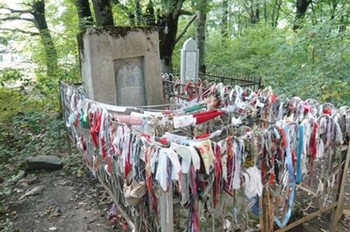
“If people didn't actually die, it's as if God wouldn't even exist, that's how it used to be.” I sat with the molla of the small farming community of Bash Shabalid in the foothills of the Caucasus mountains, in northwest Azerbaijan, a predominantly Sunni region in a country more or less equally split along Sunni and Shi'i lines, as he explained the rules of religious observance in the post-war Soviet period, particularly after the death of Stalin.Footnote 4 Molla Mahir Sheykhzade was the great-great-grandson of the town's most famous ancestor, Sheykh Baba, who had once arrived, according to his tombstone, “from Arabia” in the mid-1800s.Footnote 5 Arrested several times in connection with his religious work as a popular charismatic, Sheykh Baba gained a reputation for bedeviling the tsarist officials who soon became his adversaries. He could pass through the prison walls that fruitlessly tried to contain him, and it was he, not the Russians, who decided whether officers' horses had the power even to move when policemen would try to take him away once again. After his death in 1898, pilgrims regularly traveled to his adopted home in Bash Shabalid and built up a mausoleum around his gravesite, a small, one-room structure lined with pillows around the restored, cement framing of a grave, and giving pride of place to one of the family's many valued Qur'ans. In the eyes of his followers, Sheykh Baba's deep religious knowledge and his capacity for miracles made him an övliyyə, a word that is popularly translated as saint, but by more traditional readings designates a person who more simply might be thought of as “close to God,” from the Arabic wala, to be near, and waliya, to govern.Footnote 6 In Sheykh Baba's wake, his descendants have minded his ziyarətgah, “pilgrimage site,” or pir (a word used elsewhere across west Asia to indicate a saintly person, but here indicating the place itself). This is in recognition of the shrine's status that sets it apart from the numerous other simpler sites (ocaqlar) around it, such as the half-dozen trees and forest locations around Bash Shabalid where residents go in search of cures for coughs, dental pain, and other maladies. As across the Muslim parts of the Caucasus and central Asia today, someone in Molla Mahir's position can receive visitors from dawn to dusk. He might read the Fatiha, the first sura of the Qur'an, in Arabic upon a visitor's arrival, followed by a simple prayer in Azeri. But he is most often in charge of directing visitors to the shrine that they will commonly walk around three times before entering to make a prayer, and knot a ribbon to the window grates or fencing (Figure 2). For intentions or entreaties of greater gravity, sheep and chickens are sacrificed, and especially during religious holidays, neighbors make a steady income by supplying animals to the faithful.
Family gravesite adjacent to the pir of Sheykh Baba, Bash Shabalid. Author's photograph.

“Look, thirty years ago [in the 1970s], the idea that you would travel abroad to receive a religious education, as our grandparents used to do, even having been born here,” Molla Mahir said, gesturing to the view of the village below us, in a place that had only recently regained electricity after fifteen cold years following the collapse of the Soviet Union, “that was out of the question.”
You never went to a mosque for services. You wouldn't even think about it. The only time you made yourself known to officials was when someone died. It was as if death was the only real proof we had that our faith existed, according to the government. If people didn't actually die, it's as if God wouldn't even exist, that's how it used to be. No one would touch you if you showed up for funeral prayers, it was as if the government was afraid of what would happen if people couldn't bury their dead in the way they had become used to. But most often the government had no idea what we were doing anyway, and if anyone asked you, you always said you were praying for the dead, whether anyone had died or not.
These brief comments—on deaths that made for lively endings, and deaths that were not really deaths at all—begin to chart the kinds of flexibilities embedded in practices of worship across the Soviet period. Such flexibilities were hard won, as rules of religious engagement could shift so significantly from one generation to the next.
I had first visited Bash Shabalid in 1999 after working in the Russian Far East, when I was interested in comparative Sovietization, and in how the rather large range of populations across the massive former Soviet state experienced the famously leveling dimension of socialism in such markedly different ways. I soon learned that the village was regionally regarded for its leading role in a rebellion that took place in 1930, when as many as ten thousand men and women took up arms against the Soviet government. This was a remarkable act of bravery for the times, even in the context of the community's willful belief in imminent reinforcements from the Turkish army, backup that never came. For all the odds stacked against them, the “Sheki Rebellion,” named for the small city in the valley plains below where much of the fighting took place, enjoyed a short-lived, eerie success. One of the rebel leaders, Mahir's grandfather, Molla Mustafa, took charge of the city upon their victory. In four days of self-rule, Mustafa first rolled back the government's anti-religious legislation, and then, in what can be thought of as a very Caucasus thing to do (given the region's pivotal role in the Silk Road almost a millennium earlier), with the smoke of battle still in the air, he opened up a trade office (Grant Reference Grant2004; Nəzirli Reference Nəzirli2003).
“Pay no attention to them, it's just a provocation,” the head of security in Baku famously said when news of the rebellion first reached the capital (Abdullayev Reference Abdullayev1989). His uncharacteristic restraint has long fed the suspicion that the entire rebellion itself had been welcomed, if not even orchestrated in part by early KGB officials as a means of flushing anti-Soviet elements out into the open, something entirely plausible but so far unconfirmed by available security documents. The rebellion's other organizers, career politicians and generals, were shot on the spot or sent off into exile in the bloodshed that marked the restoration of Soviet rule to the region. But Molla Mustafa, grandson of the saintly Sheykh Baba, was nowhere to be found for years. Upon his eventual capture, he was sent into exile on the frigid Solovetsk Islands of the Russian north, and sentenced to a firing squad in 1937, along with millions of others at the height of the Stalinist purges. By some reports, however, news of Molla Mustafa's death appeared to be exaggerated. Residents from across his natal district insist that he made clandestine nighttime appearances by village roadsides through the 1950s; others placed him in Mecca given his same capacity for transubstantiation. Fact or fiction, documents from his state security file in the former KGB archives of Azerbaijan leave at least one prominent question mark: a perforated tab appended to his execution order, for detachment and delivery to the confirming authorities upon his life's end, still hangs in place decades later.Footnote 7
So was Molla Mustafa Sheykhzade, this regionally famous rebel leader, dead or not? I thought of the strangely generative quality to death in these contexts when talking to a well-educated Shi'i woman in Baku, Haci Leyla, who made frequent trips to the countryside to care for her family's pir. She was part of elite ağır səyyid circles, in the sense of being a “weighty” or “double” seyyid by tracing family lines back to the Prophet on both sides, and she made a living taking affluent pilgrims on trips to nearby Iran, Iraq, and Saudi Arabia. I asked her if her family's shrine had changed significantly since the end of the USSR. Her answer surprised me with its insistence on the dynamism of shrine life since the death of Stalin, but also for her reprisal of what I had come to think of as the “near-death experience” of Islam in the Soviet period. She remarked:
You know, people always talk about how religion suffered under Soviet government, but it depends where you look. The simple truth, at least with our pir, is that people visited [the shrine] as much then as they do now. No difference. However, when it came to larger rituals connected with Muharram [the first month in the Islamic calendar, which includes Ashura, the day on which many Shi'is in Azerbaijan would fast], we were on the spot because we were always organizing events, and there were always people at all times who might betray you. So if someone informed on us and the police came to the house to ask what we were doing, we would simply say that we were praying for the dead. And what could they say? When it came to the rites of the dead, their hands were tied. This is partly what enabled us to continue our work. The dead needed us, of course, but you might also say that we, too, needed the dead.Footnote 8
Much more might be remarked upon in the seemingly reciprocal relations with an afterlife implied in these comments, or in the fact that Molla Mahir, too, often remarked that religious observance in the 1970s and 1980s, by his experience, was often more authentic than the Islam more freely practiced today, in the sense that it was harder won. “I can tell you about sacrifices for the pir,” he explained. “People [back then] observed virtually all the rules: what kind of sheep to buy, where to buy it. Today, people hardly pay attention, it's as if they do it entirely for formality's sake. Maybe it is because people don't have as much money as they used to, but it surprises me sometimes. People, frankly, had more resources during the final years of the Soviet period.”Footnote 9
Already the remarks made by these two figures run against the grain of conventional tellings of religious life under socialism: both remark on the comparatively robust pilgrimages to the popular rural and suburban shrines that many scholars have long described as off-limits during the late Soviet period, when only the elderly would risk their reputations from the comfort of retirement to maintain the last remaining religious sites.
Despite shrines having such a heroic reputation for religious preservation, however, not everyone has been grateful for the life support that this motley collection of structures somehow extended to Islamic practice. In the summer of 2007, four young men from Bash Shabalid vandalized the shrine to Sheykh Baba after a night of drinking, something many in the village insisted would have been unthinkable even in the darkest days of earlier government harassment. Molla Mahir wanted to press charges, but the boys' parents struck a deal by promising to pack their sons off to Russia, a newly renovated kind of northern exile, where most young men and women of able body, in any case, have headed in recent years to seek a living. One of the young men who took part conceded that he did not even actually believe in God, and certainly did not pray or fast, but he objected to the pir all the same. “Places like that make Azerbaijan look bad,” he told me over tea one night after I had tracked him down in Baku. “It's not real Islam because real Islam never allowed for that kind of idol worship, because that's what it is, idol worship (bütpərəstlik).”Footnote 10 All the same, for most others in his home community of Bash Shabalid, there is only one God, Mohammed was his prophet, and Sheykh Baba was among the saints. To appreciate the nature of the young men's disapproval for the pir after so many years of its role in the very tradition they invoked to bring it down, we need to consider the changing role of such pirs across the twentieth century.
The Social Life of Shrines across the Soviet Era
The modest one-room mausoleum in Bash Shabalid contains little more than an interior pathway of stones and mortar circling three family graves, and is furnished sparely with one faded Qur'an and somewhat musty pillows lining the floor. But much as the authors of The Social Life of Things once pointed out the status of a single object can change markedly over time and space, across contexts, and particularly across changing political economies (Appadurai Reference Appadurai1986), so too has this modest shrine led multiple lives over the past one hundred years.
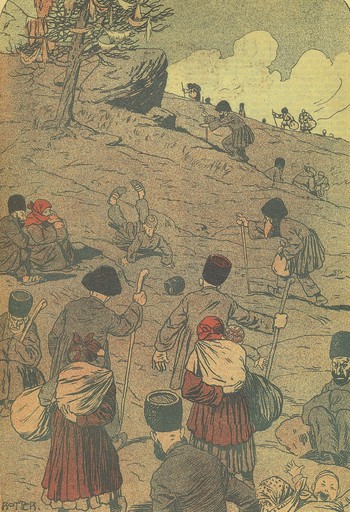
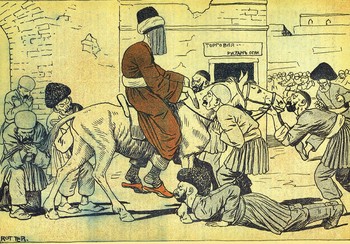
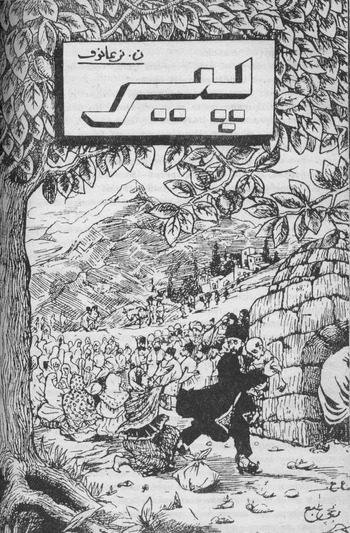
Although early Soviet atheism campaigns garner the lion's share of attention for any history of religion under socialism for the force of their initial violence, it must be said that, at least in the case of Islam, urban intelligentsias across the Caucasus and central Asia themselves could be quite cutting in their own criticisms of religious brethren in the early years of the twentieth century (Khalid Reference Khalid1998). Under the broad banner of modernization, dozens of prominent writers in Azerbaijan contributed to the popular satirical journal, Molla Nəsrəddin, for example, which drew upon a real-life historical figure from the Middle Ages to create a trickster savant as their headlining caricature.Footnote 11 The journal, produced out of Tbilisi, had a readership from Greece to China, and presented a Caucasus world where the four urban capitals of Armenia, Azerbaijan, Georgia, and northern Iran were experienced as one unified space. The fictionalized Molla Nesreddin could be used with devastating dryness to satirize Russian generals and local Caucasus politicians alike, but in the journal's anti-corruption drive, special ire was reserved for the rural religious leaders who held their countrymen in darkness with promise of magical cures, and other semi-Islamized indigenous holdovers from an earlier age. Rural pirs richly illustrated this backwardness, as can be seen in one 1907 rendering of the “Sheki Coughing Pir,” featuring a single, barren tree on a windswept hillside, receiving predominantly elderly supplicants in the name of curing sore throats (Figure 3). Religious figures in all urban centers who created cults of personality for themselves were lampooned, such as “Molla Mahmud [of Sheki] on Horseback” (Figure 4), where a theatrically veiled man pauses in the street to allow disciples to kiss his hands, feet, and the horse itself. While Molla Nesreddin's pen might have been sharper than most, any number of other blunt condemnations of religious practice can be found, such as the 1913 short story, “Pir,” by the young Azeri writer, Nariman Narimanov, who would go on to become one of the later Soviet republic's most lauded figures (Figure 5). “Pir” featured the machinations of a molla guilty of sexual assault, as well as supplicants eager to hide their own sins under the guise of homespun piety and non-medical cures.Footnote 12 Special scorn was held for the notorious nəzir qutusu, or collection box, which siphoned off monies from the faithful.
“The Sheki Coughing Pir (Şəki öskürək piri).” Artist unknown. Molla Nəsrəddin 3 (19 Jan. 1907): 5.

“Molla Mahmud of Nuxa on Horseback (Nuxada arışlı Molla Mahmud).” Nuxa is the former name for the city of Sheki. Artist unknown. Molla Nəsrəddin 20 (19 May 1907): 4.

Cover artwork from the 1913 Azeri-language printing of the short story, “Pir” (Narimanov Reference Narimanov1925 [1913]).

Looking back, this ire against all manner of shrines large and small appears harsh, given that Bash Shabalid, among thousands of other Caucasus communities like it, still actively attends to its own coughing pir today (along with a pir for dental pain, and Yel Baba, a space of open forest for quiet reflection). Many such pirs would be invisible to passersby as average-looking hillside bushes were they not so heavily laden down by brightly colored cloth ties. Indeed, as Meshchaninov pointed out in his early study, “Pirs are so commonplace that, if asked, any Azerbaijani would struggle to consider their scientific meaning” (Reference Meshchaninov1931, 16). When science did intervene, however, it was almost always tilted against pir practices. My point in this context is simply that it was not solely under Soviet rule, but well before the October Revolution that village mollas began to find themselves regularly under attack in print for their perceived pre-Islamic, defective Islamic, or simply anti-modern ways.
In the early days of the USSR, what shocked many in rural Azerbaijan, as across the former USSR, was the rapidity of social changes and the force used to advance them. The single year of 1929, when Stalin had begun to gain his hold on power, saw the banning of the veil and the replacement of the Arabic script with Latin lettering. Over the course of the 1930s, forced collectivization, famine in the countryside, and mass exile followed. Come 1937, at the height of the Ezhovshchina, or Ezhov campaign, named for the notorious commissar of State Security under Stalin who oversaw the era's mass arrests and killings, the Bash Shabalid pir entered into twenty years of stealth-by-night visitations, where open shrine activities were effectively curtailed until the general political thaw eventually introduced by Khrushchev. Mosques in the numerous nearby urban centers met harsher fates. In 1937 Sheki's main mosque was reassigned for use as a school. Still others would soon be turned into theatres, cinemas, bakeries, bathhouses, agricultural museums, silkworm hatcheries, silk processing mills, and sports halls (through 1991, the city's largest mosque functioned as a basketball court).Footnote 13 As to the appointed mollas, one 1944 Sheki administration memo grumbles about the unreliability of even those state-authorized figures who had passed government scrutiny, and emphasizes (as scores of memos did elsewhere) that the fact that mollas were being certified at all was purely for satisfying the population's funerary needs.Footnote 14
What we can learn about such matters from the dominant Russian and Azeri-language print of these years is circumscribed in specific ways. In Sheki, Baku, and the Russian metropoles, scholars in the humanities, and more specifically in Oriental Studies, often confined their best work to topics from the Middle Ages and other times past. Soviet-era ethnographic work tracking Caucasus religious practices, as was the case around the USSR, most often couched its observations in terms of the struggle with survivals of an earlier age, in the evolutionist sense (Basilov Reference Basilov1970; Datunashvili Reference Datunashvili and Klibanov1967; Sergeeva Reference Sergeeva1962).Footnote 15 Owing to the iron curtain and other limits on research access during the Cold War, Euroamerican scholarship on Islamic practice in the Caucasus and central Asia, and particularly on the role of rural shrines, brings its own complications, some of which bear mention as they run somewhat counter to how many today in Bash Shabalid have described their experiences. The term “parallel Islam,” for example, was introduced by one of the leaders of Soviet Islamic Studies in Moscow, largely in order to vindicate ongoing harassment of mosque activities by professing tolerance for their country cousins, characterized in what became known in Russian as vne-mechetskie or “extra-mosque” practices (Saroyan Reference Saroyan and Walker1997: 14). It was backhanded praise for what were commonly perceived as the less politically charged pirs.Footnote 16
The problem is not simply that the term authorized an empirically misdirected distinction between “official” and “unofficial” Islam—thereby challenging the depth of Muslimness of millions across the Caucasus and central Asia who subscribed to any number of routes to prayer, in the same ways that religious adherents do the world over—but also that the distinction took such root beyond the Soviet Union as well. It was embraced in many influential studies and continues to enjoy wide currency in the post-Soviet context today, even though most anthropologists and historians working in other parts of the Islamic world largely dispensed with the concepts of great and little traditions some years back (Asad Reference Asad1986).Footnote 17
In their book Mystics and Commissars, Bennigsen and Wimbush asserted that pirs were the local heroes of Soviet Islam, providing an outlet for the religious energies directed away from cities (Reference Bennigsen and Wimbush1985). It was as if they were relying on a kind of hydraulics metaphor to suggest the transfer of a known quantity of religious energy from city to country, and from mosque to pir. As religious practice was said to move from the orthodox to the unorthodox, so too did women enter the annals of Soviet Islam as religious leaders, using their perceived lower social status to tend to religious traditions when their wage-earning husbands would not risk the reproach of party heads. To be sure, women took on a wide range of roles in the religious life of the eastern Caucasus at this time (Dragadze Reference Dragadze, El-Solh and Malbro1994; Goluboff Reference Goluboff2008; Shami Reference Shami, Feride and Ayse2000; Tohidi Reference Tohidi, Herbert and Nayereh1998). But as Molla Mahir and others noted, men participated just as regularly in the nightly visitations to the pir in Bash Shabalid, as they did in urban prayer groups, held in apartments behind closed doors. Beyond the question of gender, one is obliged to ask, were these closed-door sessions “private”? As a capstone to scholarship on religious life in the Soviet Union at this time would have it, shunned from public realms, Islam could find refuge only in the private sphere.
From city to country, official to unofficial, orthodox to unorthodox, male to female, and public to private—Islam's perceived consignment to only one end of these spectrums over the Soviet period has established significant patterns of knowledge.Footnote 18 Was the social life of Caucasus shrines in the later Soviet era really such a quiet one, private and spectral? Molla Mahir replied: “I, for example, read the Qur'an with students all through the 1970s and early 1980s at my home or in people's apartments around Sheki. It was the twilight of the Soviet years, we can say now, but even at this time, no one did this casually. If someone walked past, of course, I lowered my tone of voice. You were always ready for some kind of interruption. But it doesn't mean that we weren't doing this all the time.” Haci Leyla put this in rather stronger terms: “Obviously we took precautions but I can't see how you would call this a private form of religious study. We were limited in the kinds of spaces where we could meet, and it was almost always behind closed doors in someone's home. But behind those doors you could find up to twenty people, men and women, Sunnis and Shi'is. What was not public about that?”Footnote 19
Public records from the communist era in the state archives of Azerbaijan, motivated as they were by all manner of political climate, to some degree support the claims made by Molla Mahir and Haci Leyla regarding the numbers of worshippers. On one hand, certainly, one can view the brutal reductions in the number of mosques over the 1930s and 1940s, and the baroque practices involved in registering them anew as a signal blow to religious activity. In 1958, when polled on the rate of pir visitation in their districts, government officials seemed to trip over themselves in efforts to evidence that all was quiet on the religious front. Though one shrine in the district of Xudat drew regular visitors, it was “nothing but a pile of rocks,” wrote one official.Footnote 20 District after district wrote in to suggest that almost all pirs were in ruins, and if there were any visitors, it was only because elderly visitors had landed there “by chance,” reported another from Kürdəmir.Footnote 21 Though a government writer in Şamaxı could identify seventeen active pirs, he insisted that they “had no significance whatsoever.”Footnote 22
On the other hand, ample documents from the same districts reveal an impressive flow of letters to local officials pressing for the return of religious rights and sites of worship. In 1956 in Sheki, citizens who had boldly raised their own money to restore a mosque on Lenin Street issued loud protest when, upon completion, the building was instead converted to a school.Footnote 23 Undeterred, the following year, four men wrote to Nikita Khrushchev to protest this injustice yet again.Footnote 24 Still other Sheki faithful who had been approved by the state for funerary rites and who were required to fill out the standard, Russian-language, Anketa sluzhitel'ia kul'ta, or “Cult Officiant Questionnaire,” did so by responding in Azeri using the outlawed Arabic script in documents as late as 1960.Footnote 25 In 1968, one Sheki resident pursued a different tactic by making the case for mosques as guarantors of social stability. He insisted that in the absence of functioning mosques, the faithful had turned to troublemaking (igtişaş).Footnote 26 To be sure, such letter writers were routinely branded in formal memoranda as troublemakers themselves, or were accused of “stirring up religious superstition for material gain” (“dini xurafat oyatmaq və maddi qazanc əlde etmək”), as was the case of Molla Allahyar Cabbarov from the nearby village of Babaratma in August of 1968.Footnote 27 But it was also clear that not a single year went by without prolix reports covering enduring popular observances surrounding Muharram, Ramadan, Eid, and so on. Perhaps most tellingly, in 1988, when perestroika had only begun to more widely publish windows onto popular opinion, officials from the same offices unanimously answered a new poll by insisting that the majority of their constituents had been religiously observant for years and were clamoring for shrine renovations and new mosque construction.Footnote 28
As we learned earlier, how descendants of the saintly were able to maintain their family pirs hinged directly on the popular assumption that some Soviet officials simply feared divine retribution for their actions. Molla Mahir recounted this story.
In the 1970s and 1980s we had a local Sheki Party Secretary who had an office in Baku. Early on in his post, he was upset that the pir was so active and he had it emptied totally. He had soldiers come by our house where we received pilgrims and took away what remained of all the guest dishes, and so forth, and had them sold. He brought one of his own office trucks for the job, too, a big Russian VAZ. It was a very harsh act. Yet only a month passed, maybe a little longer, and there was a great storm in Baku. They don't get much rain there and it caused huge flooding. The truck he had used in the act against the pir was completely washed out. He didn't die, but he lost almost everything. This is to say that we believed that all such acts as his were not without consequences. The local authorities themselves, I believe, understood that every time they tried some form of repression against us, they themselves paid the price.Footnote 29
Haci Leyla, addressing the same question back in Baku, concurred: “Think of a huge complex such as Bibi Heibat, here in the capital, where the mosque was brought down, but the pir itself was left. Pirs are connected to concrete social figures who many either feared or respected. If the Soviet government allowed them to stay, I assume that it was out of fear. It was a government built on fear. They simply feared the fact that the descendants of the saints to whom the pirs were devoted would take acts of revenge upon them.”Footnote 30
Haci Leyla spoke in categorical terms, and perhaps with too much bravado, since there should be no question about the kinds of inequalities that very much existed between those who held a monopoly on state violence in this context, and those who did not. Most citizens who considered themselves believers clearly made compromises in the name of the kinds of religious observance available to them, as did the government officials who exerted the kinds of regulation they personally believed appropriate, or within their means. But to understand these compromises, I am suggesting, contemporary scholarship might go farther in recognizing religious presences as much as absences, acts that reflected the wide engagement of those from across rural and urban communities, and the rather public nature of those interventions.
Consider some of the similarities in the narratives themselves. Between tsarist police horses that would not move until bid to do so by saintly figures (in the case of Sheykh Baba), or later Soviet government trucks overwhelmed in floods (in the case of the Sheki party secretary), there is the recurring sense that while state officials might have kept the saintly on the run, it was the saintly whom many considered the better runners. It was they who decided whether trucks or horses would do the bidding of their owners in times of crisis.
No account of such powers of transportation was more famous than the very example that Haci Leyla herself marshaled to prove that even the security police feared the pious, the tale of the near arrest of Mir Mövsüm Ağa, an essential part of Baku's oral history of Stalinism. A holy man who relied on a wheelchair and was renowned for his powers to heal others, Mir Mövsüm Ağa received the fateful knock at his door one night from police who had come to take him away. They carried him down to the car below, one of the infamous “Black Maria's” used to hasten enemies of the people to their fates. But when the car, which had been working perfectly up to that point, would suddenly no longer start, the officers feared for their lives, and decided to carry Mir Mövsüm Ağa back upstairs home (Rüstəmov Reference Rüstəmov2006; Anonymous 2008). He lived out his days in his Baku apartment, and his shrine outside the city remains one of the most active to this day. Who, then, exercised power over whom?
Shrines and Sovereigns
Scholars have long sought ways of mining the deep historical record of the Caucasus for evidence of earlier civilizational forms. But it has only been in recent years that writers have looked more expressly to problems of pluralism and examples of alternative political community, not least when this world area that has so long been famous for its trade routes and cultural mixings has recently seen the rise of perhaps more barriers between peoples than ever before through the idiom of the nation-state (Kohl and Tsetskhladze Reference Kohl, Tsetskhladze, Kohl and Tsetskhladze1995; Smith Reference Smith2005). Looking at templates for cohabitation may seem paradoxical in a region that has most recently been so dramatically torn up by violences, most notably in Chechnya, but also Abkhazia, Ossetia, Nagorno-Karabagh, and Russia's recent war with Georgia. From the pen of the Greek writer Aeschylus, from the fifth century BCE onwards, peoples of the Caucasus have been subject to a remarkably consistent mix of fear, admiration, and ridicule for their bellicose military traditions (traditions that might arguably, instead, be more fairly described as having arisen in the near constant company of competitive neighbors and a long line of foreign invaders). Yet when we consider a much wider range of accounts of early Caucasus conflicts before the final entrenchment of Russian power in the mid-nineteenth century, victory and defeat rarely ended any story. Parties from all sides in most conflicts stood in as proxies for varying powers in enemy lands, intermarried, and went back again. Trade, or at the very least tribute, rarely ceased between hostile neighbors. And the manifold practices of kidnapping—be it through the persons of brides, or the sons of rival leaders from another valley—were most often explained as the best route to upend established hierarchies, develop new alliances, and hold open basic lines of communication, come what may (Grant Reference Grant2009). It is for this reason that I earlier suggested that we think of the classic legal definitions of sovereignty in most popular circulation today, by contrast, as “closed” forms, territorially and imaginatively sealed approaches that sought more ambitious closure on questions of property, and rights to the monopoly over legitimate violence. Much of at least the nineteenth-century historical and ethnological records of shared politics in the Caucasus run counter to this, by offering example after example of the never-ending challenges to forms of political rule that are, by definition, continually forming and reforming. These are not “incomplete” forms of sovereignty but, as I would contend here, they are rather different forms entirely. They invite us to consider whether any form of political rule, in practice, should be thought to fully meet classic European definitions that equate sovereignty with full autonomy. While it may not be new to note the impossibility of most conventional definitions of sovereign forms, most social science work on the subject uses language that still echoes such ambitions. This, I am contending, often leaves us out of step with more readily available examples of ongoing interdependencies across lines of political control.
There is little question that the concept of sovereignty has been freighted in recent years by assumptions that all too often objectify it, as if sovereignty were a clearly constituted end goal that one simply fights over in order to take possession of—product rather than process. This, to my mind, is another sense of sovereignty as a closed-book affair. So, too, have studies of the former Soviet Union all too often rested on closures achieved by all means of hard and soft power, a scholarly disposition perhaps nowhere more powerfully abetted than in a Caucasus region already so consistently deemed as the epitome of the “closed society” (Arutiunov Reference Arutiunov and Dmitriev2003). What the more useful works have reminded us about I believe, instead, is the necessary slippage inherent in impossible definitions of rulers who are both inside and outside the rule of law, and in political theologies that want to presume but ultimately fail to marshal the acquiescence of all in a given system (Schmitt Reference Schmitt1985; Wagner-Pacifici Reference Wagner-Pacifici2005). What this should encourage us to ask, I think, is whether examples from the Caucasus might not properly demonstrate how no sovereign form can be entirely autonomous, or that is to say, independent of those who seek to best it.Footnote 31 It also invites closer readings of the everyday practices surrounding political, religious, and social borders in places where they were constantly being challenged and reformed.
The language of interdependency may not be standard when considering questions of sovereignty, but let us recall that such language has long been one of the premises of anthropological studies of exchange. Reciprocities of all kinds, as we have long known, have the potential to create ties that bind, in even the unlikeliest of circumstances. In the classic sense of any alms-giving, reciprocity can be just as easily established across lines of mortality as they might be through any other person-to-person encounter. One description from the shrines of Tajikistan in central Asia, for example, notes, “In the past shrines … were constructed by believers in order to have a more direct contact with supernatural powers at the places where the saints were buried or were believed to have performed some kind of miracle during their lifetime, and to receive spiritual blessing (barakat) from them.… The enshrinement of a saint was not merely concerned with the idea of receiving barakat from the saint, but was also a matter of giving something back, that is to honor the saint's soul and commemorate his/her life” (Iloliev Reference Iloliev2008: 72).Footnote 32
One might make the case that Soviet officials objected to such religiously motivated exchanges not merely because of the potential for usury or the exploitation of the working classes, but because they challenged the legitimacy of Soviet rule as the ultimate arbiter of authority in the young state. Thus, in Narimanov's 1913 account and elsewhere, most canonic socialist accounts of shrine activities emphasized their criminal underpinnings. As one Baku journalist wrote: “How did these sacred sites arise? In search of easy money, spongers, criminals, and other parasitic elements, taking advantage of the innocence, religious superstition, prejudices, ignorance, and illiteracy of certain people, declared old graves, long ago dried up trees, tombs and so forth ‘pirs,’ and ‘hearths,’ where they collected tribute in the form of sacrifice” (Mamedli Reference Mamedli1959: 3). Note how, at the close of this baroque list, sacrifice seems to condense the problem most directly. It is, ultimately, the textbook Soviet question of unauthorized exchange.Footnote 33
Yet to imply that the alms presented or the recognition directed to pirs was nothing more than a challenge to Soviet authority would be to overlook the wide range of means by which religious practices across the former USSR were transformed very much in step with, rather than in spite of socialist ideologies (Balzer Reference Balzer1999; Humphrey Reference Humphrey1983; Khalid Reference Khalid2007; Rogers Reference Rogers2009). In a socialist economy that pivoted as much on distribution as it did on production, all manner of barter, gift, exchange, and favor could be raised to high art. In this light, as Molla Mahir pointed out, all too often pilgrims were tempted to give “too much,” attempting bribery with the saints, in order to build up their trading capital. Often such logics of exchange melded all too seamlessly with socialist-era “economies of favor” (Ledeneva Reference Ledeneva1998). Observing funeral rites in another part of the eastern bloc in the 1980s, Gail Kligman remarked on how often packs of hard-to-obtain Marlboro cigarettes would line a coffin at Romanian funerals, in order for the dead to have something to trade upon entry to other worlds (Reference Kligman1988).Footnote 34
Gift, barter, favor, and alms-giving are some of the ways of transcending the boundaries of mortality in a visit to a pir. But there were other practices and events that suggest how the rather plastic lines between the living and the dead can generate meaningful social currency. Only believers themselves might decide whether Molla Mustafa really appeared stealthily at the gates of the village by dead of night, long after World War II and well into the 1950s, whether he was really one moment in Mecca, and the next moment back home, by impressive acts of transubstantiation. So, too, perhaps only believers can decide if Sheykh Baba really could stop horses in their tracks, or if Mir Mövsüm Ağa really did cut the engine of the car that was to lead him to a certain death. But what all these examples suggest, I am arguing, is a local idiom of sovereign rule that was far more open to competing realms than classic senses of a more tightly controlled state power might embrace.
Postscript: The Shrine's Two Bodies
Sovereignty, territorially speaking, is most often conveyed through borders, walls, and fences made larger than life by both the security forces and the social forces designed to police them. Yet in some parts of the USSR, at the height of the fearsome purges that sent many to their deaths for having challenged the growing regime of containment, some citizens made clear that their own horizons could not be constrained by force alone. Consider the following letter that Molla Mustafa Sheykhzade wrote in February of 1937 to his family in Bash Shabalid from a labor camp in the Russian north. It is written in the classic style of a ghazal, the poetry of lament—of love, loss, and separation—found across South Asia and the Middle East but perhaps made most famous in Iran. It was penned in the Arabic script, and arrived through the offices of prison censors on the Solovetsk Islands. After a long day of conversations, when day had turned to night, Molla Mahir took it from its location, carefully preserved in a family folder, and read it aloud to me.
Mən bilməm məram səbadan sor
I don't know, maybe you will ask northern winds after me
Məni ağıyardan sorma, aşınadan sor
Don't ask after me among the bitter, ask after me among the kind
Əger möhləti-qəm soraq olsan
If you want to know if I find respite from my travails
Məni ağıyardan sorma, coşgun bəlalardan sor
Then ask not even among the kind, ask at the very vortex of misfortune
Sureti-dəstə mükafat ola cismim
My physical body may somehow still resemble me
Yarı dilə ziyarət qila əksim
But it is my reflection that makes its own pilgrimages
Şikayət halım ola ya bənim
I have not the strength to complain
Həzindir halım cahan içrə qənim
I am weak upon this planet
Mən bəlalər içrə şahı–cahanam
I have turned into the king of all misfortunes
Öz taxtımda qəm mələkinə xanam
On my throne, I am now khan over the angels of death
Nəsibim oldu nə övlad, nə həyat, nə azad təklik
Destiny now denies me my children, my life, and even the freedom of loneliness
Nə zaman məhsud oldum, ax, ax, ax
In the time I have been condemned to this
Pirlər tək büküldü qamətim
My body has folded up like a pir
İyrənc hallara düşdü həm halım həm söhbətim
My health, as my voice, has fallen into parlous state
Hacılar, xırıtlar olmuş mərizim
My place now is to be surrounded by pilgrims and posturers
Əlvida, əlvida ey yar əzizim
Farewell, farewell my dear one(s)
Ah, beyrubət oldum, bəhanə döndüm
Inside, I am empty; I only resemble myself on the outside
Aişə tək xərabə bəs necə dözüm?
How do I face these ruins as Aisha once did?Footnote 35
[And in the closing line of the ghazal that traditionally wraps all up]
Dövrümün bəlasın hasiliyəm özüm.
I am the result of the problems of my time.
Man and mausoleum folded into one, Sheykhzade's status as the khan over angels, or as the shah of misfortune, placed him among sovereigns of a rather different order than those then ruling the state that aimed to confine him. He operated in realms that were entirely of, and yet equally beyond the Soviet embrace. As we learn from his letter, even in physical decline, a shadow of his former self, this shadow could make its own pilgrimages elsewhere. His letter seemed to signal a tragic ending that somehow never quite lost any vitality, announcing a closure while somehow keeping many doors open. His stature as the grandson of a holy man led many to believe he could lead them to a better life, just as visitors to his family's shrine found a visionary world well beyond its stone walls. Nine months later, in December 1937, Molla Mustafa Sheykhzade faced a firing squad in the Russian north, and died there. Or, as different accounts would have it, maybe not.