From the seventeenth to the twentieth centuries indigo was a fugitive among industries, wandering from Gujarat in western India to the West Indies and then back to Bengal in eastern India.Footnote 1
Introduction: turning focus on knowledge
The historiography of colonial indigo plantations in South Asia is rich. It is very clear that Bengal indigo was the embodiment of the working of colonial capital that involved exploitation of labouring classes in India, including the Bengal peasantry on whose tracts indigo was grown through a contract system and local and migrant wage earners who worked the indigo factories owned by Europeans.Footnote 2 Indigo leaves were put through the manufacturing process in the factories to produce blue dye. The finished dye was then exported to textile manufacturing nations in the west, affording generous profits to English entrepreneurs whether shippers, bankers, and brokers or manufacturers and managerial planting classes generally. A wide corpus of literature exists that has examined the case of the colonial industry and peasant resistance that dovetailed into the rising nationalist movement in the twentieth century.Footnote 3
But despite ample attention by economic and nationalist historians to the colonial indigo industry, our understanding of the genealogy and process of early origins of the Bengal plantations remains partial. This is in part the result of the unwillingness of historians to pivot their study on the knowledge dimension of indigo manufacture, especially with regard to its antecedents in the colony and elsewhere. It is not that historians have been unaware of the connections of Bengal plantations with those in other parts of the world. Blair B. Kling briefly alluded to the prior roots of Bengal indigo on the subcontinent as well as in the western hemisphere. But historians have not followed up such acknowledgements of movement to actually consider knowledge flows as constitutive of the plantation system as they emerged in the last quarter of the eighteenth century. There has been another consequence of the lack of attention to the knowledge dimension of colonial indigo plantations. One-sided focus in the existing literature on material aspects of production and on labour relations leads to the inescapable impression that the industry was founded on antiquated techniques and, furthermore, that it developed in a local system of production that was exclusively embedded within the imperial-colonial complex.Footnote 4
An examination of the genealogy of Bengal plantations outside the Indian subcontinent and their development on the Indian subcontinent through a new framework focusing on multilateral knowledge flows provides a corrective to the current inadequacies in our understanding. It is possible to connect the consolidation of the West Indian system of indigo culture and the origins of indigo manufacturing in Bengal with crosscutting knowledge flows that were not delimited by the territoriality of colonial rule or even contained within the formal rim of the British imperia. It would seem that the modern culture of indigo in reality developed at a number of sites around the world. A broad linearity in indigo's history can be traced by following the odyssey of indigo through the Caribbean, the Americas, islands in the Indian Ocean, and colonial South Asia. But current historiographical frameworks that furnish a privileged position to a singular ‘Europe’ in the making of modern indigo plantations or simply assume that a fully mature knowledge of indigo culture was abruptly introduced into South Asia from the ‘West’—from the West Indies more specifically—are not tenable in the light of the fluidity and multi-directionality of knowledge flows. Such views also do not do justice to the interactions between bodies of knowledge and the making of new forms of knowledge during this period in the colonial locality. The remnants of pre-modern systems of indigo culture on the subcontinent were not displaced from every part of the subcontinent.Footnote 5 The system that emerged in Bengal also had new elements compared with the prior regime in the western hemisphere. It thus makes sense to embrace what Ann Curthoys and Marilyn Lake call the ‘metaphors of fluidity’ and ‘metaphors of connection and relationship’ in a transnational framework to spotlight relevant processes in the emergence of the Bengal plantations. Such an approach opens the way to analyse the new dimensions that were added to the global knowledge of indigo culture in the colony. Inter alia, it also offers an opportunity to evaluate the impact of transnational forces on local forces, or, to see how the former, in the words of Curthoys and Lake, ‘interrogate, situate, supersede, or avoid. . .’ the latter.Footnote 6
West Indies: crisscrossing currents
Most historians have readily taken the line that the archetypal West Indian system of indigo manufacture was introduced by Europeans into the colony from the Caribbean. Such views imply that a coherent knowledge of indigo production was developed elsewhere and that this fully formed knowledge was transferred to the subcontinent. These stem from different claims that have persevered among sources claiming priority in introducing indigo manufacture in the ‘European manner’ to Bengal. By one account Louis Bonnaud, a Frenchman with prior experience of indigo planting in Reunion, the French island colony in the Indian Ocean, brought modern indigo culture to Bengal in 1777. These were the times when the English East India Company had not yet embraced the policy of privileging English entrepreneurs against other Europeans in the settlement of the colony. Another account claimed that distinctly European methods of indigo culture were introduced by a colonial state official, the first Collector of Tirhut, Francois Grand, in 1785. Grand wrote: ‘I introduced the manufacturing of indigo after the European manner, encouraged the establishment of indigo works and plantations, and erected three at my own expense’.Footnote 7 Initiatives introducing novelty in crop and cultivation by colonial officials like Grand were routine and so was the private trade of Company officials and other Europeans licensed to be residents in the colony, who deployed their income privately into lucrative manufacture and trade in colonial commodities like indigo.
But it seems historians have rather uncritically accepted claims about an exclusive and unmixed European lineage of indigo manufacture to make arguments that reify the elements of assimilation and absorption that went into its making. The early planters in Bengal probably used the term ‘European’ as a short hand to distinguish their methods of indigo manufacture from the pre-existing methods used by the people of India. In addition, the focus on such sources has also led historians to connect indigo manufacture with the colonial regime, and rightly so. Such tight connections remain valid for explaining the political economy of Bengal plantations. But such an emphasis often appears at the cost of examining aspects of heterogeneity in the knowledge dimension that was such an obvious part of indigo manufacture in colonial South Asia.
What exactly was the West Indian system and when and how was it historically constituted? The answer to the above is complex. The art of manufacturing blue dye from indigo leaves was an ancient one. In a late eighteenth-century commentary Edward Bancroft traced the practice of drenching of leaves in water to extract colour to India where it possibly began ‘several thousand years ago’. In Europe itself, woad, the continent's own blue-yielding plant, was subjected to ‘partial and immature fermentation’, as Bancroft then described, through pounding of leaves followed by drying. Indigo derived from several plants on various continents was variously subjected to drying and pounding—pounding of moist leaves followed by drying, and kneading them into round balls of blue dye. These balls were sold to the dyer and were macerated at the dyer's house or in private households before use. Across the world, from China to Java, to Senegal and Egypt, variations on these practices of soaking in boiling water, simply leaving indigo in a heap in open air to sweat, and grinding in a dry state followed by soaking prevailed in the pre-plantation era. All of them involved a blending of submersion in water and a physical pounding or thrashing.Footnote 8
The most immediate precedent of the Caribbean system of indigo manufacture lay in the sixteenth-century system of production by peasants on the Indian subcontinent and in the Spanish ‘greater Caribbean’.Footnote 9 On the Indian subcontinent the major areas of production were in Gujarat, Rajasthan, and the Coromandel Coast where peasants raised it as a cash crop. The Spanish indigo empire extended from the Antilles to the eastern coast of Central America. Here too the Native American peasants, rather than holders of large estates, engaged in the production of indigo. The peasant-produced indigo was then collected and sold by European traders who cornered major profits accruing from indigo manufacture during this period.
The system of indigo manufacture on plantations arose in seventeenth-century Caribbean as part of a system of trade and manufacture commonly referred to as the ‘Atlantic System’.Footnote 10 In the English colony of Barbados, the first major producer of indigo, the most important years of indigo production lay between 1638 and 1643. In the second half of the seventeenth century, the indigo plantations also sprang up in other West Indian islands. In Richard Dunn's description of plantations in Jamaica, the 1660s seem to be very much the decade of cacao and indigo. The later history of the Jamaican planter, Bryan Edwards, also indicates that in 1673 the primary produce of the island included ‘cacao, indigo, and hides’.Footnote 11 Indigo plantations further spread into the French colonies of Guadeloupe and Martinique in the West Indies as the seventeenth century progressed. Later, at the turn of the eighteenth century, indigo had also spread to the French Saint-Domingue.
The system was undoubtedly created by drawing on local knowledge(s) of different stripes. In a sense, the English and French planters in the Caribbean were direct legatees to native practices circulating in the Spanish greater Caribbean. They familiarized themselves with these processes on account of a long history of trade and domination in the region. Even as they dominated the peoples of Antilles and Central America, they learnt and appropriated their arts in order to create a new system that would be advantageous to them. In that sense the West Indian vat manufacture was an outcome of mutual interaction between Europeans and natives despite existing power asymmetries between them.Footnote 12 The Spanish started to export indigo produced by natives in Central America from the mid-sixteenth century.Footnote 13 The English too had a long process of engagement through privateering in the Elizabethan era. Among others, Dunn has provided clues by pointing towards the period of piratical economy in the Caribbean islands prior to their formal settlement. He points to the traffic of English sailors in the region who came to trade with the Spanish colonists in their private capacity or to plunder their goods and slaves. And indigo was one principal commodity of that plunder and trade. Thus he argues that the Englishmen were ‘no babes in the woods’ when they eventually set up their plantations. Rather, they were ‘heirs’ to the prior regime of plunder and conquest that had lasted for more than half a century and which brought English trade and capital to the region. The English entered into a long period of interaction with these production cultures for decades prior to formal settlement in the middle decades of the seventeenth century, and so did the French a little later.Footnote 14
There are also indications of a general effort in this period to deliberately move knowledge of indigo production from the Indian subcontinent to the islands in the Atlantic. The resources of the global British Empire were particularly helpful. English factory records disclose a shifting imperial emphasis from South Asia to the New World as far as production of indigo was concerned.Footnote 15 One series of correspondence amongst factory records from 1662 to 1663 reveals an effort by English Company officials to induce Indian methods of indigo production in the island protectorate of St Helena in the South Atlantic. This reflected a general desire to shift the pivot of indigo production westwards in a period when the Atlantic system of manufacture was expanding. The New World production offered obvious advantages in proximity to western markets. Reflecting the general shifting emphasis away from the Indian subcontinent, a letter by a colonialist proposed to send indigo seeds from the East India Company's stocks in Surat, a town on the west coast of India, to St Helena. It also promised to look into the possibility of sending across a ‘black’ [presumably an Indian native] ‘that hath knowledge how to sow it and afterward[s] worke it to perfection’. The effort did not materialize in the end as colonists in St Helena conceded that they had been unable to find a local person to sow the seeds procured from India in the appropriate way: ‘wee cannot by any means procure a black to sew it’.Footnote 16 Even if this effort failed, there were likely others that did succeed, adding to the mix of formative influences out of which the West Indian ‘vat system’ emerged.
The basic attributes of the ‘West Indian system’ were in full view by the first quarter of the eighteenth century. The system incorporated streamlined processes making indigo leaves undergo distinct changes through three vats in a sequence and was ideally suited to large scale production of the dye. West Indian planters, both English and French, fundamentally systematized the process of soaking and beating of leaves at this time in a three-stage process. Planters loaded indigo into fermenting vats, added water of a known quality, and supervised its fermentation for a stipulated time under the watchful eyes of a trained practitioner before turning the liquid over to the beating vat. It would be correct to suggest that the practice of fermentation and beating in a large-scale manufacturing system in factories was perfected in the West Indies even though these basic processes were known in different locales. The major innovation may actually have come in terms of enlargement of the scale of these scientific operations that required a corresponding construction of large vats, use of animal or water power, and a regimented system for extraction of forced labour of various types.
West Indian indigo manufacture was less a definitive knowledge closed off to new borrowings and more like a mosaic of practical knowledge that afforded itself to manipulation by practitioners to suit the needs of local economies in disparate geographies. Some of its protean characteristic was born out of its lineage from numerous sources of local knowledge in dispersed territories. It incorporated distinct practices that were favoured on the different islands of the Caribbean based on local soil, landscape, settlement, and climatic conditions and pest environments. It also incorporated differences based on distinctions of broadly English and French traditions. It was by no means a fixed knowledge ‘system’ but rather a stable form of practice that was amenable to alteration in new situations.
The formalization of indigo knowledge
The process of knowledge generation on indigo in the Caribbean was supported through a trail-blazing production of texts taken at every level. Some of these texts had exceptional longevity and ensured dispersion of Caribbean knowledge to lands far away from their point of origin. This textual knowledge on indigo also reached India through multiple routes. In the early stages, excerpts from Caribbean indigo texts were included in other texts that made their way to India. At other times full texts made their way to Britain and then found their way to India through imperial channels along with the British planters headed to the Indian subcontinent.
The first major initiative in the writing of texts was by early French naturalists who travelled to the French West Indies in the seventeenth century. By writing about what they saw on indigo plantations, the naturalists transformed the informal, tacitly known and widely practised craft into concrete knowledge that was now textual in form. In other words, they committed experiences circulating in the indigo world, those resting with ‘old hands’ and ‘native’ customs, into tangible, described knowledge. They made this knowledge clearer and more legible to current practitioners, and transportable and helpful in enlisting potential entrants. In addition, and very importantly for the future development of the ‘science’ of indigo manufacturing, they collected and catalogued plant material which was referenced by later indigo philosophers. With time, the travellers’ inputs were incorporated into important scientific texts and practical agriculturist guides, and ultimately incorporated into encyclopaedias of commercial products, gardener's texts, or pure scientific work.
The first two significant travellers from the French metropolis who touched upon the subject of Antillean indigo culture in a substantive way were both missionary-naturalists. The first was the Catholic humanist of the Dominican Order, Jean Baptiste Du Tertre, and the second, Jean Baptiste Labat, also of the Dominican Order. Du Tertre came to the Antilles in 1640. He described life in Caribbean society and defended mercantilist policies, and also included a description of indigo as part of his narration of flora and fauna in the Caribbean. His study covered all parts of the French territories in the Lesser Antilles including St Christopher, Guadeloupe, and Martinique. He published his most important work, l'Histoire generale des Antilles habitués par les Francais, in 1667, a popular text that was reprinted in 1671. Jean Baptiste Labat visited the Antilles between 1693 and 1706 and produced a work that focused more directly on the natural history of the French West Indies than did Du Tertre's. Labat resided in Guadeloupe and Martinique and also visited Saint Domingue in the early eighteenth century. He published an account of his travels, entitled Nouveau Voyage aux isles Francoises de l'Amerique in 1722, which contained a detailed account of indigo cultivation and manufacture as practised in the Macouba parish of Martinique.
Labat's account was the first widely dispersed and comprehensive explanation of indigo processes which came out of the Caribbean, and which travelled seamlessly across historical times. It readily found its way into the imagination and thought of literati and practitioners soon after its publication in Paris in 1722. It was translated into Dutch just three years later. In 1731 an English translation of the work appeared in London as Phillip Miller's Gardener's Dictionary. The text was also translated into German and appeared in multiple editions in the German language from 1768. It was evident therefore that Labat's French rendition had easily crossed language barriers and was now available in many European languages.
But more relevant to the process of dissemination to the Indian subcontinent, Labat's description of indigo processes was now available in English in the British metropolis. The latter had become a clearing house for theoretical and practical knowledge on indigo for the wider British imperial networks. It was already flush with indigo information on account of the experience of English planters in Barbados and Jamaica. Labat's description was added to that previous repertoire. The availability of indigo knowledge in the metropolis was further enriched and broadened in the process of the expansion of South Carolina indigo plantations. Miller's translation of Labat and its rendition by other planters in local journals in the American South formed the basis of information as South Carolinians embraced the production of indigo in the 1740s.Footnote 17 In the 1730s and 1740s English gardeners and merchants further developed the knowledge of indigo culture as part of the process of expansion in South Carolina. A colonial merchant, James Crokatt, for instance, actively made himself a conduit in the transmission of ideas on indigo cultivation between wider inter-imperial networks and South Carolina. He supplied seeds of the indigo varieties from Carolina to Miller for planting at his Physic Garden in London for experimentation and trial purposes. He published a treatise addressed to Carolinians which combined the specifics of the French and British colonial systems of indigo manufacture.Footnote 18
Attesting to the fact that knowledge of indigo culture had achieved a high degree of specification in the French colonies in the West Indies, a detailed account of its cultivation and manufacture was published in Saint Domingue in 1736. The author, Elias Monnereau, was a local planter with several years’ experience. He brandished his publication as the most credible account of indigo culture to date. Monnereau's claims had some basis. By the end of the first quarter of the eighteenth century Saint Domingue was the Caribbean Island with the longest history in indigo cultivation. The French island had also won acclaim as the dominant producer of the finest quality indigo in the world. Monnereau's long and accomplished experience in indigo culture was part of the deep and exceptional history of indigo in Saint Domingue.
Monnereau's intention to proprietarily reserve the knowledge of indigo culture for his French fellow colonists notwithstanding,Footnote 19 the treatise was caught up from the very beginning in crosscutting flows of knowledge. The reference to previous works on indigo in Monnereau's tract attests the multiple lineages of indigo culture even in the Caribbean. Monnereau made effective use of information provided by the naturalist, Jean Baptiste Labat, his fellow countryman, whose work would have been easily accessible to him. Monnereau also nodded in the direction of the seventeenth-century account on indigo manufacture in India by the French traveller, Jean Baptiste Tavernier. Tavernier had made multiple voyages to the East and Southeast Asia between 1640 and 1667. On these extended voyages he had undertaken extensive travels on the Indian subcontinent and had even visited the court of the esteemed Mughals there. Although the primary commercial motive on these voyages was collection and sale of precious stones from the Golconda mines in southern India, his travelogue also described methods of indigo manufacture at Sarkhez, near Agra in north India amongst other things. Monnereau used Tavernier's account in support of his theory that the leaves of the indigo plant, and not the stalks, contained the colour-yielding principle. Although he was generally disparaging of the manufacturing technique used by Indian manufacturers, whilst highlighting the superiority of the Saint Domingue practices, he cited the Indian practice to reemphasize the point that if colour was not exclusively lodged in the leaves the Indians would not spend so much time separating the leaves from the stalk.Footnote 20
Despite efforts by mercantilist states the political frontiers of English and French colonies were hardly impregnable for the movement of information on indigo from one to the other or, for that matter, in terms of making additional connections with European metropolises further afield. The interaction in the Caribbean transpired as a result of the thriving illicit trade that enabled separate trading communities to transmit key information. There is some direct evidence of an exchange of information between French and English colonies. Bryan Edwards’ history of Jamaica refers to the mercantile body, the Chamber of Agriculture in Hispaniola, which had apparently ‘made repeated experiments’ on indigo and published its results for ‘the benefit of the public’. Apparently this publication was available in Jamaica or to Edwards himself because he cites from this report on the determination of the ‘true point of fermentation’, the terminal point of maturity after which the liquor had to be immediately turned over to beating. The method involved dipping a pen in the fermentation vat at intervals of every half-hour and making a few strokes with it. The planters were advised to stop fermenting the moment the liquor started turning colourless on disturbance. Even though he had never tried it, Edwards found the method suggested in the report unconvincing: ‘It is astonishing that an experiment so simple in itself, if it answers, should have been for so many years unknown to the indigo planters in general’. As a mere narrator, though, he found the alternative method from one ‘Mr. Lediard’ more convincing. This method required making apertures in the lower part of the vat to continually let a small stream of liquor ooze out through it. According to this prescription, the process should be stopped a few hours into fermentation when the liquor started turning from green to a copper-like colour at the bottom of the vat. Although Edwards does not elaborate, it can be said with certainty that the ‘Mr. Lediard’ alluded to is John Ledyard, an experienced dyer of Milksham, Wiltshire in England. John Ledyard composed an account on appropriate methods of producing indigo which was first published in Bath in 1773, and then in Devizes in 1776. It was a text directed towards English planters based in South Carolina. This publication also included letters between Ledyard and a South Carolina based planter which were re-published from the Carolina Gazette. Edwards’ information originated from the world of indigo manufacturers and traders existing between the American South and England, further evidence of the expanding circumference of knowledge pertaining to indigo manufacture.Footnote 21
The next significant work on indigo manufacture in the Caribbean by De Beauvais- Raseau, another Frenchman, also marked the porosity of the West Indian terrain as far as knowledge was concerned. De Beauvais-Raseau's text noted the growing use in the Caribbean of alkalis as precipitants in the manufacturing process. Both Long and Edwards pointed to the use of lime in the beating vat on the English side of the Caribbean. Bryan Edwards actually described the addition of a separate lime vat in the vat series and suggested positioning an outlet at least eight inches from the bottom of the cistern containing the alkali so that only clear lime water and no solid lime residues made their way into the fermentation vat. De Beauvais-Raseau also discussed the use of precipitates in the French Caribbean and wondered about their efficacy, a pointer perhaps to the recent emergence of its use. He cited other authorities to the effect that in the preparation of indigo in India quick lime (chunam) was used whereas planters in South Carolina used lime water. He also mentioned that its substitute, urine, was known to catalyse the formation of dye grains in Jamaica as long as the addition was ‘in proportion to the perfection of the fermentation and beating’. Apparently, as per Beauvais-Raseau's account, the Saint Domingue planters had tried lime but their initial trials had not been very successful: ‘. . .the first trial with lime, not having been executed with exactitude and science, produced an Indigo which discouraged the Artists from renewing the trial’. All these meant that ‘the question upon the discovery of the true precipitant, thus remains undecided; but there is every reason to believe that an able Chymist would succeed and resolve it, if his operations were to be seconded by all Proprietors of Manufactories to whom the knowledge of it would be so very interesting’. By all indications, the planters in the French colony were hesitant towards using alkalis, a practice that in the opinion of De Beauvais-Raseau awaited ‘greater experiments and better trials’ for its validation.Footnote 22 But what all this meant was that there were no absolute barriers to the flow of information between different parts of the Caribbean and elsewhere. Neither were the philosophers and planters unaware of the precedents of such practices in the past which they were very willing to improve and embrace.
The mobility of indigo texts and the Indian subcontinent
For a century and a half the Caribbean had been a lake of diverse knowledge(s) in the making. In the last quarter of the eighteenth century it was the French West Indian colonies that were the torchbearers of indigo manufacture in the Caribbean.Footnote 23 The dominance of the French was reflected in the larger profusion of texts by French naturalists, philosophers, travellers, and practitioners. It was the latter that would come to dominate the landscape of indigo manufacturing on the Indian subcontinent. The Company Raj officials and planters on the Indian subcontinent realized the significance of these texts and became willing transmitters of the knowledge contained in them. The precise route adopted by specific texts varied. Some were translated early in the British metropolis and were common knowledge traversing within the British metropolis-South Carolina corridor. Others were translated locally in Bengal. At least one major text by a French planter based in Mauritius would be further backed by the visit of its author to the subcontinent. But whatever the exact route taken by these texts, there is no doubting that the French indigo texts and their mobility was the primary pivot of the reinvention of late eighteenth-century Caribbean knowledge on the Indian subcontinent.
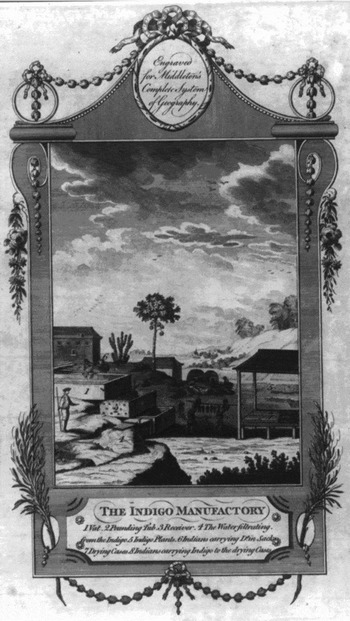
The indigo texts made their way outside the Caribbean on account of the intent by others to seek that knowledge. From 1731 excerpts translated from Labat's work were available to non-elite Englishmen who did not understand French. But the 1736 comprehensive work on indigo by Elias Monnereau was not translated into English in the British metropolis until 1769. As Monnereau wrote, he wished for experience of indigo culture in his book to serve the interest of his French countrymen and fellow colonists specifically.Footnote 24 Is it possible that the French were able to safeguard the first detailed information that was published on indigo for a longer time? One can only speculate. But finally the desire in the Americas to emulate the Caribbean practice secured the translation of Monnereau's work. The English settlers had acquired the colony in Florida in 1763. Indigo was an attractive crop for the plantations there. A member of the East Florida Society of London (a forum of English settlers in East Florida) took the initiative in publishing the work, dedicating the translation to the Society. The representations of Caribbean methods of indigo manufacture were becoming common even in travelogues in metropolitan environments (Figure 1).
Representation of indigo culture in a travel account published in London (1777).

The journey of De Cossigny de Palma's Memoir on indigo manufacture to Bengal demonstrates the ability of indigo texts to travel across separate imperial worlds. The French Indian Ocean island colonies of Mauritius (Isle de France) and Reunion (Isle de Bourbon) developed important indigo plantations in the mid eighteenth century. The two colonies were in constant communion with other French indigo growing colonies in the Caribbean. Their embedding in the French imperial system enabled the movement of planters of French extraction and indigo knowledge between them. Such movement of knowledge and enterprise was symbolized in the persona of De Cossigny who was the Governor of Mauritius and an indigo planter there. He wrote a significant account of indigo manufacturing which was published in Mauritius in French in 1779. The memoir made its way into Bengal within the decade.Footnote 25 Indeed, De Cossigny had obtained information on the Indian methods of indigo manufacture prevalent on the Coromandel Coast and had incorporated it into his treatise, using the office of the French Consulate in Pondicherry for that. He later also visited Calcutta.Footnote 26 He incorporated material on the diverse Indian methods in his own treatise.
The Caribbean indigo knowledge was applied and adapted in the French colonies before its re-emergence in South Asia. This comes across in De Cossigny's text most clearly, a text based on his experiences as an indigo planter in the French colony of Mauritius. Away from the Antillean Islands, situated in the southwest Indian Ocean, De Cossigny had experienced the perils of implementing the Antillean system. In addressing the subject of drying the indigo under direct sunlight or in shade, respectively French and English practices in the West Indies, for instance, he wrote that ‘neither of these processes succeed well at the Island of Mauritius, the one being too quick, and the other too slow, that in the shade [also] generating insects in the lower parts of the fecula’. The text reflects the spirit of accommodation and adjustment throughout.Footnote 27
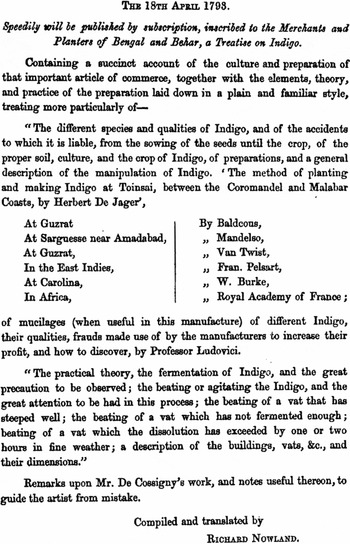
The translation of French indigo texts on the Indian subcontinent was taken up in a context of expansion of indigo plantations in the last quarter of the eighteenth century.Footnote 28 It was the outcome of a local desire to invite the knowledge of indigo manufacture for new entrants to the profession. A majority of European personnel in supervisory roles in the indigo factories were new hires, mostly immigrants. They had to be acquainted with information on the processes of manufacturing indigo. The French indigo texts seemed to be at least one major source for developing their understanding of these processes. The need for information about indigo culture had created a market for indigo texts on the subcontinent. The Company officials and private publishers, and even individuals in some cases, acted in response to that need and became facilitators in the intercontinental movement of texts. Authors, translators, and publishers were deliberate agents in creating an informational sprawl. The translator of De Cossigny's magnum opus on indigo manufacture, Manuel Cantopher, had perceived a need for indigo texts in ‘the present rising state’ of the industry in Lower Bengal.Footnote 29 Richard Nowland, another Calcutta based publisher, had also sensed the need for a compendium on indigo in the colony. In an advertisement in an important Calcutta newspaper on 18 April 1793, he announced the sale of a practical manual on the culture of indigo that could be put to use by the planters. The advertisement (Figure 2) drew the attention of proprietors of indigo factories and their controlling banks in the colonial Indian metropolis and promised to include information pertaining to indigo manufacture on the Coromandel Coast in India as well as translations of theories of indigo by German Carl Günther Ludovici and the French planter, De Cossigny.Footnote 30 The demand for texts explaining the processes of manufacture was apparently quite high.
Cosmopolitanism of Richard Nowland's compendium.

There is evidence that Calcutta and the major plantation zones in Bengal were replete with indigo texts including those by French authors in the last decades of the eighteenth century. De Cossigny's Memoir was translated in Calcutta in 1789. Five years later, Nowland published the compendium on indigo that contained amongst others very long excerpts from the works of De Beauvais-Raseau.Footnote 31 The publication of such texts continued and these were readily available to all concerned—writing in 1832, John Phipps, attested to their easy availability. Phipps was a chronicler of trade and commerce in the early nineteenth century. He wrote a detailed account of the indigo industry that also included a description of its methods of production in Bengal. He admitted that information on the manufacturing processes provided by him might not be something new for the planters, ‘but what may be found on the book shelves, or desks, of almost every [indigo] merchant connected with the India trade’.Footnote 32 The merit of his book, he clarified, chiefly lay in putting in one volume the information that was available in multiple texts in a fragmentary manner.
The interface: Caribbean knowledge and Indian methods
The expansion of Caribbean knowledge and the system of indigo manufacture based upon it occurred in a slow and piecemeal fashion in the colony in South Asia. The slow advance of the Caribbean system can be seen both in the realm of transactions between pre-existing and newly arriving knowledge, and the actual instances of European planters’ experiences as they set themselves to the task of establishing the first indigo factories. Late eighteenth-century Bengal was a new territory with no prior history of indigo cultivation. In contrast, the Coromandel region in the south had a very well established indigo manufacturing system based on the distinctively Indian method. But the asymmetries and regional variations in the prior history of indigo manufacture aside, there is an all-round impression of engagement and equivocation, not of outright banishment of prior knowledge in the era of early settlement of plantations on the subcontinent. Openness to appreciating the fluidity of accumulating indigo knowledge can help understand the broadly dispersed genealogy and cosmopolitan development of indigo knowledge. The transnational knowledge of indigo, with all its internal variegation reached Indian shores in the late eighteenth century, and would be further changed on the Indian subcontinent during the process of engagement with local knowledge and practice. Attention to the complexities of this constantly changing knowledge system enables a clearer understanding of how the ‘West Indian System’ developed on the Indian subcontinent.
There are indications that in the early stages of indigo manufacture in Bengal there was ample participation of Indians and the lingering survival of indigenous methods, all of which negate any impression one might have entertained of a sudden victory of the new method. The publishers of the two French treatises substantiate the currency of Indian methods. Manuel Cantopher, noted the presence of Indians and Indian practices on the plantations, recording, ‘several persons concerned in it being only under the guidance of natives of India’. The persistence of Indian methods had, in fact, prompted Cantopher to undertake the translation work. He thought that while Indian methods of manufacturing indigo were legitimate on account of the ‘antiquity of their practice’, the practitioners in the colony ‘may derive advantage by comparison [of their art] with that laid down by De Cossigny's treatise’.Footnote 33 Richard Nowland had also sensed the need for a compendium on indigo in the colony in the light of the prevalence of local methods. Interestingly, he cited the prior assertion by Cantopher that Bengal indigo operations were ‘only under the guidance of the Indians’ [italics in the original] in order to justify why he should have published another text in order to expose planters in India to ‘useful works from Europe’. He translated a wide selection of European indigo works which included not only those of French indigo expert De Beauvais-Raseau and the German Carl Günther Ludovici, but also many seventeenth-century accounts by Dutch, French, and German orientalists and travellers to Asia and Africa. Europe's dominant position in eighteenth-century indigo production had made it a veritable centre of indigo information collected from around the world. Nowland wished to facilitate the passage of that diverse knowledge to India, an exercise that was also likely to be profitable to him individually.Footnote 34
The best practices of indigo manufacture had not yet been settled. In fact, Cantopher pointed out that De Cossigny himself was ‘far from thinking that he has exhausted the subject’ and there were grounds for further observation and experience to explain what he ‘has left unascertained’. Thus he invited the European practitioners in India to ‘add something to the general stock of knowledge’. An exchange of information and continual improvement based on further experience was necessary.
It is true that all these texts were normative in the sense of privileging a particular knowledge and insisting on its adoption. But this knowledge itself was ‘in the making’ in the real sense of the phrase. It was not a definitive knowledge body that had closed itself off to new information. Nowland admitted this fact: ‘this art above all others is the most unfixed. . .’ Thus his compendium included a description of practices in a variety of countries, even though it chiefly focused on indigo culture in the West Indies. Nowland described indigo manufacture in seventeenth-century India including the prevalence of the ‘dry method’ that involved drying the indigo leaves, pounding them, and then either soaking or combining soaking and beating, a practice that contrasted with the West Indian method of fermenting fresh indigo leaves in a vat. He also presented information on the Dutch methods of indigo culture in Java and in South Carolina, and made some cursory remarks on prevalent methods in China and Madagascar. In leaving it to his readers to ‘compare the various methods practised in different countries. . .,’ Nowland signalled his openness to other types of knowledge. He noted that the Indian method was ‘the simplest’ and its indigo quality ‘in general . . . preferable to any other’ even as he acknowledged that the European method was the best ‘in point of accuracy’. The final word, he observed, should be left with the European manufacturers. He continued such equivocation on the matter of western versus Indian practices throughout his translated work advocating western methods in the end. It is also noteworthy that in drawing a contrast between ‘simple’ Indian methods and European ‘accurate’ methods, Nowland also seemed to be representing the broader trend in the transition of knowledge from the realm of craft to that of science in manufacturing indigo.
De Cossigny's treatise also acknowledged the cosmopolitan basis of indigo knowledge whilst presenting the West Indian system as an all-encompassing system that not only included multiple and distinct practices in the western hemisphere, but also a few pronounced practices that were characteristic of indigo manufacture in ‘the East’. Thus he described the manufacturing process as beginning with ‘the leaves of the plant, whether green or dry’ being put into the steeping vat that could be potentially made of ‘pottery ware, wood, or constructed of masonry’. In the same spirit of acknowledging ecumenical borrowings, he goes on to describe the beating process followed by drying which could take place directly under the sun or in shade. Obviously the system presented in De Cossigny's text was an admixture of various conventions followed in the Caribbean, Spanish America, and the American mainland, not a purely French, English or Spanish system. The syncretism of De Cossigny's text further comes out in a particularly stark way in his referring to the practice of assigning ‘dry’ leaves of the indigo plant into the steeping vat—a practice followed typically in many regions of India—as a viable one. De Cossigny had actually experimented with ‘dry indigo’, having received information on such a process existing on the Coromandel Coast from the French Council based in Pondicherry. Having obtained colour with dry indigo, De Cossigny declared: ‘This experiment infallibly shows that Indigo may be produced by different methods’. He called for possible improvisation of the Indian system to assess if in terms of cost and output it could be made to deliver better results than the European system. It had some merits because it did not require investment in constructing huge vats and also the difficulty of exceeding fermentation was not encountered in the Indian process, as in the European one. However, comparing the efficiency of the two systems, De Cossigny clearly advocated the European system, arguing that out of 50 bushels of the plant, the European system could yield 10 to 30 pounds of indigo compared with just one pound of indigo using the Indian system. Travellers to the Coromandel Coast who had spoken highly of the Indian system and wished for European planters to embrace that system in its current form were, in his opinion, ‘greatly mistaken’ in their enthusiasm.Footnote 35
Whatever the differences in operational practices, De Cossigny believed in the inviolability of the sequence of scientific changes involved in the production of the dye from the indigo plant. He understood and explained these changes in a certain way. The apparent ‘mechanical separation’ of the dye from the leaves was resolvable on ‘chemical principles’ and could be explained on such criteria. Indigo was contained in the plant in the form of a resinous extract along with a volatile alkali. The fermentation activated the alkali in the leaf and turned it into an ‘intermediate solvent’ that facilitated the separation of the dye and other salts from the leaf. The agitation or beating first disengaged the alkali from the vat. The motion then occasioned the separation of ‘urinous salts’ (meaning alkali salts) from the suspension in the vat as a result of which the dye was released and molecules of indigo started to fuse with each other and form the grain that precipitated to the bottom of the vat. No further change in composition occurred during drying since it was a process of physical change only. De Cossigny's notable contribution and advance over previous efforts was in proposing a distinctive ‘theory of fermentation’ on the basis of which he tried to explain the manufacture of indigo. If anything, this conviction that a definitive set of elemental processes lay at the basis of vat processes represented a certain scientific turn in understanding. It represented a quantum move towards a reductive understanding of indigo production processes.
The thesis of an arriving ‘external’ system of manufacture swiftly and completely effacing the ‘indigenous’ system of indigo culture on the subcontinent overstates the case. The assumption of continuity in an intercontinental web of efforts to improve the agriculture, science, and technique of indigo manufacture is more appropriate for developing an accurate historical understanding of the origin of indigo plantations in Bengal. As European planters extended their sway into the Indian subcontinent in the last quarter of the eighteenth and early nineteenth centuries, old theories continued to be tested and re-tested and the planting community continually arrived at new convictions in a continuing quest for improvement. Changed agro-climatic factors and land and labour issues in a new political environment provided a different context to the search for the natural limits to the improvement of the plant and the process. There was also a simultaneous engagement with knowledge and practice of indigenous manufacturing of indigo that had survived in small isolated pockets on the subcontinent.
Planters and a naturalist: Colonial pioneers of indigo manufacturing
The European planters in Bengal pledged fidelity to the manufacture of indigo in the ‘European manner’. The new indigo manufacturing process that developed in Bengal was purportedly distinct from the cultures of indigo manufacture as practised by Indian peasants in different regions of the subcontinent. Prior studies have recognized concrete measures undertaken by the state to spread information about the ‘western’ system. These efforts included handing out samples of the West Indian dye to Bengal planters for emulation, giving them letters of instruction on the process of dye manufacturing and, in a few cases, giving license to planters from the West Indies to settle in Bengal.Footnote 36
But there is ample evidence that the new system only emerged after a long period of trial and error and that Indian peasant traditions of manufacture were neither rejected out of hand nor rapidly rendered irrelevant. The discourse of legacy and connection to the numerous cultures of indigo production appears with a flourish in early accounts of its manufacture. Europeans approached Indian traditions of manufacturing with interest and their experts surveyed local varieties of indigo plant with an open mind to see which ones would give better yields. The newly arrived planters also deliberated about the best cultivating practices for indigo in a new agro-climatic environment. Global and local knowledge of indigo manufacture co-existed for a considerable length of time and in many ways, and global knowledge was further developed through the local experience of planters on the subcontinent.
The case of the indigo pioneer James Prinsep in Bengal illustrates typically the effort of Europeans in establishing the three-vat system in the colony. In 1780, Prinsep wrote to the directors of the East India Company expressing his wish to produce indigo in India for British markets.Footnote 37 Permission granted, he became one of the first private merchants to set up indigo factories in Bengal. His manufactory in Bengal was evidently set up after the model described in the Caribbean indigo text by Elias Monnereau, Indigo Maker. Footnote 38 Although there are no documents to describe the actual details of Prinsep's experience, one of his contemporaries attested to the several failures he suffered, offering the explanation that ‘indigo is not a crop that can be hurried’. Indigo was indeed a fastidious crop, and its manufacturing process was equally capricious. The translation process involved in using the West Indian system in Bengal proved to be predictably difficult. In the first two years Prinsep fell back upon buying indigo from local producers in Agra and Kanpur in Oudh that was possibly produced using indigenous methods. This indigo was sold to the Company and shipped to Britain in Company ships.Footnote 39 Prinsep later succeeded in making indigo in the West Indian manner and established several factories where this manufacturing took place. He went on to make a fortune with indigo. In 1788, eight years after launching his indigo enterprise in India, Prinsep returned to England with his fortune made in the colony. This accumulated wealth from the indigo trade allowed him to break into the ranks of the elite at home. A great career awaited him as an alderman to the city of London and as an influential Member of Parliament for Queensborough.
Claude Martin was another prominent indigo planter in the earliest days of indigo manufacture in India. A French military general who later capitulated and joined the East India Company's forces, he enjoyed a successful career with the latter. Born in Lyon, he first participated in the Anglo-French wars on behalf of the French crown in Pondicherry between 1752 and 1760, before switching to the English side. A multifaceted personality, Martin also worked for a while in the English East India Company's survey operations under James Rennell in Cooch Behar and Bhutan. Finally, he accepted the position of Superintendent of Armoury in Oudh, which was a protectorate state of the Raj under Nawab Asaf-ud-daulah. During his time in Oudh he established his indigo factories at Najafgarh, Pundri, and Korah and went on to become one of the richest Europeans in the colony.Footnote 40
Martin's letters and recollections touching upon his indigo operations reveal a person open to multivalent influences. A letter of 1787 from Martin asking his associate at the Najafgarh estate to have indigo vats constructed seems to suggest that his manufacturing conformed to the three-vat pattern. His will to his successor at Najafgarh, John Queiros, also contained his wish that the West Indian system of manufacture in existence at his indigo works be continued after his death. The system had proven to be efficient and had enabled indigo to be made ‘cheap and good’ and ‘very profitable’. Martin's letter and the will paint him as an unequivocal follower of the three-vat system and also suggest that his faith in the method was undiluted.
But other records simultaneously suggest that Martin was open to embracing the methods of indigo manufacture prevalent amongst the Indian peasantry. On a visit to Ambore in Carnatic in southern India he witnessed the indigenous method of manufacture and was apparently captivated. He wrote to highlight the advantages offered by the Indian methods for European planters. Martin wrote that he saw a local breed of indigo plant growing in higher altitude in the south that did not need ‘artificial watering’, and could withstand intense heat even at the time of harvest. That this southern plant could grow in barren hill tracts offered an advantage over the commonly known variety of indigo that Bengal planters were compelled to grow on the most fertile and expensive land available. The Carnatic plant was hardy and it could survive climatic changes such as failure of rainfall or sudden warmth that were typically known to harm crops in Bengal. The regional manufacturing process that he witnessed dispensed with the vats altogether, thus affording savings in the construction of ‘dead stocks’. In this system, the leaves were first boiled in earthen pots and the extract was poured into earthen jars embedded in ‘excavated ranges’ in the ground. The extract was then agitated for 45 minutes with bamboo sticks, then mixed with red earth and water that was alkaline in nature. Left overnight to settle, the next day the liquid at the top was siphoned off and the bottom sediment was collected and put in to bags to be dried. Martin emphasized the twin advantages of the Indian system of manufacturing and espoused its possible adoption by Europeans in Bengal. Martin's original note of 1791 was republished as late as 1812 alongside an extract from De Cossigny's tract that clearly favoured the three-vat system in the most important journal of arts and sciences in Bengal.Footnote 41 If nothing else, the simultaneous publication showed that the planters were aware of the Coromandel method that involved boiling even though they had embraced the three-vat system involving cold water fermentation in tanks.Footnote 42
The Scottish naturalist William Roxburgh achieved qualified success in popularizing the existing indigenous knowledge of indigo manufacture on the subcontinent.Footnote 43 An East India Company official, trained as a botanist and physician, Roxburgh had first accepted a position in Madras as assistant surgeon of the presidency. In Madras, he plunged into a study of the flora on the coast of Coromandel. The pursuit of natural history received his full attention after he was put in charge of the East India Company's Garden at Samulcottah in Northern Circars.Footnote 44 Roxburgh's forays into the natural habitat of the Coromandel led him to a new, local tree with substantial content of the indigo-yielding principle. He then used the boiling method for extracting dye from its leaves as distinct from the fermentation method used in Bengal. The Coromandel small landholders in the region for generations were well known practitioners of the boiling method. As a Company gardener, Roxburgh sojourned in the Coromandel until 1793 where he learnt this art from the Coromandel peasantry.Footnote 45
Roxburgh set himself the task of popularizing the new plant—which he called nerium—and the vintage boiling method practised in Coromandel. He wrote to East India Company officials in London in an effort to convince them of the good quality of colour that could be obtained from his new find. The description was also made available through a contact in Calcutta to the Supreme Government of the Company in Bengal.Footnote 46 Not only was the making of dye from nerium ‘infinitely more profitable’, he argued, but the tree could be grown in non-agricultural tracts without encroaching on ‘one foot of land that ever has been devoted to other purposes’. Thus, plantations of nerium indigo could be established in the colony without going down the fraught path of dispossessing native landholders or forcing them to divert their staple producing lands to cash-crop production. The nerium which was prone to grow on the southern rocky hills and in the wild could therefore be established in ‘the most laudable and politic manner’.
Roxburgh gave fulfilment and ‘scientific’ expression to the indigo manufacturing processes of pre-European origin. He was wedded to the idea of ‘universalizing’ the new method of indigo manufacturing that he called the ‘hot water extraction process’. He began to claim that the process using hot water was equally ideal for processing the shrubs of the indigo plant (Indigofera tinctoria) cultivated by planters in Bengal. While the Bengal planters did not embrace his method, there is concrete evidence that the hot water method was deployed by some European planters in the Coromandel where the nerium plant was readily available. In a communication of 8 January 1845, the planter G. J. Fischer mentioned that production in his indigo factory was based on nerium and on the deployment of hot water method at Salem in southern India, where use of the process had a long and continuous history. Fischer also explained that the plantation and factory based on the use of nerium would be viable if there was access to rent-free lands on which to grow the trees and the time available to wait for their slow maturation after sowing.Footnote 47 In the mid-1840s, some Bengal planters were debating if it would be viable to replace the Indigofera tinctoria variety with nerium and the hot extraction method. Opinion was divided over the amount of investment needed to buy the tracts in which to sow nerium afresh and to cover the cost of boilers and firewood to heat an immense quantity of water.Footnote 48 Clearly, then, Roxburgh had successfully inserted the hot water method into the planting discourses of the colony.
Conclusion Situating the Bengal indigo plantations Global and local: Transnational knowledge and South Asian history
What, then, was indigo knowledge? What claims can be made about indigo knowledge based on this history that unfolded on the Indian subcontinent but which had built substantial connections to developments in other parts of the world? Can it be framed as a body of knowledge that colonial planters appropriated to their own ends of profit-making, or, should it be interpreted as the local version of global knowledge? Answering in the affirmative to one or other of the two questions leads to distinct understandings. The first shows the colonial appropriation of a knowledge system over which neither the colonial nor the imperial system could claim complete monopoly. The second shows the cosmopolitan processes and ‘multiple logics’—and not a single ‘colonial logic’—that went into its making on the world stage.
It is clear that Bengal plantations came into being as a result of cosmopolitan exchanges on a worldly scale. No region or nationality could claim exclusive genealogy as the body of expert and experience-based knowledge developed and moved. The process of change in indigo knowledge continued with ecumenical borrowings on the Indian subcontinent. Thus Claude Martin's advocacy of the Coromandel system, even if not in completely unambiguous terms, coexisted with Roxburgh's quest to give credence to a system of hot water extraction adopted from peasants on the Indian subcontinent, along with efforts by the likes of De Cossigny and Richard Nowland, international experts and colonialists, to make the art of indigo manufacture conform to normative patterns. In the ensuing decades this knowledge was further modified as European planters tried to embed their system into the land structures, landscape, and broader agrarian context of colonial Bengal. This paper has looked at the diverse constitutive dynamic that went into the making of this knowledge in the prior phase.Footnote 49
The colonial histories of indigo plantations in Bengal have misrepresented the state of arrest and atrophy in the techniques of indigo culture. This latter view clearly misses some of the positive changes in the technology and knowledge of indigo production. Tracking the history of indigo knowledge in a global dimension bears out those technological changes.
The transnational history of indigo culture in plantation settings also reveals the global pattern of subordination of labour forces through regimented, extra-economic means. The eighteenth-century indigo plantations in the British and French Caribbean grew within a plantation complex on the foundations of slave labour. The French naturalists, and later Elias Monnereau, have described the servile labour forms that the planters brought to bear upon the extremely labour-intensive nature of indigo cultivation in the Caribbean. The early colonial American history of indigo cultivation provides a similar picture of the use of slave labour to fulfil the demands of labour for indigo production. Writing in The Gentleman's Magazine, a Charlestown planter stressed the importance of extra care in preparing the land needed for raising indigo in South Carolina. ‘An Indigo field ought to be a perfect garden’, he wrote. He argued that in general terms it took three times the amount of labour in South Carolina compared with the time invested by workers in agricultural fields in England. If intense effort was not made on the land, the crop would be destroyed, he emphasized, saying ‘our negroes are always at the hoe’.Footnote 50 The other prominent Asian system of indigo culture that developed in the Dutch colony of Java from around 1820 also emerged by imposing absolute control on the labour force. Here the state directly participated through the ‘Cultivation System’ in the control of labour for production as well as for the transportation of indigo in an area where mobility was severely impeded by mountainous terrain.Footnote 51 It indeed seems plausible to find similarities between indigo plantations in colonial Bengal and those elsewhere in terms of the nature of the deployment of labour.
Such similarities over more expansive zones spur us to ask if the colonial indigo in South Asia had an external arena constituted by forces that was not delimited by British imperialism and its global networks. The mobility of texts, the movement of planters in diasporas and indigo philosophers, as well as the very requirements of a worldwide market and trends in consumption, had the ability to forge connections across territories and imperial and colonial systems and were structurally central to the emergence of the Bengal plantations. A history focused on flows and movements and large networks has the potential to illuminate the process of constitution of global forces and their similarities with colonial developments in South Asia. Conceptualizing a transnational system of knowledge is not to read global homogeneity in the era of plantations; local differences in the methods of control of labour and indigo culture at different sites were too stark.Footnote 52 But a focus on the interaction between a transnational knowledge system and local forces in Bengal is insightful. It provides answers both to the global genealogy and local determinants of the Bengal plantations.Footnote 53