Introduction
Tonsillectomy remains one of the most frequently performed surgical procedures in paediatric otolaryngology worldwide. The operation is commonly indicated for recurrent tonsillitis and obstructive adenotonsillar hypertrophy, and is associated with substantial improvements in quality of life, sleep-related symptoms and overall health outcomes. Despite its widespread use and generally favourable safety profile, post-operative pain and haemorrhage continue to represent the most clinically relevant sources of morbidity following surgery.Reference Mitchell, Archer, Ishman, Rosenfeld, Coles and Finestone1–Reference Gysin3
Over the past decades, numerous surgical techniques have been developed with the aim of reducing operative morbidity while maintaining effective haemostasis. Conventional cold dissection, bipolar electrocautery, Coblation®, ultrasonic devices and vessel-sealing technologies have all been adopted in clinical practice. However, no single technique has been universally accepted as the optimal approach, and considerable variation in surgical practice persists among institutions and surgeons.Reference Lowe, van der Meulen, Cromwell, Lewsey, Copley and Browne4–Reference Sarny, Ossimitz, Habermann and Stammberger6
Coblation tonsillectomy has attracted particular interest because it uses plasma-mediated tissue ablation at relatively low temperatures, potentially reducing collateral thermal injury. Several randomised trials, systematic reviews and meta-analyses have reported lower post-operative pain scores and favourable recovery profiles compared with electrocautery-based techniques, although findings regarding post-operative haemorrhage have been less consistent.Reference Parker, Howe, Unsworth and Hilliam7–Reference Karam, Abul, Althuwaini, Almuhanna, Alenezi and Aljadi11
More recently, the BiZact™ tonsillectomy device has been introduced as a vessel-sealing and tissue-division system derived from LigaSure™ technology. Early clinical studies have suggested that the technique may facilitate efficient dissection and haemostasis while maintaining acceptable post-operative morbidity. Nevertheless, the currently available literature remains limited, and direct comparisons with other contemporary tonsillectomy techniques are relatively scarce, particularly in paediatric populations.Reference Krishnan, Stepan, Du, Padhye, Bassiouni and Dharmawardana12–Reference Leavitt, Carter, Messner, Liu, Saraiya and Sitton16
Given the ongoing interest in optimising post-operative recovery after tonsillectomy, further comparative data are needed to better characterise the relative performance of currently available technologies. The present prospective cohort study was designed to compare BiZact, Coblation and bipolar electrocautery tonsillectomy in paediatric patients with respect to post-operative pain, operative time, recovery outcomes, post-operative haemorrhage and device-related disposable costs.
Materials and methods
Study design and patient selection
This prospective comparative cohort study was conducted at the Department of Otorhinolaryngology–Head and Neck Surgery at Bursa Medicana Hospital, between December 2024 and September 2025. The study was carried out in accordance with the ethical principles of the Declaration of Helsinki (2013 revision). Ethical approval was obtained from the Bursa Medicana Hospital Ethics Committee (decision number: 2024/02-09). All patients or their legal guardians gave written informed consent prior to enrolment.
A total of 120 paediatric patients undergoing elective tonsillectomy were prospectively enrolled into one of three surgical cohorts (BiZact, Coblation or bipolar electrocautery). No random allocation was performed. Surgical technique was determined within routine clinical practice according to surgeon preference and device availability. Recruitment continued prospectively until 40 patients had been included in each surgical cohort. No formal matching or stratification by sex was performed.
Baseline demographic and clinical characteristics were recorded prospectively for all participants and subsequently compared among the three study groups.
Inclusion criteria were: age between 5 and 12 years, indication for tonsillectomy with or without adenoidectomy due to obstructive adenotonsillar hypertrophy and/or recurrent tonsillitis, availability for scheduled follow up, and written parental or guardian consent.
Patients were excluded if they had known coagulation disorders, bleeding diathesis, craniofacial anomalies, syndromic disease, neuromuscular disease, previous tonsillar surgery, history of peritonsillar abscess, acute upper respiratory tract infection at the time of surgery or incomplete follow-up data.
Concomitant adenoidectomy was performed when clinically indicated and was similarly distributed among the three groups.
Pre-operative assessment
All patients underwent standardised pre-operative evaluation, including detailed history, physical examination, surgical indication assessment and routine pre-operative laboratory testing according to institutional practice. Tonsil size was graded pre-operatively using the Brodsky classification in all patients. Surgical indication was categorised as obstructive adenotonsillar hypertrophy and/or recurrent tonsillitis.
Surgical techniques
All procedures were carried out under general anaesthesia by three senior consultant otolaryngologists who were experienced in all three surgical techniques and had completed their learning curves for each technique before the study period. Standardised operative principles were applied across groups. All procedures were performed as extracapsular tonsillectomies, with complete removal of the tonsillar tissue and capsule; no intracapsular tonsillotomy procedures were included.
In the bipolar electrocautery group, tonsillectomy was conducted using a bipolar forceps system (Medtronic, Minneapolis, Minnesota, USA) at standardised power settings of 10–20 W for both dissection and haemostasis. In the Coblation group, tonsillectomy was performed using the Coblator II radiofrequency system (Smith & Nephew, Austin, Texas, USA), which provides plasma-mediated tissue ablation under continuous saline irrigation, with standard ablation and coagulation settings of 7 and 3, respectively. In the BiZact group, tonsillectomy was carried out using the BiZact Tonsillectomy Device (a LigaSure-based bipolar vessel-sealing and tissue-division system; Medtronic), according to the manufacturer’s recommended settings.
Operative time was defined as the interval from initiation of tonsillar dissection to completion of final haemostasis.
Peri-operative and post-operative care
Peri-operative anaesthetic management, post-operative analgesia, oral intake recommendations, discharge criteria and follow-up procedures were standardised across all groups.
The post-operative analgesic regimen was standardised for all patients throughout the study period. Oral paracetamol (10–15 mg/kg every 6 hours) and ibuprofen (5–10 mg/kg every 8 hours) were routinely administered during the first post-operative week unless contraindicated. Parents and caregivers received standardised written and verbal instructions regarding medication use, oral intake, post-operative warning signs and pain assessment before discharge.
Post-operative hospitalisation followed routine institutional practice, with patients generally observed for 1 day and hospitalisation extended when clinically indicated.
All patients were routinely followed up for one month after surgery, for assessment of post-operative recovery and post-operative haemorrhage. Standardised post-operative pain assessments were performed at predefined time points on post-operative days 1, 3 and 7, with post-operative day 7 representing the final scheduled pain assessment.
Outcome measures
The primary outcome was post-operative pain intensity assessed using the Wong–Baker FACES® Pain Rating Scale on post-operative days 1, 3 and 7. Parents and caregivers were instructed to assist younger children in understanding the scale without influencing the selected response.
Secondary outcomes included operative time, time to first solid food intake, length of hospital stay, post-operative haemorrhage and device-related disposable cost.
Post-operative haemorrhage was classified according to timing and severity. Early bleeding was defined as haemorrhage occurring within the first 24 hours after surgery, whereas late bleeding was defined as bleeding occurring after 24 hours. Minor haemorrhage was defined as self-limited or conservatively managed bleeding not requiring surgical intervention. Bleeding requiring a return to the operating theatre was defined as haemorrhage necessitating surgical haemostasis under general anaesthesia.
Device-related disposable cost was calculated based on the institutional purchase price of procedure-specific disposable instruments. Operating theatre time, anaesthesia cost, staff cost, hospitalisation cost and costs related to post-operative complications were not included; therefore, this analysis reflects device-related disposable cost rather than total procedural cost.
Statistical analysis
Statistical analyses were performed using IBM SPSS Statistics for Windows, version 25.0 (IBM, Armonk, New York, USA).
Continuous and ordinal variables were summarised as median and interquartile range, whereas categorical variables were presented as frequencies and percentages. Normality of continuous variables was assessed using the Shapiro–Wilk test. As the assumption of normal distribution was not met, non-parametric statistical methods were used for continuous outcome comparisons.
Baseline continuous and ordinal variables were compared using the Kruskal–Wallis test. Baseline categorical variables were compared using the chi-square test.
For post-operative pain outcomes, overall group comparisons were performed using the Kruskal–Wallis test. When significant overall differences were identified, pairwise comparisons were conducted using Dunn’s post hoc test with Bonferroni adjustment for multiple testing.
For operative and recovery outcomes, overall group comparisons were performed using the Kruskal–Wallis test, followed by pairwise comparisons using the Mann–Whitney U test with Bonferroni correction when appropriate.
Post-operative bleeding outcomes were analysed using the Fisher–Freeman–Halton exact test because of the low frequency of events.
A post hoc power analysis based on post-operative day 1 Wong–Baker FACES pain scores was performed using the observed between-group effect size at a two-sided α level of 0.05 to estimate the achieved statistical power for the primary outcome.
All statistical tests were two-sided, and a p-value of less than 0.05 was considered statistically significant.
Results and analysis
The study included 120 paediatric patients, with 40 patients in each treatment group. Complete data were available for all enrolled participants. No significant between-group differences were identified for age, sex distribution, surgical indication, Brodsky tonsil grade or concomitant adenoidectomy rates (all p > 0.05) (Table 1).
Baseline demographic and clinical characteristics of study groups

Table 1 Long description
Baseline demographic and clinical characteristics are compared across three study groups: bipolar electrocautery, BiZact, and coblation, with 40 participants in each group. Median age was similar: 6.5 years for bipolar electrocautery, 7.0 for BiZact, and 6.0 for coblation, with no statistically significant difference. Sex distribution was identical across groups, with 20 females and 20 males in each. Surgical indication was comparable: hypertrophy was most common (75 percent bipolar, 65 percent BiZact, 70 percent coblation) and infection accounted for the remainder. Brodsky tonsil grade medians were all 3, with similar grade distributions across groups (grade 1 about 12 to 15 percent, grade 2 about 22 to 30 percent, grade 3 about 32 to 35 percent, grade 4 about 22 to 30 percent). Concurrent adenoidectomy occurred in 45 percent of participants in every group. Overall, the p-values indicate no statistically significant baseline differences between groups, supporting comparability before outcome analyses.
Note: Group comparisons for continuous and ordinal variables were performed using the Kruskal–Wallis test. Categorical variables, including sex, surgical indication and concurrent adenoidectomy, were compared using the chi-square test. A two-sided p-value of less than 0.05 was considered statistically significant.
* n = 40 for each group. IQR = interquartile range
Post-operative pain scores differed significantly among groups on post-operative days 1, 3 and 7. Median pain scores on post-operative day 1 were 8 (interquartile range, 8–10) in the bipolar electrocautery group, 8 (interquartile range, 7.5–8) in the BiZact group and 6 (interquartile range, 6–8) in the Coblation group. Pairwise comparisons demonstrated significant differences between all groups after Bonferroni adjustment.
Median pain scores on post-operative day 3 were 8 (interquartile range, 8–8), 6 (interquartile range, 6–6) and 6 (interquartile range, 4–6) in the bipolar electrocautery, BiZact and Coblation groups, respectively. Significant differences were observed between the bipolar electrocautery group and both the BiZact and Coblation groups (both p < 0.001), whereas the difference between BiZact and Coblation did not retain statistical significance after Bonferroni adjustment (adjusted p = 0.071).
Median pain scores on post-operative day 7 were 6 (interquartile range, 6–6.5) in the bipolar electrocautery group, 4 (interquartile range, 4–6) in the BiZact group and 4 (interquartile range, 4–4) in the Coblation group. All pairwise comparisons remained statistically significant after Bonferroni adjustment. Overall comparisons remained significant on post-operative day 1 (H = 57.865, p < 0.001), post-operative day 3 (H = 78.477, p < 0.001) and post-operative day 7 (H = 71.440, p < 0.001) (Table 2, Figure 1). The post hoc power analysis based on post-operative day 1 Wong–Baker FACES pain scores demonstrated an achieved power of 99 per cent for the primary outcome.
Median post-operative Wong–Baker FACES pain scores on post-operative days 1, 3 and 7.

Post-operative Wong–Baker FACES pain scores: primary outcome

Table 2 Long description
Post-operative Wong to Baker FACES pain scores are reported as medians with interquartile ranges for three surgical techniques (bipolar electrocautery, BiZact, and Coblation) on post-op days 1, 3, and 7, along with overall group tests and pairwise comparisons. On day 1, median pain was 8 (8 to 10) for bipolar electrocautery, 8 (7.5 to 8) for BiZact, and 6 (6 to 8) for Coblation; overall group differences were statistically significant and all pairwise comparisons were significant, including Coblation lower than both other groups. On day 3, bipolar electrocautery remained highest at 8 (8 to 8), while BiZact and Coblation were both 6, with BiZact at 6 (6 to 6) and Coblation at 6 (4 to 6); overall differences were significant, and Coblation versus BiZact did not remain significant after adjustment, while both differed from bipolar electrocautery. On day 7, pain decreased in all groups, with bipolar electrocautery at 6 (6 to 6.5), BiZact at 4 (4 to 6), and Coblation at 4 (4 to 4); overall differences were significant and all pairwise comparisons were significant. Interpretation should note that one subgroup had no variability on day 7, which can affect how dispersion is understood for that group.
Note: Overall group comparisons were performed using the Kruskal–Wallis H test. Post hoc pairwise comparisons were conducted using Dunn’s test with Bonferroni adjustment. *The difference between the Coblation and BiZact groups on post-operative day 3 did not reach statistical significance after Bonferroni correction (adjusted p = 0.071).
† All patients in the Coblation group had a Wong–Baker FACES score of 4 on post-operative day 7, resulting in no variability within this subgroup. IQR = interquartile range
Length of hospital stay was similar across the three groups, with a median duration of 1 day in each group (p = 1.000) (Table 3).
Operative efficiency and post-operative recovery outcomes

Table 3 Long description
Comparison of three tonsil surgery techniques on operative efficiency and recovery: operative time, days to first solid food, hospital stay, and per case device cost. Median operative time was 25 minutes for bipolar electrocautery, 18 minutes for BiZact, and 20 minutes for coblation, with all pairwise differences statistically significant. Time to first solid food followed the same pattern: bipolar electrocautery 4 days, BiZact 3 days, and coblation 4 days, with all pairwise differences statistically significant. Length of hospital stay was 1 day in all three groups, with no statistically significant differences. Device cost differed markedly, at 10 dollars for bipolar electrocautery, 100 dollars for BiZact, and 250 dollars for coblation, and was reported descriptively without statistical testing. Overall, BiZact showed the best efficiency and quickest return to solid food, while bipolar electrocautery was slowest, but cost and clinical priorities may affect technique choice.
Note: Overall group comparisons were performed using the Kruskal–Wallis test. Pairwise comparisons were conducted using the Mann–Whitney U test with Bonferroni correction. Statistical significance was set at p < 0.05. IQR = interquartile range
Early bleeding occurred in two patients (5.0 per cent) in the BiZact group and was not observed in either the bipolar electrocautery or Coblation groups. Late bleeding was recorded in two patients (5.0 per cent) in the bipolar electrocautery group and in one patient (2.5 per cent) in each of the BiZact and Coblation groups.
Minor haemorrhage was documented in one patient (2.5 per cent) in the bipolar electrocautery group, three patients (7.5 per cent) in the BiZact group and one patient (2.5 per cent) in the Coblation group. Return to the operating theatre because of post-operative bleeding was required in a single patient (2.5 per cent) treated with bipolar electrocautery, whereas no such events occurred in the BiZact or Coblation groups.
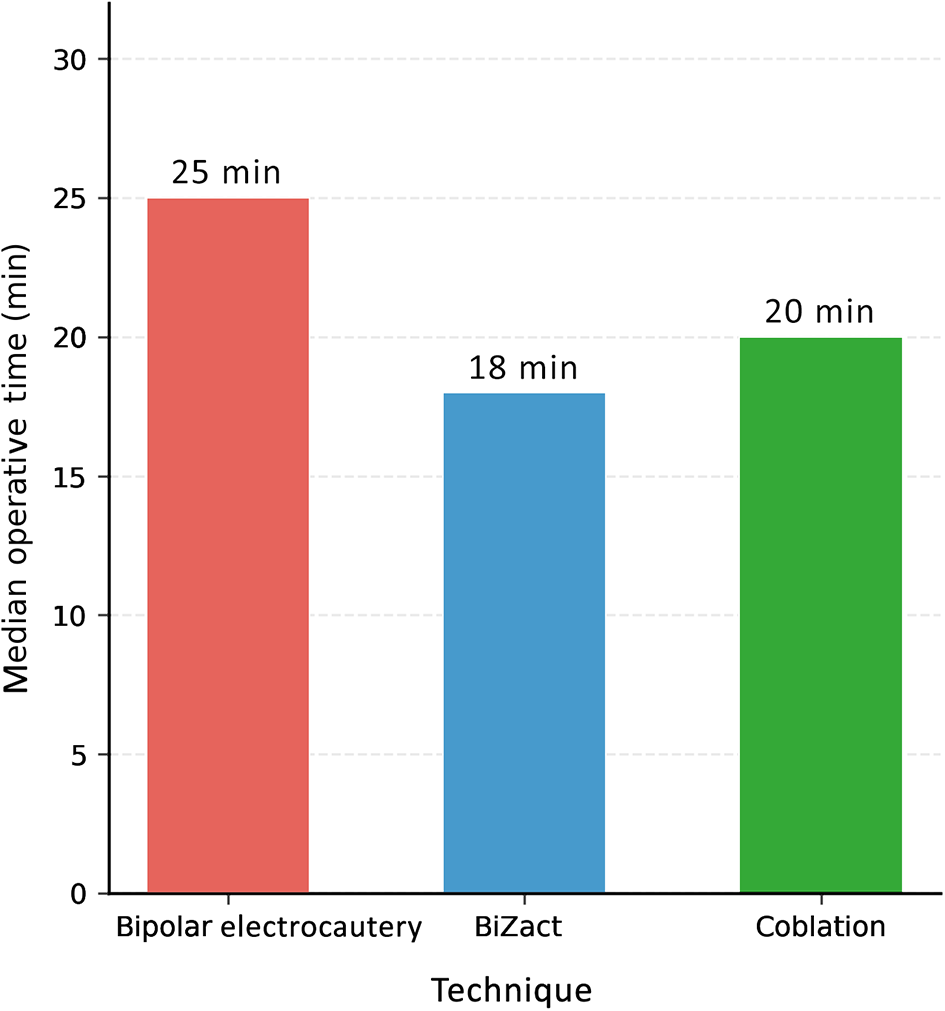
Median operative duration was 25 minutes (interquartile range, 24–26) in the bipolar electrocautery group, 18 minutes (interquartile range, 17–19) in the BiZact group and 20 minutes (interquartile range, 19–21) in the Coblation group. Overall differences among groups were statistically significant (p < 0.001). Pairwise comparisons demonstrated significant differences between all treatment groups (all p < 0.001) (Table 3, Figure 2).
Median operative time by treatment group. Min = minutes.

The median time to first solid food intake was 4 days (interquartile range, 4–5) in the bipolar electrocautery group, 3 days (interquartile range, 3–4) in the BiZact group and 4 days (interquartile range, 3–4) in the Coblation group. Pairwise comparisons remained significant following post hoc analysis (all p < 0.001).
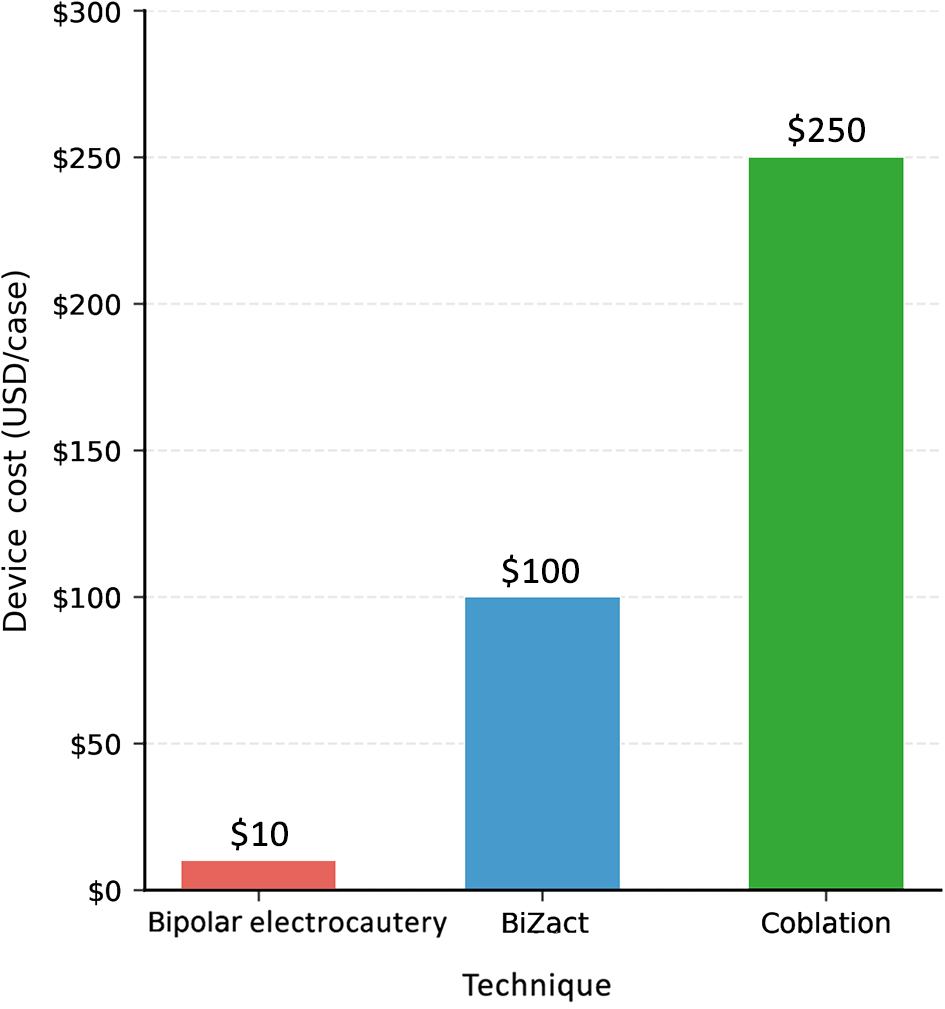
Device-related disposable costs ranged from \$10 per procedure for bipolar electrocautery to \$250 for Coblation, while the corresponding cost for BiZact was \$100. Cost data were reported descriptively and were not included in comparative statistical analyses (Table 3, Figure 3).
Disposable device cost per case by treatment group.

Discussion
The present prospective cohort study compared post-operative pain, operative outcomes, recovery parameters and haemorrhage rates among paediatric patients undergoing tonsillectomy using bipolar electrocautery, BiZact or Coblation techniques. Differences were observed among the three techniques with respect to post-operative pain, operative time and time to resumption of solid food intake. Lower post-operative pain scores were generally observed in the Coblation group, whereas shorter operative times and earlier return to solid food intake were observed in the BiZact group. No statistically significant differences in post-operative haemorrhage outcomes were observed among the study groups.
Post-operative pain remains one of the most important determinants of recovery following paediatric tonsillectomy. Several randomised studies comparing Coblation and bipolar electrocautery techniques have reported lower post-operative pain scores and more favourable early recovery profiles with Coblation.Reference Parker, Howe, Unsworth and Hilliam7, Reference Wiltshire, Cronin, Lintern, Fraser-Kirk, Anderson and Barr8, Reference Bhardwaj and Singh17–Reference Hong, Cho, Chae, Lee and Woo21 These observations have also been supported by meta-analyses and systematic reviews, which have suggested that reduced thermal injury associated with Coblation may contribute to improved post-operative comfort.Reference Metcalfe, Muzaffar, Daultrey and Coulson9–Reference Karam, Abul, Althuwaini, Almuhanna, Alenezi and Aljadi11, Reference Alexiou, Salazar-Salvia, Jervis and Falagas22 Nevertheless, the magnitude of the reported benefit has varied across studies, and differences in pain assessment methods, patient populations and post-operative analgesic regimens may partially explain the heterogeneity of published findings.Reference Pynnonen, Brinkmeier, Thorne, Chong and Burton10, Reference Hong, Cho, Chae, Lee and Woo21
The findings of the present study are broadly consistent with the available literature. Pain scores were lower in the Coblation group throughout the first post-operative week. Although the difference between Coblation and BiZact did not remain statistically significant on post-operative day 3 after adjustment for multiple comparisons, both techniques were associated with lower pain scores than bipolar electrocautery. These observations suggest that reduced thermal tissue injury may contribute to post-operative recovery, although the mechanisms underlying post-operative pain were not specifically investigated in the present study.
No significant differences were observed among groups for early bleeding, late bleeding, minor haemorrhage or bleeding requiring a return to the operating theatre (all p > 0.05) (Table 4).
Post-operative bleeding outcomes

Table 4 Long description
Post-operative bleeding outcomes are compared across three surgical techniques bipolar electrocautery, BiZact, and coblation reporting counts and percentages plus a group comparison p-value. Early bleeding within 24 hours occurred only in the BiZact group, with 2 cases (5.0 percent), while the other two groups had none. Late bleeding after 24 hours was uncommon: 2 cases (5.0 percent) with bipolar electrocautery and 1 case (2.5 percent) each with BiZact and coblation. Minor bleeding was reported in 1 case (2.5 percent) for bipolar electrocautery, 3 cases (7.5 percent) for BiZact, and 1 case (2.5 percent) for coblation. Bleeding requiring return to the operating theatre occurred once (2.5 percent) in the bipolar electrocautery group and did not occur in the other groups. Across all outcomes, the p-values indicate no statistically significant differences between techniques, so small numeric differences should be interpreted cautiously.
Note: Group comparisons were performed using the Fisher–Freeman–Halton (FFH) exact test. No statistically significant differences were observed among the groups for any bleeding outcome (all p > 0.05).
Operative efficiency has become an increasingly important consideration in contemporary tonsillectomy practice. Previous investigations evaluating BiZact have consistently reported relatively short operative times, which have been attributed to the integration of vessel sealing and tissue division within a single instrument.Reference Krishnan, Stepan, Du, Padhye, Bassiouni and Dharmawardana12–Reference Kang, Stybayeva and Hwang14, Reference Leavitt, Carter, Messner, Liu, Saraiya and Sitton16 Similar findings have been reported for other vessel-sealing technologies, including LigaSure-based systems.Reference Attner, Hemlin and Söderman23–Reference Lachanas, Hajiioannou, Karatzias, Filios, Koutsias and Mourgelas25 In contrast, Coblation techniques generally require separate dissection and haemostatic manoeuvres, while bipolar electrocautery may be associated with longer operative durations depending on surgical technique and intra-operative bleeding control.Reference Wiltshire, Cronin, Lintern, Fraser-Kirk, Anderson and Barr8, Reference Krishnan, Stepan, Du, Padhye, Bassiouni and Dharmawardana12, Reference Kang, Stybayeva and Hwang14
Operative duration differed significantly among groups in the present cohort. The shortest operative times were observed in the BiZact group, followed by Coblation and bipolar electrocautery. These findings are consistent with previous reports suggesting that vessel-sealing technologies may facilitate efficient tonsillar dissection. However, operative time represents only one aspect of surgical performance and should be interpreted together with post-operative recovery and safety outcomes.
Early resumption of oral intake is an important marker of recovery following tonsillectomy and is closely related to post-operative pain, swallowing function and overall patient comfort. Previous studies evaluating Coblation have frequently reported earlier recovery and improved oral intake compared with electrocautery-based techniques, although the magnitude of these differences has varied across studies.Reference Parker, Howe, Unsworth and Hilliam7, Reference Metcalfe, Muzaffar, Daultrey and Coulson9, Reference Karam, Abul, Althuwaini, Almuhanna, Alenezi and Aljadi11, Reference Saeed, Emin, Yaseen and Saleh18
A return to solid food occurred earliest in the BiZact group in the present study. While the underlying mechanisms cannot be determined from the current data, this finding suggests that factors beyond pain alone may influence post-operative recovery. Given the observational design of the study, these results should be interpreted cautiously and warrant further evaluation in randomised investigations.
Post-operative haemorrhage remains the most clinically significant complication of tonsillectomy and continues to be a major determinant of surgical safety. Large multicentre audits and observational studies have demonstrated that haemorrhage rates are influenced by multiple factors, including patient characteristics, surgical indication and operative technique.Reference Sarny, Ossimitz, Habermann and Stammberger6, Reference Lowe and van der Meulen26–Reference Perkins, Liang, Gao, Shultz and Friedman28 Although some reports have suggested increased secondary haemorrhage rates following Coblation tonsillectomy,Reference Belloso, Chidambaram, Morar and Timms29, Reference Praveen, Parthiban and Terry30 more recent systematic reviews and comparative studies have generally failed to demonstrate consistent differences between contemporary surgical techniques.Reference Metcalfe, Muzaffar, Daultrey and Coulson9–Reference Karam, Abul, Althuwaini, Almuhanna, Alenezi and Aljadi11, Reference Chuang, Hawke and Douglas15
No significant differences were identified among the three groups with respect to early bleeding, late bleeding, minor haemorrhage or bleeding requiring a return to the operating theatre. Only a small number of haemorrhagic events were observed overall, and a single patient required a return to the operating theatre. These findings are in agreement with previous reports suggesting that clinically significant post-operative haemorrhage is relatively uncommon and may not differ substantially among modern tonsillectomy techniques. At the same time, the limited number of bleeding events should be considered when interpreting these results, as the study was not specifically powered to detect small differences in haemorrhage risk.
Economic considerations have become increasingly relevant when evaluating emerging surgical technologies. Previous cost analyses have suggested that reductions in operative time or post-operative morbidity may partially offset the higher acquisition costs associated with advanced energy-based devices.Reference Guest, Rana and Hopkins31 However, meaningful economic comparisons remain challenging because institutional costs, operating theatre expenses and healthcare systems differ considerably among settings.
The present analysis was limited to disposable device costs and was not designed as a formal cost-effectiveness evaluation. Bipolar electrocautery was associated with the lowest device-related cost, whereas Coblation was associated with the highest. BiZact demonstrated intermediate disposable costs. These findings should therefore be interpreted within the context of the study design, as broader economic outcomes, including operating theatre utilisation, healthcare resource consumption and management of complications, were not assessed.
Several strengths of the present study should be acknowledged. Data were collected prospectively using a standardised post-operative assessment protocol, and complete follow up was achieved for all enrolled patients. In addition to post-operative pain and haemorrhage outcomes, operative duration, recovery parameters and device-related costs were evaluated, allowing a comprehensive comparison of three contemporary tonsillectomy techniques in a paediatric population.
Several limitations should also be considered. Firstly, the study was designed as a prospective, non-randomised cohort investigation rather than a randomised, controlled trial. Surgical technique was determined according to surgeon preference and device availability, which may have introduced selection bias despite the comparable baseline characteristics observed among the groups. Secondly, although all participating surgeons were experienced in the evaluated techniques, the potential influence of surgeon-related factors cannot be completely excluded. Thirdly, post-operative pain assessment was based on patient- or parent-reported outcomes and may therefore have been influenced by individual differences in pain perception. Although a standardised post-operative analgesic regimen was used, actual analgesic consumption and rescue analgesic requirements were not prospectively quantified on an individual-patient basis. In addition, standardised pain scores were not collected beyond post-operative day 7; therefore, differences in pain persisting later in the post-operative course could not be evaluated. Finally, the sample size of 40 patients per group, together with the low number of post-operative haemorrhage events, limited the statistical power to detect differences in bleeding outcomes among the three techniques. Although the post hoc analysis demonstrated 99 per cent power for the primary pain outcome, the study remained underpowered for haemorrhage outcomes, and the absence of statistically significant differences in bleeding should therefore be interpreted with caution.
Future randomised studies with larger sample sizes and standardised peri-operative protocols may help further clarify the relative contributions of surgical technique to post-operative recovery and haemorrhage outcomes following paediatric tonsillectomy. Accordingly, the present findings should be interpreted as a comparative assessment of potential trade-offs among extracapsular tonsillectomy techniques rather than as evidence supporting the universal superiority of any single technique.
• Coblation and bipolar electrocautery are widely used tonsillectomy techniques, with previous studies suggesting differences in post-operative pain and recovery
• BiZact has emerged as a novel vessel-sealing device for tonsillectomy, but comparative data in paediatric populations remain limited
• BiZact, Coblation and bipolar electrocautery for extracapsular tonsillectomy were prospectively compared in children
• Coblation was associated with lower post-operative pain scores, and BiZact with shorter operative times and earlier return to solid food
• No statistically significant differences in post-operative haemorrhage outcomes were observed, although the study was underpowered for haemorrhage outcomes
Conclusion
Among paediatric patients undergoing extracapsular tonsillectomy, post-operative outcomes varied according to the surgical technique used. Coblation was associated with lower post-operative pain scores, whereas BiZact was associated with shorter operative times and an earlier return to solid food intake. No statistically significant differences were observed in post-operative haemorrhage, although these findings should be interpreted cautiously given the limited statistical power for haemorrhage outcomes.
These findings suggest that the evaluated techniques may offer distinct advantages rather than supporting the overall superiority of any single technique. Further randomised studies with larger sample sizes are warranted to confirm these findings.
Competing interests
None declared.
Ethical standards
The study was conducted in accordance with the ethical principles of the Declaration of Helsinki. Ethical approval was obtained from the Bursa Medicana Hospital Ethics Committee (decision number: 2024/02-09). Written informed consent was obtained from the parents or legal guardians of all participants prior to enrolment.
Acknowledgements
The authors thank the nursing staff and operating theatre personnel at the Department of Otorhinolaryngology–Head and Neck Surgery for their support during patient care and follow up.