Introduction
Crinoids suffered a mass extinction at the onset of Late Ordovician glaciations (Eckert, Reference Eckert1988; Donovan, Reference Donovan1989, Reference Donovan1994; Peters and Ausich, Reference Peters and Ausich2008), which resulted in the demise of the early Paleozoic Crinoid Evolutionary Fauna (Ausich et al., Reference Ausich, Kammer and Baumiller1994; Baumiller, Reference Baumiller, David, Guille, Féral and Roux1994). Recovery and establishment of the middle Paleozoic Crinoid Evolutionary Fauna occurred through the Llandovery (Peters and Ausich, Reference Peters and Ausich2008; Ausich and Deline, Reference Ausich and Deline2012). Historically, our understanding of this recovery was hampered by a general lack of Llandovery crinoid faunas. Beginning during the 1980s, Llandovery crinoids have been described primarily from Laurentia and Avalonia (e.g., Eckert, Reference Eckert1984; Ausich, Reference Ausich1984a, Reference Ausichb, Reference Ausich1985, Reference Ausich1986a, Reference Ausichb, Reference Ausichc, Reference Ausich1987; Donovan, Reference Donovan1993; Fearnhead and Donovan, Reference Fearnhead and Donovan2007; Ausich and Copper, Reference Ausich and Copper2010). The Baltica paleocontinent is well known for its rich Wenlock and Ludlow (Silurian) crinoid faunas, primarily from Gotland, Sweden (e.g., Angelin, Reference Angelin1878; Bather, Reference Bather1893; Franzén, Reference Franzén1982, Reference Franzén1983). Only recently have Llandovery crinoids been described from Estonia (Ausich et al., Reference Ausich, Wilson and Vinn2015; Ausich and Wilson, Reference Ausich and Wilson2016).
Besides Avalonia and Baltica faunas, relatively little is known about Silurian crinoids (crown-based taxa) from the remainder of Europe. Recently, one Wenlock taxon was described from the southern Urals (Bogolepova et al., Reference Bogolepova, Donovan, Harper, Suyarkova, Yakupov and Gubanov2018). Crinoids are also known from the Ludlow of the Czech Republic, and scyphocrinitidae are known from several sites in the Silurian-Devonian boundary strata (Webster and Webster, Reference Webster and Webster2013).
Here we report a small crinoid fauna dominated by a single species from the Kalana Konservat Lagerstätte of central Estonia. The first reports of the Kalana Lagerstätte biota have been published recently (Tinn et al., Reference Tinn, Meidla, Ainsaar and Pani2009, Reference Tinn, Mastik, Ainsaar and Meidla2015; Mastik and Tinn, Reference Mastik and Tinn2015, Reference Mastik and Tinn2017; Tinn and Märss, Reference Tinn and Märss2018). Because of the unique kind of preservation, only two crinoid species are well enough understood to be fully described and named: a new diplobathrid camerate, Kalanacrinus mastikae n. gen. n. sp., and a new disparid, Tartucrinus kalanaensis n. gen. n. sp. Whereas the unusual preservation, described below, is not ideal for crinoid preservation, this Lagerstätte offers a unique glimpse of the non-calcified fauna and flora that may have thrived alongside crinoids in other Silurian subtidal benthic communities.
Geographic and stratigraphic occurrences
Specimens described herein were collected from the Kalana Lagerstätte exposed in the Kalana (Otisaare) Quarry located near the village of Kalana, in central Estonia (58.722118°N, 26.038226°E) (Fig. 1). The operating quarry opens the upper part of the Jõgeva Beds, Nurmekund Formation, Raikküla Regional Stage (Llandovery, Silurian). The Raikküla Stage consists of a variety of carbonate rocks. The Kalana section is dominated by wackestones and packstones, but the strata also contain numerous 1–20 mm thick lenses and irregular interbeds of light- to dark-brown, organic-rich, microlaminated, argillaceous limestones.
Locality and stratigraphic column for the Kalana Lagerstätte. (1) General map of northwestern Europe; (2) map of Estonia, with the outcrop belt of the Raikküla Stage indicated by shading, and the Kalana Quarry is indicated by a star; (3) stratigraphic column of the Kalana Quarry with the position of the Kalana Lagerstätte indicated by the profile of a crinoid.

Strata containing the exceptionally preserved fossils were present only at the lowermost part of the section, near the bottom of the quarry (Fig. 1). Strata containing the Kalana exceptionally preserved fossils are no older than the middle Aeronian Pribylograptus leptotheca graptolite Zone and are in the middle of the Pranognathus tenuis conodont Zone (Ainsaar et al., Reference Ainsaar, Tinn, Männik, Meidla, Bauert, Hints, Meidla and Männik2014; Männik et al., Reference Männik, Tinn, Loydell and Ainsaar2016), which places these strata in the middle Aeronian.
Preservation of the Kalana Lagerstätte
The Kalana Lagerstätte is within a shallow-water carbonate sequence. The Jõgeva Beds are dominated by dolomitized packstones and wackestones that contain numerous intervals of 1–10 mm thick lenses of light- to dark-brown, organic-rich, microlaminated, commonly dolomitized micrite. As described in Tinn et al. (Reference Tinn, Meidla, Ainsaar and Pani2009, Reference Tinn, Mastik, Ainsaar and Meidla2015), Mastik and Tinn (Reference Mastik and Tinn2015, Reference Mastik and Tinn2017), Männik et al. (Reference Männik, Tinn, Loydell and Ainsaar2016), and Tinn and Märss (Reference Tinn and Märss2018), the Kalana Lagerstätte preserves numerous taxa of non-calcified thallophytic algae, the most diverse among them dasyclades (Chlorophyta), but the most abundant and common algal species is Leveilleites hartnageli Foerste, Reference Foerste1923, described as a putative rhodophyte. Common faunal elements include graptolites, conodonts, scolecodonts, bryozoans, sponges, and crinoids. The majority of gastropod and rhynchonelliformean brachiopod specimens occur in storm-deposited coquina lenses. Although relatively rare, the remainder of the fauna includes tabulate and rugose corals, orthocone and coiled cephalopods, trilobites, and rare vertebrate fossils (Tinn et al., Reference Tinn, Meidla, Ainsaar and Pani2009; Ainsaar et al., Reference Ainsaar, Tinn, Männik, Meidla, Bauert, Hints, Meidla and Männik2014; Mastik and Tinn, Reference Mastik and Tinn2015; Männik et al., Reference Männik, Tinn, Loydell and Ainsaar2016; Tinn and Märss, Reference Tinn and Märss2018). The preservation varies largely from soft-bodied fossils with exquisitely preserved details to decalcified molds of shelly fauna.
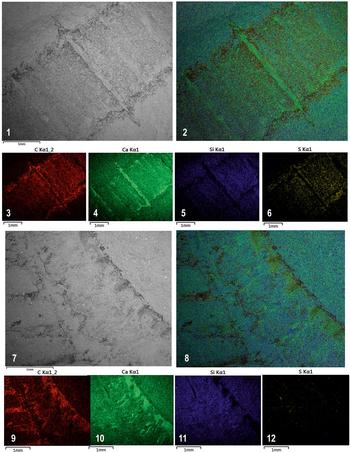
Element mapping diagrams (Fig. 2) present the distribution of elements in the crinoid specimens. The column has the largest portion of preserved calcite (marked with element calcium, Ca, in the diagrams) in the fossils (Fig. 2.1–2.6). Calcium distribution is correlated with the height and width of the columnals. Nodals are the widest and highest columnals, and priminternodals, secundinternodals, and tertinternodals decrease progressively in width and height. The largest amount of calcium is retained in the position of the nodals with decreasing amounts in the priminternodal and secundinternodal positions (Fig. 2.4). Otherwise, calcium is more randomly distributed with a concentration along one side of the column. The soft tissues of once living animals have left a fine carbonaceous (C) film on and around the specimens (Fig. 2.3).
Kalanacrinus mastikae n. gen. n. sp. (1) BSE image of the specimen (TUG 1736-21) showing variable z-contrast between carbon, calcite, and sedimentary matrix; (2) montage of four charge contrast images of the specimen; (3–6) elemental maps for C, Ca, Si, and S of the same specimen; (7) BSE image of the specimen (TUG 1736-22), showing variable z-contrast between carbon, calcite, and sedimentary matrix; (8) montage of four charge contrast images of the specimen; (9–12) elemental maps for C, Ca, Si, and S of the same specimen.

The arms have a different pattern of preservation (Fig. 2.7–2.12). In the arms calcium is mostly randomly distributed, but again, a concentration is present along one side of the arm (Fig. 2.10). Some of the brachials have a small amount of calcite (Ca in the diagrams), but large parts of them, as well as most of the attached pinnules, are preserved as carbonaceous films only (Fig. 2.9). Silica (Si) in the matrix is probably associated with mostly clay minerals, and sulfur (S) occurs either as dispersed pyrite or is associated with organics.
Whereas the paleoenvironment of the Kalana Lagerstätte and the mechanism of fossilization of these exceptionally preserved specimens are not completely clear yet, some features indicate microbial activity. The role of microbes in the preservation of soft tissues has been demonstrated by a number of experiments and actuopaleontologic studies (for further references see Briggs and McMahon, Reference Briggs and McMahon2016). At the same time, microbes can also play an important role in the dissolution of minerals, forming chemically complex and reactive microenvironments (Uroz et al., Reference Uroz, Calvaruzo, Turpault and Frey-Klett2009; Dong, Reference Dong2010; Ahmed and Holmström, Reference Ahmed and Holmström2015). Thus, we currently hypothesize that the partial preservation and/or dissolution of the Kalana crinoid specimens should be attributed to microbial activity on the specimens.
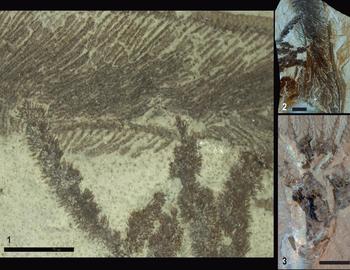
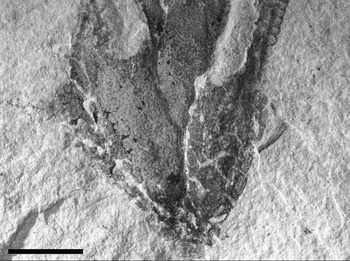
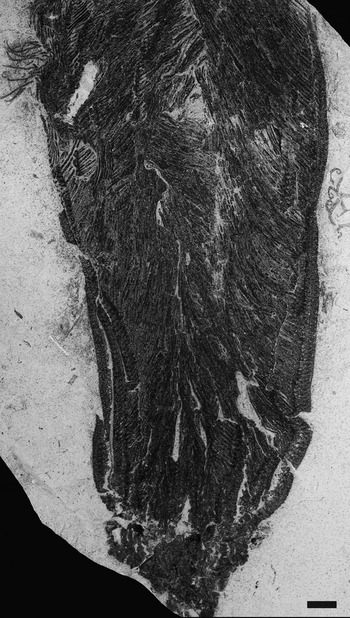
In the case of crinoids, the vast majority of crinoid material is partly decalcified and flattened (Fig. 3.1, 3.2); however, curiously, a few specimens have typical preservation with crinoid ossicles preserved as single crystals of calcite. Rarely (e.g., TUG 1736-8), a single specimen grades from a calcified proximal calyx to a decalcified distal calyx and arms (Fig. 3.3). A decalcified specimen is preserved with shallow relief and a faint brown to black coloration, which is in part carbonaceous and similar to the preservation of non-calcified alga (Fig. 3.1, 3.2). Carbon films are preserved in primarily what would have been the inside of a calyx (Figs. 4.1, 5), and some carbonaceous material is preserved on what is best interpreted as along the outside of a specimen. The two crinoids from the Lagerstätte beds have contrasting preservation. Kalanacrinus mastikae n. gen. n. sp. is nearly always decalcified and flattened, whereas all known specimens of Tartucrinus kalanaensis n. gen. n. sp. are preserved in calcite. Further, some isolated pluricolumnals in the Lagerstätte beds are calcified, and these belong to T. kalanaensis n. gen. n. sp. One would assume that the smaller crinoid T. kalanaensis n. gen. n. sp. would have been more susceptible to decalcification, but it was not the case. The much larger K. mastikae n. gen. n. sp. would have contained much more soft tissue than T. kalanaensis n. gen. n. sp. It is possible that the larger volume of organics contributed to conditions that favored decalcification in diagenetic microenvironments of the Kalana Lagerstätte.
Preservational details of Kalanacrinus mastikae n. gen. n. sp.: (1, 2) preservation of adjacent decalcified-calcite arms and non-calcareous algae; TUG 1736-16; (1) enlargement of portion of (2); (3) specimen with most of calyx and proximal arms preserved as carbon film, but infrabasal and basal plate preserved in calcite; paratype, TUG 1736-8; all scale bars 5.0 mm.

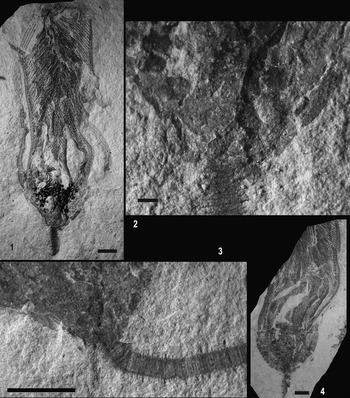
Kalanacrinus mastikae n. gen. n. sp. (1, 2) Lateral view of calyx, holotype, TUG 1736-3A; (2) enlargement of portion of (1) with low-angle highlight, note median ray ridge that divides on the radial plate and connects to like ridges on basal plates; short portion of infrabasal plate visible, scale bar 1.0 mm; (3) proximal calyx with length of column attached, note wide and very narrow epifacet extensions on most columnals; paratype, TUG 1736-7; (4) lateral view of calyx, paratype, TUG 1736-4; all scale bars, except part 2, 5.0 mm.

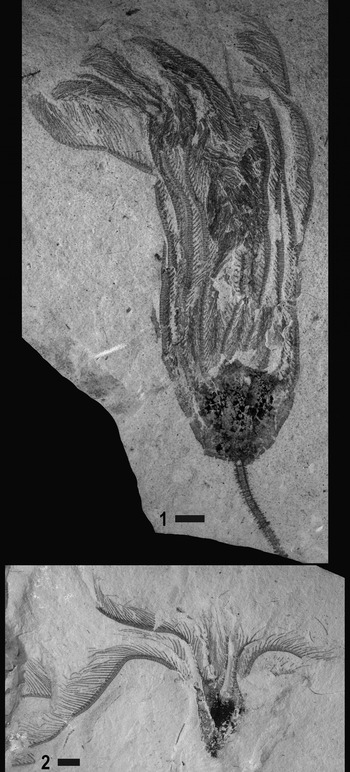
Kalanacrinus mastikae n. gen. n. sp. (1) Lateral view of calyx with arms mostly closed, paratype, TUG 1736-5; (2) lateral view of calyx with arms open, paratype, TUG 1736-6A; all scale bars 5.0 mm.

Unfortunately, the flattened, decalcified specimens of Kalanacrinus mastikae n. gen. n. sp. tend to split along a single crown surface that is typically one calyx wall and through the arms. Parts and counterparts of this material are two views of a single side of the body wall, as well as a slice through the arms. Either the inside or outside of poorly defined calyx plates is preserved and the corresponding mold of that surface (either internal or exterior) will preserve the reverse relief. This preservation is especially challenging for character discrimination and definition of taxa. Regardless, the full morphology of K. mastikae n. gen. n. sp. can be assembled from numerous specimens.
Crinoids are typically well preserved with calcite in the Silurian of Baltica (Bather, Reference Bather1893; Franzén, Reference Franzén1982, Reference Franzén1983; Ausich et al., Reference Ausich, Wilson and Vinn2012, Reference Ausich, Wilson and Vinn2015; Ausich and Wilson, Reference Ausich and Wilson2016), and the mode of preservation in the Kalana Lagerstätte is unique in Baltica. However, Silurian Lagerstätte are known from several locations in Ludlow strata of Laurentia (e.g., Erdtmann and Prezbindowski, Reference Erdtmann and Prezbindowski1974; Lo Duca, Reference Lo Duca1990; Klussendorf, Reference Kluesssendorf1994; Lo Duca and Brett, Reference Lo Duca, Brett, Brett and Baird1997; Saunders et al., Reference Saunders, Bates, Kluessendorf, Loydell and Mikulic2009). Several aspects of the Kalana Lagerstätte preservation and biota are similar to these Laurentian occurrences. However, in North America, only the Mississinewa Shale Member of the Wabash Formation contains well-preserved crinoids (Lane and Ausich, Reference Lane and Ausich1995). Like Kalana crinoids, Mississinewa crinoids are preserved as molds and casts with minor amounts of calcite preservation. However, organic residues are absent in the molds and casts of Mississinewa crinoids.
Materials and methods
Materials used for the descriptions were collected during the field seasons of 2013 and 2014. Most of the crinoids were found in a lens with a diameter of ~6–7 m, at the lowermost level (bottom) of the eastern part of the quarry. The position of the specimens lying in close proximity to each other and the exquisite preservation of the finest details suggest that the specimens were not transported and were most probably buried in situ. Among other fossils associated with these crinoids, the most notable are algae, such as Leveilleites hartnageli Foerste, Reference Foerste1923; Palaeocymopolia silurica Mastik and Tinn, Reference Mastik and Tinn2015; and Kalania pusilla Tinn et al., Reference Tinn, Mastik, Ainsaar and Meidla2015. Considering their nearly complete preservation, the algae presumably lived close to the crinoids.
Specimens were photographed with the stereomicroscope system Leica S9i at the Department of Geology, University of Tartu. Specimens were also studied with the Zeiss EVO MA15 scanning electron microscope (SEM) backscattered electrons detector (BSE) in low vacuum regime. Elemental analyses were performed with Oxford X-MAX 80 energy dispersive detector system and Aztec Energy software.
Specimens of Kalanacrinus mastikae n. gen. n. sp. are largely preserved as flattened molds with organic residue. Thus, the measured width of a fossil specimen does not represent the width of the specimen when it was alive. To estimate the true width, the diameter of a flattened specimen was doubled to yield the circumference, and the circumference was divided by π to estimate the uncompacted diameter when the animal was alive. The nature of this material is such that most specimens described here were collected as molds. The letters A and B following a specimen number refer to the mold and cast of a single specimen. Where it can be determined, the half in positive relief is designated as A, and the half in negative relief is designated B.
Repositories and institutional abbreviations
Specimens are deposited in the following institutions: TUG, University of Tartu; GIT, Institute of Geology, Geological Institute of Tallinn.
Systematic paleontology
The superfamilial classification used here follows Cole (Reference Cole2017), Wright (Reference Wright2017), and Wright et al. (Reference Wright, Ausich, Cole, Peter and Rhenberg2017); and family-level classifications follow Moore and Teichert (Reference Moore and Teichert1978). Morphologic terminology follows Ubaghs (Reference Ubaghs, Moore and Teichert1978) and Ausich et al. (Reference Ausich, Brett, Hess, Simms, Hess, Ausich, Brett and Simms1999), with modifications as noted in Zamora et al. (Reference Zamora, Rahman and Ausich2015). The plating of interrays is given by the number of plates in each range from proximal-most plate to the last range before the tegmen. In the posterior interray, the primanal is indicated by “P,” and the first interradial plate in regular interrays is indicated by “1.” A “?” indicates that more distal plating is unknown. Abbreviations used in designating measurements include CrH, crown height; CaH, calyx height; CaW, calyx width; CoH, column height. An * indicates a measurement was incomplete. Following Ausich's (Reference Ausich2018) work on the distribution of simple and compound radial plates in disparid crinoids, the radial circlet configuration is given as five numbers, so that 11212 signifies that the A-ray radial plate is simple, the B-ray radial plate is simple, the C-ray radial plate is compound, the D-ray radial plate is simple, and the E-ray radial plate is compound.
Class Crinoidea Miller, Reference Miller1821
Subclass Camerata Wachsmuth and Springer, 1885
Infraclass Eucamerata Cole, Reference Cole2017
Order Diplobathrida Moore and Laudon, Reference Moore and Laudon1943
Family Dimerocrinitidae von Zittel, 1879
Genus Kalanacrinus new genus
Type species
K. mastikae n. gen. n. sp.; by monotypy.
Diagnosis
As for the type species by monotypy.
Occurrence
Silurian (Llandovery, Aeronian); Estonia (Baltica paleocontinent).
Etymology
The genus name recognizes the village Kalana, Estonia, that is near the quarry where this specimen was collected.
Remarks
As outlined in Ausich and Copper (Reference Ausich and Copper2010, table 5), 10 genera of Silurian dimerocrinitids are known with only four having 20 atomous free arms, including Dimerocrinites Phillips, Reference Phillips and Murchison1839; Eucrinus Angelin, Reference Angelin1878; Nexocrinus Eckert, Reference Eckert1984; and Cybelecrinus Ausich and Copper, Reference Ausich and Copper2010. Kalanacrinus n. gen. is the fifth. Kalanacrinus n. gen. is most similar to Cybelecrinus and is compared below to these four genera. Dimerocrinites has a medium bowl-shaped calyx, stellate and smooth plate sculpturing, infrabasal plates not visible in lateral view, anitaxial ridge present, interray regions depressed with respect to rays, first primibrachial tetragonal (rarely hexagonal), primaxil shape pentagonal (rarely hexagonal), fixed pinnules absent, 10–20 free arms, atomous free arms, biserial pinnulate brachials, and circular columnals. Eucrinus has a medium cone-shaped calyx, smooth and nodose plate sculpturing, distal-most portions of infrabasal plates visible in lateral view, anitaxial ridge present, interray regions depressed with respect to rays, first primibrachial hexagonal, primaxil pentagonal, second secundibrachial axillary, fixed pinnules absent, 20 free arms, atomous free arms, biserial pinnulate brachials, and circular columnals. Nexocrinus has a medium cone-shaped calyx, smooth plate sculpturing, distal-most portions of infrabasal plates not visible in lateral view, anitaxial ridge present, interray regions inflated with rays, first primibrachial hexagonal, primaxil shape heptagonal, second to fourth secundibrachial axillary, fixed pinnules absent, 20 free arms, branching free arms, rectilinear uniserial pinnulate brachials, and circular columnals. Cybelecrinus has a medium cone-shaped calyx, stellate and smooth plate sculpturing, distal-most portions of infrabasal plates visible in lateral view, anitaxial ridge present, interray regions flush with rays, first primibrachial hexagonal, primaxil shape heptagonal, fourth secundibrachial axillary, fixed pinnules present, 20 free arms, atomous free arms, rectilinear uniserial pinnulate brachials, and circular columnals. In contrast, Kalanacrinus n. gen. has a high cone- to bowl-shaped calyx, nodose plate sculpturing, distal-most portions of infrabasal plates visible in lateral view (condition of the anitaxial ridge unknown), interray regions flush with rays, first primibrachial hexagonal, primaxil shape heptagonal, third secundibrachial axillary, fixed pinnules present, 20 free arms, atomous free arms, rectilinear uniserial pinnulate brachials, and circular columnals.
Kalanacrinus mastikae new species
Figures 2–9
Camera lucida drawings of Kalanacrinus mastickae n. gen. n. sp. depicting calyx plating. (1) Aboral cup and ray plating in TUG 1736-3A (holotype); compare to Fig. 4.2; (2) calyx plating in TUG 1736-6B (paratype), despite plate displacement, first interradial plate on shoulders of two radial plates and two interradial plates directly above first interradial plate; compare to Fig. 7; black = radial plates; dotted pattern = interradial plates; large dots = along midline of ray ridges; gray = matrix.

Kalanacrinus mastikae n. gen. n. sp. Enlargement of calyx with plate morphology preserved on the right and texture of internal mold on left; note interradial plates slightly separated and two plates above the proximal interradial plate in this regular interray; paratype, TUG 1736-6B; scale bar, 5.0 mm.

Kalanacrinus mastikae n. gen. n. sp. Large set of arms articulated to partial calyx, arms preserved with especially dark coloration; note small noncalcareous alga adjacent to arms in upper right portion of image; TUG 1736-12; scale bar, 5.0 mm.

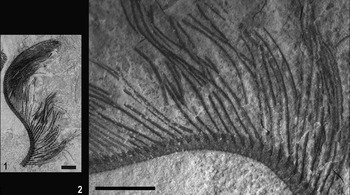
(1) Isolated arm of Kalanacrinus mastikae n. gen. n. sp., paratype, TUG 1736-10; (2) enlargement of proximal portion of arm; all scale bars 5.0 mm.

Type
Holotype: TUG 1736-3A (part), TUG 1736-3B (counterpart).
Diagnosis
Dimerocrinitid with high cone- to bowl-shaped calyx, nodose plate sculpturing, distal-most portions of infrabasal plates visible in lateral view (condition of anitaxial ridge unknown), interray regions flush with rays, first primibrachial hexagonal, primaxil shape heptagonal, third secundibrachial axillary, fixed pinnules present, 20 free arms, atomous free arms, rectilinear uniserial pinnulate brachials, and circular columnals.
Occurrence
Kalanacrinus mastikae n. gen. n. sp. is only known from the Kalana Lagerstätte in the Kalana Quarry, near the village of Kalana, Jõgeva County, central Estonia; Silurian, Llandovery, middle Aeronian.
Description
Crown medium in size; high bowl- or cone-shape (Fig. 4.1, 4.4); arms not grouped; calyx plate sculpturing nodose with median ray ridges (Figs. 4.2, 4.4, 5.1) that divide on radial plates and continue proximally to basal plates.
Infrabasal circlet ~50% of calyx height; presumably five infrabasal plates, only distal corners of infrabasals visible in lateral visible (Figs. 3.3, 4.2, 6.1). Basal circlet ~20% of calyx height, entire circlet visible in lateral view; presumably five basal plates, branches from ray ridges of the superjacent radial plates meet at center of basal plate and divides proximally presumably leading to the infrabasal plates. Radial circlet ~24% of calyx height; radial plates presumably five, heptagonal, ~1.5 times wider than high; larger than basal plate.
Normal interrays do not interrupt radial plate circlet, in contact with tegmen; plate sculpturing nodose. First interradial plate hexagonal, wider than high, intermediate in size between radial and basal plates and first primibrachial plates; second range with two plates, proximal plating 1-2-2-? (Figs. 6.2, 7). Interradial regions and intrabrachial regions within half-rays connect to tegmen. Fixed pinnules may be present.
Primanal present, CD interray wider than normal interrays, but other details of CD interray not preserved.
First primibrachial fixed, hexagonal wider than high, smaller than radial plates but approximately the same size as the first interradial plate in normal interrays; second primibrachial axillary, heptagonal (Figs. 4.2, 6.2). Third secundibrachial fixed, axillary. Intrabrachial plates between adjacent secundibrachial half-rays, plating 1-2-2-?, in contact with tegmen. Tegmen unknown.
Free arms 20, become free on approximately the ninth tertibrachial, atomous (Fig. 5.1). Brachial plates rectilinear uniserial, wider than high; densely pinnulate (Fig. 8) with very long pinnules (Fig. 9.1, 9.2).
Column circular, holomeric, and heteromorphic. In proximal mesistele, nudinodals separated by one priminternodal and two secundinternodals, in more distal parts of the mesistele, tertinternodals present (Figs. 2, 4.3). Nudinodals slightly higher than internodals that are all approximately the same height. Nudinodals with wide, narrow flange that doubles the width of the columnal, first internodal with narrower flange, secundinternodals and tertinternodals without flange (Fig. 4.3). Details of columnal facets and holdfast not known.
Etymology
The species name recognizes Viirika Mastik for her contributions to understanding the Kalana Lagerstätte, which supported this study in many ways.
Materials
Holotype: TUG 1736-3(A, B); paratypes: TUG 1736-4(A, B)–TUG 1736-11; other non-type specimens: TUG 1736-12(A, B), TUG 1736-17(A, B), and many unnumbered specimens.
Measurements
Holotype: TUG 1736-3: CrH, 56.0*; CaH, 14.5; CaW, 9.5; CoH, 2.0*. Paratypes: TUG 1736-4: CrH 52.0*; CaH, 15.0; CaW, 12.7; CoH, 19.0*; TUG 1736-5: CrH, 75.0; CaH, 14.0; CaW, 12.1; CoH, 20.0*; TUG 1736-6: CrH, 70.0; CaH, 15.0; CaW, 7.0; TUG 1736-7: CrH, 59.0*; CaH, 14.0; CaW, 11.5; CoH, 20.0* (note the calyx width was calculated as described above).
Remarks
As noted above, the preservation style of the Kalana Lagerstätte crinoids resulted in flattening of the calyxes, making dimensions of the calyx other than that of the living organism. The true diameter was calculated assuming that the preserved diameter was one-half the circumference, and the true diameter was calculated with the standard geometric formula.
The proximal calyx of the Kalana specimens is rarely visible on specimens that were split during collection. Hence, the presence and characteristic of the infrabasal circlet are only known on a few specimens. The part of the holotype (TUG 1736-3A) exposes a corner of an infrabasal below two basal plates, if the specimen is viewed with a very low-angle highlight (Fig. 4.1, 4.2). Also, TUG 1736-8 is a specimen that combines calcite and moldic/carbon impression preservation. In this specimen, plates of the calyx are preserved in cross section in calcite and reveal that a plate circlet (the infrabasal circlet) is present along the base of the calyx (Fig. 3.3).
A few specimens preserve the plating in normal interradial regions. In TUG 1736-6A, the plates are slightly disarticulated and clearly demonstrate that the first interradial plate is sutured above shoulders of the two radial plates and that the second range consists of two plates (Figs. 5.2, 6, 7). The details of CD interray plating are not known. However, specimen TUG 1736-9 exposes an interray that is clearly wider than those on typical specimens, and that the radial plate positions are too far apart for them to be in lateral contact. This is interpreted to be evidence that the radial circlet is interrupted in the CD interray.
Subclass Pentacrinoidea Jaekel, Reference Jaekel1918
Infraclass Inadunata Wachsmuth and Springer, 1885
Parvclass Disparida Moore and Laudon, Reference Moore and Laudon1943
Order Myelodactylida Ausich, Reference Ausich1998
Family Iocrinidae Moore and Laudon, Reference Moore and Laudon1943
Tartucrinus new genus
Type species
Tartucrinus kalanaensis, n. gen. n. sp.
Diagnosis
As for the type species by monotypy.
Occurrence
Silurian (Llandovery, Aeronian); Estonia (Baltica paleocontinent).
Etymology
This new crinoid is named for Tartu, the second largest city in Estonia and home of the University of Tartu.
Remarks
GIT 405-257, GIT 405-258, and GUT 1736-20 each preserve two radial plates, and TUG 1736-20 has a single radial plate preserved. Some of the radial plates are complete and some are damaged. In all cases, these are simple radial plates. Where preserved, the first primibrachial is always a normal brachial plate. What is known about the radial circlet is: (1) the CD interray is not exposed on any specimens (or is unrecognizable); (2) the iocrinid condition, with a C-ray superradial plate above the level of other radial plates, is either not exposed or absent; and (3) all three specimens with two radials preserved have two adjacent simple radial plates. This latter point is significant because the condition with two adjacent simple radial plates is present in only a limited number of Ordovician and Silurian disparids. Furthermore, if derived families with distinctive attributes (e.g., Calceocrinidae, Zophocrinidae) are eliminated, the only families with two adjacent simple radial plates are the Cincinnaticrinidae (Ordovician, 11212 radial circlet configuration), Columbicrinidae (Columbicrinidae (Ordovician, 11212), Iocrinidae (Ordovician–Silurian, 11211), Maennilicrinidae (Ordovician, 11111), and Tornatilicrinidae (Ordovician, 11211). Of these families, only the Iocrinidae and Cincinnaticrinidae have taxa with distinctive depressions along the aboral cup sutures; and most Cincinnaticrinidae have an aboral cup that is proportionally much higher than iocrinids and Tartucrinus n. gen. Further, taxa in the five families noted above nearly all have plenary radial facets, except iocrinids, of which Iocrinus Hall, Reference Hall1866, Muicrinus Lin et al., Reference Lin, Ausich, Baliński, Bergström and Sun2018, Schaldichocrinus Rozhnov, Reference Rozhnov1997, and Westheadocrinus Donovan, Reference Donovan1989 have peneplenary radial facets. Finally, and certainly not an absolute criterion, of the families considered, only the Iocrinidae ranges into the Silurian. Consequently, by the process of elimination, we regard Tartucrinus n. gen. as a member of the Iocrinidae, recognizing that this assignment is subject to verification when the morphology of T. kalanaensis n. gen. n. sp. can be more fully described.
Within the Iocrinidae, Tartucrinus n. gen. is unique with the following combination of characters: angustary radial facets, three primibrachials, two arm bifurcations, and a holomeric column (Supplemental Table 1). It is most similar to Pariocrinus heterodactylus Eckert, Reference Eckert1984, from the early Silurian (Llandovery, Rhuddanian) of North America. Pariocrinus has basal plates visible in lateral view, plenary radial facets, smooth anal sac plates, four or five primibrachials, at least three arm bifurcations, fixed interradial plates absent, pentagonal to circular column, pentameric column, and a column spiral absent. In contrast, Tartucrinus n. gen. has basal plates visible in lateral view, angustary radial facets, character of anal sac plates unknown, three primibrachials, two arm bifurcations, fixed interradial plates absent, circular column, holomeric column, and a column spiral absent. Tartucrinus n. gen. is compared to all genera in the Iocrinidae in Supplemental Table 1.
Tartucrinus kalanaensis new species
Figure 10
Tartucrinus kalanaensis n. gen. n. sp., note all crown plates preserved with calcite. (1) Lateral view of partial crown, specimen coated with ammonium chloride, holotype, GIT 405-257; (2, 3) lateral view; paratype, TUG 1372-20; (2) partial crown, note carbon film preserved between arms that may be the remnants of a non-calcified anal sac; (3) enlargement of carbon film between arms; scale bar 2.5 mm; (4) lateral view of calyx, paratype, GIT 405-254; all scale bars, except (3), 5.0 mm.

Holotype
GIT 405-257.
Diagnosis
Iocrinid with basal circlet visible in lateral view, angustary radial facets, (character of anal sac plates unknown), three primibrachials, two arm bifurcations, fixed interradial plates absent, column circular, holomeric, and not spiraled (columnal facets in mesistele unknown).
Occurrence
Tartucrinus kalanaensis n. gen. n. sp. is only known from the Kalana Lagerstätte in the Kalana Quarry, near the village of Kalana, Jõgeva County, central Estonia; Silurian, Llandovery, middle Aeronian.
Description
Crown small in size, subovate (Fig. 10.2). Aboral cup small, low cone in shape, maximum width 1.7 times wider than high; plates very convex with deep depressions, as noted below; other plate sculpturing smooth.
Basal circlet ~40% of aboral cup height (less at basal plate-basal plate suture) (Fig. 10.1); basal plate width 2.0 times wider than high, deep depression at radial plate-radial plate-basal plate triple junction, elongate depression along basal plate-basal plate suture. Radial circlet ~60% of aboral cup height (although much more through midline of radial plate), strongly convex proximal to distal middle of plate that continues to brachials, also strongly convex to form a broad ridge to adjoining radial plates; radial plates larger than basal plates. Radial facet angustary, ~40% of distal radial plate width; declivate (Fig. 10.4).
Number of basal plates, number of compound versus simple radial plates, posterior interray plating, and oral surface unknown.
Presumably five free arms, branch twice with isotomous divisions (as known) (Fig. 10.2); primibrachials 1.3 times higher than wide, strongly convex, third primibrachial axillary (Fig. 10.1); secundibrachials 2.5 times higher than wide, strongly convex, in single example second to fifth secundibrachial axillary; tertibrachials unbranched through as many as eight brachials. Arms apinnulate.
Column circular, holomeric, heteromorphic with N3231323 pattern; columnals low, all columnals have a convex latus, but height and width of columnal and degree of convexity are greatest in nodals and become less with each subsequent internodal cycle (Fig. 10.1).
Materials
Holotype: GIT 405-257; Paratypes: GIT 405-258, GIT 405-254B–GIT 405-254B,TUG 1372-20, and TUG 1736-20.
Measurements
Holotype: GIT 405-257: CrH, 14.0*; CaH, 2.9; CaW, 4.3; CoH, 18.0*; Paratypes: GIT 405-258: CrH 50.0*; CaW, 10.0 ; CoH, 20.0 *; TUG 1372-20: CrH, 48.0; CaH, 5.0; CaW, 9.0; CoH, 18.0*.
Remarks
Four incomplete specimens of Tartucrinus kalanaensis n. gen. n. sp. are known from the Kalana Lagerstätte. All expose a partial aboral cup, a few to several arms (Fig. 10.2, 10.3), and a length of column. Although strong convexity of aboral cup plates with depressions at the plate triple junctions and along the basal plate-basal plate, sutures are reminiscent of some Ordovician camerates (e.g., Reteocrinus and Xenocrinus), this Estonian taxon is monocyclic; the arms lack pinnules; and there are no fixed interradial plates, all of which identify this as a disparid.
Despite the fact that Kalana Lagerstätte specimens of this species are preserved with 3D calcite, specimen TUG 1376-20 has an organic residue within the enclosed arms. There is no plating associated with this organic residue, so one can only speculate on its origin. Possibilities included a non-calcified anal sac (Kammer and Ausich, Reference Kammer and Ausich2007), soft tissue from the ambulacra, or a combination of both.
Accessibility of supplemental data
Color images of Kalana crinoids and diagnostic tables are available from the Dryad Digital Repository: https://doi.org/10.5061/dryad.68pv736.
Acknowledgments
We thank the following groups for their support that made this work possible: National Geographic Society (NGS 60031112) (W.I.A. and M.A.W.); Ohio State University Emeritus Academy (W.I.A.); The College of Wooster Luce Fund (M.A.W.); and Estonian Research Agency project PUT 1484 (O.T.) Discussions with W.B. Lyons were helpful, and B. Deline, T.W. Kammer, K. Kirsimäe, and S. Zamora significantly improved an early draft of this manuscript.