Dancing in the Archaeological Museum
This article examines from an artist-researcher perspective the durational solo dance work Likely Terpsichore? (Fragments), which I created for and performed at the Ashmolean Museum of Art and Archaeology, Oxford (UK) in April 2018.Footnote 1 This work emerged as a key part of a wider practice-as-research project probing shifting experiences of temporality when choreography “performs” as museum exhibit.Footnote 2 The project asked how we might consider the live female dancer in the archaeological museum as a counter-archive or, to use performance theorist Rebecca Schneider's reworking of philosopher Michel Foucault's term, as a site of “counter-memory” (Schneider Reference Schneider2011, 105). How might dance's presence in the museum allow an alternative visibility, a hypervisibility, for those ancient female bodies previously rendered invisible—or, only partially visible—by history? Furthermore, how might the presence of the live female dancer in the museum allow certain buried female histories to surface and be “re-collected,” becoming—through performance—part of the museum's collection (at least, temporarily)? By unpacking these questions here, I aim to make a claim for dance in the archaeological museum itself as a potentially subversive act of what I term “radical archaeology,” both in terms of how it plays on notions of disremembering and remembering histories, and how it seeks to disrupt received notions of how we view and understand ancient history and culture.
Dance in the art museum in the UK and continental Europe is once again in the choreographic zeitgeist, with major events such as French choreographer Boris Charmatz's Musée de la danse (Dancing Museum), and Belgian choreographer Anne Teresa de Keersmaeker's Work/Travail/Arbeid—both at Tate Modern, London (UK), in Reference Charmatz2015 and Reference De Keersmaeker2016 respectively—as select examples among manyFootnote 3 and with dance scholarship reflecting this.Footnote 4 However, although the practice of dance in the art museum seems to be enjoying exponential growth, as does the scholarship on it, dancing in the museum of ancient history and archaeology seems a rare phenomenon, at least in the UK.Footnote 5 There are historical antecedents for it: we might think of the pioneers of modern dance in the early twentieth century, such as Isadora Duncan (c.1877–1927), working in the British Museum, for example. But why dance in the archaeological museum today? Such was my question as I embarked upon the creation and performance of Likely Terpsichore? (Fragments) at the Ashmolean Museum.
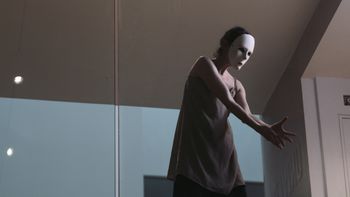
Marie-Louise Crawley in mask in Likely Terpsichore? (Fragments), Ashmolean Museum of Art and Archaeology, UK, 2018. Photograph: Brandon Kahn.

Likely Terpsichore? (Fragments)
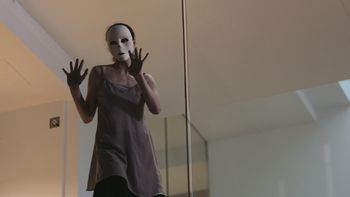
This durational work, performed over two weeks in April 2018 throughout the opening hours of the museum (10:00 a.m.–5:00 p.m.), was composed of four dance fragments. I performed each of the four solos—subtitled Galatea, Myrrha, Philomela, and Medusa—in the signature glass windows and bridges that connect the Ashmolean's galleries. The performances, viewed behind glass, thereby offered a visual echo of the glass vitrines enclosing ancient artefacts throughout the museum. The dance was juxtaposed against the museum's other representations of female histories—in the surrounding marble sculptures, fixed in pigment on frescoes and ancient vases, and more strikingly and shockingly still, in the physical remains of the exhibited Romano-Egyptian female mummified bodies. I must pause here to remember the sensations of shock and anger that I felt on an initial site visit to the Ashmolean, when I first encountered the female Romano-Egyptian mummies on display in the museum's Ancient Egypt and Nubia galleries. Some of these female “remains” even have mummy portraits, painstakingly restored prior to the Ashmolean's redisplay and the five-million-pounds’ Egypt project that brought them out from storage in 2011. The oldest of these portraits, on linen, is of a young woman dating from 55–70 CE: she was excavated by Flinders Petrie (1853–1942) at the Roman cemeteries of Hawara in Fayum, south west of Cairo, in 1911. However, although this woman's body—and a representation of her face—is undeniably materially present in the Ashmolean, I was struck by how her story, and a sense of who she was, is absent. On seeing her body and the bodies of other “unknown” women on display, I began to ask who these women really were. Similarly, on that same first site visit, as I walked through the museum's gallery 21, the Randolph Greek and Roman Sculpture Gallery, my eyes were drawn toward a marble sculpture of a seated woman. This statue was missing both its head and arms. The label next to her informed me that she is a Roman artifact (50–150 CE) and, despite missing the identifiable lyre, is considered to be “likely Terpsichore, the muse of the dance.” I was struck by the term “likely” and how the fragmented statue's very identity is defined by what is missing. Significantly, it was the curt descriptive label next to this sculpture that gave the final durational dance-work its title.
Half exhibit, half dance installation, the four solos were performed in silence (or in the relative, ambient silence of the museum). Galatea, Myrrha, Philomela, and Medusa are all female characters from Roman author Ovid's (43 BCE–17 CE) Metamorphoses, a text written contemporaneously to the development of the Roman dance-theater pantomime form, tragoedia saltata (danced tragedy). All four solos take their root in the foundational principles of this ancient form to somehow explore how, in the moment of performance itself, we might reconfigure a (performance) history into something new. The four fragments feature classical heroines whose voices and bodies have been appropriated throughout history (even by Ovid), and aim to reclaim a space in history (and a body in the present) for them. The solos were performed on a loop; as such, they could be viewed in any order, and, significantly, even partially viewed as fragments. Housed in their glass “display cases,” they could also be viewed and reviewed from different perspectives; from above, from below, close-up, or at a distance, the visitor chancing upon the work could choose to spend as much or as little time with each work as they wished in the same way as they might view another artifact in the museum's collection. In viewing the dance in the museum setting, my aim was that the viewer-spectator somehow “completed” the alternative glimpse of an alternative female bodily history offered by the dancer's performance. This was further reinforced by the way in which viewers could experience the work in a fragmentary fashion: walking around the museum, they might only see one of the four solos, or they might glimpse short fragments of each, seen from above, below, face-to-face, close-up, or from a distance—the live dancer seen against marble friezes and sculptures, caught in passing. Each viewer might then reassemble the performance's fragments in a different order, putting the pieces back together in a way unique to them, re-collecting the female stories my dance was putting on display through my body in both senses of the word.
We often think of the museum as a temple to memory, as the resting place of history, and as the space in which we come to reflect upon that history, to recollect. Yet the very etymological definition of “museum” is a shrine to the Muses; in my own dance practice in the Ashmolean, the museum is very specifically the shrine to both Clio, the muse of history, and also to Terpsichore, the muse of the dance (as well as of their seven sisters). When I think of Clio and Terpsichore at play in the archaeological museum, I cannot help but see before me traces of dance scholar Susan Foster's vivid description in Choreographing History (Reference Foster1995) of the duet between these two Muses, dressed in their combat outfits and sneakers, as they enter some sort of choreographic tussle. In Foster's imagination, their sweaty, fleshy duet is a dialogue playing out the tensions, frictions, and collisions between the rhetorical body and the dancing body. For Foster, Terpsichore senses “the need to rationalize choreography as persuasive discourse” and Clio realizes “the need to bring movement and fleshiness into historiography” (18). These Muses know their differences, yet they also have an idea of their common strength: the positive force of a coalition emerging from their collision, a coalition to resist and disembody the “tyrant” (18). As I dance in the archaeological museum, I, too, feel that I am playing out this collision and coalition between Clio and Terpsichore. In a practice that somehow attempts to offer an alternative visibility for those who have been partially buried by history, and of whom only fragments are remaining, the coalition of Clio and Terpsichore together presents a resistance against the looming tyrant of a patrilineal, institutionalized history. These two sister Muses are at work resisting the status quo that the museum, as a house of authority, of institutionalized power, might represent. However, for me, the picture that Foster paints is itself fragmentary and incomplete. I wish to add a third character, an older (perhaps wiser) figure waiting in the wings, watching and witnessing: memory. For, lest we forget, the mother of the Muses—and of Clio and Terpsichore—was Mnemosyne, the goddess of memory. It is memory who births history, it is memory who births the dance, and it is she who will eventually call them to account.
If we think about the ancient Greek idea of the archive—the ἀρχεῖον—as the home of the tyrant who has the power, we might say that the archaeological museum houses the very monuments of history and of collective memory that define who holds the power and who does not. This idea necessarily relies on a definition of a museum as the very embodiment of historical, cultural heritage. In looking at a museum like the Ashmolean, it is important to keep in mind the high stakes of its history and politics as the UK's oldest museum, and the fact that museums such as the Ashmolean emerged in the seventeenth and eighteenth centuries as storehouses of collective cultural memory.Footnote 6 As such, we might think of the museum as a permanent and static fixture embodying cultural memory (what Diana Taylor (Reference Taylor2003) would indeed classify as an archive). Yet, due to the institutional developments brought about by the movement of the “New Museology,”Footnote 7 museums have gradually become—and are becoming—much more fluid, transient spaces where the historicized past meets the present moment. It is within this framework that performance has entered the museum. In fact, as museology scholar Helen Rees Leahy suggests, it is “the inherent transience and fluidity of performance that confronts the apparent solidity and stasis of the museum” (Reference Rees Leahy, Jackson and Kidd2011, 28). It is performance, which takes place in the present moment, in all its brokenness and incompleteness, but also in its movement, that challenges the static, frozen quality of the institution. For me, Rees Leahy's suggestion chimes with Foster's description of the battling, moving Muses. Terpsichore challenges Clio to enter the fray, which then becomes a dance; and, as Foster suggests, it is this constant movement, this dance, which then resists, challenges, and disrupts the authorial stasis of the museum as archive, the house of collective memory.
Writing on museum and heritage theater, performance and theater scholar Paul Johnson points to performance in the museum as a potential alternative means of writing history:
If in the New Museology, … meaning is socially determined and assigned, then surely history must be written in a similar way, and indeed the museum or heritage site is one of the locations where an embodied form of that writing takes place, and so performance itself can be one of the ways of writing. (Reference Johnson, Jackson and Kidd2011, 58)
Whereas Johnson is here talking about museum theater, he makes a valid point for what dance performance might also be doing in the archaeological museum. As the writing of the dance, choreography in the museum offers an alternative means of how we might write history. Yet it also offers an alternative means of how we might read history, too, and how we might view it. I would like to focus now on exactly how dance performance does this, in relation to the ideas of the monumental (the solid, static objects of collective memory, as defined by those holding the power) and the fragmentary.
Indeed, whereas the museum might purport to exhibit the monumental, these monuments are dislocated in time and space: they, too, are often incomplete and fragmented. We need only think of the Parthenon Marbles housed in the British Museum, and the gaps remaining on the Parthenon, where they originally were; the Marbles are half here and half there, suspended across geographical space as well as across historical time.Footnote 8 It is this dislocation and fragmentation that can lend such poignancy to seeing ancient objects on display. Furthermore, as performance studies scholar Jennifer Parker-Starbuck writes, the very nature of their fragmentation has now become an almost performative feature of museum exhibition and display:
A shift toward how collections and objects perform histories, and what the performative curatorial strategies of cultural narratives might signal about these histories, has begun to shape museums very differently. I was, for example, surprisingly moved when I visited the then newly opened Acropolis Museum in Athens. Walking through the great hall around the replica of the Acropolis, studying the spaces where the missing Parthenon Marbles belonged as I looked upward at the actual Parthenon on the hill was a surprisingly poignant moment—the missing objects were specifically curated to be as belonging within the gaps in the reconstruction. (Parker-Starbuck Reference Parker-Starbuck2017, 9)
It is the gaps between the fragments that seem to speak to us across time and space.
In 2017, at the opening symposium of the Kings College London research project “Modern Classicisms,” which explores the enduring legacy of Greek and Roman visual culture in contemporary art, artist Marc Quinn made a strong case for the classical fragmentary:
If all classical culture had been perfectly kept, we wouldn't be interested … if it's fragmented, it has time in it. (Reference Quinn2017)Footnote 9
Quinn's proposition is a striking one for my own dance explorations. It is the fragmentary that contains time; taking this further, we might say that it is from the fragmentary that time might escape. It is through the gaps between fragments that the past may escape to the present; it is through the fragmentary that the past can speak to the present and, conversely, the present reply to the past. It is through the fragmentary that Clio dances with Terpsichore and, with Mnemosyne as witness to their dancing, they are able to resist the historical status quo. It is essential to point out here that I am claiming a positive sense for the fragmentary, particularly in terms of the feminist critical frameworkFootnote 10 underpinning my practice-as-research in the museum.
This idea of the fragmentary, of completing the picture, of putting the pieces back together again, as I asked of my spectators, also speaks to dance scholar Gabriele Brandstetter's work on the fragmentary nature of performance in the museum as offering an alternative to traditional historiography.Footnote 11 Brandstetter (Reference Brandstetter2016) points to how that which she terms the “museum in transition”Footnote 12 can serve as a cultural model for restructuring traditional categories of narrative. Following on from Jean-François Lyotard's La Condition Postmoderne (Reference Lyotard1979), Brandstetter posits the “historeme” or the anecdotal or unpublished as a contrast to the grand récit (Lyotard's “meta-narrative”) and uses dance in the museum, citing redoings of postmodern dance history in the museum (such as those in French choreographer Boris Charmatz's Musée de la danse), to state how performance can challenge critical historiography. Brandstetter suggests that, although traditional historiography tells history with a beginning, middle, and end, it is performance in the museum that can offer an opportunity for the anecdotal to be revealed, and this precisely because of performance's fragmentary nature. In fact, one of the strongest arguments for including performance within the repertoire of interpretative strategies a museum has at its disposal is that “it provides museums with a resource that helps them fill some of the inevitable gaps in their collections and the narratives that they tell” (Jackson Reference Jackson, Jackson and Kidd2011, 21). It is in this recovery of distant, hidden, fragmented, and marginalized voices through performance that an attempt can be made to re-present that which is absent.
Dance as Radical Archaeology
Thinking about connections between writing, reading, viewing, and dancing history, leads me to highlight the relationship between choreography and archaeology that is central to my practice. I am indebted here to an argument first made by archaeological scholars Michael Shanks and Christopher Tilley in their seminal text, Re-Constructing Archaeology ([Reference Shanks and Tilley1987] 1992), and, in particular, their reading of the archaeologist as some sort of time traveler navigating between the past (that which is being “re-constructed”) and the present (the point at which that reconstruction is happening in the here and now). Shanks and Tilley's reading of the archaeologist's relationship with time rests on an understanding of the contrast between history and memory. History, a word containing both a subjective and objective genitive (Ricœur Reference Ricœur and Thompson1981), is to be regarded both as what has happened and the apprehension of that happening. As such, it does not take place primarily as a past event, that which is gone, for “there is no abstract concept of ‘event’ which exists separately from the practice of apprehending and comprehending the past” (Shanks and Tilley [Reference Shanks and Tilley1987] 1992, 17). As Shanks and Tilley point out, there is no verb corresponding to the noun “history,” and the absence of such a verb as “to history” is something that they wish their study to address. There is a related verb—“to remember”; and memory “presumes the active practice of remembering, incorporating past into present; it is a suspension of the subject-object distinction” (17). Furthermore, memory is linked to storytelling, a mnemonic act addressing an audience. Here the archaeologist becomes a “story-teller” (again Shanks and Tilley's term), and the act of remembering the past becomes a performance. Furthermore, it is a performance that does not attempt to construct a coherent continuity, to tell the whole story. Such an attempt would be fruitless, as the past is never fixed, it is forever being reinterpreted, and the hermeneutic reinterpreting is endless:
The archaeologist may textually cement one piece of the past together but almost before the cement has dried it begins to crack and rot … archaeology should be conceived as the process of the production of a textual heterogeneity which denies finality and closure; it is a suggestion that archaeologists live a new discursive, practical relation with the past. This relation is one of ceaseless experiment, dislocation, refusal and subversion of the notion that the past can ever be “fixed” or “tied down” by archaeologists in the present. It involves an emphasis on the polyvalent qualities of the past always inscribed in the here and now. (Shanks and Tilley [Reference Shanks and Tilley1987] 1992, 20)
Shanks and Tilley's groundbreaking argument has undeniably paved the way for how I consider the choreographer and dancer in the museum to be very similar to the archaeologist. The dancer in the museum is navigating past and present; she is “doing” history, remembering, storytelling; choreography, like archaeology, continually inscribes “the polyvalent qualities of the past” (Shanks and Tilley [Reference Shanks and Tilley1987] 1992, 20) in its presentness. The relationship between archaeology and performance has emerged as influential on performance theory and practice (Pearson and Shanks Reference Pearson and Shanks2001) and questions concerning connections between the two disciplines have been addressed at length by Giannachi, Kaye, and Shanks (Reference Giannachi, Kaye and Shanks2012). Building on these studies exploring the “negotiations of tenses of place and time” (11) that both archaeology and performance entail, and while not wishing to do a disservice to archaeologists, I would like to suggest that, in such negotiations, dance in the museum perhaps has the power to go even further than archaeology. Dance in the museum is, in a sense, something I have begun to coin as “radical archaeology.” Whereas archaeologists aim to survey, excavate, and produce texts, and there is rarely recourse to an empathetic (or bodily) understanding of the past, my museum dance practice aims to communicate the emotions and sensations of women from the past to its viewers in the present to encourage in them an empathetic, visceral connection to the past. This radical archaeology, which takes place in the bodies of both the dancer and the viewer, is a grounding principle behind my dance practice in the museum. Although I am writing from the choreographer-dancer's perspective, and an outline of the “audience's” reception of the work is limited here, it seems clear that the physicality of the dance and the connection that it is able to make on a visceral, emotional bodily level is significant in terms of how it might enable a re-viewing of the museum collection, and also a rethinking of what that collection represents.Footnote 13
The idea of dance as radical archaeology chimes with work currently being proposed in the fields of phenomenology and sensory studies in archaeology,Footnote 14 and there is indeed some overlap in the field of sensory classical archaeology (e.g., Betts Reference Betts2017). However, sensory classical Roman archaeology has to date tended to focus on the sonic and the haptic, rather than the kinesthetic. Likely Terpsichore? (Fragments) affirms dance practice as a vital and necessary base for inquiry into ancient history, culture, and performance. It reflexively speaks back to classical archaeology itself as a sensory, embodied practice and how that practice might meet the museum. Its subversion of the museum's institutional narrativizing points to the nature of dance as an act of radical archaeology, asserting dance not merely as an art object or educational project to enliven or animate the museum collection, but as an integral element of that collection, and therefore of our understanding of the histories represented within it.
Fragments and Monuments
The archaeological museum is often a repository of fragments of monuments, which are themselves repositories of fragmentary cultural memory. Classicist Helen Lovatt posits that an exploration of the monumental brings together two sides of the gaze, “the powerful and disempowered, subject and object, same and other, male and female, to explore the end result of epic: the traces that are left behind” (Reference Lovatt2013, 347; my emphasis). To illustrate her point, Lovatt uses an episode drawn from Ovid's Metamorphoses—that of Perseus, he who slays the snake-haired gorgon Medusa, whose female gaze petrifies anything that dares look it in the eye. This same episode lies at the root of “Medusa,” one the four dance fragments of Likely Terpsichore? that I created for the Ashmolean.Footnote 15 Furthermore, in her inquiry into how the epic gaze interacts with epic acts of preservation and remembrance (acts that, I would argue, are within the domain of the archaeological museum), Lovatt evokes the indeterminate, elusive gaps in the epic monument (Reference Lovatt2013, 274). In response to Lovatt, I suggest that live dance in the museum as simultaneously fragmentary and monumental can offer such elusiveness, at least for the fleeting moment of performance.
As Lovatt reminds us, Medusa symbolizes the monstrous-feminine, a figure who has been appropriated by both psychoanalysis and feminism (e.g., Sarton Reference Sarton1971; Cixous Reference Cixous1975; Rimell Reference Rimell2006), a “pin-up for female objectification … the petrifying image of a mask-like female face … a synecdoche for women in epic: monster, uncanny, associated with the divine, powerful, at the same time as she is raped, objectified, an object conquered and exchanged by men to give them power” (Lovatt Reference Lovatt2013, 356–357). Significantly, classics scholar Mary Beard (Reference Beard2017) points to the decapitated head of Medusa as a defining image of the radical separation—real, cultural, and imaginary—between women and power in Western history: “one of the most potent ancient symbols of male mastery over the destructive dangers that the very possibility of female power represented” (71).Footnote 16 Furthermore, the head of Medusa, the gorgon's head, the object held aloft by the victorious Perseus, was itself popularly represented in antiquity on an object known as a gorgoneion, an apotropaic amulet. On this object, Medusa's face becomes a monument, a visible sign that stimulates an act of remembrance. Author Geoff Dyer describes such historical monuments as “permanent, built to last, [that have] none of the vulnerability of the human body” (Dyer Reference Dyer1995, 127). I wonder how the live, female body in the museum, surrounded by fragmentary monuments, might itself defy Dyer's definition and become monumental through the fragmented dance and through its very vulnerability? Might the Medusa's head one day dance its way through the museum alongside her body?
Marie-Louise Crawley in mask in Likely Terpsichore? (Fragments), Ashmolean Museum of Art and Archaeology, UK, 2018. Photograph: Brandon Kahn.

“Medusa”
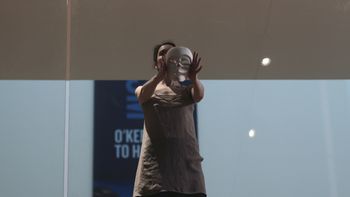
In constructing the choreography of “Medusa,” I sought to explore the idea of the ashamed and frightened young woman behind the monstrous apotropaic “monument” (i.e., the head of Medusa as apotropaic object). I strove to subvert Medusa's role in history as the one whose hair is made of snakes and whose monstrous gaze turns to stone anyone she looks at. Rather than dance Medusa as the one who petrifies, I aimed to dance Medusa's own petrification, her own metamorphosis, which has made her take on the mask of the monster. I returned to Ovid's Metamorphoses (4.753-803), in which it is Perseus who gets to tell her story; again, the man speaks for the woman, as he brandishes her impotent head around for all to see. It is Ovid who tells us that Medusa was only transformed into a monster because it was a punishment: her crime—having been raped by Poseidon.Footnote 17 In “Medusa,” the motif of the snakes—a continuous, circular movement of the hands, recalling the helissein (a coiling, twisting movement) of Roman pantomime dancers,Footnote 18 emanates from within my pelvis and torso, a manifestation of her fear and shame. The snakelike movement of the hands, wrists, and fingers becomes an increasingly inescapable binding motion, which gradually overtakes the whole body. The coiling motion develops from the arms and torso into the hips and legs, pulling me into deliberately repetitive and accumulative sequences of ronds de jambes and turns, which trace circular figure eight patterns on the floor.Footnote 19 Enclosed within the glass confines of the vitrine-like balcony, the circular phrase accelerates, Medusa's transformation an unstoppable force hurtling through my body and the space surrounding me. This frenetic phrase was punctuated by moments of what I came to term stillness-that-was-not-quite-stillnessFootnote 20—hands crowning the head, snakelike above the mask. In this moment of moving stillness, I wanted to subvert the idea of stillness as petrification and Medusa's petrifying gaze. After a long moment's stillness-that-was-not-quite-stillness, in which my breath danced heavily as my heart rate slowed, the snaking hands motif would begin again and the accumulative phrase repeat to the other side of my glass enclosure. Again, the repetition of the movement served to stress the repetition of this particular story through time and history, the impossibility of escape from it. Rape and blame doomed to repeat throughout the centuries: the woman punished, deemed monstrous. As the dance came to a final “stillness,” facing the Ashmolean's colossal front doors, my playing of the apotropaic gaze was broken by my removing the mask from my face.Footnote 21 My hands stretched the mask out in offering to the visitors surrounding me on all sides—below me, above me, opposite me—as if to say, “You have only seen the mask that history has given her, but she is a woman. This, too, is Medusa.” I revolved slowly, my arms stretched out to offer the mask to every viewer whose gaze I was able catch. In those final moments, I aimed to return the gaze, but also to hold it, acknowledging a moment of witness. We are all Medusas. We are all witnesses to this story. As choreographer-dancer, I see “Medusa” as an example of dance in the museum as the moment when the apotropaic monument is broken and shatters to pieces, that moment which philosopher Paul Ricœur speaks of as the “rupture of memory” (Reference Ricœur, Blamey and Pellauer2004, 11). It is a moment of resistance, a dance of resistance; it is dance as radical archaeology.
Marie-Louise Crawley in Likely Terpsichore? (Fragments), Ashmolean Museum of Art and Archaeology, UK, 2018. Photograph: Brandon Kahn.