Introduction
The Corded Ware phenomenon of Northern and Central Europe (c. 2900–2000 cal BC), despite being named for its characteristic pottery, is frequently associated with strictly regulated mortuary practices (e.g. Ebbesen Reference Ebbesen2006; Haak et al. Reference Haak, Brandt, de Jong, Meyer, Ganslmeier, Heyd, Hawkesworth, Alistair, Pike, Meller and Alt2008; Meyer et al. Reference Meyer, Brandt, Haak, Ganslmeier, Meller and Alt2009). Even though there is some variation (Furholt Reference Furholt2014: 75–76 and references therein), the Corded Ware deceased were often placed in a crouched position, with gender differentiation reflected in the orientation of the body. The grave goods (e.g. ground-stone battle axes, cord-decorated beakers and bone, and amber and copper pendants and ornaments) are likewise prescribed by gender and placed around the body (Larsson Reference Larsson2009: 60–62 and references therein).
Although the material culture used in Corded Ware funerary rituals is well known, a full appreciation of the associated mortuary practices is still lacking. In fact, even though evidence for internal wooden and stone structures is commonly documented in Corded Ware mortuary contexts (e.g. Fischer Reference Fischer1956; Malmer Reference Malmer1962; Hansen Reference Hansen1994; Vander Linden Reference Vander Linden2007), detailed information on the ways that structures within the grave might have been furnished is largely missing. The use of textiles, mats and furs to cover grave pit walls and floors is commonly documented in Yamnaya Culture graves (Heyd Reference Heyd, Borgna and Müller-Celka2011). This culture represents the best-known proxy for the incoming gene-flow that occurred in Europe during the third millennium BC, resulting in the formation of the Corded Ware phenomenon (Allentoft et al. Reference Allentoft, Sikora, Sjögren, Rasmussen, Rasmussen, Stenderup, Damgaard, Schroeder, Ahlström, Vinner, Malaspinas, Margaryan, Higham, Chivall, Lynnerup, Harvig, Baron, Della Casa, Dabrowski, Duffy, Ebel, Epimakhov, Frei, Furmanek, Gralak, Gromov, Gronkiewicz, Grupe, Hajdu, Jarysz, Khartanovich, Khokhlov, Kiss, Kolář, Kriiska, Lasak, Longhi, McGlynn, Merkevicius, Merkyte, Metspalu, Mkrtchyan, Moiseyev, Paja, Pálfi, Pokutta, Pospieszny, Price, Saag, Sablin, Shishlina, Smrčka, Soenov, Szeverényi, Tóth, Trifanova, Varul, Vicze, Yepiskoposyan, Zhitenev, Orlando, Sicheritz-Pontén, Brunak, Nielsen, Kristiansen and Willerslev2015; Haak et al. Reference Haak, Lazaridis, Patterson, Rohland, Mallick, Llamas, Brandt, Nordenfelt, Harney, Stewardson, Fu, Mittnik, Bánffy, Economou, Francken, Friederich, Garrido Pena, Hallgren, Khartanovich, Khokhlov, Kunst, Kuznetsov, Meller, Mochalov, Moiseyev, Nicklisch, Pichler, Risch, Rojo Guerra, Roth, Szécsényi-Nagy, Wahl, Meyer, Krause, Brown, Anthony, Cooper, Alt and Reich2015; Kristiansen et al. Reference Kristiansen, Allentoft, Frei, Iversen, Johannsen, Kroonen, Pospieszny, Price, Rasmussen, Sjögren, Sikora and Willerslev2017). Similar practices may, therefore, have occurred in the Corded Ware tradition. In fact, the Corded Ware graves already show strong affinities to the Yamnaya burial rituals; for example, in the practice of a single inhumation under a barrow (Kristiansen et al. Reference Kristiansen, Allentoft, Frei, Iversen, Johannsen, Kroonen, Pospieszny, Price, Rasmussen, Sjögren, Sikora and Willerslev2017: 336).
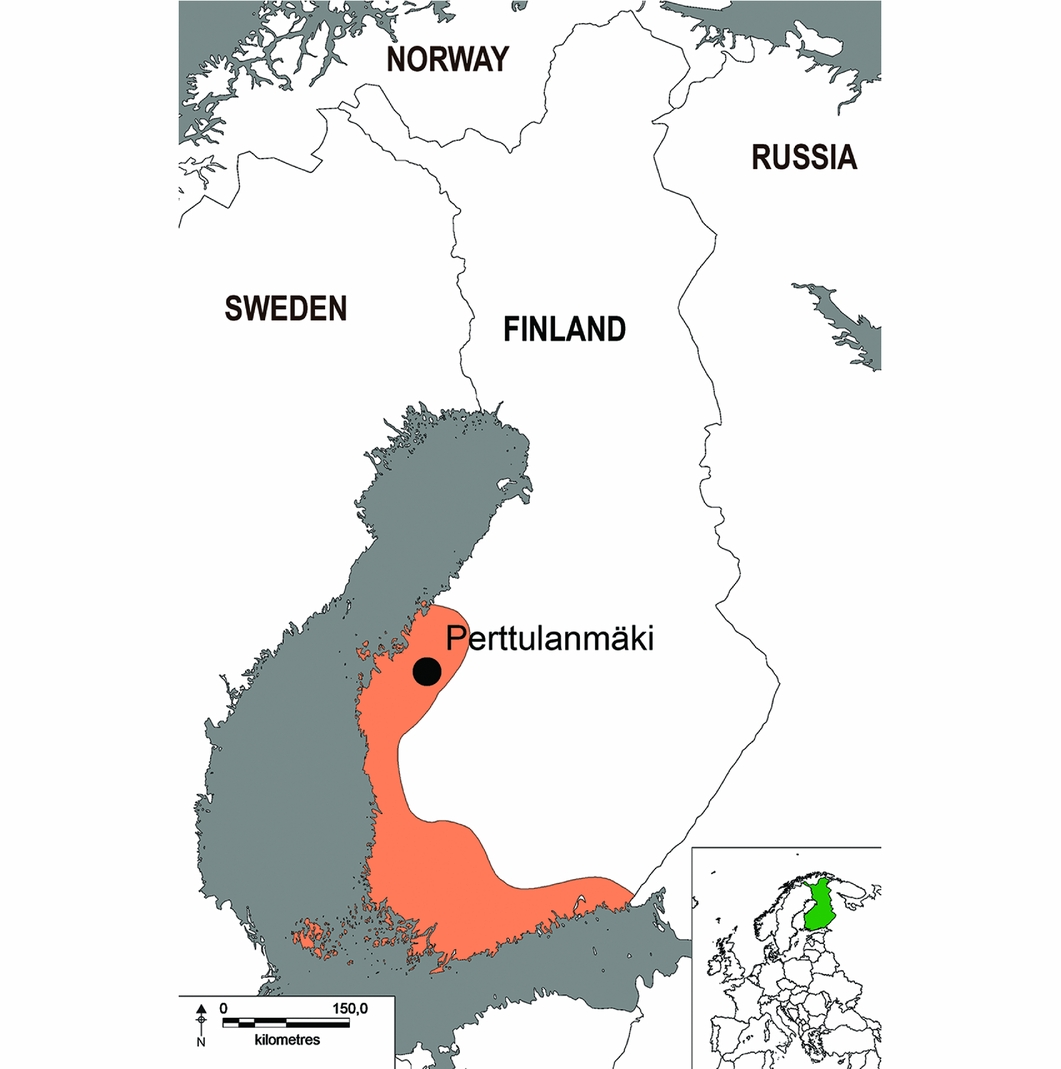
New information on Corded Ware mortuary practices has come from the northern periphery of the cultural area. The results are based on microscopic analyses conducted on soil samples collected from the Perttulanmäki Corded Ware grave in western Finland (Figure 1). These analyses suggest that a goat skin had been placed in the grave. This discovery is important as it provides clear evidence of a mortuary practice that has only in rare cases been previously suspected (e.g. Torvinen Reference Torvinen1979; Meurkens et al. Reference Meurkens, van Beek, Doorenbosch, Fokkens, Heunks, Debono Spiteri, Knippenberg, Meirsman, van Hees and Verbaas2015).
Location of the Perttulanmäki site. The distribution of the Corded Ware phenomenon in Finland is marked in orange. Map: K. Vajanto.

The Corded Ware phenomenon in the Finnish territory
The Corded Ware phenomenon has commonly been associated with a mixed pastoral and arable economy (e.g. Hecht Reference Hecht2007; Lõugas et al. Reference Lõugas, Kriiska and Maldre2007; Larsson Reference Larsson2009: 71; Müller et al. Reference Müller, Sergély, Becker, Christensen, Fuchs, Kroll, Mischka and Schüssler2009; Sjögren et al. Reference Sjögren, Price and Kristiansen2016). In Finland, however, no clear evidence of cultivation or animal herding has so far been discovered. Instead, the Finnish Corded Ware phenomenon (c. 2800/2700–2300 BC) is characterised by the appearance of cord-decorated pottery and battle axes in archaeological contexts (e.g. Äyräpää Reference Äyräpää1923, Reference Äyräpää1939; Edgren Reference Edgren1970, Reference Edgren and Blomstedt1984; Nordqvist & Häkälä Reference Nordqvist and Häkälä2014). Artefact distributions show that the core area of Corded Ware settlement was in southern and western Finland (Figure 1). In contrast to the evidence from other regions, Finnish Corded Ware was also associated with large numbers of settlement sites, which are often found in the locations of Early Neolithic (c. 5200–3900 cal BC) hunter-gatherer settlements (Äyräpää Reference Äyräpää1923: 26–27; Edgren Reference Edgren and Blomstedt1984: 75; Nordqvist & Häkälä Reference Nordqvist and Häkälä2014).
No domestic faunal remains dating to the Corded Ware period have so far been discovered in Finland, yet the location of Finnish Corded Ware settlements on previously occupied dwelling sites with fertile soils has been seen as indicative of a subsistence culture that relied on a pastoral economy (Äyräpää Reference Äyräpää1939: 118; Edgren Reference Edgren and Blomstedt1984: 75; Bläuer & Kantanen Reference Bläuer and Kantanen2013). This interpretation has been further supported by recent lipid analyses conducted on Finnish Corded Ware pottery, which confirm the presence of milk fats derived from domestic livestock (Cramp et al. Reference Cramp, Evershed, Lavento, Halinen, Mannermaa, Oinonen, Kettunen, Perola, Onkamo and Heyd2014). Estonian Neolithic animal bone material also suggests that sheep, cattle and pigs were present south of the Gulf of Finland during the Corded Ware period (Lõugas et al. Reference Lõugas, Kriiska and Maldre2007); the absence of domestic animal bones from Finland could, therefore, simply be due to taphonomic processes, as unburnt osseous material is generally not preserved in the acidic soil of Finland.
The dearth of preserved organic materials has also complicated the study of Corded Ware mortuary practices in Finland. Most of the sites interpreted as Corded Ware burials are actually stray finds of Corded Ware pottery or axes with no associated burial structures (Lappalainen Reference Lappalainen2007: 5–6). Knowledge of Corded Ware mortuary rites in Finland is therefore based mainly on the few sites that provide evidence of a possible grave feature together with grave goods typical of the period (e.g. Kivikoski Reference Kivikoski1934; Edgren Reference Edgren1958; Siiriäinen Reference Siiriäinen1974; Torvinen Reference Torvinen1979; Purhonen Reference Purhonen1986). From these, it seems that most of the burials discovered are pit graves, which are also common in areas of northern and central Poland and the Baltic States (Larsson Reference Larsson2009: 61). It must be noted, however, that the quantity of graves is small, and in many cases, the grave structure has been destroyed (e.g. by later land use) or only partially excavated. Our understanding of Finnish Corded Ware graves and mortuary practices is thus fragmentary at best.
Previous studies at the Perttulanmäki site
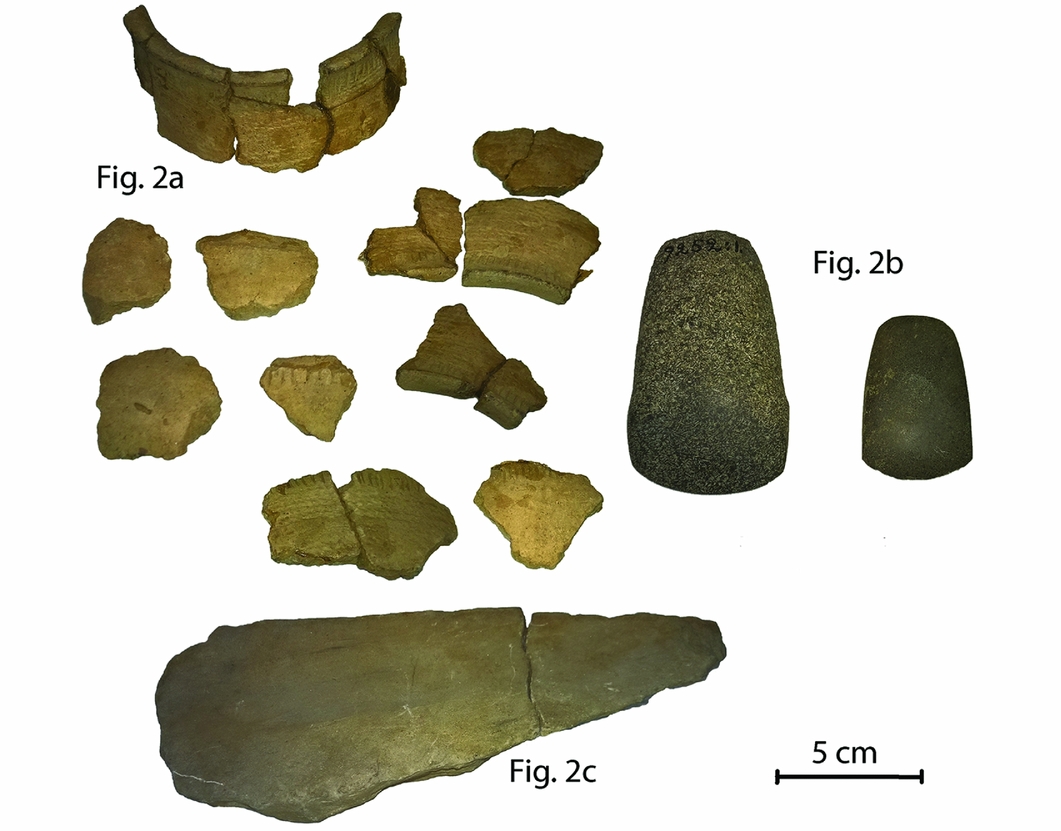
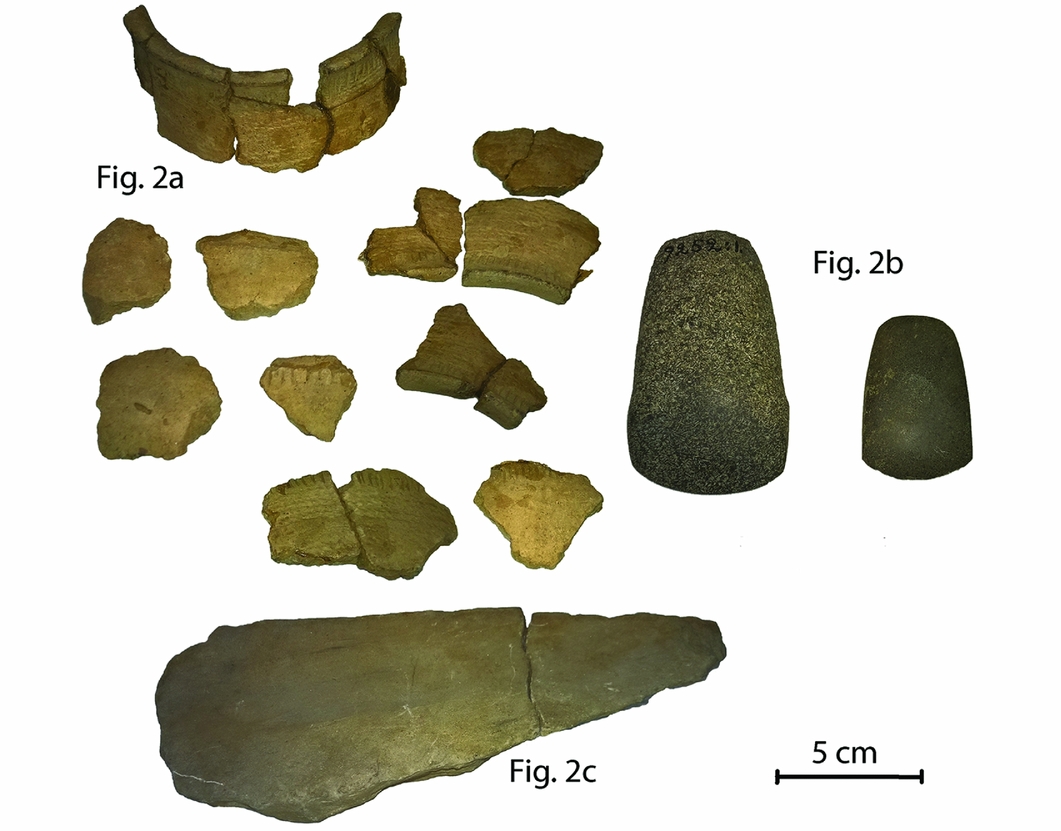
The Perttulanmäki grave is located in Kauhava municipality in southern Ostrobothnia (Figure 1), and lies at the very northern border of the Corded Ware's cultural sphere of influence in Finland. It was discovered in the early 1930s by local farmers who found sherds of Corded Ware pottery, a whetstone and a fragmented adze (Figure 2) from an area of “black soil with a length of nearly two meters” (Äyräpää Reference Äyräpää1930: 1). Archaeologist Aarne Äyräpää subsequently conducted excavations at the site, revealing a partly preserved grave furnished with another stone adze (Figure 2). As a fragment of human molar enamel was discovered near the adze, Äyräpää (Reference Äyräpää1931: 6) concluded that the structure was indeed a grave.
Artefacts from the Perttulanmäki burial: a) sherds of Corded Ware pottery, b) two stone adzes, c) a whetstone. Photographs: M. Ahola.
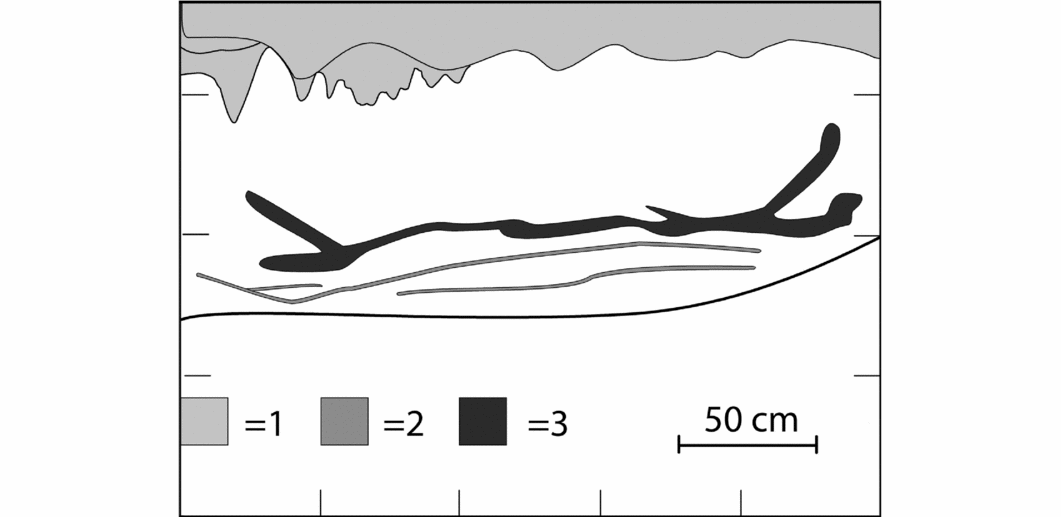
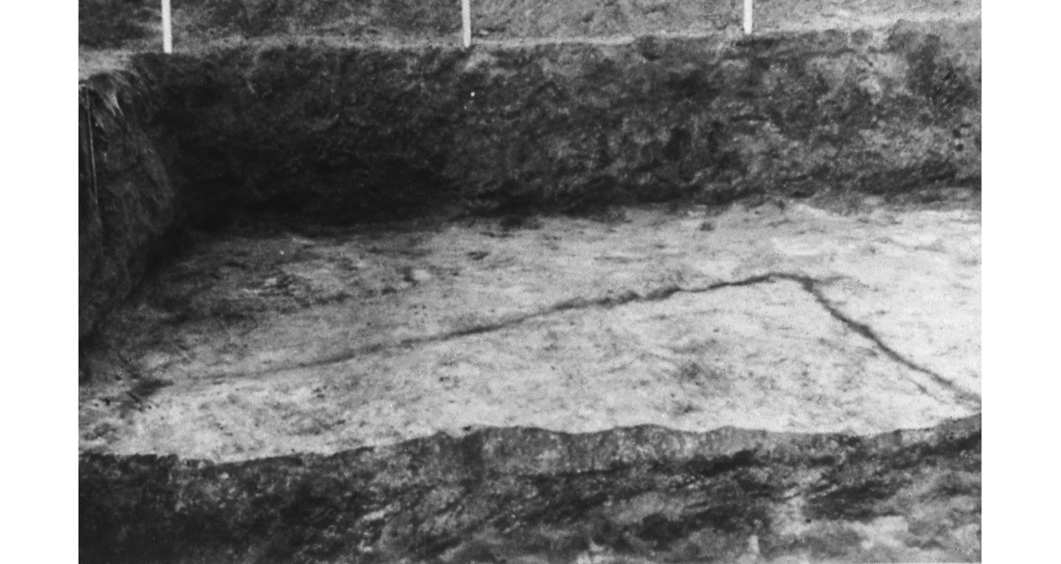
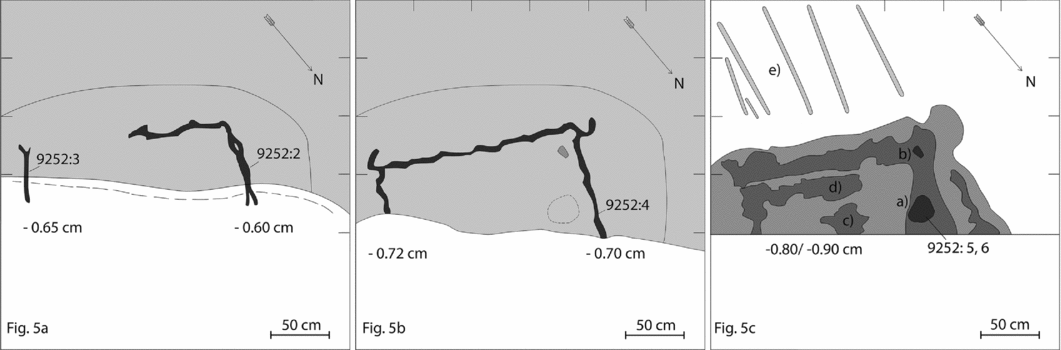
The Perttulanmäki grave was discovered at a depth of approximately 0.35m and follows the tradition of a pit grave (Äyräpää Reference Äyräpää1931: 4). The grave structure, seen clearly on the north–south profile (Figure 3), consisted of a dark feature 2.25m in width with forked ends (Figure 4) (Äyräpää Reference Äyräpää1931: 4–5). According to Äyräpää’s excavation report, this feature lay within a larger, nearly rectangular pit with vertical sides. The feature was first recorded at a depth of 0.35m as a circular layer of dark soil that, at a depth of 0.7m, covered the whole area of the grave. At this depth, the dark layer was rectangular in shape, with a slightly wavy outline and hook-like extensions at its south-west and north-east corners (Figure 5b). Discovery of the adze and molar enamel at this depth indicated that this was the burial layer.
Stratigraphic profile of the Perttulanmäki grave: 1) top soil; 2) natural layers of rust; 3) the grave structure (drawn by K. Vajanto, based on map by A. Äyräpää (Reference Äyräpää1930: map 3)).

The Perttulanmäki grave at a depth of around 0.7m, facing south. Photograph: A. Äyräpää (Reference Äyräpää1930)/Finnish National Board of Antiquities.

Maps of the Perttulanmäki grave from depths of approximately 0.6–0.9m (drawn by K. Vajanto, based on maps by A. Äyräpää (Reference Äyräpää1930: maps 1–4)): a) the grave at 0.6–0.65m depth, with samples NM 9252:2–3 locations; b) the grave at a depth of around 0.7m; c) the grave at a depth of 0.8–0.9m with samples NM 9252:5–6 locations. In map c: a) location of the molar fragment; b) location of the adze; c–d) Äyräpää’s interpretation (Reference Äyräpää1930) of the locations of the pelvis and the feet of the deceased; and e) natural rust layers. NM in sample numbers refers to The 290 Archaeological Collections of the National Board of Antiquities, Finland.

To identify the nature of the dark feature, Äyräpää (Reference Äyräpää1931: 12) took approximately 0.5L soil samples from the north-west (sample NM 9252:2) and the south-east (sample NM 9252:3) ends of the feature at a depth of 0.6–0.65m. Further samples were taken from the south-east end of the feature at a depth of 0.7–0.72m (sample NM 9252:4), and adjacent to the molar fragment (sample NM 9252:5) at a depth of 0.8–0.9m. Figure 5 details the location of these samples. The soil samples were chemically and microscopically analysed to determine their composition, and the results were published by Äyräpää in 1931. The aim of chemical analysis was to ascertain whether the sampled feature was of animal or vegetable origin. Without comparative material from outside the grave, the small amounts of detected nitrogen (N), sulphur (S) and iron (Fe) offered no clear proof of animal or vegetable origin for the sampled features. Fibres were, however, discovered within the soil samples, and these were examined by textile specialist Tyyni Vahter and zoologist V.A. Korvenkontio, using optical microscopy. Both researchers identified single fibres with a scale structure characteristic of animal hair, and hypothesised that the fibres were probably sheep hair or wool. Combining this information with the morphological features of the grave structure, Äyräpää (Reference Äyräpää1931: 10–11) concluded that the dark feature represented a chamber-like structure made from two layers of animal skin attached to wooden poles at the outer corners.
Research material and methods
In 2015, we reanalysed the soil samples microscopically and selected possible fibre fragments for further analysis. The fibre material selected was around 0.5–2mm long, with a diameter of 15–39µm. The hair fragments were also reanalysed. These were originally sampled in 1931 and curated on 17 microslides (NM 9252:2–5). Modern reference material for the study was acquired from the Fennoscandian wild mammal hair collection at the Finnish Museum of Natural History of the University of Helsinki. The Falkulla Domestic Animal Farm played an essential role by providing hair material from local domestic breeds, i.e. the Finnish Landrace goat (Capra hircus), Finnsheep (Ovis aries) and Finncattle (Bos taurus). Each fibre sample was placed on double-sided carbon tape, which was fastened to aluminium stubs. The hairs were coated with a 5nm-thick layer of carbon (C) using a Leica ACE 600 sputtering device. As the carbon caused considerable charging for the fully organic modern reference samples, these were additionally coated with a 5nm-thick layer of platinum (Pt).
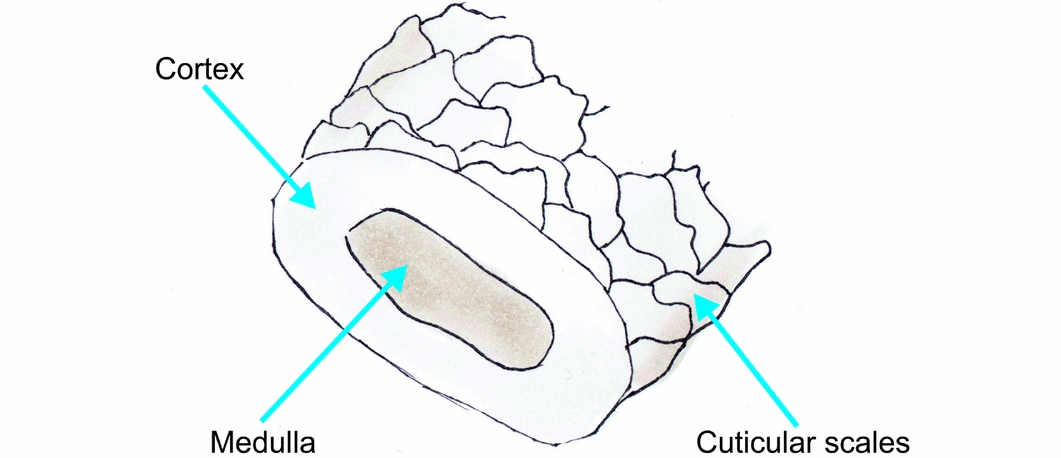
The SEM imaging was performed using a Zeiss Sigma VP scanning electron microscope. The micrographs were created by collecting secondary electrons. The acceleration voltage was 2–3kV for the archaeological samples and approximately 1.5kV for the modern references. The hair cuticle pattern was documented micrographically according to the longitudinal hair line. Unfortunately, the fibres were so brittle that sample preparation for observing cross-sections by SEM or TEM (transmission electron microscopy) was not possible. The key features for fibre identification were the diameter, medulla form, cross-section form and cuticular scale structure (Figure 6). Identification was based on keys in Appleyard (Reference Appleyard1978), Rast-Eicher (Reference Rast-Eicher2016), and the online source produced by Furskin Co. (2011), which offers a wide variety of reference material. The descriptors for verbal classifications followed Teerink (Reference Teerink2003) and Furskin Co. (2011). The microslides and the samples prepared for SEM analysis are stored with the excavation finds and remaining soil samples at the Finnish National Board of Antiquities.
The structure of mammalian hair (drawing: T.A. Kirkinen).

Results
We identified a total of 21 fibres of animal origin. All the material was highly fragmented and mineralised, thus verifying its archaeological origin; no modern contaminants (e.g. finely coloured wool fibres and the like) were observed. In total, the cuticular scale structure was detected in 18 fibres. In only 10 fibres were the scales in suitable condition for identification. The diameter and the scale structure indicate that the fibres were mostly fine (15–22µm) and intermediate (27–28µm) hairs. One was identified as an intermediate/guard hair (39µm).
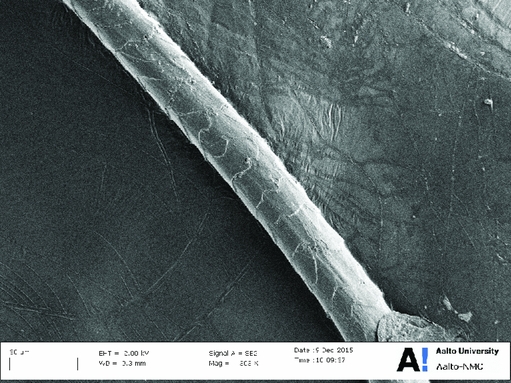
In the fine hairs of the Perttulanmäki samples, the scales were of cornet type (Figure 7). This scale structure is common and can be found in both domestic and wild Artiodactyla, in the tip and root sections of the fine hairs of the European beaver (Castor fiber), and also in some predators (e.g. pine marten (Martes martes)) and wolverine (Gulo gulo) (Appleyard Reference Appleyard1978). Only one fibre from our samples had a tapered shaft; it most probably originated from the distal end of the hair. Tentatively, the other hairs originated from the shafts of the hair.
SEM of a fine hair from sample NM 9252:4 (photograph: K. Vajanto).

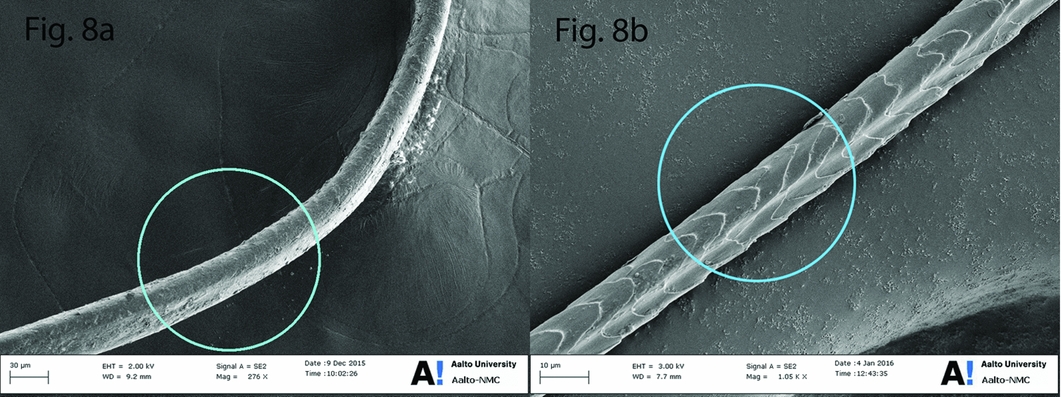
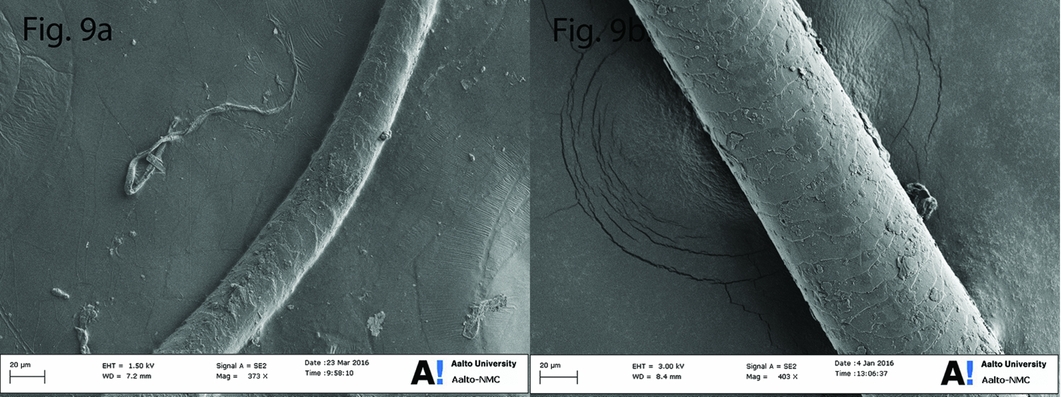
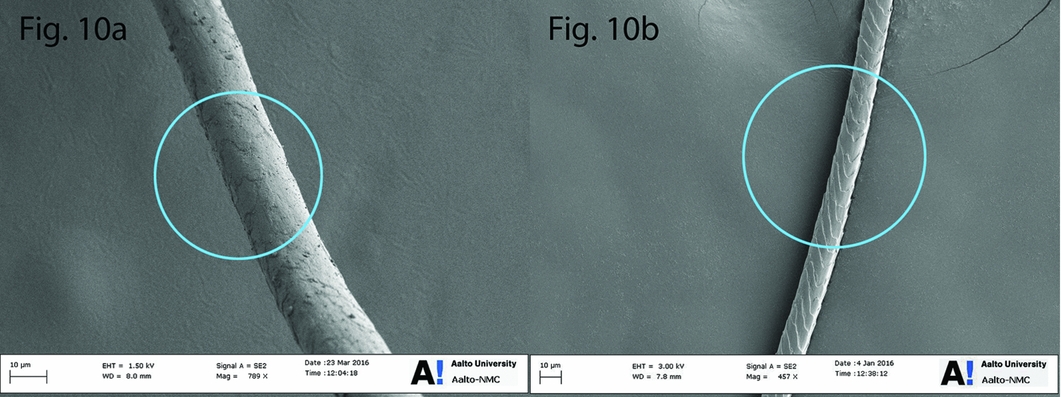
In intermediate/guard hairs the scales were rounded/crenated tile-like scales. In some of these hairs, the shape of the shaft results in a biconcave or dumbbell-shaped cross-section (Figure 8; Teerink Reference Teerink2003: 11). Even though the structure of the medulla was not identifiable, the medullary index (the ratio between medulla and hair diameter) was 1:2 at its largest. These qualities, combined with the cornet-like structure of the fine hairs, match only to domestic goat. Comparisons of the hairs with the Finnish Landrace goat are presented in Figures 8, 9 and 10. On the basis of these features, the samples were identified as goat.
SEM of a guard hair from sample NM 9252:2 (a), compared to Finnish Landrace goat hair (b). Note the biconcave cross-section of the hairs (photograph: K. Vajanto and T. Kirkinen).

SEM of a guard hair from sample NM 9252:2 (a), compared to Finnish Landrace goat hair (b) (photograph: K. Vajanto).

SEM of an intermediate/guard hair from sample NM 9252:2 (a), compared to Finnish Landrace goat hair (b) (photograph: K. Vajanto and T. Kirkinen).

Discussion
The discovery of preserved goat hair in a Corded Ware context provides the oldest evidence for goats in Finland. As goat is not a native species to Finland, the preserved goat hairs seem to suggest the presence of goat herding. We must, however, keep in mind that this discovery comes from a mortuary context. Burials and their associated goods do not always reflect the realities of the lives of the interred individuals (e.g. Parker Pearson Reference Parker Pearson1999). The goatskin might, for example, represent a valued gift originating from areas practising pastoral economy. Given that milk residues originating from domestic stock have already been discovered among Finnish Corded Ware pottery (Cramp et al. Reference Cramp, Evershed, Lavento, Halinen, Mannermaa, Oinonen, Kettunen, Perola, Onkamo and Heyd2014), it could also be plausible that goat herding was practised at the very northern border of the Corded Ware phenomenon.
The archaeological context from which the Perttulanmäki hair samples originated (the dark, hide-like feature covering the pit walls and floor) suggests the probable placement of a goat skin in the grave. Even though Äyräpää (Reference Äyräpää1931: 10–11) interpreted the feature as a chamber made of skins, the double hook-shaped feature (Figure 3) could also be interpreted as the remains of several overlaid hides or skins, with the skin(s) being used to cover or to separate the dead from the floor of the pit. The grave may also have had a wooden chamber, but no evidence of this was discovered. Moreover, the skins of other animal species may also have been present.
The discovery of hairs in a Neolithic context was unexpected, considering the generally poor preservation of organic materials from the Finnish Stone Age. It is noteworthy, however, that keratin resists degradation by acids, which have no effect on sulphur bonds and only minimal effect on peptide bonds (Tímár-Balázsy & Eastop Reference Tímár-Balázsy and Eastop1998). Microscopic remains of animal skins might, therefore, be discovered in other graves. Unfortunately, soil samples are not available from the other Finnish Corded Ware graves in which a similar dark feature with hook-shaped corners has been documented (e.g. Torvinen Reference Torvinen1979: 42–43). At Perttulanmäki, it is possible that the iron (Fe) present in the soil samples aided the preservation of the fibres.
Fibre mineralisation meant that our findings could not be verified by ancient DNA (aDNA). Furthermore, mass spectrometric analysis was not undertaken because the samples were of inadequate size. The identification of the fibres as domestic goat was then based solely on morphological identification. This is not completely unproblematic as domestic animals have undergone hundreds of years of selective breeding that has altered the hair morphology (Meyer et al. Reference Meyer, Seger, Hülmann and Neurand1997, Reference Meyer, Schnapper, Hülmann and Seger2000; Houck & Budowle Reference Houck and Budowle2002; Brandt et al. Reference Brandt, Schmidt, Mannering, Sarret, Kelstrup, Olsen and Cappellini2014; Leroy et al. Reference Leroy, Besbes, Boettcher, Hoffmann, Capitan and Baumung2015). There are, for example, well-known modern goat breeds that are bred specifically for their fine hair, such as Cashmere, which produce cashmere wool, and Angora, which produce mohair fibre. The Finnish Landrace goat, with its coarse, double-coated fleece, was, and still is, mainly bred for milk production. Despite these two different forms of goat husbandry, however, domestic goats show no clear differences from their wild relatives in cuticle structure; artificial selection has not focused principally on the quality of the goat hair (De Marinis & Asprea Reference De Marinis and Asprea2006a & Reference De Marinis and Aspreab). Even without bioarchaeological analysis, however, we can confidently state that the morphology of the best-preserved, fine, intermediate and guard hair fragments from the Perttulanmäki grave most closely match those of domesticated goat.
The identification of the Perttulanmäki goat hair offers a rare opportunity to observe the relationship between people and animals (e.g. Ingold Reference Ingold2000; Willerslev Reference Willerslev2007). Burials of early pastoralists in south-east Europe were accompanied by sacrificed goats, sheep, cattle and horses. This suggests that the spread of the new subsistence economy was deeply intertwined with new ritual values (Anthony Reference Anthony2007: 160–61). The goatskin discovered in the Perttulanmäki grave therefore not only indicates animal husbandry, but also the special role of domesticated animals in Corded Ware cosmology. Still deeper insight is gained when observing the use of goatskin from the perspective of identity, a feature commonly emphasised in Corded Ware mortuary practices (e.g. Vander Linden Reference Vander Linden2007: 185; Larsson Reference Larsson2009: 354). As Larsson (Reference Larsson2009: 354) has stated:
For the Battle Axe members [Battle Axe culture is an alternative name for the Corded Ware culture of Scandinavia], the mortuary event established the deceased as a worthy representative of the society, perfect and idealized since the dead body is both mute and immobile. The ideal Battle Axe burial should contain a properly oriented body in the right position, with the correct set of burial gifts indicating that this was a true member of the community—and by extension, so were those that officiated at the funeral.
The identity emphasised by the Perttulanmäki goatskin could belong to a pastoral farming community in which the correct set of burial gifts also included domesticated animals. This interpretation does not rule out the presence of a mixed economy in which cultivation, or hunting, fishing and gathering were also practised, although these are not clearly evidenced in the Perttulanmäki grave inventory (e.g. Müller et al. Reference Müller, Sergély, Becker, Christensen, Fuchs, Kroll, Mischka and Schüssler2009; Furholt Reference Furholt2014; Sjögren et al. Reference Sjögren, Price and Kristiansen2016). The animal accompaniment could be present in various forms. Several Corded Ware burials in the Baltic area have been furnished with artefacts made of domestic animal bone (Zagorska Reference Zagorska, Larsson and Zagorska2006: 103; Lõugas et al. Reference Lõugas, Kriiska and Maldre2007: 25–26; Larsson Reference Larsson2009: 63). That all milk residues from Finnish Corded Ware pottery were found exclusively in beaker-type ‘drinking’ vessels (Cramp et al. Reference Cramp, Evershed, Lavento, Halinen, Mannermaa, Oinonen, Kettunen, Perola, Onkamo and Heyd2014: 4) further supports this idea. These beakers are usually found in grave deposits (Edgren Reference Edgren1970: 76–77; Larsson Reference Larsson2009: 352), so the animal could have also been represented by placing milk, or a vessel connected with milk, in the grave (Edgren Reference Edgren1970: 76–77; Larsson Reference Larsson2009: 352). This being said, it must be noted that, due to the vast distribution area of the Corded Ware phenomenon, the same objects or symbols might not have been connected with the same ideas (Furholt Reference Furholt2014: 82). Moreover, some prehistoric societies might have also repeated the ritual practice simply as tradition—after its original meaning had been forgotten (Nilsson Stutz Reference Nilsson Stutz2003: 319). It has even been proposed that the search for the meaning behind these actions should be abandoned, and that the focus should be directed to the ways in which these ritualised actions can be observed in the physical remains of mortuary practices (Berggren & Nilsson Stutz Reference Berggren and Nilsson Stutz2010). In that perspective, it is evident that the use of axes, adzes and pottery vessels as grave goods (at least in Finland) is in clear contrast to the graves of local Neolithic hunter-gatherers, where such artefacts are only rarely encountered (Ahola Reference Ahola, Honkasalo, Koski and Kanerva2015: 33). This suggests the introduction of new mortuary practices, where a differing identity of the deceased is heavily emphasised. Thus, even if the symbols were interpreted differently by the original participants, or the ritual practices repeated with only a vague understanding of their original meaning, the recurring presence of domesticated animals in the burials suggests that the herder identity was initially at the very core of the Corded Ware belief system.
Conclusions
Our return to Perttulanmäki nearly 90 years after Äyräpää’s excavations, the application of modern microscopic analyses and reanalysis of the soil samples collected from the dark feature surrounding the burial has yielded striking results. Remarkably, using SEM micrographs, we discovered preserved Neolithic animal hairs in samples that Äyräpää had collected. Even though the mineralised fibres were poorly preserved and therefore unsuitable for aDNA or mass spectrometric analyses, we were nevertheless able to identify the species from which the animal hairs derived. We have therefore discovered the oldest evidence of domestic goat in Neolithic Finland. Although this discovery indicates the practice of a pastoralist herding economy in the Late Neolithic of this region, the ritual context of the find also suggests that the herder identity played a significant role in the Corded Ware belief system.
Acknowledgements
We would like to thank Volker Heyd (Bristol University) for his valuable comments, Kirsi Ripatti (Helsinki University) for providing article translations, and Tuuli Kirkinen for the drawings. We acknowledge the provision of facilities and technical support by Aalto University at OtaNano—Nanomicroscopy Center. For funding this project, we thank the Academy of Finland (Nature in Arts, Culture and History, ‘Temporal Sedimentations of Landscape and the Diversity of Nature’ project, 1278008), and the Doctoral School of History and Cultural Heritage at the University of Helsinki.