The 2008 presidential election was waged amidst signs that another economic recession was underway, and the not unexpected result was that the incumbent party's candidate lost to the Democratic challenger. Since the in party and its presidents are often credited with having effective policies in times of prosperity and blamed for failed policies in periods of recession, the confluence of the electoral calendar and the business cycle offers yet another opportunity to review the historical record. Our objective was to assess how presidential performance compares with public perceptions of the economy.
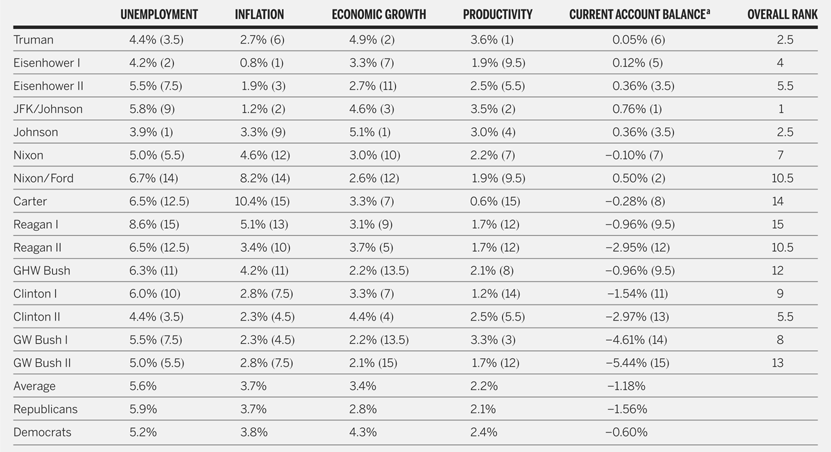
The Presidential Economic Scorecard for the period 1949–2004 (Dolan, Frendreis, and Tatalovich Reference Dolan, Frendreis and Tatalovich2008, 258) is updated through 2008 (see Table 1). We included five measures of macro-economic performance: unemployment, inflation, economic growth, the current account balance, and productivity. So important are the first four measures of economic performance that B. Guy Peters (Reference Peters1999, 190) calls them the “golden quadrangle” of economic policy. We added productivity because increased output per hour of labor means that the economy can grow and produce more goods and services without fueling inflation.
Presidential Economic Scorecard

Sources: Bureau of Labor Statistics and Bureau of Economic Analysis
a Calculated as percentage of GDP.
The current account balance includes exports of goods and services and income receipts, imports of goods and services and income payments, and unilateral current transfers, such as the exchange of U.S. government grants, pensions, and private remittances. Here we made one statistical adjustment in our calculation of the net inflow and outflow of capital between the United States and other nations. Our Presidential Economic Scorecard previously utilized nominal dollar values for the current account balance. But since the U.S. deficit in the current account balance has ballooned since 1992, using nominal dollar values would necessarily disadvantage presidents Bill Clinton and George W. Bush relative to their predecessors. A more objective measure of the deterioration in the U.S. economic relationships with other nations, therefore, would be to calculate the surplus or deficit as a percentage of the total size of the American economy. This revision only slightly altered the standings of all 15 presidential terms.
ECONOMIC PERCEPTIONS AND ECONOMIC REALITY
The economy is very important to the ebb and flow of domestic politics, here and abroad. A review of nearly 400 empirical studies concluded that the economy is a significant predictor of voter choice (Lewis-Beck and Stegmaier Reference Lewis-Beck, Stegmaier, Dalton and Klingemann2007, 518–37). There is research on the impact of economic variables on presidential voting (for examples, see Erikson Reference Erikson1989; Fair Reference Fair1988), and statistical models designed to predict the outcome of presidential elections invariably include key economic variables (Lewis-Beck and Rice Reference Lewis-Beck and Rice1992). Other studies also show that economic conditions influence presidential popularity (Chappell Reference Chappell1990; Ostrom and Simon Reference Ostrom and Simon1985). Both inflation and unemployment should hurt presidential approval ratings, though some research indicates that inflation has stronger negative effects (for examples, see MacKuen Reference MacKuen1983; Kernell Reference Kernell1978). A related issue asks whether people evaluate the economy based on their own pocketbook finances or on a sociotropic perspective that focuses on national economic conditions, though some researchers believe that both matter (Conover and Feldman Reference Conover and Feldman1986). One reason why personal economics may have less effect is that our political culture emphasizes that personal economic well being is primarily our own responsibility (Feldman Reference Feldman1982).
Most research employs objective indicators of economic performance, though increasingly analysts are adding public perceptions as an explanatory variable. This innovation, however, has prompted a scholarly debate over whether retrospective or prospective economic assessments guide voters. V. O. Key (Reference Key1966) was likely the first political scientist to argue that the electorate is “rational” because their vote choices largely supported their retrospective evaluations of economic and political issues. But he never attempted to evaluate the accuracy of those public perceptions. Building upon Key, Fiorina (Reference Fiorina1981, 197) argues that “directly experienced and/or perceived events and conditions first contribute to performance evaluations, and both in turn contribute to future expectations.” Although Fiorina's models show that “mediated retrospective evaluations” involve both retrospective and prospective evaluations, he does not attempt to evaluate the accuracy of those perceptions.
Some analysts argue forcefully that voters make prospective evaluations of economic conditions (MacKuen, Erikson, and Stimson Reference MacKuen, Erikson and Stimson1992). Others counter that most voters make retrospective evaluations (Norpoth Reference Norpoth1996; Clarke and Stewart Reference Clarke and Stewart1994; Kiewiet and Rivers Reference Kiewiet and Rivers1984), while a more complex model utilizes sophisticated voters who combine both retrospective and prospective evaluations (Chappell and Keech Reference Chappell and Keech1985). The retrospective assumption that a poorly performing economy would prompt a “throw the rascals out” reaction by the electorate would also affect congressional candidates of the president's party (Tufte Reference Tufte1975; Stigler Reference Stigler1973; Kramer Reference Kramer1971). If true, then apparently voters have come to expect good economic times, because the electorate is more likely to penalize congressional incumbents for bad economic conditions than to reward them for prosperity (Bloom and Price Reference Bloom and Price1975).
One of the first studies to use the Survey of Consumer Finances found that changes in prices and unemployment affected public perceptions that, in turn, affected presidential popularity (Shapiro and Conforto Reference Shapiro and Conforto1980). The Survey of Consumer Finances asked retrospectively whether “you and your family are better off or worse off financially than you were a year ago?” Not only is this question a valid measure of personal economic well being (Rosenstone, Hansen, and Kinder Reference Rosenstone, Hansen and Kinder1986), but it also tracks objective changes in real disposable personal income per capita (Markus Reference Markus1988). There is revisionist research that partisanship affects these economic perceptions (for example, see Evans and Andersen Reference Evans and Andersen2006), but longitudinal analysis by Lewis-Beck, Nadeau, and Elias (Reference Lewis-Beck, Nadeau and Elias2008) counters that economic perceptions do influence presidential voting and that they are not simply a function of partisanship.
In sum, it is not implausible that economic perceptions would influence the electorate more than actual economic conditions, especially when the mass media dramatizes economic developments (for example, see Hetherington Reference Hetherington1996). Yet this observation begs a fundamental question that Kristen Monroe (Reference Monroe1979, 167) asked 30 years ago: “How much correspondence is there between mass public perceptions of economic reality and reality, as measured by the aggregate economic indicators usually considered in empirical analysis?” That question has supremely important normative implications because voters who make retrospective judgments based on erroneous or wrong economic information, and who blame the incumbent administration, are doing a disservice to democratic accountability.
THE ACCURACY OF PUBLIC ECONOMIC PERCEPTIONS
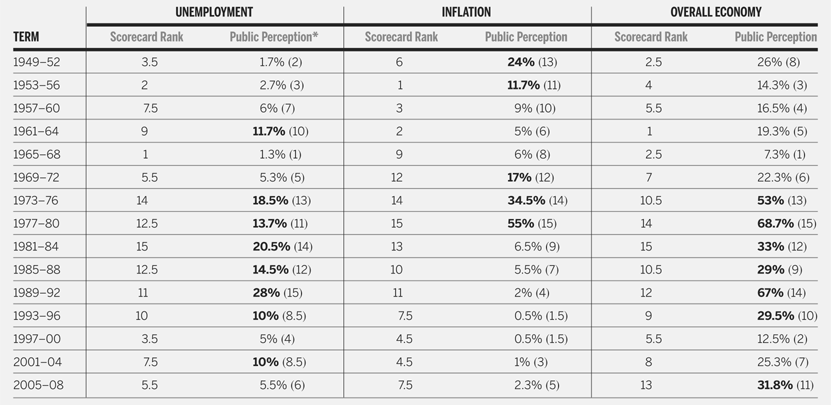
Few studies have evaluated whether public perceptions of unemployment and inflation match economic reality. One was a three-stage panel study conducted in Lexington, Kentucky, from March 1982 to April 1983, but, as its authors acknowledge, time and space limitations raise questions about the generalizability of its findings (Conover, Feldman, and Knight Reference Conover, Feldman and Knight1986). Another study surveyed Milwaukee County respondents during the 1992 presidential election and, like the Lexington research, found that people were more accurate about the unemployment rate than the inflation rate (Holbrook and Garand Reference Holbrook and Garand1996). Unlike the Lexington study, however, here the objective was to evaluate which variables best explained perceptual accuracy. One counterintuitive finding was that respondents who cited the economy as the “most important” problem were no more likely to be accurate in their economic estimates. Even more troubling was the effect of economic perceptions on electoral choice; as Holbrook and Garand (Reference Holbrook and Garand1996, 371) explain: “Voters who overstate unemployment and inflation rates tend to evaluate national economic conditions negatively, and these negative evaluations are translated into political behavior and attitudes even when the information upon which the evaluations are based is inaccurate.” That is, while those Milwaukee respondents believed that both unemployment and inflation were too high, national Gallup polls (Table 2) reported Americans saying that unemployment during 1989–1992 was the worst in nearly 60 years but that inflation recorded its fourth-best performance overall.
Comparing Public Perceptions with Economic Performance

* Public perception is the percent of respondents citing unemployment, inflation, or the overall economy (those citing unemployment, inflation, and the economy as the “most important” problem on all Gallup Polls taken during the presidential term). Bold indicates those percentages above the average based on 43 Gallup Polls taken from January 1949 through November 2008 for unemployment (8.6%), inflation (11.5%), and the overall economy (28.9%).
Erikson, MacKuen, and Stimson (Reference Erikson, MacKuen and Stimson2002, 105) dismiss simple retrospection in favor of a “rational expectations” approach whereby voters' “expectations efficiently weigh retrospective and prospective knowledge of the economy.” Comparing the Index of Economic Performance and the Index of Consumer Sentiment on presidential approval led Erikson, MacKuen, and Stimson (Reference Erikson, MacKuen and Stimson2002, 90) to conclude that “the objective economy affects Presidential Approval by affecting perceptions of the economy, and these perceptions are captured by the Index of Consumer Sentiment.” Most directly relevant here is their finding that the Index of Economic Performance correlated highly (.86) with the Index of Consumer Sentiment (Erikson, MacKuen, and Stimson Reference Erikson, MacKuen and Stimson2002, 90). While this linkage strongly implies that economic conditions shape public perceptions, a correlation is not direct evidence. And since the Index of Economic Performance is composed of 13 economic indicators, we do not know if every indicator is equally salient in the public mind.
Cross-cultural research by Duch and Stevenson (Reference Duch and Stevenson2008, 158) finds that “there has been relatively little effort to investigate empirically whether variations in the economy register with the typical voter.” For that reason, they conducted a six-nation survey to assess whether voters recognize variability in economic growth. While perceptions of economic growth did not correlate highly (.56) with overall economic assessments, Duch and Stevenson (160) compared those perceptions with actual growth rates and concluded “that voters have well-formed beliefs about variation in their national economies and that these beliefs are grounded in economic reality.” To date, their work is the best evidence that economic perceptions match economic performance, but, unfortunately, the United States was not included in their six-nation survey.
Our Presidential Economic Scorecard affords another opportunity to compare economic reality against public perceptions of economic performance. Those perceptions are based on this Gallup Poll question: “what is the most important problem facing the country?” It has been asked since 1946 at irregular intervals, though most often during the months leading up to a presidential election. From January of 1949 through November of 2008 the Gallup Poll asked this question 43 times, and we averaged the responses on all surveys during each four-year presidential term. We tabulated the average four-year percentage of respondents who mentioned unemployment, inflation, or the economy as the “most important” problem facing the country. To derive a measure for the overall economy, we included the percentage citing unemployment and inflation as well as any references to general economic conditions. We then ranked these public perceptions from 1 (for the smallest percentage citing unemployment or inflation or the economy) to 15 (with the highest percentages).
To gauge the public saliency of these economic conditions for the period 1949–2008, we derived the average percentage citing unemployment, inflation, or the economy in 43 Gallup Polls. Unemployment was cited by 8.6% of the respondents, inflation by 11.5%, and the economy by 28.9%.Footnote 1 We then calculated the Spearman Rank-Order Correlation Coefficient to compare the rankings of actual economic conditions against the rankings of public perceptions of unemployment, inflation, and the overall economy. The Spearman Coefficient was .95 for unemployment (significant at the .01 level), .39 for inflation (insignificant), and .83 for the overall economy (significant at the .01 level). Therefore public perceptions of unemployment parallel the severity of the actual unemployment rate and, although the Spearman Coefficient does not show causation, there is no doubt about the direction of causation here. Perceptions do not cause the unemployment rate; rather the unemployment rate influences public perceptions. Our finding that the highest percentage of Gallup respondents cited unemployment as the “most important” problem during 1989–1992 confirms scholarly research that unemployment was the key factor in the reelection defeat of president George H.W. Bush, whereas inflation was a non-issue (Clarke, Rapkin, and Stewart Reference Clarke, Rapkin and Stewart1994).
The disparity between public perceptions of inflation and the inflation rate may seem counterintuitive, but there is a possible explanation. We know that past experience with inflation affects public expectations about future inflation (Haller and Norpoth Reference Haller and Norpoth1994). Also some research argues that the impact of inflation on presidential popularity lags in time behind the president's approval ratings (Monroe Reference Monroe1981, Reference Monroe1978), though others have raised methodological doubts (Norpoth and Yantek Reference Norpoth and Yantek1983). The Lexington study similarly found that retrospective evaluations of unemployment were much more accurate than those for inflation and, moreover, that a lag affected inflation more than unemployment: “The public responds very slowly to changes in the rate of inflation but very quickly to changes in unemployment” (Conover, Feldman, and Knight Reference Conover, Feldman and Knight1986, 585). Because inflation involves price changes over time, its ambiguity may hinder accurate cognition more than absolute changes in the unemployment rate. A 1996 study of economic knowledge found that 37% of the respondents correctly perceived the five-year trend in unemployment but only 16% correctly perceived the five-year trend in inflation (Blendon et al. Reference Blendon, Benson, Brodie, Morin, Altman, Gitterman, Brossard and James1997, 108). Previously Paul Peretz (Reference Peretz1983, 74) found that, although inflation remained below 2% during 1958–1966, between 40 and 60% believed that prices had risen. In contrast, according to the Lexington study, unemployment at any point in time is more concrete and “salient” for the public. Our data (Table 2) confirm that the unemployment rate was worst during 1981–1984 than during any other presidential term, before or since, and public perceptions ranked unemployment during President Reagan's first term as the fourteenth worst during the entire period. From this vantage point, the time constraints in the Lexington study were more pronounced than the constraints of geography because the national unemployment rate reached a post-Depression high of 10% from September 1982 to June of 1983. The conclusions of the localized study of Lexington nicely comport with national economic trends.
We did not lag public perceptions of inflation against the four-year inflation rate, but there are clues of lag effects. The inflation problem was not highly salient during Eisenhower's tenure and the Kennedy-Johnson term, when the inflation rate was below 2% (see Table 1). Although inflation increased to 3.3% under Johnson, only 6% told Gallup that inflation was the “most important” problem facing the country. But public perceptions of the inflation problem became more salient under Nixon, Nixon-Ford, and especially Carter, when the actual four-year inflation rate escalated to 4.6%, 8.2%, and 10.4%. Carter ranks last on both the actual inflation rate and public perceptions of inflation while his successor, Ronald Reagan, ranked ninth in public perceptions of inflation even though the actual inflation rate of 5.1% ranked Reagan as having the thirteenth-worst performance. Nonetheless, the public undoubtedly believed that 5.1% was a substantial improvement over the 10.4% average for the Carter years, and this comparison was more compelling than the fact that the Reagan inflation rate was worse than any other presidential term except Nixon-Ford and Carter.
The Spearman Coefficient of .83 indicates that public perceptions of the economy closely parallel the indicators in our Presidential Economic Scorecard. Public perceptions of the economy were salient during the six presidential terms of Nixon/Ford through Clinton and also the second term of George W. Bush, and those presidential terms collectively represent the seven worst overall performances on our Presidential Economic Scorecard. The saliency of economic concerns for the six terms of Nixon/Ford through Clinton were linked to public apprehension about the unemployment rate, but that was not the situation during the second term of president George W. Bush. During 2005–2008 the general economic anxiety, whatever its cause, was not linked to the relatively low unemployment rate, and the inflation rate was precisely at the mid-point of this distribution. What especially dragged down the overall ranking for president George W. Bush was economic growth (ranked 15), productivity (ranked 12), and the current account balance (ranked 15). While these objective indicators may explain why the 2005–2008 term performed so poorly, those statistics would not account for public perceptions of economic anxiety. In the 43 Gallup Polls respondents never cited productivity as the “most important” problem. Although rates of productivity are included in news reports, apparently Americans are unable to conceptualize the impact of that indicator on their own well being or its significance for the health of the economy.Footnote 2 And rarely did the public mention trade. Even during the tenure of president George W. Bush when the current account balance experienced its most severe deterioration, less than 0.5% of the respondents cited “foreign trade/trade deficit” in eight Gallup Polls and 1% did so in three other surveys taken between 2001 and December of 2008.
This article brings a novel perspective to the enduring question of whether public perceptions of the economy match economic conditions, because no other research has utilized the Gallup “most important” problem question to assess that linkage. Our conclusion is that the public perceptions do coincide with economic reality, particularly with respect to unemployment and the general health of the economy, but not so regarding inflation.