Introduction
It is estimated that about 36 million people around the world now have dementia and these figures are set to double every 20 years, to 65.7 million by 2030 and to 115.4 million by 2050 (Prince, Reference Prince, Prince and Jackson2009). An early and ideally differential diagnosis, which involves ruling out other neurological and non-neurological conditions, is now regarded as important for treatment and planning purposes (Prince et al., Reference Prince, Bryce and Ferri2011; Verhey et al., Reference Verhey, Orrell and Zarit2011) and may also be cost effective (Banerjee and Wittenberg, Reference Banerjee and Wittenberg2009). However, dementia remains a largely invisible and under-diagnosed health condition and most people currently living with dementia have never received a formal diagnosis. Even in high-income countries, only 20–50% of dementia cases are recognized and documented in primary care (Prince et al., Reference Prince, Bryce and Ferri2011). Indeed it is noted that when a diagnosis is made, it is typically made at a relatively late stage in the disease process (Prince et al., Reference Prince, Bryce and Ferri2011). At a European and international level, given the increasing numbers of people with dementia, assessment and diagnosis of dementia is gaining increasing attention (Prince et al., Reference Prince, Bryce and Ferri2011; World Health Organization, 2012).
Although no clear definition of a memory clinic (MC) exists and there is a distinct absence of specific standards or guidelines available for setting up MCs, it is broadly accepted that MCs play a key role in the identification, investigation, and treatment of dementia and have become a widely accepted healthcare service (Jolley et al., Reference Jolley, Benbow and Grizzell2006). Within the Dementia Strategies in England, Wales, and France, MCs have been identified as critical to early diagnosis. The National Dementia Strategy in England stipulates that every specialist mental health service for older people should have an MC (Department of Health, 2009). The Republic of Ireland (ROI) as yet has no National Dementia Strategy. Like several other European countries (Galeotti et al., Reference Galeotti, Giusti, Meduri, Raschetti, Scardetta and Vanacore2013), the ROI plans to have one in the short-term and the Government's commitment to develop a Strategy has heightened debate about the preferred approach to dementia assessment and diagnosis in the ROI and the respective roles that MCs, General Practitioners (GPs), primary care teams, and specialists can and should play.
Positive opinions have been expressed about the diagnostic value of the MC (van Hout et al., Reference Van Hout, Vernooij-Dassen, Hoefnagels and Grol2001). It has been demonstrated that an integrated multidisciplinary approach to diagnosing dementia can contribute to the quality of life of those experiencing symptoms of memory and cognitive problems (Wolfs et al., Reference Wolfs, Kessels, Dirksen, Severens and Verhey2008). Melis et al. (Reference Melis, Meeuwsen, Parker and OldeRikkert2009: 457) have concluded that “there is evidence to suggest that there is a good chance that a state-of-the-art multidisciplinary MC will be an effective and cost-effective healthcare service for providing dementia diagnosis and guidance.”
Efforts to improve timely diagnosis and treatment through the establishment of a national network of multidisciplinary MCs have however been criticized, most notably in England. This criticism pertains to the question about whether MC services can be shown to be effective as a post-diagnostic setting when directly compared with usual care offered by GP services. Although the value of engaging people with mild cognitive impairment and dementia in on-going professional relationship that encourages future planning is recognized (Cahill et al., Reference Cahill, Gibb, Bruce, Headon and Drury2008a; Garand et al., Reference Garand, Dew, Lingler and DeKosky2011), a recent randomized control trial has shown that at follow-up, the benefits of MCs versus more routine GP services may be negligible (Meeuwsen et al., Reference Meeuwsen2012). In this study, no evidence was found of any difference in effectiveness between MCs and GP services regarding post-diagnostic treatment and coordination of care for patients with dementia.
Against this backdrop, the aim of this study is to collect information at a national level on the resourcing, distribution, and practices adopted at MC services in the ROI.
Methods
For the purposes of this study, we did not specify in advance what would or would not qualify as an MC as there appears to be no one generally accepted definition of the term (Phipps and O'Brien, Reference Phipps and O'Brien2002; Passmore and Craig, Reference Passmore and Craig2004). Similar to other surveys of this kind (Lindesay et al., Reference Lindesay, Marudkar, vanDiepen and Wilcock2002), we were interested in the range of services that operate under this heading. All relevant services were identified as MCs through a series of phone calls and inquiries to experts. Experts included key staff in the Health Service Executive (which is responsible for the provision of health and personal social services in the ROI), the Dementia Services Information and Development Centre (a National Centre of Excellence in Dementia), the National Memory Clinic at St James's Hospital, Dublin, and by word of mouth from senior staff already employed at other MCs. At the time of data collection there were no neurology-led memory or cognitive clinics in the ROI, although people with cognitive impairment associated with neurological disorders undoubtedly present at neurology-led clinics situated in hospitals throughout the country.
Data collection instrument
A brief survey instrument comprising both closed and open-ended questions was developed. The questionnaire consisted of three sections. The first sought information from Directors about their professional background and the catchment area covered by their respective MC services. The second asked questions about clinical and non-clinical issues, staffing profile and composition, numbers of new and review patients seen annually, access to other allied health professionals, referral process, wait times, and funding. The third section used open-ended questions to explore with Directors three specific questions regarding the future direction of MC services in the ROI, namely: (i) their views on what was needed nationally to support their respective MC service; (ii) their views on the advantages and disadvantages of standards for MCs; and (iii) what they as Directors might do, were they to be given an unlimited budget for MC development.
Telephone interviews
The survey was conducted in March/April 2011. Data were collected by audio-taped telephone calls. Initially, contact was made with each of the 14 identified MC Directors when the study's aims and objectives were explained. All clinics agreed to participate although in two cases Directors nominated other senior staff member to respond. Interviews were transcribed verbatim and statistical and qualitative data were collated manually. Since the number of MCs involved was small, only descriptive statistical analysis was performed. Analysis of the open-ended question was undertaken using Framework Analysis. This approach was chosen as it is based on participant accounts and allows changes throughout the analysis as themes emerge. It facilitates transparent data management, is systematic, and allows for all stages of data analysis to be analyzed methodically generating a methodical treatment of the data (Ritchie et al., Reference Ritchie, Spencer, O'Connor, Ritchie and Lewis2003; Sirvastava and Thomson, Reference Sirvastava and Thomson2009). The study did not require ethical approval.
Results
Defining an MC service
All but two of the 14 MCs specialize in the diagnosis of memory disorders or dementia. Of the former two, one, based at a university, provides pre-diagnostic and post-diagnostic supports, while the other offers only post-diagnostic supports. Two other clinics are dedicated to the assessment and diagnosis of memory and cognitive needs of people with an intellectual disability (ID). The majority (12 out of 14) use the term “Memory Clinic” or “Cognitive Clinic” in the clinic's official title, yet when asked specifically “would you describe this service as a MC?,” five Directors prefer to call the service “a memory assessment service.” This was also the case with one other clinic specializing in memory assessment and diagnosis of cognitive problems in people with an ID. This service uses the term “Dementia Advisory Resource Centre” rather than MC in its official title.
Location and leadership
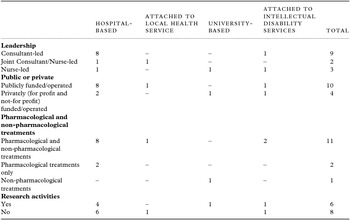
A total of 14 MCs were identified in the ROI: five in Dublin North East, four in Dublin Mid-Leinster, four in the South, and one in the West. Table 1 shows that ten of the 14 clinics are hospital-based, one is located in a Health Service Executive Health Care Clinic, two are part of ID community services (one of which is run privately by a religious organization), and the remaining MC is University-based. Clinics are largely publicly funded – only two hospital-based MCs are privately funded. Four MCs, all based in Dublin and three of which are private, accept referrals from people living anywhere in the country. However, most MCs restrict their service to people living in the local geographical area within which the MC is based, typically the Local Health Office (LHO) area or county and bordering LHO areas or counties.
Variations between memory clinics by location

Table 1 also highlights that nine clinics are medical consultant led; five have as Directors Psychiatrists (three Old Age Psychiatrists (OAPs) and two General Psychiatry), and four have Geriatricians. Two are jointly led, in one case by an OAP and a Nurse, and in the other by a Geriatrician and a Nurse. The remaining three clinics are nurse led.
Staffing
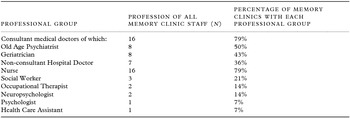
The total mean number of staff per clinic is 3.4. On average, there are 1.4 Medical Consultant Specialists; 1.1 Nursing staff; and 0.6 Allied Health Professionals (AHPs) employed per MC. Other professional staffing of MCs is shown in Table 2. The majority (79%) report that Consultant Medical Doctors are regularly involved in their clinics. Old Age Psychiatrists (OAPs) are involved in 50% of MCs and Geriatricians in 43%. Two MCs employ both an OAP and a Geriatrician. Nursing staff are also commonly involved in the majority (79%) of MCs.
Staffing of memory clinics, 2011

Only six of the 14 MCs have AHPs attached to the clinic. Of these, the best-resourced clinic (national) employs a Senior Social Worker, Neuropsychologist, Research Nurse, Administrator, and two Medical Consultants (sessional). Amongst the other six MCs who employ AHPs, data show that Neuropsychologists, Social Workers, or Occupational therapists are available at each on referral. In contrast, Speech and Language Therapists and Dieticians are only available on referral at one MC.
Frequency of service, referrals, and waiting time
MCs operate on average twice a week, although findings show huge variation. Only three see patients every weekday (Monday to Friday) while nine restrict services to either once (N = 6) or twice (N = 3) a week. Two clinics provide services either once a fortnight or once a month (half day). Based on data available from 13 of the 14 clinics, the average patient waiting time is six weeks for an initial assessment (range = 1–16 weeks).
Most patients are referred by GPs (N = 5) or a combination of GPs and Medical consultants (N = 7). Only one MC accepts self-referrals along with the usual sources of referrals, that is, from GPs and the Alzheimer Society of Ireland (ASI). One of the two ID services is unusual in that it seeks out referrals for dementia screening purposes using its own database.
Treatments – pharmacological and non-pharmacological
Twelve of the 14 MCs offer both pharmacological and non-pharmacological interventions (Table 1). Non-pharmacological interventions broadly include the provision of information and advice about dementia or mild cognitive impairment; support with adjusting to and coping with the diagnosis; information on legal, financial issues, and welfare entitlements; health promotion and lifestyle information; support to carers and family members; driving and OT assessments; and the management of behavioral and psychological problems. All MCs arrange access to a range of external specialists and services including psychological and neurological support services, AHP, community care services, carer courses, and the Alzheimer Society of Ireland.
Numbers using memory clinics
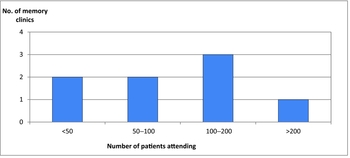
Data on the numbers using MCs are based on information supplied by eight MCs. Despite follow up phone calls to six clinics, six Directors were either unable or refused to provide information on patient throughput. The available data indicate that wide variation exists regarding the numbers of patients seen at MC services (see Figure 1). The average number of patients seen during 2011 was 126 (range was 18–404). Four of these eight MCs saw fewer than 100 patients (less than two patients weekly), whilst the remaining four saw more than 100 patients. These figures generally include both new and review patients, although in one clinic review patients were seen in a separate out-patient clinic and in another all patients had undergone a nurse-led pre-assessment. On average, about 50% of patients are new and 50% review, although this figure varies markedly between MCs.
Memory clinics by numbers attending, 2011.

Only six of the 14 MCs were at the time of the survey research active (Table 1). Of the remaining eight, three had previously been research active or were hoping to conduct research in the future.
Attitudes to MC services
In response to a question about what was needed nationally to support MC services, by far the majority of Directors reported a need for more resources and in particular dedicated funding to employ additional clinical and allied health support:
. . .I would like to have a second senior clinical person to diagnose and do the general clinical assessment
Memory Clinic 8
. . .the wait list is getting longer because we are getting more and more referrals, more and more complex cases, so we probably need more people to actually see patients for the assessment part
Memory Clinic 6
A small minority referred to the need for a National Dementia Strategy and for it to include dementia diagnosis, early intervention, and improved clinical care pathways as core elements. Smaller numbers claimed that improved community awareness of dementia was needed; that service providers needed to be more proactive in detecting dementia, that more GP education was required, and better communication between service providers and more integrated care pathways. One Director argued that MC models in the ROI are so diverse that a consensus on core service provision needs to be reached. Another Director, who clearly did not embrace the medical model, called for an open public debate on the topic of MCs to ensure that future dementia service development would evolve in a manner responsive to client need:
I'm not a massive fan of a medical model memory clinic. . .I think in countries like the Netherlands and the UK where there are loads of memory clinics people still don't go to them and we have to stop blaming people for that. . .So I think there needs to be a huge amount of public debate before there is too much more public reform . . .
Memory Clinic 11
Responses to the question posed about the advantages/disadvantages of National Standards for MCs were equivocal. Whilst the vast majority (N = 10) welcomed the potential standards had for placing more clarity on the MC service, and to generate more equity/uniformity of service provision, several Directors also worried that in the absence of additional funding, standards might result in the closure of already poorly resourced services.
I think the disadvantage is that many areas wouldn't be able to provide what's necessary in standards and therefore they would close down . . .
Memory Clinic 10
you could exclude us completely if you put in guidelines as to what should be there, because if finances aren't local, we are not going to get them . . .
Memory Clinic 1
Finally, when asked how an unlimited budget for MC enhancement might be used, by far the majority reported they would employ more AHPs to augment multidisciplinary team composition. The vision of one MC Director reflects the views of several other participants in this survey:
Additional clinical support. . .a second senior clinical person. . .plus a team to include a Nurse Specialist, Social Work. . .dedicated Neuropsychology. . .Occupational Therapy, Physiotherapy so that it would be a dedicated cognitive assessment team. . .centers of excellence. . .with the ability to do domiciliary assessment in addition to nursing home and hospital based assessment . . .
Memory Clinic 8
A small minority reported they would use resources to improve access to clinical supports including neuro-imaging, CT, MRI, and PET scans and for community supports such as home care services. Some, especially those providing little in the way of post-diagnostic services, claimed that an unlimited budget would enable them provide a more continuous, seamless service. Another small minority mentioned that it would enable them to up-skill staff or involve staff in training others.
Discussion
The survey provides new information on the organization, location, resourcing, staff composition, treatments, waiting time, and numbers of patients attending MCs in the ROI for the year 2011. It shows that since 2009 (Maher, Reference Maher2009) an additional three MCs have been established. This expansion of service is in line with European trends, most notably the UK, where number of MCs has almost tripled over a ten-year period (Lindesay et al., Reference Lindesay, Marudkar, vanDiepen and Wilcock2002) and more recently, in the Netherlands where numbers have increased by a factor of five (Ramakers and Verhey, Reference Ramakers and Verhey2011). In Australia in the last three years, the number of MCs has also increased significantly from 23 in 2009 (Woodward and Woodward, Reference Woodward and Woodward2009) to probably circa 30 at the end of 2012 (Personal email communication from Michael Woodward, 1 December 2012).
It seems that MCs in the ROI have evolved in an ad hoc, haphazard way with no mapping or top-down planning of service provision for areas of acute need, i.e. linking new service development to geographical areas known to have a disproportionately high prevalence of dementia and no MC service. Indeed this problem of geographical inequity was an issue raised by several respondents in this survey. The ROI may not be unique in this regard; the ALCOVE project found although MCs are reported to be present in the majority of countries across the EU, there is variation between countries in terms of their geographical and population coverage (Brooker et al., Reference Brooker, La Fontaine, Evans and Karim2013). Given population aging and the projected increase in the number of people with dementia, it would seem prudent to work towards reaching a European or global consensus regarding the appropriate number of MC services for a given population or geographical area. In the Netherlands, it is noted that one MC exists for every 250,000 Dutch inhabitants (Ramakers and Verhey, Reference Ramakers and Verhey2011). If the Dutch figures were to be used as a benchmark, the findings of our survey show that MC services in the ROI fall short for the size of our population. In addition to that, the distance to the nearest MC varies considerably depending on where in the ROI a person lives.
There were an estimated 47,746 people with dementia in the ROI in 2011 (Pierce et al., forthcoming) and a tentative estimate suggests that approximately 4,000 new cases arise every year (O'Shea, Reference O'Shea2007). However, since there is no register for dementia in the ROI, it is not known how many of these people receive a diagnosis of dementia, nor where that diagnosis occurs, or how long it takes from the time the symptoms first present to when the diagnosis is made. Based on our figures, and bearing in mind that only eight MCs could provide data, a very tentative estimate is that 1,764 people were seen at MCs in 2011. As stated, no national data are available from this study on how many of these people were diagnosed at the MC, or indeed what proportion may have already had a tentative diagnosis made by GPs, nor is there reliable data available on the exact breakdown between new and review patients at all MCs. Furthermore, no data are currently available on the number of people diagnosed with dementia in primary care or in specialist hospital clinics not attached to MCs. Whilst collecting good quality data on dementia diagnosis is time consuming, it would be beneficial to have a nationwide system of data collection in place which pays special attention to collecting relevant diagnostic information in MCs, hospitals’ specialist clinics, and in primary care. Collecting this data on a nationwide basis would contribute to and expand knowledge about dementia diagnostic rates and place of diagnosis in the ROI. It could potentially be used to make comparisons and share data with other European Union member states. This is in keeping with the recommendations of the ALCOVE project (Galeotti et al., Reference Galeotti, Giusti, Meduri, Raschetti, Scardetta and Vanacore2013).
Our findings show that the traditional model of hospital-based psycho-geriatric MC continues to prevail in the ROI. This is in contrast to the UK where more recently developed MCs are less likely to be hospital-based, focus more on direct service provision (Lindesay et al., Reference Lindesay, Marudkar, vanDiepen and Wilcock2002), and where initial assessments are often undertaken at home. In other parts of the world such as in remote parts of Canada (rural Saskatchewan), and by way of using clinic time more efficiently, initial MC assessments are undertaken via tele-health videoconferencing in the patients’ community, where the clinic nurse and Neuropsychologists interview the patient and family member about the referring problem, organize blood tests, obtain a medical history, and advise the patient and family member about what to expect at the clinic (Morgan et al., Reference Morgan2009). Caregivers later accompany their relatives to a full day in-person diagnostic assessment at a hospital-based MC. Follow-up appointments are then conducted via tele-health videoconferencing at very regular intervals – six weeks, 12 weeks, six months, and at one year. The approach has been shown to foster excellent interdisciplinary and transdisciplinary liaison with opportunities for cross-disciplinary learning. In countries where resources are scarce, and populations widely dispersed, this integrated model of MC service including a “virtual MC pre-assessment” has considerable potential.
The results of our survey reveal much variability with respect to the staffing of MCs in the ROI. The low level of AHPs employed in many MCs is particularly striking. The absence of an occupational therapist or psychologist for instance is likely to mean that the MC cannot offer cognitive stimulation therapies (CST), cognitive training (CT), and cognitive rehabilitation services to patients diagnosed with dementia. Nor can the MC offer specialist advice on important home adaptation issues including assistive technology to complement pharmacological treatments, unless it partners with a community-based occupational therapist with specialist knowledge of dementia. The fact that very few MCs in the ROI employ a neuropsychologist is of critical concern, given how prior research in the ROI has shown that waiting times for referral to community-based neuropsychology can be quite significant and many areas have no access whatsoever (Cahill et al., Reference Cahill, Clarke, O'Connell, Lawlor, Coen and Walsh2008b). The absence of social work support in most MCs is also noteworthy given that many patients and their family members who have just received a diagnosis will be shocked and distressed and may be in need of immediate advice about medico-legal issues including driving, banking, and making Enduring Powers of Attorney. The absence of a social work service also means that access to other post-diagnostic support services such as home help, day care, home care packages, and residential respite may be delayed. This matter is further compounded by the fact that there are few social workers dedicated to care of older people and based in the community in the ROI.
Our results show much variability across the 14 MCs surveyed. Given the diversity and heterogeneous results found in this study, we would argue for the need for diversity rather than uniformity in MC service provision. The “worried well” may be better served attending “memory assessment” as opposed to “diagnostic services” where, as proposed in the Welsh national plan on dementia, expert intervention is given within a very reasonable time period after referral and “mind your memory” risk factor information imparted. Younger people with serious cognitive complaints may feel less stigmatized being diagnosed in primary care services that co-opt in the expertise of MC staff to assist with differential diagnosis. Those with Down syndrome and suspected dementia may be better off being assessed by Disability Service professional staff already familiar with them. Those with alcohol-related dementia may benefit from being assessed in specialist drug and alcohol services where direct linkages are established with rehabilitation. Accordingly, the type of assessment/diagnostic service sought out, its location, and the professional background of the clinician may be determined by the nature of the presenting problem and the skills and expertise of primary care physicians responsible for making the relevant referrals. However, these issues call for more open public debate with practitioners, patients, and other experts involved in front line service delivery and need careful consideration in planning future dementia assessment/diagnostic services.
Although this is an Irish-based study, our findings raise several important questions pertinent to many countries around the world currently developing and expanding diagnostic and post-diagnostic services to address the challenge of dementia. First, what type of specialist services do MCs offer and what are their core aims and objectives? Are MCs concerned with offering a more correct diagnosis than what might otherwise be available through generalist services? Are they committed to providing earlier diagnoses and interventions in more unusual cases (including memory problems that are reversible) and if this is the case, is a waiting time of up to four months acceptable? In the ROI, GPs are permitted to initiate cholinesterase inhibitors for patients diagnosed with dementia, but would it be preferable if the prescription of such drugs was confined to MCs or other specialists involved in dementia diagnosis? What role do MCs play with respect to the education and training of primary care and other allied health professionals? Should this role be confined to only the larger longer established clinics that become Centers of Excellence and review only few and very rare cases?
Finally, should all MCs strive to provide both diagnostic and post-diagnostic treatments and follow-up services? It has been established that, on the one hand, in comparison to usual care, diagnosis in an MC setting increases health-related quality of life of people with dementia and of family caregivers (Logiudice et al., Reference Logiudice, Waltrowicz, Brown, Burrows, Ames and Flicker1999; Wolfs et al., Reference Wolfs, Kessels, Dirksen, Severens and Verhey2008) and that this approach is cost-effective (Wolfs et al., Reference Wolfs, Dirksen, Kessels, Severens and Verhey2009). On the other hand, regarding post-diagnostic treatments and coordination of care, there is no evidence showing any difference in effectiveness between MCs and GPs (Meeuwsen et al., Reference Meeuwsen2012). Accordingly, while the evidence points to the importance of MCs as diagnostic settings, the important question remains as to where the ideal location is for the delivery of post-diagnostic services. Presuming quality of care can be guaranteed in all settings, would post-diagnostic services then be best provided outside of MCs where such services are likely to be less costly? (Meeuwsen et al., Reference Meeuwsen2012).
Many of the above questions relate to quality of care issues and standards. In some countries, the need for consistent standards of quality for MCs has emerged as a pressing issue (Verhey et al., Reference Verhey, Orrell and Zarit2011). A comprehensive set of quality standards now exists in the UK, known as the Memory Services National Accreditation Programme (MSNAP). Quality indicators for MCs have also been developed and validated in the Netherlands (Draškovid et al., Reference Draškovid, Vernooij-Dassen, Verhey, Scheltens and Olde Rikkert2008), and a quality database has been established in Denmark (Verhey et al., Reference Verhey, Orrell and Zarit2011). However, it could be argued that the lack of clarity regarding the goals and outcomes of MCs highlight the difficulties involved in attempting to develop standards to assess quality of care. If there are no clear-cut goals, how can standards be developed and even in circumstances where MC goals are clearly articulated and standards developed, should MCs that fail to meet required standards be closed down? In other words, is a sub-optimal specialist service preferable to no MC service? Our results show that the development of standards for MCs in the ROI was broadly welcomed by Directors, but for those operating under major resource and staffing constraints, such developments were viewed as potentially damaging since they could possibly result in service closure.
A major strength of this study is the very high response rate achieved with all known MCs across the ROI identified and each agreeing to participate. The study therefore is a national survey and provides a representative account of the location, resourcing, and operation of MCs in the ROI and the views of Directors in relation to future service development. From a clinician's perspective a weakness is that the study design and survey instrument developed, failed to collect data on diagnosis, tests, and scales routinely performed or on precise clinical activity undertaken.
Finally, as stated earlier, the issues pertaining to MC goals, standards, and outcomes raised in this paper are not unique to the ROI but have application to other countries across the world currently developing approaches to respond to the challenge of dementia including the challenge of early assessment and timely diagnosis. Thus at the outset, whilst efforts to standardize MCs at a national level may appear logical, standard development is complex not least since there are obvious difficulties developing standards for services committed to different goals and outcomes. Our findings would lead us to question the purpose of standards. Who are these standards targeting? Are they being developed to provide a template for the setting up of new services or being used to improve pre-existing services or for accreditation purposes? Finally, we would contend that standards can only be realistically established, aspired to and achieved when services are committed to similar goals and outcomes, adequately and equitably resourced and when the views of those most affected by the service, that is, service users including people with dementia and their caregivers are elicited, listened to, and taken on board.
Conflict of interest
None.
Description of authors’ roles
All three authors, S. Cahill, M. Pierce, and V. Moore, designed the questionnaire, analyzed the data, and co-wrote the paper. V. Moore was responsible for collecting the data.