

How do individual differences explain entrepreneurship? A variety of theoretical approaches have provided an explanation to this question (e.g., Krueger & Carsrud, Reference Krueger and Carsrud1993). However, there is still significant disarray in the literature. In this paper, we aim to contribute to the understanding of the role of individual values as entrepreneurial determinants. Specifically, our purpose is to answer the question, “How do individual values explain entrepreneurial behavior?”
Individual values work as guiding principles in people’s life and help individuals to select actions (Schwartz, Reference Schwartz, van de Vijver, Chasiotis and Breugelmans2011). Hence, values are essential for understanding the decisions people make in their professional lives, including the decision to select into an entrepreneurial career (e.g., Halaby, Reference Halaby2003). Even though individual values have been scarcely studied in the entrepreneurship literature (e.g., Fayolle, Liñán, & Moriano, Reference Fayolle, Liñán and Moriano2014), existing research provides evidence that they are relevant for understanding entrepreneurial intentions (e.g., Liñán, Moriano, & Jaén, Reference Liñán, Moriano and Jaén2016), aspirations (Lechner, Sortheix, Obschonka, & Salmela-Aro, Reference Lechner, Sortheix, Obschonka and Salmela-Aro2018) and behavior (e.g., Noseleit, Reference Noseleit, Freytag and Thurik2010). Individual values, however, do not necessarily influence action directly. Instead, motivational theories suggest that values indirectly predict behavior via a series of more proximal cognitive processes (e.g., Locke, Reference Locke1991).
Despite the relevance of individual values in explaining behavior (e.g., Hitlin & Piliavin, Reference Hitlin and Piliavin2004), there is virtually no entrepreneurship research specifying how individual values influence entrepreneurial behavior via a particular set of entrepreneurial cognitive processes. Initial research suggests that attitudes and self-efficacy may mediate the link between values and entrepreneurial intentions (Gorgievski, Stephan, Laguna, & Moriano, Reference Gorgievski, Stephan, Laguna and Moriano2018). To address this gap, we build upon previous research in entrepreneurial values that uses Schwartz (Reference Schwartz and Zanna1992, Reference Schwartz, van de Vijver, Chasiotis and Breugelmans2011) individual-level theory and integrate it with a sequence of ulterior cognitive processes using Frese’s (Reference Frese, Baum, Michael and Baron2007) entrepreneurial action theory. In this way, we follow recent research in the field (Morales, Holtschlag, Masuda, & Marquina, Reference Morales, Holtschlag, Masuda and Marquina2019) that specifically calls for the study of cognitive variables mediating the link between individual values and entrepreneurship, arguing that mediators can increase the explanatory power of values.
This article’s starting point is based on two theoretical assumptions (Morales, Reference Morales2016). First, entrepreneurship is fundamentally personal (e.g., Baum, Frese, Baron, & Katz, Reference Baum, Frese, Baron, Katz, Baum, Frese and Baron2007). Even though there are contextual and external causes for venture creation, none of them alone will identify and exploit an opportunity. Therefore, there must be an individual who has the motivation to behave entrepreneurially. These individuals have some particular attributes in comparison to the average population that make them more likely to behave in this way (e.g., Schumpeter, Reference Schumpeter1934). Second, entrepreneurship is an action-based process. An individual must ultimately act to become an entrepreneur (McMullen & Shepherd, Reference McMullen and Shepherd2006). This means that entrepreneurship requires action. A number of authors include the action dimension as indispensable to understanding entrepreneurship (e.g. Gartner, Reference Gartner1988; Schumpeter, Reference Schumpeter1934).
The two theoretical frameworks used in this article are aligned with these two assumptions. Schwartz’s (Reference Schwartz and Zanna1992) individual values and Frese’s (Reference Frese, Baum, Michael and Baron2007) entrepreneurial action theory are developed for individuals (i.e. the individual as the unit of analysis) and are action-based. Individual values can explain behavior (e.g., Rohan, Reference Rohan2000), and the proposed sequence is based on cognitive concepts that are directly related to action (Frese, Reference Frese, Baum, Michael and Baron2007). Not every cognitive model in entrepreneurship research is action oriented. A number of theoretical developments in entrepreneurship cognition deal with pre-action cognitive processes (e.g. Krueger, Reference Krueger2000).
The remainder of the article is structured as follows. We first review the literature on individual values as determinants of entrepreneurship. We then introduce Frese’s (Reference Frese, Baum, Michael and Baron2007) cognitive variables and use them to develop our conceptual framework presenting four theoretical propositions highlighting the effect of Schwartz’s (Reference Schwartz and Zanna1992) individual values on each of the Frese’s (Reference Frese, Baum, Michael and Baron2007) cognitive processes. We conclude with a discussion of the implications of our arguments for future research.
Individual values and Entrepreneurship
Values refer to abstract goals that individuals want to attain. They guide selection of behavior and events, are ordered by relative importance, transcend specific situations (Schwartz, Reference Schwartz and Zanna1992), and are stable over long time (Inglehart & Baker, Reference Inglehart and Baker2000). “All attitudinal and behavioral decisions ultimately should be traceable to personal value priorities” (Rohan, Reference Rohan2000; p. 270). Despite its role as predictors of behavior (e.g., Hitlin & Piliavin, Reference Hitlin and Piliavin2004; Rokeach, Reference Rokeach1973), and despite their relevance to explaining the agency for becoming an entrepreneur, individual values have been largely ignored in the entrepreneurship literature (e.g., Jaén, Moriano & Liñán, Reference Jaén, Moriano, Liñán, Fayolle, Kyrö, Mets and Venasaar2013; Licht, Reference Licht, Freytag and Thurik2010). Scholarly work in the field has traditionally analyzed values as cultural indicators at the country-level of analysis. Social scientists however, state that values should be studied firstly at the individual level (e.g., Morales & Holtschlag, Reference Morales and Holtschlag2013) because they are individual attributes (Rohan, Reference Rohan2000) and because in this way, ecological fallacies are avoided (König, Steinmetz, Frese, Rauch, & Wang, Reference König, Steinmetz, Frese, Rauch and Wang2007).
The study of individual values complements existing research on the psychological characteristics of entrepreneurs, predominantly focused on entrepreneurial skills (e.g., Brush, Reference Brush2008), cognition (Busenitz & Barney, Reference Busenitz and Barney1997), attitudes toward risk (e.g., van Praag & Cramer, Reference van Praag and Cramer2001), intentions (e.g., Schlaegel & Koenig, Reference Schlaegel and Koenig2014), need for achievement (McClelland, Reference McClelland1961), and personality traits (e.g., Rauch & Frese, Reference Rauch and Frese2007). The distinction between individual values and personality traits is important in the field of entrepreneurship given the amount of research dedicated to traits. In a meta-analysis Parks-Leduc, Feldman, & Bardi, Reference Parks-Leduc, Feldman and Bardi2015) conclude that traits and values are different constructs and the way they are related to each other does not vary significantly across societies. The main difference is that traits are descriptive, whereas values are motivational variables (e.g., Karp, Reference Karp, Borgatta and Rhonda2000). Values-based behavior implies more cognitive control over personal actions (Roccas, Sagiv, Schwartz, & Knafo, Reference Roccas, Sagiv, Schwartz and Knafo2002), while traits are defined as fixed elements of personality. Values explain entrepreneurship because they describe what a person wants in his/her life, whereas traits describe what a person is like.
Schwartz’s (Reference Schwartz and Zanna1992) proposes an individual-values theory defining ten broad values according to the motivation that underlies each one. These values are classified in a circular structure with two poles: Self-enhancement values (i.e., power and achievement) versus self-transcendence values (i.e., universalism and benevolence), and openness to change (i.e., self-direction and stimulation) versus conservation values (i.e., security and conformity) (Schwartz, Reference Schwartz and Zanna1992, Reference Schwartz, van de Vijver, Chasiotis and Breugelmans2011). Hedonism shares features of both openness and self-enhancement. An individual’s emphasis on one pole means that the values of the opposite pole are less important.
Entrepreneurship research using Schwartz’s (Reference Schwartz and Zanna1992) motivational model is scant. Recent publications are elucidating the complex links between values and entrepreneurship. For example: Gorgievski et al., (Reference Gorgievski, Stephan, Laguna and Moriano2018) reported that the link between openness-to-change and self-enhancement values and entrepreneurial intentions, is partially mediated by self-efficacy and attitudes toward entrepreneurship. Holland and Shepherd (Reference Holland and Shepherd2013) argue that individual’s values and the level of adversity affect the decision to persist (or not). Jaén et al., (Reference Jaén, Moriano, Liñán, Fayolle, Kyrö, Mets and Venasaar2013) provide evidence that openness-to-change and self-enhancement values predict higher entrepreneurial intentions. In a similar line, Liñán et al., (Reference Liñán, Moriano and Jaén2016) argue that cultural and personal values are relevant to explain entrepreneurial intentions and prove a double-effect (individual and cultural) of individualistic values on entrepreneurial intention. Morales et al., (Reference Morales, Holtschlag, Masuda and Marquina2019) provide evidence on a compensatory mechanism: openness-to-change and self-enhancement individual values are more important for explaining entrepreneurship in non-entrepreneurial cultures.
More broadly, when studying Schwartz’s individual values as independent variable, the literature agrees that two groups of values may have direct effects on entrepreneurship. Firstly, openness to change, which includes self-direction values (independent thought and action, the need for control, autonomy, freedom, creativity, willingness to choose one’s own goals, and curiosity) and stimulation values (the need to achieve variety and activity, novelty, and challenge in life). And secondly, self-enhancement, which consists of achievement values (obtaining resources by showing competence and being ambitious, influential, capable, successful, and self-respected) and power values (the attainment of social status and prestige, control over resources, authority, social power, preserving public image, and social recognition) (Gorgievski et al., Reference Gorgievski, Stephan, Laguna and Moriano2018; Jaén et al., Reference Jaén, Moriano, Liñán, Fayolle, Kyrö, Mets and Venasaar2013; Licht, Reference Licht, Freytag and Thurik2010; Liñán et al., Reference Liñán, Moriano and Jaén2016; Morales et al., Reference Morales, Holtschlag, Masuda and Marquina2019; Noseleit, Reference Noseleit, Freytag and Thurik2010; Shepherd & Patzelt, Reference Shepherd, Patzelt, Shepherd and Patzelt2018).
Values, however, do not necessarily have a direct but rather an indirect effect on behavior (Locke, Reference Locke1991). Schwartz’s (Reference Schwartz and Zanna1992) theory itself contemplates that values may influence behavior through different psychological mechanisms (Bardi & Schwartz, Reference Bardi and Schwartz2003; Hitlin & Piliavin, Reference Hitlin and Piliavin2004). When testing the explanatory role of openness-to-change and self-enhancement values on entrepreneurial behavior, Morales et al., (Reference Morales, Holtschlag, Masuda and Marquina2019) specifically call for further research on a sequence of cognitive meditators that increase the explanatory capacity of values. That is, “the process through which a would-be entrepreneur with a particular set of values becomes an actual entrepreneur” (pp. 20–21).
The mediating cognitive processes
Business research developing mediating models to analyze how values explain behavior (e.g., Jayawardhena, 2004) has been focused on the classic values-attitudes-behavior path (e.g. Homer & Kahle, Reference Homer and Kahle1988). This chain is in turn, based on the theoretical difference between values and attitudes –attitudes refer to specific actions, objects or situations (e.g., Eagly & Chaiken, Reference Eagly and Chaiken1993) and are less persistent in time than values (e.g., Hitlin & Piliavin, Reference Hitlin and Piliavin2004). More specifically, entrepreneurship research has predominantly relied upon the Theory of Planned Behavior (TPB) (Ajzen, Reference Ajzen1991) to explain entrepreneurial intentions, under the assumption that intentions are good predictors of entrepreneurial behavior. In the case of the TPB the path goes from attitudes, subjective norms, and perceived behavioral control to entrepreneurial intentions (e.g. Krueger, Reilly, & Carsrud, Reference Krueger, Reilly and Carsrud2000).
In this line, a recent study by Gorgievski et al., (Reference Gorgievski, Stephan, Laguna and Moriano2018) reports that self-efficacy and attitudes toward entrepreneurship partially mediate the link between openness-to-change and self-enhancement values and entrepreneurial intentions. Extending this research stream we propose an alternative path of mediators. We do this with the goal of advancing the understanding of the complex mechanisms by which individual values may influence entrepreneurial behavior, not only intention. New research suggests that the rate of transformation from intention into action is low (Liñán & Jaén, Reference Liñán, Jaén, Brännback and Carsrud2018) and the link between self-efficacy and entrepreneurial intentions is not necessarily as strong as previously predicted. Recent studies have singled out some conditions that weaken the explanatory value of self-efficacy on intentions (e.g. Hsu, Wiklund & Cotton, Reference Hsu, Wiklund and Cotton2017; Piperopoulos & Dimov, Reference Piperopoulos and Dimov2015). Moreover, the link between self-efficacy and intention “is contingent on subjective assessments of whether the pursuit of entrepreneurship fulfills personal needs (i.e., perceived fit with entrepreneurship)” (Hsu et al., Reference Hsu, Burmeister-Lamp, Simmons, Foo, Hong and Pipes2019 p. 315).
In order to explain the way in which individual values influence behavior, we therefore draw on an alternative framework of cognitive variables. Frese (Reference Frese, Baum, Michael and Baron2007) proposes an action theory of entrepreneurship within which a so-called Action Sequence is developed. Sequence in Frese’s approach, “refers to how actions unfold” (p. 153), the very point required to further explain how values affect entrepreneurial action and a potential link connecting entrepreneurial behavior with the state of the art in research of individual entrepreneurial values. Frese’s sequence is a useful theoretical tool based on action-related concepts.
Following previous action theoretical approaches, Frese (Reference Frese, Baum, Michael and Baron2007) proposes that at least five steps can be differentiated in the action sequence: 1) Goal setting and intentions, 2) mapping of information about the environment, 3) planning, 4) monitoring of the execution, and 5) feedback processing. For entrepreneurial action: “This means that a would-be entrepreneur has the goal to found a firm (or not to work as an employee), maps out the area in which the firm is supposed to operate (opportunity detection may be one facet), plans how to achieve this goal, monitors the process of executing these ideas, and processes feedback from (potential) customers, banks, business angels, the public, and so on” (p. 153).
Individual values and the mediating cognitive processes
Frese (Reference Frese2009) affirms that personality may play an important role in explaining entrepreneurship. Frese acknowledges then, that even though the sequence of cognitive processes can account for entrepreneurial action, entrepreneurship firstly depends on more permanent and deeply rooted individual characteristics. As outlined above, we argue that individual values, in comparison to personality traits, may be a more relevant individual characteristic for explaining why a person chooses an entrepreneurial career.
Individual values influence the way a person selects actions and serve as standards to evaluate people, events, and to define what individuals prefer (Schwartz, Reference Schwartz, van de Vijver, Chasiotis and Breugelmans2011). Values, as well, serve to direct attention, influencing what individuals notice and how they interpret it (Schwartz, Reference Schwartz, Sander and Brosch2015). For example, when making a vocational or a job-related decision, starting up an organization or behaving entrepreneurially, values may influence which information people search for, how they evaluate that information and in which way it is used. In this sense values may work as yardsticks for each mediating process. Specifically, values guide the type of goals people set, the way contextual information is processed, the activities to be included within a plan, as well as their chronological order and hierarchy, the way entrepreneurs monitor the execution of these activities, and the processing and filtering of the feedback they receive.
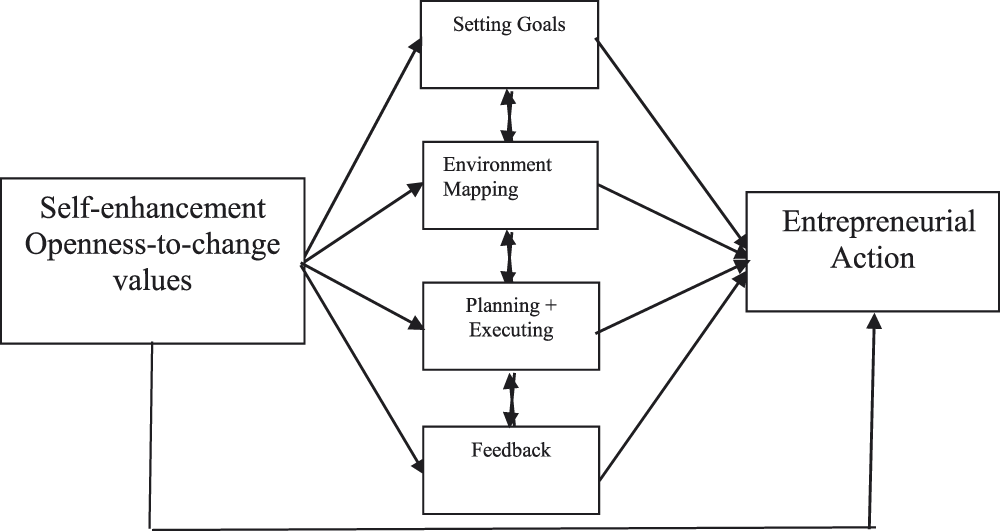
Frese (Reference Frese, Baum, Michael and Baron2007) states that the five sequence steps (i.e. goal setting, mapping of the environment, planning, monitoring the execution and feedback) are not always a regular and ordered chain. Action does not necessarily happen in a predictable way following a clear pattern. For instance, the possibility to re-plan or re-set the goals after the action, after receiving (and incorporating) some feedback and/or mapping the environment is always open. These cognitive processes usually go back and forth depending on the information the environment provides and what the person is able to scrutinize and take. Even though this sequence is not invariable, all the steps are necessary for effective entrepreneurial action (Frese, Reference Frese, Baum, Michael and Baron2007). Due to the not-necessarily successive structure of the sequence, we propose a theoretical model with four parallel, i.e. not lineal, mediators in which individual values are the main predictor. Below we describe this model whereby Schwartz’s (Reference Schwartz and Zanna1992, Reference Schwartz, van de Vijver, Chasiotis and Breugelmans2011) values of openness to change and self-enhancement, identified by previous research as entrepreneurial values, predict entrepreneurial action via each of Frese’s (Reference Frese, Baum, Michael and Baron2007) Action Sequence’s processes.
Goal setting
Action starts with a purpose, a goal, an intention. Goal setting theory has proven that motivation is directly linked to goals (Locke & Latham, Reference Locke and Latham1990) and that action is goal-oriented behavior. Goals thus, play a central role when it comes to understanding actions. Values, on the other hand, are defined by Schwartz (e.g., 2011) as broad motivational goals that express what is important to people. In this sense, Frese’s (Reference Frese, Baum, Michael and Baron2007) goal-setting process is a natural beginning for linking values with the cognitive sequence leading to entrepreneurial action.
The Schwartz’s definition implies that all values represent goals. “What distinguishes one value from another is the type of goal or motivation that the value expresses” (Schwartz, Reference Schwartz, Sander and Brosch2015 p. 68). Specifically, openness-to-change and self-enhancement values may influence the way specific (action-related) goals are set. On the one hand, individuals who prioritize openness to change over other values are more likely to seek autonomy, novelty, and independence of thought and action, having challenge in life or being able to exploit their creativity and curiosity. On the other hand, individuals with high self-enhancement values are more likely to seek opportunities to exercise their ambition, power, and social recognition, to obtain resources (and to have control over them) and to be achievement-motivated. These Schwartz’s broad motivational goals in turn, may influence in a funneling process an aligned and more specific set of goals directly related to actions (Masuda, Kane, Shoptaugh, & Minor, Reference Masuda, Kane, Shoptaugh and Minor2010). For example, searching for autonomy and power may translate in specific goals such as starting up a company, working for oneself, no longer reporting to a boss, creating a prototype, developing a minimum viable product, having a first customer, and/or obtaining capital. Therefore, we propose that openness-to-change and self-enhancement values will lead to set entrepreneurial action goals. This suggests the following proposition.
Proposition 1: Individuals with higher levels of openness-to-change and self-enhancement values are more likely to develop a set of goals related to entrepreneurial action. Hence, openness-to-change and self-enhancement values may influence the goal-setting process that, in turn, influence entrepreneurial action.
Mapping of the environment
Entrepreneurs need to know the environment where they plan to operate in. Research in entrepreneurial cognition has analyzed the different ways in which entrepreneurs understand and interpret their environment (e.g., Simon & Houghton, Reference Simon and Houghton2002; Valliere, Reference Valliere2013). Based on previous research in cognitive psychology (Gentner & Stevens, Reference Gentner and Stevens1983), Frese (Reference Frese, Baum, Michael and Baron2007) identifies four important factors that helps an entrepreneur to understand the environment: 1) Having a realistic mental model (this depends on the extent to which cognitive bias and heuristics are overcome and how optimism influences the perception of reality); 2) having a broad signal inventory (signals tell an entrepreneur which type of actions are better in which situation and help him/her to grasp complex patterns faster. Opportunity recognition, for example, may be conditioned by the inventory of signals that a person has); 3) developing a map of the environment that is operative (meaning that it should help entrepreneurs to go into action); and 4) having the right level of decomposition to understand an environment (being able to split a situation into different levels of analysis).
People pay more attention to situations related to their values when these situations threaten or when they offer opportunities to attain people’s values (Schwartz, Reference Schwartz, Sander and Brosch2015). For example, value priorities may influence whether entrepreneurship is perceived as an opportunity (for more autonomy) or a threat to status quo and security because of its inherent uncertainty. In particular, the two identified entrepreneurial values –openness to change and self-enhancement– could explain three out of the four factors outlined by Frese, i.e. the broadness of an entrepreneur’s signal inventory, the development of an environmental map and the level of situational decomposition. These three points share “expertise” as a common factor.
Frese (Reference Frese, Baum, Michael and Baron2007) notes that the signals inventory directly depends on expertise. The development of an environmental map also requires previous experience: “mapping is as often the result of action (experimentation) and the feedback the actor receives as a result of that action” (p. 156). Finally, the level of decomposition assumes certain level of previous experience as well (decomposition refers to the extent to which a person splits a situation into different levels of analysis. For example, product attributes are in a different level than market characteristics. The entrepreneur’s ability to differentiate these two levels may have a positive result).
We argue that individuals who give priority to openness-to-change and self-enhancement values might develop the three key characteristics when mapping the environment: a) A more extensive repertoire of signals that allow them to match situations with entrepreneurial actions i.e., signals that inform them which actions are required in which situations, b) a sketch of a map of the environment able to lead them to go into action, and c) the knowledge that the situation needs to be analyzed in different levels. This may be explained by two reasons: Firstly, these individuals are more likely to have previously experienced similar situations in which these values have guided their action. Values are long-termed and stable characteristics (e.g., Inglehart & Baker, Reference Inglehart and Baker2000) and are formed early on in life (Goodnow, Reference Goodnow, Grusec and Kuczynski1997). So, even though those previous situations were not directly related to entrepreneurship, they could call for a particular kind of action based on the same underlying values (openness to change and self enhancement). It is likely then, that the person may use this (non entrepreneurship specific) expertise as a signal for intuiting what to do when a situation calls for an entrepreneurially related action, how to develop an action-oriented map of the environment and which levels may minimally constitute this environment. Secondly, Schwartz (Reference Schwartz, Sander and Brosch2015) states that one of the mechanisms linking values to behavior is the effect that values have on perception, attention and understanding of the environment. Individual values “influence behavior by affecting what people attend to and perceive and how they interpret situations” (Schwartz, Reference Schwartz, Sander and Brosch2015, p. 78). If values affect the way a person cognitively captures the environment, then values may affect the entrepreneur’s repertoire of signals, the way he/she maps the environment and his/her understanding of the situation’s levels.
Specifically, we argue that because of their focus on self-direction values and motivations such as curiosity, need for control, and need for autonomy; individuals high in openness-to-change, are more likely to be alert, understand and acquire a broad range of external signals, as well as to properly grasp the levels of situational decomposition. In this way, they can develop a more accurate map of the environment than people who prioritize other motivational values. Further, because individuals high in self-enhancement values seek ambitious goals, search for more power, network, and social status, they will likely seek for knowledge that will help them to develop a map of the environment. The more accurate the map the better the information obtained to fulfil these motivations. Therefore we propose that:
Proposition 2: Individuals with higher levels of openness-to-change and self-enhancement values are more likely to develop an action-oriented map of the environment. Hence, openness-to-change and self-enhancement values may influence the process of mapping the environment that, in turn, influence entrepreneurial action.
Planning and Executing
Frese (Reference Frese, Baum, Michael and Baron2007) affirms that planning “already implies execution” (p. 159). Monitoring execution implies managing a series of actions while they are being translated from cognitions. Thus, we discuss both phases together. Frese (Reference Frese, Baum, Michael and Baron2007) and Schwartz (Reference Schwartz, Sander and Brosch2015) rely upon Gollwitzer’s (Reference Gollwitzer, Gollwitzer and Bargh1996) assertion that planning leads to an implementation and to a focused search for opportunities when trying to achieve a goal. Planning also has other volitional benefits for goal achievement such as avoiding “giving up in the face of difficulties when increased effort and persistence are needed instead” (Gollwitzer, Reference Gollwitzer, Gollwitzer and Bargh1996, p. 287). In this line, research on entrepreneurship reports positive effects of planning on a number of entrepreneurial outcomes (e.g., Dimov, Reference Dimov2010; Shane & Delmar, Reference Shane and Delmar2004).
According to Frese, (2007) plans describe an order of operations for the next few seconds, minutes, months or years. Some of them are elaborate, while others are only a general idea of how to proceed. Planning in particular, “increases the likelihood that people get started by translating their goals into actions and mobilizes extra effort” (p. 158). In a similar vein, Schwartz (Reference Schwartz, Sander and Brosch2015) explained that planning is one of the mechanisms by which values influence behavior. Specifically, planning influences behavior by (1) helping the individual to focus on the benefits of desired actions more than on the disadvantages, (2) increasing the individuals’ belief in their ability to achieve a goal, to keep on track, and to persist when faced with challenges, and (3) raising the likelihood of value-consistent behavior.
Values describe a hierarchy of motivational goals. “The more important a value, the more likely people are to form action plans to express it” (Schwartz, Reference Schwartz, Sander and Brosch2015 p. 77). Therefore, individuals who give more importance to openness-to-change values will plan to implement actions, such as for example, learning about innovations, exploring market needs, creating something innovative to solve some people’s problem, because they are aligned with their life focus on stimulation and self-direction. High self-enhancement individuals on the other hand, are more likely to plan and act upon entrepreneurial action that focus on ambition, power, money and prestige such as search for growth, investment, or presenting themselves. They do this in order to fulfil their motivation for power, achievement and status.
Proposition 3: Individuals with higher levels of openness-to-change and self-enhancement values are more likely to develop and execute plans to behave entrepreneurially. Hence, openness-to-change and self-enhancement values may influence the process of planning that, in turn, influence entrepreneurial action.
Feedback
Entrepreneurs usually deal with situations of high complexity and high uncertainty. This requires that feedback needs to be actively sought, constructed and adequately interpreted. From an action theory perspective, the most useful feedback is the negative one (Frese, Reference Frese, Baum, Michael and Baron2007). Negative feedback stresses the fact that the individual has not yet achieved the goal (Frese & Zapf, Reference Frese, Zapf, Triandis, Dunette and Hough1994). On the other hand, positive feedback means that the goals have been accomplished. Positive feedback may produce some extra motivation to repeat a particular action, but learning does not necessarily occur. The relevance of feedback lies in that it is only through feedback that individuals can find out where they are with regard to their goal (Frese, Reference Frese, Baum, Michael and Baron2007).
We propose that some particular features of openness-to-change and self-enhancement values may be related to an active way to seek and use feedback. People driven by openness-to-change values search for stimulation, novelty, and challenge in life. Receiving feedback is one way to fulfil these motivations. Specifically, feedback may provide individuals with perspectives, ideas or viewpoints they did not imagine, feeding in this way, the individuals’ search for novelty and stimulation. The more feedback is sought, the higher the probability of receiving something novel. Moreover, when feedback is critical it may mean some degree of challenge in life.
In the same way, people who prioritize self-enhancement values, search for obtaining resources by showing competence, enhance their public image, and adapt their public behavior to obtain social recognition. Competence, public image and social recognition already imply some level of feedback. The three of them are characteristics intrinsically related to what other people think about and attribute to the individual. In other words, the role of other people’s feedback is key for someone to receive social-recognition and maintain a desirable public-image. It is expected then, that people who are motivated by self-enhancement values are actively searching for feedback. Based on this reasoning we propose that:
Proposition 4: Individuals with higher levels of openness-to-change and self-enhancement values are more likely to actively search for feedback useful for their entrepreneurial action. Hence, openness-to-change and self-enhancement values may influence process of searching for feedback that, in turn, influence entrepreneurial action.
Discussion
Motivational values, albeit an important variable to explain behavior (e.g., Rohan, Reference Rohan2000), are under-theorized in research explaining individual entrepreneurial determinants (e.g., Fayolle et al., Reference Fayolle, Liñán and Moriano2014; Licht, Reference Licht, Freytag and Thurik2010). We address this gap by proposing a theoretical model that builds upon existing evidence of the direct effects of Schwartz’s individual values on entrepreneurship, and on Frese’s (Reference Frese, Baum, Michael and Baron2007) action theory that identifies the cognitive processes that explain entrepreneurial action. Specifically, we argue that certain values identified by Schwartz’s theory would predict entrepreneurship behavior by influencing Frese´s four cognitive steps, which are necessary for entrepreneurship action (Frese, Reference Frese, Baum, Michael and Baron2007). Hence, the main contribution of this article is the development of a theoretical model that integrates two complementary theories to predict entrepreneurial action.
Values are abstract goals that guide the way individuals select actions (which is not to say that values are enough to completely explain behavior). Then, values are not tied to specific objects or situations (e.g, Schwartz, Reference Schwartz and Zanna1992). Unlike attitudes, which are completely linked to particular subjects (Eagly & Chaiken, Reference Eagly and Chaiken1993), values transcend them. This condition gives the study of values the additional advantage that, as a higher level of the human cognitive hierarchy (Hitlin & Piliavin, Reference Hitlin and Piliavin2004), they are able to provide more general explanations of behavior whilst relying on fewer explanatory variables. Individual values then, are distal variables (Hitlin & Piliavin, Reference Hitlin and Piliavin2004). The proximal process through which a would-be entrepreneur becomes an actual entrepreneur having a particular set of values remains unclear. As such, the sequence proposed by Frese (Reference Frese, Baum, Michael and Baron2007), complements the theory of values when explaining entrepreneurial action. That is, Frese theoretical tool models this internal path of entrepreneurial action processes. This implies that each step makes the explanation of how the whole process unfolds clearer. Each part therefore, gradually sheds light on the values influence.
Despite their complementarity, these two lines of research have not been previously intertwined to explain entrepreneurial behavior. The concept of values as an individual attribute has a well-established tradition in sociology (e.g., Hechter, Reference Hechter1992; Inglehart, Reference Inglehart1971; Parsons & Shils, Reference Parsons and Shils1951) and social psychology (e.g., Allport, Reference Allport1961; Kluckhohn, Reference Kluckhohn, Parsons and Shils1951; Rokeach, Reference Rokeach1973; Schwartz, Reference Schwartz and Zanna1992). Values theorists from a number of fields, in spite of the diversity of their approaches, coincide on the key point that value priorities explain attitudinal and behavioral decisions (e.g., Rohan, Reference Rohan2000). Building upon previous theories, Schwartz’s (Reference Schwartz and Zanna1992) proposes a circular structuration of values and provide empirical evidence on the existence of core values recognized in all cultures. That is, the human value system is universal. People differ only in terms of the relative importance they give to these values.
On the other hand, Frese’s (Reference Frese, Baum, Michael and Baron2007) action theory belongs to the tradition of entrepreneurial cognition research. As a response to the limitations of the personality traits approach in the study of the entrepreneur (e.g. Shapero, Reference Shapero1975), scholars in the field began to use concepts of cognitive psychology (e.g., Bird, Reference Bird1988). Within the remarkable diversity of cognitive approaches (Mitchell et al., Reference Mitchell, Busenitz, Bird, Gaglio, McMullen, Morse and Smith2007), Frese’s theory is part of the research stream that underlines the role of action and its link with the way entrepreneurs think (e.g., Shepherd, McMullen & Jennings, Reference Shepherd, McMullen and Jennings2007). Particularly, Frese’s approach assumes that action is related not just to cognitive processes, but also to more stable cognitive styles.
In this paper, we explained how these two lines of research, i.e. individual values and entrepreneurial cognition are compatible and together may stimulate a research agenda to predict behavior in entrepreneurship. Particularly, these theories are complementary because of the central role both ascribed to action. McMullen and Shepherd (Reference McMullen and Shepherd2006) proposed that the decision-making process leading to action occurs in two moments, first, when individuals realize that an opportunity (that can be exploited for anyone) exists; and second when individuals overcome doubt and develop a belief that this opportunity is achievable by themselves. Individual values may be an antecedent of these two moments since they influence attention; perception and the way individuals evaluate events. Furthermore, due to their motivational condition, values guide the prioritization of certain actions over others (Feather, Reference Feather1992) and the explanations of these actions.
Interestingly, Schwartz and Frese’s approaches share roots in the same social scientific tradition. In his seminal work “The Structure of Social Action” (1937), Talcott Parsons argued for the need to advance an individual action theory on which social theory can be grounded. In this influential piece, Parsons understands individuals as purposeful, equipped with volitional choice and values-guided subjects. Furthermore, the purpose of Parsons with such an attempt was not different than the current purpose of understanding the reasons of individual entrepreneurs’ behavior, i.e., to explain individual action for understanding macro socio-economic consequences.
Bringing together theoretical approaches that have followed separate tracks offers the key advantage to give a broader scope to study the phenomena they both are interested in, in this case entrepreneurial action. With the proposed model we hope to provide some clarity on how entrepreneurship actions steam from individual values differences via cognitive processes. We also hope to encourage scholars to begin further operationalizing and testing this resulting new model, thus creating a more comprehensive theory.
Although this paper focus on individual differences as sources of entrepreneurship action, we acknowledge that entrepreneurial behavior is not explained exclusively by individual characteristics. An entrepreneur is somebody who makes a decision in a society with specific regulations that affect the way he/she interacts with several stakeholders. Additionally, this society promotes and rewards particular behaviors over others. It is feasible then that entrepreneurial attributes (e.g. openness to change and/or the search for autonomy) are more accepted in some societal groups than in others. For example, the closer context with which a person interacts, i.e. family, friends, job, organizations, community and networks, could interact with the person´s values to influence entrepreneurial decisions (Greve & Salaff, Reference Greve and Salaff2003).
Assuming that entrepreneurship action is a function of both individual and contextual variables, the proposed model could be further expanded to add country level variables that interact with individual values and cognition to predict behavior. For example, it would be interesting to examine how cognitive variables interplay with macro-level variables (e.g., economic conditions, culture, institutions) to predict entrepreneurship action. Among others, a microfoundations approach might be particularly useful. The study of microfoundations aims to disaggregate higher-levels of analysis into its lower-level constituent parts. Despite their relevance in generating better explanations and clarifying how individual attributes explain entrepreneurship (e.g., Bryant, Reference Bryant2014), entrepreneurship researchers have tended to ignore the microfoundations of entrepreneurs’ behavior (Zahra & Wright, Reference Zahra and Wright2011).
We also encourage a comprehensive research program with a series of studies testing the validity of the proposed model. First, we encourage the creation and validation of measures of the four elements described by Frese´s model. Second, we suggest the use of multiple methods to test this model. For example, longitudinal designs could be conducted measuring values, types of goals, ability to conduct environmental mapping, ability to plan and execute, and feedback seeking behaviors over time to predict entrepreneurship action. Different studies can address different paths. For example, one could test the effects of one of Schwartz’s values (e.g. self-enhancement) on entrepreneurship via the four elements addressed in this paper. Another study could be designed to test one single path of the proposed model in Figure 1. For instance, researchers could examine how entrepreneurial values explain planning activities that in turn explain entrepreneurial behavior. This research agenda could also include more studies examining other types of values not mentioned here such as conservative values (e.g. security and conformity) and how they can inhibit instead of promote entrepreneurial action.
Theoretical Model

The proposed model may also foment other research questions related with individual values that create social entrepreneurship action. In this article we do not address social entrepreneurship’s specificities. However, we do acknowledge that social entrepreneurs have particular attributes and it is likely that their set of values do not completely coincide with commercial entrepreneurs. Previous research shows that social entrepreneurs tend to prioritize self-transcendence instead of self-enhancement values as their commercial counterparts do (Stephan & Drencheva, Reference Stephan, Drencheva, Ahmetoglu, Chamorro-Premuzic, Klinger and Karcisky2017), while openness to change is a shared characteristic.
In a related line, further research may also explore the way values shape business choices. Current research shows that entrepreneurs who give more relevance to openness to change are likely to emphasize non-economic benefits from entrepreneurial action in their decision-making processes. Conversely, for individuals driven by self-enhancement (power and achievement), financial returns are likely to play a significant role in decisions concerning how attractive entrepreneurship can be (Holland & Shepherd, Reference Holland and Shepherd2013). This suggests differences in entrepreneurial behavior based on the value preference.
In short, by integrating Schwartz’s theory of values and Frese´s theory to propose a theoretical model explaining entrepreneurship action, we not only hope to have provided some clarity on the mechanisms that explain how individuals with certain values choose to become entrepreneurs, but we also hope to have encouraged more research on Schwartz’s values and entrepreneurship.