Some years ago, I realized that I was the first historian of Germany hired in a tenure-track position at Amherst College. I got my job in 2000. Steeped in German history, I was surprised that a premier liberal arts college chose to hire a historian of Germany only at the very end of the twentieth century. My generation of historians of Germany often think—and other historians of Europe share our perception—that German history is a strong (if not the strongest) field in modern European history. Whether measured anecdotally by the number of job openings, the number of historians hired, the stream of published books, or the share of German history articles in academic journals, it always seems that German historians and German history are at the forefront. In fact, though, historians of Germany have always made up the smallest cohort of historians of the major European history fields (that also include British, Russian, and French history). According to the latest figures available from the American Historical Association (AHA), in 2010 there were 990 historians of Britain, 668 historians of Russia, 605 historians of France, and 592 historians of Germany in the United States.
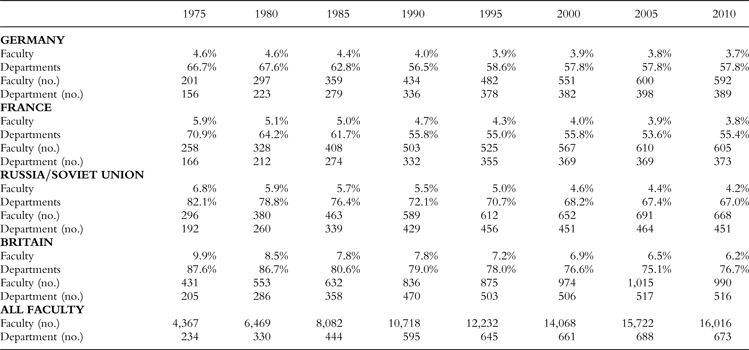
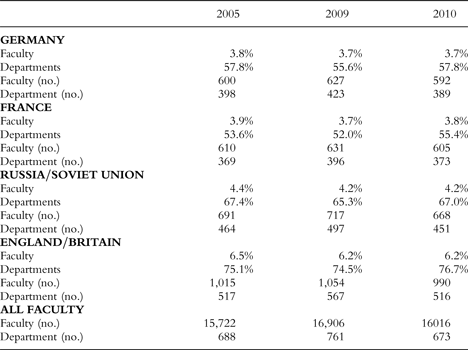
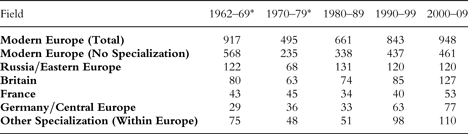
Prior to World War II, historians of Europe saw modern European history as one field. After 1945, however, the postwar expansion of the university system allowed European history to become more specialized and thus organized in national fields. In this article, I explain why modern German history has remained less well represented in the American academy than modern British, French, and Russian history.Footnote 1 I also chart the waxing and waning fortunes of each of those major fields. Two data sets inform my arguments. One, provided to me by Robert B. Townsend, gives the number of historians of each European national field since 1975 as recorded in the AHA Directory (see Tables 1 and 2).Footnote 2 The other, compiled by me, includes almost all job advertisements for tenure-track positions in modern European history posted by the AHA (since 1962) and H-Net (since 2000) through 2009—some 3,864 job ads (Table 3).Footnote 3
Tabulation of Faculty in AHA Directory with European Field Specializations

Source: Robert B. Townsend, AHA Directory.
Tabulation of Faculty in AHA Directory with European Field Specializations: 2005, 2009, 2010
Source: Robert B. Townsend, AHA Directory.
Job Advertisements for Historians of Modern Europe (per Decade)
Source: AHA Job Advertisements in Newsletter of the AHA (1962–69); Employment Information Bulletin (1971–82); Perspectives (1982–2007); Perspectives on History (2007-); H-Net Job Guide Postings.
*The table does not include job advertisements posted between October 1969 and November 1971. The numbers of job postings listed for the decades 1962–69 and 1970–79 are thus artificially low. Hundreds of jobs were surely advertised in that two-year period that covered three annual cycles of job hiring. See Footnote 3 for an explanation.
In the post-World War II decades, ideological and other influences, often from outside the academy, shaped decisions to hire historians of Europe. College and university administrators who authorized searches made their decisions within a set of institutional constraints. At the same time, historians of modern Europe rarely hired in their own national fields. Instead, historians of other European national fields, and historians of other parts of the world, sat on search committees that made hiring decisions at the departmental level. In the following pages, I suggest the various external ideological influences, internal institutional constraints, and historiographical fashions that—at different times and with different weights—shaped the hiring of historians of Europe. Why, then, did American colleges and universities long favor the hiring of historians of Britain, Russia, and France over historians of Germany? When and why have certain fields of modern European history been “hot,” while others decidedly less so? And despite the alleged success of the “Eurocentrism” attack, how can we explain the enduring strength of European history even today?
A “New Field”: European History 1900–1945
Modern European history in the United States has always reflected contemporary American concerns. Before 1900, American historians saw medieval and (what we call) early modern European history as “prenatal American history.”Footnote 4 If they worked on European history at all, American historians were most likely to focus on these earlier eras. They deemed modern European history a marginal affair. They also did not focus on the histories of particular nations or empires. Only British history, so crucial to the history of the early American Republic, was regularly taught in colleges and universities. A handful of individuals taught French history. The French Revolution, with its ideals of liberty and equality, resonated with America's self-understanding. As early as 1866, Andrew D. White, later the president of Cornell University, taught the first course in French history at the University of Michigan.Footnote 5 German and Russian history lagged behind by at least a generation. In 1894, Harvard professor Archibald Cary Coolidge taught the first course on Russian history at an American university. This course, the “History of Northern Europe,” was a one-semester class that examined Denmark, Sweden, Poland, and Russia.Footnote 6 If any courses on German history were taught in the nineteenth century, they were few and very far between. Even though numerous American historians studied in Germany and worshipped its model of higher education, Germany's recent past didn't seem relevant to a historical profession bent on proving America's singularity in the world.Footnote 7
Interest in the “new field” of modern European history grew in the decade before World War I.Footnote 8 Ambitious professors at a few institutions were eager to expand the geographical reach of their departments. Progressive New Historians also looked to the history of European institutions so as to cast light on their own.Footnote 9 It took World War I, however, really to stimulate sustained interest in modern European history in the United States. The Great War intimated a fundamental interest between Europe and the United States. During and after the war, American historians came to argue that Europe and America were partners in a great Atlantic civilization, bound together by a common march toward progress and democracy. They believed that the old continent, despite national differences, shared an underlying heritage that was their heritage, too. Such notions found currency in “Western Civilization” courses, widely adopted during the interwar years.Footnote 10 American historians thus invented the field of “European history”—a field that did not exist in Europe, where historians wrote and taught the national histories of their own countries.
By the 1920s, European history was more widely taught, but research, and particularly research into modern European history, was negligible. In 1923, Harvard professor Charles H. Haskins wrote an overview of “European History and American Scholarship.” In fact, this was a survey of everything that Americans had not researched in European history. According to Haskins, “Of the various countries of medieval and modern Europe, England has naturally received chief attention, for English history is in a sense early American history.” Yet in the same paragraph, Haskins regretted that “We have done relatively little for the period since 1783.” Of French history, Haskins wrote, “The French Revolution . . . has never ceased to excite interest throughout the United States.” Still, he lamented that “monographic research [on the French Revolution] has been sporadic” and enumerated numerous gaps in American scholarship on modern French history. Of modern German history, Haskins asserted “[one scholar] is at home in many phases of modern Germany, including the antecedents of the Great War.” Just one scholar! Haskins nonetheless added that “the war has compelled the reexamination of many phases of German history, especially the more recent.” Finally, Haskins lost few words on Russian history. Like Coolidge in the 1890s, he lumped it together with Swedish history: “With respect to the North and East of Europe not much can be said. Gustavus Adolphus and Peter the Great some years ago attracted American biographies, but the recent product is scanty.”Footnote 11
This meager research output reflected the formidable difficulties faced by American historians of Europe. In 1926, Chester P. Higby, a professor at the University of Wisconsin, sent out a questionnaire to the roughly 250 American historians of Europe that he had identified; 160 responded.Footnote 12 As Higby observed three years later, “Modern European history scholars have struggled with the problems of heavy schedules of teaching, small financial resources, and the lack of the tools of scholarship.” Most worked in libraries where only the most basic secondary sources were available. They rarely had access to academic journals or bibliographical aids. Publication venues were limited. Only about half of the respondents had ever even traveled to Europe. Yet Higby thought current developments promising. New university presses were creating opportunities for publication. The establishment of Guggenheim, Commonwealth, and other scholarships made it possible for talented Americans to go abroad for research stints. Finally, the new Hoover War Library at Stanford University made a fine collection of primary sources pertaining to Europe available on this side of the Atlantic.Footnote 13
In the 1920s, historians of Europe made up a small minority of the American historical profession. In 1926, total membership in the AHA was 2,868. Fewer than ten percent of AHA members were historians of Europe.Footnote 14 Higby, an indefatigable promoter of European history, set out to change this. By 1922, he had organized meetings at the annual AHA convention for historians of Europe. These events were intended to overcome the isolation of European historians working in departments composed largely of historians of the United States. At the same time, Higby and others began to lobby for a journal devoted to modern European history.Footnote 15 These efforts culminated in the founding of the Journal of Modern History (JMH) in 1929. As Higby proudly wrote in the first issue of the JMH, the journal “gives modern European history scholars an opportunity for the publication of articles such as they had never possessed before.”Footnote 16 The journal founders also established a Modern European History Section of the AHA to serve as the parent body of the JMH.Footnote 17
Until the 1930s, American historians of Europe primarily researched diplomatic history.Footnote 18 They were particularly interested in the origins of the Great War. The two most important works in this regard, Sidney Bradshaw Fay's The Origins of the World War (1928) and Bernadotte Schmitt's The Coming of the War, 1914 (1930), shaped generations of scholarship on the topic. In the 1930s, it became more common for American historians to specialize in particular national histories. In part, this reflected the drama of ongoing European events and individual countries' responses to them.Footnote 19 Eugene Newton Anderson, Walter Dorn, and Raymond Sontag all published monographs on German history. Crane Brinton, Leo Gershoy, and Louis Gottschalk became known as first-rate specialists in the French Revolution. Still, specialization in the continental fields of European history remained relatively rare. During the 1930s the American Historical Review (AHR), the journal of the AHA, published just two articles on German history.Footnote 20
At the start of World War II, modern European history was a small, but growing field. While still few in numbers, American historians of Europe had become more professional. They had their own journal, AHA section, and something of a corporate identity. In addition, the specialization that would fragment modern European history into national fields was also underway.
European History for a New World Order: Western Civ
World War II proved a caesura. The postwar years saw an exponential expansion of American higher education. The 1944 GI Bill provided for the postwar education of millions of veterans. In 1947, Harry S. Truman also released the Report of the President's Commission on Higher Education. It called for federal support for a system of higher education that would educate masses of students.Footnote 21 The President's Commission anticipated the enormous postwar increase in student enrollment: there were 2.3 million students in 1947, 8.5 million in 1970.Footnote 22 The growing numbers of students fueled an unprecedented job market for professional historians and, not least, historians of Europe.
A number of factors led specifically to the growth of European history. For one, historians of Europe enjoyed respect due to their wartime contribution to America's military triumph. Many historians of Europe served in the Research and Analysis Branch (R&A) of the Office of Strategic Services (OSS), the forerunner to the CIA. William Langer, a historian of Europe on leave from Harvard, headed up R&A; he was ably assisted by Sherman Kent, a historian of modern France at Yale. R&A veterans included Hajo Holborn, Eugene Anderson, Abram Bergson, Crane Brinton, John Clive, Gordon Craig, John Curtiss, Walter Dorn, Franklin Ford, H. Stuart Hughes, Leonard Krieger, Donald McKay, David Pinkney, Geroid Robinson, and Carl Schorske—all of whom were or became distinguished historians of modern European history or its national fields.Footnote 23 Barry Katz has argued that engagement with the real world of government fostered a critical understanding of history among the budding historians working for OSS. At the same time, their wartime work led them to adopt the ethos of the engaged scholar. Deeply conscious of their social responsibility as intellectuals, they maintained an abiding interest in contemporary events that profoundly shaped their historical work.Footnote 24 This ethos also impacted their teaching. Many of these historians were known for their enthralling lectures and seminars.
Even more important, European history was now to play a crucial role in the education of responsible American citizens. In 1945, Harvard University released a report, General Education in a Free Society, commonly called the “Red Book” (due to its crimson cover). It argued that student learning should go beyond the content and skills of the various disciplines. “Education must look to the whole man. It has been wisely said that education aims at the good man, the good citizen, and the useful man.”Footnote 25 Universities were to inculcate values, wisdom, and emotional capacities that would allow students to function as good citizens in a modern democracy.
Among other recommendations, the Red Book proposed a course “Western Thought and Institutions.” The authors believed that the “principal emphasis in the course should be placed upon the evolution of such institutions as representative government and the reign of law, the impact of the Reformation upon society and government, as well as upon religion and philosophy, the growth of religious toleration, the nature and legacy of the natural-rights philosophy, the growing confidence in the power of reason to deal with human problems, the expansion of humanitarianism, the rise of the laissez-faire philosophy and its relation to the economy of the preindustrial age, and the impact of the technological revolution upon industrial organization, the growth of populations, and the vast expansion of social and economic legislation.” The authors were confident that such a course “will offer the student, even though he may fail to grasp the significance of much of the material at the time, a set of intellectual tools which will be of the greatest value to him.”Footnote 26
In a society obsessed with the present, European history was deemed relevant for solving the great issues of the day.Footnote 27 Although Harvard never actually introduced the proposed course, Western Civilization requirements became ubiquitous at colleges and universities across the nation. Even if professors did not necessarily teach them in this way, Western Civ courses were intended to bolster American students' commitment to freedom and democracy. They were to underscore the importance of rationality and science in overcoming strife and inhumanity. They were to emphasize not only the fusion of European and American history, but also the emergence of the United States as the great heir and successor to the European tradition. They were also to further America's security goals. By positing a community of interests between America and the European democracies that had vanquished Hitler and now faced the Soviet threat, Western Civ justified the need for collective security within the “Atlantic Community.”Footnote 28 It was no accident that the growth of interest in European history occurred just as (western) Europe's stature in the world declined.
The predominance of required Western Civ courses brought Europeanists new power in American history departments.Footnote 29 A 1952 survey of AHA members (fifty-six percent of whom responded) showed that now more than one-third of respondents (more than 1,000 individuals) specialized in the history of the United States. Modern European historians, however, were the next largest cohort, with 685 historians. In third place was another European history specialization, medieval history, with 183 historians.Footnote 30 These trends would further crystallize in the second half of the 1950s. Between 1955 and 1959, 38.4 percent of all new Ph.D.s in history were in European history (and virtually all of those degree holders would soon have jobs).Footnote 31 In the first postwar decades, historians of Europe made up close to forty percent of the American historical profession.
At the same time, conditions for American historians of Europe improved immeasurably. For one, it became much easier to get to Europe. In 1958, jet airplane service was introduced. It cut travel time to Europe from eight days to eight hours.Footnote 32 Americans also benefited from more fellowship opportunities to study abroad. Once in Europe, they lived well on the strength of the dollar. The flagship of the postwar fellowship programs, the Fulbright Program, begun in 1949, was rooted in the same ideological impetus as Western Civ courses. Senator J. William Fulbright strongly believed that the United States was part of a shared western civilization that it was obliged to defend, not least through educational exchange.Footnote 33
The Special Place of British History
Departments rushed to hire Europeanists to staff their Western Civ courses. Although Kant and other German thinkers figured in Western Civ surveys, departments were still more eager to hire historians of France and Britain. They wanted historians of France to cover the Enlightenment and the French Revolution, the bedrocks of any Western Civ course. But they were even more eager to hire historians of Britain. Even small colleges often had an early modern and a modern historian of Britain. The AHA's 1952 survey illustrated the salience of British history in U.S. history departments. In declaring their primary specialty, 155 individuals chose modern history of the British Isles, and another 74 Tudor and Stuart history. This compared to 123 historians of France, 81 of Russia and eastern Europe, and 99 of Germany and central Europe (23 of the latter).Footnote 34
The numerical superiority of historians of Britain—over those of every other European field—has remained constant ever since. In part, this is due to the large number of early modern historians of Britain and the fact that departments are still hiring in this field. Early modern historians of France, particularly those who specialize in the Enlightenment and the French Revolution, have also boosted the numbers of historians of France. Since the Western Civ narrative placed the birth of modernity in the Renaissance/Reformation period, one might have expected high numbers of historians who specialize in fields such as the German Reformation and the Italian Renaissance. But the numbers of historians who specialize in the German Reformation never matched those of early modern historians of Britain or France.
Colleges and universities privileged British history because it illustrated the ideological tenets that undergirded Western Civ courses. American historians, however, also believed that Britain and the United States shared a unique, linked heritage. British history embodied core tenets of the history of the United States, including the growth of liberty, the march of progress, and the development of great public institutions. It thus bolstered the case for American exceptionalism. By highlighting the English origins of representative government, capitalism, and individualism, historians of Britain pointed to the special destiny of Anglo-American civilization. The Constitution and the Bill of Rights arose from the Magna Carta. The booming postwar U.S. economy was the full-grown version of the industrial revolution. The recent war only made the case for Anglo-American exceptionalism—read virtue—stronger. Roosevelt and Churchill had successfully led the Allies to preserve liberty against a terrible fascist threat.Footnote 35 The interest in British history also reflected the new “special relationship” between England and the United States. Although rooted in British weakness, the two countries foresaw ever greater military, diplomatic, and economic cooperation. Finally, the WASP, Anglophilic elite at exclusive east coast institutions ensured Britain's special place in history curricula.Footnote 36
American historians also saw Britain as the pioneer of the modern world. In the 1950s, social science was much influenced by the modernization paradigm, according to which all countries would eventually follow a trajectory modeled by Britain, France, and the United States. In this schema, Britain, and particularly its Victorian era, held pride of place. The Victorians were the first “moderns.” They had enviably achieved capitalist modernity by peaceful and democratic means.Footnote 37 Victorian studies became a popular endeavor. The interdisciplinary journal Victorian Studies was started in 1957, even before the more general Journal of British Studies.
Given the British Empire, British history also offered a venue for those who wished to explore the world beyond Europe and the United States. Historians of Britain made the case that they were essentially historians of the world. As William McNeill later characterized this sort of argument, much history started only when “Europeans discovered, colonized, and civilized” the world.Footnote 38 After 1945, many historians who studied Asia and Africa initially did so through the lens of British imperial history.
One of the curious facts of my research was the discovery that there is no overview of the development of British history in the United States. This may be because British history has always been taught and written in the United States; no founding moment later demanded explanation. But the absence may also reflect the sense that British history in the United States is not a field unto its own, separate from its development in Britain. Compared to its continental counterparts, British history on both sides of the Atlantic has been a relatively integrated field. Historians in Britain and the United States have long known and respected each other's work.Footnote 39 They can readily access each other's books, journals, and reviews. Nonetheless, there are differences in approach. Historians in Britain have not written their country's history as part of a western tradition of liberty and progress.Footnote 40 They do not explore the English origins of American exceptionalism. Today, there is also less emphasis on British imperial history in Britain than in the United States.
“Know Your Enemy”: The Cold War and the Rise of Russian History
By the late 1940s, the dangerous enemy was not fascism, but communism, not Germany, but the Soviet Union. In a sense, Western Civ and the new interest in Russia were two sides of the same Cold-War coin. While Western Civ courses were to educate students in the values of liberty and democracy, the new emphasis on Russia was about “knowing the enemy.” To confront this new and mysterious opponent, American leaders instituted a battery of intellectual initiatives. The result was a rare cooperation among humanists, social scientists, university administrators, government officials, and foundation donors to create the most successful area studies endeavor in the United States.
The area studies approach had its roots in the wartime OSS. Geroid Robinson, a historian of Russia at Columbia, headed the R&A's U.S.S.R. division. At its height, his staff included some sixty social scientists.Footnote 41 After the war, Robinson spearheaded the founding of Columbia's Russia Institute. The institute opened in 1946 and was staffed with many former R&A colleagues. Two years later, Robinson encouraged the founding of the Russian Research Center at Harvard. It, too, included many R&A veterans.Footnote 42 These centers and subsequent ones across the country were soon funded by the Carnegie Endowment for International Peace, and the Rockefeller and Ford Foundations. While there were five Russian and/or east European centers at American universities in 1951, there were forty such centers in 1964, and more than eighty in 1971.Footnote 43
In 1938, there had been just a dozen historians of Russia in all of the United States.Footnote 44 After the war, though, the training of historians of Russia exploded. Russian émigrés, who had fled the Russian Revolution, played an important role in training American historians of Russia. Indeed, these émigrés' influence may even have outstripped that of the refugees who had fled Nazi Germany and specialized in modern German history (see below). At Harvard since 1927, Michael Karpovich trained more than thirty graduate students in Russian history in the decade after World War II. Alexander Gerschenkron joined him in working with these and other students. At Yale, George Vernadsky also trained numerous historians of Russia after the war.Footnote 45 Given that history was a party matter in the Soviet Union, Karpovich, Gerschenkron, and Vernadsky kept alive a liberal tradition of Russian historiography that was now only possible abroad.
In the 1950s, Ph.D. candidates completed some 275 dissertations in Russian history. These numbers grew even more spectacularly in the 1960–74 period, when 1,240 doctoral candidates defended dissertations in Russian history (many, though, received their degrees after the job crisis began in 1971 and thus never held academic positions).Footnote 46 In the 1950s and 1960s, the “bonanza years,” newly minted historians of Russia fanned out across the country.Footnote 47 In the 1960s, more AHA job advertisements called for a modern Russian historian than for any other field of modern European history; there were 122 job postings for Russian (100) and/or eastern European (22) historians (see Table 3). In 1975, the AHA Guide to History Departments listed 296 historians of Russia, the second largest cohort of European historians (see Table 1).
The leaders in Russian studies in the United States saw themselves engaged in an urgent enterprise to educate Americans about the Soviet Union. The exigency of their task, combined with available funding, made them institution builders. Historians of Russia were the first Europeanists (after the medievalists in 1925) to have their own professional organization and journal, albeit in interdisciplinary form.Footnote 48 In 1948, the Joint Committee on Slavic Studies (JCSS) was founded as “a sort of executive committee for the field.”Footnote 49 It arranged for the continued publication of the American Slavic and East European Review (begun when the British Slavonic and East European Review temporarily relocated to the United States in 1941).Footnote 50 Renamed Slavic Studies in 1961, it provided a premier venue in which historians of Russia could publish their work. In 1959, the JCSS gave way to a membership organization, the American Association for the Advancement of Slavic Studies (AAASS).
For much of the postwar period, Russian history benefited from generous government and foundation support. In 1956, first the Inter-University Committee on Travel Grants (IUCTG) and its successor in 1968, the International Research and Exchanges Board (IREX), made academic travel to the Soviet Union and eastern Europe financially possible. Funded both by government and foundation support (Carnegie gave start-up funds to UICTG, while Ford initially bankrolled IREX), these programs allowed thousands of American scholars to undertake research in the Soviet Union and eastern Europe. Several acts of federal legislation also spurred on the study of Russia. In 1958, the National Defense Education Act (NDEA), inspired by the Sputnik satellite launch, called for additional Russian language training (as well as scientific education) in universities.Footnote 51
Generous funds available for Soviet area studies through the 1960s dried up in the 1970s. In 1966, for example, the Ford Foundation allocated forty-seven million dollars to Soviet studies. In 1979, that figure dropped to just two million dollars.Footnote 52 By the late 1970s, scholars were writing that “the study of Russia in the United States is in deep trouble today.”Footnote 53 In the following decade, however, renewed Cold-War militancy prompted increased spending on Soviet studies. In 1983, the State Department began Title VIII funding to maintain expertise on the Soviet Union and eastern Europe (and now the independent states of the former Soviet Union).
Still, for all the institutional strengths of Russian area studies, historians of Russia faced formidable difficulties. Between 1936 and 1956, the Soviet Union did not allow American academics to enter the country.Footnote 54 Historians of Russia thus saw their sources limited to what could be found in American or western European archives and libraries: prerevolutionary periodicals, documents brought out by those fleeing the revolution, and memoirs and oral histories of émigrés eager to discuss events in which they had participated. Given this source base, many graduate students in Russian history in the 1950s chose to focus on intellectual history; this, though, also reflected a general trend toward intellectual history among European historians in the United States. Even after 1956, when American scholars were allowed to travel to the Soviet Union, their access to libraries and archives was often very limited, bound by endless red tape.
In the first postwar decades, most historians of Russia focused their research on the period leading up to the Bolshevik Revolution. The big question was 1917. What had allowed the revolution? Did it represent an aberration from Russia's history as a European country, or did it show that Russia was not, in fact, part of the European heritage?Footnote 55 Mirroring the profession, historians of Russia turned to social history in the mid-1960s. They now explored the history of social movements and how these influenced 1917.Footnote 56 They also considered the country's trajectory in terms of the modernization paradigm. This led to both a backward and forward chronological expansion of topics—back to the Great Reforms of the 1860s and forward to Stalin's “revolution from above” in the 1930s.Footnote 57 In the 1970s, historians such as Stephen F. Cohen and Sheila Fitzpatrick began to undertake the first empirical studies of Soviet history in the 1920s and 1930s. They questioned whether the Russian Revolution inevitably led to Stalinism, or whether it contained the seeds of a more emancipatory order.Footnote 58
Given their limited access to sources, historians of Russia were not—nor could they be—at the forefront of innovative historical methodologies. They found themselves imitating, rather than initiating, the new kinds of historical inquiries practiced by their colleagues in other fields of modern European history.Footnote 59 Only after 1991 could historians of Russia and the Soviet Union base their studies on the sort of rich sources that historians of Britain, France, and Germany have long taken for granted.
The Slow Rise of German History
After 1945, interest in German history among historians of Europe was considerable. As William H. McNeill has written, “My generation of European historians came of age during World War II. We confronted two big questions . . . . First and most burning was: What went wrong with Germany?”Footnote 60 How could Germany, a cultured society in the very heart of Europe, descend to such depths? Yet despite interest in this question, many institutions refrained from hiring a historian of Germany. For one, American historians deemed historians of Germany less well suited to teach Western Civ. After all, modern German history did not fit the Western Civ paradigm—Germany was the anti-story, the story of liberty thwarted rather than achieved. But other factors also played a role. There simply weren't as many trained historians of Germany as of Britain and France. Many Americans also viewed Germany as a barbarous country and were wary of bringing historians of it to their institutions. Then, too, a pervasive antisemitism led to employment practices that disadvantaged the hiring of historians who were Jews or of Jewish descent (as many émigré historians were).Footnote 61
Yet some institutions actually sought a historian of Germany. They wanted a specialist who could explain why Germany had not only brought on World War I, but also Hitler and World War II. As early as the 1930s, some of these departments turned to the talented pool of émigré historians who had just fled Hitler's Europe. These refugee historians—trained in Germany—played an enormous role in the development of German history in the United States. During his time at Yale (1934–69), Hajo Holborn supervised the dissertations of some fifty-five doctoral candidates, many of whom became leading historians of Germany in the United States.Footnote 62 Hans Rosenberg, who taught at Brooklyn College (1938–59) and Berkeley (1959–70), and Dietrich Gerhard, at Washington University in St. Louis (1936–65), also trained many graduate students in German history. These and other refugee historians imparted to their American students a cosmopolitism coupled with intimate knowledge of Europe.Footnote 63
The refugee historians helped to raise the quality of German and European history written in the United States so that it was equal (or sometimes even superior) to the history produced in Europe.Footnote 64 Moreover, while the Nazis were still in power, these historians saw themselves as the “guardians of German history,” as the historians who could write dispassionate history while their counterparts inside Germany were hostage to Nazi ideological frameworks.Footnote 65 After 1945, these historians pursued a critical view of German history that was at odds with their established (and generally very conservative) German counterparts. Their more critical history, however, influenced younger generations of German historians who would come to dominate the West German historical profession from the 1970s onward.Footnote 66
In the 1950s, a younger generation of émigré historians, who had fled Europe as children or teenagers and received their doctoral training in the United States, took up positions in German and European history. This group included Werner T. Angress, Klaus Epstein, Peter Gay, Georg Iggers, Klemens von Klemperer, Arno Mayer, George Mosse, Fritz Stern, and Gerhard Weinberg. These émigré historians, however, were socialized in American academia. They adopted some of the distinctive elements of the American historical profession. Not least, they came to view historical developments in their native countries through the American lens of European history as a unified, western civilization. They were also drawn to intellectual history, then enjoying preeminence in the United States.Footnote 67
For German historians, the major historical question was how and why Germany had abandoned liberal democracy and succumbed to Nazism in 1933. In this, they paralleled historians of Russia and their preoccupation with the Bolshevik Revolution. As early as the 1950s, historians of Germany in the United States insisted on a negative German Sonderweg (special path)—that Germany had traveled a path to modernity that diverged from that of western countries.Footnote 68 As Hajo Holborn put it in 1952, “The split between Germany and the West will of necessity always be an important theme for historians.”Footnote 69 In the late 1950s and early 1960s, a wave of influential books addressed how and why Germany had departed from a purported western norm and ultimately produced Hitler. In The German Idea of Freedom (1957), Leonard Krieger explored how the German notion of freedom differed from that of other western cultures. Hajo Holborn analyzed Germany's peculiar trajectory in his wide-ranging, all-encompassing three-volume A History of Modern Germany (1959–69). Fritz Stern and George Mosse explored the intellectual origins of Nazism in The Politics of Cultural Despair (1961) and The Crisis of German Ideology (1964), respectively. Stern and Mosse's focus on nationalism, racism, and antisemitism pointed to the cultural antecedents of the Holocaust, even though they and many other refugee historians did not directly explore the destruction of Europe's Jews.Footnote 70
Indeed, to us today, a striking feature of the refugee historians was their seeming disinterest in the Holocaust. This was true even though captured German documents related to the murder of the Jews were readily available in the National Archives. Holborn's trilogy, for example, devoted all of one page to the Holocaust.Footnote 71 The refugee historians (and their many students) studied 1933, Germany's rejection of liberal democracy, to exhaustion. Their liberal ethos kept them focused on the abandonment of democracy. By contrast, they did not ascribe particular importance to 1941, when the Germans began mass killings of Jews. Some were even reluctant to discuss the Holocaust in their classes.Footnote 72 At the same time, the most influential first-generation refugee historians did not think of themselves as Jews. Many grew up as Protestants or otherwise had tenuous links to their Jewish origins. To them, the Holocaust had happened to others—and thus rightly belonged to the purview of other historians. This was less true of second-generation refugee historians, many of whom did have Jewish identities. It seems, though, that they (and many others) needed time before they could address the trauma of the Holocaust. Indeed, in the first postwar decades, little research was done on the Holocaust by anyone anywhere. As Steven Aschheim has written, “it was not polite to talk of such things.”Footnote 73 In addition, the Holocaust was not yet seen as an exclusively Jewish phenomenon. What happened to the Jews was viewed as part and parcel of the Nazis' universal attack on humanity.Footnote 74 Several decades would pass before historians of Germany turned to the study of the Holocaust.
In the 1960s, German history and German historians came of age. By then, the era of Western Civ was drawing to a close. The late 1960s cast doubt on all that Western Civ stood for. To many, the notion that the west reflected a heritage of liberty and progress seemed preposterous. The United States was mired in the Vietnam War, a conflict rooted in Europe's imperial past. Urban blight was everywhere, race riots common headlines. A series of assassinations, especially those of Martin Luther King, Jr., and Robert F. Kennedy, seemed to halt the forces of progressive change. The rise of identity politics and its concomitant emphases on race, class, and gender also made Western Civ seem hopelessly outdated. Marginalized populations, including women and African-Americans, felt that Western Civ ignored them. Many now came to view Western Civ as a course about too many DWEMs—“dead white European males.” If European history still seemed of interest, it was not for its alleged tradition of liberty and democracy, but rather for its dark side, for the tragedies it wrought in human history. The very collapse of the Western Civ paradigm likely stimulated interest in hiring historians of Germany. If European history was no longer an inevitable march toward progress, but rather a sordid affair of counterrevolution, domination, and irrationality, German history illustrated this best.
The Fragmentation of European History
The breakdown of the Western Civ paradigm led to a fragmentation of European history into national fields. There now seemed few compelling intellectual grounds for why Europe should be treated as a unified geographic entity. In addition, political, diplomatic, and intellectual historians, whose interests had ranged widely across the continent, lost their dominance to social historians, who usually explored their topics in a highly localized fashion (see below).Footnote 75 There was thus no brake to halt the advancing specialization of European history into national fields of study. This, in turn, was reflected in job listings. In the 1960s, sixty-two percent of all job openings in modern European history posted by the AHA were listed simply as jobs in modern European history (or Western Civ). Since the 1970s, that number has dropped to roughly fifty percent of all jobs (the number has ranged from a low forty-seven percent in the 1970s to a high fifty-two percent in the 1990s). Put otherwise, since the 1970s, roughly half of all modern European history job openings have asked for a historian of a specific country or region.
This growing fragmentation left many historians of Europe more eager to speak with specialists in their national fields than with other Europeanists. In 1950, the North American Conference on British Studies (NACBS) was founded.Footnote 76 Five years later, the group that became the Society for French Historical Studies convened its first meeting.Footnote 77 The society launched French Historical Studies in 1958 and was soon followed by NACBS's Journal of British Studies in 1961. Historians of Germany and central Europe followed later in such organizational endeavors. In 1958, they founded the AHA-affiliated Conference Group for Central European History (CGCEH). Its primary function was to oversee and secure financing for the filming of captured German war documents.Footnote 78 CGCEH helped to launch Austrian History Yearbook in 1965, and founded Central European History (CEH) in 1968. CEH replaced the interdisciplinary Journal of Central European Affairs that had become defunct in 1964. Scholars of Germany did not have a membership organization that held annual conferences until the founding of the Western Association of German Studies in 1976. In 1983, it became the German Studies Association (GSA).
Funding for graduate study abroad also became more country specific. Over the decades, the German and French governments created fellowship programs to support American graduate study in their countries. Students of German history have enjoyed particularly generous funding sources, including the Alexander von Humboldt Foundation, the German Academic Exchange Service (DAAD), and the German Marshall Fund. Students of French history have been eligible for the highly competitive Chateaubriand Fellowships, offered by the French Embassy in the United States since 1967.Footnote 79 Graduate students in British history are less fortunate; fewer fellowship opportunities are directed solely at them.Footnote 80
A National Job Market: Hiring Trends in the 1960s and 1970s
By the early 1960s, the increasing numbers of jobs available—and a shortage of historians to fill them—led to a national job market for historians. In December 1962, the AHA began a “Professional Register” that consisted of job listings in its newly founded Newsletter. Footnote 81 From 1962 through 1969, some 917 jobs in modern European history (or Western Civ) were listed; of those, 568 were listed as general jobs in Modern Europe or Western Civ. In addition to the 122 job listings in Russian/eastern European history, there were 80 in modern British history, 43 in modern French history, and 29 in modern German/central European history, as well as a smattering of ads for other specialties (see Table 3 on page 603).Footnote 82
These statistics bolster the analysis presented above. Many institutions were seeking general Europeanists who could staff Western Civ classes. The high numbers of openings in Russian history reflect the Cold-War investment in Soviet area studies. Institutions were still less likely to search for a German than a British or French historian. Still, it was largely British, French, and German historians—as opposed to historians of other European countries—who were hired to fill positions listed as “modern Europe.” At the same time, these statistics hardly include all job openings. Many institutions, and particularly the most prestigious ones, did not list their openings in the “Professional Register” at all. As John L. Shover complained in late 1971, some schools refused to use the service because “somehow this would be demeaning to prestige.”Footnote 83 The “old boys' network” remained a strong force in the hiring process.
The early 1970s saw the first of what has become a perpetual job crisis in history. At the 1971 AHA convention, 2,300 applicants vied for 155 advertised jobs (in all fields of history).Footnote 84 Throughout the decade, the job market for historians remained grim. In part, the bad market for historians reflected general trends in higher education. Many scholars mark 1970 as the end of the “golden age” of the American university. Optimism in the value of higher education had eroded. Many colleges and universities faced their first postwar budget crises. The humanities also lost their once more privileged status in the academy. Science and more “practical” fields came to dominate university curricula.
Developments specific to the history profession also played a role in the constriction of the job market. The retreat from Western Civ, led by historians themselves, robbed European historians of their strongest claim to legitimacy in the postwar educational system.Footnote 85 If history in the guise of Western Civ no longer served as the unifying bond of general education, why support it? Students, too, came to question the value of history. Between 1970 and 1979, the number of majors in history plummeted by almost half (from 43,386 to 21,019).Footnote 86 All of these trends were reflected in hiring patterns. In the 1970s, the number of advertised jobs fell dramatically. The AHA advertised sixty-eight openings in Russian history (including six in Russian/eastern European history), sixty-three in British history, forty-five in French history, and thirty-six in German/central European history.
In the 1970s, as measured by a variety of indicators, German history remained the least strong of the major European national fields. In 1975, the AHA began to publish an annual Guide to Departments of History (renamed the Directory of History Departments and Organizations in the United States and Canada in 1990). In the first Guide, only 234 departments were included. It listed 431 historians of Britain, 296 historians of Russia/Soviet Union, 259 historians of France, and 201 historians of Germany (see Table 1). In addition, according to the 1975 Guide, historians of Germany were less well represented in American history departments than other historians of Europe. While 66.7 percent of departments had at least one historian of Germany, 70.9 percent had one of France, 82.1 percent one of Russia, and 87.6 percent one of Britain. Another statistic also illustrates the slower growth of German history. William H. McNeill calculated the number of books about European history since 1750 published in the United States between 1968 and 1978. He found 543 books published on Great Britain; 311 on the U.S.S.R., 304 on France, and just 231 on Germany.Footnote 87
In the 1970s, although jobs were hard to come by, historians of Germany actually fared better than those of other European fields. It seems that history departments were now more eager to hire those who would teach the dark side of modernity. Many institutions also already had historians of Britain, France, and Russia. According to the AHA's 1980 Guide, the number of historians of Germany grew at a faster pace than those of France in the second half of the 1970s, even though there were still fewer historians of Germany (297) than France (328) at the end of the decade. By 1980, more departments had a historian of Germany (67.6 percent) than of France (64.2 percent). In the five-year period between 1975 and 1980, German history was the only national field that grew its representation in departments (see Table 1).
Data culled from the 1977–78 Guide suggests that historians of Germany were also younger than their counterparts in the other major fields; 58.2 percent of historians of Germany had received their Ph.D.s in 1965 or thereafter. The same was true of only 52.5 percent of historians of Britain, 51.8 percent of historians of Russia, and 45.9 percent of historians of France. The fact that many historians of Germany got their Ph.D.s or came up for tenure after the job crisis began may explain why the field has long been perceived as strong. Those historians of Germany who got jobs chose to publish, rather than perish.
The Heyday of French History
In the 1970s, British history still retained its strong numbers in the American academy. Past hiring meant that historians of Britain were firmly entrenched in their tenured positions. But British history no longer retained the same luster. Once seen as a splendid empire, Britain's declining status in the world was all too evident. A wave of national liberation struggles led to Britain's retreat from virtually all of its former colonies. Race riots in Notting Hill shattered the country's genteel reputation. Historiographical trends also undermined the status of the field. Few historians remained convinced that the Victorian era was the key to Britain's modernization, the notion that had earlier animated Victorian studies.Footnote 88 Many British historians also continued to work on “old-fashioned” political and constitutional history.
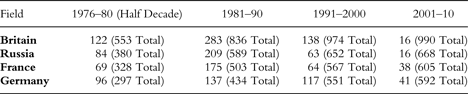
Still, some historians of Britain turned to innovative studies of class. In 1963, the unorthodox British Marxist historian E. P. Thompson published The Making of the English Working Class. As Peter Novick has written, “Surely no work in European history ever so profoundly and so rapidly influenced so many American historians.”Footnote 89 Thompson played up the agency and spontaneity of the working class. He also studied working-class culture. To many young, radical historians who wanted to shake up the history profession, Thompson's book was a breath of fresh air. In the 1970s, not least due to Thompson's influence, historians of Britain (and every other field, too) turned to social history. Many historians of Britain now analyzed worker radicalism, middle-class revolution, and the transition to capitalism. In the 1970s and 1980s, historians of Britain not only remained the strongest contingent of European historians, but they also grew the most in absolute numbers—by a whopping 283 in the 1980s alone (see Tables 1 and 4). The continued strong interest in hiring historians of Britain may have reflected tradition or Thompson—or both. Some larger history departments had as many as four historians of Britain.Footnote 90
Absolute Growth of Faculty within European Field Specializations
Source: Table 1, “Tabulation of Faculty in AHA Directory with European Field Specializations.”
In many ways, though, it was historians of France who benefited the most from new trends in history. The 1970s and 1980s were the heyday of French history in the American academy. Politics played a part. While the United States was mired in problems that defied resolution, France enjoyed a leftist upsurge. “In the early and mid-1970s,” Edward Berenson has written, “I felt extremely alienated from my own country, angry over the war in Vietnam, the corruption of the Nixon administration, and the sorry state of American urban life. Once in Paris, I was dazzled by the widespread refusal to accept the status quo.”Footnote 91 In the late 1960s and early 1970s, many graduate students in European history turned to French history precisely because of their leftist politics. Not least, they believed that France and its democratic tradition might have something to offer the United States.Footnote 92 Some even chose France over an initial inclination to study Germany because they found the French political tradition more appealing. As Lynn Hunt has argued, “the French Revolution signaled creativity, optimism, and forward movement whereas the Nazi rise to power bespoke anti-Enlightenment irrationalism and reactionary politics. Genes probably explain my preference for optimism.”Footnote 93 Finally, a more mundane factor made the study of France attractive. Until the mid-1970s, French was the most popular foreign language taught in American secondary schools.Footnote 94 In Leonard V. Smith's words, studying France offered “the path of least linguistic resistance.”Footnote 95
French history may also have been attractive because Americans sensed that they could make original contributions to that country's history. In 1958, David Pinkney proposed what became known as the “Pinkney Thesis.” American historians, he claimed, could never match French historians' archival research. As a result, they were doomed to write synthetic accounts that at most drew on original archival research to fill in small gaps of knowledge. Since American historians' contribution to French history could not be other than marginal, it would never receive much recognition from French historians.Footnote 96 In fact, though, by the early 1970s American historians had made signal contributions to the study of French history. Moreover, they did so, as R. R. Palmer proudly noted, without a wave of influential refugees that jump-started Russian and German history in the United States.Footnote 97 In particular, American historians tackled the politically charged “Franco-French wars” that their French colleagues avoided.Footnote 98 Nowhere was this more evident than in their examination of the Vichy regime and its collaboration with Nazi Germany. The gradual French acceptance of Robert O. Paxton's now classic Vichy France (1972) helped to integrate the American and French fields of French history.Footnote 99 As Pinkney later admitted, he had been too pessimistic about the potential of Americans to influence French history in the Hexagon.Footnote 100
Historians of France in the United States pioneered innovative historical practices. As William H. Sewell has written, “American historians of France have naturally been influenced by the example of the powerful and prestigious ‘Annales school.’. . . This tended to give us the sense of being in the historiographical avant garde.”Footnote 101 Along with E. P. Thompson, the influential Annales school helped to inspire the social history that came to dominate the American historical profession in the 1970s. American historians of France led the way in studying ordinary folks long neglected by political historians. They now eagerly wrote the histories of those down and out and on the margins of society. To research those who left few traditional paper trails, social historians developed sophisticated quantitative historical methods. While claiming to say something general about the process of modernization, social historians usually focused on a specific community, social class, or occupational group. Joan Scott's Glassworkers of Carmaux (1974) was typical of this kind of work.Footnote 102 Precisely these innovative methods led some departments to hire historians of France. As Thomas Kselman later wrote of the mid-1970s, “I was hired primarily because my colleagues in the history department [at Notre Dame] were interested in someone from the University of Michigan who applied the fashionable methods of social history to religious phenomena.”Footnote 103
In the early 1980s, American historians of France were at the forefront of the “linguistic turn” or the new cultural history, often an exploration of “mentalities.” Indeed, the very historians who had led the way with quantitative social history methods—Lynn Hunt, Joan Scott, and William Sewell—later turned to the study of cultural systems.Footnote 104 Inspired by Philippe Aries and Michel Foucault, these historians drew on cultural anthropology. Their postmodernist work focused on discursive practices and how they, in turn, constituted social reality. Perhaps the most influential writing in this vein was Joan Scott's 1986 AHR article on “Gender: A Useful Category of Historical Analysis.” The new cultural historians questioned all the basic tenets of social history. As Sewell has written, they were reluctant to recognize “social structures, social forces, modes of production, or class relations as facts standing outside of textual logics.”Footnote 105 No doubt, for many historians, the new cultural history proved liberating. By the late 1980s, the new cultural history had displaced social history as the reigning orthodoxy in European history. Still, since it resisted claims of truth and morality, many historians of Russia and Germany remained skeptical of it.Footnote 106 How could one justify writing the history of the Holocaust or the Gulag as a constructed reality?Footnote 107
In 1987, the British historian David Cannadine wrote that “If Europe is studied at all, it is the history of France that is more likely to command international interest.”Footnote 108 Indeed, throughout the 1980s, French history enjoyed preeminence in the broader field of European history in the United States. Articles on France made up twenty-two percent of all contributions to the JMH between 1965 and 1974, but twenty-seven percent between 1975 and 1984.Footnote 109 Similarly, at annual AHA conventions from 1969 through 1990, French history was, on average, third in terms of papers presented; nineteen percent of all papers were in U.S. history, nine percent in British history, and eight percent in French history.Footnote 110 The bicentennial of the French Revolution also helped to sustain interest in modern French history. At the 1989 AHA Annual Convention, fifteen percent of all papers were on French history.Footnote 111 The bicentennial also generated considerable popular interest in France and its revolution; there was an outpouring of academic and popular books on French history. At the end of the 1980s, professors of French history were optimistic about student interest in their field.Footnote 112 The 1980s were thus a very good decade for historians of France. While the number of jobs advertised in French history actually declined, the number of historians of France jumped dramatically. Departments that advertised for modern European historians must have been impressed by young historians of France. The 1990 AHA Directory listed 175 more historians of France than the 1980 edition.
Social History and German Historians
By contrast, in the 1970s and 1980s, German history fared less well. Like their counterparts in British and French history, younger American historians of Germany also turned to social history. Writing in 1985, Konrad Jarausch argued that a generational turnover had occurred. “With the passing of the émigré scholars and World War Two participant generation, the successor cohort of American academics of the mid-1980s had started to ask a different set of questions of the German past . . . If the study of German history is to retain its relevance and vitality in the future, such a shift towards a social approach seems both necessary and desirable.”Footnote 113 Jarausch's statement certainly reflected the pulse of the times. As he showed, social history had been of very marginal interest to German historians before 1970. Articles on social history had made up just 2.5 percent of all articles on Germany history in the Journal of Central European Affairs and 1.5 percent of those published in the JMH. By the end of the 1970s, though, one-fifth of all articles on German history that appeared in CEH and the JMH were on social history. The number was even higher for articles published in CEH in the first half of the 1980s.Footnote 114 A survey of history dissertations completed between 1978 and 1983 further illustrated this trend. Among newly minted historians of Germany, 26.5 percent had written dissertations in social history, 19 percent in intellectual and cultural history, and 18 percent in traditional political history.Footnote 115
Yet German social history did not enjoy the avant-garde status of French social history. In part, this was due to the influence of the refugee historian Hans Rosenberg, who was widely seen as a pioneer of German social history. Writing in the 1950s and 1960s, Rosenberg focused on elites and the structures in which they operated, not on marginalized populations that captured the playful imagination of later social historians. Rosenberg, however, had a profound influence on German historians in Germany, particularly on the Bielefeld School. That school, in turn, set the agenda for many American social historians of Germany in the 1970s. American social historians of Germany interested in other kinds of social history—particularly the history of outcast or minority populations—tended to imitate their counterparts in British and French history. As Jarausch wrote, “In many other areas such as the history of women, German social historians in North American still respond to the impulses of their colleagues in other Western fields more than they contribute themselves.”Footnote 116
The turn toward social history was also an attempt to integrate German historical developments into a more universal story of modernization. While social historians of Germany could not ignore Germany's peculiar path to modernity, they still worked to make German history look more like British or French history. It was British historians David Blackbourn and Geoff Eley who wrote the most influential book of this sort, The Peculiarities of German History (1984). Making a wholesale attack on the Sonderweg thesis, Blackbourn and Eley argued that there was no clear-cut western path, and that German history shared many parallels with its British and French counterparts. Both Blackbourn and Eley were soon working in the United States, at Harvard and Michigan respectively. Yet by stripping German history of its particularities, American social historians of Germany may have diminished interest in their field. In a sense, social history ignored much that makes German history interesting (at least to us today), namely how Germans came to act with such criminal violence against “others” in their midst. With historians of Germany imitating the methodologies of French or British historians, and/or showing that German history was not so very different from French or British history, search committees may well have wondered why they should hire a German historian at all.
Indeed, hiring statistics in the 1980s were particularly dismal for historians of Germany. While departments in the 1970s hired proportionately more German historians, they were distinctly less interested in hiring historians of Germany a decade later. In the 1980s, some 661 jobs in modern European history were advertised. Of these, 338 were general modern European history jobs. In addition, colleges and universities posted 131 jobs in Russian or Russian/eastern European history, seventy-four in modern British history, thirty-four in modern French history, and thirty-three in modern German/central European history (see Table 3). At the same time, historians of Germany showed the slowest growth in absolute numbers during that decade. By 1990, there were 283 more historians of Britain, 209 more of Russia, 175 more of France, and just 137 more of Germany (see Table 4). Unlike their counterparts in French history, historians of Germany were not wowing search committees that were looking broadly at the pool of modern European historians.
Banner Years for German History: Holocaust Consciousness and the Revolutions of 1989
By the late 1980s, developments were underway that would make German history a more arresting field. The historiography of German history began a major transformation, one that would eventually focus the field on the Holocaust rather than the collapse of Weimar democracy. For a start, historians came to see Nazi Germany as a “racial state.” This reflected the preoccupation with race and gender that emerged from “identity politics.” New works explored the central role of gender and race in the Nazi regime, including When Biology Became Destiny (1984), coedited by Renate Bridenthal, Atina Grossmann, and Marion Kaplan; Mothers in the Fatherland (1987), by Claudia Koonz; and The Racial State (1991), by Michael Burleigh and Wolfgang Wippermann. The emphasis on race and gender made historians of Germany au courant. At the same time, when historians argued that European history represented the nadir of modernity, German history and the Holocaust best illustrated their point. American historians now saw historians of Germany—rather than those of Britain and France—as those who studied the key moment in modern European history.
In the first postwar decades, the popularization of Anne Frank's diary and the 1961 Eichmann trial (famously reported on by Hannah Arendt) generated some Holocaust awareness. The rise of identity politics, however, thrust the Holocaust into the American mainstream. Identity politics turns on victimhood; past suffering is a badge of honor. As Jews came to argue, who had suffered more than Jews in the Holocaust? The Holocaust became the standard against which all other evil was measured. In April 1978, when NBC broadcast the miniseries Holocaust, close to 100 million Americans tuned in.Footnote 117 During the 1980s, the Holocaust continued to command attention through President Reagan's Bitburg visit and the debates surrounding the founding of the U.S. Holocaust Memorial Museum (USHMM). Yet the 1990s were the banner decade for the Holocaust. In 1993, Steven Spielberg's Schindler's List swept the Oscars. That same year, the USHMM opened its doors in Washington, D.C. It joined the Simon Wiesenthal Center (opened in 1977) and the Detroit Holocaust Museum (1984), and was soon followed by other major Holocaust memorials or museums in Los Angeles (1993), Boston (1995), Houston (1996), and New York City (1997).
The intense interest in the Holocaust had an impact on university hiring and course offerings. Professors came to want to teach the Holocaust, and students, in turn, wanted to take their courses.Footnote 118 Franklin Littell, a professor of religion, taught the first graduate seminar on the Holocaust at Emory University in 1959/1960.Footnote 119 Brandeis University and Brooklyn College both offered undergraduate classes on the Holocaust in the 1960/1961 academic year.Footnote 120 It was only in the 1970s, though, that there was a significant rise in Holocaust courses. The 1980s saw further growth in such courses. In the 1990s, however, a veritable explosion occurred. The number of Holocaust courses doubled in the first half of that decade.Footnote 121 By 2002, the Center for Advanced Holocaust Studies had identified some 1,002 Holocaust courses taught at American college and universities.Footnote 122
It was never clear who should teach the Holocaust. The Holocaust has no obvious disciplinary home. Professors of religion, literature, or ethics are just as suited (if not more so) for teaching the Holocaust as professors of history, not least because the popularity of these courses rests on their ability to generate discussion about ethical dilemmas.Footnote 123 Indeed, some have argued that Holocaust courses are now the courses that meet the basic goal of liberal education, the shaping of the minds and characters of students.Footnote 124 Perversely, the nadir of European history serves the pedagogical goals once deemed the preserve of Western Civ courses.Footnote 125
Although others are clearly qualified to teach the Holocaust, as of 1995, half of all Holocaust courses in American colleges and universities were offered through history departments.Footnote 126 Even within history departments, however, it was not clear who should teach the Holocaust. One might reasonably expect historians of the Jews to do so. Not so. As David Engel has eloquently described, many historians of the Jews do not consider the Holocaust part of their purview. To them, the Holocaust has no place in the grand narrative of emancipation and assimilation that structures their field; imposed on the Jews from the outside, the Holocaust does not belong to the meaningful flow of Jewish history.Footnote 127 Many historians of the Jews thus believe that the Holocaust belongs to modern European history, to those who perpetrated genocide.Footnote 128 Somewhat by default, then, the teaching of the Holocaust (and research into it) has fallen to historians of Europe and, most often, to historians of Germany.Footnote 129 In turn, due to student interest in the Holocaust, historians of Germany frequently teach some of the best-enrolled classes in their departments.Footnote 130 At the same time, historians of Germany are now often hired with the expectation that they will teach courses on the Holocaust or Nazi Germany.
At the same time, the Holocaust has become the central concern of German history and German studies more generally. Between 2001 and 2004, for example, some fifteen to twenty percent of all sessions of the annual German Studies Association meetings were devoted to the Holocaust.Footnote 131 The emphasis on the Holocaust has shifted the whole field of German history. In Helmut Walser Smith's phrase, the “vanishing point” in German history has shifted from 1933 (when Hitler came to power) to 1941 (when the genocide unfolded).Footnote 132 As historians give less attention to the collapse of Weimar democracy, topics once deemed vital no longer arouse the same passionate interest. With the jettisoning of the Sonderweg thesis, historians have paid less attention to the Second Empire, long seen as the source of Germany's illiberal development. The political history of Weimar Germany no longer commands the same degree of attention as when it was studied as the direct antecedent to 1933. Even the history of the Nazi era has shifted. Overviews of Nazi Germany used to emphasize the 1930s and explored the state, the party, and the role of the churches in the Third Reich. Now they focus on the 1940s and dwell on racial politics, euthanasia, and genocide. In Smith's formulation, the older histories focused on “politics,” the newer ones on “violence.”Footnote 133
The fall of the Berlin Wall spurred on a closer look at the Holocaust. The 1989 revolutions opened up important archival resources long locked behind the Iron Curtain. Historians are now able to write much fuller records of how the Holocaust unfolded. At the same time, an outpouring of works has transformed the field of Holocaust history. Among other changes, there is now a much greater emphasis on agency—perhaps due to the fact that people power breached the Berlin Wall. Historians turned away from bloodless structural analyses and the notion of “industrial killing” to emphasize the ideology, responsibility, and actions of individual leaders, bureaucrats, and perpetrators.Footnote 134 Christopher Browning's Ordinary Men (1992) and Daniel Jonah Goldhagen's Hitler's Willing Executioners (1996) led this trend (although Goldhagen is not a historian, and his book was widely disparaged by historians).
The fall of the Berlin Wall reinvigorated German and central European history in other ways, too. Historians uncovered whole new areas of history. Prior to 1989, the study of the history of East Germany (the German Democratic Republic, GDR) was all but impossible. It is now a recognized subfield of German history. The collapse of the GDR also gave contour to the history of postwar West Germany. The years 1945–89 are now viewed as a distinct period in German history. In addition, the events of 1989 revitalized the field of Habsburg history. Before 1989, historians paid little attention to the nationalistic strivings of central European peoples. Communist regimes had either successfully quashed nationalist movements or used them to advance their own agendas. The 1989 revolutions, however, involved an outpouring of nationalistic feeling. This, along with the subsequent Balkan Wars, pushed historians to examine the history of nationalism. The field of central European history is now rich with studies of the construction of national identity and the role of nationalistic politics in this region of the world. The new attention to Habsburg history has also led history departments to redefine jobs in German history to positions in German/central European history, or simply central European history.
Historians of Germany benefited from the fact that interest in their field coincided with the best job market in decades (especially from 1997–2001, topped only by 2005–08).Footnote 135 In its 1999 request for a position in central European history (that I eventually filled), the Amherst College History Department stated, “Our preference . . . would be to hire a specialist in Central Europe, broadly defined . . . as a way of . . . responding both to student demand for courses in this area and engaging recent developments that are reshaping more generally the study of twentieth-century European history.”Footnote 136 In its desire to hire a historian of central Europe, Amherst was part of a trend. In the 1990s, the AHA listed 843 positions in modern European history. Of those, 437 were general modern European positions. There were also 105 open positions in Russian history (120 if the listing read Russian/east European history), eighty-five in British history, sixty-three in German or central European history, and just forty in French history (see Table 3). The shifts in absolute numbers of modern European historians were even more telling. Between 1990 and 1999, historians of Britain continued to show the largest jump (138), but historians of Germany were second (117). The absolute rise in numbers of French (sixty-four) and Russian (sixty-three) historians was much smaller (see Table 4).
The Rise of Transnational History: The Imperial Turn
In the past fifteen years or so, universities have insisted on the need to teach students to be citizens of the world. In response, historians of Europe have emphasized their abilities to teach transnational or global history, usually in the guise of Europe's imperial past. They thus claim relevance in an academic environment in which globalization is all the rage. Furthermore, they argue that the legacy of imperialism inside Europe allows them to discuss “hot” topics such as race, minority politics, immigration, and gender. Indeed, while historians of Europe once served to educate Americans in the western tradition of liberty and democracy, they can now plausibly claim to serve our society's commitment to racial, ethnic, and other diversity.Footnote 137
British history was the first to make the imperial turn—in part, at least, as a response to the perceived decline in the field's status in the American academy. Although British history was and remains the numerically strongest European field in U.S. history departments, historians of Britain seem the most anxious about the future of their field. In 1999, the North American Conference on British Studies (NACBS) published a “Report on the State and Future of British Studies in North America.” The report attempted to “respond to the widespread perception among the members of the profession that British Studies does not occupy the same position of importance within the academy that it once had.” It stated that the report's authors had not gathered statistical evidence to support or refute this perception. It nonetheless declared, “It is readily apparent, however, that opportunities for scholars in our field have been significantly reduced over the past twenty-five years. A net loss in the number of academic positions in British history and to a lesser extent in British literature has made employment of Ph.D.s in these areas more difficult than in other fields. In some cases positions in British history have been redefined as slots in European history; in others they have been converted to positions in non-Western fields.”Footnote 138
There can be little doubt that the broader assumption of the report—that British history has lost its preeminence in the American historical profession—is true. In 1975, historians of modern Britain made up 9.9 percent of historians listed in the AHA Guide, but only 6.2 percent of all historians listed in 2010. In the same period, the number of departments that had a historian of Britain dropped from 87.6 percent to 76.7 percent. Statistical evidence, however, suggests that the report's reliance on anecdotal evidence was misplaced. From 1990 to 2000, the number of historians of Britain in the United States grew from 836 to 974. In the 2000s, the numbers rose only slightly—to 990 historians of Britain (see Table 4). In that same decade, however, more jobs were advertised in British history than in any other European national field. While the pace of new positions has slowed, colleges and universities continue to replace retired historians with younger colleagues in British history.
The NACBS Report was eager to showcase the ways in which British history had shed its “fuddy-duddyism.” It argued that departments, in making the case for a new hire in British history, should emphasize that the field has been “historiographically central to the development of Marxist history, Feminist history, Gay and Lesbian history and post-Colonial theory.”Footnote 139 Moreover, the report insisted that historians of Britain, who study the country that once ruled much of the globe, are well suited to teach and research transnational developments. Britain, after all, created the first “world system” and first “world market.”Footnote 140 At the same time, the “new imperial history” highlights how imperialism impacted not just colonized populations, but also the metropole (later hotly debated after the 2004 publication of Bernard Porter's The Absent-Minded Imperialists). Britain's multicultural population, a legacy of imperialism, also lends itself to historical work on minority politics and ethnic identity. Although the report insisted that English domestic history remains important, it nonetheless implied that doctoral candidates who pursued such research topics were likely to hurt their employment prospects.Footnote 141
Whether the NACBS Report accurately predicted trends, or graduate students simply followed its advice, imperial history is now the dominant framework for modern British history.Footnote 142 It is also what search committees now often seek in a historian of Britain. Of the 127 jobs listed in British history between 2000 and 2009 (the most of any European national history), at least forty-four explicitly sought a historian who placed Britain in a world context; of these, the vast majority asked for a historian of the British Empire.
Since 1990, Russian history is the field of modern European history that has seen the slowest growth. In the 1980s, due to Reagan's Cold-War militancy and Gorbachev's ascendance, there was a substantial uptick in the numbers of historians of Russia and the Soviet Union. By the end of that decade, there were some 209 new positions in Russian/Soviet history (see Table 4). After 1991, however, Russia was no longer one of two superpowers, and the country seldom made headlines. Enrollments that had surged during the Gorbachev years sagged during the 1990s.Footnote 143 The study of Russia and its neighbors, however, remains a strategic concern. After 9/11, as the United States waged its war against terrorism, new funding poured into Russian and Eurasian studies; the Soviet successor states, some of which have majority Islamic populations, continue to have strategic importance.Footnote 144 In the 1990s, 120 positions in Russian/Soviet history were advertised. By the end of that decade there were also sixty-three more historians of Russian/Soviet history. The 2000s, however, saw much slower growth. While 120 positions were advertised, there was a net rise of only sixteen historians (see Tables 3 and 4). Still, for the foreseeable future, colleges and universities remain committed to making Russian history a staple of their course offerings.
The events of 1989–91 also revitalized research into Russian/Soviet history. As many long-secret holdings were opened (however briefly), researchers engaged in a veritable “archival gold rush” and wrote whole new chapters of Russian and Soviet history.Footnote 145 This field also saw a paradigm shift, as the “vanishing point” switched from the Bolshevik Revolution of 1917 to the “end of the story” in 1991.Footnote 146 Today, historians are even looking at the post-Soviet era and examining continuities that bridge the 1991 divide.Footnote 147 At the same time, historians of Russia made the “imperial turn.” Many now write on Russia's imperial past, the history of borderlands areas, Russian/Soviet nationality policy, and the role of Islam in that region of the world.Footnote 148 Historians of Russia also often study non-Russian peoples who were once part of the Russian empire or Soviet Union. The field's wholesale transformation is reflected in the changing names of its major association and journal. The AAASS is now the Association for Slavic, East European, and Eurasian Studies (ASEEES), and Slavic Review adopted the subtitle Russian, Eurasian, and East European Studies.Footnote 149 Job ads also reflect this transformation. Before 2000, no job posting in Russian history asked for a historian of Russia with an imperial focus. But since then, at least twenty-four ads have called for a historian who could place Russia in a transnational perspective; of those, sixteen specifically called for a historian who specialized in central Asia.
Historians of Germany have benefited less from the new vogue for transnational and imperial history. Germany came late to acquiring colonies beyond Europe and was forced to relinquish them after World War I. Its relatively small empire was much less consequential than its British and French counterparts. This, however, has not deterred historians of Germany from trying to reap the imperial harvest. While some have directly explored Germany's colonial empire (including its genocide of the Herero people in Southwest Africa), others have attempted to recast Germany's “push to the east” (into eastern Europe) into an imperial paradigm. Ultimately, though, much of the work on Germany's imperial past rests on how its legacy influenced Nazi actions. The Third Reich and the Holocaust—and not the abbreviated German colonial past—continue to constitute the main appeal for hiring a historian of Germany.
At the same time, though, historians have rightly viewed the Holocaust as a transnational phenomenon.Footnote 150 This undermines the sense that historians of Germany are the historians of the Holocaust and, by extension, genocide. Moreover, as historians of non-European societies turn to the study of genocide, history departments may no longer look for historians of Germany to teach genocide. This is already evident in nomenclature. “Holocaust studies” continue to morph into “Holocaust and genocide studies.” Historians of Germany may well lose the Holocaust “bonus” that they have recently enjoyed.
But the new emphasis on transnational history may well benefit historians of Germany in other ways. Given Germany's contentious role as the key player in the European Union (EU), we may expect more historical interest in its role in the EU. Similarly, in recent decades, Germany's importance in east central European affairs has only grown. We thus may see more transnational history on Germany and east central Europe (including Holocaust-related work in this area). In the 2000s, German history was—just barely—the field that saw the most growth. But there are still fewer historians of Germany than any other major field of European history (see Tables 1 and 4).
In terms of numbers, French history has held its own. In some ways, this defies explanation. France had no 1989, it did not perpetrate the Holocaust, and its empire had a smaller global reach than Britain's. In addition, the end of the Cold War undermined the importance of the revolutionary tradition that stretched from 1789 to 1917. The French Revolution now seems a less pivotal world historical event than was once the case. As a prominent historian of France, Jan Goldstein, has written, “The defining event of modernity now seems to be the Holocaust, the perverse turning of hard-won technological and bureaucratic expertise to the project of man-made mass death. This historian's question ‘How could it have happened?’ has right now a stronger hold on our imagination when applied to the Nazi regime and its extermination camps than when applied to the Tennis Court Oath and the storming of the Bastille.” Goldstein thus concludes, “If a choice had to be made of the single European history most relevant to the American understanding of the world today, it would probably be German history, not French.”Footnote 151 To some historians, the central questions of French history are less compelling than was once the case. France also no longer occupies the exalted position it once held in the American imagination.Footnote 152 Between 1993 and 1998, there was a twenty-five-percent drop in French studies at colleges and universities in the United States.Footnote 153 In the past two decades, fewer jobs were advertised in French history than in the other European fields (see Table 3). Still, historians of France continue to be hired, and French history remains relatively well represented in the American academy. In 2009, for example, the British historian Richard J. Evans found that in the eight top U.S. history departments, ten percent of all historians worked on France, compared to nine percent each who worked on Britain or Germany.Footnote 154 Historians of France retain their share of the Europeanist pie.
Conclusion: Back to the Future
This survey of hiring patterns of historians of Europe in the United States suggests a number of conclusions. In the first postwar decades, the impetus to hire staff for Western Civ courses favored the employment of historians of Britain and France. The particular role ascribed to Britain in the unfolding of American history made historians of Britain the largest cohort of European historians in the United States. The Cold War stimulated the hiring of historians of Russia. The very fact that so many historians of Britain, France, and Russia were hired in the quarter-century following World War II shaped history departments for years to come. While there was more interest in hiring historians of Germany in the early 1970s, this was also when the job market in history constricted. In addition, the turn to social history seems to have stalled interest in the hiring of historians of Germany.
During the 1970s and particularly the 1980s, historians of France were in ascendance. This was due both to 1968 and the innovative methodologies that historians of France employed. The 1990s, though, were a banner decade for historians of Germany. German history benefited from the confluence of Holocaust consciousness, the fall of the Berlin Wall, and a booming job market. Still, due to past hiring, the numbers of historians of Germany have lagged behind historians of the other European national traditions. In recent years, this gap has largely closed, at least with historians of France. During the 1990s, first historians of Britain, and then those of Russia and France emphasized their transnational character—especially via the imperial past of their countries of study. They successfully reinvented themselves so as to make the claim that they could teach classes on diversity and global encounters. Despite the alleged success of the “Eurocentrism” attack, departments continue to hire historians of Europe.Footnote 155
Indeed, European history remains strong—surprisingly strong—in the United States. In 2009, there were, in absolute numbers, more historians of every major national field of European history than ever before (see Table 2 on page 602). The most recent decade (2000–09) saw more job openings in European history than any decade since the 1960s. This was true even with the 2008 downturn, when the job market essentially collapsed (see Table 3).Footnote 156 There were also sixteen more historians of Britain, forty-one more of Germany, thirty-eight more of France, and sixteen more of Russia/Soviet Union in 2010 than in 2000 (see Table 4). Despite job crisis after job crisis, the number of European historians employed in colleges and universities (or at least those listed in the AHA Directory) more than doubled between 1975 and 2010. Almost every history department has at least one historian of Europe.Footnote 157 In 2010, roughly one-third (32.7 percent) of all historians in the United States were still historians of Europe.Footnote 158
Still, there is a pervasive sense that European history is in decline. There is convincing statistical evidence for this. Although the numbers of historians of the major European fields grew slightly from 2000–10, they declined in every field but French history between 2005 and 2010 (see Table 2). The 2009 AHA figures for historians of Europe were higher than the numbers for any five-year mark. But in 2010, these numbers dropped dramatically—from 1,054 to 990 historians of Britain, 717 to 668 historians of Russia/Soviet Union, 631 to 605 historians of France, and 627 to 592 historians of Germany (see Table 2). How can we explain these dramatic numbers? Some fraction of the decline may be attributed to the fact that fewer history departments reported their figures to the AHA. But this cannot explain most of the drop. Instead, it seems that large numbers of historians of Europe retired in 2009. Colleges and universities did not immediately replace these historians with new historians of Europe. Indeed, budget-strapped universities were more likely to put a freeze on the hiring of historians of Europe than of other geographical areas.Footnote 159 It is possible, of course, that the 2010 numbers of historians of Europe represent just a temporary drop. Departments often delay the replacing of a retired colleague for several years. For the time being, though, it is likely that the numbers of historians of Europe in the United States has peaked.
Even before 2010, there was much evidence that the number of historians of Europe was declining. While absolute numbers of historians of Europe continued to rise through 2009, the proportion of historians of Europe listed in the AHA Directory dropped. In 1975, 39.0 percent of all historians were Europeanists. In 2010, this percentage dropped to 32.7 percent.Footnote 160 Current trends suggest that the proportion of historians of Europe will continue to slip. Of faculty members in history departments who received their Ph.D.s between 2001 and 2010, only 26.1 percent specialized in European history (32.4 percent had specialized in European history between 1981 and 2000, and 37.7 percent before 1981). In addition, historians of Europe (along with those of the United States) make up a larger percentage of professors at or near retirement age.Footnote 161 In the next decades, then, historians of Europe will likely drop to a quarter, rather than a third, of all historians in the United States.
The tough job market also bolsters anxieties about the state of European history. Even though young Europeanists have fared slightly better than their peers with other geographical specialties, too many graduate students are chasing too few jobs in European history.Footnote 162 In part, this is unavoidable. Graduate programs depend on student enrollment. Successful programs demand a critical mass of students to people graduate courses. Universities need graduate students as teaching assistants in large introductory courses. In response to the job crisis, however, doctoral programs have significantly scaled back admissions. This has had a significant impact on the training of historians of Europe. Graduate programs can no longer hold graduate seminars in the national fields of European history; too few students are admitted in any year (or set of years) to make this possible. In turn, graduate students not only have fewer peers as interlocutors, but they also have less training in the intricacies of their particular national field.Footnote 163 They now take seminars in general modern European history—or in themes that span the various European countries—that serve all of the (few) graduate students in modern European history.
At the same time, the training of historians of Europe has become more demanding. Doctoral candidates must learn the histories of several nations, as well as additional foreign languages, to complete the ambitious projects that transnational history envisions. Given the job market that graduate students face, this serves these historians of tomorrow well. But as some historians emphasize, herein lurks a danger: universities will use the emphasis on “transnational interconnection” to “economize on European positions.”Footnote 164 Put otherwise, when European historians emphasize their transnational abilities, they may condemn themselves to becoming the “quintessential ‘twofers.’”Footnote 165 Given the straitened circumstances of academic hiring, however, departments searching for a European historian will likely seek one with expertise in multiple national fields. As we move deeper into the twenty-first century, one historian of modern Europe may well have to provide the coverage that two or more once did.
While European history remains strongly represented in the American academy, historians of Europe still feel the need to justify its study. There are, of course, excellent reasons for studying European history. For good or ill, Europe once ruled over much of the globe. Europe remains the source of our most important political and other institutions. Europe's cultural heritage is our heritage, even as new influences shape our cultural world, too. The Europe of today provides an intriguing political model: the European Union, the largest experiment in the integration of sovereign states, may—or may not—prove an answer to governance in a world that increasingly defies national boundaries. Within the discipline of history, the richness of the historiography of Europe remains a compelling reason to learn its history. Finally, the study of European history (as well as the humanities more generally) develops critical faculties that serve students well in today's ever-changing world. In the words of the 2008 president of the AHA, Gabrielle M. Spiegel, studying European history—and not least Nazis—is important so as to recognize the dangers “when states claim the right to define what humanity is, or who is good and who is evil, and therefore justify movements like ethnic cleansing.”Footnote 166 As a laboratory of human error, European history offers students enormous opportunity to contemplate what it means to be human and, in turn, what constitutes just and humane action.
Where, though, does this leave the histories of particular European nations? If European history has a future (and job market indicators suggest that it still does), it is likely that transnational historical agendas will dominate its study. In an era of shrinking university resources and a greater demand for coverage of other parts of the world, history departments will be hard-pressed to insist on a line for each major European nation-state. Instead, they will seek historians who can bridge geographical areas and build on transnational themes. The small but pronounced trend in job advertisements of calling for a historian of a transnational theme rather than of a nation-state illustrates this development. In a sense, we are back to the future. As European history in the United States becomes more Europeanized, it may once again be seen as a single unit of study. This, however, is not the old Western Civ narrative of a triumphant Europe striding forward as the global leader of progress and democracy. It is, instead, the story of an old continent looking back on the dilemmas of modernity; the dark side of past global dominance; and the challenges of an interdependent, democratic, and postindustrial order. Shrunk to size, European history in the United States will remain a vibrant endeavor. But a leaner professoriate will do well to press the case for why Europe's history remains relevant in tomorrow's world.